Making teams work for you in 2013


       by Toronto Training and HR

             January 2013
CONTENTS
3-4     Introduction to Toronto Training and HR   52-55 Team performance and knowledge
5-6     Definition                                       resources
7-8     Types of teams                            56-57 Factors that influence motivation
9-14    Different types of teams                  58-63 Team coaching
15-16   Key features of effective teams           64-65 Dimensions of cultural differences
17-18   Behaviours                                66-70 Team effectiveness
19-20   Team processes and team                   71-74 Virtual teams
        knowledge-use behaviours                  75-78 Teamwork
21-23   Roles which people play                   79-80 Drill A
24-25   Team development                          81-83 Reviewing your team
26-27   Enabling top-notch performance            84-85 Productive conflict
28-29   Team management wheel                     86-88 How well is the team running?
30-31   Leadership lessons                        89-90 Dysfunctional teams
32-35   Team productivity and positivity          91-92 Teams with poor leadership
36-37   Outcomes of team competencies             93-94 Fixing a team that is broken
38-39   Underlying constructs                     95-96 Reshuffling teams
40-41   Network content                           97-98 Drill B
42-44   Subgroups                                 99-100 Conclusion and questions
45-46   Teaming
47-49   A process for teambuilding
50-51   Organizing a team building event


                                            Page 2
Introduction


     Page 3
Introduction to Toronto Training
              and HR
Toronto Training and HR is a specialist training and
human resources consultancy headed by Timothy Holden
10 years in banking
10 years in training and human resources
Freelance practitioner since 2006
The core services provided by Toronto Training and HR
are:
              Training event design
              Training event delivery
              Reducing costs, saving time plus improving
              employee engagement and morale
              Services for job seekers
                           Page 4
Definition


   Page 5
Definition
  • What is a team?
  • Benefits


   Page 6
Types of teams


      Page 7
Types of teams
     •    Formal
     •    Informal
     •    Permanent
     •    Temporary


         Page 8
Different team types


         Page 9
Different team types 1 of 5
           •    Advice/involvement groups
           •    Production/service teams
           •    Action/negotiation teams
           •    Project/development teams
           •    Project teams
           •    Traditional work teams
           •    Parallel teams
           •    Management teams
           •    Project teams
           •    Production teams
               Page 10
Different team types 2 of 5
           •    Decision-making teams
           •    Mixed teams
           •    Ad hoc project teams
           •    Ongoing project teams
           •    Ad hoc production teams
           •    Ongoing production teams
           •    Ad hoc teams
           •    Intact teams
           •    Short-term teams
           •    Long-term teams
               Page 11
Different team types 3 of 5
           • Professional teams
           • Student teams
           • Cross-functional teams
           • Cross-functional project teams
           • Cross-functional product teams
           • New product development
             teams
           • X-teams
           • Extreme action teams


               Page 12
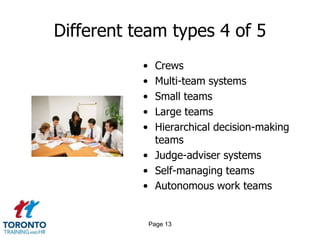
Different team types 4 of 5
           • Crews
           • Multi-team systems
           • Small teams
           • Large teams
           • Hierarchical decision-making
             teams
           • Judge-adviser systems
           • Self-managing teams
           • Autonomous work teams


               Page 13
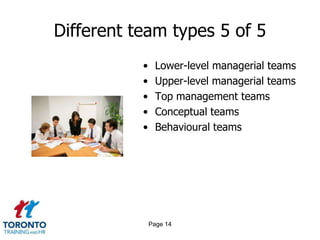
Different team types 5 of 5
           •    Lower-level managerial teams
           •    Upper-level managerial teams
           •    Top management teams
           •    Conceptual teams
           •    Behavioural teams


               Page 14
Key features of effective
         teams


           Page 15
Key features of effective teams
             •    Individuals
             •    Dynamics
             •    Leadership
             •    Structure
             •    Boundary management
             •    Image


                 Page 16
Behaviours


   Page 17
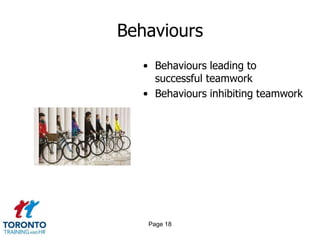
Behaviours
   • Behaviours leading to
     successful teamwork
   • Behaviours inhibiting teamwork


    Page 18
Team processes and team
knowledge-use behaviours


          Page 19
Team processes and team
knowledge-use behaviours
          • Heightened drive for consensus
          • Increased propensity to focus
            on common knowledge
          • Switch in priorities from
            learning towards project
            completion
          • Emphasized conformity to each
            member’s position in the
            team’s hierarchy


           Page 20
Roles which people play


          Page 21
Roles which people play 1 of 2
            •    Skills developed
            •    Positive, active roles
            •    Positive, maintenance roles
            •    Negative roles


                Page 22
Roles which people play 2 of 2
            BELBIN
            • Plant
            • Resource-investigator
            • Co-ordinator
            • Shaper
            • Monitor-evaluator
            • Team worker
            • Implementer
            • Completer
            • Specialist

             Page 23
Team development


       Page 24
Team development
      •    Forming
      •    Storming
      •    Norming
      •    Performing


          Page 25
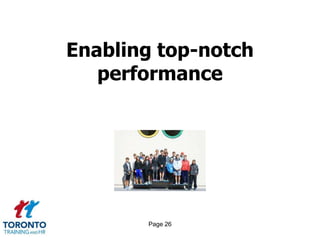
Enabling top-notch
   performance


       Page 26
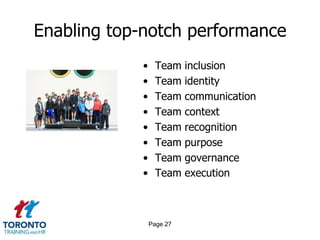
Enabling top-notch performance
            •    Team     inclusion
            •    Team     identity
            •    Team     communication
            •    Team     context
            •    Team     recognition
            •    Team     purpose
            •    Team     governance
            •    Team     execution


                Page 27
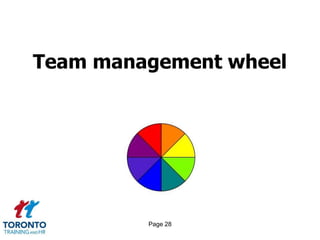
Team management wheel


         Page 28
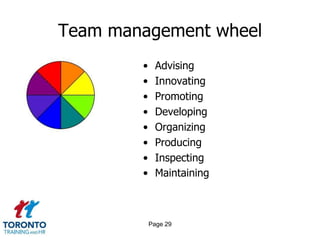
Team management wheel
        •    Advising
        •    Innovating
        •    Promoting
        •    Developing
        •    Organizing
        •    Producing
        •    Inspecting
        •    Maintaining


            Page 29
Leadership lessons


       Page 30
Leadership lessons
      •    Total commitment
      •    Empathy
      •    Adversity management
      •    Mutual respect for teammates
      •    We thinking
      •    Ownership of project
      •    Relinquish ego
      •    Kinetic leadership


          Page 31
Team productivity and
     positivity


         Page 32
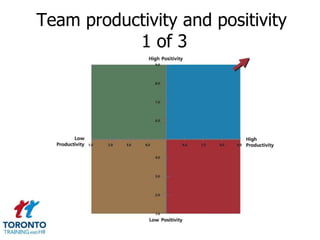
Team productivity and positivity
           1 of 3
Team productivity and positivity
           2 of 3
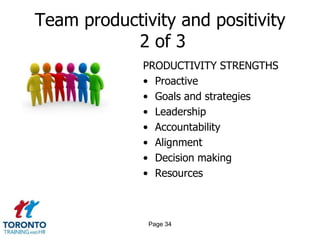
             PRODUCTIVITY STRENGTHS
             • Proactive
             • Goals and strategies
             • Leadership
             • Accountability
             • Alignment
             • Decision making
             • Resources


              Page 34
Team productivity and positivity
           3 of 3
             POSITIVITY STRENGTHS
             • Trust
             • Optimism
             • Constructive interaction
             • Communication
             • Camaraderie
             • Values diversity
             • Respect


              Page 35
Outcomes of team
  competencies


      Page 36
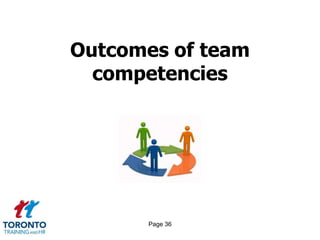
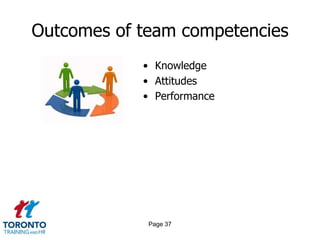
Outcomes of team competencies
            • Knowledge
            • Attitudes
            • Performance


             Page 37
Underlying constructs


         Page 38
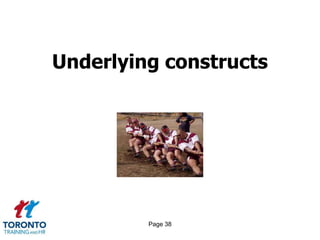
Underlying constructs
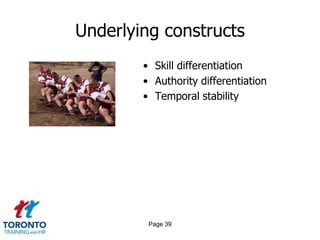
        • Skill differentiation
        • Authority differentiation
        • Temporal stability


         Page 39
Network content


      Page 40
Network content
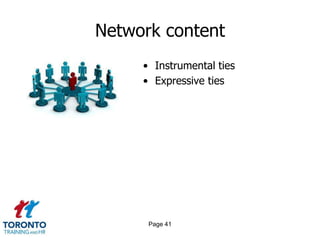
     • Instrumental ties
     • Expressive ties


      Page 41
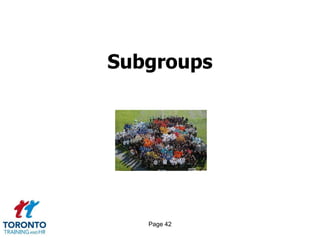
Subgroups


   Page 42
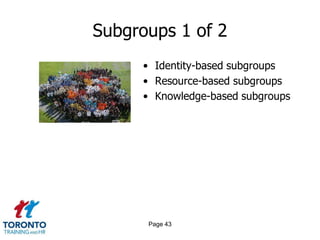
Subgroups 1 of 2
     • Identity-based subgroups
     • Resource-based subgroups
     • Knowledge-based subgroups


      Page 43
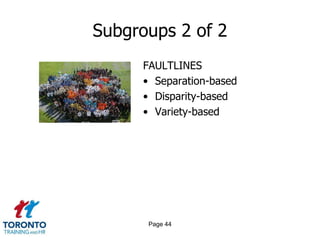
Subgroups 2 of 2
     FAULTLINES
     • Separation-based
     • Disparity-based
     • Variety-based


      Page 44
Teaming


  Page 45
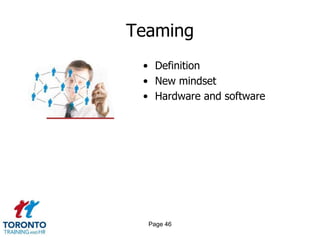
Teaming
 • Definition
 • New mindset
 • Hardware and software


  Page 46
A process for teambuilding


           Page 47
A process for teambuilding 1 of 2
              • Get the right people on board
                the bus
              • Control the message
              • Adopt the language of
                teamwork
              • Share the vision
              • Model teamwork


               Page 48
A process for teambuilding 2 of 2
              • Provide cross-training where
                appropriate
              • Set team goals
              • Evaluate individual
                performance from a team
                perspective
              • Celebrate team success


               Page 49
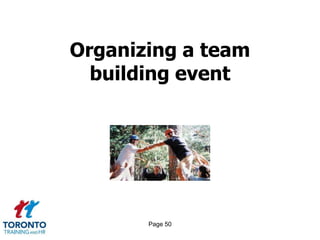
Organizing a team
  building event


       Page 50
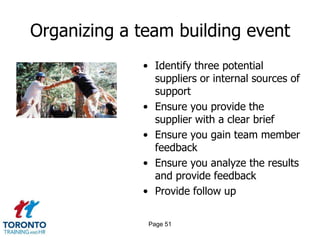
Organizing a team building event
             • Identify three potential
               suppliers or internal sources of
               support
             • Ensure you provide the
               supplier with a clear brief
             • Ensure you gain team member
               feedback
             • Ensure you analyze the results
               and provide feedback
             • Provide follow up

              Page 51
Team performance and
 knowledge resources


        Page 52
Team performance and knowledge
        resources 1 of 3
             • Team performance and
               decision quality improve when
               members possess the right
               type and level of task
               knowledge


              Page 53
Team performance and knowledge
        resources 2 of 3
             • Outcomes are better when
               team members are aware of
               the knowledge others hold


              Page 54
Team performance and knowledge
        resources 3 of 3
             • Distribution of knowledge
               resources within teams affects
               their ability to share and pool
               information from different
               members


              Page 55
Factors that influence
     motivation


         Page 56
Factors that influence motivation
              • Equity/fairness
              • Achievement
              • Camaraderie


               Page 57
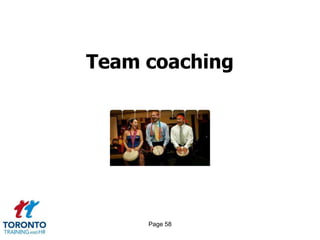
Team coaching


     Page 58
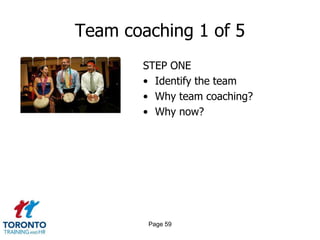
Team coaching 1 of 5
        STEP ONE
        • Identify the team
        • Why team coaching?
        • Why now?


        Page 59
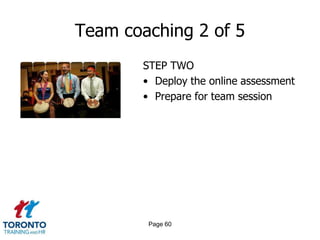
Team coaching 2 of 5
        STEP TWO
        • Deploy the online assessment
        • Prepare for team session


         Page 60
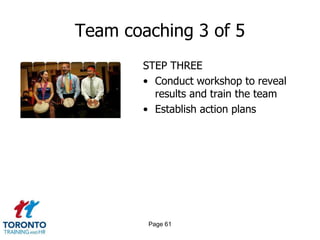
Team coaching 3 of 5
        STEP THREE
        • Conduct workshop to reveal
          results and train the team
        • Establish action plans


         Page 61
Team coaching 4 of 5
        STEP FOUR
        • Schedule of ongoing team
          coaching sessions


         Page 62
Team coaching 5 of 5
        STEP FIVE
        • Deploy follow-up assessment


         Page 63
Dimensions of cultural
    differences


         Page 64
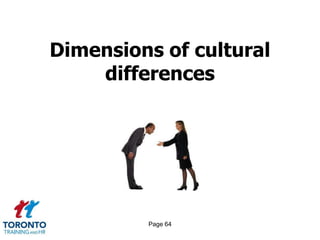
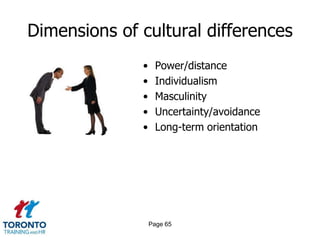
Dimensions of cultural differences
              •    Power/distance
              •    Individualism
              •    Masculinity
              •    Uncertainty/avoidance
              •    Long-term orientation


                  Page 65
Team effectiveness


       Page 66
Team effectiveness 1 of 4
          • Start by creating alignment
            around the purpose of the
            team
          • Align from the outside in by
            focusing the team on its core
            priorities-the real reasons it
            exists


           Page 67
Team effectiveness 2 of 4
          • Using the list of key
            contributions, the team should
            come up with a mandate; this
            should be a concise statement
            explaining what the team
            exists to do


           Page 68
Team effectiveness 3 of 4
          • Once a team has its
            mandate, create a list of
            imperatives
          • Use the team’s mandate and
            imperatives to define the rules
            of engagement


           Page 69
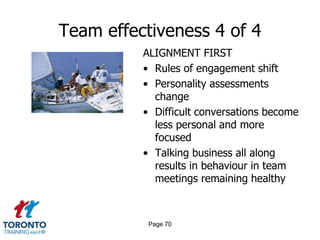
Team effectiveness 4 of 4
          ALIGNMENT FIRST
          • Rules of engagement shift
          • Personality assessments
            change
          • Difficult conversations become
            less personal and more
            focused
          • Talking business all along
            results in behaviour in team
            meetings remaining healthy


           Page 70
Virtual teams


     Page 71
Virtual teams 1 of 3
       •    Definition
       •    Types of virtual teams
       •    Geographical challenges
       •    Technological challenges
       •    Communication
       •    Benefits
       •    Telecommuting
       •    Effectiveness
       •    Best practice


           Page 72
Virtual teams 2 of 3
       TRUST
       • Building trust
       • Factors that impede trust
       • Understanding others


        Page 73
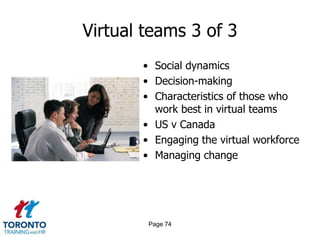
Virtual teams 3 of 3
       • Social dynamics
       • Decision-making
       • Characteristics of those who
         work best in virtual teams
       • US v Canada
       • Engaging the virtual workforce
       • Managing change


        Page 74
Teamwork


   Page 75
Teamwork 1 of 3
     • Important skills and habits
     • Teamwork quotes


      Page 76
Teamwork 2 of 3
     STUMBLING BLOCKS
     • Conflict
     • Facts, myths, unknowns and
       values
     • Resources and barriers
     • Covert agendas
     • Decision-making outside of
       meetings
     • Group members not taking
       ownership of the group
       process
      Page 77
Teamwork 3 of 3
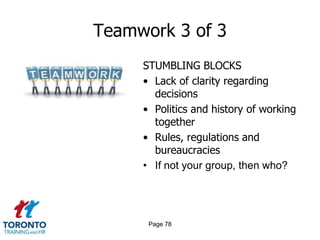
     STUMBLING BLOCKS
     • Lack of clarity regarding
       decisions
     • Politics and history of working
       together
     • Rules, regulations and
       bureaucracies
     • If not your group, then who?


      Page 78
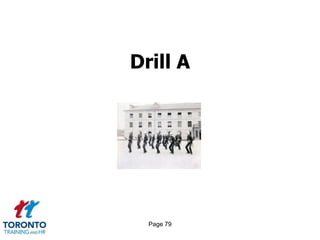
Drill A


  Page 79
Drill A


    Page 80
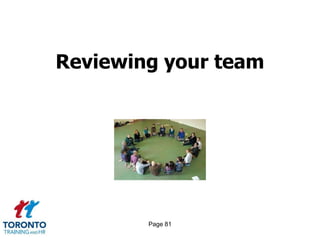
Reviewing your team


        Page 81
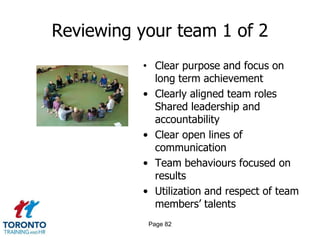
Reviewing your team 1 of 2
          • Clear purpose and focus on
            long term achievement
          • Clearly aligned team roles
            Shared leadership and
            accountability
          • Clear open lines of
            communication
          • Team behaviours focused on
            results
          • Utilization and respect of team
            members’ talents
           Page 82
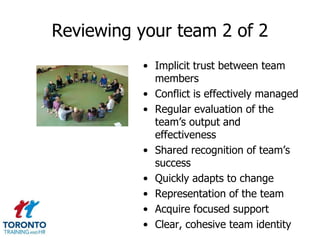
Reviewing your team 2 of 2
          • Implicit trust between team
            members
          • Conflict is effectively managed
          • Regular evaluation of the
            team’s output and
            effectiveness
          • Shared recognition of team’s
            success
          • Quickly adapts to change
          • Representation of the team
          • Acquire focused support
          • Clear, cohesive team identity
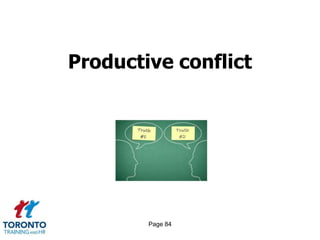
Productive conflict


        Page 84
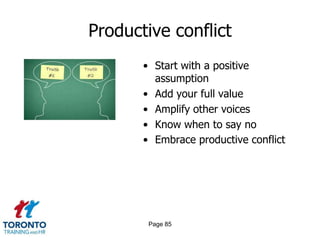
Productive conflict
       • Start with a positive
         assumption
       • Add your full value
       • Amplify other voices
       • Know when to say no
       • Embrace productive conflict


        Page 85
How well is the team
     running?


        Page 86
How well is the team running?
            1 of 2
            •    Commitment
            •    Creativity
            •    Constituency
            •    Challenge
            •    Contribution
            •    Communication
            •    Celebration


                Page 87
How well is the team running?
            2 of 2
            HEAR THEM OUT
            • Challenge team members to
              push the limits, be creative and
              communicate the expectation
              that all must contribute
            • Champion and support their
              ideas and recommendations
            • Explain any barriers and
              encourage the team to rethink
              the idea with new information
              if necessary

             Page 88
Dysfunctional teams


        Page 89
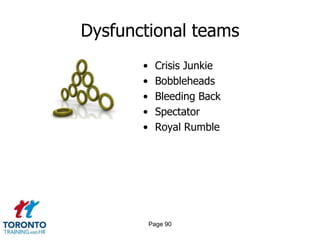
Dysfunctional teams
       •    Crisis Junkie
       •    Bobbleheads
       •    Bleeding Back
       •    Spectator
       •    Royal Rumble


           Page 90
Teams with poor
   leadership


      Page 91
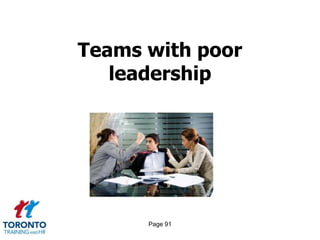
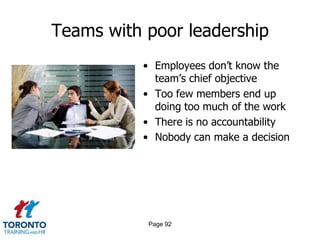
Teams with poor leadership
          • Employees don’t know the
            team’s chief objective
          • Too few members end up
            doing too much of the work
          • There is no accountability
          • Nobody can make a decision


           Page 92
Fixing a team that is
       broken


         Page 93
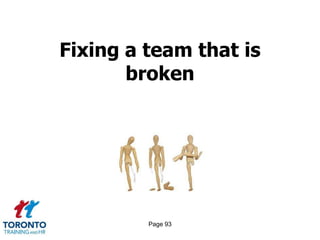
Fixing a team that is broken
           •    Make meetings better
           •    Map your value add
           •    Decide how you’ll decide
           •    Make ideas better
           •    Build all types of trust
           •    Improve your communication
                connection


               Page 94
Reshuffling teams


       Page 95
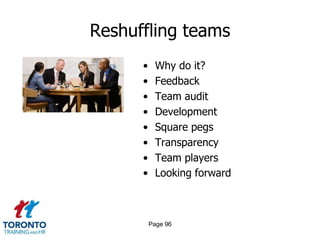
Reshuffling teams
      •    Why do it?
      •    Feedback
      •    Team audit
      •    Development
      •    Square pegs
      •    Transparency
      •    Team players
      •    Looking forward


          Page 96
Drill B


  Page 97
Drill B


    Page 98
Conclusion and questions


          Page 99
Conclusion and questions
Summary
Videos
Questions


                Page 100

Teams January 2013

  • 1.
    Making teams workfor you in 2013 by Toronto Training and HR January 2013
  • 2.
    CONTENTS 3-4 Introduction to Toronto Training and HR 52-55 Team performance and knowledge 5-6 Definition resources 7-8 Types of teams 56-57 Factors that influence motivation 9-14 Different types of teams 58-63 Team coaching 15-16 Key features of effective teams 64-65 Dimensions of cultural differences 17-18 Behaviours 66-70 Team effectiveness 19-20 Team processes and team 71-74 Virtual teams knowledge-use behaviours 75-78 Teamwork 21-23 Roles which people play 79-80 Drill A 24-25 Team development 81-83 Reviewing your team 26-27 Enabling top-notch performance 84-85 Productive conflict 28-29 Team management wheel 86-88 How well is the team running? 30-31 Leadership lessons 89-90 Dysfunctional teams 32-35 Team productivity and positivity 91-92 Teams with poor leadership 36-37 Outcomes of team competencies 93-94 Fixing a team that is broken 38-39 Underlying constructs 95-96 Reshuffling teams 40-41 Network content 97-98 Drill B 42-44 Subgroups 99-100 Conclusion and questions 45-46 Teaming 47-49 A process for teambuilding 50-51 Organizing a team building event Page 2
  • 3.
  • 4.
    Introduction to TorontoTraining and HR Toronto Training and HR is a specialist training and human resources consultancy headed by Timothy Holden 10 years in banking 10 years in training and human resources Freelance practitioner since 2006 The core services provided by Toronto Training and HR are: Training event design Training event delivery Reducing costs, saving time plus improving employee engagement and morale Services for job seekers Page 4
  • 5.
  • 6.
    Definition •What is a team? • Benefits Page 6
  • 7.
  • 8.
    Types of teams • Formal • Informal • Permanent • Temporary Page 8
  • 9.
  • 10.
    Different team types1 of 5 • Advice/involvement groups • Production/service teams • Action/negotiation teams • Project/development teams • Project teams • Traditional work teams • Parallel teams • Management teams • Project teams • Production teams Page 10
  • 11.
    Different team types2 of 5 • Decision-making teams • Mixed teams • Ad hoc project teams • Ongoing project teams • Ad hoc production teams • Ongoing production teams • Ad hoc teams • Intact teams • Short-term teams • Long-term teams Page 11
  • 12.
    Different team types3 of 5 • Professional teams • Student teams • Cross-functional teams • Cross-functional project teams • Cross-functional product teams • New product development teams • X-teams • Extreme action teams Page 12
  • 13.
    Different team types4 of 5 • Crews • Multi-team systems • Small teams • Large teams • Hierarchical decision-making teams • Judge-adviser systems • Self-managing teams • Autonomous work teams Page 13
  • 14.
    Different team types5 of 5 • Lower-level managerial teams • Upper-level managerial teams • Top management teams • Conceptual teams • Behavioural teams Page 14
  • 15.
    Key features ofeffective teams Page 15
  • 16.
    Key features ofeffective teams • Individuals • Dynamics • Leadership • Structure • Boundary management • Image Page 16
  • 17.
    Behaviours Page 17
  • 18.
    Behaviours • Behaviours leading to successful teamwork • Behaviours inhibiting teamwork Page 18
  • 19.
    Team processes andteam knowledge-use behaviours Page 19
  • 20.
    Team processes andteam knowledge-use behaviours • Heightened drive for consensus • Increased propensity to focus on common knowledge • Switch in priorities from learning towards project completion • Emphasized conformity to each member’s position in the team’s hierarchy Page 20
  • 21.
    Roles which peopleplay Page 21
  • 22.
    Roles which peopleplay 1 of 2 • Skills developed • Positive, active roles • Positive, maintenance roles • Negative roles Page 22
  • 23.
    Roles which peopleplay 2 of 2 BELBIN • Plant • Resource-investigator • Co-ordinator • Shaper • Monitor-evaluator • Team worker • Implementer • Completer • Specialist Page 23
  • 24.
  • 25.
    Team development • Forming • Storming • Norming • Performing Page 25
  • 26.
    Enabling top-notch performance Page 26
  • 27.
    Enabling top-notch performance • Team inclusion • Team identity • Team communication • Team context • Team recognition • Team purpose • Team governance • Team execution Page 27
  • 28.
  • 29.
    Team management wheel • Advising • Innovating • Promoting • Developing • Organizing • Producing • Inspecting • Maintaining Page 29
  • 30.
  • 31.
    Leadership lessons • Total commitment • Empathy • Adversity management • Mutual respect for teammates • We thinking • Ownership of project • Relinquish ego • Kinetic leadership Page 31
  • 32.
    Team productivity and positivity Page 32
  • 33.
    Team productivity andpositivity 1 of 3
  • 34.
    Team productivity andpositivity 2 of 3 PRODUCTIVITY STRENGTHS • Proactive • Goals and strategies • Leadership • Accountability • Alignment • Decision making • Resources Page 34
  • 35.
    Team productivity andpositivity 3 of 3 POSITIVITY STRENGTHS • Trust • Optimism • Constructive interaction • Communication • Camaraderie • Values diversity • Respect Page 35
  • 36.
    Outcomes of team competencies Page 36
  • 37.
    Outcomes of teamcompetencies • Knowledge • Attitudes • Performance Page 37
  • 38.
  • 39.
    Underlying constructs • Skill differentiation • Authority differentiation • Temporal stability Page 39
  • 40.
  • 41.
    Network content • Instrumental ties • Expressive ties Page 41
  • 42.
    Subgroups Page 42
  • 43.
    Subgroups 1 of2 • Identity-based subgroups • Resource-based subgroups • Knowledge-based subgroups Page 43
  • 44.
    Subgroups 2 of2 FAULTLINES • Separation-based • Disparity-based • Variety-based Page 44
  • 45.
  • 46.
    Teaming • Definition • New mindset • Hardware and software Page 46
  • 47.
    A process forteambuilding Page 47
  • 48.
    A process forteambuilding 1 of 2 • Get the right people on board the bus • Control the message • Adopt the language of teamwork • Share the vision • Model teamwork Page 48
  • 49.
    A process forteambuilding 2 of 2 • Provide cross-training where appropriate • Set team goals • Evaluate individual performance from a team perspective • Celebrate team success Page 49
  • 50.
    Organizing a team building event Page 50
  • 51.
    Organizing a teambuilding event • Identify three potential suppliers or internal sources of support • Ensure you provide the supplier with a clear brief • Ensure you gain team member feedback • Ensure you analyze the results and provide feedback • Provide follow up Page 51
  • 52.
    Team performance and knowledge resources Page 52
  • 53.
    Team performance andknowledge resources 1 of 3 • Team performance and decision quality improve when members possess the right type and level of task knowledge Page 53
  • 54.
    Team performance andknowledge resources 2 of 3 • Outcomes are better when team members are aware of the knowledge others hold Page 54
  • 55.
    Team performance andknowledge resources 3 of 3 • Distribution of knowledge resources within teams affects their ability to share and pool information from different members Page 55
  • 56.
    Factors that influence motivation Page 56
  • 57.
    Factors that influencemotivation • Equity/fairness • Achievement • Camaraderie Page 57
  • 58.
  • 59.
    Team coaching 1of 5 STEP ONE • Identify the team • Why team coaching? • Why now? Page 59
  • 60.
    Team coaching 2of 5 STEP TWO • Deploy the online assessment • Prepare for team session Page 60
  • 61.
    Team coaching 3of 5 STEP THREE • Conduct workshop to reveal results and train the team • Establish action plans Page 61
  • 62.
    Team coaching 4of 5 STEP FOUR • Schedule of ongoing team coaching sessions Page 62
  • 63.
    Team coaching 5of 5 STEP FIVE • Deploy follow-up assessment Page 63
  • 64.
    Dimensions of cultural differences Page 64
  • 65.
    Dimensions of culturaldifferences • Power/distance • Individualism • Masculinity • Uncertainty/avoidance • Long-term orientation Page 65
  • 66.
  • 67.
    Team effectiveness 1of 4 • Start by creating alignment around the purpose of the team • Align from the outside in by focusing the team on its core priorities-the real reasons it exists Page 67
  • 68.
    Team effectiveness 2of 4 • Using the list of key contributions, the team should come up with a mandate; this should be a concise statement explaining what the team exists to do Page 68
  • 69.
    Team effectiveness 3of 4 • Once a team has its mandate, create a list of imperatives • Use the team’s mandate and imperatives to define the rules of engagement Page 69
  • 70.
    Team effectiveness 4of 4 ALIGNMENT FIRST • Rules of engagement shift • Personality assessments change • Difficult conversations become less personal and more focused • Talking business all along results in behaviour in team meetings remaining healthy Page 70
  • 71.
  • 72.
    Virtual teams 1of 3 • Definition • Types of virtual teams • Geographical challenges • Technological challenges • Communication • Benefits • Telecommuting • Effectiveness • Best practice Page 72
  • 73.
    Virtual teams 2of 3 TRUST • Building trust • Factors that impede trust • Understanding others Page 73
  • 74.
    Virtual teams 3of 3 • Social dynamics • Decision-making • Characteristics of those who work best in virtual teams • US v Canada • Engaging the virtual workforce • Managing change Page 74
  • 75.
    Teamwork Page 75
  • 76.
    Teamwork 1 of3 • Important skills and habits • Teamwork quotes Page 76
  • 77.
    Teamwork 2 of3 STUMBLING BLOCKS • Conflict • Facts, myths, unknowns and values • Resources and barriers • Covert agendas • Decision-making outside of meetings • Group members not taking ownership of the group process Page 77
  • 78.
    Teamwork 3 of3 STUMBLING BLOCKS • Lack of clarity regarding decisions • Politics and history of working together • Rules, regulations and bureaucracies • If not your group, then who? Page 78
  • 79.
    Drill A Page 79
  • 80.
    Drill A Page 80
  • 81.
  • 82.
    Reviewing your team1 of 2 • Clear purpose and focus on long term achievement • Clearly aligned team roles Shared leadership and accountability • Clear open lines of communication • Team behaviours focused on results • Utilization and respect of team members’ talents Page 82
  • 83.
    Reviewing your team2 of 2 • Implicit trust between team members • Conflict is effectively managed • Regular evaluation of the team’s output and effectiveness • Shared recognition of team’s success • Quickly adapts to change • Representation of the team • Acquire focused support • Clear, cohesive team identity
  • 84.
  • 85.
    Productive conflict • Start with a positive assumption • Add your full value • Amplify other voices • Know when to say no • Embrace productive conflict Page 85
  • 86.
    How well isthe team running? Page 86
  • 87.
    How well isthe team running? 1 of 2 • Commitment • Creativity • Constituency • Challenge • Contribution • Communication • Celebration Page 87
  • 88.
    How well isthe team running? 2 of 2 HEAR THEM OUT • Challenge team members to push the limits, be creative and communicate the expectation that all must contribute • Champion and support their ideas and recommendations • Explain any barriers and encourage the team to rethink the idea with new information if necessary Page 88
  • 89.
  • 90.
    Dysfunctional teams • Crisis Junkie • Bobbleheads • Bleeding Back • Spectator • Royal Rumble Page 90
  • 91.
    Teams with poor leadership Page 91
  • 92.
    Teams with poorleadership • Employees don’t know the team’s chief objective • Too few members end up doing too much of the work • There is no accountability • Nobody can make a decision Page 92
  • 93.
    Fixing a teamthat is broken Page 93
  • 94.
    Fixing a teamthat is broken • Make meetings better • Map your value add • Decide how you’ll decide • Make ideas better • Build all types of trust • Improve your communication connection Page 94
  • 95.
  • 96.
    Reshuffling teams • Why do it? • Feedback • Team audit • Development • Square pegs • Transparency • Team players • Looking forward Page 96
  • 97.
    Drill B Page 97
  • 98.
    Drill B Page 98
  • 99.
  • 100.