Foundations of Group
     Behavior
What is Group?
A group is defined as two or more individuals,
interacting and interdependent, who have come
together to achieve particular objectives.
• Formal groups
• Informal groups
• Command group
• Task groups
• Interest group
• Friendship groups
Stages of Group
                 Development
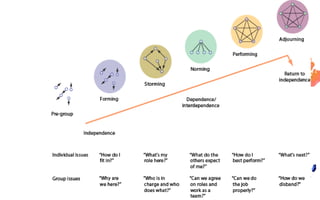
The Five-Stage Model
•Stage I: Forming
    – Characterized by much uncertainty
•Stage II: Storming
    – Characterized by intra-group conflict
•Stage III: Norming
    – Characterized by close relationships and cohesiveness
•Stage IV: Performing
    – The stage when the group is fully functional
•Stage V: Adjourning
    – The final stage in group development for temporary groups,
      characterized by concern with wrapping up activities rather than
      task performance
But in Reality…

• Groups do not necessarily progress
  clearly through the stages one at a time.
• Groups can sometimes go back to an
  earlier stage.
• Conflict can sometimes be helpful to the
  group.
• Context can matter: airline pilots can
  immediately reach performing stage.
The Punctuated-Equilibrium
                Model
• Phase 1
   – The first meeting sets the group’s direction.
   – The first phase of group activity is one of inertia.
• Transition
   – A transition takes place at the end of the first phase, which
     occurs exactly when the group has used up half its allotted
     time.
   – The transition initiates major changes.
• Phase 2
   – A second phase of inertia follows the transition.
• Last meeting is characterized by markedly accelerated activity.
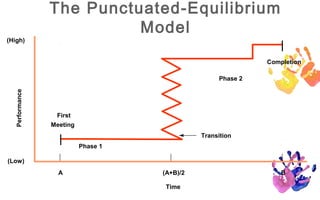
The Punctuated-Equilibrium
                          Model
(High)


                                                             Completion

                                                   Phase 2
  Performance


                 First
                Meeting
                                              Transition
                          Phase 1

(Low)
                  A                 (A+B)/2                      B

                                    Time
Group Structure
• Roles
• Norms
• Status
• Group Size
• Degree of group cohesiveness
Teams


How groups and teams are different?
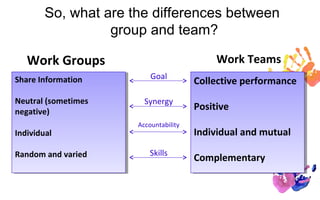
So, what are the differences between
                  group and team?

   Work Groups                             Work Teams
Share Information         Goal
 Share Information                     Collective performance
                                       Collective performance
Neutral (sometimes
 Neutral (sometimes     Synergy
negative)
                                       Positive
                                       Positive
 negative)
                      Accountability
Individual
 Individual                            Individual and mutual
                                        Individual and mutual
Random and varied
 Random and varied        Skills
                                       Complementary
                                       Complementary
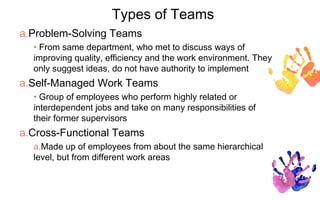
Types of Teams
a.Problem-Solving Teams
  • From same department, who met to discuss ways of
  improving quality, efficiency and the work environment. They
  only suggest ideas, do not have authority to implement
a.Self-Managed Work Teams
  • Group of employees who perform highly related or
  interdependent jobs and take on many responsibilities of
  their former supervisors
a.Cross-Functional Teams
  a.Made up of employees from about the same hierarchical
  level, but from different work areas
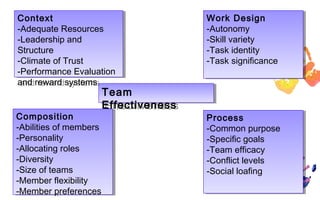
Context
 Context                             Work Design
                                      Work Design
-Adequate Resources
 -Adequate Resources                 -Autonomy
                                      -Autonomy
-Leadership and
 -Leadership and                     -Skill variety
                                      -Skill variety
Structure
 Structure                           -Task identity
                                      -Task identity
-Climate of Trust
 -Climate of Trust                   -Task significance
                                      -Task significance
-Performance Evaluation
 -Performance Evaluation
and reward systems
 and reward systems
                     Team
                     Team
                     Effectiveness
                     Effectiveness
Composition
 Composition                         Process
                                      Process
-Abilities of members
 -Abilities of members               -Common purpose
                                      -Common purpose
-Personality
 -Personality                        -Specific goals
                                      -Specific goals
-Allocating roles
 -Allocating roles                   -Team efficacy
                                      -Team efficacy
-Diversity
 -Diversity                          -Conflict levels
                                      -Conflict levels
-Size of teams
 -Size of teams                      -Social loafing
                                      -Social loafing
-Member flexibility
 -Member flexibility
-Member preferences
 -Member preferences
Creating Effective Teams – Process

•   Common Purpose
•   Specific Goals
•   Team Efficacy
•   Managed Level of Conflict
•   Accountability
Creating a Team Charter
• What are team members’ names and contact
  information (e.g., phone, email)?
• How will communication among team members take
  place (e.g., phone, email)?
• What will the team ground rules be (e.g., where and
  when to meet, attendance expectations, workload
  expectations)?
• How will decisions be made (e.g., consensus, majority
  vote, leader rules)?
• What potential conflicts may arise in the team? Among
  team members?
• How will conflicts be resolved by the group?
Increasing Socio-emotional Cohesiveness
• Keep the group relatively small.
• Strive for a favorable public image to increase the
  status and prestige of belonging.
• Encourage interaction and cooperation.
• Emphasize members’ common characteristics and
  interests.
• Point out environmental threats (e.g., competitors’
  achievements) to rally the group.
Increasing Instrumental Cohesiveness

• Regularly update and clarify the group’s goal(s) .
• Give every group member a vital “piece of the
  action.”
• Channel each group member’s special talents toward the
  common goal(s).
• Recognize and equitably reinforce every member’s
  contributions.
• Frequently remind group members they need each
  other to get the job done.

Copy of foundations group behavior

  • 1.
  • 2.
    What is Group? Agroup is defined as two or more individuals, interacting and interdependent, who have come together to achieve particular objectives. • Formal groups • Informal groups • Command group • Task groups • Interest group • Friendship groups
  • 3.
    Stages of Group Development The Five-Stage Model •Stage I: Forming – Characterized by much uncertainty •Stage II: Storming – Characterized by intra-group conflict •Stage III: Norming – Characterized by close relationships and cohesiveness •Stage IV: Performing – The stage when the group is fully functional •Stage V: Adjourning – The final stage in group development for temporary groups, characterized by concern with wrapping up activities rather than task performance
  • 5.
    But in Reality… •Groups do not necessarily progress clearly through the stages one at a time. • Groups can sometimes go back to an earlier stage. • Conflict can sometimes be helpful to the group. • Context can matter: airline pilots can immediately reach performing stage.
  • 6.
    The Punctuated-Equilibrium Model • Phase 1 – The first meeting sets the group’s direction. – The first phase of group activity is one of inertia. • Transition – A transition takes place at the end of the first phase, which occurs exactly when the group has used up half its allotted time. – The transition initiates major changes. • Phase 2 – A second phase of inertia follows the transition. • Last meeting is characterized by markedly accelerated activity.
  • 7.
    The Punctuated-Equilibrium Model (High) Completion Phase 2 Performance First Meeting Transition Phase 1 (Low) A (A+B)/2 B Time
  • 8.
    Group Structure • Roles •Norms • Status • Group Size • Degree of group cohesiveness
  • 9.
    Teams How groups andteams are different?
  • 10.
    So, what arethe differences between group and team? Work Groups Work Teams Share Information Goal Share Information Collective performance Collective performance Neutral (sometimes Neutral (sometimes Synergy negative) Positive Positive negative) Accountability Individual Individual Individual and mutual Individual and mutual Random and varied Random and varied Skills Complementary Complementary
  • 11.
    Types of Teams a.Problem-SolvingTeams • From same department, who met to discuss ways of improving quality, efficiency and the work environment. They only suggest ideas, do not have authority to implement a.Self-Managed Work Teams • Group of employees who perform highly related or interdependent jobs and take on many responsibilities of their former supervisors a.Cross-Functional Teams a.Made up of employees from about the same hierarchical level, but from different work areas
  • 12.
    Context Context Work Design Work Design -Adequate Resources -Adequate Resources -Autonomy -Autonomy -Leadership and -Leadership and -Skill variety -Skill variety Structure Structure -Task identity -Task identity -Climate of Trust -Climate of Trust -Task significance -Task significance -Performance Evaluation -Performance Evaluation and reward systems and reward systems Team Team Effectiveness Effectiveness Composition Composition Process Process -Abilities of members -Abilities of members -Common purpose -Common purpose -Personality -Personality -Specific goals -Specific goals -Allocating roles -Allocating roles -Team efficacy -Team efficacy -Diversity -Diversity -Conflict levels -Conflict levels -Size of teams -Size of teams -Social loafing -Social loafing -Member flexibility -Member flexibility -Member preferences -Member preferences
  • 13.
    Creating Effective Teams– Process • Common Purpose • Specific Goals • Team Efficacy • Managed Level of Conflict • Accountability
  • 14.
    Creating a TeamCharter • What are team members’ names and contact information (e.g., phone, email)? • How will communication among team members take place (e.g., phone, email)? • What will the team ground rules be (e.g., where and when to meet, attendance expectations, workload expectations)? • How will decisions be made (e.g., consensus, majority vote, leader rules)? • What potential conflicts may arise in the team? Among team members? • How will conflicts be resolved by the group?
  • 15.
    Increasing Socio-emotional Cohesiveness •Keep the group relatively small. • Strive for a favorable public image to increase the status and prestige of belonging. • Encourage interaction and cooperation. • Emphasize members’ common characteristics and interests. • Point out environmental threats (e.g., competitors’ achievements) to rally the group.
  • 16.
    Increasing Instrumental Cohesiveness •Regularly update and clarify the group’s goal(s) . • Give every group member a vital “piece of the action.” • Channel each group member’s special talents toward the common goal(s). • Recognize and equitably reinforce every member’s contributions. • Frequently remind group members they need each other to get the job done.