Building beyond the course, or
even the program: how can
virtual worlds extend the
learning environment and create
community?

      SUNY CIT 2012 – Stony Brook
         Eileen O’Connor, Ph.D.
        Eileen.oconnor@esc.edu
          Empire State College
Agenda
• Background
   – Teaching & learning – different connection & modalities,
     always being tried (review)
   – Including other faculty
   – Research island – island design; virtual shifting
• Framework of a learning environment
• Expansive efforts to date
   – Teachers coming / student research / outreach to other
     students / outreach to admin/admissions – how can you
     extend beyond a course too?
   – Considerations and issues – development, maintenance,
     support ; sharing design – reality and feasibility
http://commons.esc.edu/open/

On August 22-24, 2012, SUNY—Empire State College will be hosting a virtual conference on open education. The
conference is global in scope and will be occurring over multiple time zones; therefore, the event will be conducted in a virtual world
called Second Life. The modality will be a synchronous/asynchronous mode—participants can attend sessions as they occur, or session
presentations will be recorded for play back at later times. Currently, we seek individuals to participate in the conference.
Call for Presentations (and Posters)
The OP*EN Virtual Conference welcomes presenters and posters that integrate one or more of these themes, as they relate to the
concept of open education. As the aim is to cover open education for a world-wide audience, we would value a range of presentations,
challenges, and discussion-starters around these areas:
Philosophy: what conceptual, sociological, institutional, and educational underpinnings separate open education from other forms of
teaching and learning? What are the core issues in defining openness, and what other forms of openness are required for open education
(open leadership, open science, etc.)? Are there related concepts, constructs, and paradigms that serve or enhance openness as a
concept?
Process: what ways can a resource, course, learning experience move into the process of becoming “open”? How can current courses and
resources be moved from behind ivory towers into open educational areas? How can current post-secondary institutions transform
themselves into open universities?
Projects: what are the examples of projects within your experience, personal, institutional or within your learning sphere that you would
like to offer as a model or best practice?
Policy: are there institutional issues that surround Open Education within your educational sphere? Have projects and ideas been brought
forward within your institution and what organizations, governance groups, unions, or professional organizations have spoken to these
issues? What areas do you expect might influence policy within your educational and learning sphere? What public policies effect
openness (regulation, legislation, grants, accreditation)?
Practices: in what ways have you or your colleagues begun to consider and develop open resources and practices?
We encourage a variety of presentation styles as well as topics. The only common element we ask from all presentations and posters is
that it should in some way challenge your audience to take openness to the next level.

Abstracts/summaries/battle plans or other treatments should be emailed to open@esc.edu by June 22nd, 2012.
 http://commons.esc.edu/open/2012/05/04/call-for-papers/
Call for Presentations (and Posters)
On August 22-24, 2012, SUNY—Empire State College will be
hosting a virtual conference on open education. The conference
is global in scope and will be occurring over multiple time zones;
therefore, the event will be conducted in Second Life. The
modality will be a synchronous/asynchronous mode—
participants can attend sessions as they occur, or session
presentations will be recorded for play back at later times.
Currently, we seek individuals to participate in the conference.

The OP*EN Virtual Conference Abstracts/summaries/battle
plans or other treatments should be emailed to open@esc.edu
by June 22nd, 2012.
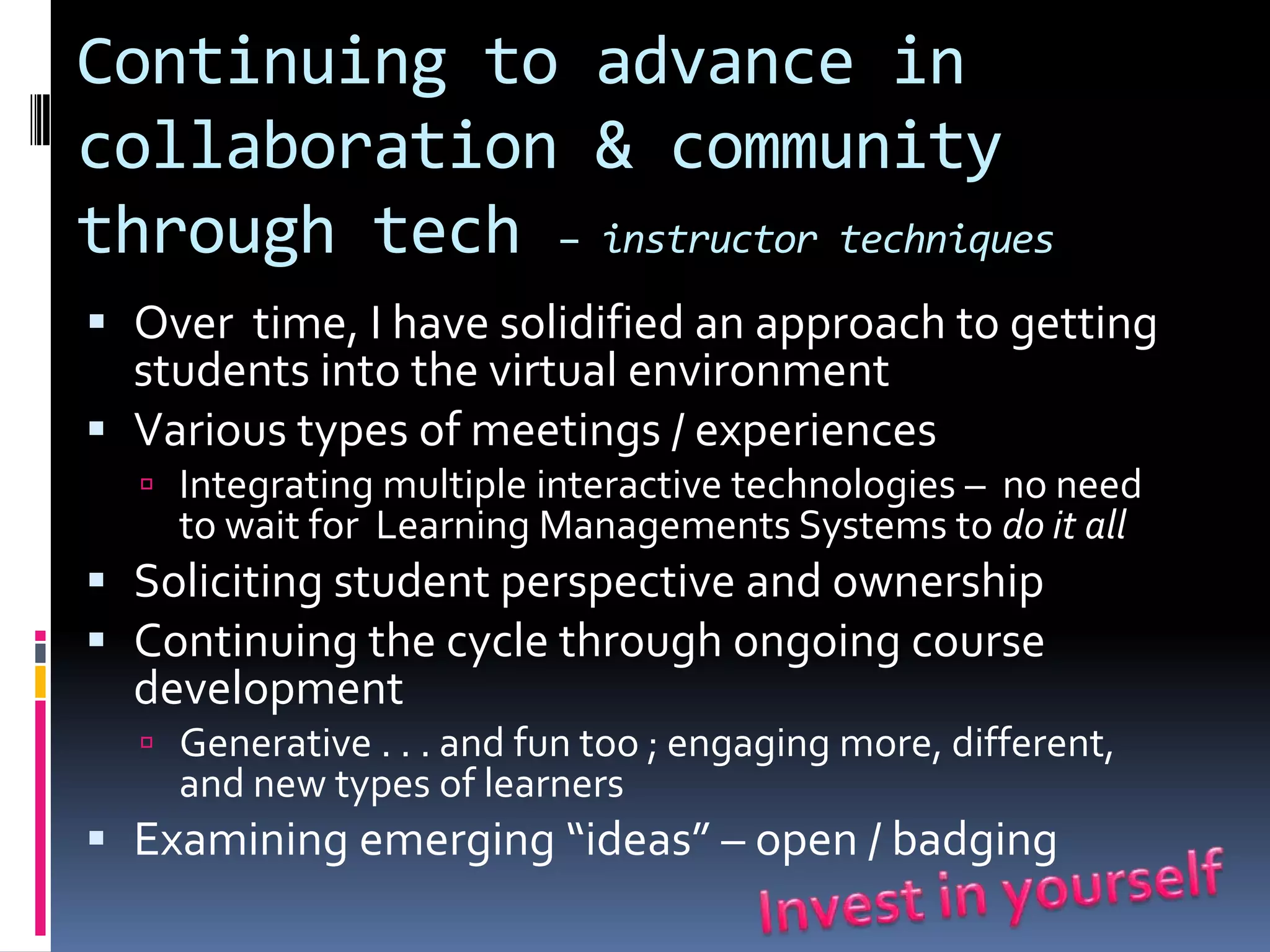
Continuing to advance in
collaboration & community
through tech – instructor techniques
 Over time, I have solidified an approach to getting
  students into the virtual environment
 Various types of meetings / experiences
   Integrating multiple interactive technologies – no need
    to wait for Learning Managements Systems to do it all
 Soliciting student perspective and ownership
 Continuing the cycle through ongoing course
  development
   Generative . . . and fun too ; engaging more, different,
    and new types of learners
 Examining emerging “ideas” – open / badging
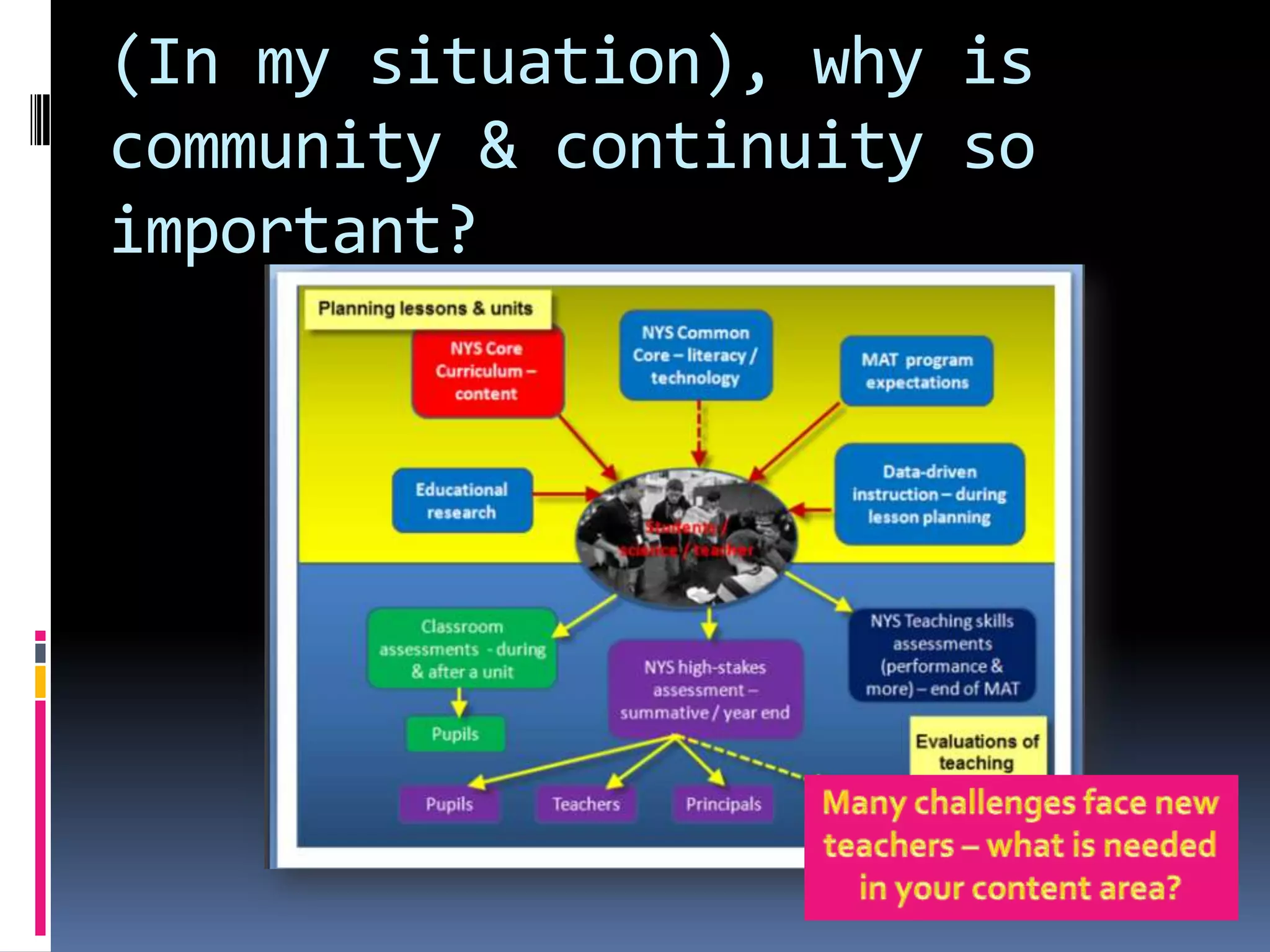
(In my situation), why is
community & continuity so
important?
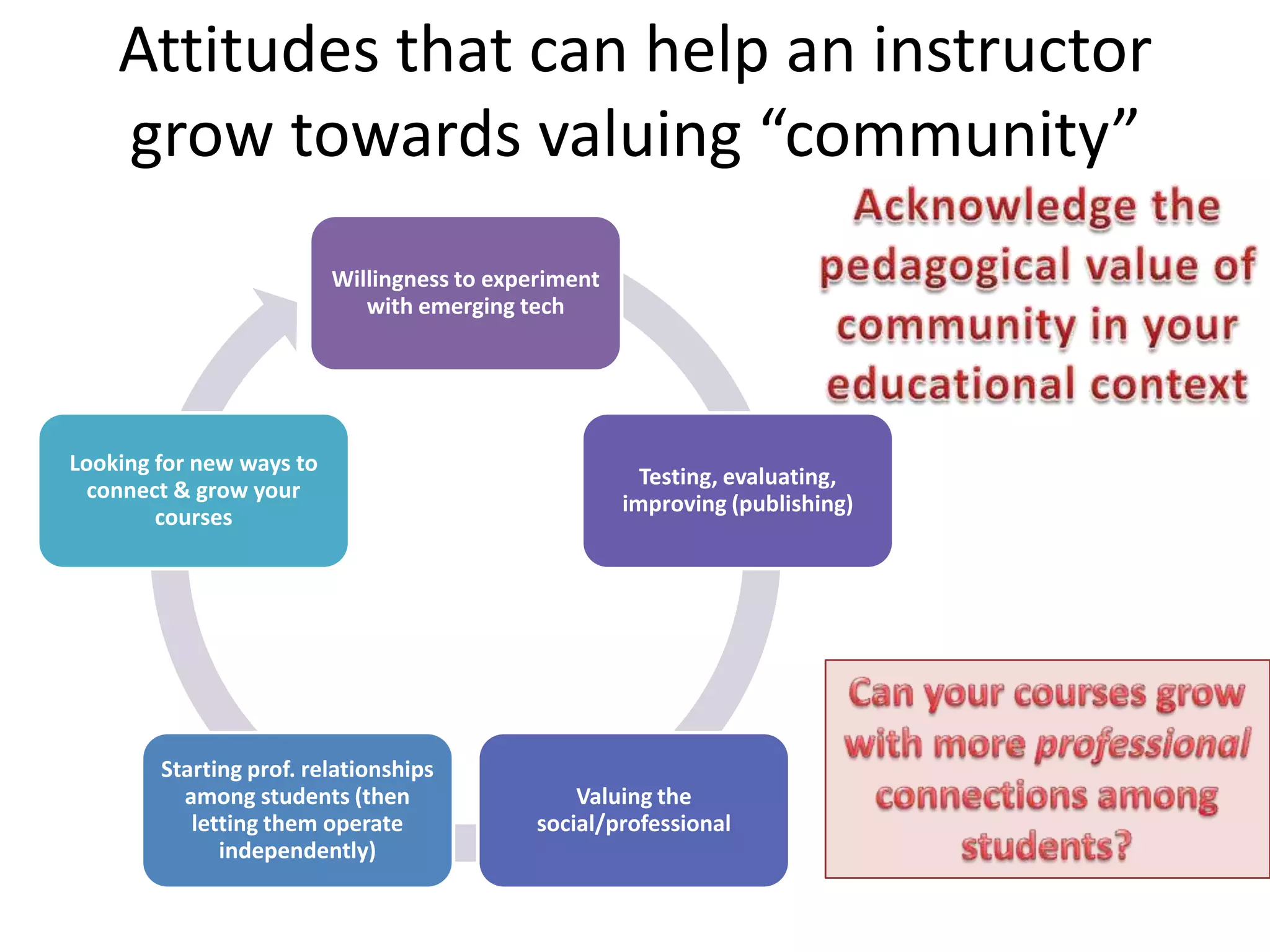
Attitudes that can help an instructor
    grow towards valuing “community”
                          Willingness to experiment
                             with emerging tech


Looking for new ways to
                                                        Testing, evaluating,
  connect & grow your
                                                      improving (publishing)
        courses


        Starting prof. relationships
          among students (then                   Valuing the
           letting them operate              social/professional
              independently)
Developing virtual environments, present
 ideas & past practices – ideas to consider
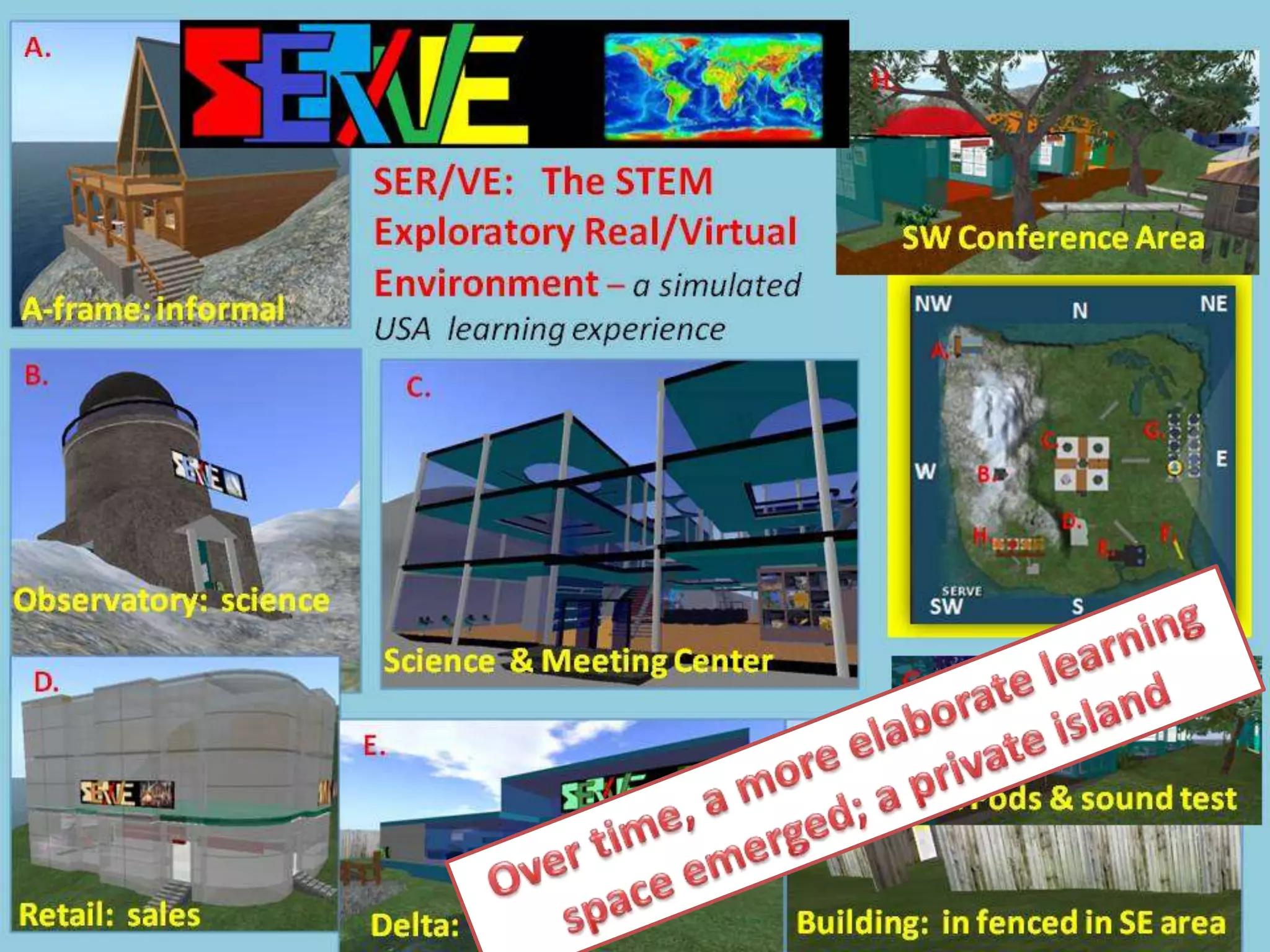
 • On a shoe string ; without programming or artists
   (at least initially)
   – Images & design – inelegant but practical & growing
   – Gained insight from ongoing pilots with my students –
     expanding my knowledge regularly
   – Considered grants (no luck) then worked ideas into
     courses
      • Having courses do “real” work within a professional masters
   – Having virtual locations that serve as teacher resource
     areas; creating simple and useful
   – Involving others – pros and cons
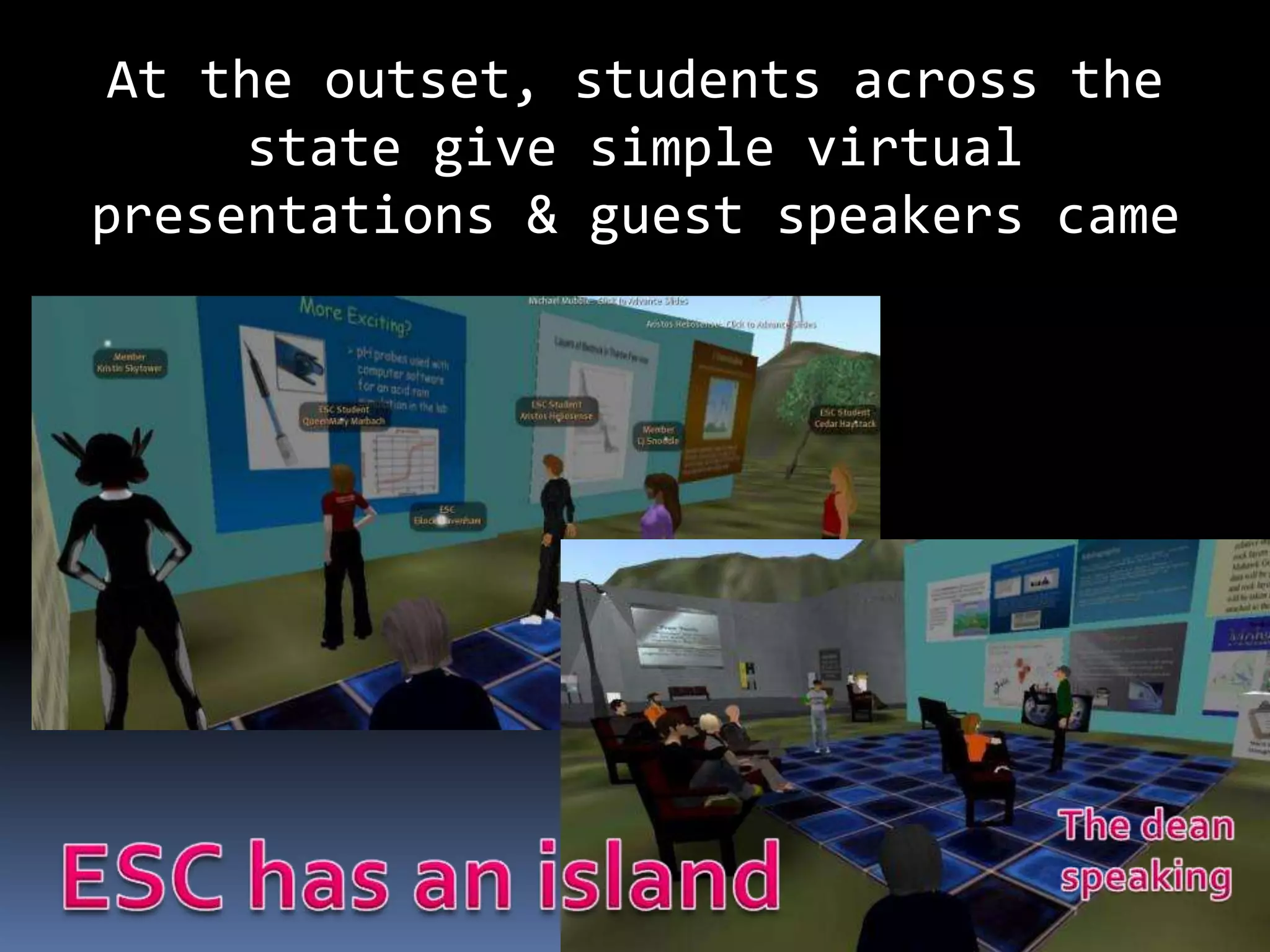
At the outset, students across the
     state give simple virtual
presentations & guest speakers came
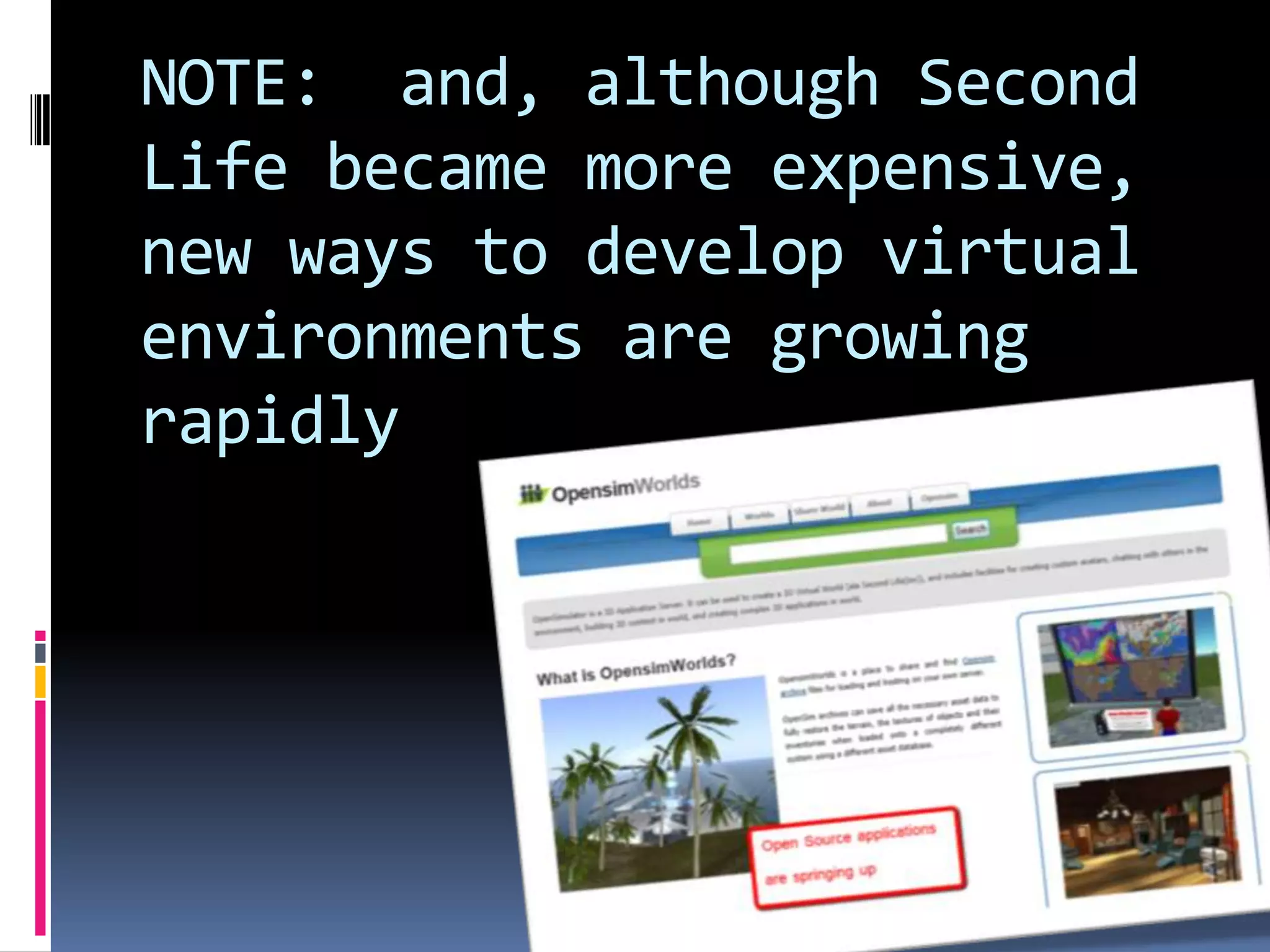
NOTE: and, although Second
Life became more expensive,
new ways to develop virtual
environments are growing
rapidly
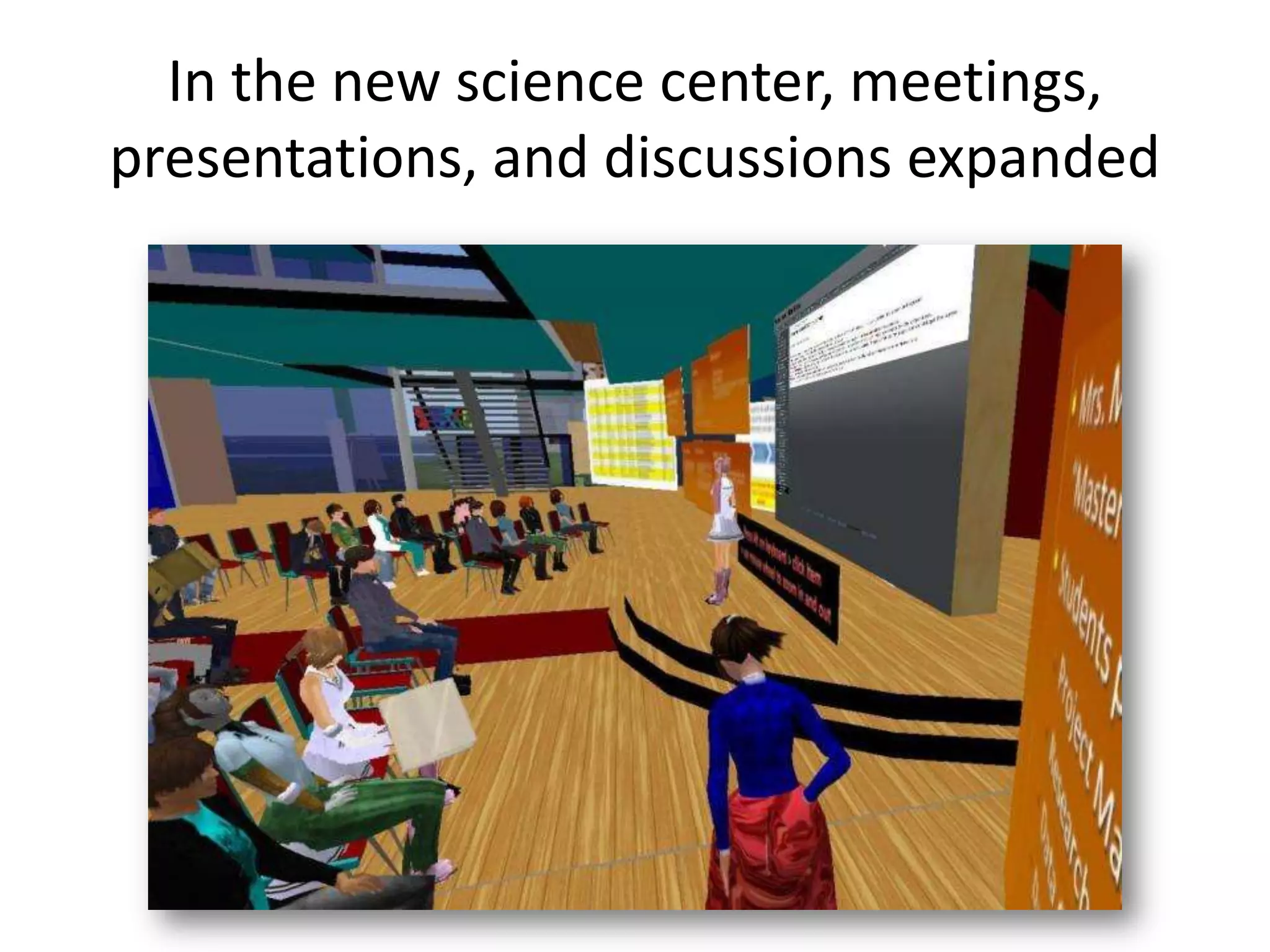
In the new science center, meetings,
presentations, and discussions expanded
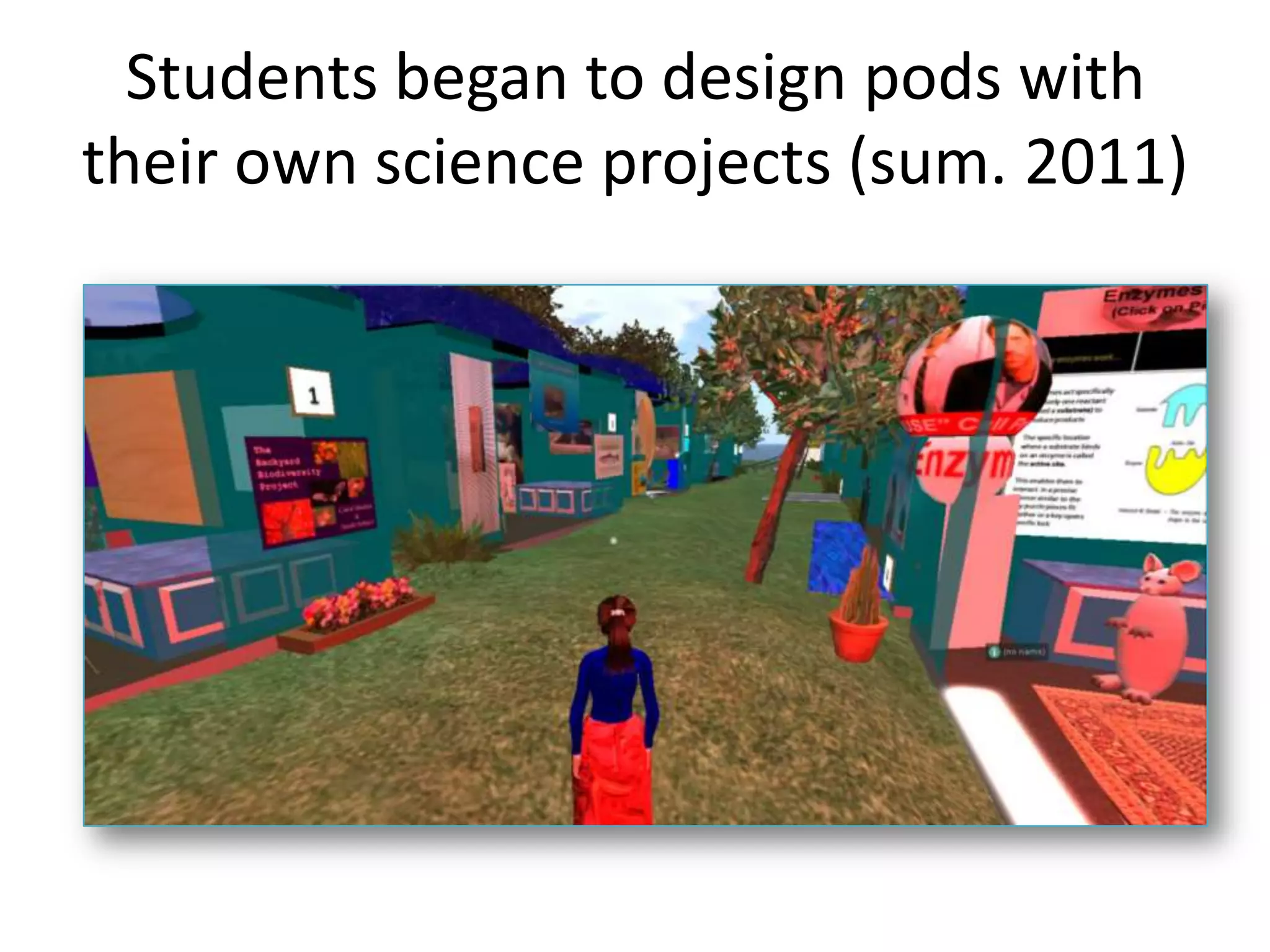
Students began to design pods with
their own science projects (sum. 2011)
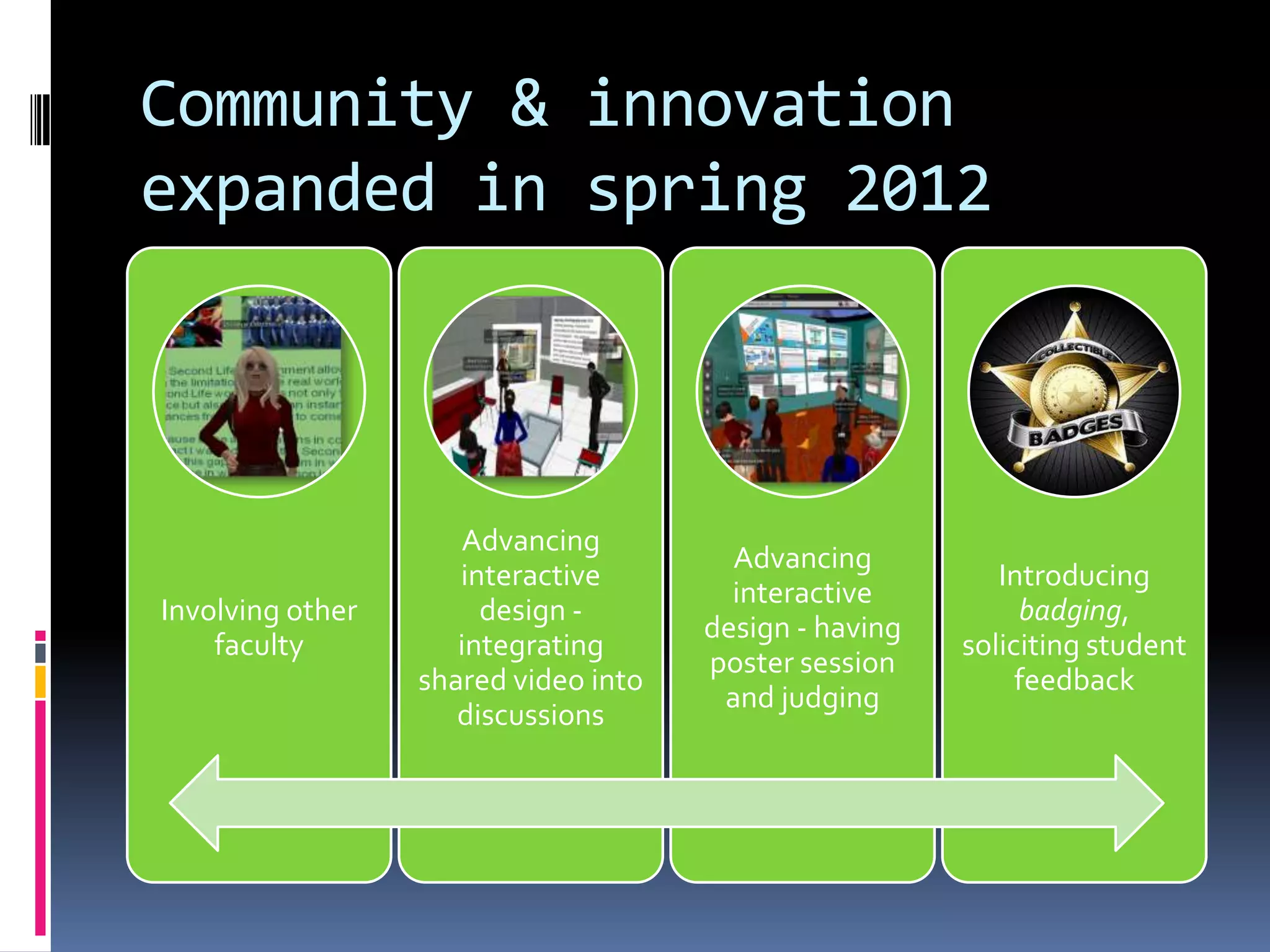
Community & innovation
expanded in spring 2012


                     Advancing
                                        Advancing
                     interactive                           Introducing
                                        interactive
Involving other        design -                              badging,
                                      design - having
    faculty          integrating                        soliciting student
                                      poster session
                  shared video into                          feedback
                                       and judging
                     discussions
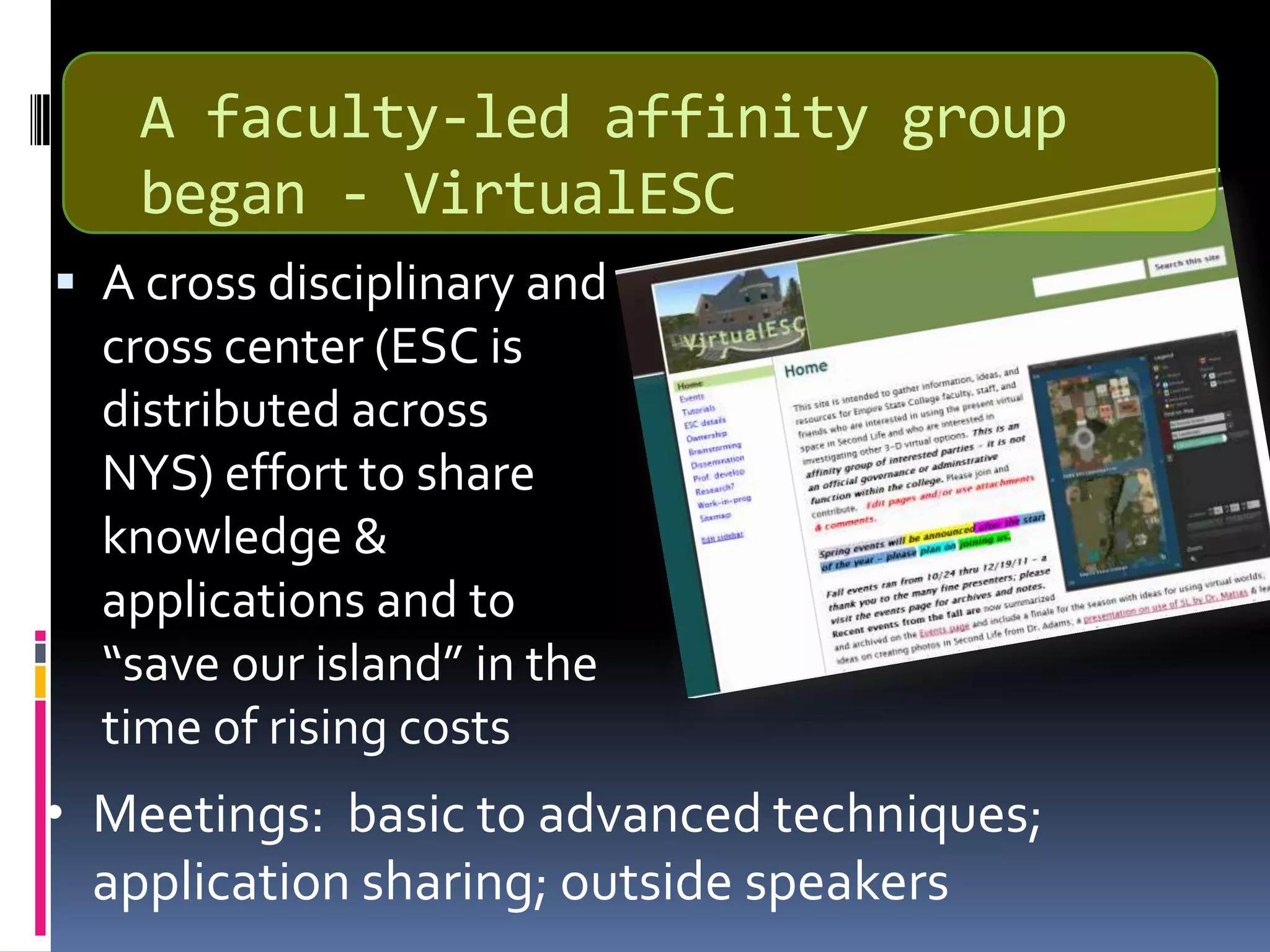
A faculty-led affinity group
    began - VirtualESC
 A cross disciplinary and
  cross center (ESC is
  distributed across
  NYS) effort to share
  knowledge &
  applications and to
  “save our island” in the
  time of rising costs
• Meetings: basic to advanced techniques;
  application sharing; outside speakers
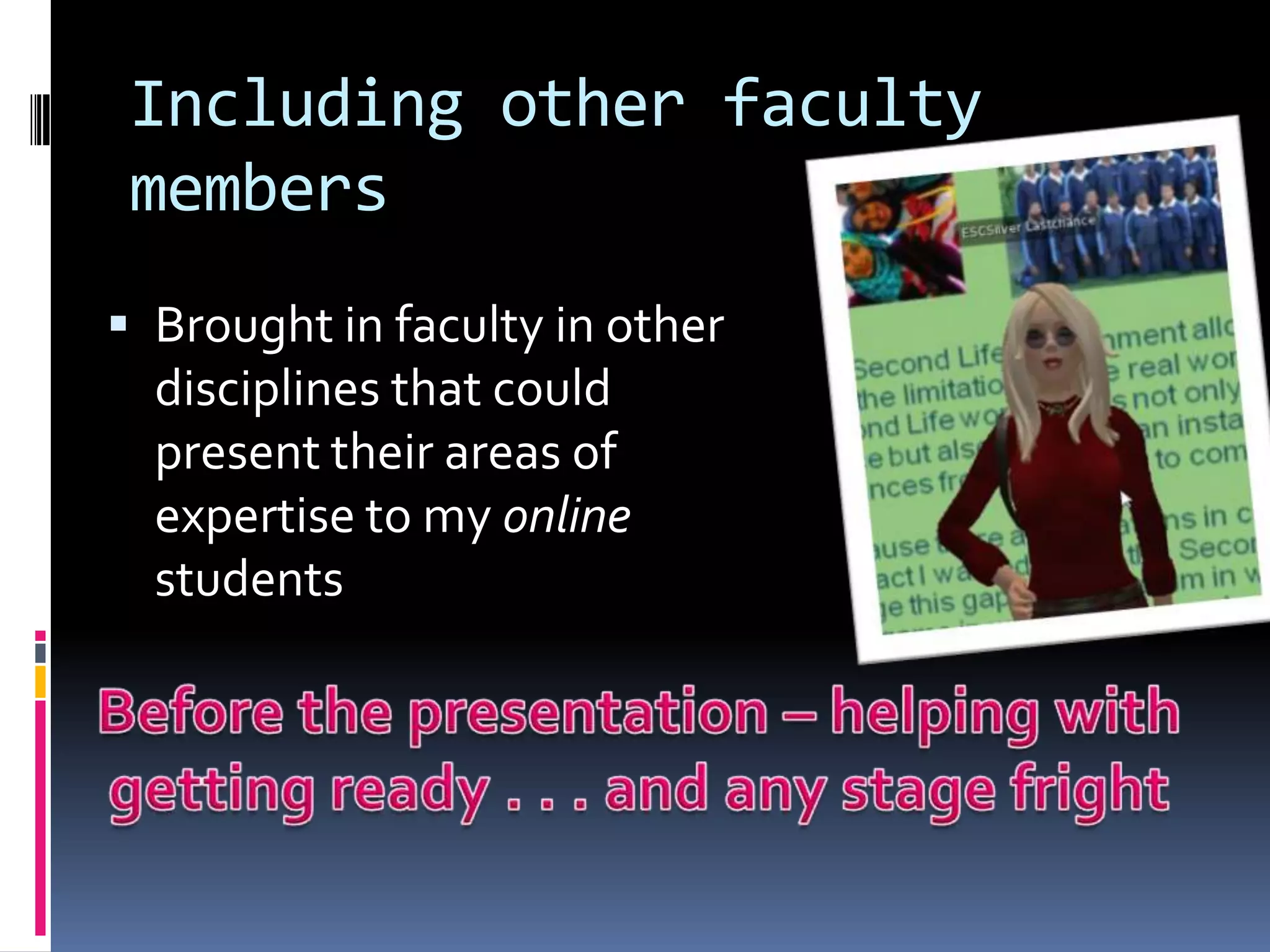
Including other faculty
 members
 Brought in faculty in other
  disciplines that could
  present their areas of
  expertise to my online
  students
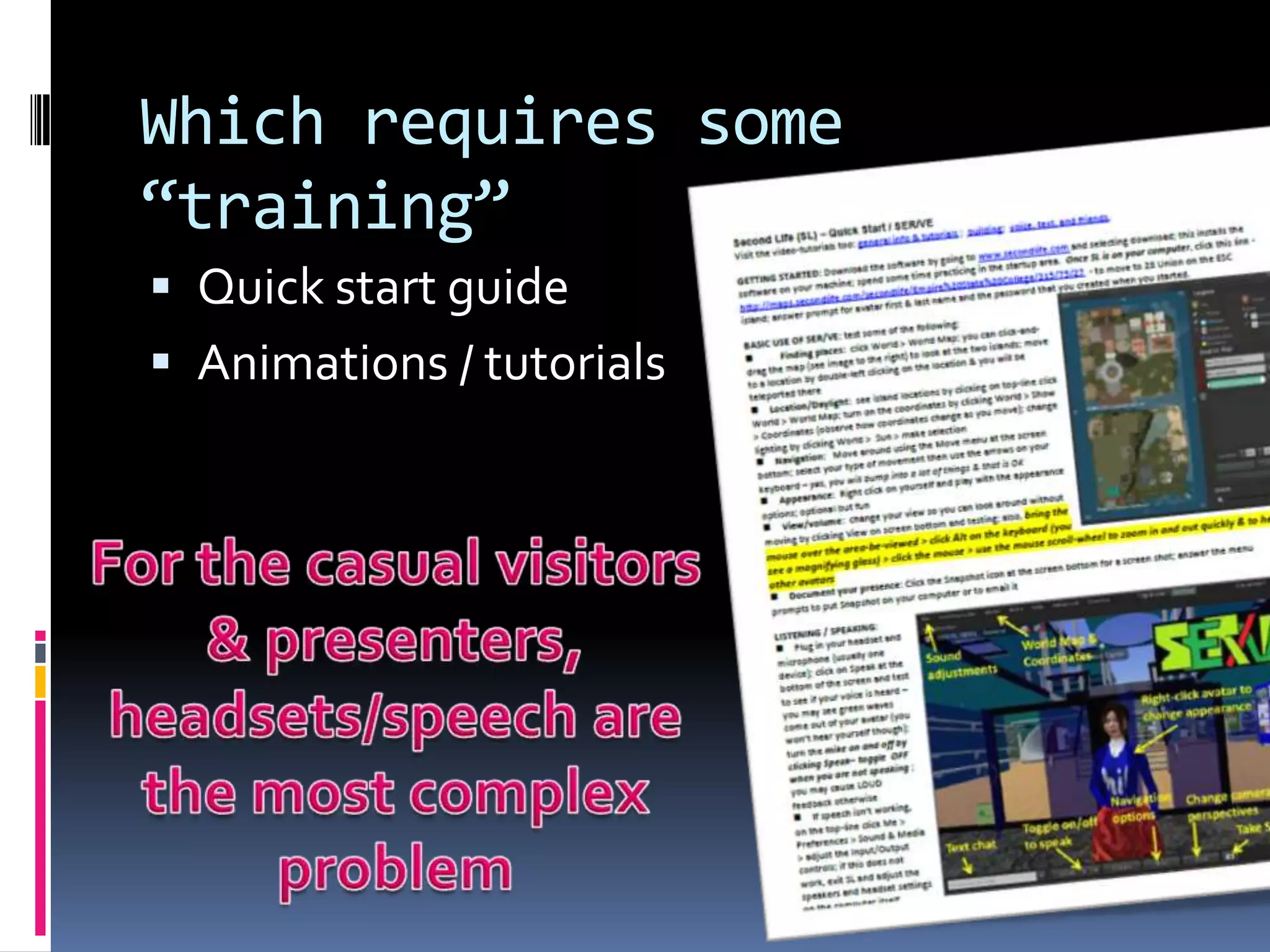
Which requires some
“training”
 Quick start guide
 Animations / tutorials
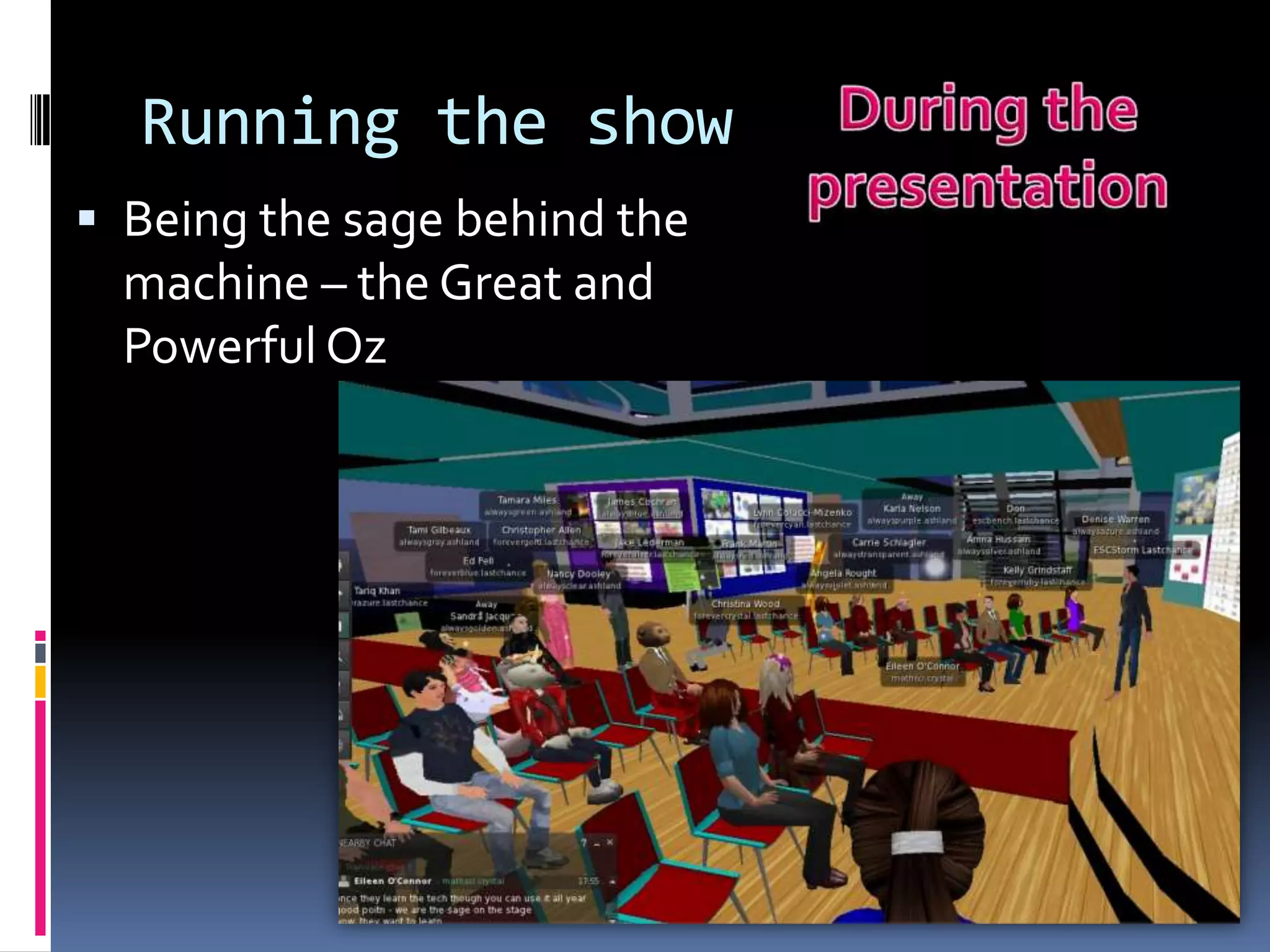
Running the show
 Being the sage behind the
  machine – the Great and
  Powerful Oz
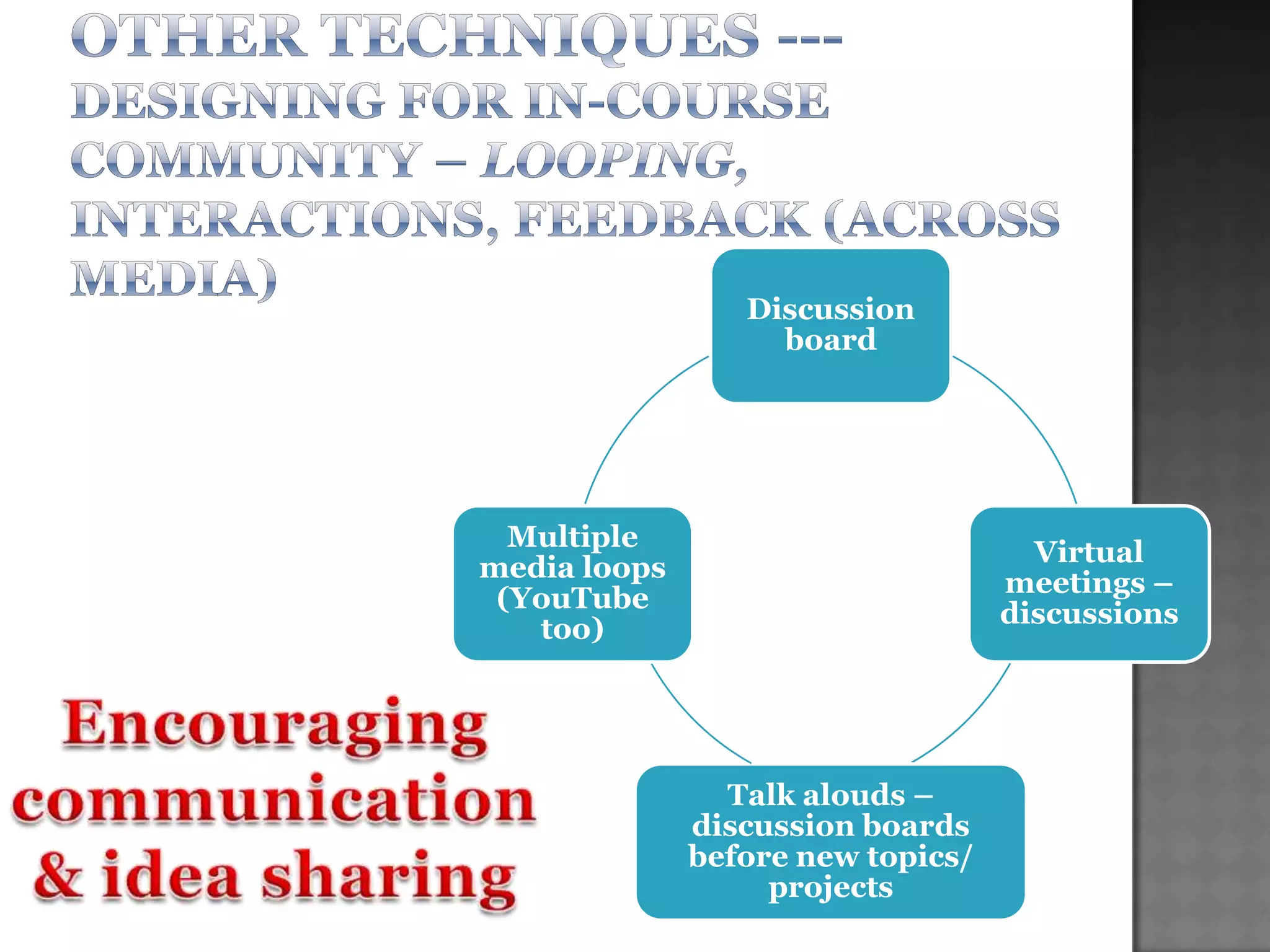
Discussion
                   board


  Multiple
                                     Virtual
media loops
                                   meetings –
 (YouTube
                                   discussions
   too)


                Talk alouds –
              discussion boards
              before new topics/
                   projects
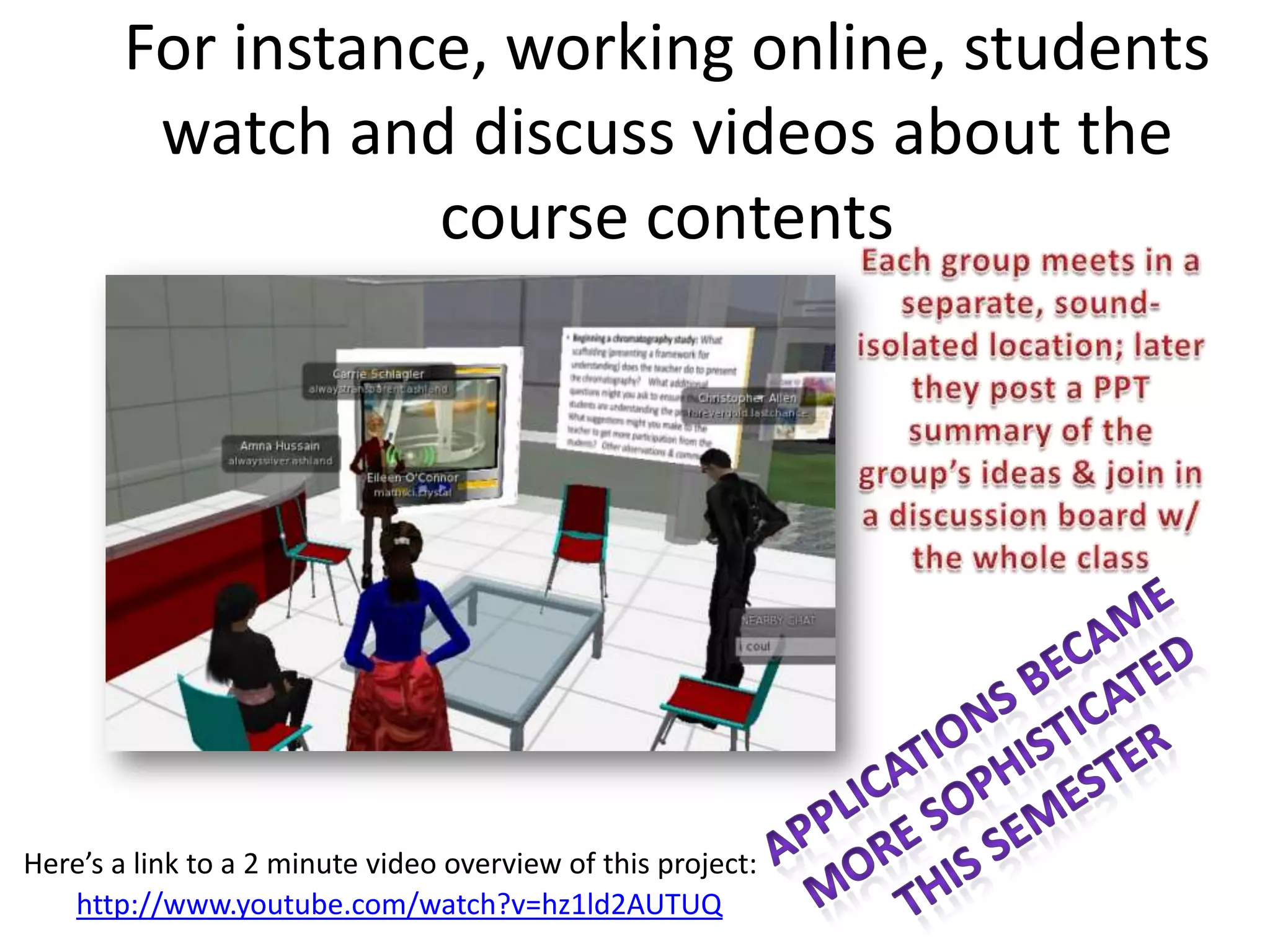
For instance, working online, students
         watch and discuss videos about the
                   course contents


Here’s a link to a 2 minute video overview of this project:
   http://www.youtube.com/watch?v=hz1ld2AUTUQ
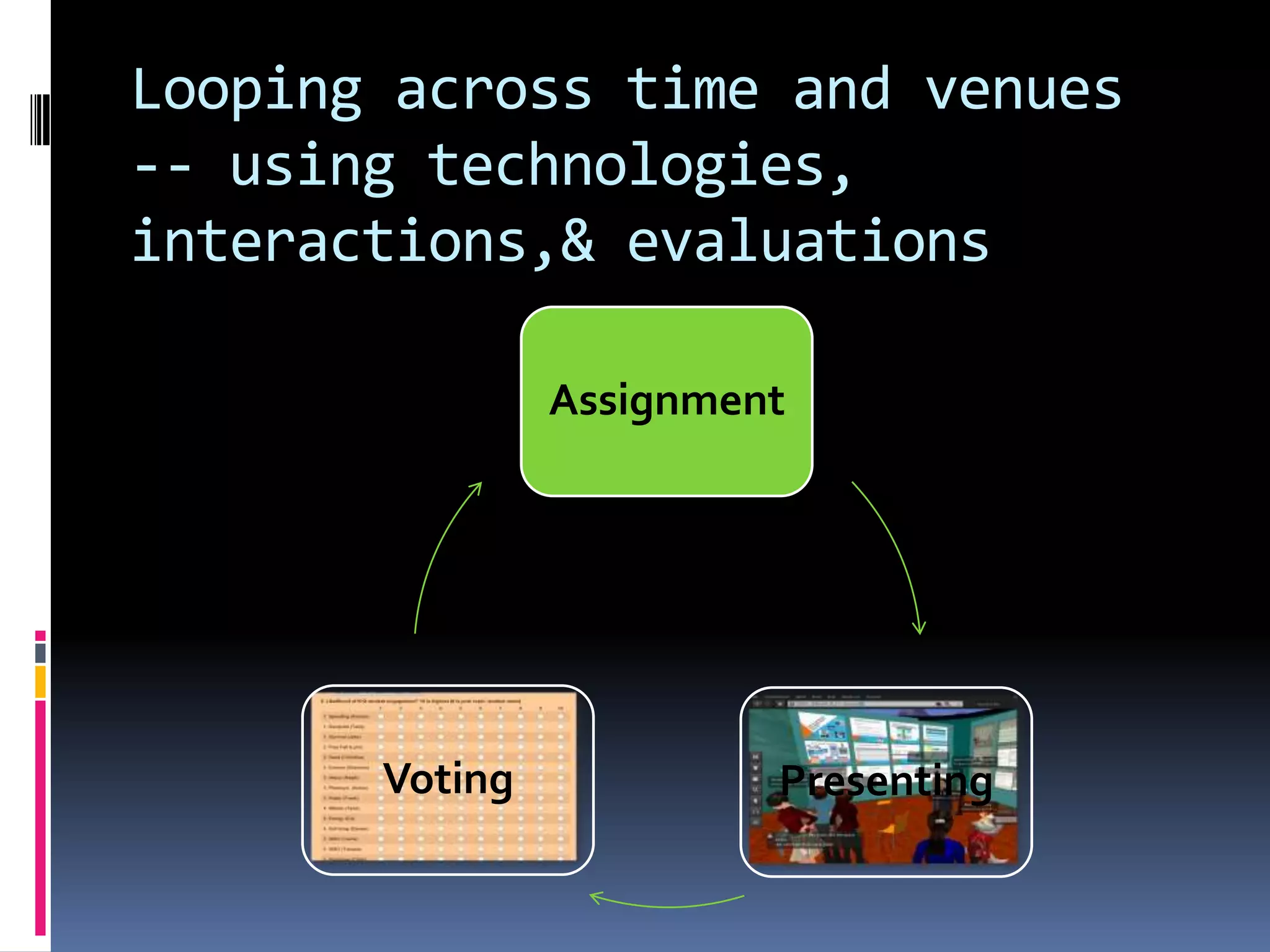
Looping across time and venues
-- using technologies,
interactions,& evaluations

                Assignment


       Voting            Presenting
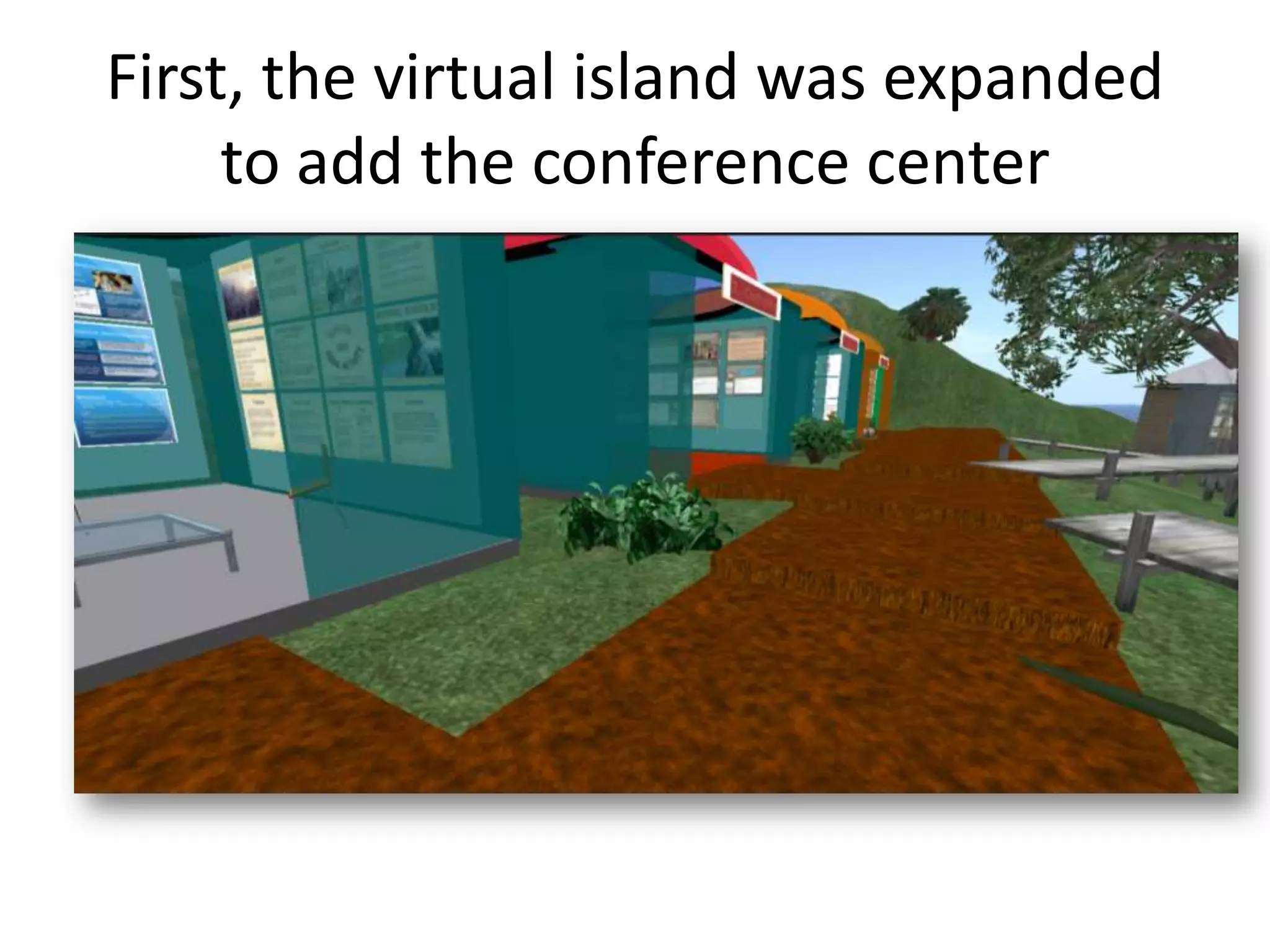
First, the virtual island was expanded
     to add the conference center
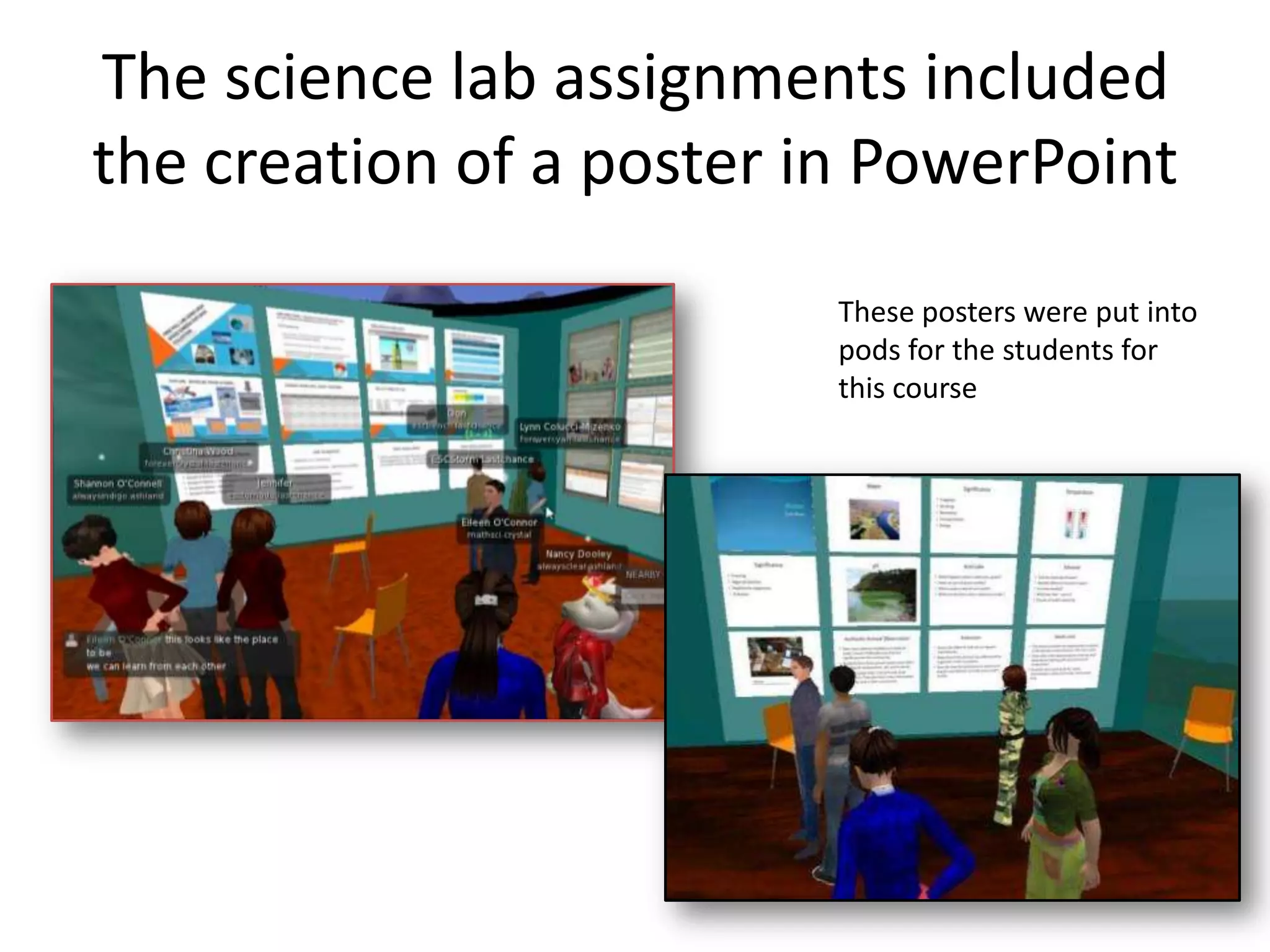
The science lab assignments included
the creation of a poster in PowerPoint
                          These posters were put into
                          pods for the students for
                          this course
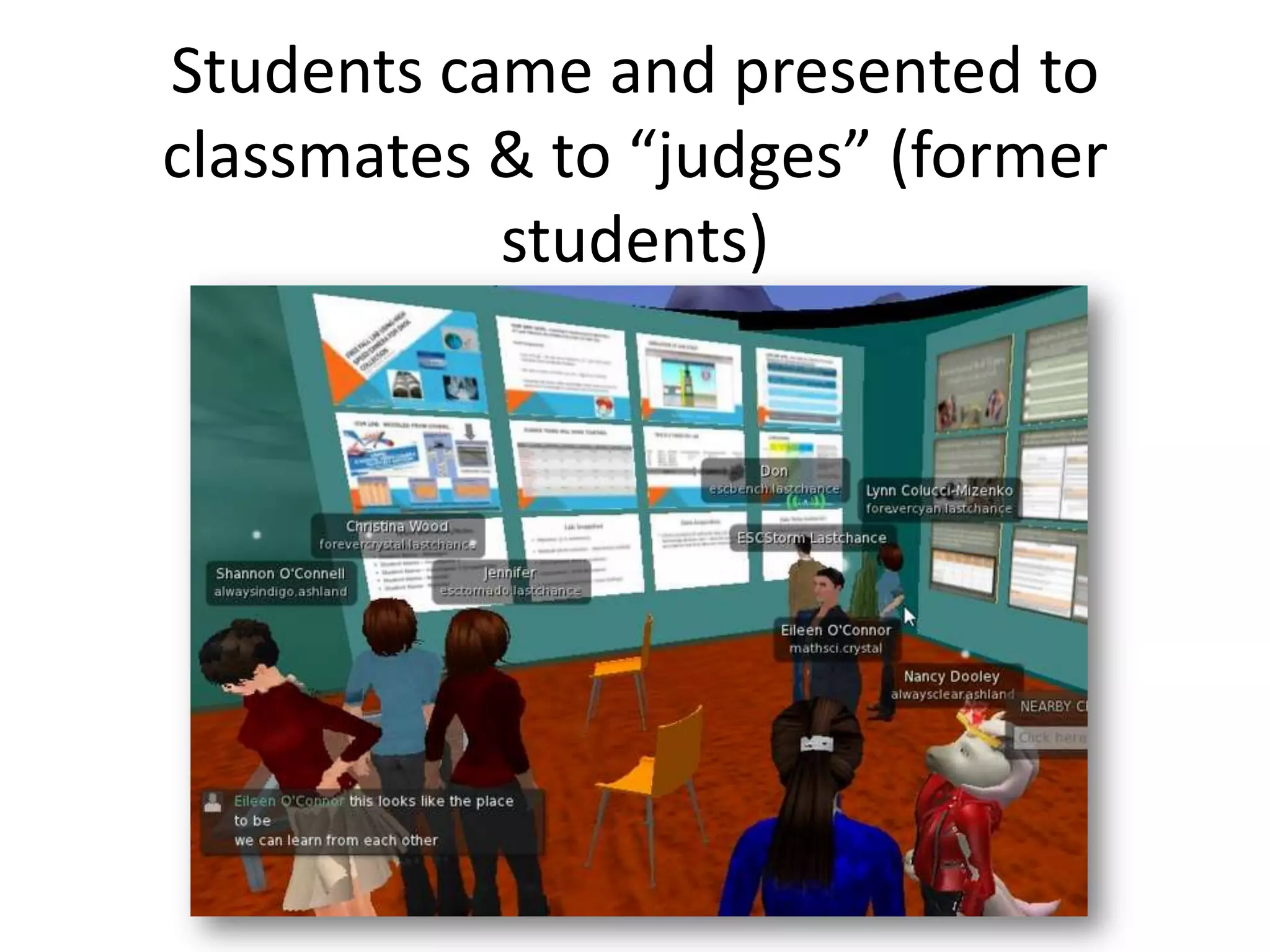
Students came and presented to
classmates & to “judges” (former
           students)
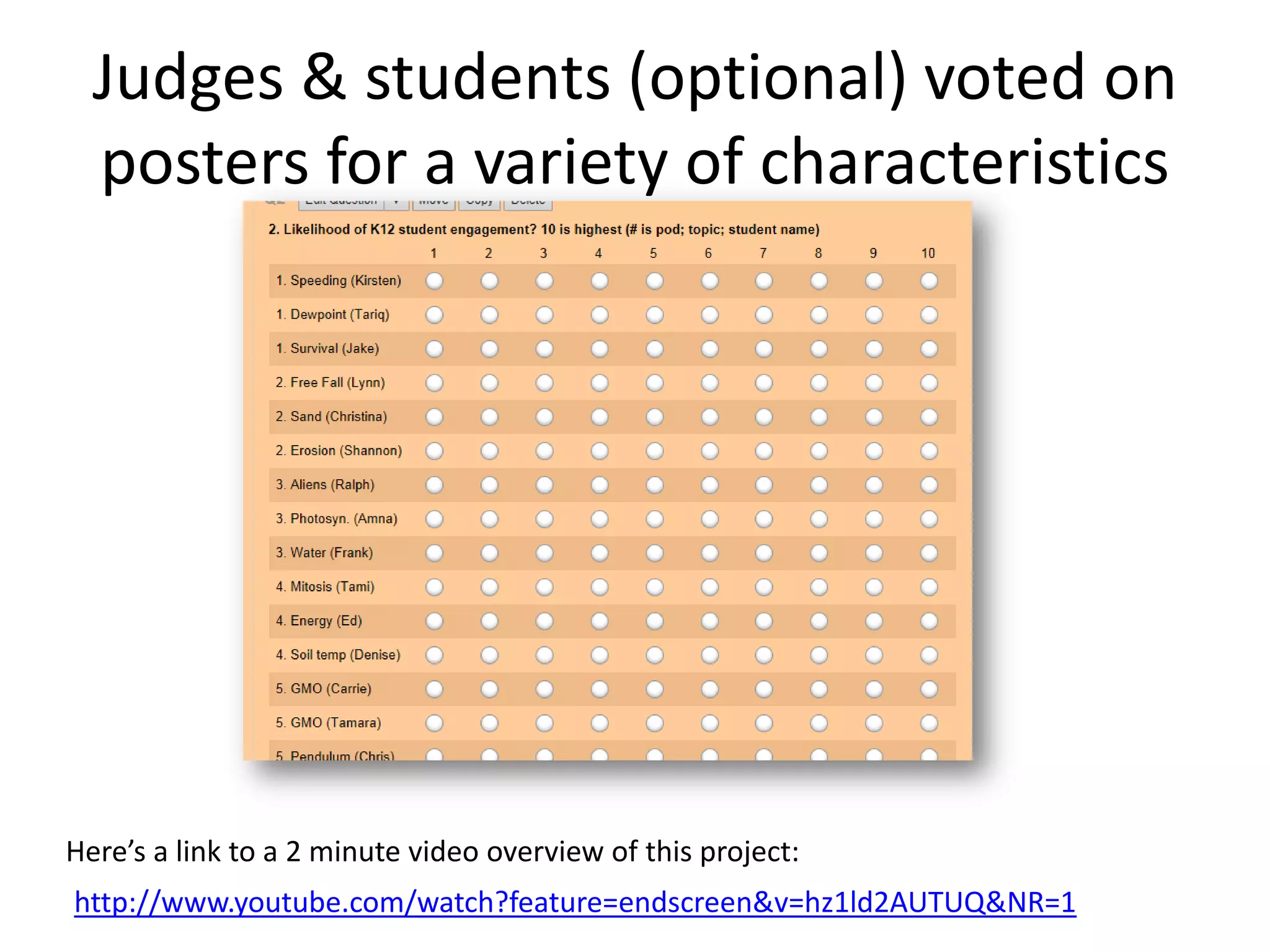
Judges & students (optional) voted on
  posters for a variety of characteristics


Here’s a link to a 2 minute video overview of this project:
http://www.youtube.com/watch?feature=endscreen&v=hz1ld2AUTUQ&NR=1
Another new technique: a virtual
     speaker addressed badging
• After the presentation, students broke into
  groups and discussed the possible role of
  badging – in K12 & in graduate courses
• (Badging will be incorporated into the summer
  course requirements too)
• Here are YouTubes from the video discussion:
  – http://youtu.be/FECB2m3QNPg
    http://youtu.be/gDXdhjZHeVI
  – http://youtu.be/-N2LtOp4XBs
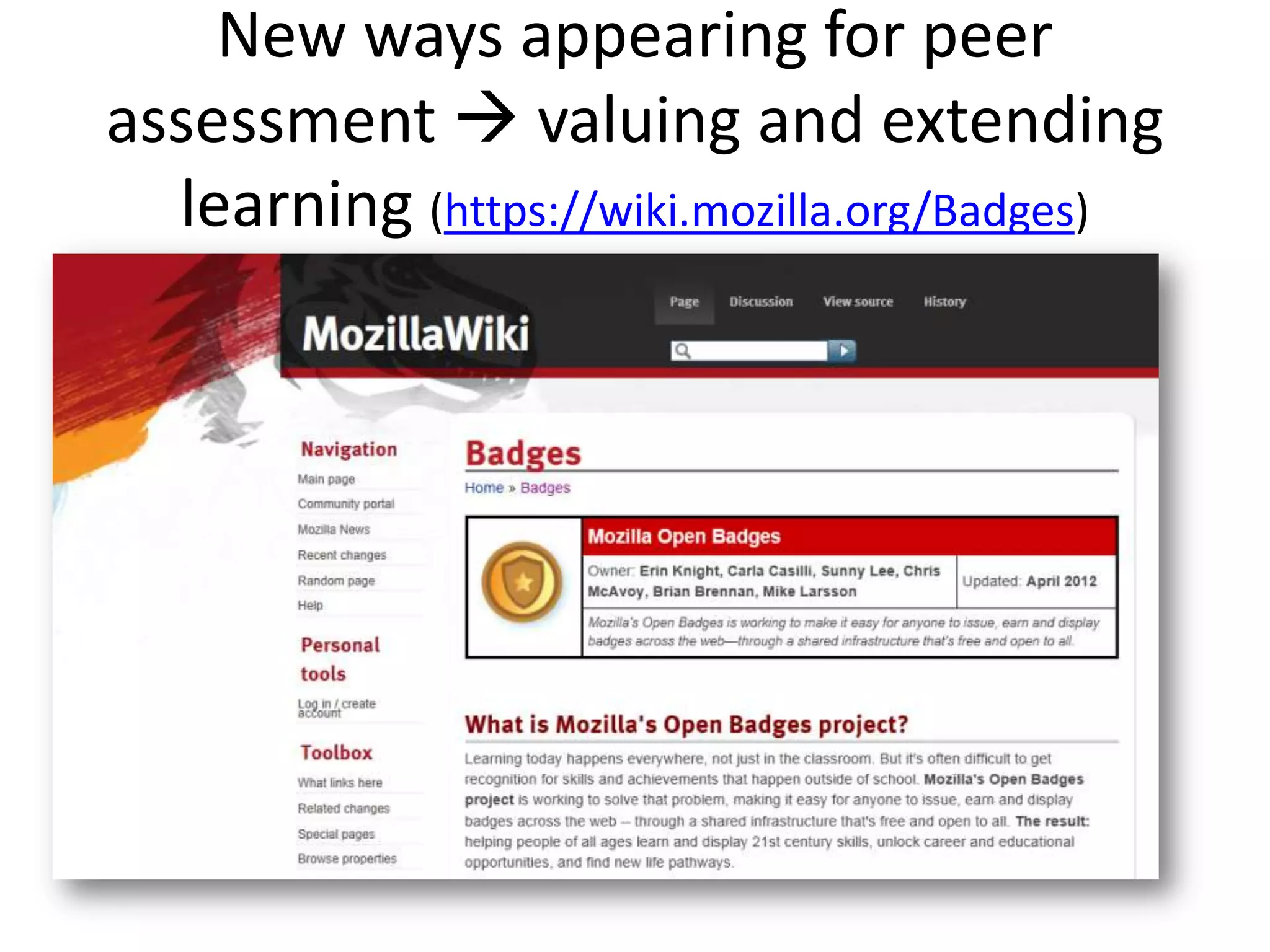
New ways appearing for peer
assessment  valuing and extending
  learning (https://wiki.mozilla.org/Badges)
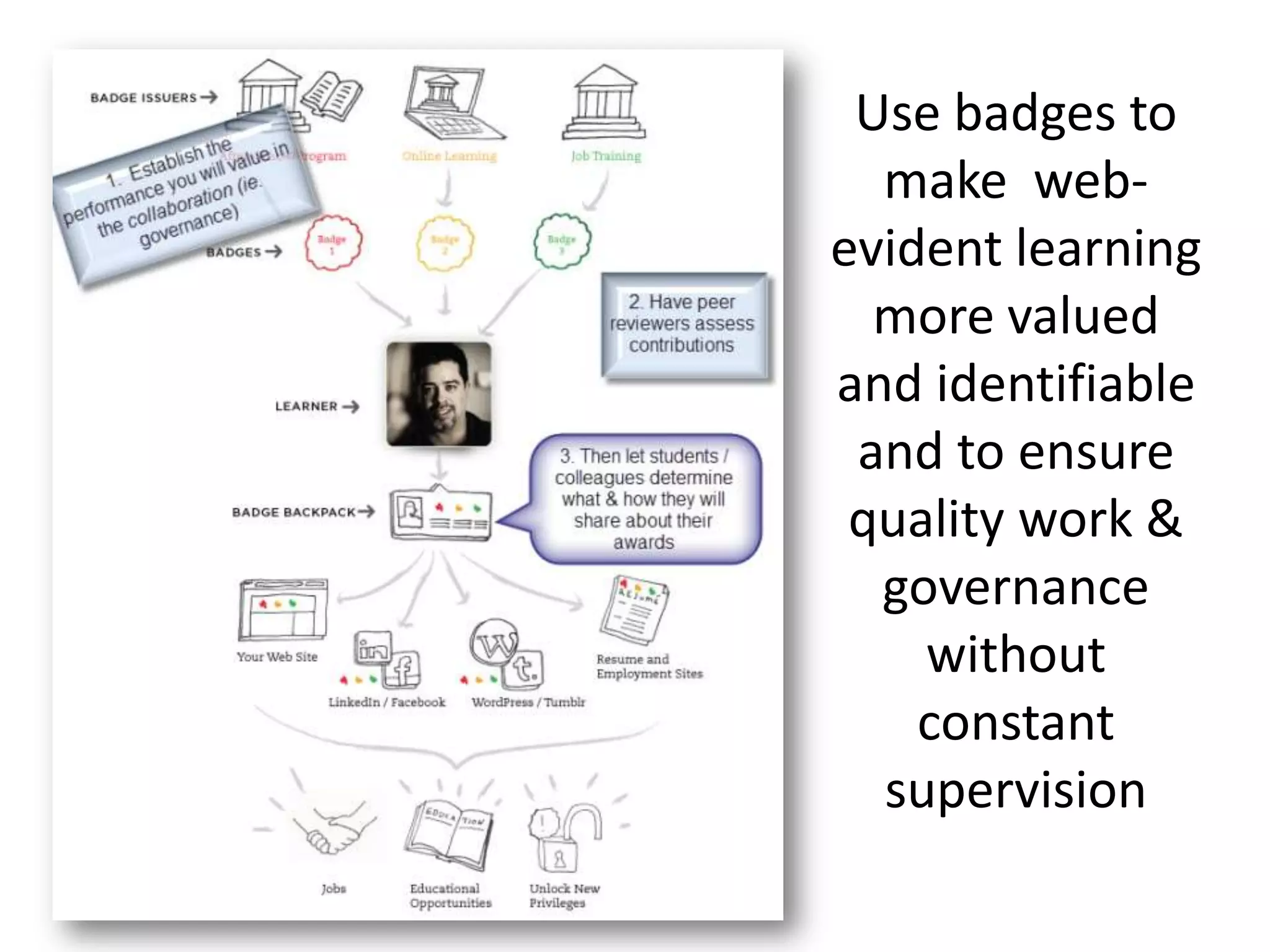
Use badges to
  make web-
evident learning
  more valued
and identifiable
 and to ensure
 quality work &
  governance
    without
    constant
  supervision
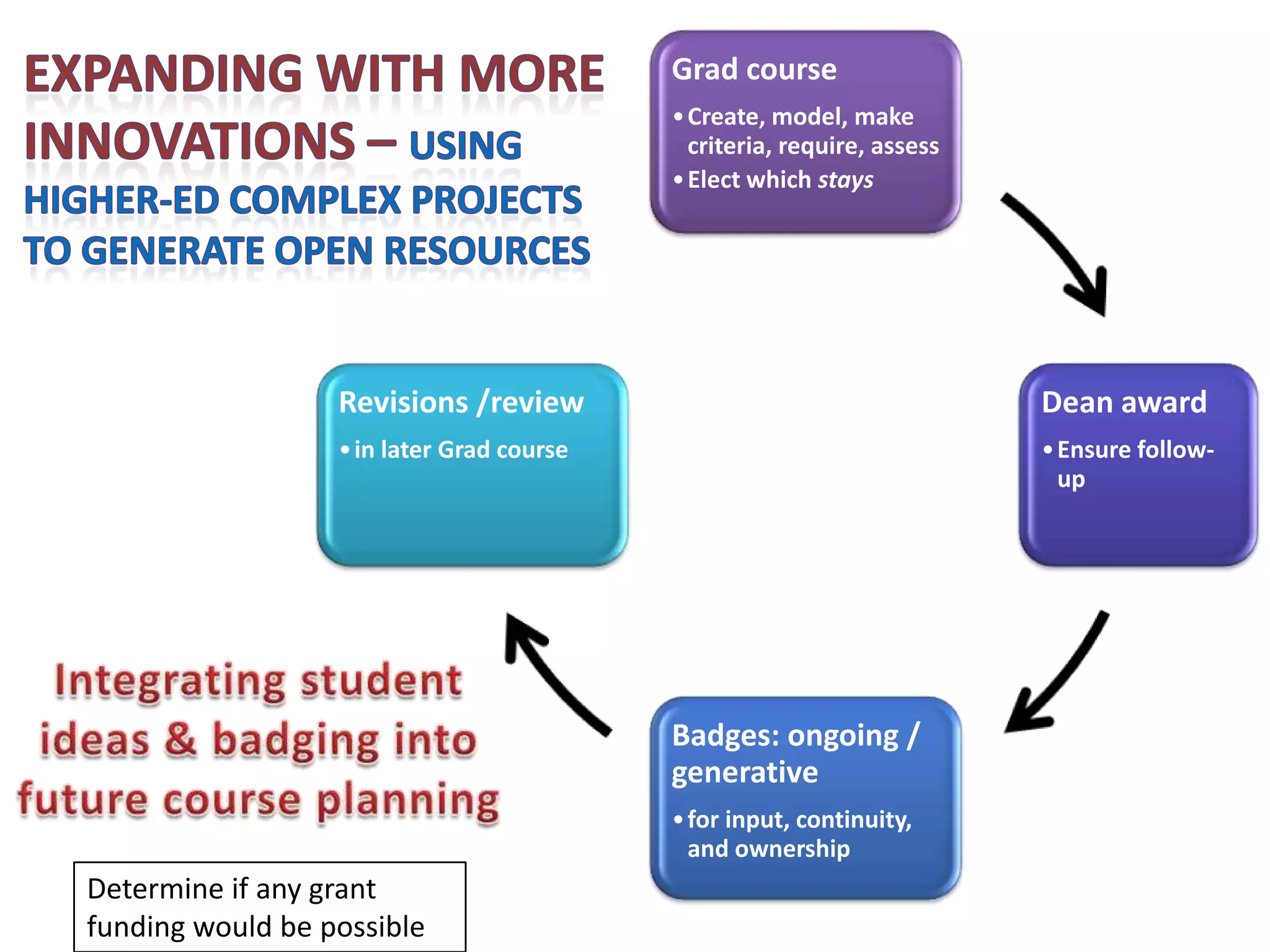
Grad course
                                           • Create, model, make
                                             criteria, require, assess
                                           • Elect which stays


                  Revisions /review                                      Dean award
                  • in later Grad course                                 • Ensure follow-
                                                                           up


                                           Badges: ongoing /
                                           generative
                                           • for input, continuity,
                                             and ownership
Determine if any grant
funding would be possible
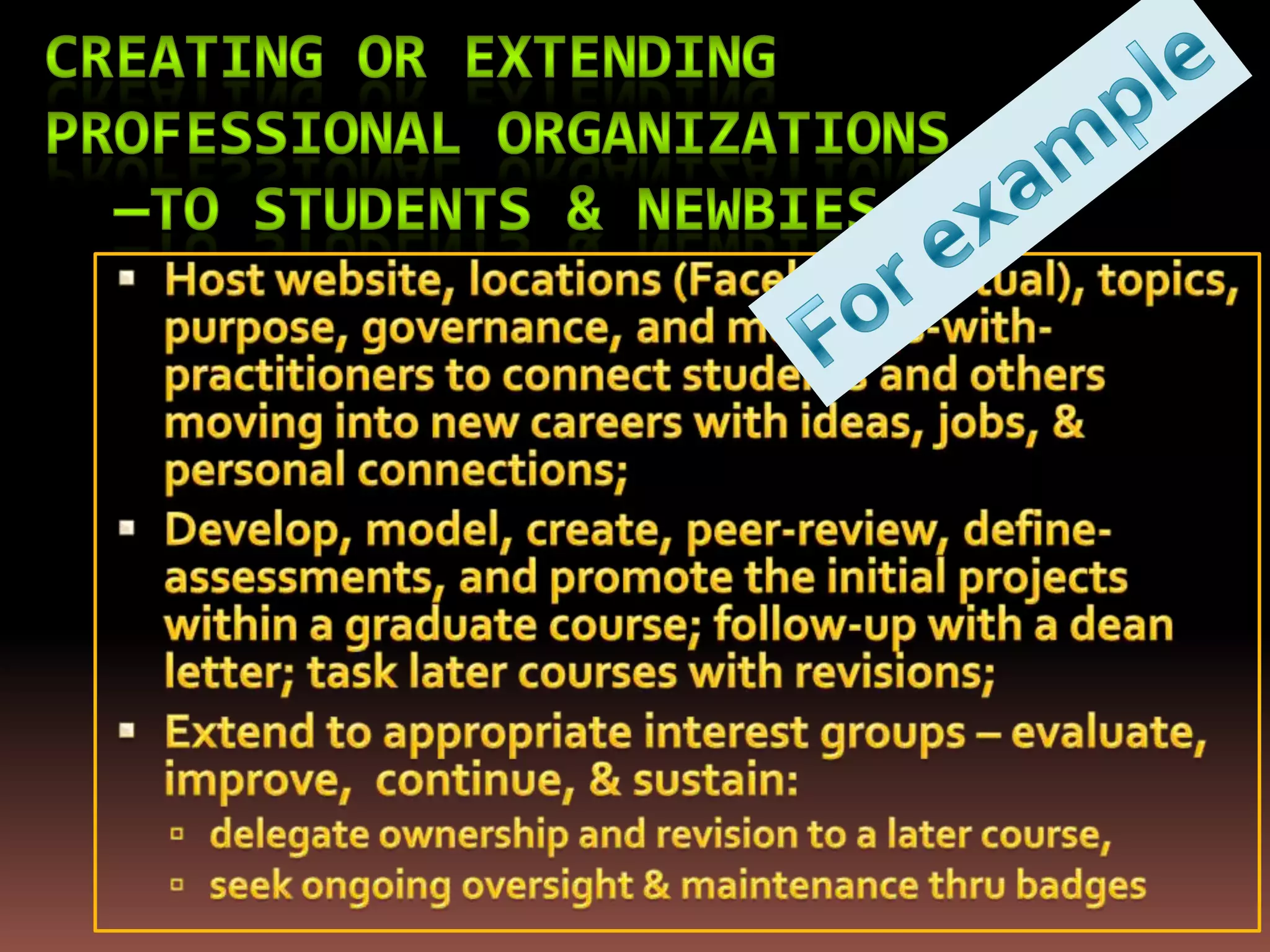
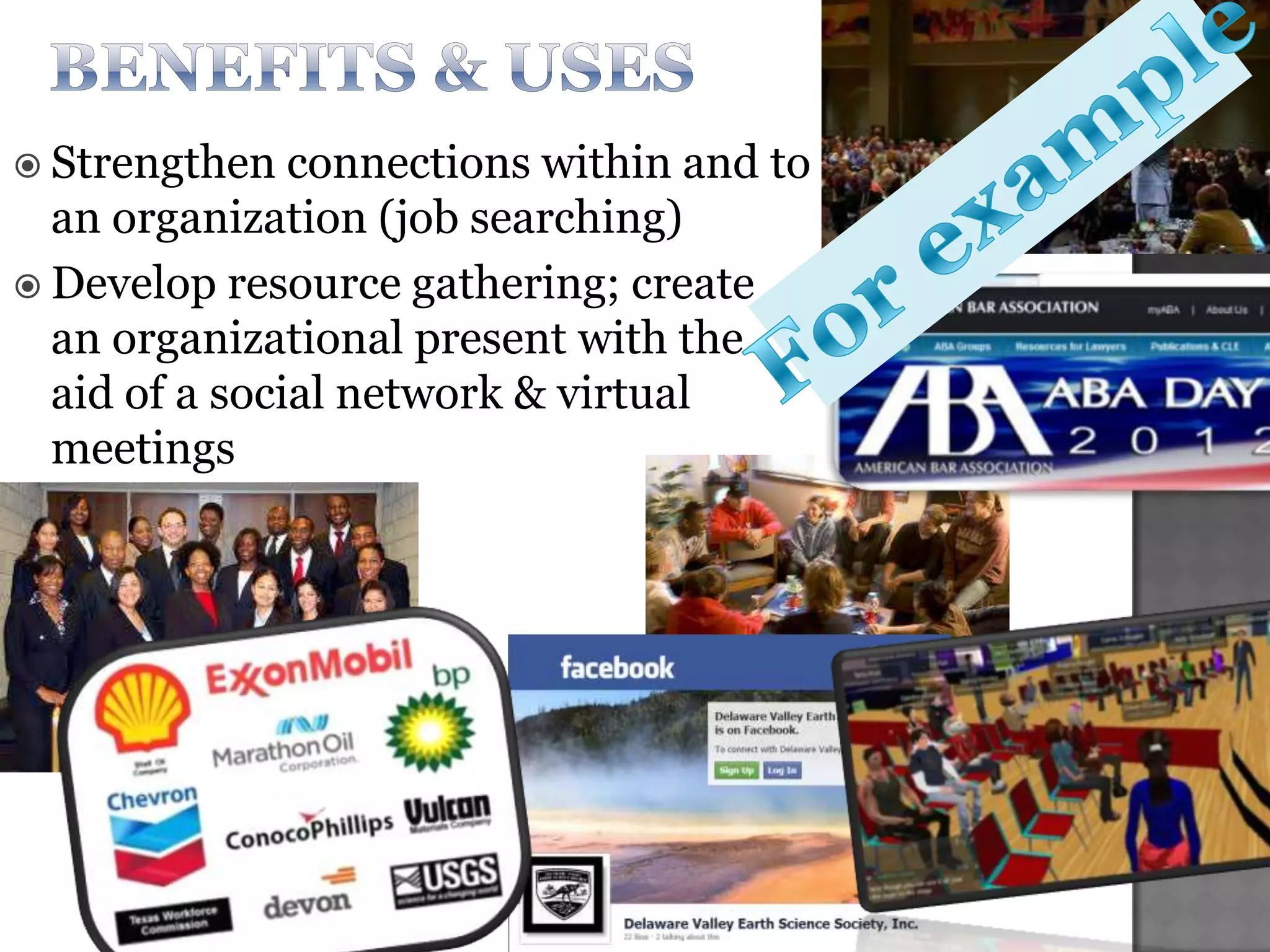
 Strengthen   connections within and to
  an organization (job searching)
 Develop resource gathering; create
  an organizational present with the
  aid of a social network & virtual
  meetings
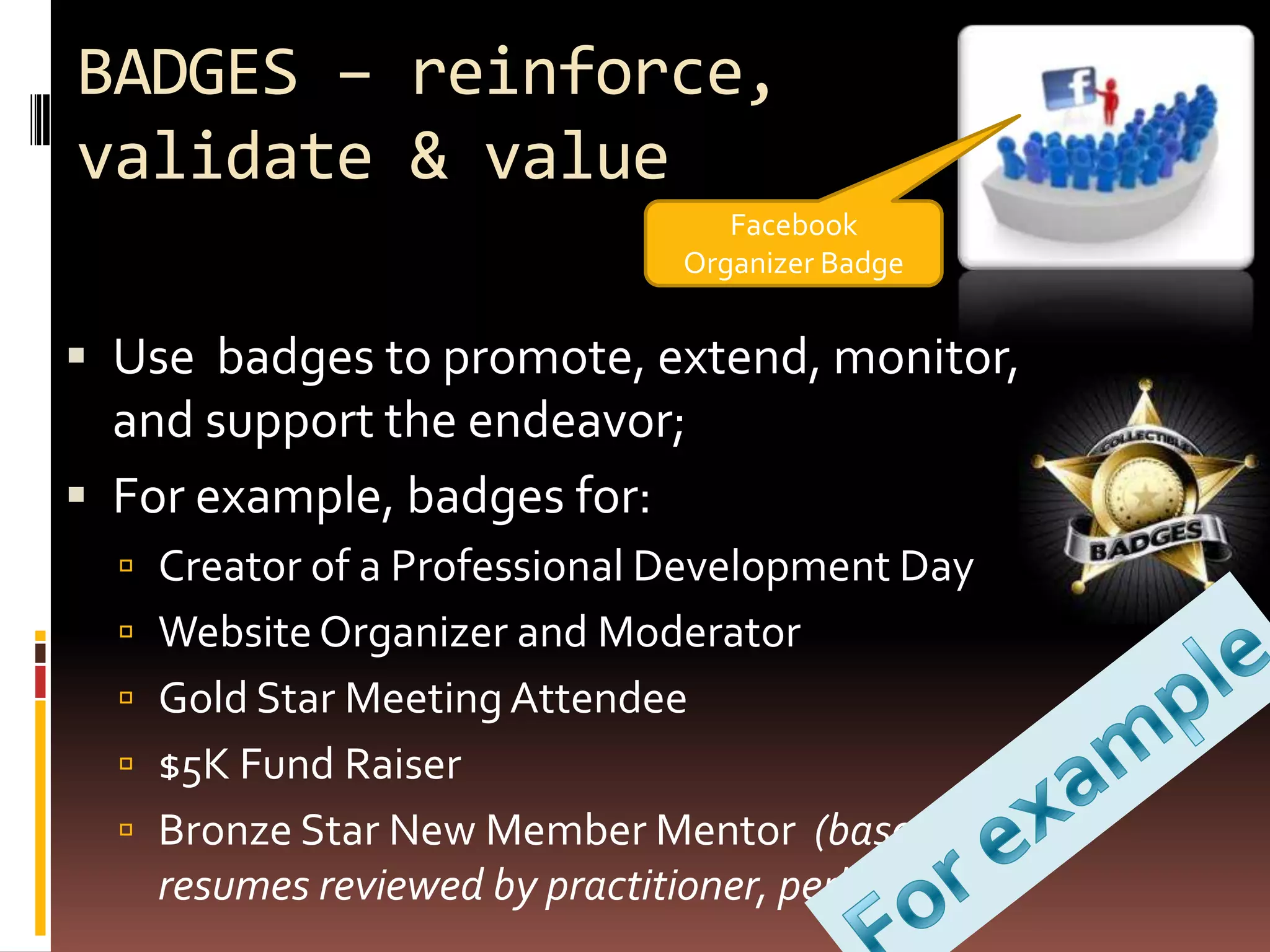
BADGES – reinforce,
validate & value
                                   Facebook
                                Organizer Badge


 Use badges to promote, extend, monitor,
  and support the endeavor;
 For example, badges for:
   Creator of a Professional Development Day
   Website Organizer and Moderator
   Gold Star Meeting Attendee
   $5K Fund Raiser
   Bronze Star New Member Mentor (based on
    resumes reviewed by practitioner, perhaps)
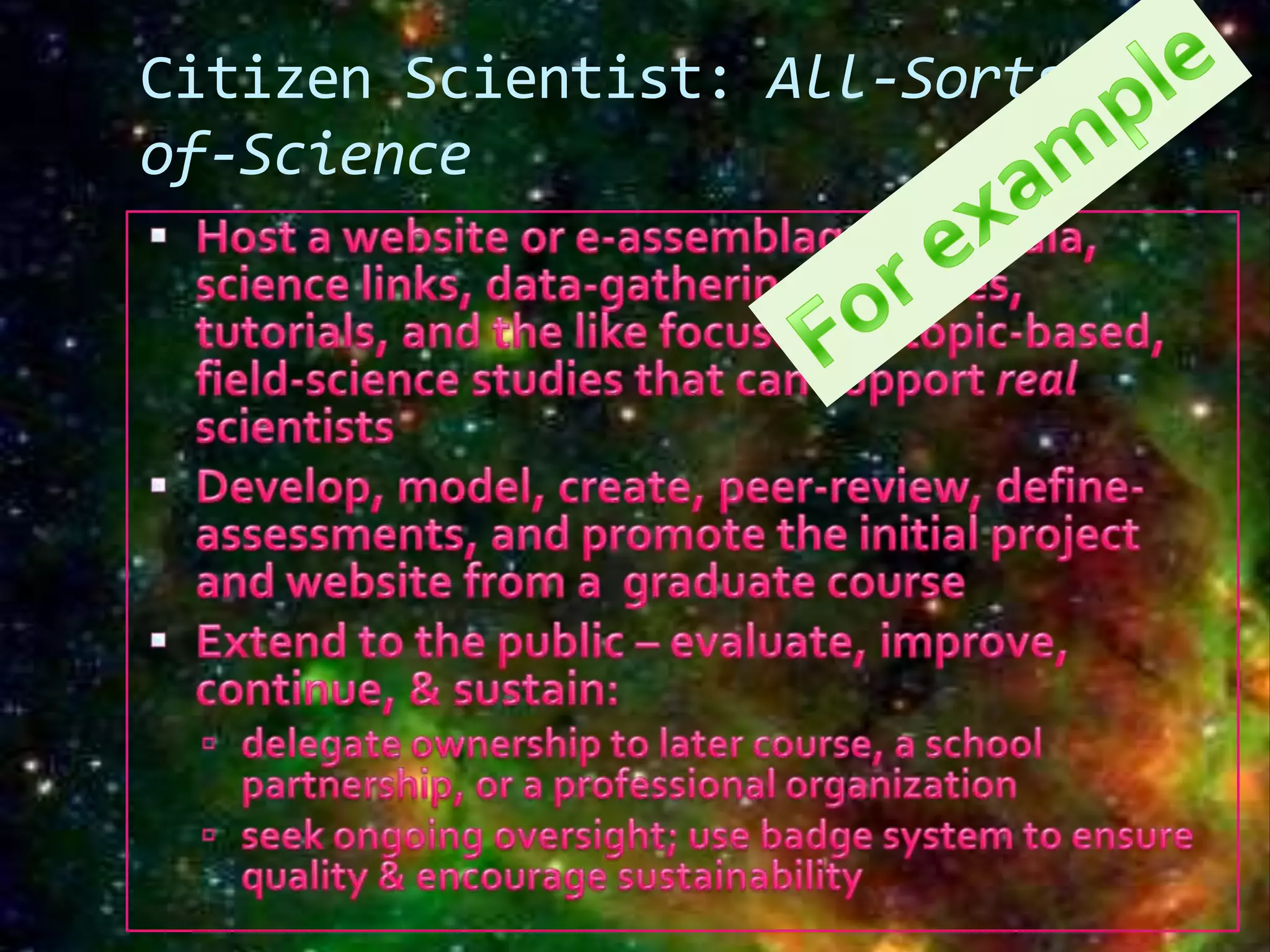
Citizen Scientist: All-Sorts-
of-Science
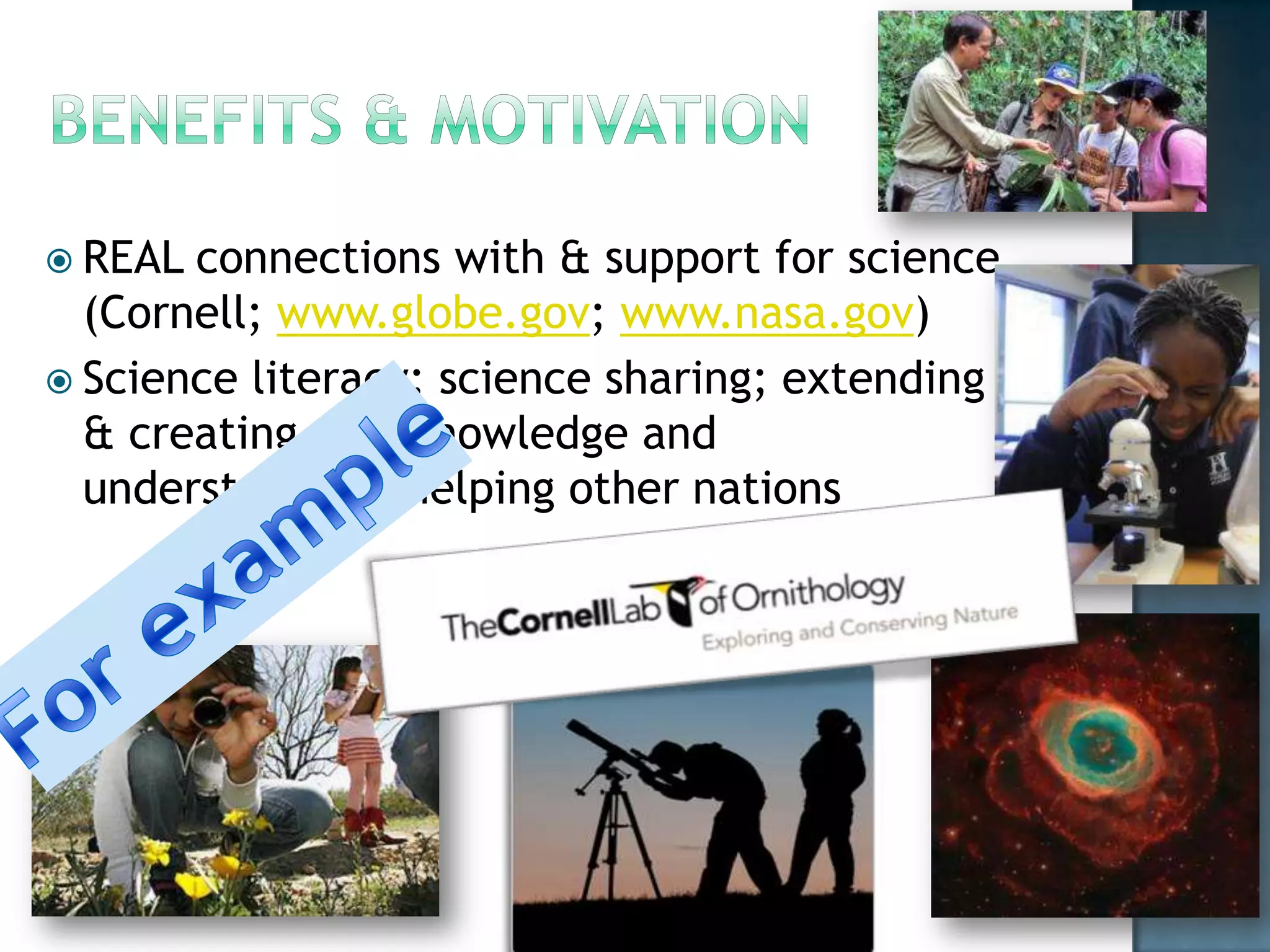
 REAL connections with & support for science
  (Cornell; www.globe.gov; www.nasa.gov)
 Science literacy; science sharing; extending
  & creating new knowledge and
  understanding; helping other nations
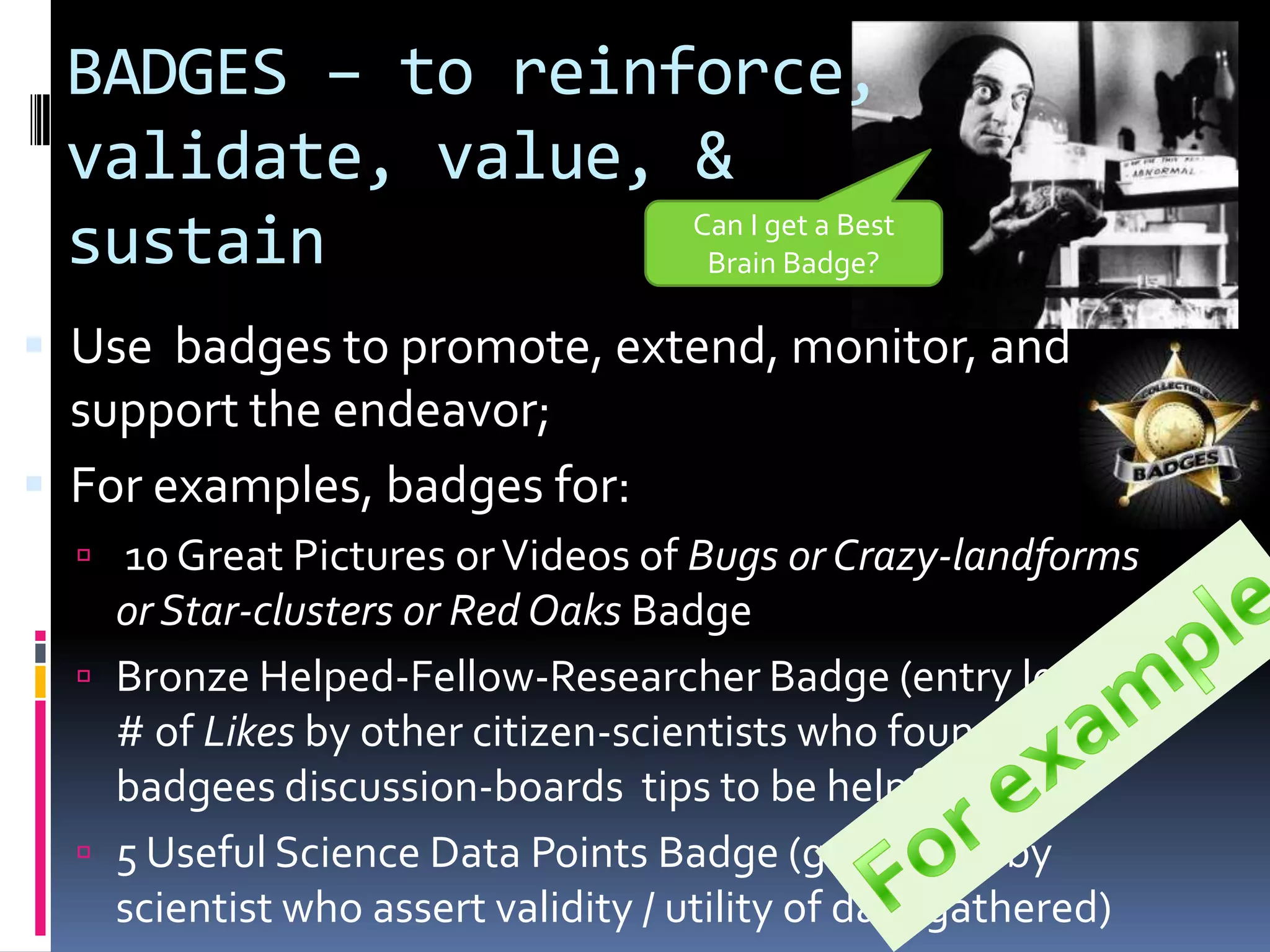
BADGES – to reinforce,
 validate, value, &
 sustain          Can I get a Best
                   Brain Badge?

 Use badges to promote, extend, monitor, and
  support the endeavor;
 For examples, badges for:
   10 Great Pictures or Videos of Bugs or Crazy-landforms
    or Star-clusters or Red Oaks Badge
   Bronze Helped-Fellow-Researcher Badge (entry level
    # of Likes by other citizen-scientists who found this
    badgees discussion-boards tips to be helpful)
   5 Useful Science Data Points Badge (generated by
    scientist who assert validity / utility of data gathered)
New considerations – making online
         more real but . . .
• Schedule for synchronous
  – but when moving to collaboration that can be a
    problem
  – Online work is not necessarily independent work by
    students / a new paradigm now within online itself
• Plan for yours’ and students’ growth over time
• The detailed startup helped / but they need to
  have good computers
  – server issues too can happen; challenges with
    headsets
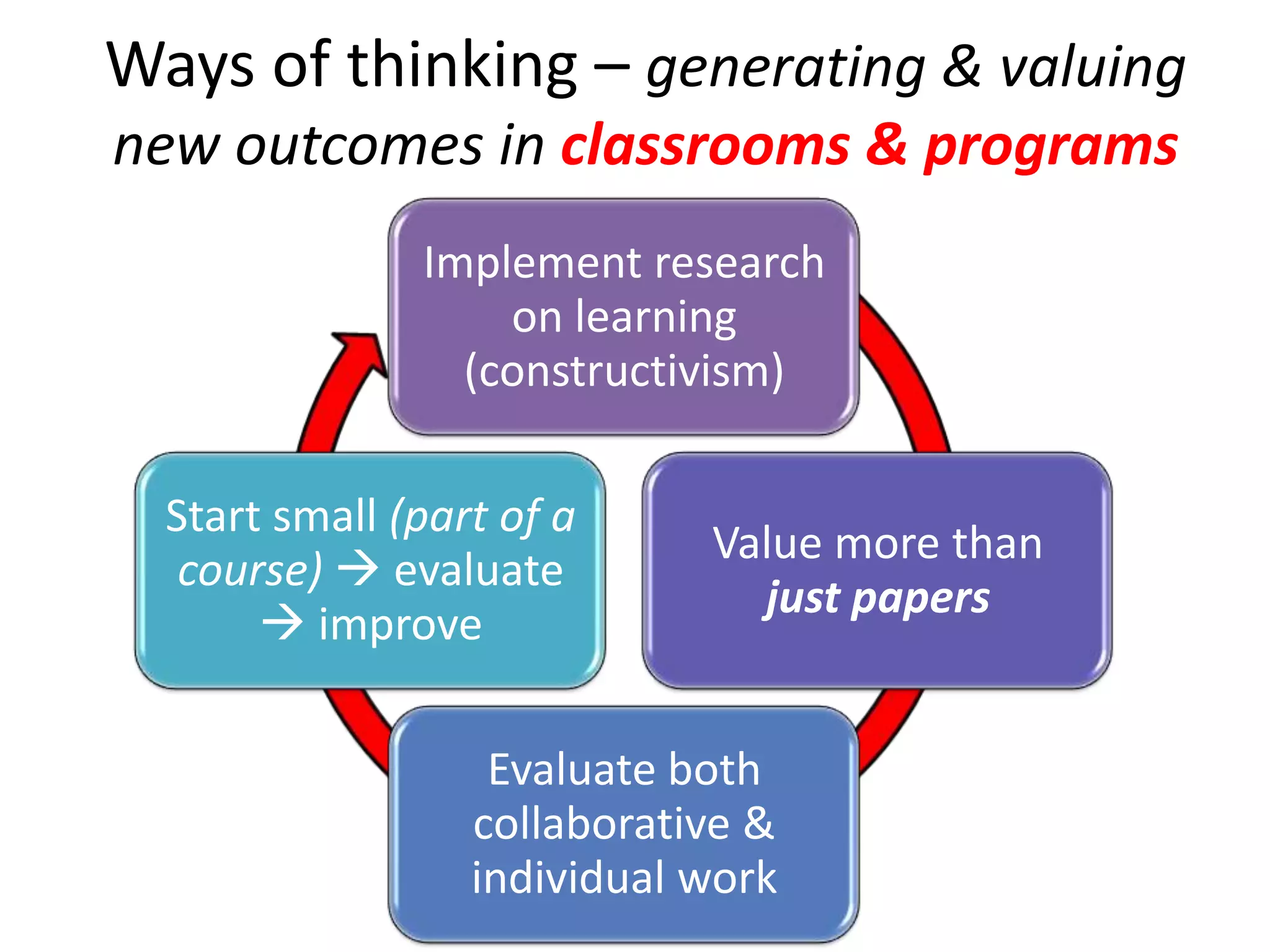
Ways of thinking – generating & valuing
new outcomes in classrooms & programs
               Implement research
                   on learning
                 (constructivism)

  Start small (part of a
                             Value more than
   course)  evaluate
                               just papers
        improve

                   Evaluate both
                  collaborative &
                  individual work
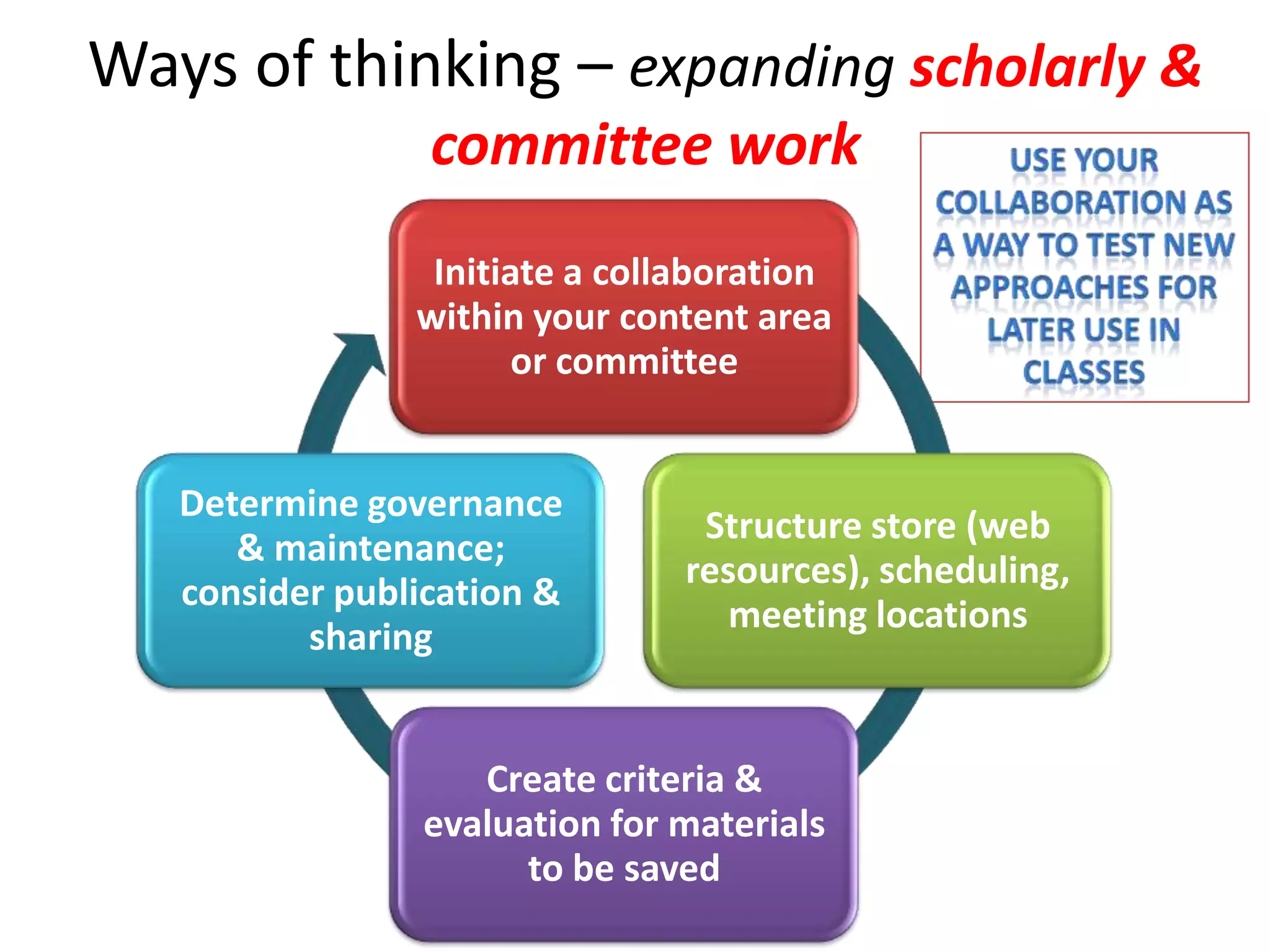
Ways of thinking – expanding scholarly &
                 committee work
                 Initiate a collaboration
                within your content area
                       or committee


   Determine governance
                                 Structure store (web
      & maintenance;
                                resources), scheduling,
   consider publication &
                                   meeting locations
          sharing


                   Create criteria &
                evaluation for materials
                      to be saved
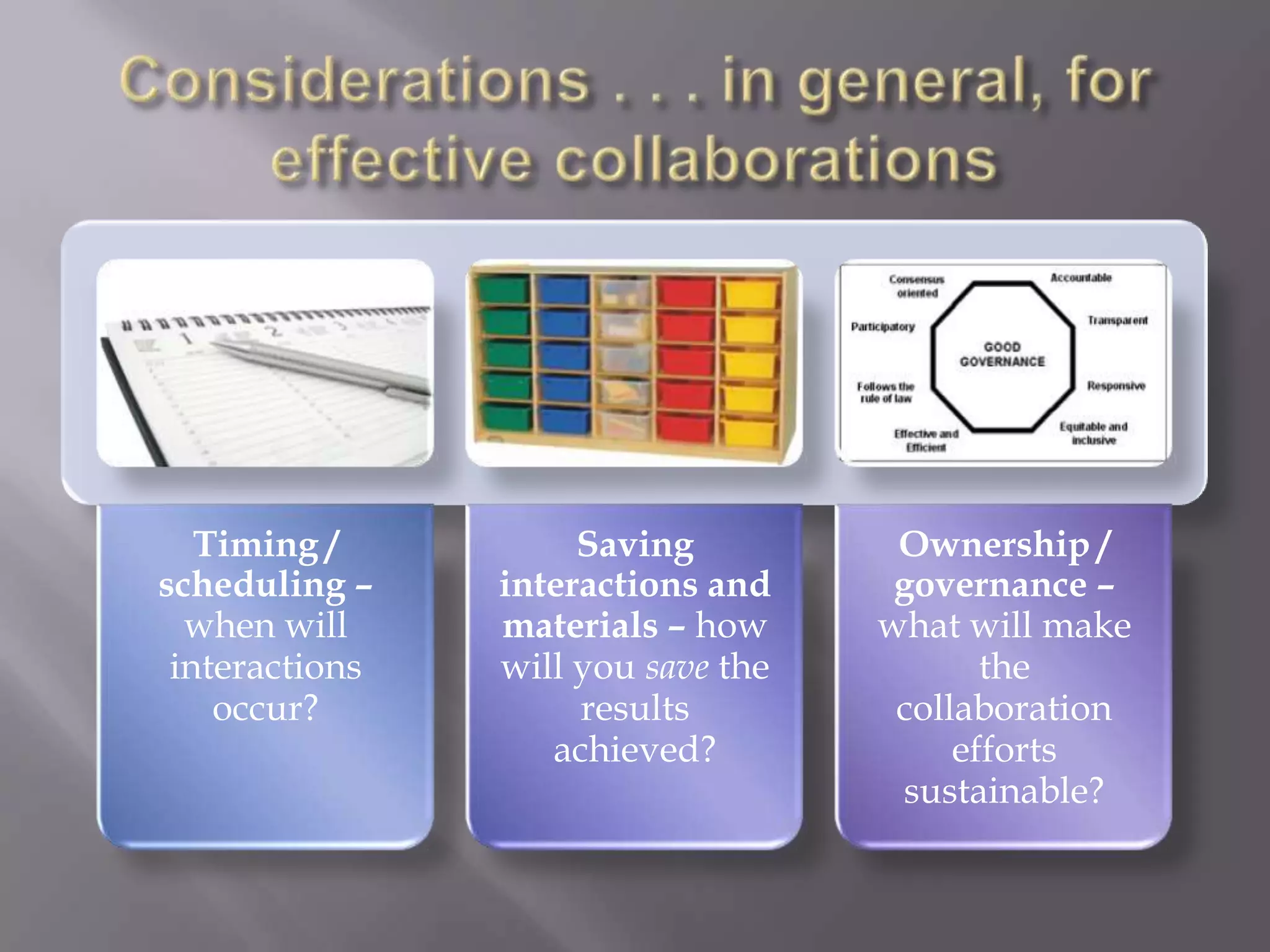
Timing /          Saving          Ownership /
scheduling –    interactions and     governance –
  when will     materials – how     what will make
 interactions   will you save the          the
    occur?           results         collaboration
                   achieved?             efforts
                                     sustainable?
Creating opportunities . . . &
              requirement
• Becoming firmer in my own beliefs and values
  – Progressing despite the odds
• Mapping to professional organizations
  – Empowering students
  – Immersive, enriched environments
     • Threaded with empowering conversations
• Valuing knowledge, growth, and ideas
  – Seeing growth in more then “just papers”

Building beyond the course

  • 1.
    Building beyond thecourse, or even the program: how can virtual worlds extend the learning environment and create community? SUNY CIT 2012 – Stony Brook Eileen O’Connor, Ph.D. Eileen.oconnor@esc.edu Empire State College
  • 2.
    Agenda • Background – Teaching & learning – different connection & modalities, always being tried (review) – Including other faculty – Research island – island design; virtual shifting • Framework of a learning environment • Expansive efforts to date – Teachers coming / student research / outreach to other students / outreach to admin/admissions – how can you extend beyond a course too? – Considerations and issues – development, maintenance, support ; sharing design – reality and feasibility
  • 3.
    http://commons.esc.edu/open/ On August 22-24,2012, SUNY—Empire State College will be hosting a virtual conference on open education. The conference is global in scope and will be occurring over multiple time zones; therefore, the event will be conducted in a virtual world called Second Life. The modality will be a synchronous/asynchronous mode—participants can attend sessions as they occur, or session presentations will be recorded for play back at later times. Currently, we seek individuals to participate in the conference. Call for Presentations (and Posters) The OP*EN Virtual Conference welcomes presenters and posters that integrate one or more of these themes, as they relate to the concept of open education. As the aim is to cover open education for a world-wide audience, we would value a range of presentations, challenges, and discussion-starters around these areas: Philosophy: what conceptual, sociological, institutional, and educational underpinnings separate open education from other forms of teaching and learning? What are the core issues in defining openness, and what other forms of openness are required for open education (open leadership, open science, etc.)? Are there related concepts, constructs, and paradigms that serve or enhance openness as a concept? Process: what ways can a resource, course, learning experience move into the process of becoming “open”? How can current courses and resources be moved from behind ivory towers into open educational areas? How can current post-secondary institutions transform themselves into open universities? Projects: what are the examples of projects within your experience, personal, institutional or within your learning sphere that you would like to offer as a model or best practice? Policy: are there institutional issues that surround Open Education within your educational sphere? Have projects and ideas been brought forward within your institution and what organizations, governance groups, unions, or professional organizations have spoken to these issues? What areas do you expect might influence policy within your educational and learning sphere? What public policies effect openness (regulation, legislation, grants, accreditation)? Practices: in what ways have you or your colleagues begun to consider and develop open resources and practices? We encourage a variety of presentation styles as well as topics. The only common element we ask from all presentations and posters is that it should in some way challenge your audience to take openness to the next level. Abstracts/summaries/battle plans or other treatments should be emailed to open@esc.edu by June 22nd, 2012. http://commons.esc.edu/open/2012/05/04/call-for-papers/
  • 4.
    Call for Presentations(and Posters) On August 22-24, 2012, SUNY—Empire State College will be hosting a virtual conference on open education. The conference is global in scope and will be occurring over multiple time zones; therefore, the event will be conducted in Second Life. The modality will be a synchronous/asynchronous mode— participants can attend sessions as they occur, or session presentations will be recorded for play back at later times. Currently, we seek individuals to participate in the conference. The OP*EN Virtual Conference Abstracts/summaries/battle plans or other treatments should be emailed to open@esc.edu by June 22nd, 2012.
  • 5.
    Continuing to advancein collaboration & community through tech – instructor techniques  Over time, I have solidified an approach to getting students into the virtual environment  Various types of meetings / experiences  Integrating multiple interactive technologies – no need to wait for Learning Managements Systems to do it all  Soliciting student perspective and ownership  Continuing the cycle through ongoing course development  Generative . . . and fun too ; engaging more, different, and new types of learners  Examining emerging “ideas” – open / badging
  • 6.
    (In my situation),why is community & continuity so important?
  • 7.
    Attitudes that canhelp an instructor grow towards valuing “community” Willingness to experiment with emerging tech Looking for new ways to Testing, evaluating, connect & grow your improving (publishing) courses Starting prof. relationships among students (then Valuing the letting them operate social/professional independently)
  • 8.
    Developing virtual environments,present ideas & past practices – ideas to consider • On a shoe string ; without programming or artists (at least initially) – Images & design – inelegant but practical & growing – Gained insight from ongoing pilots with my students – expanding my knowledge regularly – Considered grants (no luck) then worked ideas into courses • Having courses do “real” work within a professional masters – Having virtual locations that serve as teacher resource areas; creating simple and useful – Involving others – pros and cons
  • 9.
    At the outset,students across the state give simple virtual presentations & guest speakers came
  • 11.
    NOTE: and, althoughSecond Life became more expensive, new ways to develop virtual environments are growing rapidly
  • 12.
    In the newscience center, meetings, presentations, and discussions expanded
  • 13.
    Students began todesign pods with their own science projects (sum. 2011)
  • 14.
    Community & innovation expandedin spring 2012 Advancing Advancing interactive Introducing interactive Involving other design - badging, design - having faculty integrating soliciting student poster session shared video into feedback and judging discussions
  • 15.
    A faculty-led affinitygroup began - VirtualESC  A cross disciplinary and cross center (ESC is distributed across NYS) effort to share knowledge & applications and to “save our island” in the time of rising costs • Meetings: basic to advanced techniques; application sharing; outside speakers
  • 16.
    Including other faculty members  Brought in faculty in other disciplines that could present their areas of expertise to my online students
  • 17.
    Which requires some “training” Quick start guide  Animations / tutorials
  • 18.
    Running the show Being the sage behind the machine – the Great and Powerful Oz
  • 19.
    Discussion board Multiple Virtual media loops meetings – (YouTube discussions too) Talk alouds – discussion boards before new topics/ projects
  • 20.
    For instance, workingonline, students watch and discuss videos about the course contents Here’s a link to a 2 minute video overview of this project: http://www.youtube.com/watch?v=hz1ld2AUTUQ
  • 21.
    Looping across timeand venues -- using technologies, interactions,& evaluations Assignment Voting Presenting
  • 22.
    First, the virtualisland was expanded to add the conference center
  • 23.
    The science labassignments included the creation of a poster in PowerPoint These posters were put into pods for the students for this course
  • 24.
    Students came andpresented to classmates & to “judges” (former students)
  • 25.
    Judges & students(optional) voted on posters for a variety of characteristics Here’s a link to a 2 minute video overview of this project: http://www.youtube.com/watch?feature=endscreen&v=hz1ld2AUTUQ&NR=1
  • 26.
    Another new technique:a virtual speaker addressed badging • After the presentation, students broke into groups and discussed the possible role of badging – in K12 & in graduate courses • (Badging will be incorporated into the summer course requirements too) • Here are YouTubes from the video discussion: – http://youtu.be/FECB2m3QNPg http://youtu.be/gDXdhjZHeVI – http://youtu.be/-N2LtOp4XBs
  • 27.
    New ways appearingfor peer assessment  valuing and extending learning (https://wiki.mozilla.org/Badges)
  • 28.
    Use badges to make web- evident learning more valued and identifiable and to ensure quality work & governance without constant supervision
  • 29.
    Grad course • Create, model, make criteria, require, assess • Elect which stays Revisions /review Dean award • in later Grad course • Ensure follow- up Badges: ongoing / generative • for input, continuity, and ownership Determine if any grant funding would be possible
  • 31.
     Strengthen connections within and to an organization (job searching)  Develop resource gathering; create an organizational present with the aid of a social network & virtual meetings
  • 32.
    BADGES – reinforce, validate& value Facebook Organizer Badge  Use badges to promote, extend, monitor, and support the endeavor;  For example, badges for:  Creator of a Professional Development Day  Website Organizer and Moderator  Gold Star Meeting Attendee  $5K Fund Raiser  Bronze Star New Member Mentor (based on resumes reviewed by practitioner, perhaps)
  • 33.
  • 34.
     REAL connectionswith & support for science (Cornell; www.globe.gov; www.nasa.gov)  Science literacy; science sharing; extending & creating new knowledge and understanding; helping other nations
  • 35.
    BADGES – toreinforce, validate, value, & sustain Can I get a Best Brain Badge?  Use badges to promote, extend, monitor, and support the endeavor;  For examples, badges for:  10 Great Pictures or Videos of Bugs or Crazy-landforms or Star-clusters or Red Oaks Badge  Bronze Helped-Fellow-Researcher Badge (entry level # of Likes by other citizen-scientists who found this badgees discussion-boards tips to be helpful)  5 Useful Science Data Points Badge (generated by scientist who assert validity / utility of data gathered)
  • 36.
    New considerations –making online more real but . . . • Schedule for synchronous – but when moving to collaboration that can be a problem – Online work is not necessarily independent work by students / a new paradigm now within online itself • Plan for yours’ and students’ growth over time • The detailed startup helped / but they need to have good computers – server issues too can happen; challenges with headsets
  • 38.
    Ways of thinking– generating & valuing new outcomes in classrooms & programs Implement research on learning (constructivism) Start small (part of a Value more than course)  evaluate just papers  improve Evaluate both collaborative & individual work
  • 39.
    Ways of thinking– expanding scholarly & committee work Initiate a collaboration within your content area or committee Determine governance Structure store (web & maintenance; resources), scheduling, consider publication & meeting locations sharing Create criteria & evaluation for materials to be saved
  • 40.
    Timing / Saving Ownership / scheduling – interactions and governance – when will materials – how what will make interactions will you save the the occur? results collaboration achieved? efforts sustainable?
  • 41.
    Creating opportunities .. . & requirement • Becoming firmer in my own beliefs and values – Progressing despite the odds • Mapping to professional organizations – Empowering students – Immersive, enriched environments • Threaded with empowering conversations • Valuing knowledge, growth, and ideas – Seeing growth in more then “just papers”

Editor's Notes

  • #2 Designing for community and continuity in virtual environments: consideration when bridging beyond the courseFor this instructor, virtual learning has proven to be an ongoing challenge, and an ongoing blessing. Over the past five years, she has brought many cohorts of students into Empire State College’s Second Life islands and into a private island licensed for research with K12 students. After the initial struggle, the adult students become comfortable, benefit from the virtual encounters with online colleagues, listen to speakers from a variety of backgrounds, and take field trips to other virtual educational islands; these future science teachers find great value in visiting the NASA, NOAA, and ISTE islands. The virtual environment has created a sense of community and belonging, extending the effectiveness of the courses, particularly since a key course and program goal is to create a cohort among these teachers slatted for high-needs schools. At this juncture, with the experience and interests of the instructor, the increased licensing fees, and the need to strengthen K12 teaching for the rigors on ongoing improvement and evaluation, the instructor wants to expand the engagement in the virtual environment beyond the confines of the courses. A variety of efforts are underway to create a cohesive and connected learning environment with embedded reasons to return after courses have ended. From having students make virtual “pods” where they create, save, and display their science-project work, to having graduates return to share with present students, to inviting administrators within the college and the K12 community, to encouraging committees that will govern and suggest future island uses, to supporting K12 research efforts among students within the courses, the instructor is testing and evaluating the effectiveness of these ventures in creating a viable and extended learning community. As she works, she encounters the issues of training short term visitors, of establishing guidelines and expectations for behaviors when the island is not directly used for a class, of choosing materials to display at the island, and of ensuring that the college’s interests are represented adequately. Presently, the work is being conducted on the private island for which there is limited access. This presentation will report on the enhancements and expansions being tested this semester as the instructor pilots expanded island usage with virtual speakers and events beyond the classroom, with K12 research within the island’s confines, and with the development and use of enriched context for creating a science learning environment – all on a budget. Overview: Having used three-dimensional virtual learning environments for several years, this instructor will explain how she is expanding into realms beyond a course seeking to create a cohesive community by engaging administrators, encouraging her students’ virtual research, preserving student works and artifacts, and initiating virtual development and governance committees. Interested parties: faculty, instructional designers, administrators Questions: How do you plan on developing the programs that encourage outside presenters to visit your growing list of students and graduates? How will you train these individuals? What are the biggest challenges to creating a cohesive community beyond the course? (time, expense, delegation with no authority) What recommendations do you have to others that might be considering a similar venture?
  • #5 On August 22-24, 2012, SUNY—Empire State College will be hosting a virtual conference on open education. The conference is global in scope and will be occurring over multiple time zones; therefore, the event will be conducted in Second Life. The modality will be a synchronous/asynchronous mode—participants can attend sessions as they occur, or session presentations will be recorded for play back at later times. Currently, we seek individuals to participate in the conference.Call for Presentations (and Posters) The OP*EN Virtual Conference welcomes presenters and posters that integrate one or more of these themes, as they relate to the concept of open education. As the aim is to cover open education for a world-wide audience, we would value a range of presentations, challenges, and discussion-starters around these areas: Philosophy: what conceptual, sociological, institutional, and educational underpinnings separate open education from other forms of teaching and learning? What are the core issues in defining openness, and what other forms of openness are required for open education (open leadership, open science, etc.)? Are there related concepts, constructs, and paradigms that serve or enhance openness as a concept?Process: what ways can a resource, course, learning experience move into the process of becoming “open”? How can current courses and resources be moved from behind ivory towers into open educational areas? How can current post-secondary institutions transform themselves into open universities? Projects: what are the examples of projects within your experience, personal, institutional or within your learning sphere that you would like to offer as a model or best practice? Policy: are there institutional issues that surround Open Education within your educational sphere? Have projects and ideas been brought forward within your institution and what organizations, governance groups, unions, or professional organizations have spoken to these issues? What areas do you expect might influence policy within your educational and learning sphere? What public policies effect openness (regulation, legislation, grants, accreditation)?Practices: in what ways have you or your colleagues begun to consider and develop open resources and practices? We encourage a variety of presentation styles as well as topics. The only common element we ask from all presentations and posters is that it should in some way challenge your audience to take openness to the next level.Abstracts/summaries/battle plans or other treatments should be emailed to open@esc.edu by June 22nd, 2012.
  • #6 Discussing how some “less academic” can shine here ; you need to grow each year