SER/VE (STEM Exploratory
     Real/Virtual Environment):
  connecting science education and
       urban youth, virtually
               Eileen O’Connor, Ph.D.
                Empire State College

   Eileen.oconnor@esc.edu
November 4, 2011 (SUNY STEM Conference) – 2:15pm – 3:30 pm
Agenda: intended; many pictures
• Evolution & development of SER/VE
  – Rationale & need
  – Progress within virtual spaces
     • Historical development within teacher education –
       from visits & discussion  creating “pods”
     • Integration of K12 directly – development, pilot, &
       study
• Future – plans and development
  – Making lemonade
  – Getting your ideas, expertise, support, and help
Poll of attendees
• Your STEM interests?
• Your experience in K12 . . . In high needs?

• Have you ever considered a virtual
  environment for learning STEM?
  – What would be in it?
  – Who might meet there?
Background of instructor, need,
  and project – the perfect storm
• Instructor – Science Technology Engineering
  Math (STEM) working experiences:
  – a environmental chemist in government and an
    application, analytical chemist in industry
  – a technical writer, sales & marketing for IBM in
    areas related to in health, aerospace, government,
    and industry
  – Last 20 years in education—in chemistry,
    computers, education, instructional technology,
    and science education
Background of instructor, need,
  and project – the perfect storm
• Need – from working within science and then
  within education the need for stronger K12
  STEM instruction was evident:
  – Professional developer in high needs schools
  – Over 300 observation visits to K12 classroom
• Observed, mostly:
  – Traditional, didactic, note-taking teaching
  – Little info, energy, or interest towards careers
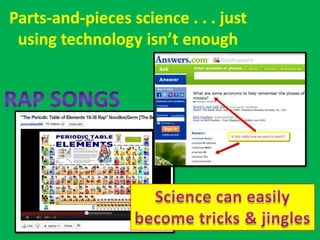
Parts-and-pieces science . . . just
 using technology isn’t enough
Labs that are just about proving what
 is already known . . . in a very cook-
               book way
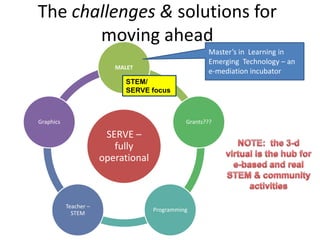
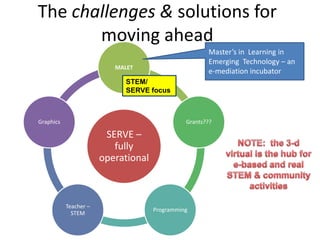
The challenges & solutions for
       moving ahead
                                                      Master’s in Learning in
                                                      Emerging Technology – an
                          MALET
                                                      e-mediation incubator
                             STEM/
                             SERVE focus


Graphics                                       Grants???

                        SERVE –
                          fully
                       operational


           Teacher –
                                     Programming
             STEM
Benefits to SER/VE work
• Student engagement in 21st century skills
  – Technology, communications, expanded
    connections with other K12 schools & teachers
• Student creation / student direction
  – Students can become in building, scheduling,
    governance; important future skills
• Students experience STEM careers & futures
  – Work as STEM professionals / meet STEM
    professionals
PRIMARY MOTIVATION FOR WORKING
    WITH VIRTUAL LEARNING
• Kids learn this way
• Kids are engaged, challenge, tested, and
  exercised this way (aka, gaming)
• SO, why aren’t we using it in K12 teaching???


http://www.interactivelearningsolutions.net/serve
Reviewing the history of working
within virtual environments:
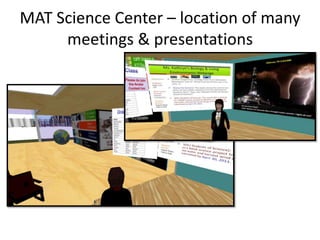
MAT Science Center – location of many
     meetings & presentations
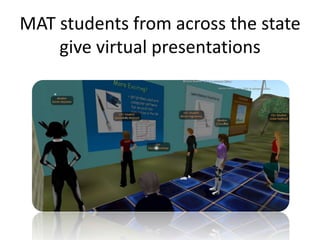
MAT students from across the state
    give virtual presentations
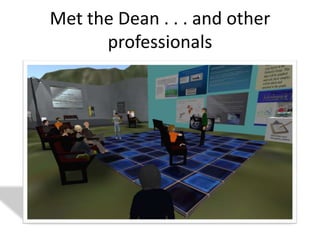
Met the Dean . . . and other
      professionals
Plus, there are many good STEM
activities already available within
virtual spaces like Second Life, for
            instance . . .
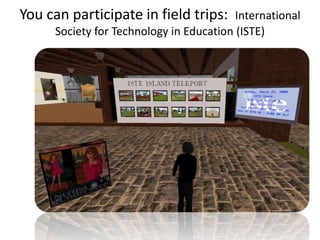
You can participate in field trips:      International
     Society for Technology in Education (ISTE)
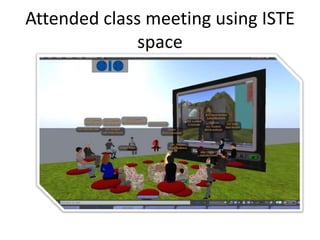
Attended class meeting using ISTE
              space
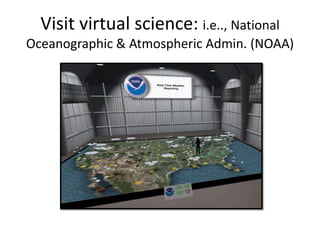
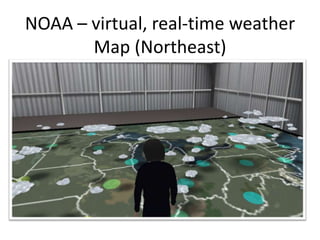
Visit virtual science: i.e.., National
Oceanographic & Atmospheric Admin. (NOAA)
NOAA – virtual, real-time weather
       Map (Northeast)
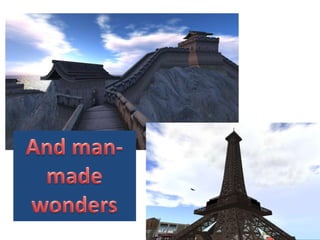
And, much more in education and
           culture
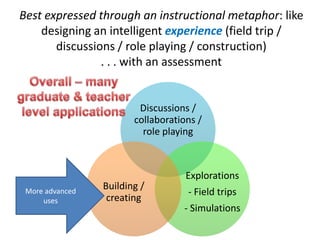
Best expressed through an instructional metaphor: like
    designing an intelligent experience (field trip /
       discussions / role playing / construction)
                . . . with an assessment


                         Discussions /
                        collaborations /
                          role playing


                                    Explorations
                 Building /
 More advanced                      - Field trips
     uses         creating
                                   - Simulations
It was time to begin developing the
      K12 environment  SER/VE:
• A private island in Second Life was secured &
  development begun – Jan 2010 – Oct 2010
   – Mathematics, engineering, tech  was then to
     move to science
• Based on a grant focus, moved into an applied science
  project – fall 2010
• Attempted to work w/ K12 – security issues
• K12 teachers began to design within virtual spaces --
  May – July 2011
• STEP program use the virtual environment – July 2011
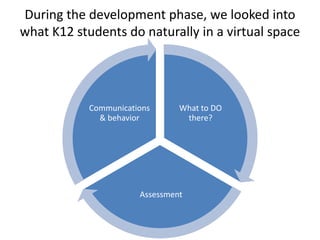
During the development phase, we looked into
what K12 students do naturally in a virtual space


            Communications      What to DO
              & behavior         there?


                       Assessment
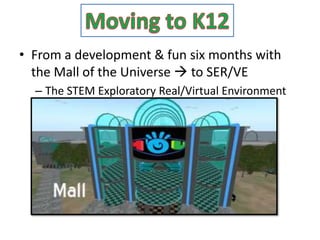
• From a development & fun six months with
  the Mall of the Universe  to SER/VE
  – The STEM Exploratory Real/Virtual Environment
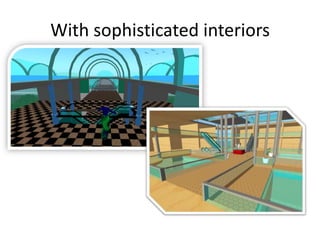
With sophisticated interiors
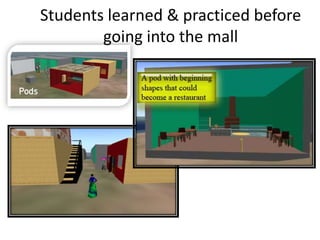
Students learned & practiced before
        going into the mall
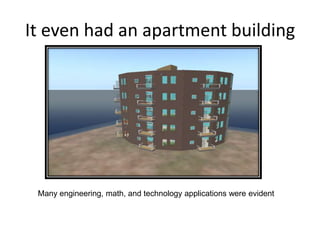
It even had an apartment building


 Many engineering, math, and technology applications were evident
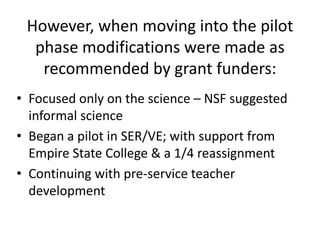
However, when moving into the pilot
  phase modifications were made as
   recommended by grant funders:
• Focused only on the science – NSF suggested
  informal science
• Began a pilot in SER/VE; with support from
  Empire State College & a 1/4 reassignment
• Continuing with pre-service teacher
  development
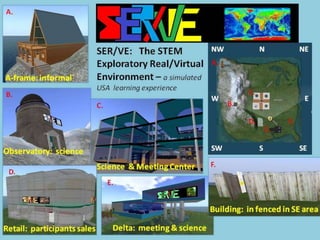
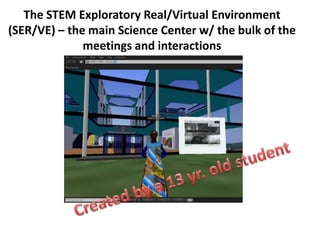
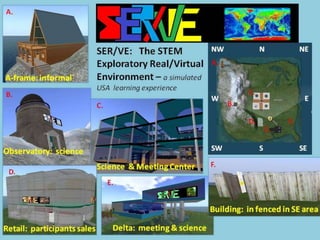
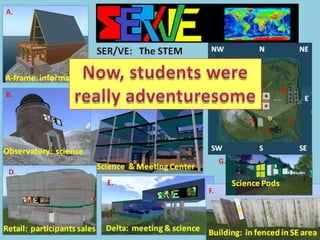
The STEM Exploratory Real/Virtual Environment
(SER/VE) – the main Science Center w/ the bulk of the
              meetings and interactions
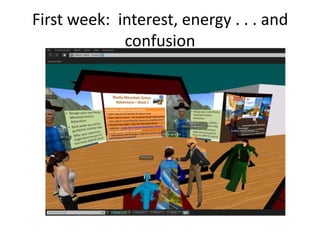
First week: interest, energy . . . and
             confusion
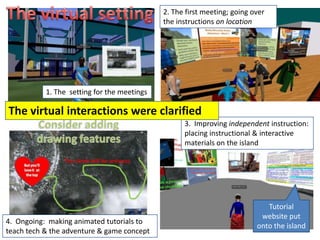
2. The first meeting; going over
                                             the instructions on location


           1. The setting for the meetings

The virtual interactions were clarified
                                                   3. Improving independent instruction:
                                                   placing instructional & interactive
                                                   materials on the island


                                                                             Tutorial
                                                                           website put
4. Ongoing: making animated tutorials to
                                                                          onto the island
teach tech & the adventure & game concept
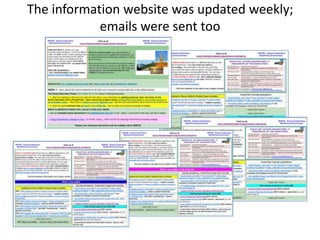
The information website was updated weekly;
            emails were sent too
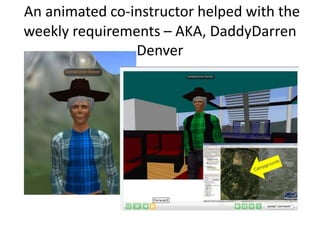
An animated co-instructor helped with the
weekly requirements – AKA, DaddyDarren
                Denver
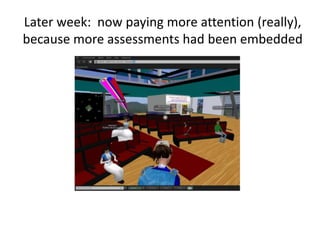
Later week: now paying more attention (really),
because more assessments had been embedded
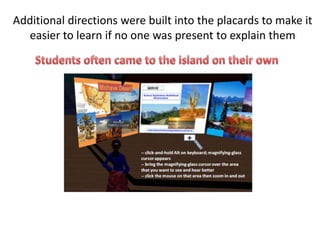
Additional directions were built into the placards to make it
  easier to learn if no one was present to explain them
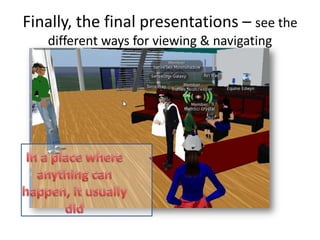
Finally, the final presentations – see the
   different ways for viewing & navigating
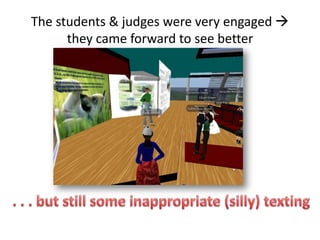
The students & judges were very engaged 
      they came forward to see better
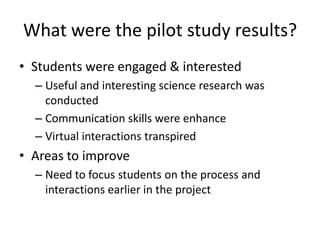
What were the pilot study results?
• Students were engaged & interested
  – Useful and interesting science research was
    conducted
  – Communication skills were enhance
  – Virtual interactions transpired
• Areas to improve
  – Need to focus students on the process and
    interactions earlier in the project
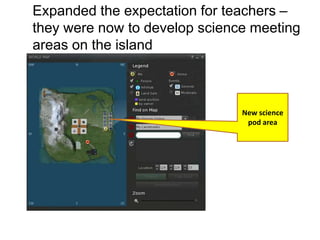
Expanded the expectation for teachers –
they were now to develop science meeting
areas on the island


                               New science
                                pod area
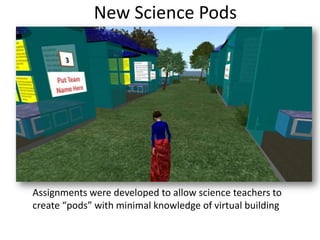
New Science Pods


Assignments were developed to allow science teachers to
create “pods” with minimal knowledge of virtual building
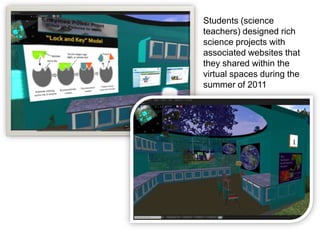
Students (science
teachers) designed rich
science projects with
associated websites that
they shared within the
virtual spaces during the
summer of 2011
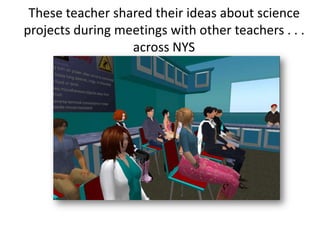
These teacher shared their ideas about science
projects during meetings with other teachers . . .
                  across NYS
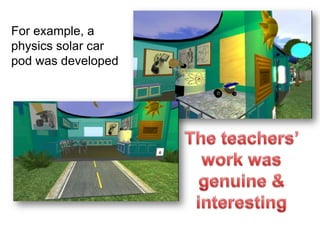
For example, a
physics solar car
pod was developed
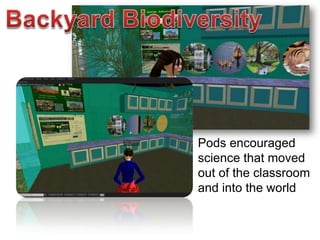
Pods encouraged
science that moved
out of the classroom
and into the world
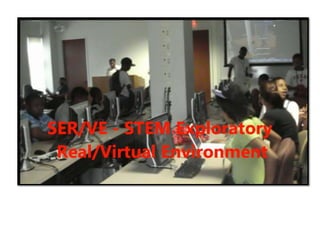
Bringing urban students into the
 virtual worlds, the Second Life
 private island – summer 2011
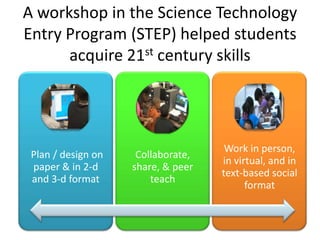
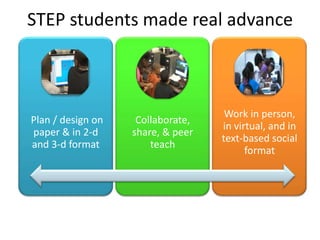
A workshop in the Science Technology
Entry Program (STEP) helped students
      acquire 21st century skills


                                     Work in person,
 Plan / design on    Collaborate,
                                    in virtual, and in
 paper & in 2-d     share, & peer
                                    text-based social
 and 3-d format         teach
                                          format
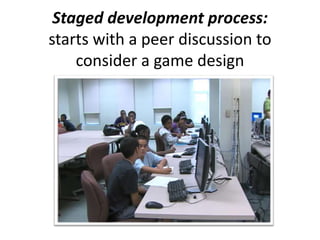
Staged development process:
starts with a peer discussion to
    consider a game design
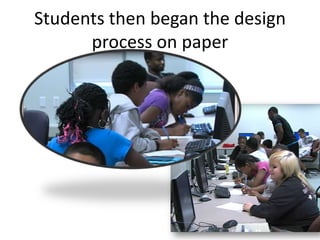
Students then began the design
      process on paper
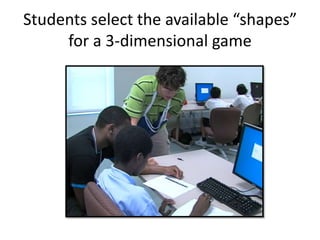
Students select the available “shapes”
     for a 3-dimensional game
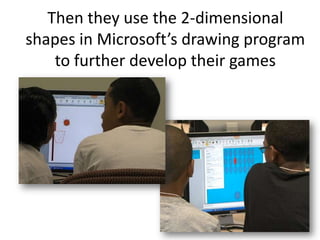
Then they use the 2-dimensional
shapes in Microsoft’s drawing program
    to further develop their games
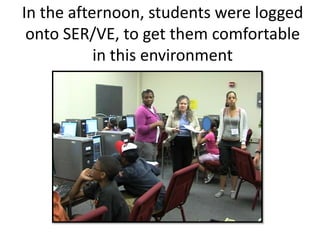
In the afternoon, students were logged
 onto SER/VE, to get them comfortable
           in this environment
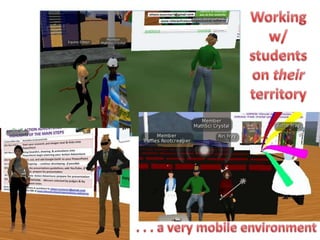
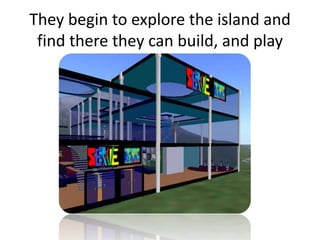
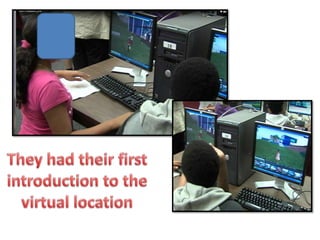
They begin to explore the island and
 find there they can build, and play
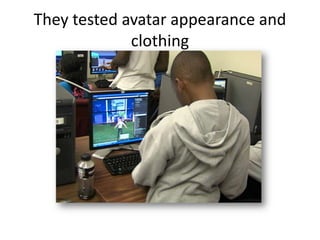
They tested avatar appearance and
             clothing
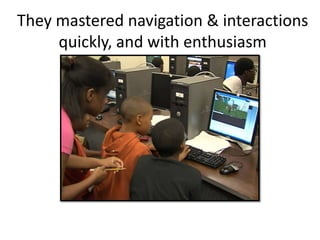
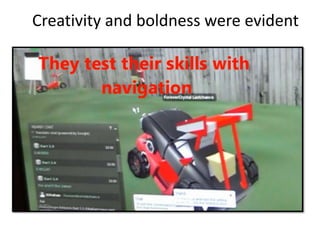
They mastered navigation & interactions
     quickly, and with enthusiasm
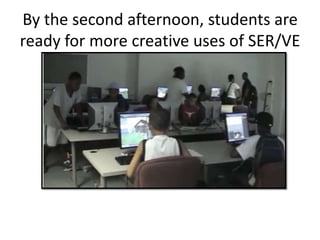
By the second afternoon, students are
ready for more creative uses of SER/VE
Creativity and boldness were evident
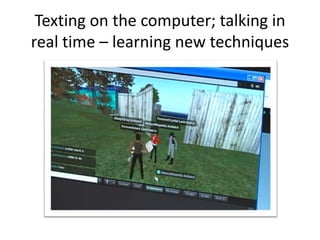
Texting on the computer; talking in
real time – learning new techniques
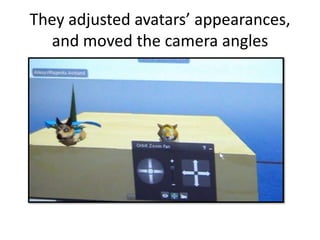
They adjusted avatars’ appearances,
  and moved the camera angles
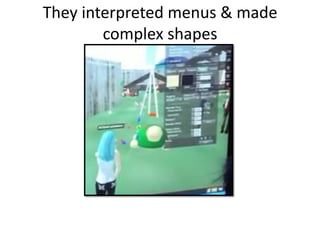
They interpreted menus & made
        complex shapes
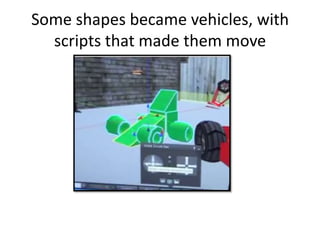
Some shapes became vehicles, with
  scripts that made them move
STEP students made real advance


                                    Work in person,
Plan / design on    Collaborate,
                                   in virtual, and in
paper & in 2-d     share, & peer
                                   text-based social
and 3-d format         teach
                                         format
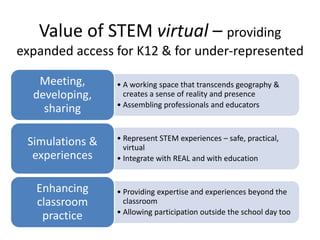
Value of STEM virtual – providing
expanded access for K12 & for under-represented

   Meeting,      • A working space that transcends geography &
  developing,      creates a sense of reality and presence
                 • Assembling professionals and educators
    sharing

                 • Represent STEM experiences – safe, practical,
 Simulations &     virtual
  experiences    • Integrate with REAL and with education


   Enhancing     • Providing expertise and experiences beyond the
   classroom       classroom
                 • Allowing participation outside the school day too
    practice
The challenges & solutions for
       moving ahead
                                                      Master’s in Learning in
                                                      Emerging Technology – an
                          MALET
                                                      e-mediation incubator
                             STEM/
                             SERVE focus


Graphics                                       Grants???

                        SERVE –
                          fully
                       operational


           Teacher –
                                     Programming
             STEM
Eileen A. O'Connor, Ph.D. (Eileen.oconnor@esc.edu )
Recent Publications – Emerging technologies:

O’Connor, E. A. (2011) Migrating Towards K12 in Virtual Spaces: Second Life Lessons
Learned as Higher Education Meets Middle School Students. Published with the AACE
Society for Information Technology & Teacher Education International Conference,
March 2011

O’Connor, E.A. (June 2010) Using Second Life (a virtual reality) in Language
Instruction: Practical Advice on Getting Started; published with the proceedings of
the 4th International Scientific and Methodological Conference
on "Information and Communication Technologies in Foreign Language Teaching‖

O’Connor, E. A. (2010- 2011) The effect on learning, communication, and assessment
when student-created YouTubes of microteaching were used in an online teacher-
education course. Journal of Educational Technology Systems, 39(2), pp. 135-154.

O’Connor, E. A. (2010) Practical Considerations When Using Virtual Spaces for
Learning and Collaboration, with Minimal Setup and Support. A book chapter
published in the Handbook of Research on Practices and Outcomes in Virtual Worlds
and Environment, IGI Global publishers
Eileen A. O'Connor, Ph.D. (Eileen.oconnor@esc.edu )
Recent Publications – Emerging technologies:
O’Connor, E. A. The Use of a Wiki in Teacher Education: How Does Learning and
Instruction Change When Work Can ―Go Public‖? Published with the AACE Society
for Information Technology & Teacher Education International Conference in March
2010

O’Connor, E. A. (2009-2010) Instructional and Design Elements that Support Effective
Use of Virtual Worlds: What Graduate Student Work Reveals about Second Life.
Journal of Educational Technology Systems, 38(2), pp. 214 – 234.

O’Connor, E. A. and Sakshaug, L. (2009) Preparing for Second Life: Two Teacher
Educators Reflect on Their Initial Foray into Virtual Teaching and Learning, Journal of
Educational Technology Systems, 37(3), pp. 259-272.

O'Connor, E. (2008). Becoming a Virtual Instructor: How Can Higher Education Faculty
Prepare for Second Life?. In G. Richards (Ed.), Proceedings of World Conference on E-
Learning in Corporate, Government, Healthcare, and Higher Education 2008 (pp.
1144-1149). Chesapeake, VA: AACE.

O’Connor, E. A. (2008) Initial Study of Pre-Service Teachers’ Comments on a Reality-
Based, Urban-Student Video Streamed within an Online Course, Journal of
Educational Technology Systems, 37(2), pp. 139-158.
Eileen A. O'Connor, Ph.D. (Eileen.oconnor@esc.edu )
Recent Publications – Emerging technologies:
O’Connor, E. A. (2008) Moving Beyond Text Interactions: The Use of Streaming Video in Internet-Based
Courses. Published with the 3rd International Scientific and Methodological Conference on "Information and
Communication Technologies in Foreign Language Teaching‖

Sakshaug, L. and O’Connor, E.A. (2008) Pedagogical, cultural and epistemological shifts: The dynamics of
learning to teach in the Master of Arts in Teaching (MAT) Program at SUNY Empire College – published with
2009 National Conference proceedings of the National Center for Alternative Certification;
http://www.teach-now.org/Sakshaug_OConnor.doc - retrieved on 7/22/09

Oconnor, E. (2007). Using Reality-Based, Authentic Streamed-Videos and Online Conversations to Prepare Pre-
Service Teachers for Urban Classrooms: A Pilot Study. In T. Bastiaens & S. Carliner (Eds.), Proceedings of World
Conference on E-Learning in Corporate, Government, Healthcare, and Higher Education 2007 (pp. 1179-1184).
Chesapeake, VA: AACE.

O’Connor, E. A. (2007) A Case Study of the Approach to Teaching and to Technology of Three New Teachers in
an Alternative Teacher Certification Program, Journal of Educational Technology Systems, 35(3), pp. 357-382.
O’Connor, E. A. (2006). Encouraging community: Why, when, and how to structure online interactions to
support collegiality and honesty. Published with the 2nd International Scientific and Methodological
Conference on "Information and Communication Technologies in Foreign Language Teaching ‖
(http://distance.ffl.msu.ru/cdo/conf0606/oconnor.doc - retrieved August 2007)
Presentations

SUNY STEM, virtual

  • 1.
    SER/VE (STEM Exploratory Real/Virtual Environment): connecting science education and urban youth, virtually Eileen O’Connor, Ph.D. Empire State College Eileen.oconnor@esc.edu November 4, 2011 (SUNY STEM Conference) – 2:15pm – 3:30 pm
  • 3.
    Agenda: intended; manypictures • Evolution & development of SER/VE – Rationale & need – Progress within virtual spaces • Historical development within teacher education – from visits & discussion  creating “pods” • Integration of K12 directly – development, pilot, & study • Future – plans and development – Making lemonade – Getting your ideas, expertise, support, and help
  • 4.
    Poll of attendees •Your STEM interests? • Your experience in K12 . . . In high needs? • Have you ever considered a virtual environment for learning STEM? – What would be in it? – Who might meet there?
  • 5.
    Background of instructor,need, and project – the perfect storm • Instructor – Science Technology Engineering Math (STEM) working experiences: – a environmental chemist in government and an application, analytical chemist in industry – a technical writer, sales & marketing for IBM in areas related to in health, aerospace, government, and industry – Last 20 years in education—in chemistry, computers, education, instructional technology, and science education
  • 6.
    Background of instructor,need, and project – the perfect storm • Need – from working within science and then within education the need for stronger K12 STEM instruction was evident: – Professional developer in high needs schools – Over 300 observation visits to K12 classroom • Observed, mostly: – Traditional, didactic, note-taking teaching – Little info, energy, or interest towards careers
  • 7.
    Parts-and-pieces science .. . just using technology isn’t enough
  • 8.
    Labs that arejust about proving what is already known . . . in a very cook- book way
  • 9.
    The challenges &solutions for moving ahead Master’s in Learning in Emerging Technology – an MALET e-mediation incubator STEM/ SERVE focus Graphics Grants??? SERVE – fully operational Teacher – Programming STEM
  • 10.
    Benefits to SER/VEwork • Student engagement in 21st century skills – Technology, communications, expanded connections with other K12 schools & teachers • Student creation / student direction – Students can become in building, scheduling, governance; important future skills • Students experience STEM careers & futures – Work as STEM professionals / meet STEM professionals
  • 11.
    PRIMARY MOTIVATION FORWORKING WITH VIRTUAL LEARNING • Kids learn this way • Kids are engaged, challenge, tested, and exercised this way (aka, gaming) • SO, why aren’t we using it in K12 teaching??? http://www.interactivelearningsolutions.net/serve
  • 12.
    Reviewing the historyof working within virtual environments:
  • 13.
    MAT Science Center– location of many meetings & presentations
  • 14.
    MAT students fromacross the state give virtual presentations
  • 15.
    Met the Dean. . . and other professionals
  • 16.
    Plus, there aremany good STEM activities already available within virtual spaces like Second Life, for instance . . .
  • 17.
    You can participatein field trips: International Society for Technology in Education (ISTE)
  • 18.
    Attended class meetingusing ISTE space
  • 19.
    Visit virtual science:i.e.., National Oceanographic & Atmospheric Admin. (NOAA)
  • 20.
    NOAA – virtual,real-time weather Map (Northeast)
  • 21.
    And, much morein education and culture
  • 25.
    Best expressed throughan instructional metaphor: like designing an intelligent experience (field trip / discussions / role playing / construction) . . . with an assessment Discussions / collaborations / role playing Explorations Building / More advanced - Field trips uses creating - Simulations
  • 26.
    It was timeto begin developing the K12 environment  SER/VE: • A private island in Second Life was secured & development begun – Jan 2010 – Oct 2010 – Mathematics, engineering, tech  was then to move to science • Based on a grant focus, moved into an applied science project – fall 2010 • Attempted to work w/ K12 – security issues • K12 teachers began to design within virtual spaces -- May – July 2011 • STEP program use the virtual environment – July 2011
  • 27.
    During the developmentphase, we looked into what K12 students do naturally in a virtual space Communications What to DO & behavior there? Assessment
  • 28.
    • From adevelopment & fun six months with the Mall of the Universe  to SER/VE – The STEM Exploratory Real/Virtual Environment
  • 29.
  • 30.
    Students learned &practiced before going into the mall
  • 31.
    It even hadan apartment building Many engineering, math, and technology applications were evident
  • 32.
    However, when movinginto the pilot phase modifications were made as recommended by grant funders: • Focused only on the science – NSF suggested informal science • Began a pilot in SER/VE; with support from Empire State College & a 1/4 reassignment • Continuing with pre-service teacher development
  • 33.
    The STEM ExploratoryReal/Virtual Environment (SER/VE) – the main Science Center w/ the bulk of the meetings and interactions
  • 35.
    First week: interest,energy . . . and confusion
  • 36.
    2. The firstmeeting; going over the instructions on location 1. The setting for the meetings The virtual interactions were clarified 3. Improving independent instruction: placing instructional & interactive materials on the island Tutorial website put 4. Ongoing: making animated tutorials to onto the island teach tech & the adventure & game concept
  • 37.
    The information websitewas updated weekly; emails were sent too
  • 38.
    An animated co-instructorhelped with the weekly requirements – AKA, DaddyDarren Denver
  • 39.
    Later week: nowpaying more attention (really), because more assessments had been embedded
  • 40.
    Additional directions werebuilt into the placards to make it easier to learn if no one was present to explain them
  • 41.
    Finally, the finalpresentations – see the different ways for viewing & navigating
  • 42.
    The students &judges were very engaged  they came forward to see better
  • 43.
    What were thepilot study results? • Students were engaged & interested – Useful and interesting science research was conducted – Communication skills were enhance – Virtual interactions transpired • Areas to improve – Need to focus students on the process and interactions earlier in the project
  • 45.
    Expanded the expectationfor teachers – they were now to develop science meeting areas on the island New science pod area
  • 46.
    New Science Pods Assignmentswere developed to allow science teachers to create “pods” with minimal knowledge of virtual building
  • 47.
    Students (science teachers) designedrich science projects with associated websites that they shared within the virtual spaces during the summer of 2011
  • 48.
    These teacher sharedtheir ideas about science projects during meetings with other teachers . . . across NYS
  • 49.
    For example, a physicssolar car pod was developed
  • 50.
    Pods encouraged science thatmoved out of the classroom and into the world
  • 51.
    Bringing urban studentsinto the virtual worlds, the Second Life private island – summer 2011
  • 52.
    A workshop inthe Science Technology Entry Program (STEP) helped students acquire 21st century skills Work in person, Plan / design on Collaborate, in virtual, and in paper & in 2-d share, & peer text-based social and 3-d format teach format
  • 53.
    Staged development process: startswith a peer discussion to consider a game design
  • 54.
    Students then beganthe design process on paper
  • 55.
    Students select theavailable “shapes” for a 3-dimensional game
  • 56.
    Then they usethe 2-dimensional shapes in Microsoft’s drawing program to further develop their games
  • 57.
    In the afternoon,students were logged onto SER/VE, to get them comfortable in this environment
  • 58.
    They begin toexplore the island and find there they can build, and play
  • 60.
    They tested avatarappearance and clothing
  • 61.
    They mastered navigation& interactions quickly, and with enthusiasm
  • 62.
    By the secondafternoon, students are ready for more creative uses of SER/VE
  • 64.
  • 65.
    Texting on thecomputer; talking in real time – learning new techniques
  • 66.
    They adjusted avatars’appearances, and moved the camera angles
  • 67.
    They interpreted menus& made complex shapes
  • 68.
    Some shapes becamevehicles, with scripts that made them move
  • 69.
    STEP students madereal advance Work in person, Plan / design on Collaborate, in virtual, and in paper & in 2-d share, & peer text-based social and 3-d format teach format
  • 71.
    Value of STEMvirtual – providing expanded access for K12 & for under-represented Meeting, • A working space that transcends geography & developing, creates a sense of reality and presence • Assembling professionals and educators sharing • Represent STEM experiences – safe, practical, Simulations & virtual experiences • Integrate with REAL and with education Enhancing • Providing expertise and experiences beyond the classroom classroom • Allowing participation outside the school day too practice
  • 72.
    The challenges &solutions for moving ahead Master’s in Learning in Emerging Technology – an MALET e-mediation incubator STEM/ SERVE focus Graphics Grants??? SERVE – fully operational Teacher – Programming STEM
  • 73.
    Eileen A. O'Connor,Ph.D. (Eileen.oconnor@esc.edu ) Recent Publications – Emerging technologies: O’Connor, E. A. (2011) Migrating Towards K12 in Virtual Spaces: Second Life Lessons Learned as Higher Education Meets Middle School Students. Published with the AACE Society for Information Technology & Teacher Education International Conference, March 2011 O’Connor, E.A. (June 2010) Using Second Life (a virtual reality) in Language Instruction: Practical Advice on Getting Started; published with the proceedings of the 4th International Scientific and Methodological Conference on "Information and Communication Technologies in Foreign Language Teaching‖ O’Connor, E. A. (2010- 2011) The effect on learning, communication, and assessment when student-created YouTubes of microteaching were used in an online teacher- education course. Journal of Educational Technology Systems, 39(2), pp. 135-154. O’Connor, E. A. (2010) Practical Considerations When Using Virtual Spaces for Learning and Collaboration, with Minimal Setup and Support. A book chapter published in the Handbook of Research on Practices and Outcomes in Virtual Worlds and Environment, IGI Global publishers
  • 74.
    Eileen A. O'Connor,Ph.D. (Eileen.oconnor@esc.edu ) Recent Publications – Emerging technologies: O’Connor, E. A. The Use of a Wiki in Teacher Education: How Does Learning and Instruction Change When Work Can ―Go Public‖? Published with the AACE Society for Information Technology & Teacher Education International Conference in March 2010 O’Connor, E. A. (2009-2010) Instructional and Design Elements that Support Effective Use of Virtual Worlds: What Graduate Student Work Reveals about Second Life. Journal of Educational Technology Systems, 38(2), pp. 214 – 234. O’Connor, E. A. and Sakshaug, L. (2009) Preparing for Second Life: Two Teacher Educators Reflect on Their Initial Foray into Virtual Teaching and Learning, Journal of Educational Technology Systems, 37(3), pp. 259-272. O'Connor, E. (2008). Becoming a Virtual Instructor: How Can Higher Education Faculty Prepare for Second Life?. In G. Richards (Ed.), Proceedings of World Conference on E- Learning in Corporate, Government, Healthcare, and Higher Education 2008 (pp. 1144-1149). Chesapeake, VA: AACE. O’Connor, E. A. (2008) Initial Study of Pre-Service Teachers’ Comments on a Reality- Based, Urban-Student Video Streamed within an Online Course, Journal of Educational Technology Systems, 37(2), pp. 139-158.
  • 75.
    Eileen A. O'Connor,Ph.D. (Eileen.oconnor@esc.edu ) Recent Publications – Emerging technologies: O’Connor, E. A. (2008) Moving Beyond Text Interactions: The Use of Streaming Video in Internet-Based Courses. Published with the 3rd International Scientific and Methodological Conference on "Information and Communication Technologies in Foreign Language Teaching‖ Sakshaug, L. and O’Connor, E.A. (2008) Pedagogical, cultural and epistemological shifts: The dynamics of learning to teach in the Master of Arts in Teaching (MAT) Program at SUNY Empire College – published with 2009 National Conference proceedings of the National Center for Alternative Certification; http://www.teach-now.org/Sakshaug_OConnor.doc - retrieved on 7/22/09 Oconnor, E. (2007). Using Reality-Based, Authentic Streamed-Videos and Online Conversations to Prepare Pre- Service Teachers for Urban Classrooms: A Pilot Study. In T. Bastiaens & S. Carliner (Eds.), Proceedings of World Conference on E-Learning in Corporate, Government, Healthcare, and Higher Education 2007 (pp. 1179-1184). Chesapeake, VA: AACE. O’Connor, E. A. (2007) A Case Study of the Approach to Teaching and to Technology of Three New Teachers in an Alternative Teacher Certification Program, Journal of Educational Technology Systems, 35(3), pp. 357-382. O’Connor, E. A. (2006). Encouraging community: Why, when, and how to structure online interactions to support collegiality and honesty. Published with the 2nd International Scientific and Methodological Conference on "Information and Communication Technologies in Foreign Language Teaching ‖ (http://distance.ffl.msu.ru/cdo/conf0606/oconnor.doc - retrieved August 2007) Presentations

Editor's Notes

  • #2 SER/VE (STEM Exploratory Real/Virtual Environment): connecting science education and urban youth, virtuallyThis workshop and poster proposal for the 2011 SUNY STEM (science, technology, engineering, mathematics) Conference focuses primarily on: the evolution of SER/VE (the STEM Exploratory Real/Virtual Environment), a three-dimensional, avatar-driven STEM learning environment; the rationale for the development of SER/VE; the work that has been piloted to date within high-needs K12 teaching and teacher education using SER/VE; and, the plans and needs for the further development of SER/VE. The need for SER/VE itself came from the experiences of Dr. Eileen O’Connor as a science-education faculty member within a clinically-based and largely online (the “academic” portion), alternative-certification, teacher-education program. This virtual learning environment has become an emerging focal point for her work with pre-service and in-service teachers and has the potential to bring novel and motivational, scale-able, sustainable STEM resources, materials, and experiences to K12 students in high need areas. The workshop would begin by explaining the context of SER/VE and its emergence from within Empire State College’s (ESC) Master of Arts in Teaching (MAT) program. Since its inception in 2004, the MAT program within ESC was chartered to bring high-qualified career-changing adults from science, engineering, mathematics, and other professions into high needs classroom. Within this teacher-education model, the faculty themselves visit and work with new teachers in their classrooms, experiencing directly the challenges faced by these teachers within high needs settings in New York State. Thus Dr. O’Connor was able to observe more than 300 classes directly, experiencing the struggles of science teachers in high needs settings. In her ongoing reflection and efforts at course and program improvements, she sought to integrate new approaches, methodologies, and e-materials into her work trying to bridge the educational and cultural gaps she had witnessed firsthand. Given her prior work experiences in applications of science and of technology (having worked in chemistry and at IBM for 15 years before entering teacher education), Eileen embraced the ways that 21st century technologies could help to strengthened her students and could create strong networks of teachers—who could thus work more effectively with their K12 students. Despite the fact that her academic instruction was largely online, she was able to network, both socially and professionally, her across-the-state K12 science teachers leading to their sharing resources, websites, projects, tutorials, and self-made YouTubes of laboratory work and of data probe science equipment. As these teachers grew in practical, inter-connected, peer-shared experiences, they in turn generated more engaging experiences for their classrooms. Progressively, Dr. O’Connor attempted to enrich, amplify, and connect an e-based learning environment – moving it beyond the limitations of classrooms and buildings – by moving into virtual learning. In 2007, she began studying how the physical sense of presence within the three-dimensional world of Second Life with her graduate science-education could improve their learning experience. The value of “place” in otherwise disembodied e-communications proved most intriguing; she published her findings at conferences and in journals. Most recently she brought this virtual experience into the K12 work directly, moving beyond simply bringing graduate students into the virtual space. In fall of 2010, after developing a primitive and private science island, she piloted a small study with middle school students and, during the summer of 2011, she brought a group of 30 urban students into this virtual space. (This work is being featured in another poster session within the conference.) Although her request for funding from the National Science Foundation to extend the development and to incorporate internal data-gathering for assessment was not granted (NSF gave good ratings to the educational concept but wanted more specific curriculum), release-time and support from ESC has allowed her to continue a more limited development of the virtual K12 environment, and thus enabled these work, noted above, with urban and middle-school students. This emerging virtual environment—SER/VE (the STEM Exploratory Real/Virtual Environment)—has been used in an developmental, exploratory manner for the past 18-months. Presently it serves as a meeting place for K12 teachers and as a testing area for interactions with small groups of K12 students. The intention is to develop engaging, challenging, game-like but deep, STEM learning experiences for student within this environment. The initial science and technology pilot (O’Connor, 2011) proved fruitful and gave support and direction for K12 improvements; the summer work with the urban students has extended the development. More interactions with teachers and students are planned and the intended outreach to STEM professionals is continuing to progress although more slowly than if funded by NSF.Dr. O’Connor has been particularly intrepid with her forward momentum on SER/VE, thanks to the support of her dean, Dr. Robert Clougherty, and Empire State College. But she will also overview the areas that need to grow and the ways that a collective of SUNY support could help in her efforts to create a virtual, online, STEM hub that could support and enable more students to become involved in STEM careers. Much groundwork has been laid but doors still need to be opened to gain entry to K12 classrooms and to have the teaching cultures within high needs schools needs become more open to the possibilities with urban students. As under current development, a doctor will come to work with K12 students – virtually. An engineer will come to explain how buildings are now being planned through three-dimensional venues – virtually. Endlessly more STEM meetings, adventures, and research opportunities could be launched. Dr. O’Connor would welcome the brainstorming and participation of attendees to help move SER/VE and teacher education into more fruitful ways of immersing K12 urban youth in STEM areas and of segueing them into the careers of the 21st century. SER/VE could be one of these venues!This workshop and poster sessions would combine aspects of the themes of partnering and releasing.O'Connor, E. (2011). Migrating Towards K12 in Virtual Spaces: Second Life Lessons Learned as Higher Education Meets Middle School Students. In Proceedings of Society for Information Technology & Teacher Education International Conference 2011 (pp. 2192-2198). Chesapeake, VA: AACE. http://www.editlib.org.library.esc.edu/p/36630 Submitted by: Eileen O’Connor, Ph.D. Eileen.oconnor@esc.edu518 783-6203
  • #4 SER/VE (STEM Exploratory Real/Virtual Environment): connecting science education and urban youth, virtuallyThis workshop and poster proposal for the 2011 SUNY STEM (science, technology, engineering, mathematics) Conference focuses primarily on: the evolution of SER/VE (the STEM Exploratory Real/Virtual Environment), a three-dimensional, avatar-driven STEM learning environment; the rationale for the development of SER/VE; the work that has been piloted to date within high-needs K12 teaching and teacher education using SER/VE; and, the plans and needs for the further development of SER/VE. The need for SER/VE itself came from the experiences of Dr. Eileen O’Connor as a science-education faculty member within a clinically-based and largely online (the “academic” portion), alternative-certification, teacher-education program. This virtual learning environment has become an emerging focal point for her work with pre-service and in-service teachers and has the potential to bring novel and motivational, scale-able, sustainable STEM resources, materials, and experiences to K12 students in high need areas. The workshop would begin by explaining the context of SER/VE and its emergence from within Empire State College’s (ESC) Master of Arts in Teaching (MAT) program. Since its inception in 2004, the MAT program within ESC was chartered to bring high-qualified career-changing adults from science, engineering, mathematics, and other professions into high needs classroom. Within this teacher-education model, the faculty themselves visit and work with new teachers in their classrooms, experiencing directly the challenges faced by these teachers within high needs settings in New York State. Thus Dr. O’Connor was able to observe more than 300 classes directly, experiencing the struggles of science teachers in high needs settings. In her ongoing reflection and efforts at course and program improvements, she sought to integrate new approaches, methodologies, and e-materials into her work trying to bridge the educational and cultural gaps she had witnessed firsthand. Given her prior work experiences in applications of science and of technology (having worked in chemistry and at IBM for 15 years before entering teacher education), Eileen embraced the ways that 21st century technologies could help to strengthened her students and could create strong networks of teachers—who could thus work more effectively with their K12 students. Despite the fact that her academic instruction was largely online, she was able to network, both socially and professionally, her across-the-state K12 science teachers leading to their sharing resources, websites, projects, tutorials, and self-made YouTubes of laboratory work and of data probe science equipment. As these teachers grew in practical, inter-connected, peer-shared experiences, they in turn generated more engaging experiences for their classrooms. Progressively, Dr. O’Connor attempted to enrich, amplify, and connect an e-based learning environment – moving it beyond the limitations of classrooms and buildings – by moving into virtual learning. In 2007, she began studying how the physical sense of presence within the three-dimensional world of Second Life with her graduate science-education could improve their learning experience. The value of “place” in otherwise disembodied e-communications proved most intriguing; she published her findings at conferences and in journals. Most recently she brought this virtual experience into the K12 work directly, moving beyond simply bringing graduate students into the virtual space. In fall of 2010, after developing a primitive and private science island, she piloted a small study with middle school students and, during the summer of 2011, she brought a group of 30 urban students into this virtual space. (This work is being featured in another poster session within the conference.) Although her request for funding from the National Science Foundation to extend the development and to incorporate internal data-gathering for assessment was not granted (NSF gave good ratings to the educational concept but wanted more specific curriculum), release-time and support from ESC has allowed her to continue a more limited development of the virtual K12 environment, and thus enabled these work, noted above, with urban and middle-school students. This emerging virtual environment—SER/VE (the STEM Exploratory Real/Virtual Environment)—has been used in an developmental, exploratory manner for the past 18-months. Presently it serves as a meeting place for K12 teachers and as a testing area for interactions with small groups of K12 students. The intention is to develop engaging, challenging, game-like but deep, STEM learning experiences for student within this environment. The initial science and technology pilot (O’Connor, 2011) proved fruitful and gave support and direction for K12 improvements; the summer work with the urban students has extended the development. More interactions with teachers and students are planned and the intended outreach to STEM professionals is continuing to progress although more slowly than if funded by NSF.Dr. O’Connor has been particularly intrepid with her forward momentum on SER/VE, thanks to the support of her dean, Dr. Robert Clougherty, and Empire State College. But she will also overview the areas that need to grow and the ways that a collective of SUNY support could help in her efforts to create a virtual, online, STEM hub that could support and enable more students to become involved in STEM careers. Much groundwork has been laid but doors still need to be opened to gain entry to K12 classrooms and to have the teaching cultures within high needs schools needs become more open to the possibilities with urban students. As under current development, a doctor will come to work with K12 students – virtually. An engineer will come to explain how buildings are now being planned through three-dimensional venues – virtually. Endlessly more STEM meetings, adventures, and research opportunities could be launched. Dr. O’Connor would welcome the brainstorming and participation of attendees to help move SER/VE and teacher education into more fruitful ways of immersing K12 urban youth in STEM areas and of segueing them into the careers of the 21st century. SER/VE could be one of these venues!This workshop and poster sessions would combine aspects of the themes of partnering and releasing.O'Connor, E. (2011). Migrating Towards K12 in Virtual Spaces: Second Life Lessons Learned as Higher Education Meets Middle School Students. In Proceedings of Society for Information Technology & Teacher Education International Conference 2011 (pp. 2192-2198). Chesapeake, VA: AACE. http://www.editlib.org.library.esc.edu/p/36630 Submitted by: Eileen O’Connor, Ph.D. Eileen.oconnor@esc.edu518 783-6203
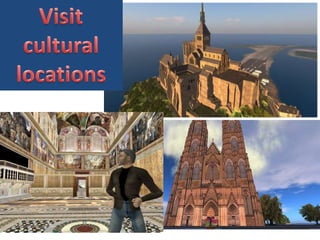
  • #24 this recreation of Le Mont Saint Michel off the coast of France; this recreation of Le Mont Saint Michel off the coast
  • #66 Texting and talking