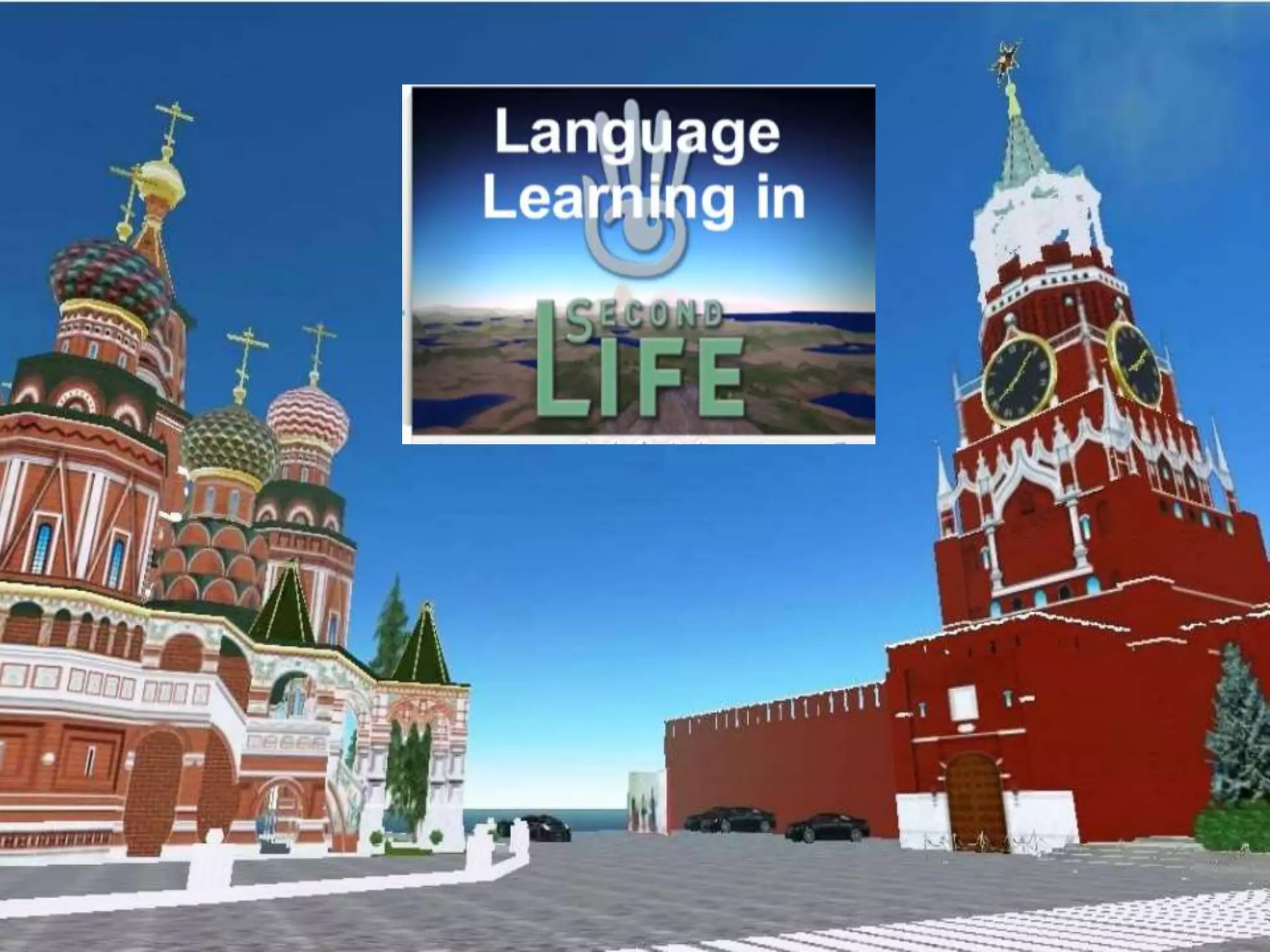
SECOND LIFE & VIRTUAL WORLDS –
A SHORT PICTORIAL HISTORY OF
DEVELOPING DIFFERENT TYPES OF
VIRTUAL LEARNING COMMUNITIES


 Eileen O’Connor, Ph.D.
 Empire State College

 Eileen.oconnor@esc.edu
What will be addressed
 The following is largely a pictorial essay on
  different types of applications that have been
  created by Dr. Eileen O’Connor
 The first slides show simple college & graduate
  applications  ending with a metaphor
 The next slides show K12 uses – from pilot work
  – and show increasing more sophisticated
  graduate applications
 The end has peer-reviewed publications related
  to Dr. O’Connor’s work
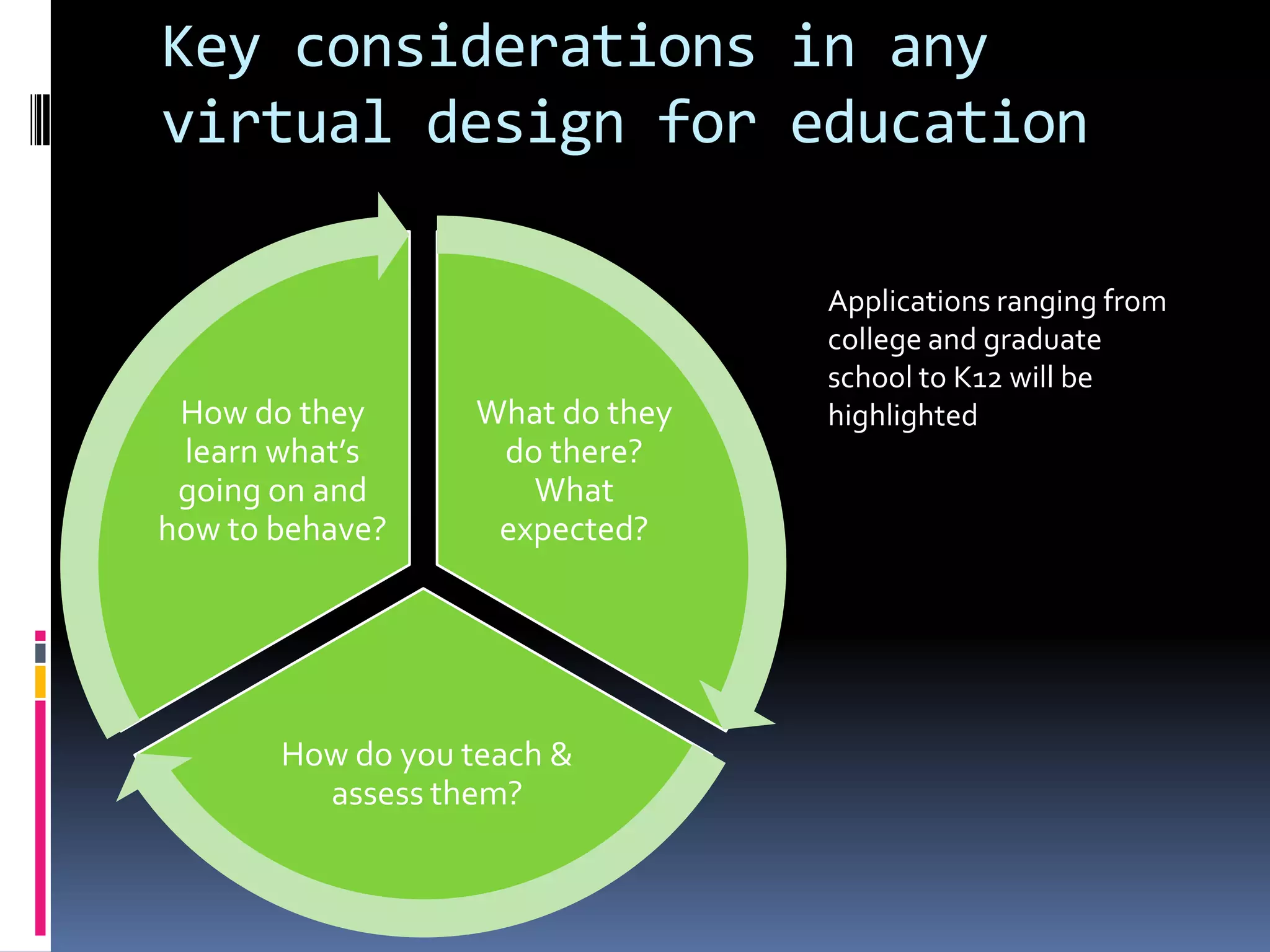
Key considerations in any
virtual design for education

                                  Applications ranging from
                                  college and graduate
                                  school to K12 will be
 How do they       What do they   highlighted
 learn what’s       do there?
 going on and         What
how to behave?      expected?


       How do you teach &
         assess them?
Some startup graduate/college
applications

 Use simple startups ideas
   Meeting, interactions, discussions
   Find existing materials, virtual
    islands, activities that are already in
    existence
   Have student create some simple
    virtual development
 Practice as a meeting space for your own
  work first
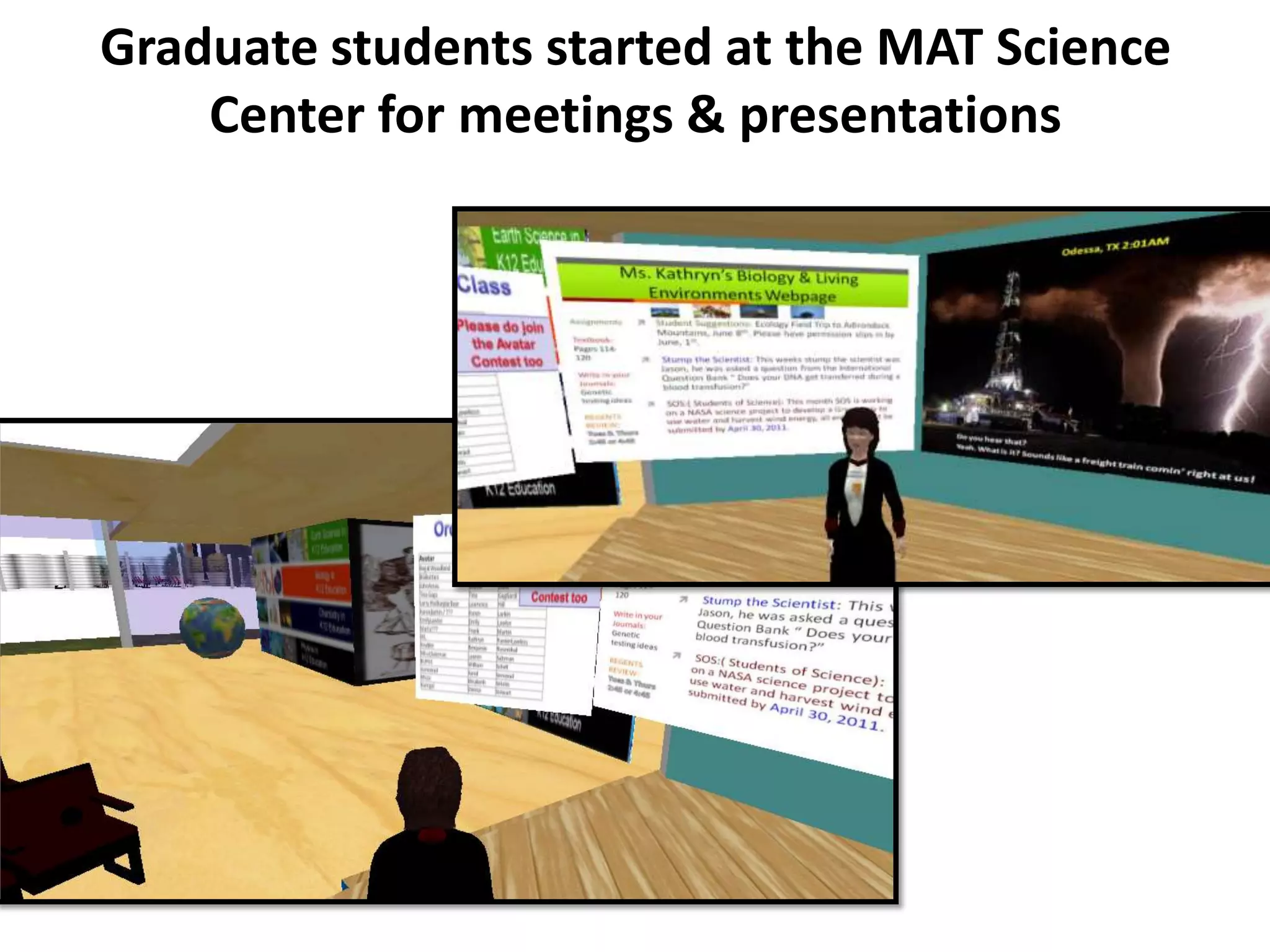
Graduate students started at the MAT Science
    Center for meetings & presentations
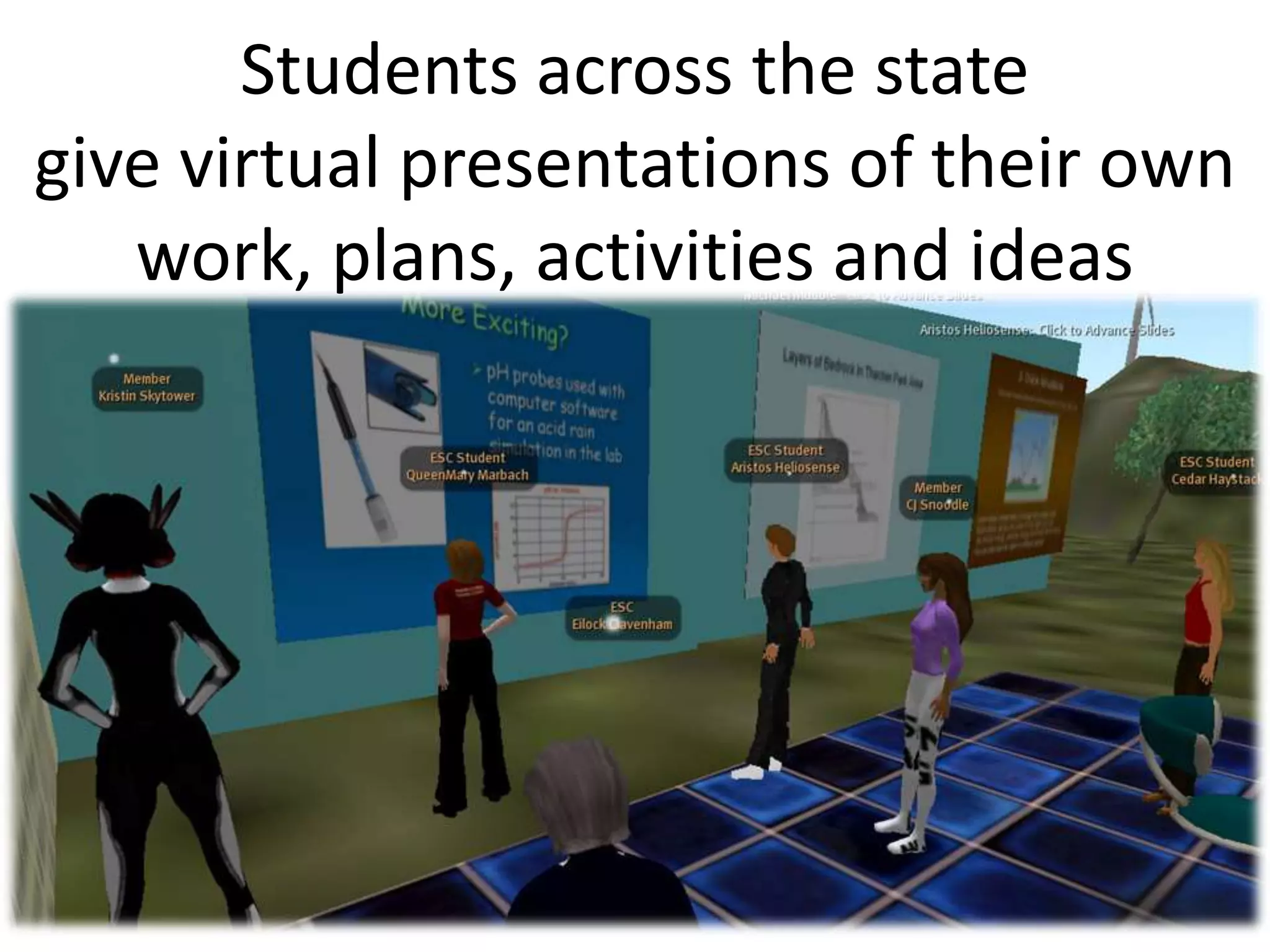
Students across the state
give virtual presentations of their own
   work, plans, activities and ideas
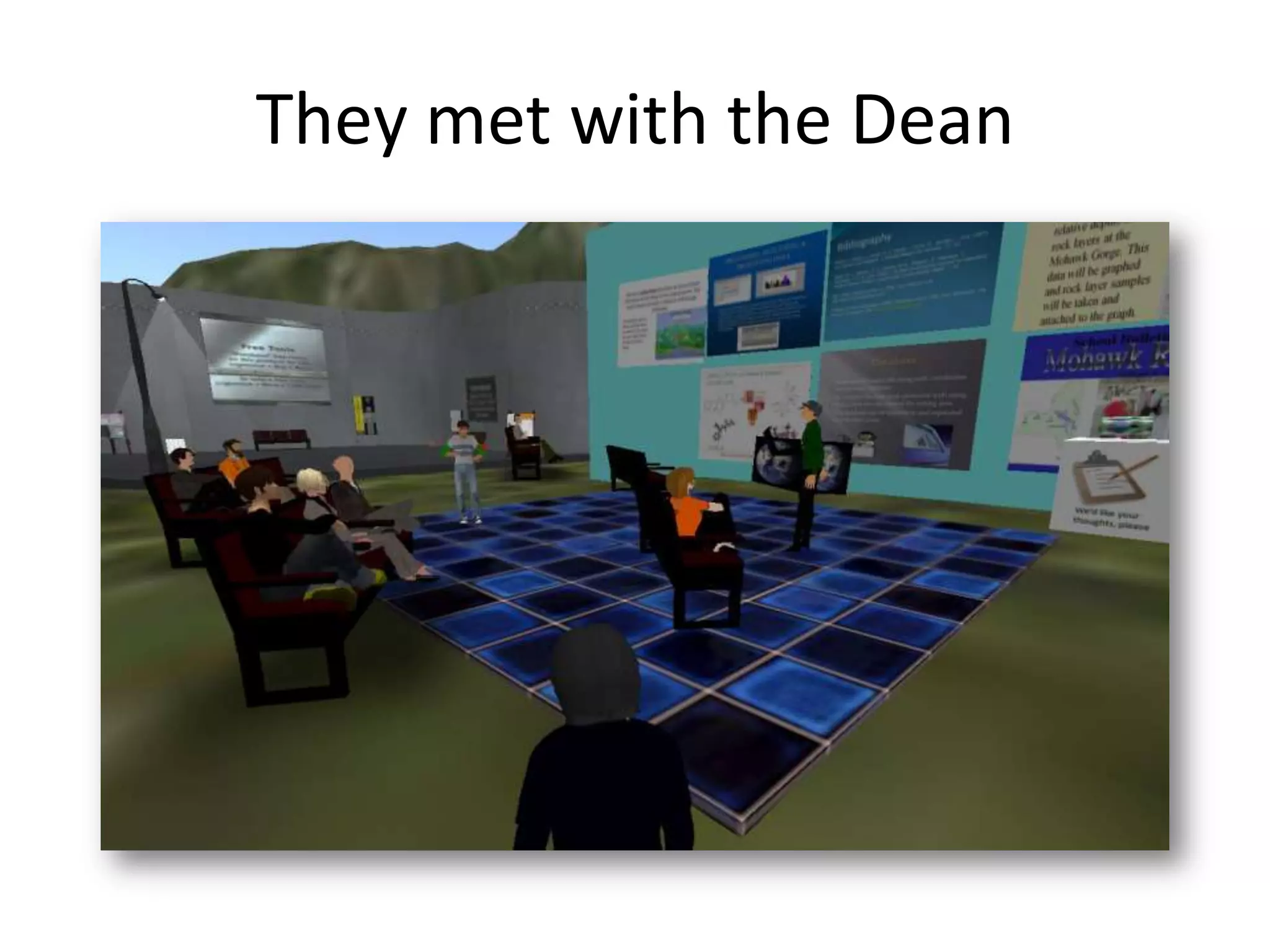
They met with the Dean
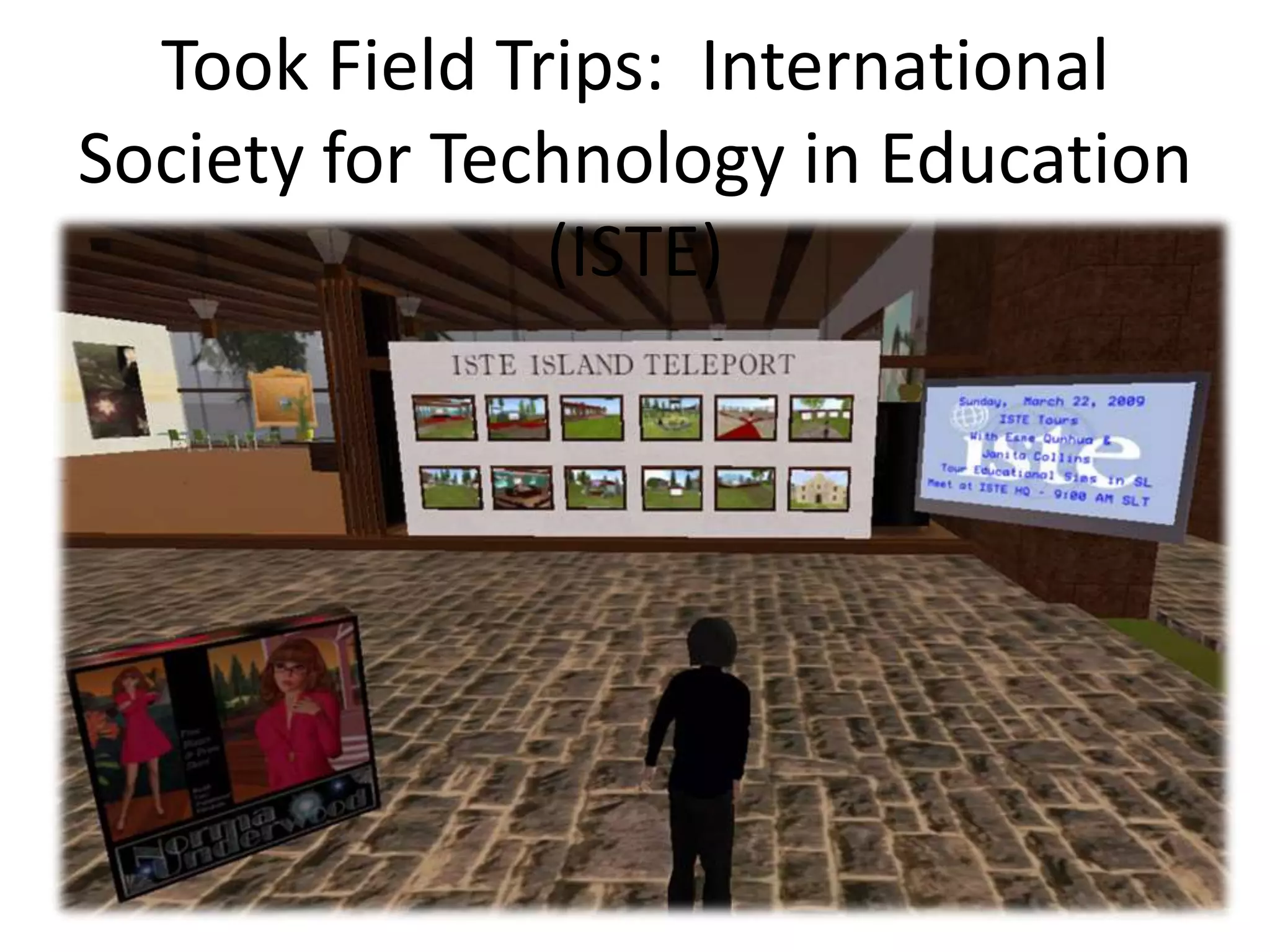
Took Field Trips: International
Society for Technology in Education
               (ISTE)
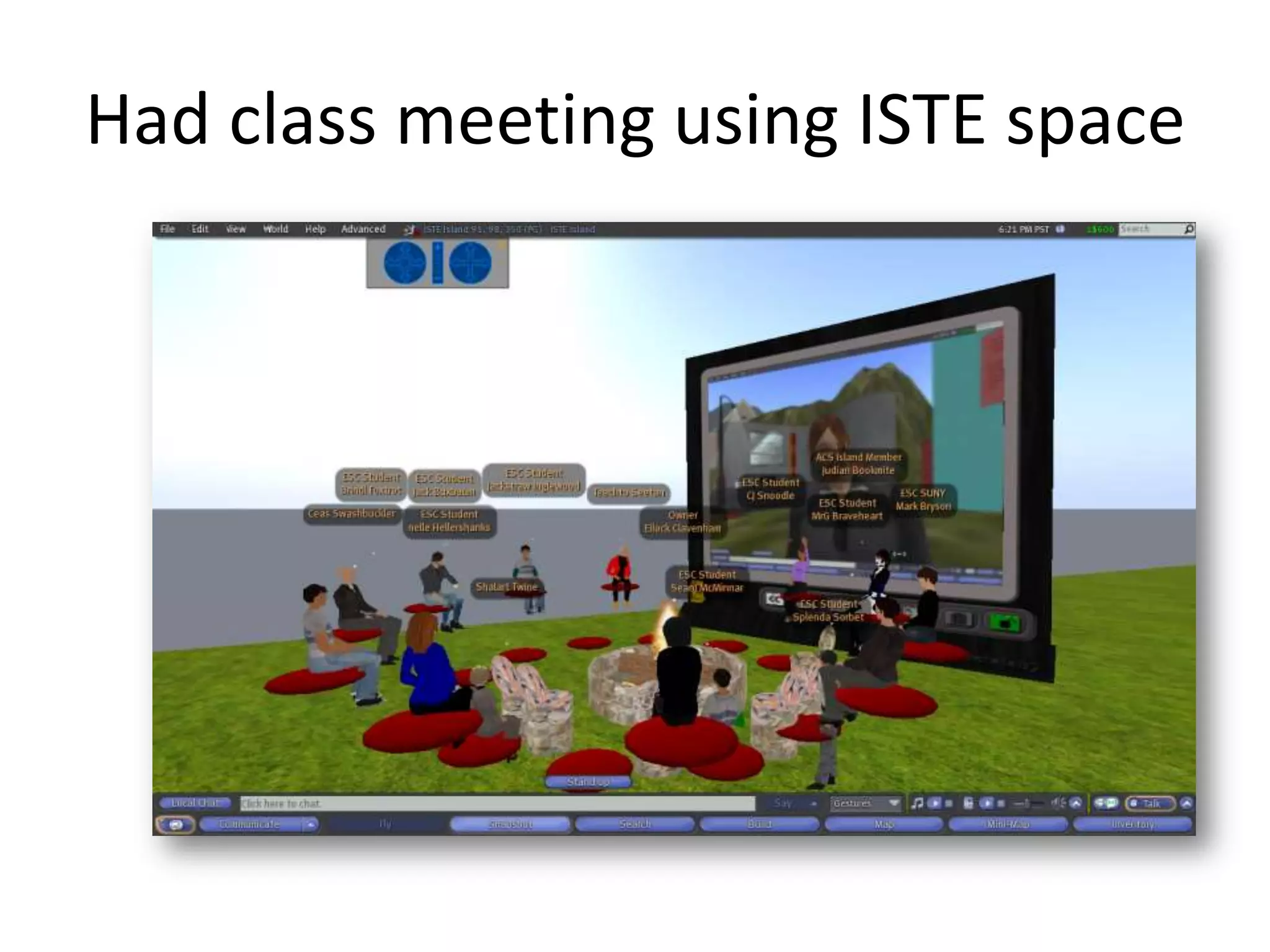
Had class meeting using ISTE space
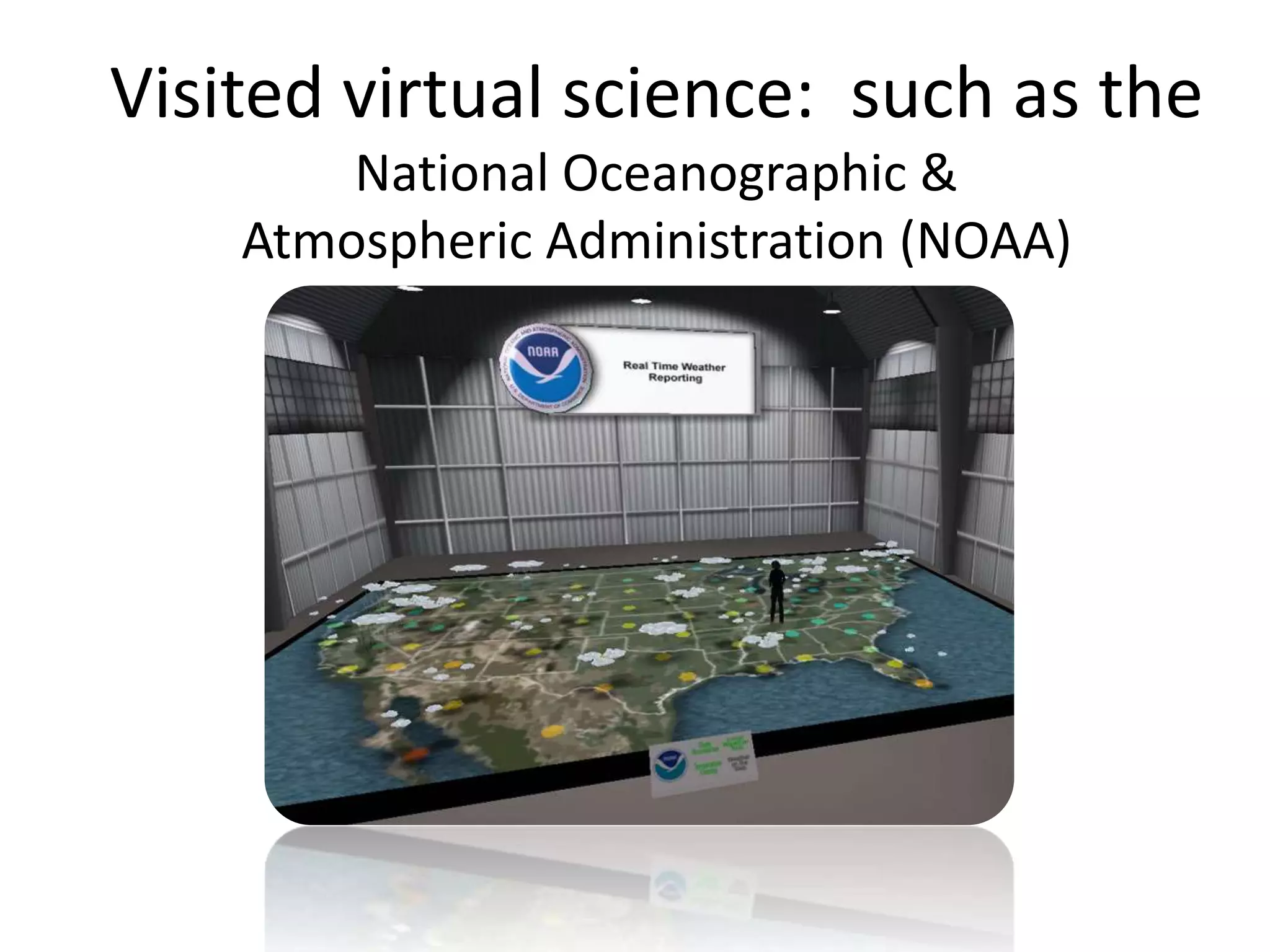
Visited virtual science: such as the
        National Oceanographic &
    Atmospheric Administration (NOAA)
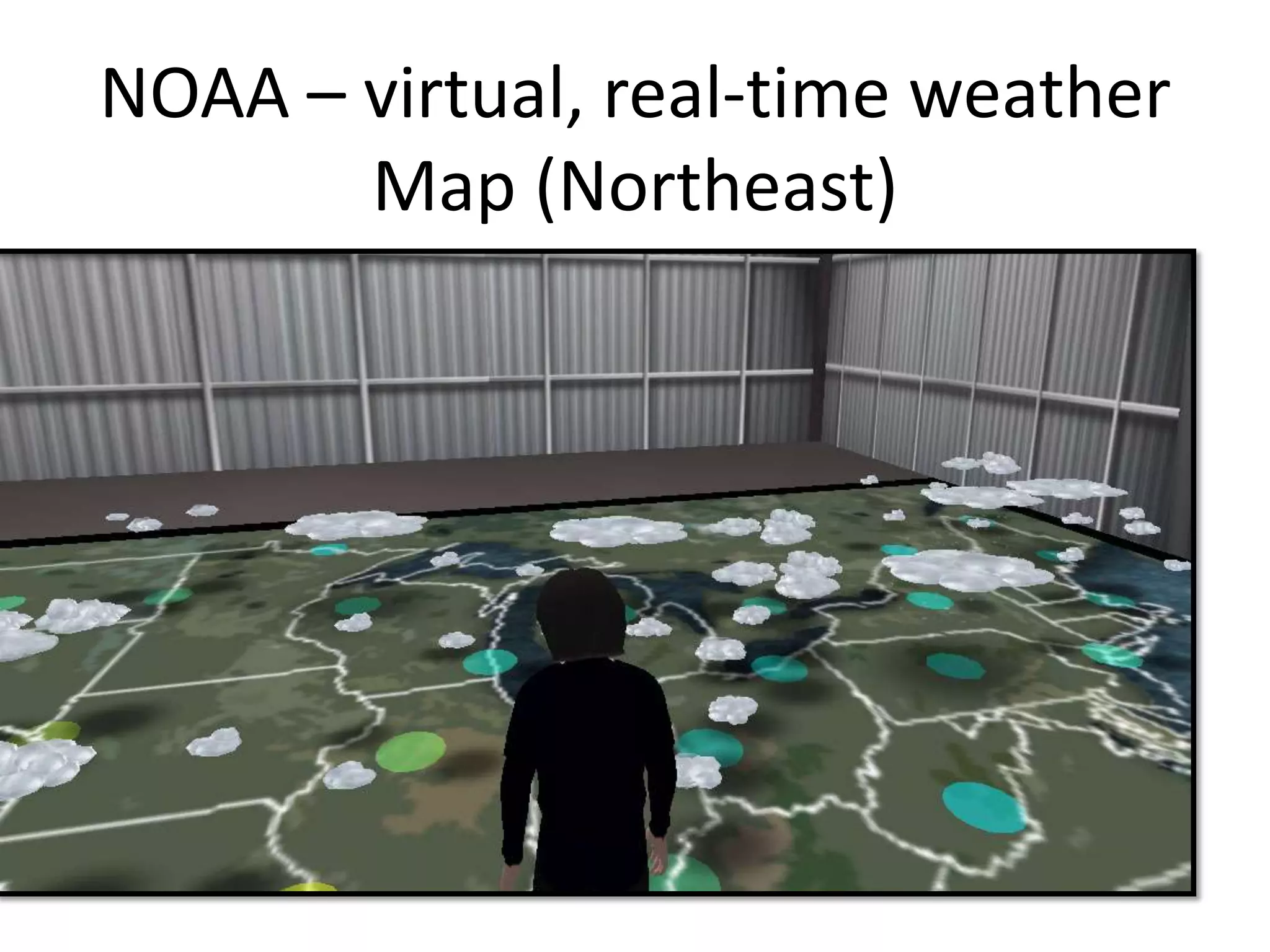
NOAA – virtual, real-time weather
       Map (Northeast)
Much more is possible too in all
content areas
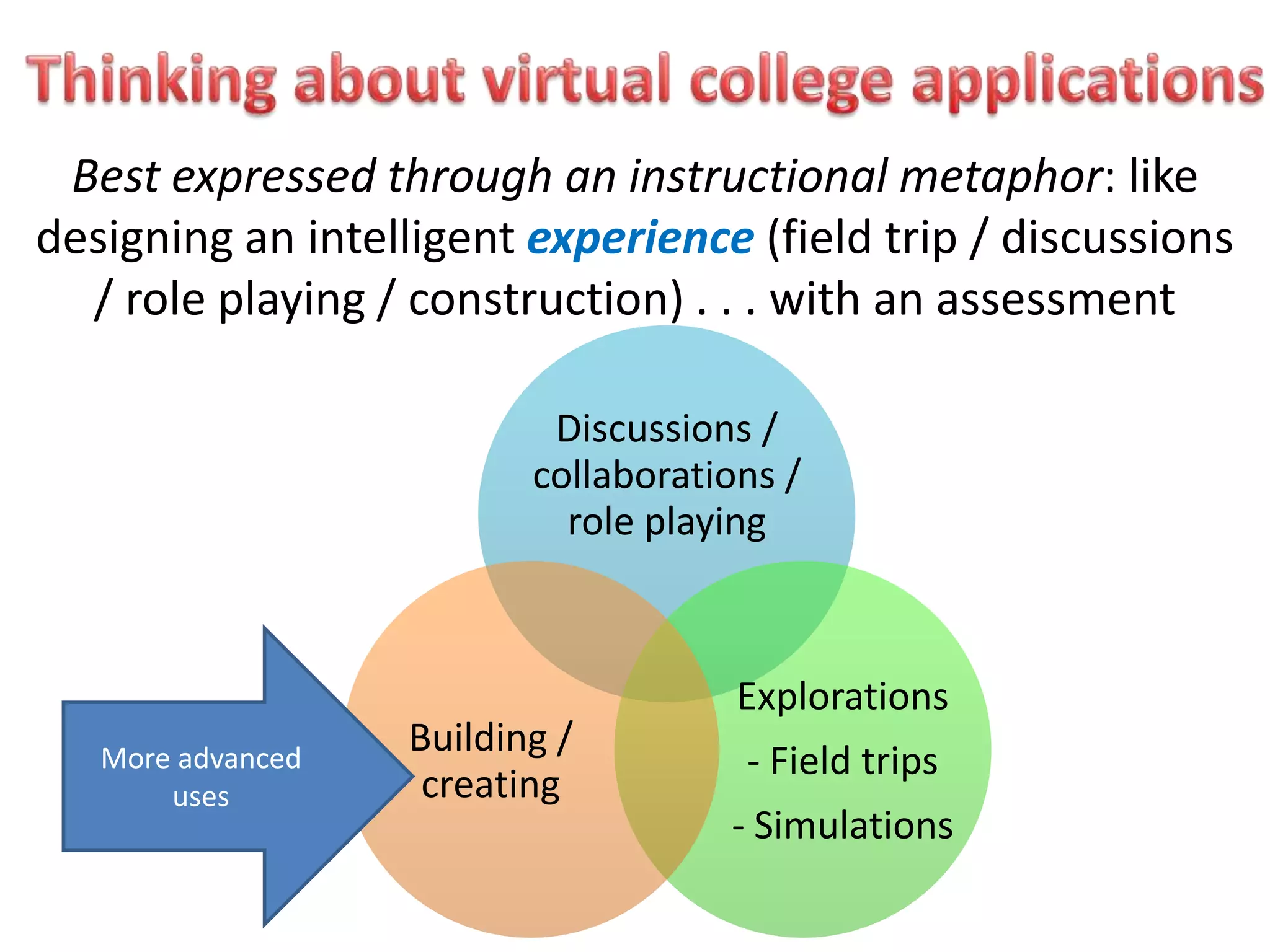
Best expressed through an instructional metaphor: like
designing an intelligent experience (field trip / discussions
  / role playing / construction) . . . with an assessment

                           Discussions /
                          collaborations /
                            role playing


                                      Explorations
                   Building /
   More advanced                      - Field trips
       uses         creating
                                     - Simulations
Over time, the science-education
applications moved into a private
space
  Thus, K12 applications were possible (still under
   research and study)
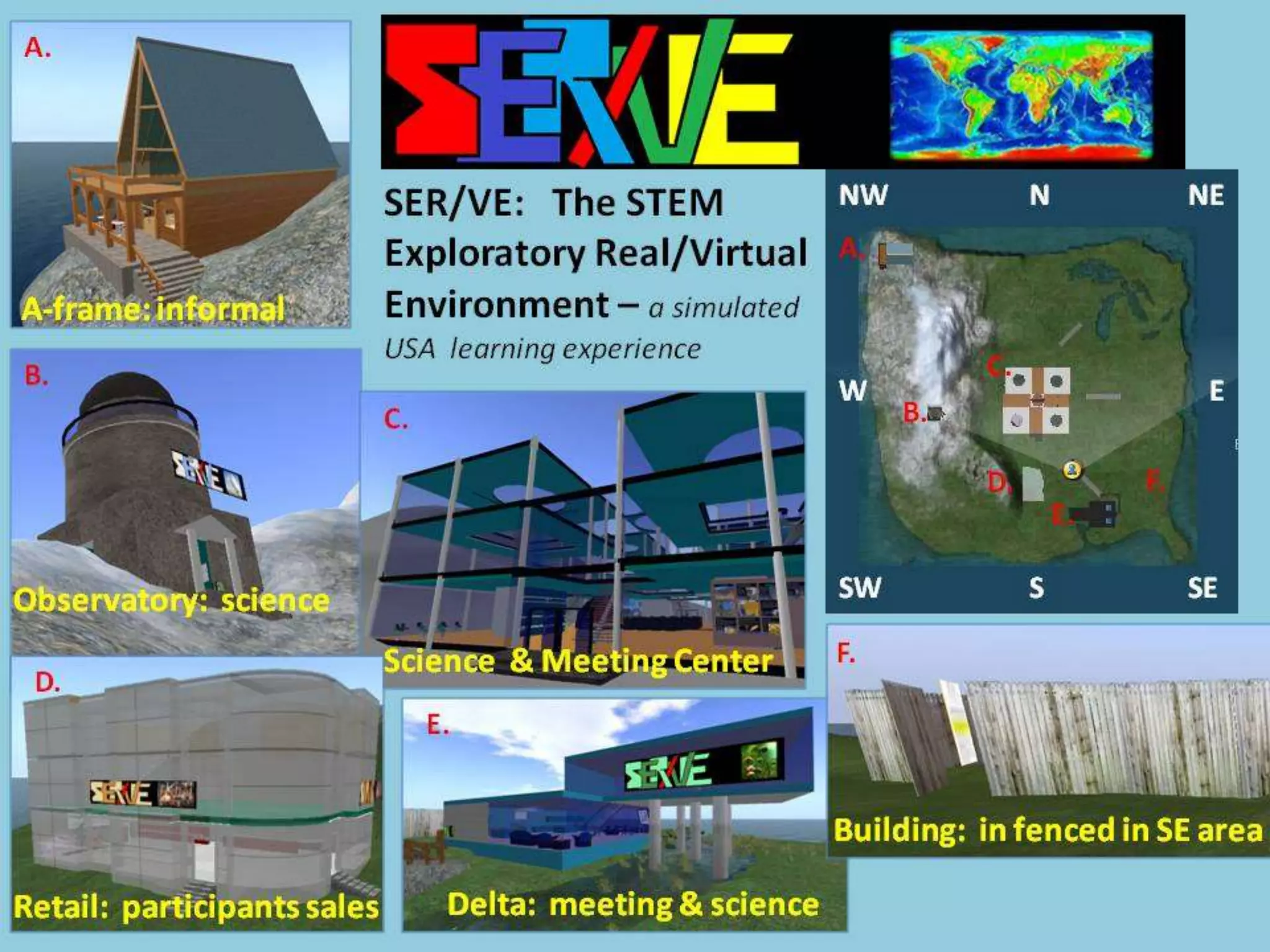
  A science-education island was designed
   (looked like the USA); virtual meetings and
   presentations continued
  NOW though students (pre-service teachers) did
   some basic development too
  K12 pilots have been conducted too
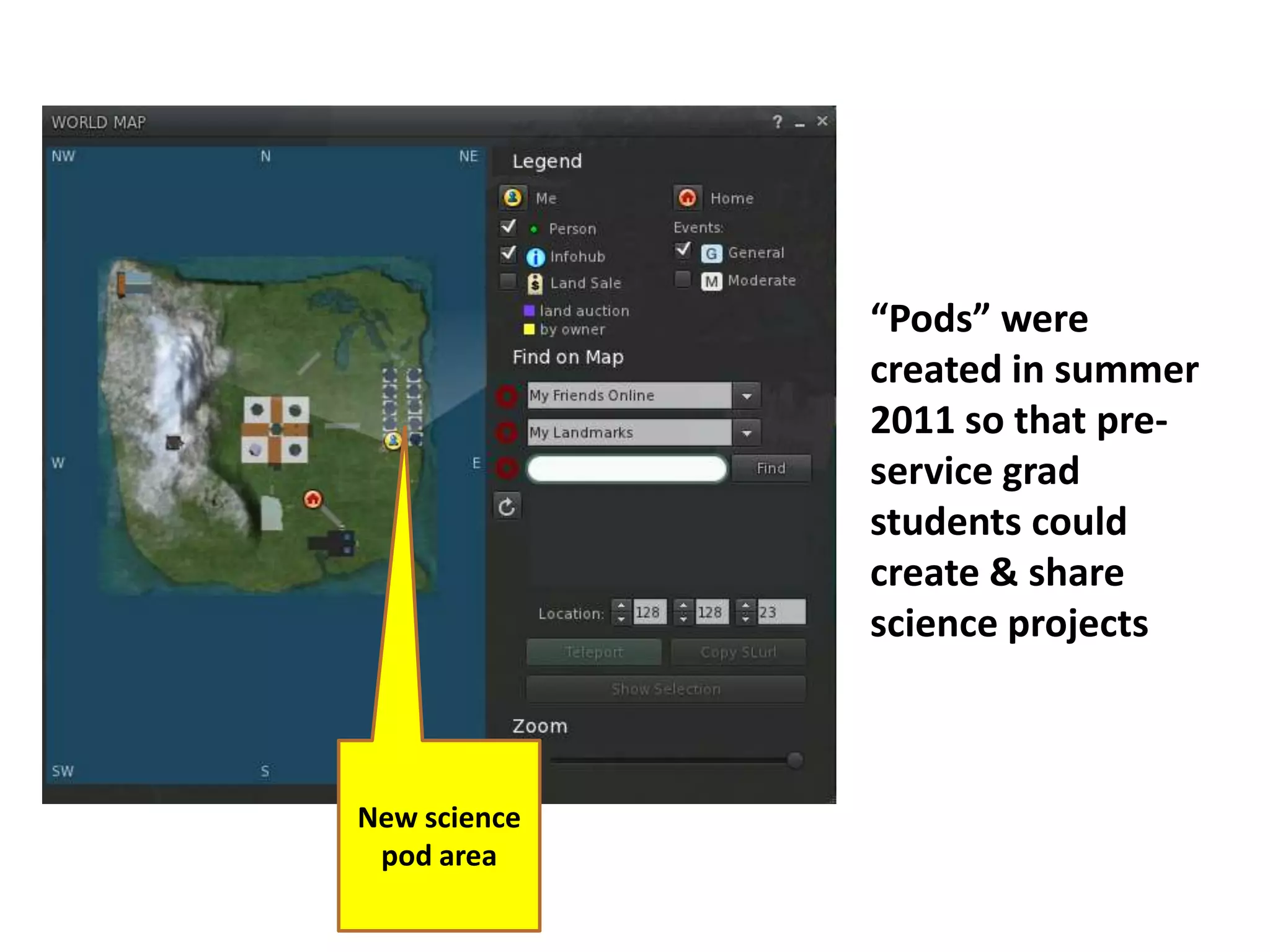
“Pods” were
              created in summer
              2011 so that pre-
              service grad
              students could
              create & share
              science projects


New science
 pod area
The new science “pods” – empty at first


 To be developed by graduate students – with minimal knowledge of Second Life
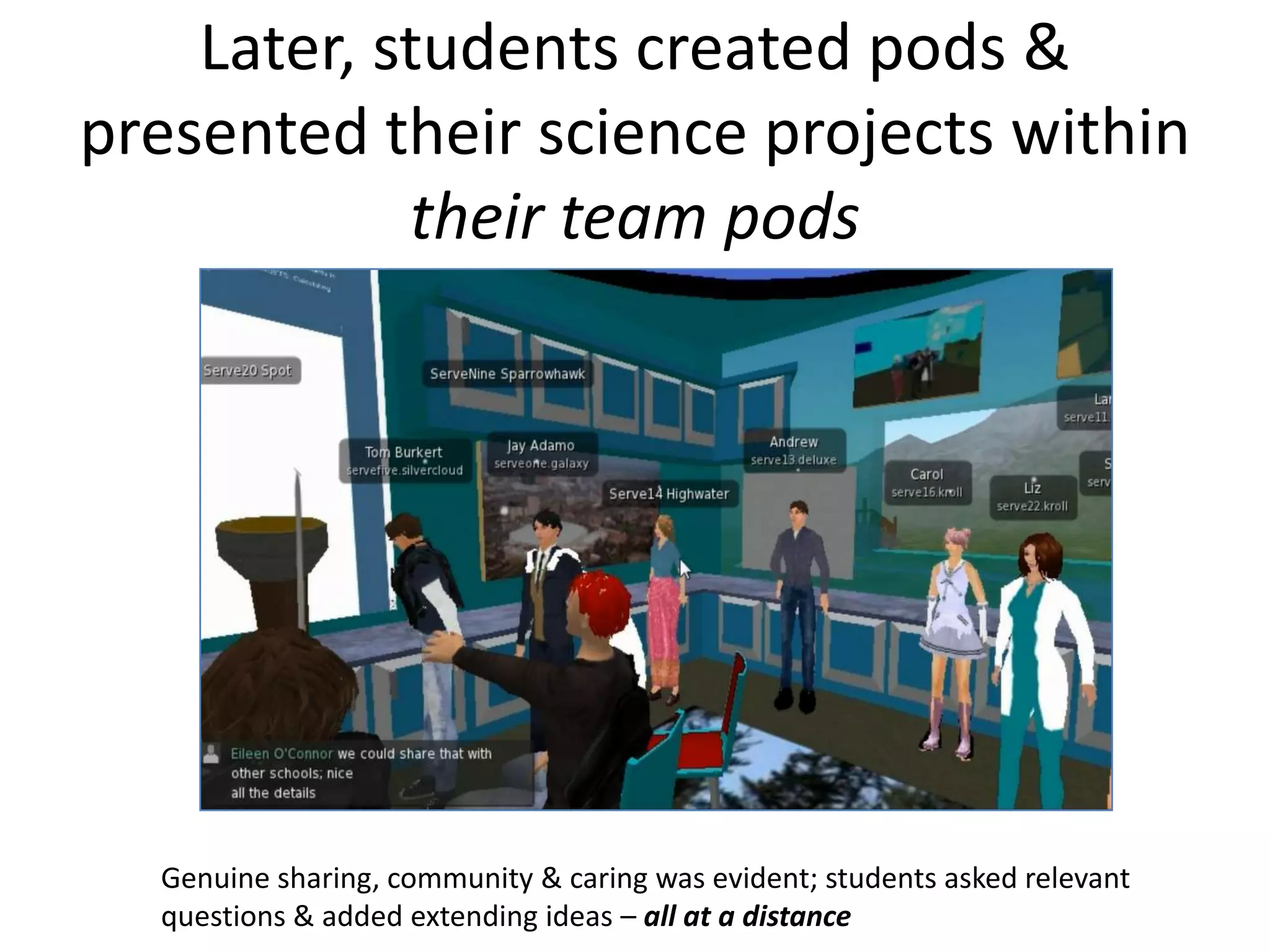
Later, students created pods &
presented their science projects within
            their team pods


  Genuine sharing, community & caring was evident; students asked relevant
  questions & added extending ideas – all at a distance
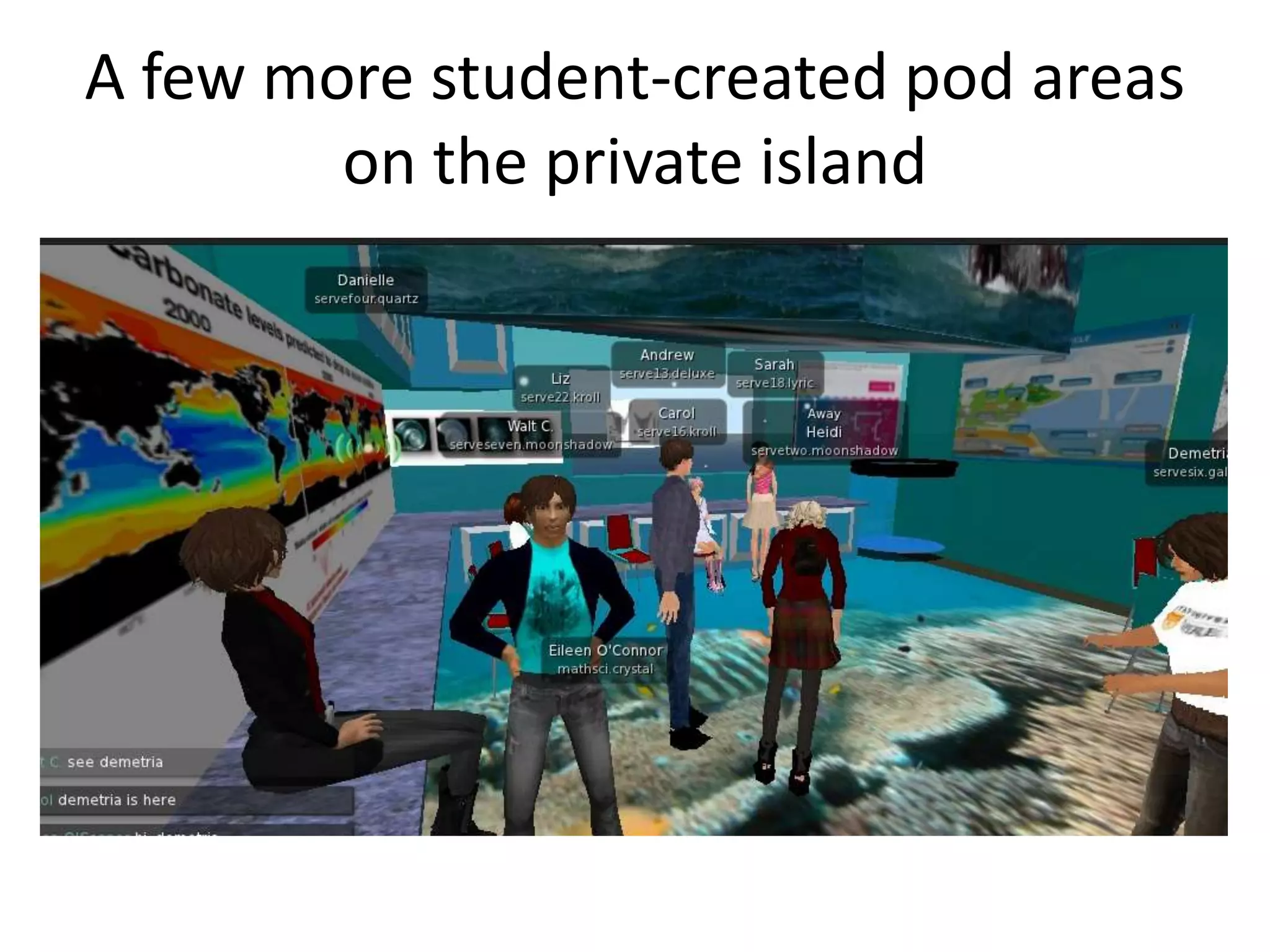
A few more student-created pod areas
        on the private island
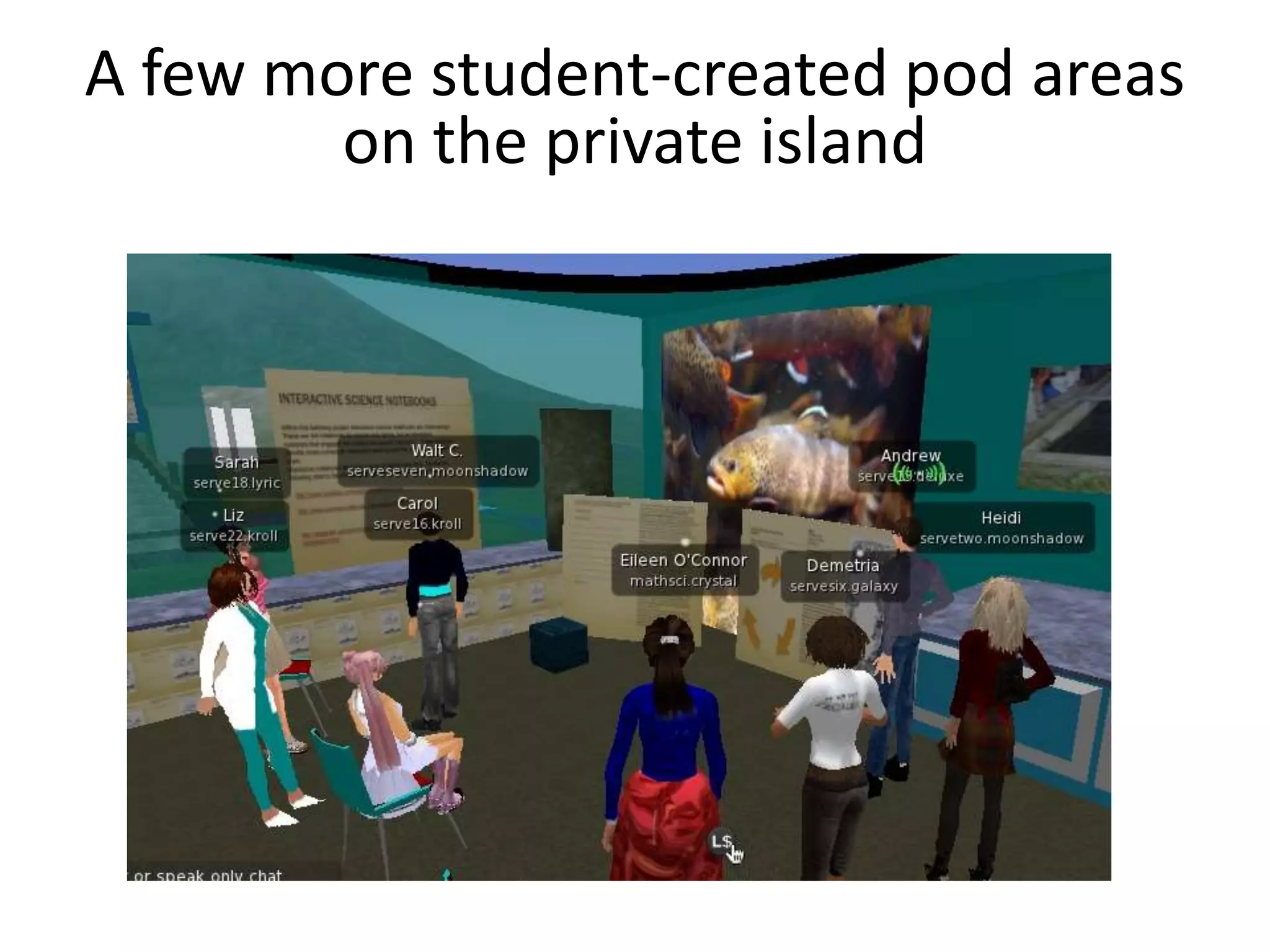
A few more student-created pod areas
        on the private island
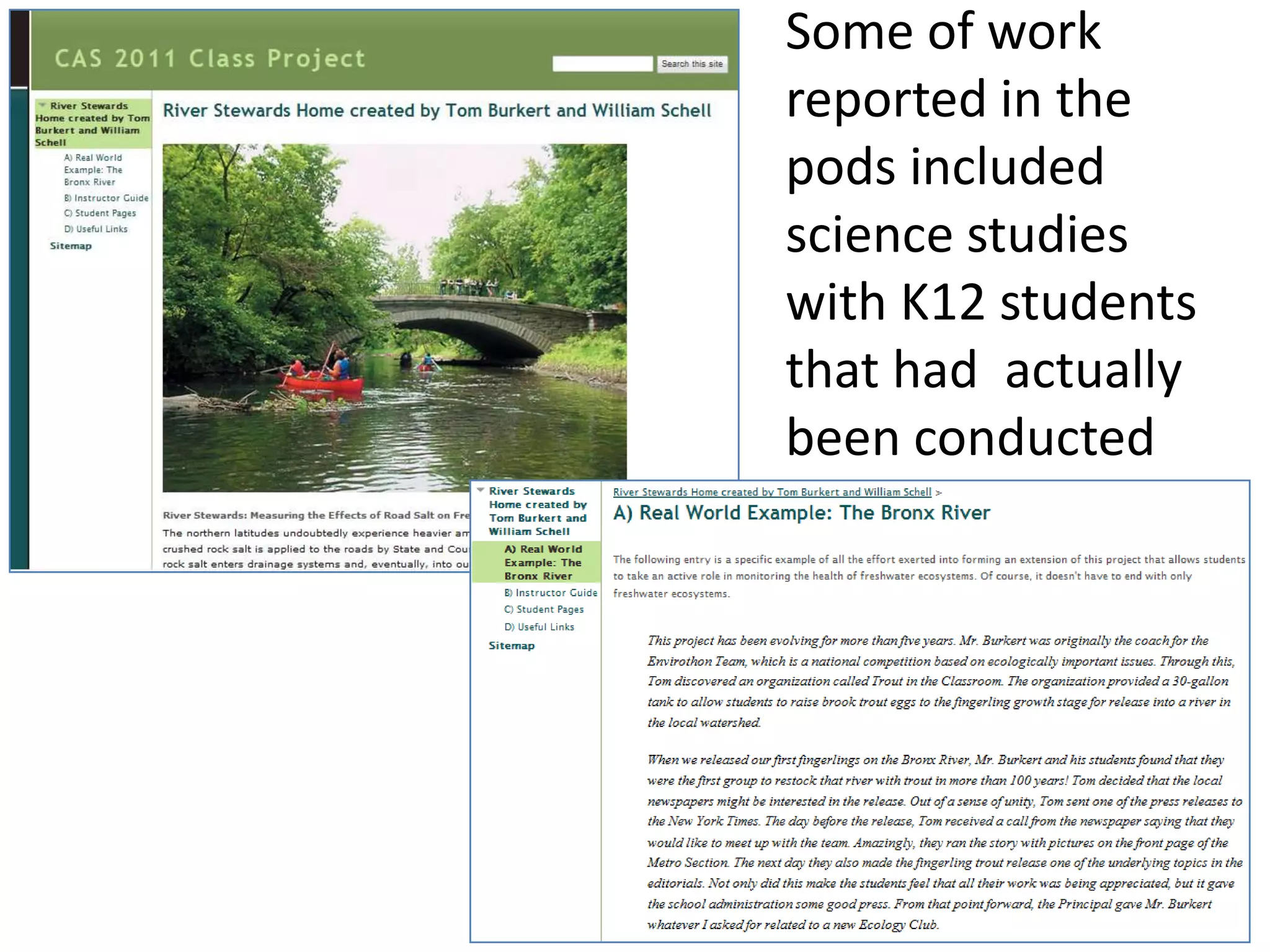
Some of work
reported in the
pods included
science studies
with K12 students
that had actually
been conducted
Now that a private space
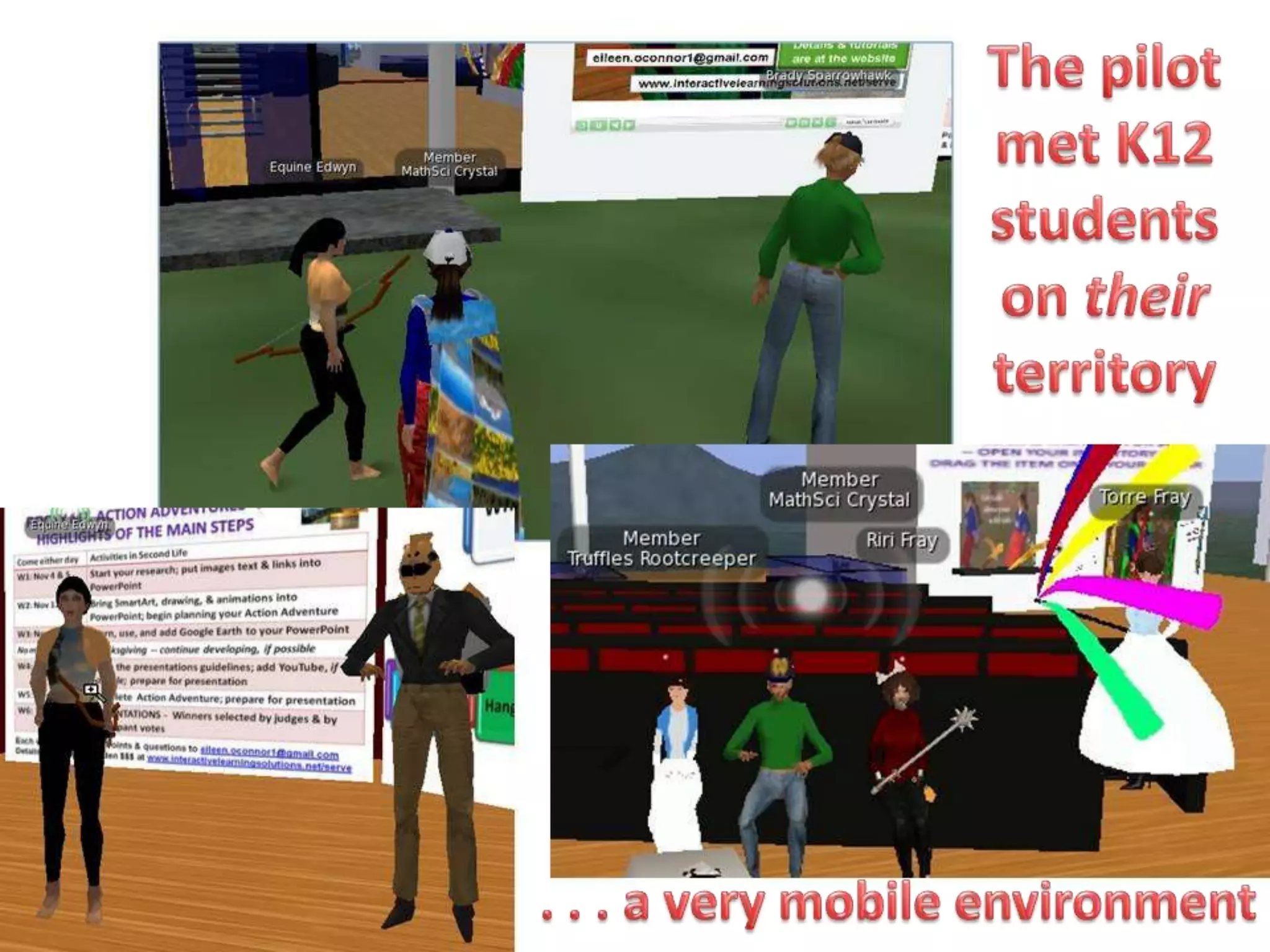
  existed, K12 students could be
  brought in too, as was begun in
  2009
 In fall 2009 & spring 2010, a pilot with 9
  students was conducted – the students
  met, researched (using internet), and then
  presented in the space
   Results reported at conference
   Peer reviewer paper now available on this pilot (see
    the end of this presentation)
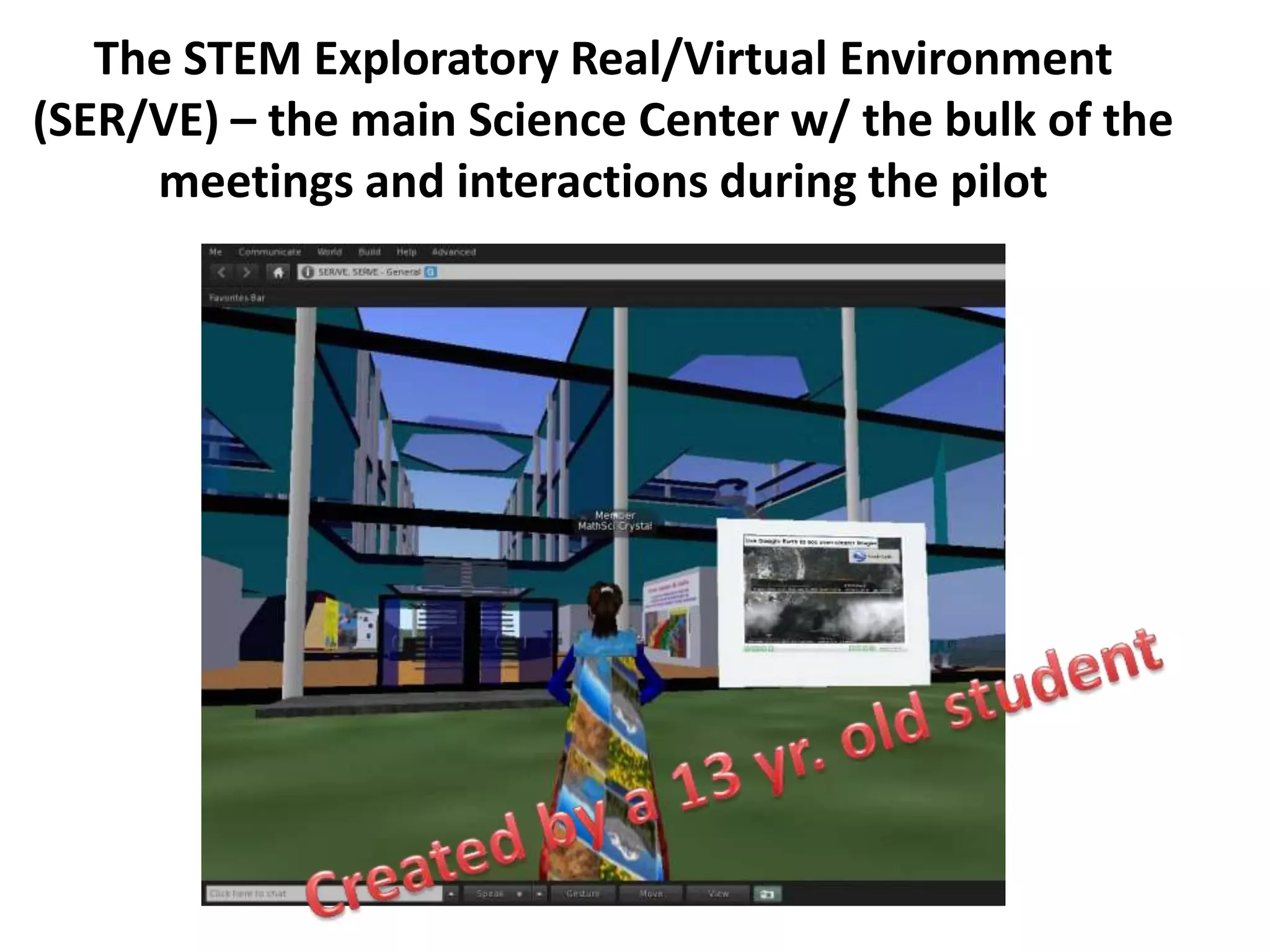
The STEM Exploratory Real/Virtual Environment
(SER/VE) – the main Science Center w/ the bulk of the
     meetings and interactions during the pilot
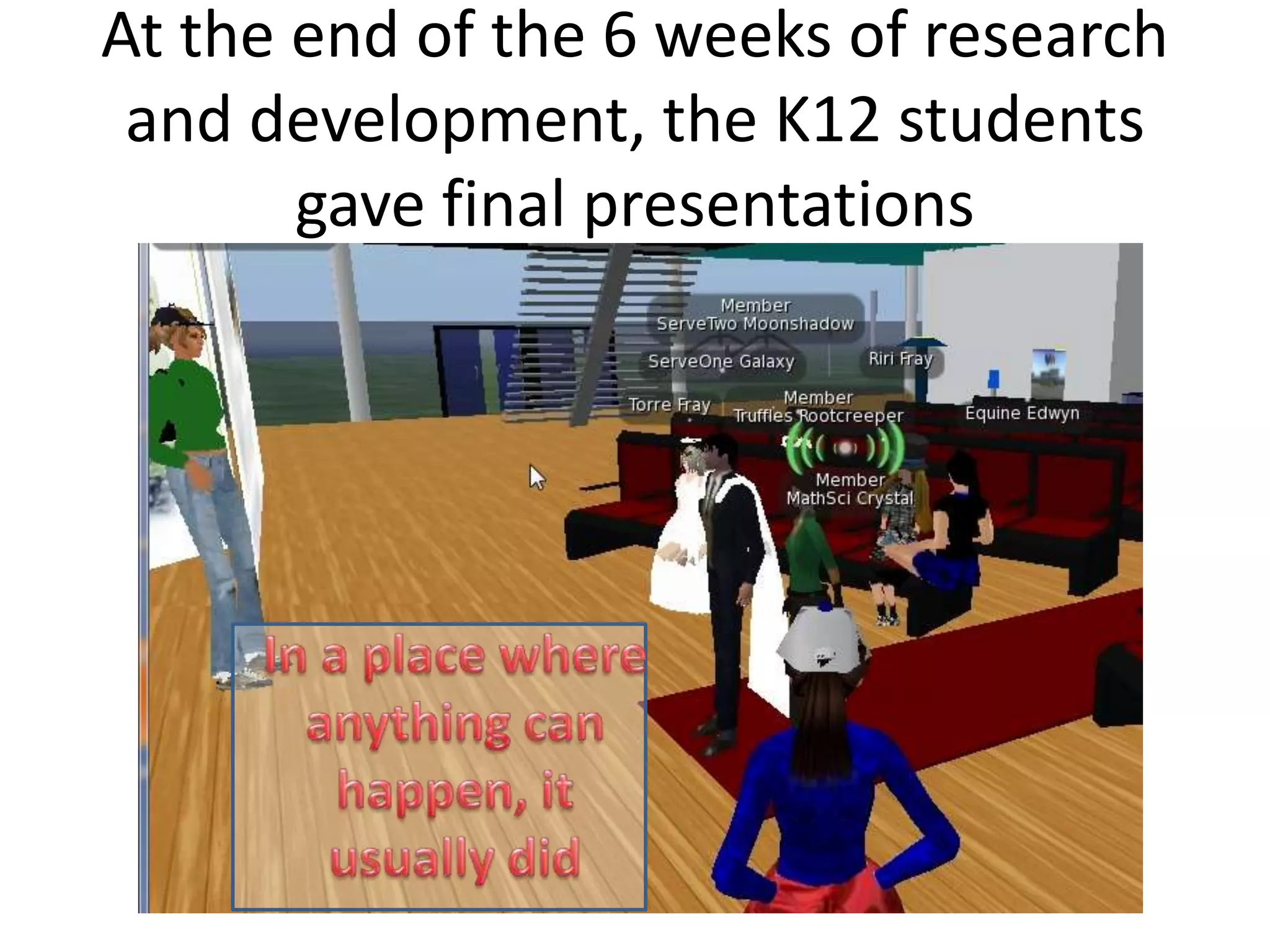
At the end of the 6 weeks of research
 and development, the K12 students
       gave final presentations
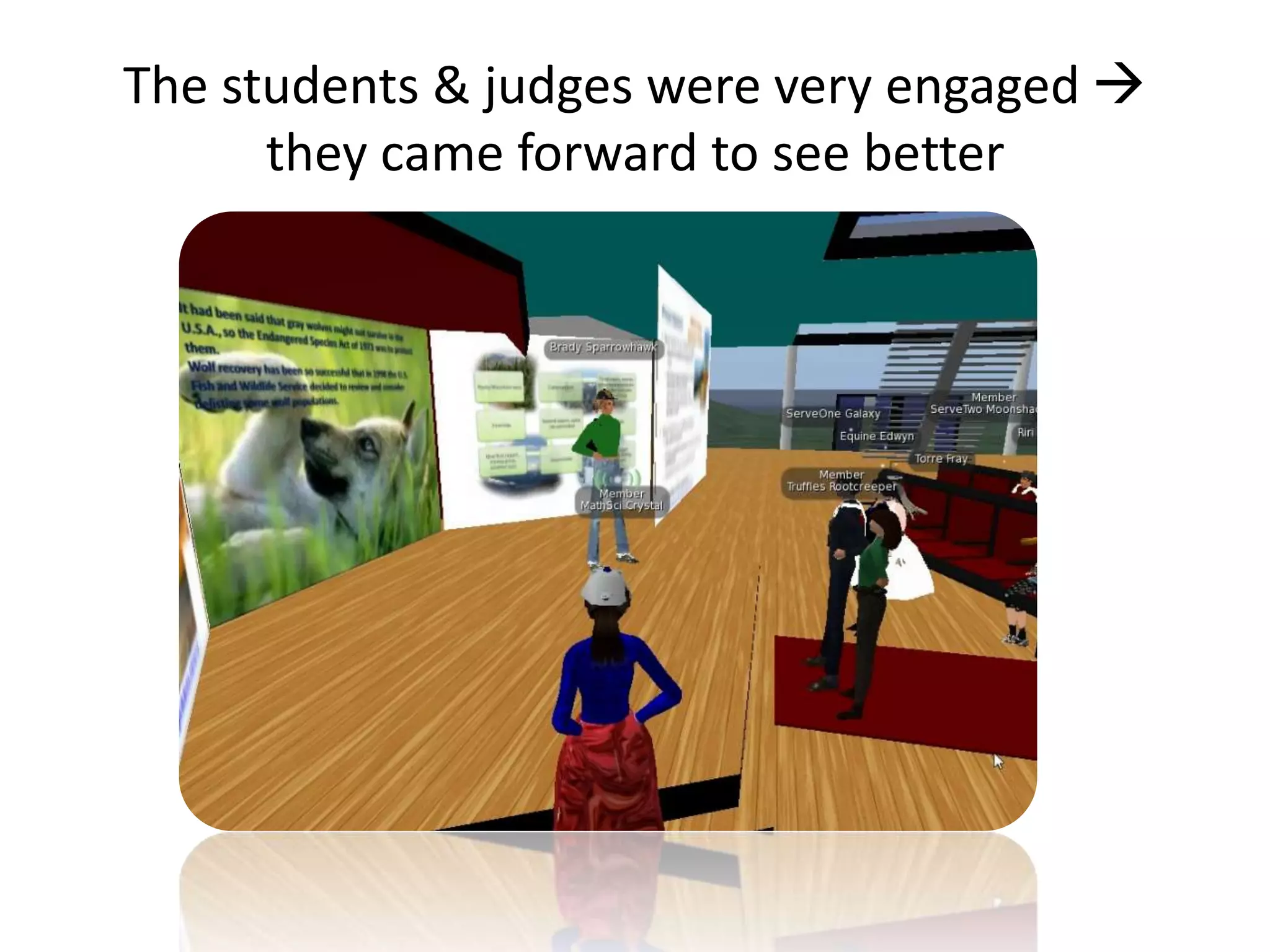
The students & judges were very engaged 
      they came forward to see better
Efforts to integrate K12
  students continue
 30 students from the Science Technology Entry
  Program from a summer workshop at U-Albany
  participated during 2011
   This cohort were from under-represented STEM
    groups
   The results were reported at a SUNY STEM
    conference in Nov. 2011 at the Crowne Plaza in
    Albany
   More on this project –
    http://www.slideshare.net/eoconnor/serve-the-stem-
    exploratory-realvirtual-environment
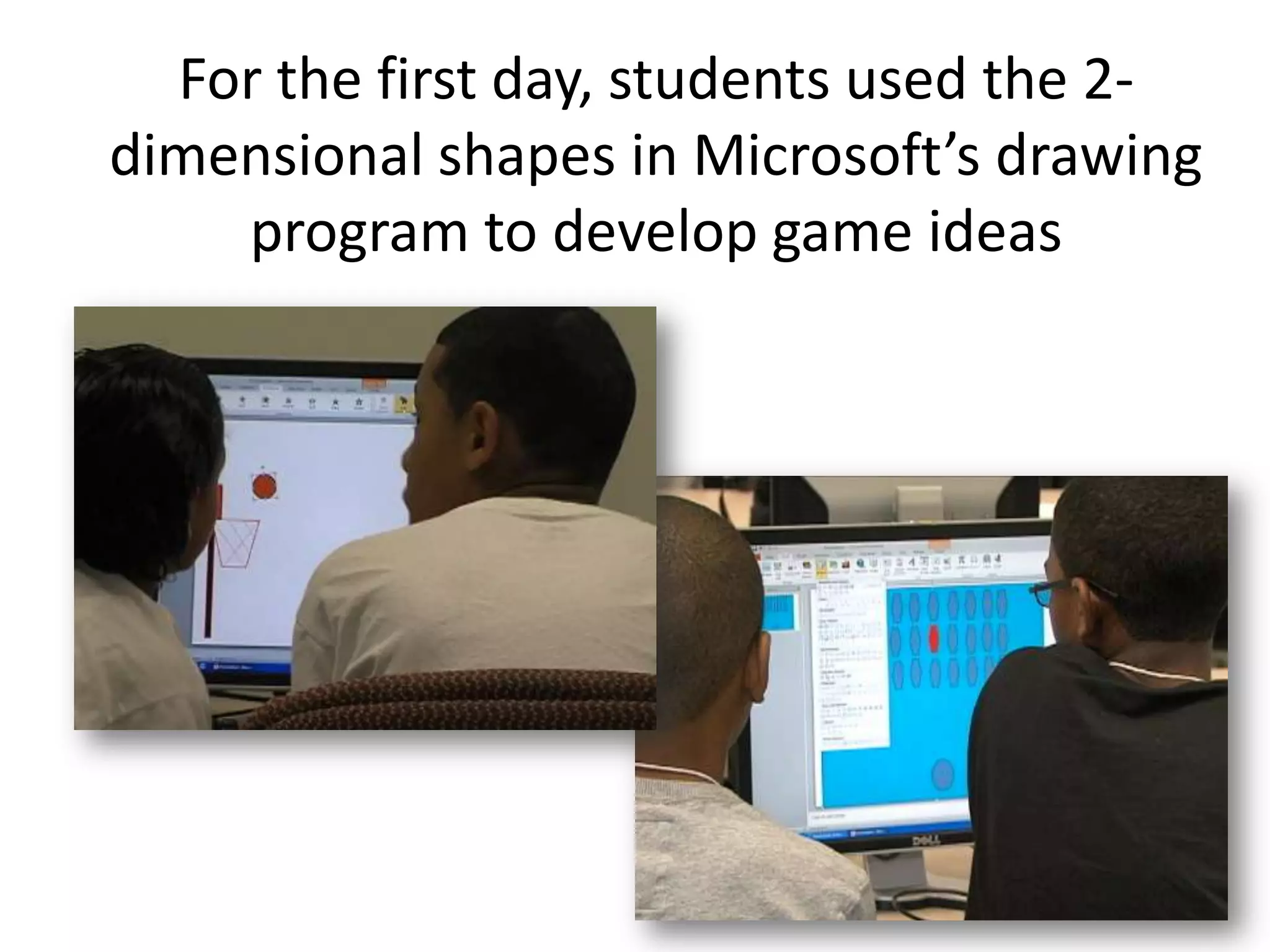
For the first day, students used the 2-
dimensional shapes in Microsoft’s drawing
    program to develop game ideas
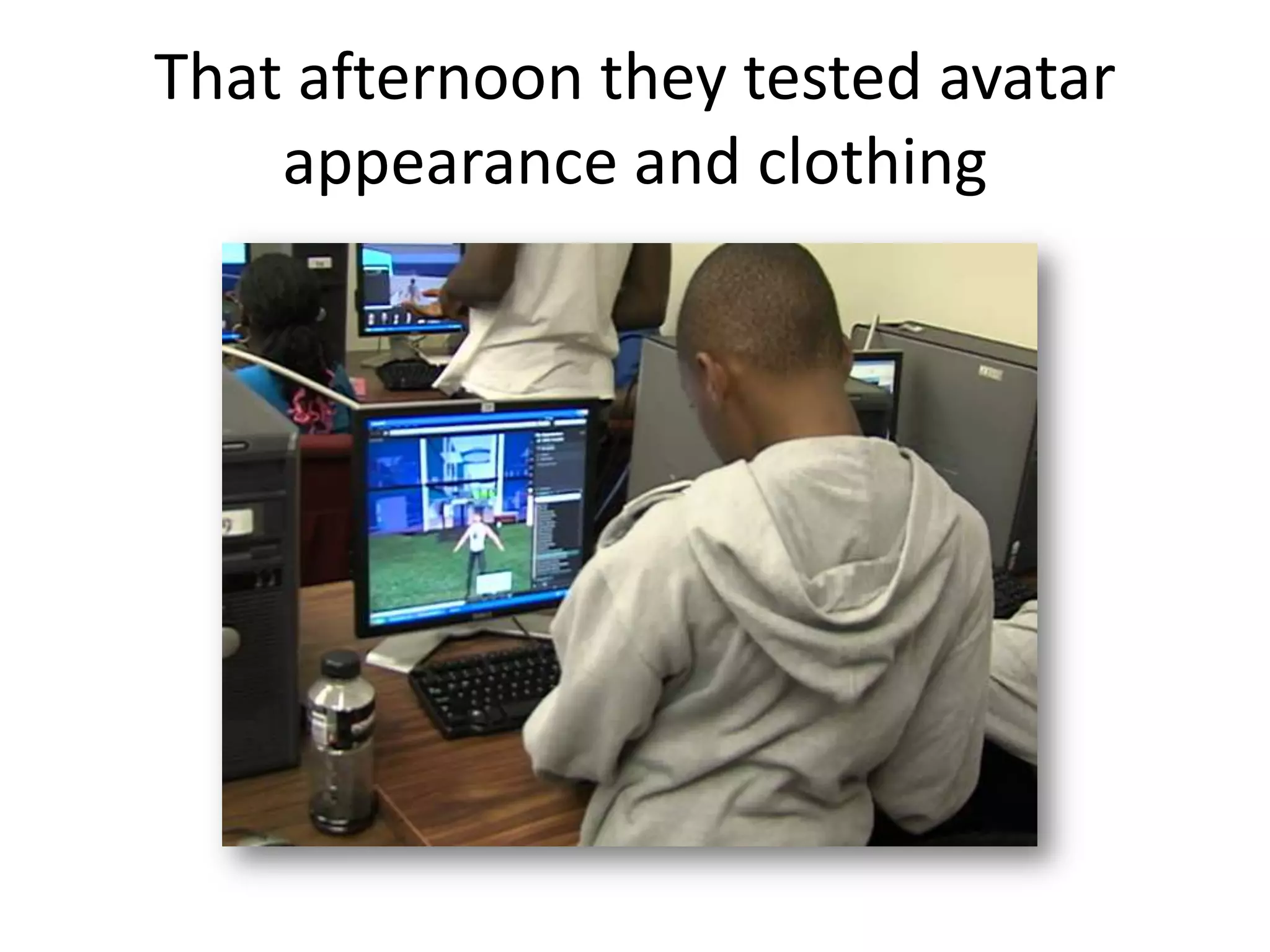
That afternoon they tested avatar
    appearance and clothing
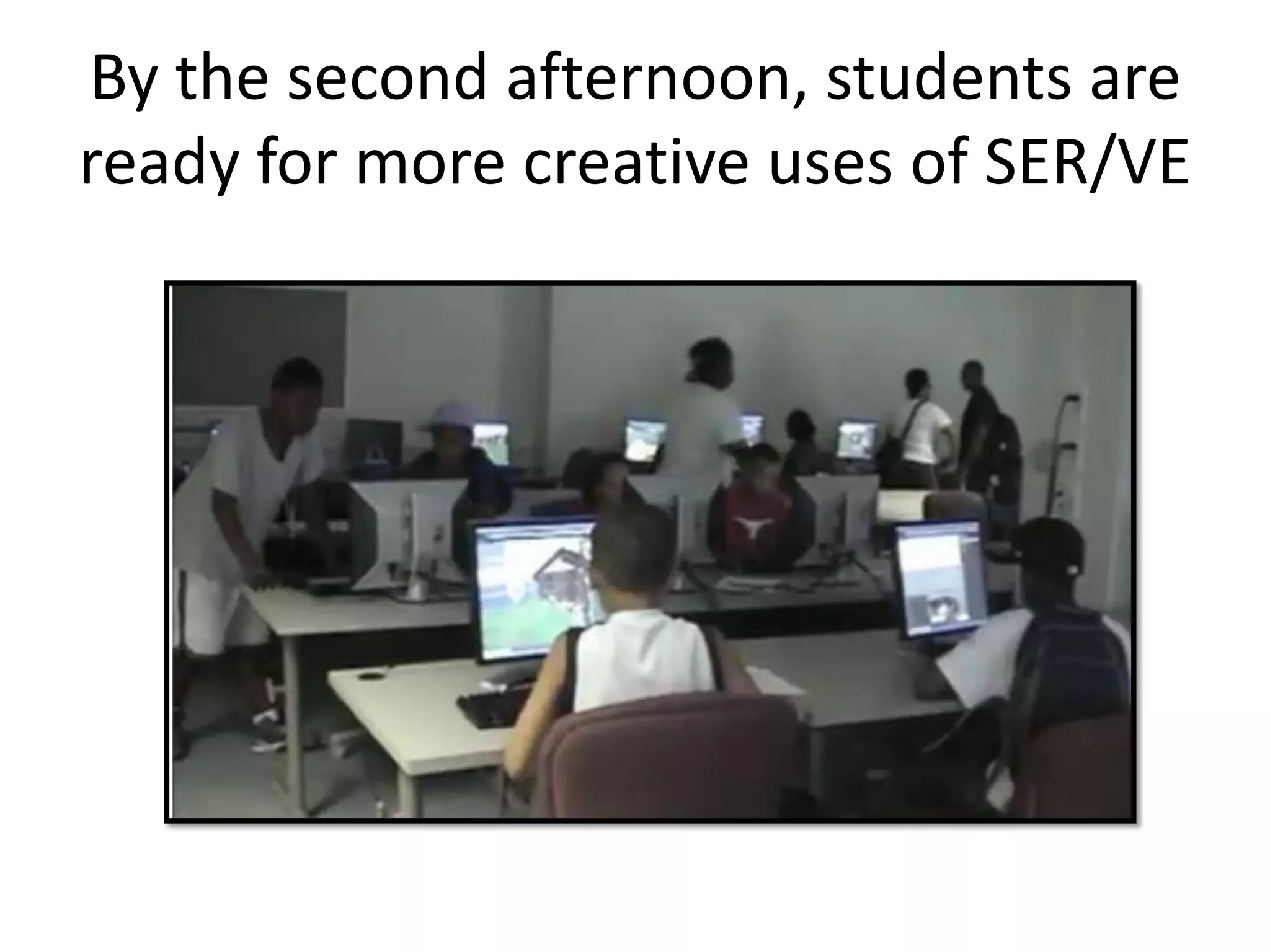
By the second afternoon, students are
ready for more creative uses of SER/VE
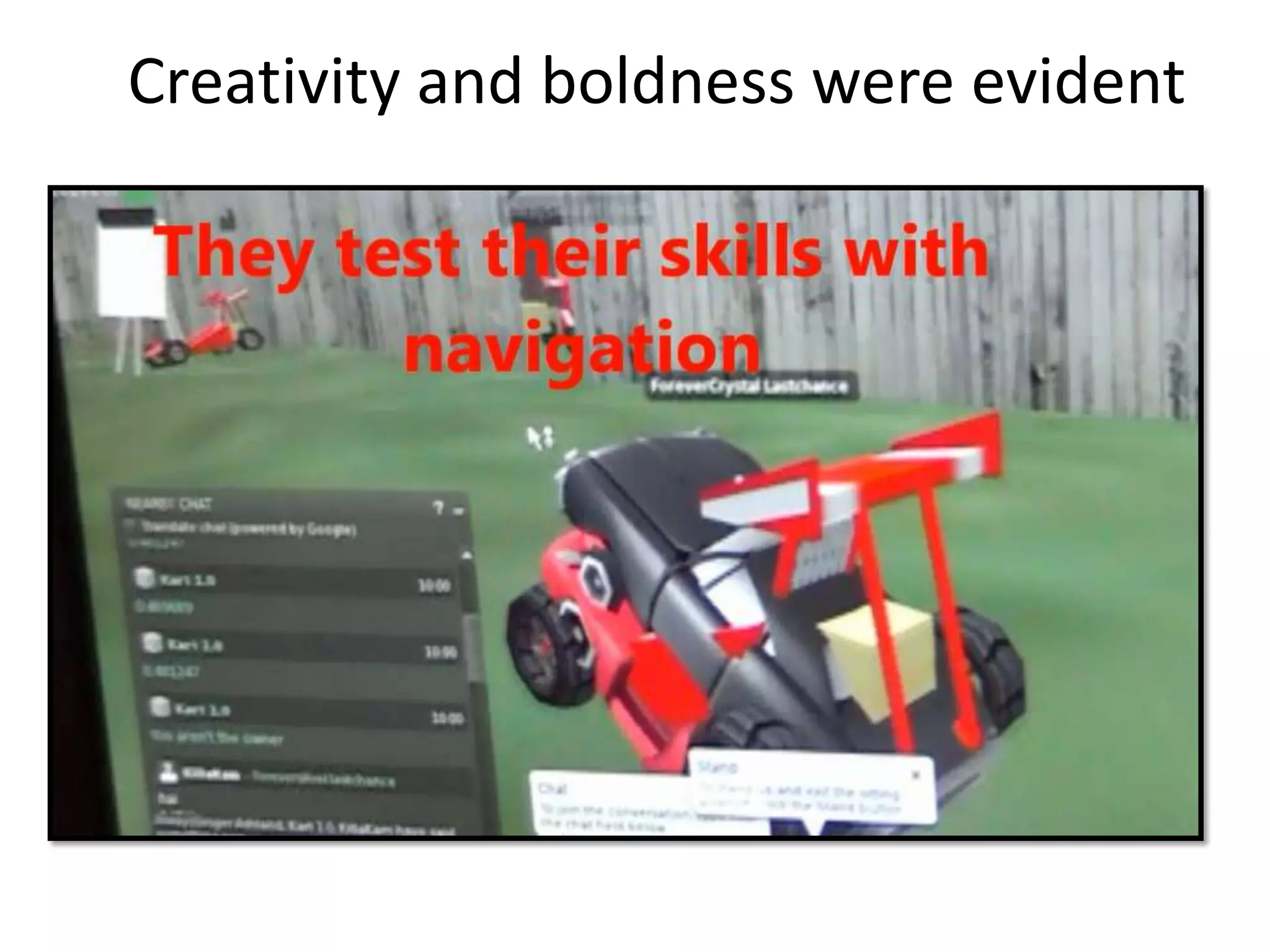
Creativity and boldness were evident
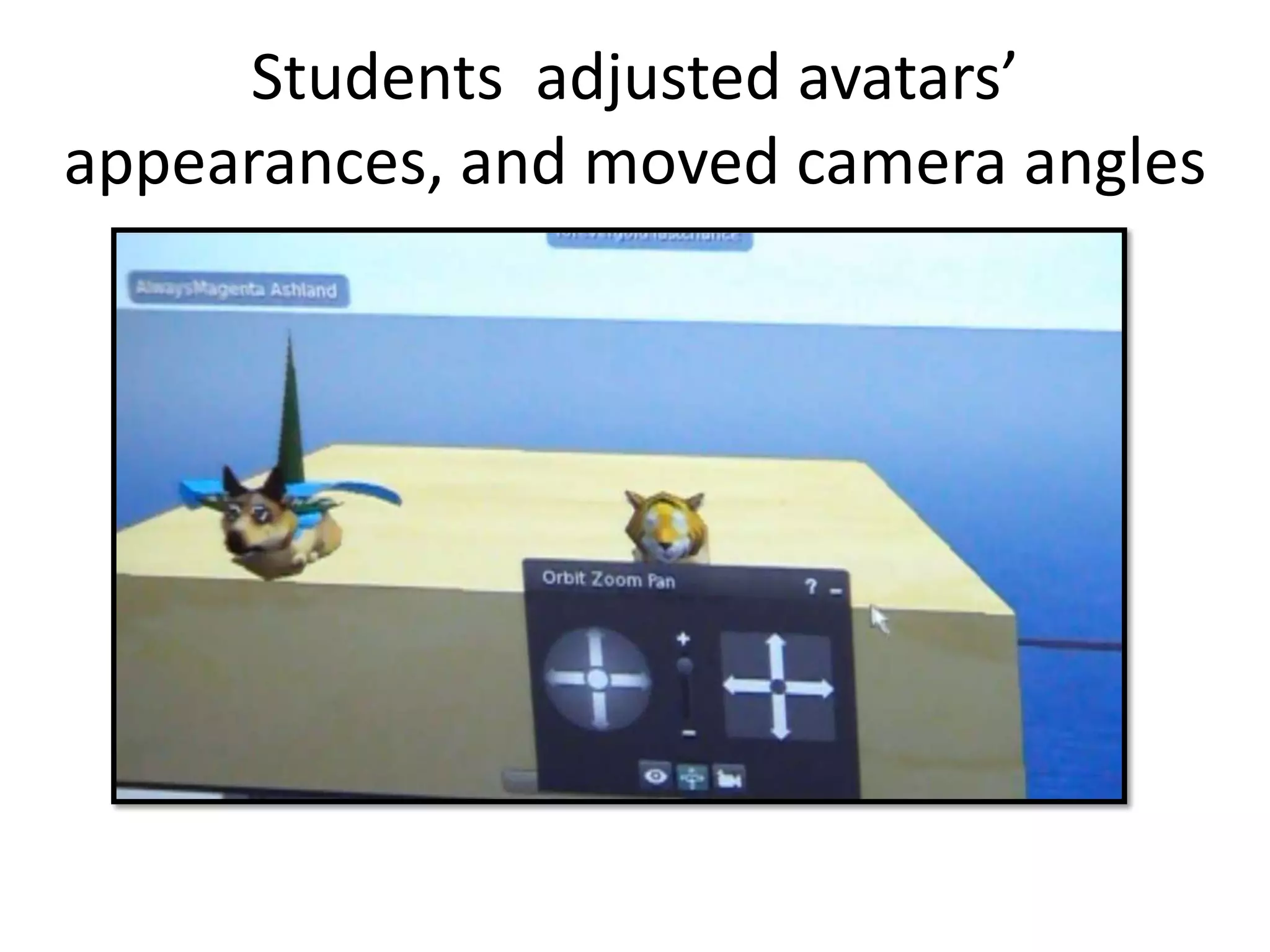
Students adjusted avatars’
appearances, and moved camera angles
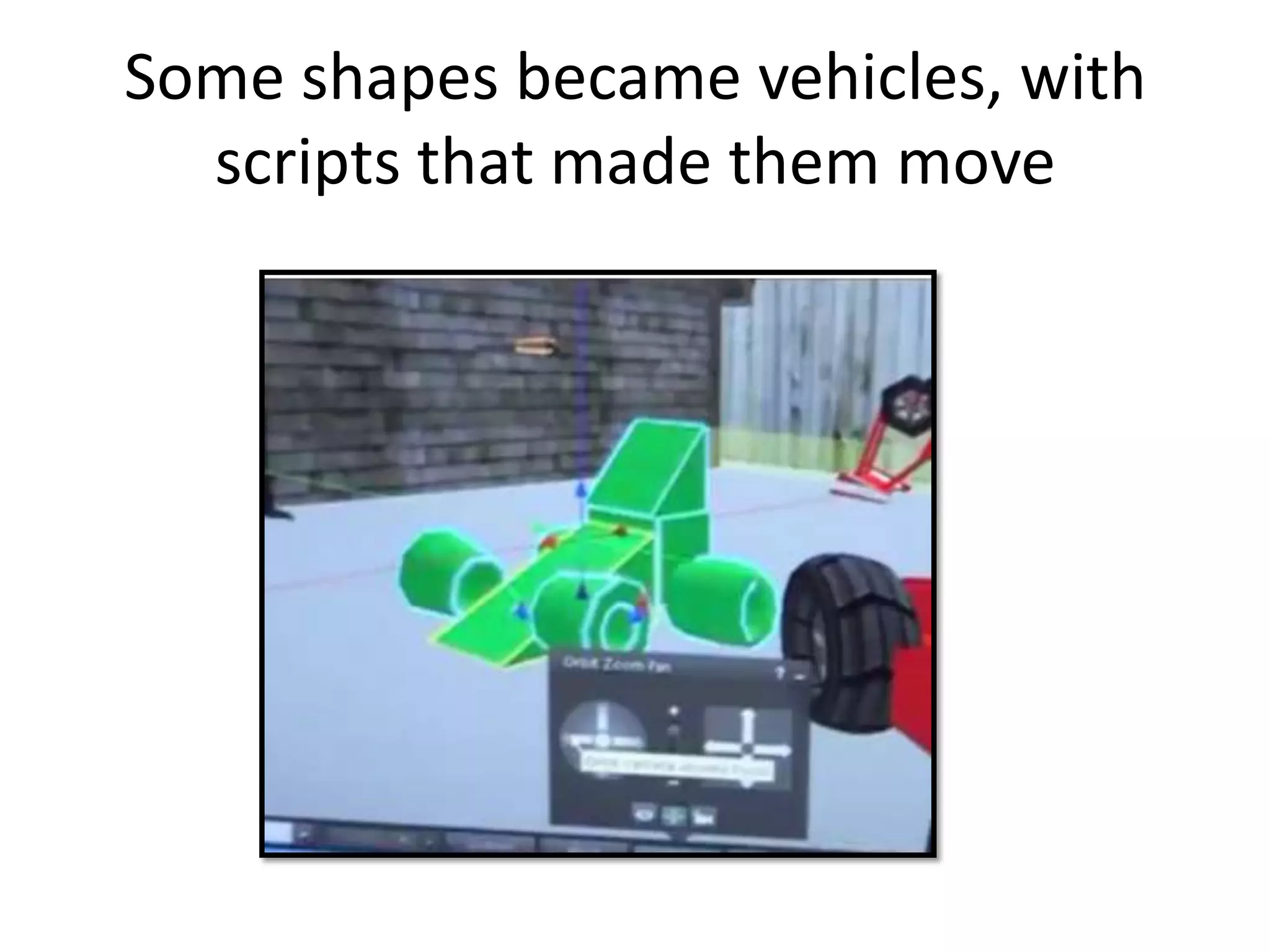
Some shapes became vehicles, with
  scripts that made them move
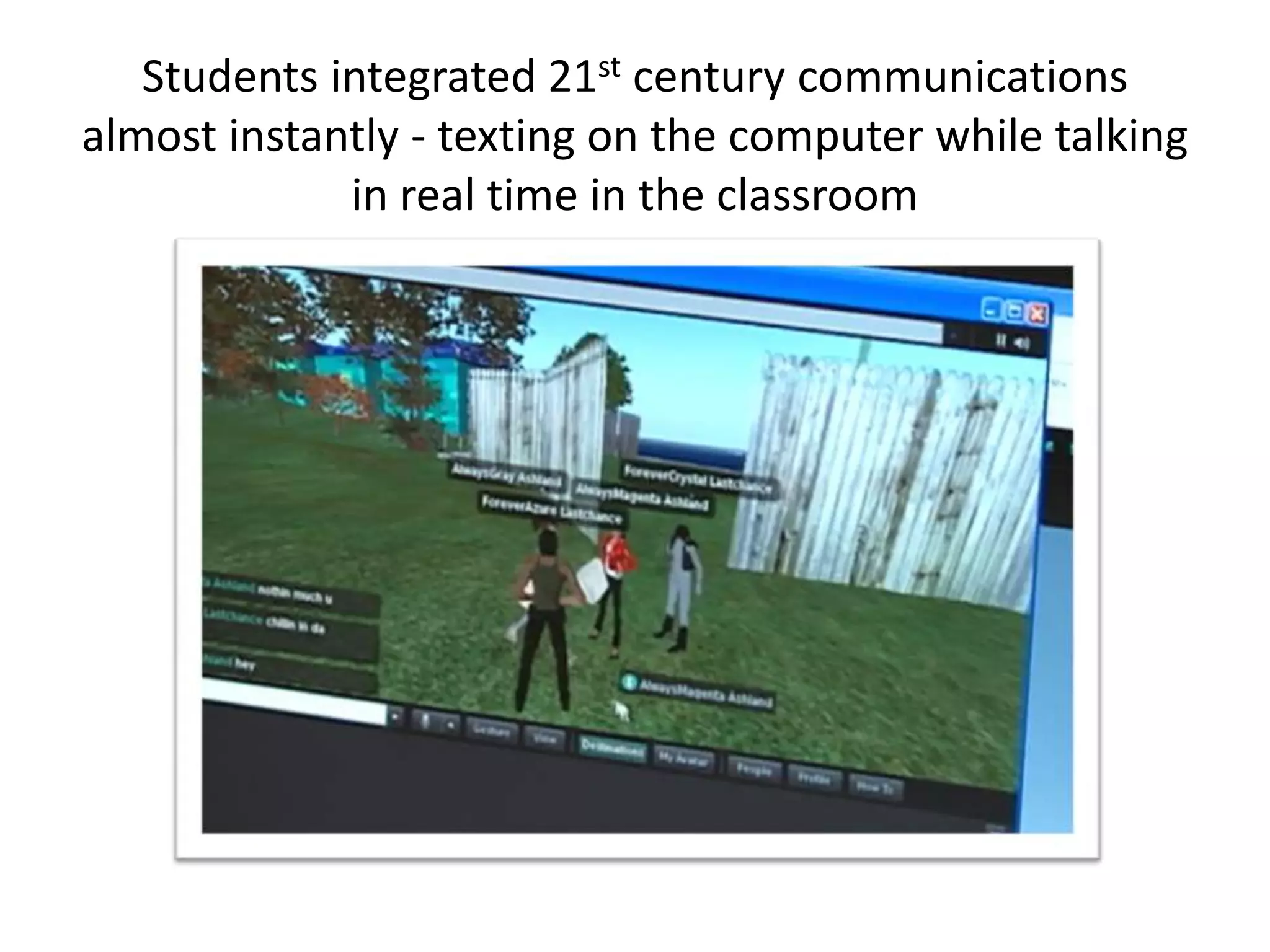
Students integrated 21st century communications
almost instantly - texting on the computer while talking
             in real time in the classroom
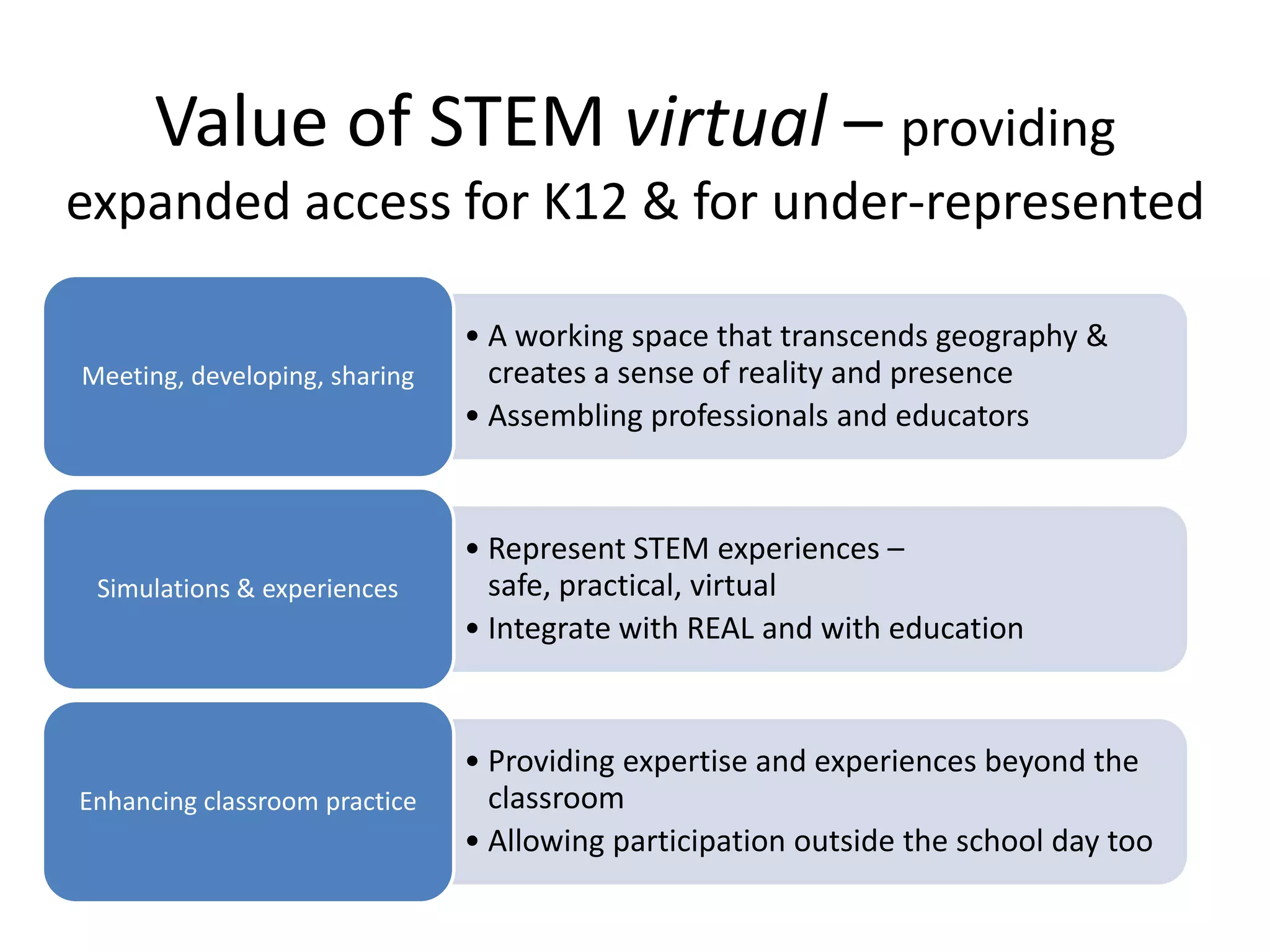
Value of STEM virtual – providing
expanded access for K12 & for under-represented

                               • A working space that transcends geography &
Meeting, developing, sharing     creates a sense of reality and presence
                               • Assembling professionals and educators


                               • Represent STEM experiences –
 Simulations & experiences       safe, practical, virtual
                               • Integrate with REAL and with education


                               • Providing expertise and experiences beyond the
Enhancing classroom practice     classroom
                               • Allowing participation outside the school day too
Virtually any application is
possible

and, context, proximity, and creativity
DO make a difference

Eileen.Oconnor@esc.edu
Eileen A. O'Connor, Ph.D. (Eileen.oconnor@esc.edu )
Recent Publications – Emerging technologies:

O’Connor, E. A. (in press). Developing effective online collaborative science projects by using course scaffolding, a virtual
world, and web 2.0 technologies. Society for Information Technology & Teacher Education International Conference 2012.

Abendroth, M.A., Golzy, J., & O’Connor, E.A. (in press). Self-created YouTube recordings of microteachings: their effects upon
candidates’ readiness for teaching and instructors’ assessment. Journal of Educational Technology Systems.

O’Connor, E. A. (in press). A survival guide from an early adopter: how Web 2.0 and the right attitude can enable learning and
expansive course design. Journal of Educational Technology Systems

O’Connor, E. (2011). Practical considerations when using virtual spaces for learning and collaboration, with minimal setup and
support. In H. H. Yang, & S. C. Yuen (Eds.), Handbook of Research on Practices and Outcomes in Virtual Worlds and Environment.
Hershey PA: IGI Global.

O’Connor, E. A. (2011) Migrating Towards K12 in Virtual Spaces: Second Life Lessons Learned as Higher Education Meets Middle
School Students. Published with the AACE Society for Information Technology & Teacher Education International
Conference, March 2011

O’Connor, E.A. (June 2010) Using Second Life (a virtual reality) in Language Instruction: Practical Advice on Getting Started;
published with the proceedings of the 4th International Scientific and Methodological Conference
on "Information and Communication Technologies in Foreign Language Teaching‖

O’Connor, E. A. (2010- 2011) The effect on learning, communication, and assessment when student-created YouTubes of
microteaching were used in an online teacher-education course. Journal of Educational Technology Systems, 39(2), pp. 135-154.
O’Connor, E. A. (2010) Practical Considerations When Using Virtual Spaces for Learning and Collaboration, with Minimal Setup
and Support. A book chapter published in the Handbook of Research on Practices and Outcomes in Virtual Worlds and
Environment, IGI Global publishers
Eileen A. O'Connor, Ph.D. (Eileen.oconnor@esc.edu )
Recent Publications – Emerging technologies:
O’Connor, E. A. The Use of a Wiki in Teacher Education: How Does Learning and
Instruction Change When Work Can ―Go Public‖? Published with the AACE Society
for Information Technology & Teacher Education International Conference in March
2010

O’Connor, E. A. (2009-2010) Instructional and Design Elements that Support Effective
Use of Virtual Worlds: What Graduate Student Work Reveals about Second Life.
Journal of Educational Technology Systems, 38(2), pp. 214 – 234.

O’Connor, E. A. and Sakshaug, L. (2009) Preparing for Second Life: Two Teacher
Educators Reflect on Their Initial Foray into Virtual Teaching and Learning, Journal of
Educational Technology Systems, 37(3), pp. 259-272.

O'Connor, E. (2008). Becoming a Virtual Instructor: How Can Higher Education Faculty
Prepare for Second Life?. In G. Richards (Ed.), Proceedings of World Conference on E-
Learning in Corporate, Government, Healthcare, and Higher Education 2008 (pp.
1144-1149). Chesapeake, VA: AACE.

O’Connor, E. A. (2008) Initial Study of Pre-Service Teachers’ Comments on a Reality-
Based, Urban-Student Video Streamed within an Online Course, Journal of
Educational Technology Systems, 37(2), pp. 139-158.

Educational uses of virtual realities

  • 1.
    SECOND LIFE &VIRTUAL WORLDS – A SHORT PICTORIAL HISTORY OF DEVELOPING DIFFERENT TYPES OF VIRTUAL LEARNING COMMUNITIES Eileen O’Connor, Ph.D. Empire State College Eileen.oconnor@esc.edu
  • 2.
    What will beaddressed  The following is largely a pictorial essay on different types of applications that have been created by Dr. Eileen O’Connor  The first slides show simple college & graduate applications  ending with a metaphor  The next slides show K12 uses – from pilot work – and show increasing more sophisticated graduate applications  The end has peer-reviewed publications related to Dr. O’Connor’s work
  • 3.
    Key considerations inany virtual design for education Applications ranging from college and graduate school to K12 will be How do they What do they highlighted learn what’s do there? going on and What how to behave? expected? How do you teach & assess them?
  • 4.
    Some startup graduate/college applications Use simple startups ideas  Meeting, interactions, discussions  Find existing materials, virtual islands, activities that are already in existence  Have student create some simple virtual development  Practice as a meeting space for your own work first
  • 5.
    Graduate students startedat the MAT Science Center for meetings & presentations
  • 6.
    Students across thestate give virtual presentations of their own work, plans, activities and ideas
  • 7.
    They met withthe Dean
  • 8.
    Took Field Trips:International Society for Technology in Education (ISTE)
  • 9.
    Had class meetingusing ISTE space
  • 10.
    Visited virtual science:such as the National Oceanographic & Atmospheric Administration (NOAA)
  • 11.
    NOAA – virtual,real-time weather Map (Northeast)
  • 12.
    Much more ispossible too in all content areas
  • 16.
    Best expressed throughan instructional metaphor: like designing an intelligent experience (field trip / discussions / role playing / construction) . . . with an assessment Discussions / collaborations / role playing Explorations Building / More advanced - Field trips uses creating - Simulations
  • 17.
    Over time, thescience-education applications moved into a private space  Thus, K12 applications were possible (still under research and study)  A science-education island was designed (looked like the USA); virtual meetings and presentations continued  NOW though students (pre-service teachers) did some basic development too  K12 pilots have been conducted too
  • 19.
    “Pods” were created in summer 2011 so that pre- service grad students could create & share science projects New science pod area
  • 20.
    The new science“pods” – empty at first To be developed by graduate students – with minimal knowledge of Second Life
  • 21.
    Later, students createdpods & presented their science projects within their team pods Genuine sharing, community & caring was evident; students asked relevant questions & added extending ideas – all at a distance
  • 22.
    A few morestudent-created pod areas on the private island
  • 23.
    A few morestudent-created pod areas on the private island
  • 24.
    Some of work reportedin the pods included science studies with K12 students that had actually been conducted
  • 25.
    Now that aprivate space existed, K12 students could be brought in too, as was begun in 2009  In fall 2009 & spring 2010, a pilot with 9 students was conducted – the students met, researched (using internet), and then presented in the space  Results reported at conference  Peer reviewer paper now available on this pilot (see the end of this presentation)
  • 26.
    The STEM ExploratoryReal/Virtual Environment (SER/VE) – the main Science Center w/ the bulk of the meetings and interactions during the pilot
  • 28.
    At the endof the 6 weeks of research and development, the K12 students gave final presentations
  • 29.
    The students &judges were very engaged  they came forward to see better
  • 30.
    Efforts to integrateK12 students continue  30 students from the Science Technology Entry Program from a summer workshop at U-Albany participated during 2011  This cohort were from under-represented STEM groups  The results were reported at a SUNY STEM conference in Nov. 2011 at the Crowne Plaza in Albany  More on this project – http://www.slideshare.net/eoconnor/serve-the-stem- exploratory-realvirtual-environment
  • 31.
    For the firstday, students used the 2- dimensional shapes in Microsoft’s drawing program to develop game ideas
  • 32.
    That afternoon theytested avatar appearance and clothing
  • 33.
    By the secondafternoon, students are ready for more creative uses of SER/VE
  • 34.
  • 35.
  • 36.
    Some shapes becamevehicles, with scripts that made them move
  • 37.
    Students integrated 21stcentury communications almost instantly - texting on the computer while talking in real time in the classroom
  • 38.
    Value of STEMvirtual – providing expanded access for K12 & for under-represented • A working space that transcends geography & Meeting, developing, sharing creates a sense of reality and presence • Assembling professionals and educators • Represent STEM experiences – Simulations & experiences safe, practical, virtual • Integrate with REAL and with education • Providing expertise and experiences beyond the Enhancing classroom practice classroom • Allowing participation outside the school day too
  • 39.
    Virtually any applicationis possible and, context, proximity, and creativity DO make a difference Eileen.Oconnor@esc.edu
  • 40.
    Eileen A. O'Connor,Ph.D. (Eileen.oconnor@esc.edu ) Recent Publications – Emerging technologies: O’Connor, E. A. (in press). Developing effective online collaborative science projects by using course scaffolding, a virtual world, and web 2.0 technologies. Society for Information Technology & Teacher Education International Conference 2012. Abendroth, M.A., Golzy, J., & O’Connor, E.A. (in press). Self-created YouTube recordings of microteachings: their effects upon candidates’ readiness for teaching and instructors’ assessment. Journal of Educational Technology Systems. O’Connor, E. A. (in press). A survival guide from an early adopter: how Web 2.0 and the right attitude can enable learning and expansive course design. Journal of Educational Technology Systems O’Connor, E. (2011). Practical considerations when using virtual spaces for learning and collaboration, with minimal setup and support. In H. H. Yang, & S. C. Yuen (Eds.), Handbook of Research on Practices and Outcomes in Virtual Worlds and Environment. Hershey PA: IGI Global. O’Connor, E. A. (2011) Migrating Towards K12 in Virtual Spaces: Second Life Lessons Learned as Higher Education Meets Middle School Students. Published with the AACE Society for Information Technology & Teacher Education International Conference, March 2011 O’Connor, E.A. (June 2010) Using Second Life (a virtual reality) in Language Instruction: Practical Advice on Getting Started; published with the proceedings of the 4th International Scientific and Methodological Conference on "Information and Communication Technologies in Foreign Language Teaching‖ O’Connor, E. A. (2010- 2011) The effect on learning, communication, and assessment when student-created YouTubes of microteaching were used in an online teacher-education course. Journal of Educational Technology Systems, 39(2), pp. 135-154. O’Connor, E. A. (2010) Practical Considerations When Using Virtual Spaces for Learning and Collaboration, with Minimal Setup and Support. A book chapter published in the Handbook of Research on Practices and Outcomes in Virtual Worlds and Environment, IGI Global publishers
  • 41.
    Eileen A. O'Connor,Ph.D. (Eileen.oconnor@esc.edu ) Recent Publications – Emerging technologies: O’Connor, E. A. The Use of a Wiki in Teacher Education: How Does Learning and Instruction Change When Work Can ―Go Public‖? Published with the AACE Society for Information Technology & Teacher Education International Conference in March 2010 O’Connor, E. A. (2009-2010) Instructional and Design Elements that Support Effective Use of Virtual Worlds: What Graduate Student Work Reveals about Second Life. Journal of Educational Technology Systems, 38(2), pp. 214 – 234. O’Connor, E. A. and Sakshaug, L. (2009) Preparing for Second Life: Two Teacher Educators Reflect on Their Initial Foray into Virtual Teaching and Learning, Journal of Educational Technology Systems, 37(3), pp. 259-272. O'Connor, E. (2008). Becoming a Virtual Instructor: How Can Higher Education Faculty Prepare for Second Life?. In G. Richards (Ed.), Proceedings of World Conference on E- Learning in Corporate, Government, Healthcare, and Higher Education 2008 (pp. 1144-1149). Chesapeake, VA: AACE. O’Connor, E. A. (2008) Initial Study of Pre-Service Teachers’ Comments on a Reality- Based, Urban-Student Video Streamed within an Online Course, Journal of Educational Technology Systems, 37(2), pp. 139-158.

Editor's Notes

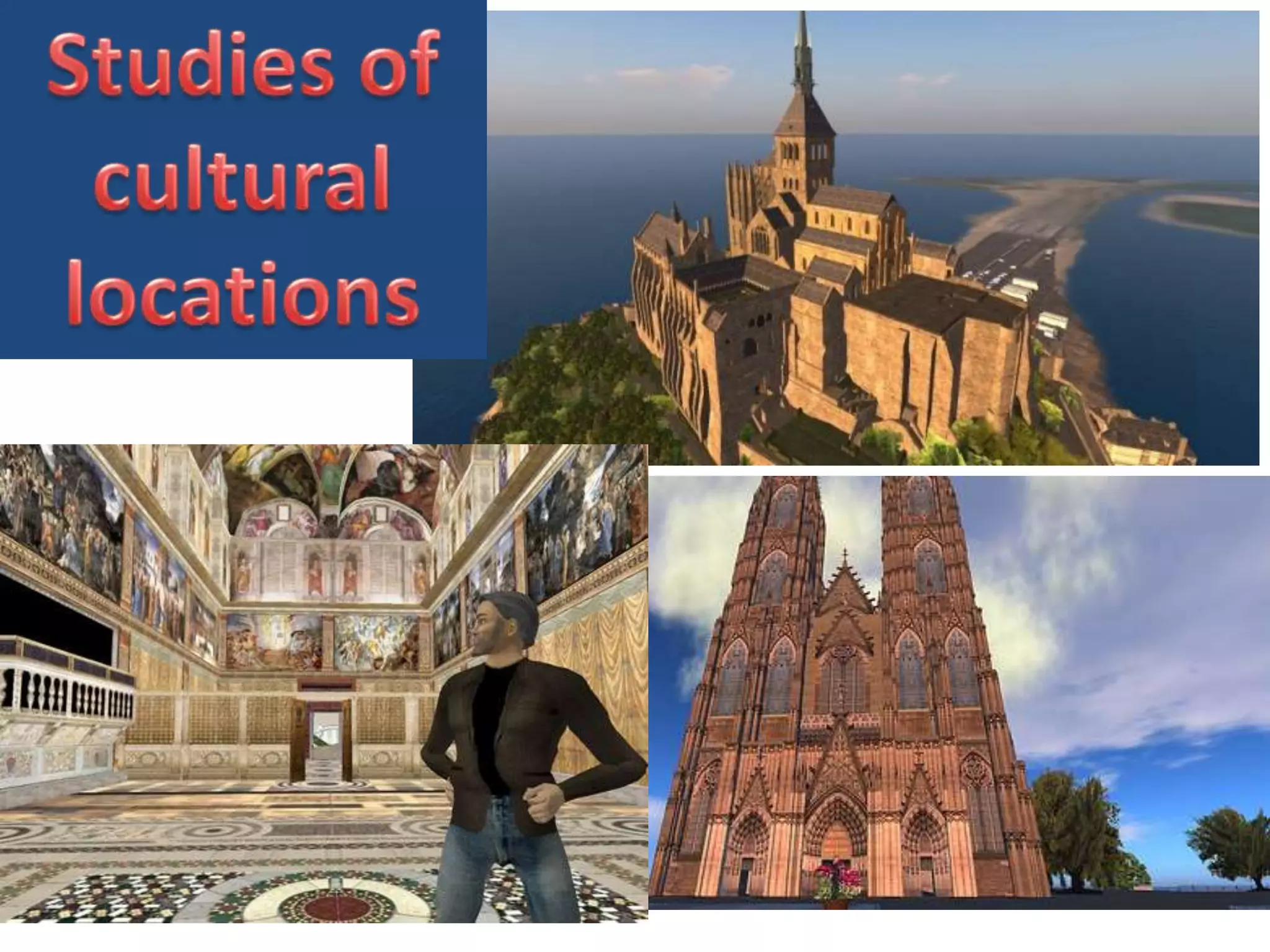
  • #15 this recreation of Le Mont Saint Michel off the coast of France; this recreation of Le Mont Saint Michel off the coast
  • #38 Texting and talking
  • #40 G