

PRESENTATION
ON
PERFORMANCE APPRAISAL
AT
AIRPORTS AUTHORITY OF INDIA
NEW DELHI
Presented By:
Palak Gupta
MBA-HR (2nd)
R.NO. 01213014
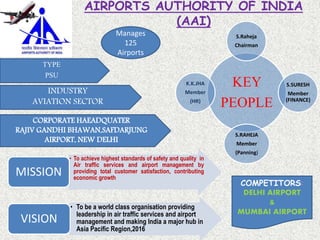
TYPE
PSU
INDUSTRY
AVIATION SECTOR
CORPORATE HAEADQUATER
RAJIV GANDHI BHAWAN,SAFDARJUNG
AIRPORT, NEW DELHI
KEY
PEOPLE
S.Raheja
Chairman
S.SURESH
Member
(FINANCE)
S.RAHEJA
Member
(Panning)
K.K.JHA
Member
(HR)
AIRPORTS AUTHORITY OF INDIA
(AAI)
• To achieve highest standards of safety and quality in
Air traffic services and airport management by
providing total customer satisfaction, contributing
economic growth
MISSION
• To be a world class organisation providing
leadership in air traffic services and airport
management and making India a major hub in
Asia Pacific Region,2016
VISION
Manages
125
Airports
COMPETITORS:
DELHI AIRPORT
&
MUMBAI AIRPORT
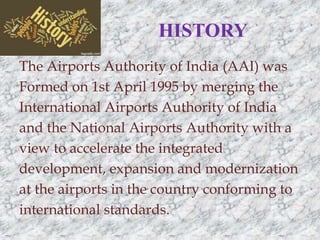
HISTORY
The Airports Authority of India (AAI) was
Formed on 1st April 1995 by merging the
International Airports Authority of India
and the National Airports Authority with a
view to accelerate the integrated
development, expansion and modernization
at the airports in the country conforming to
international standards.
INDUSTRY PROFILE
(AVIATION SECTOR)
 Indian Aviation Industry is one of the fastest growing airline industries in the
world. The history of Indian Aviation Industry started in December 1912 with
its first domestic air route between Karachi and Delhi.
 The civil aviation market in India is all set to become the world's third largest
by 2020 and has allowed 100 per cent foreign direct investment (FDI) .
 Aviation Sector enters into the new era by modernizing Airports, Low cost
Airlines, Strengthening of runways etc.
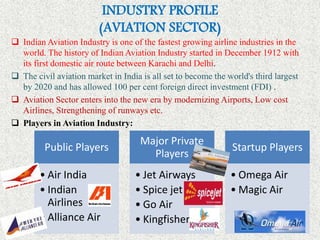
 Players in Aviation Industry:
Public Players
• Air India
• Indian
Airlines
• Alliance Air
Major Private
Players
• Jet Airways
• Spice jet
• Go Air
• Kingfisher
Startup Players
• Omega Air
• Magic Air
AVIATION SECTOR: SOME FACTS
In present scenario around 11 domestic airlines operating in India
Growth of airlines traffic in Aviation Industry in India is almost four
times above international average
Type of market
In 1953, all airlines merged into Indian Airlines or Air India
Monopoly perpetuated for next 40 years
Controlled by Directorate General of Civil Aviation
On 1 March 1994, Government open the gates for private entrants
Sensing a huge opportunity, a large number of players jumped into
the fray
Now the market is Oligopoly
India is currently the ninth largest aviation market in the world
PERFORMANCE APPRAISAL
Manpower Management is a most crucial job because “managing people is the heart
and essence of being a manager”
 Performance appraisal offers an excellent opportunity - perhaps the best that will
ever
occur - for a supervisor and subordinate to recognize and agree upon individual
training and development needs.
 Performance appraisal can make the need for training more pressing and relevant by
linking it clearly to performance outcomes and future career aspirations.
Some of the training cells of AAI are NIAMAR, Delhi and CATC, Allahabad for
training & development of the employees.
Performance Appraisal is done ANNUALLY at Airports
Authority of India.
OBJECTIVES OF PERFORMANCE
APPRAISAL AT AAI
• To use performance appraisal as a process for development.
• To generate significant, relevant, open and valid information about the
employee’s performance based on Key Performance Area’s(KPA’s)
• To realign the Organizational/Departmental objectives with individual
objectives
• To evaluate potential of the employees to assure higher responsibilities.
• To identify the high performance for rewards.
• To bring out openness
• To identify training needs
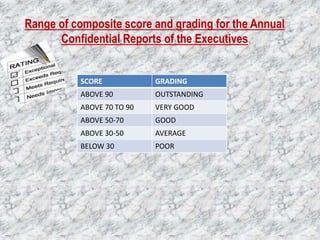
Range of composite score and grading for the Annual
Confidential Reports of the Executives
SCORE GRADING
ABOVE 90 OUTSTANDING
ABOVE 70 TO 90 VERY GOOD
ABOVE 50-70 GOOD
ABOVE 30-50 AVERAGE
BELOW 30 POOR
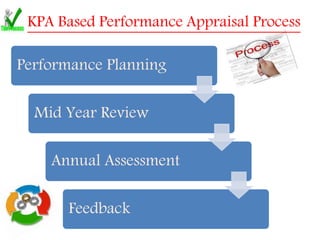
Performance Planning
Mid Year Review
Annual Assessment
Feedback
KPA Based Performance Appraisal Process
MAJOR FINDINGS
• Most of the officers agrees that in an appraisal system employee
should be given an opportunity to rate his own performance
• Most of the respondents agrees that a good performance system
should take into consideration the problems the employees faces
in performing his job.
• Some of the respondents strongly felt that the employee should
know the Boss’s thinking and get an opportunity to have a
dialogue with him.
• Mostly respondents are very confident that the present system
will succeed but those who are somewhat confident emphasized
the need of training and more workshops for orientation.
SUGGESTIONS
• Consistent and ongoing training for managers
and supervisors is essential for its success.
• The appraisal process should be continually
under Review.
• Discuss the overall yearly record to identify
the tasks that were performed well and those
that require improvement.
• Employees should get a chance to
communicate with their boss to know his/her
strengths & weakness.
CONCLUSION
In Conclusion:
The attitude of the Officers was found to be generally positive towards
Performance Appraisal System. They consider Performance Appraisal
as an important tool in growth and development. The present Performance
Appraisal System has been found effective by the Airports Authority of India
officers in the following areas:
• Identification of Strengths and Weaknesses of the employees.
• Identification of training needs.
• Setting operational objectives.
Present Performance Appraisal System is an improvement over previous
system of confidential reports.
Performance aPPRAISAL at AAI ppt

Performance aPPRAISAL at AAI ppt

  • 1.
    PRESENTATION ON PERFORMANCE APPRAISAL AT AIRPORTS AUTHORITYOF INDIA NEW DELHI Presented By: Palak Gupta MBA-HR (2nd) R.NO. 01213014
  • 2.
    TYPE PSU INDUSTRY AVIATION SECTOR CORPORATE HAEADQUATER RAJIVGANDHI BHAWAN,SAFDARJUNG AIRPORT, NEW DELHI KEY PEOPLE S.Raheja Chairman S.SURESH Member (FINANCE) S.RAHEJA Member (Panning) K.K.JHA Member (HR) AIRPORTS AUTHORITY OF INDIA (AAI) • To achieve highest standards of safety and quality in Air traffic services and airport management by providing total customer satisfaction, contributing economic growth MISSION • To be a world class organisation providing leadership in air traffic services and airport management and making India a major hub in Asia Pacific Region,2016 VISION Manages 125 Airports COMPETITORS: DELHI AIRPORT & MUMBAI AIRPORT
  • 3.
    HISTORY The Airports Authorityof India (AAI) was Formed on 1st April 1995 by merging the International Airports Authority of India and the National Airports Authority with a view to accelerate the integrated development, expansion and modernization at the airports in the country conforming to international standards.
  • 5.
    INDUSTRY PROFILE (AVIATION SECTOR) Indian Aviation Industry is one of the fastest growing airline industries in the world. The history of Indian Aviation Industry started in December 1912 with its first domestic air route between Karachi and Delhi.  The civil aviation market in India is all set to become the world's third largest by 2020 and has allowed 100 per cent foreign direct investment (FDI) .  Aviation Sector enters into the new era by modernizing Airports, Low cost Airlines, Strengthening of runways etc.  Players in Aviation Industry: Public Players • Air India • Indian Airlines • Alliance Air Major Private Players • Jet Airways • Spice jet • Go Air • Kingfisher Startup Players • Omega Air • Magic Air
  • 6.
    AVIATION SECTOR: SOMEFACTS In present scenario around 11 domestic airlines operating in India Growth of airlines traffic in Aviation Industry in India is almost four times above international average Type of market In 1953, all airlines merged into Indian Airlines or Air India Monopoly perpetuated for next 40 years Controlled by Directorate General of Civil Aviation On 1 March 1994, Government open the gates for private entrants Sensing a huge opportunity, a large number of players jumped into the fray Now the market is Oligopoly India is currently the ninth largest aviation market in the world
  • 7.
    PERFORMANCE APPRAISAL Manpower Managementis a most crucial job because “managing people is the heart and essence of being a manager”  Performance appraisal offers an excellent opportunity - perhaps the best that will ever occur - for a supervisor and subordinate to recognize and agree upon individual training and development needs.  Performance appraisal can make the need for training more pressing and relevant by linking it clearly to performance outcomes and future career aspirations. Some of the training cells of AAI are NIAMAR, Delhi and CATC, Allahabad for training & development of the employees. Performance Appraisal is done ANNUALLY at Airports Authority of India.
  • 8.
    OBJECTIVES OF PERFORMANCE APPRAISALAT AAI • To use performance appraisal as a process for development. • To generate significant, relevant, open and valid information about the employee’s performance based on Key Performance Area’s(KPA’s) • To realign the Organizational/Departmental objectives with individual objectives • To evaluate potential of the employees to assure higher responsibilities. • To identify the high performance for rewards. • To bring out openness • To identify training needs
  • 9.
    Range of compositescore and grading for the Annual Confidential Reports of the Executives SCORE GRADING ABOVE 90 OUTSTANDING ABOVE 70 TO 90 VERY GOOD ABOVE 50-70 GOOD ABOVE 30-50 AVERAGE BELOW 30 POOR
  • 10.
    Performance Planning Mid YearReview Annual Assessment Feedback KPA Based Performance Appraisal Process
  • 11.
    MAJOR FINDINGS • Mostof the officers agrees that in an appraisal system employee should be given an opportunity to rate his own performance • Most of the respondents agrees that a good performance system should take into consideration the problems the employees faces in performing his job. • Some of the respondents strongly felt that the employee should know the Boss’s thinking and get an opportunity to have a dialogue with him. • Mostly respondents are very confident that the present system will succeed but those who are somewhat confident emphasized the need of training and more workshops for orientation.
  • 12.
    SUGGESTIONS • Consistent andongoing training for managers and supervisors is essential for its success. • The appraisal process should be continually under Review. • Discuss the overall yearly record to identify the tasks that were performed well and those that require improvement. • Employees should get a chance to communicate with their boss to know his/her strengths & weakness.
  • 13.
    CONCLUSION In Conclusion: The attitudeof the Officers was found to be generally positive towards Performance Appraisal System. They consider Performance Appraisal as an important tool in growth and development. The present Performance Appraisal System has been found effective by the Airports Authority of India officers in the following areas: • Identification of Strengths and Weaknesses of the employees. • Identification of training needs. • Setting operational objectives. Present Performance Appraisal System is an improvement over previous system of confidential reports.