
Bubble deck slab
K.Renuka
14L41A0113
Technical seminar
on
Bubble deck slab
Contents:
• Introduction
 Type of bubble decks
 Materials
 construction
 Experimental studies
 advantages
 Case study
 Conclusion
Introduction:
 Eliminating all concrete.
 Reducing structural dead weight.
 Increasing the efficiency.
 Reduces the loads up to 30 to 50%.
 Less energy consumption.
 Used for storey, roof and ground floor slabs.
 It reduce earthquake damage.
Type of bubble decks:
 Type A- Filigree Elements
 Type B- Reinforcement Modules
 Type C- Finished Planks
Type A- Filigree Elements:
•Type-A is a combination of constructed and unconstructed
elements.
•Act as formwork and part of the finished depth .
•Supported by temporary stands.
•Additional steel may be inserted.
•techniques and finished as necessary
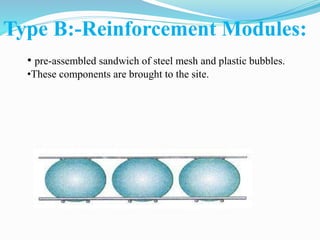
Type B:-Reinforcement Modules:
• pre-assembled sandwich of steel mesh and plastic bubbles.
•These components are brought to the site.
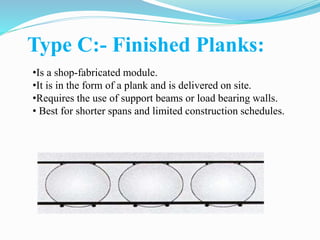
Type C:- Finished Planks:
•Is a shop-fabricated module.
•It is in the form of a plank and is delivered on site.
•Requires the use of support beams or load bearing walls.
• Best for shorter spans and limited construction schedules.
MATERIALS:
CONCREAT -the concrete is made of standard
Portland cement with max aggregate size of ¾ inch
STEEL-The steel
reinforcement is of MS
or HYSD can be used.
PLASTIC SPHERES
•hollow spheres made from
recycled high density
polyethylene.
Enough strength & rigidity.
Not porous.
Doesnt react chemically
with concrete or steel.
construction:
 The minimum distance between gaps is 1/9 of the gap diameter.
 Bubble Deck slab elements are plates with ribs on two
directions made of reinforced concrete .
 Connected with vertical ribs that go around the gaps.
 First construct bottom concrete part and then upper concrete
part.
EXPERIMENTAL STUDIES:
 1.Shear strength-80% of solid deck slab.
 2.Deflections -same as solid deck.
 3.Weight-40% less than a solid slab.
 4.Fire resistance -65% of solid slab.
ADVANTAGES:
Construction
 Easy incorporation of ducts and pipes into slab.
 Less work on construction site.
 Light in weight less equipment is required
 Earthquake resistant designs
Environment
•Less material and energy consumption
•Reducing CO2.
•Economy.
•Sustaining the natural resources.
•Faster construction time.
•MILLENNIUM TOWER
(ROTTERDAM)
•First high rise building erected with
Bubble Deck with 131m height
• Second Highest building in
Netherlands with 34 stores.
CASE STUDY:
SCOPE OF FUTURE USE:
•Used for constructing all types of building especially sky scrapers
•Best for larger span halls like theatres and auditoriums
•Pedestrian bridge decks
•Used in parking areas as less number of columns are required
CONCLUSION:
• Obviously this intellectual slab design may become the
future of slab construction which gives a tremendous
contribution in Sustainable development
BUBBLE DECK SLAB
BUBBLE DECK SLAB

BUBBLE DECK SLAB

  • 1.
  • 2.
  • 3.
    Contents: • Introduction  Typeof bubble decks  Materials  construction  Experimental studies  advantages  Case study  Conclusion
  • 4.
    Introduction:  Eliminating allconcrete.  Reducing structural dead weight.  Increasing the efficiency.  Reduces the loads up to 30 to 50%.  Less energy consumption.  Used for storey, roof and ground floor slabs.  It reduce earthquake damage.
  • 5.
    Type of bubbledecks:  Type A- Filigree Elements  Type B- Reinforcement Modules  Type C- Finished Planks
  • 6.
    Type A- FiligreeElements: •Type-A is a combination of constructed and unconstructed elements. •Act as formwork and part of the finished depth . •Supported by temporary stands. •Additional steel may be inserted. •techniques and finished as necessary
  • 7.
    Type B:-Reinforcement Modules: •pre-assembled sandwich of steel mesh and plastic bubbles. •These components are brought to the site.
  • 8.
    Type C:- FinishedPlanks: •Is a shop-fabricated module. •It is in the form of a plank and is delivered on site. •Requires the use of support beams or load bearing walls. • Best for shorter spans and limited construction schedules.
  • 9.
    MATERIALS: CONCREAT -the concreteis made of standard Portland cement with max aggregate size of ¾ inch STEEL-The steel reinforcement is of MS or HYSD can be used. PLASTIC SPHERES •hollow spheres made from recycled high density polyethylene. Enough strength & rigidity. Not porous. Doesnt react chemically with concrete or steel.
  • 10.
    construction:  The minimumdistance between gaps is 1/9 of the gap diameter.  Bubble Deck slab elements are plates with ribs on two directions made of reinforced concrete .  Connected with vertical ribs that go around the gaps.  First construct bottom concrete part and then upper concrete part.
  • 11.
    EXPERIMENTAL STUDIES:  1.Shearstrength-80% of solid deck slab.  2.Deflections -same as solid deck.  3.Weight-40% less than a solid slab.  4.Fire resistance -65% of solid slab.
  • 12.
    ADVANTAGES: Construction  Easy incorporationof ducts and pipes into slab.  Less work on construction site.  Light in weight less equipment is required  Earthquake resistant designs Environment •Less material and energy consumption •Reducing CO2. •Economy. •Sustaining the natural resources. •Faster construction time.
  • 13.
    •MILLENNIUM TOWER (ROTTERDAM) •First highrise building erected with Bubble Deck with 131m height • Second Highest building in Netherlands with 34 stores. CASE STUDY:
  • 14.
    SCOPE OF FUTUREUSE: •Used for constructing all types of building especially sky scrapers •Best for larger span halls like theatres and auditoriums •Pedestrian bridge decks •Used in parking areas as less number of columns are required
  • 15.
    CONCLUSION: • Obviously thisintellectual slab design may become the future of slab construction which gives a tremendous contribution in Sustainable development