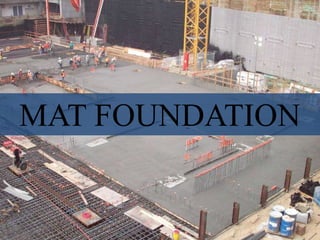
MAT FOUNDATION
Submitted by-
1. Sohanur Rahman Prince (1316006)
2. Syeda Khushnuma Wasim (1316011)
3. Md Alifnur Salim (1316016)
4. Md Razu Alam Raz (1316022)
5. Aliur Rahman Shuvo (1316027)
Bangladesh University of Engineering and Technology
A mat foundation is a thick
reinforced concrete slab
supporting arrangements of
columns or walls in a row or
rows and transmitting the loads
to the soil. It is used to support
storage tanks, industrial
equipment, silos, chimneys and
various tower structures.
WHAT IS A MAT FOUNDATION?
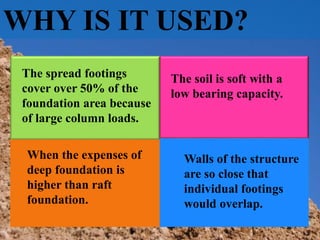
WHY IS IT USED?
When the expenses of

deep foundation is
higher than raft
foundation.
Walls of the structure
are so close that
individual footings
would overlap.
The spread footings
cover over 50% of the
foundation area because
of large column loads.
The soil is soft with a
low bearing capacity.
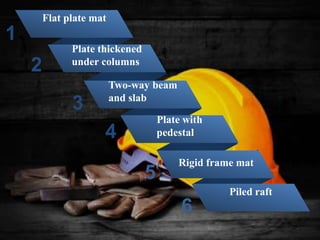
TYPES OF MAT FOUNDATION
1
2
Plate thickened
under columns
Flat plate mat
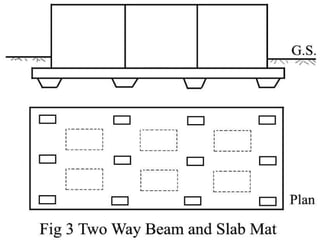
Two-way beam
and slab
3
4
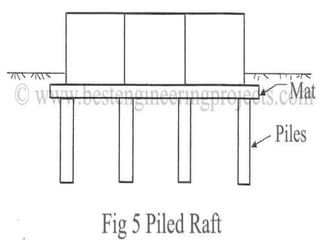
Plate with
pedestal
Piled raft
Rigid frame mat
5
6
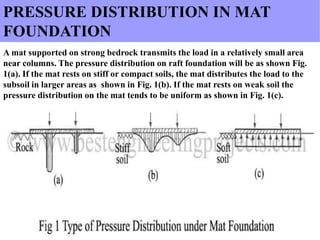
PRESSURE DISTRIBUTION IN MAT
FOUNDATION
A mat supported on strong bedrock transmits the load in a relatively small area
near columns. The pressure distribution on raft foundation will be as shown Fig.
1(a). If the mat rests on stiff or compact soils, the mat distributes the load to the
subsoil in larger areas as shown in Fig. 1(b). If the mat rests on weak soil the
pressure distribution on the mat tends to be uniform as shown in Fig. 1(c).
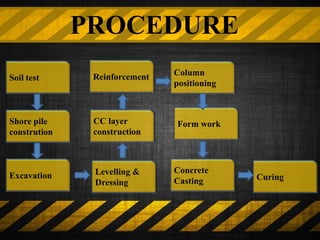
Soil test
Shore pile
constrution
Curing
Form work
Concrete
Casting
Excavation
Column
positioning
Reinforcement
Levelling &
Dressing
CC layer
construction
PROCEDURE
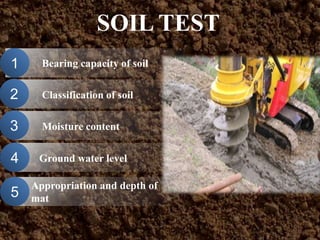
SOIL TEST
Bearing capacity of soil1
Classification of soil2
Moisture content3
Ground water level4
Appropriation and depth of
mat5
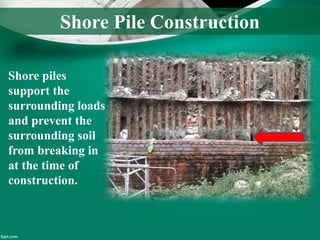
Shore Pile Construction
Shore piles
support the
surrounding loads
and prevent the
surrounding soil
from breaking in
at the time of
construction.
TIE BEAM
 A horizontal timber
connecting two structural
members to keep them
from spreading apart, as
a beam connecting the feet
of two principal rafters in
a roof truss.
It is constructed mainly
to join the piles of
border line
 It is attached to studs to
provide lateral support to
wall framing.
BRACING
 A horizontal support for
the boundary shores
during excavation and
foundation.
 Metal straps, timber or
sheet bracing can be used
for bracing
KING POST
A king post is a
central vertical
post used in
architectural or
bridge designs,
working in tension
to support a beam
below from a truss
apex above
EXCAVATION
Partial & Full
Excavation is required
before the Bracing,
Strutting, BFS &
Placement of
Reinforcement etc…
Levelling
Manual Leveling Machine Leveling
LEVELING
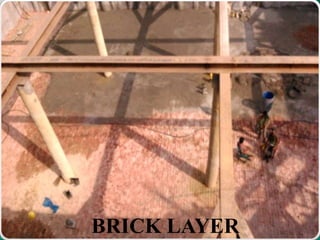
Brick layer
BRICK LAYER
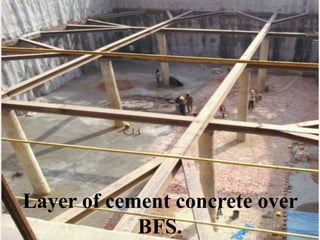
CC layer
Layer of cement concrete over
BFS.
Damp proof course
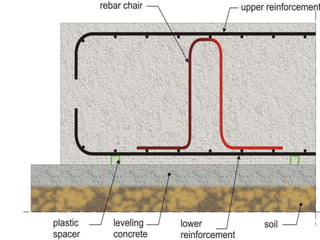
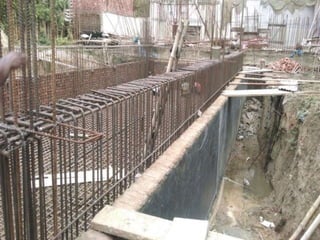
A batch of horizontal
reinforcement placing;
Another batch of reinforcement
placement to complete the
bottom mesh;
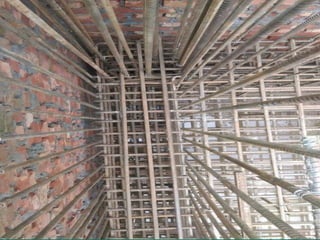
Column rod placement;
Vertical rod (chair) placement
over bottom mesh to hold the
upper mesh;
Upper mesh placement.
PLACING OF REINFORCEMENT
Column positioning
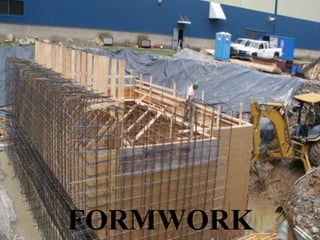
FORMWORK
• Formwork is a mold or open box, like container into
which fresh concrete is poured and compacted.
• When the concrete is set, the formwork is removed
and a solid mass is produced in the shape of the inner
face of the formwork.
• The top of the formwork is normally left open.
• False work is the necessary support system that
holds the formwork in the correct position.
FORMWORK
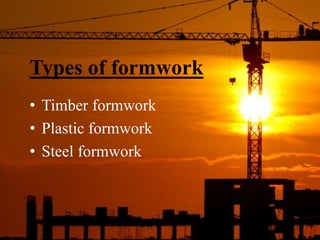
Types of formwork
• Timber formwork
• Plastic formwork
• Steel formwork
TIMBER FORMWORK
The formwork is built on site
out of timber and plywood or
moisture-resistant
particleboard. It is easy to
produce but time-consuming
for larger structures. It is still
used extensively where the
labour costs are lower than
the costs for procuring
reusable formwork.
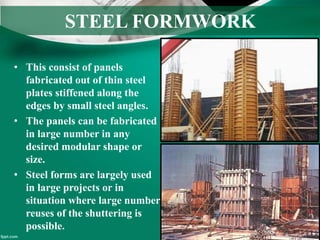
STEEL FORMWORK
• This consist of panels
fabricated out of thin steel
plates stiffened along the
edges by small steel angles.
• The panels can be fabricated
in large number in any
desired modular shape or
size.
• Steel forms are largely used
in large projects or in
situation where large number
reuses of the shuttering is
possible.
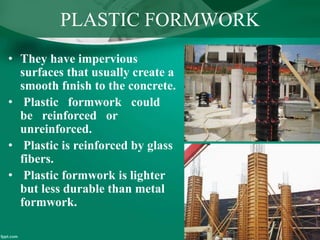
PLASTIC FORMWORK
• They have impervious
surfaces that usually create a
smooth fınish to the concrete.
• Plastic formwork could
be reinforced or
unreinforced.
• Plastic is reinforced by glass
fibers.
• Plastic formwork is lighter
but less durable than metal
formwork.
Clear cover is the least
distance between the surface
of embedded reinforcement
and the outer surface of the
concrete.
CLEAR COVER
1.Start from one end
2.Layer basis casting
3.Side basis casting
CASTING
COMPACTION
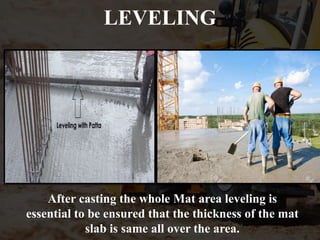
LEVELING
After casting the whole Mat area leveling is
essential to be ensured that the thickness of the mat
slab is same all over the area.
TYPES OF CURING
Shading concrete work
Covering concrete surface
with gunny bags
Sprinkling ofPonding method
Steam curing
1. Raft foundation is economic due to
combination of foundation & floor slab
2. Requires little excavation
3. can cope with mixed & poor ground
condition
4. it reduces different settlement .
ADVANTAGE OF MAT FOUNDATION
DISADVANTAGE OF MAT FOUNDATION
1. It requires specific treatment for point loads.
2. Edge erosion occurs if not treated properly
THANK YOU
ANY QUESTIONS?

Mat foundation

  • 1.
  • 2.
    Submitted by- 1. SohanurRahman Prince (1316006) 2. Syeda Khushnuma Wasim (1316011) 3. Md Alifnur Salim (1316016) 4. Md Razu Alam Raz (1316022) 5. Aliur Rahman Shuvo (1316027) Bangladesh University of Engineering and Technology
  • 3.
    A mat foundationis a thick reinforced concrete slab supporting arrangements of columns or walls in a row or rows and transmitting the loads to the soil. It is used to support storage tanks, industrial equipment, silos, chimneys and various tower structures. WHAT IS A MAT FOUNDATION?
  • 4.
    WHY IS ITUSED? When the expenses of deep foundation is higher than raft foundation. Walls of the structure are so close that individual footings would overlap. The spread footings cover over 50% of the foundation area because of large column loads. The soil is soft with a low bearing capacity.
  • 5.
    TYPES OF MATFOUNDATION
  • 6.
    1 2 Plate thickened under columns Flatplate mat Two-way beam and slab 3 4 Plate with pedestal Piled raft Rigid frame mat 5 6
  • 12.
    PRESSURE DISTRIBUTION INMAT FOUNDATION A mat supported on strong bedrock transmits the load in a relatively small area near columns. The pressure distribution on raft foundation will be as shown Fig. 1(a). If the mat rests on stiff or compact soils, the mat distributes the load to the subsoil in larger areas as shown in Fig. 1(b). If the mat rests on weak soil the pressure distribution on the mat tends to be uniform as shown in Fig. 1(c).
  • 13.
    Soil test Shore pile constrution Curing Formwork Concrete Casting Excavation Column positioning Reinforcement Levelling & Dressing CC layer construction PROCEDURE
  • 14.
    SOIL TEST Bearing capacityof soil1 Classification of soil2 Moisture content3 Ground water level4 Appropriation and depth of mat5
  • 15.
    Shore Pile Construction Shorepiles support the surrounding loads and prevent the surrounding soil from breaking in at the time of construction.
  • 16.
    TIE BEAM  Ahorizontal timber connecting two structural members to keep them from spreading apart, as a beam connecting the feet of two principal rafters in a roof truss. It is constructed mainly to join the piles of border line
  • 17.
     It isattached to studs to provide lateral support to wall framing. BRACING  A horizontal support for the boundary shores during excavation and foundation.  Metal straps, timber or sheet bracing can be used for bracing
  • 18.
    KING POST A kingpost is a central vertical post used in architectural or bridge designs, working in tension to support a beam below from a truss apex above
  • 19.
    EXCAVATION Partial & Full Excavationis required before the Bracing, Strutting, BFS & Placement of Reinforcement etc…
  • 20.
  • 21.
  • 22.
    CC layer Layer ofcement concrete over BFS.
  • 23.
  • 24.
    A batch ofhorizontal reinforcement placing; Another batch of reinforcement placement to complete the bottom mesh; Column rod placement; Vertical rod (chair) placement over bottom mesh to hold the upper mesh; Upper mesh placement. PLACING OF REINFORCEMENT
  • 30.
  • 31.
    FORMWORK • Formwork isa mold or open box, like container into which fresh concrete is poured and compacted. • When the concrete is set, the formwork is removed and a solid mass is produced in the shape of the inner face of the formwork. • The top of the formwork is normally left open. • False work is the necessary support system that holds the formwork in the correct position.
  • 32.
  • 33.
    Types of formwork •Timber formwork • Plastic formwork • Steel formwork
  • 34.
    TIMBER FORMWORK The formworkis built on site out of timber and plywood or moisture-resistant particleboard. It is easy to produce but time-consuming for larger structures. It is still used extensively where the labour costs are lower than the costs for procuring reusable formwork.
  • 35.
    STEEL FORMWORK • Thisconsist of panels fabricated out of thin steel plates stiffened along the edges by small steel angles. • The panels can be fabricated in large number in any desired modular shape or size. • Steel forms are largely used in large projects or in situation where large number reuses of the shuttering is possible.
  • 36.
    PLASTIC FORMWORK • Theyhave impervious surfaces that usually create a smooth fınish to the concrete. • Plastic formwork could be reinforced or unreinforced. • Plastic is reinforced by glass fibers. • Plastic formwork is lighter but less durable than metal formwork.
  • 37.
    Clear cover isthe least distance between the surface of embedded reinforcement and the outer surface of the concrete. CLEAR COVER
  • 38.
    1.Start from oneend 2.Layer basis casting 3.Side basis casting CASTING
  • 40.
  • 41.
    LEVELING After casting thewhole Mat area leveling is essential to be ensured that the thickness of the mat slab is same all over the area.
  • 42.
    TYPES OF CURING Shadingconcrete work Covering concrete surface with gunny bags Sprinkling ofPonding method Steam curing
  • 43.
    1. Raft foundationis economic due to combination of foundation & floor slab 2. Requires little excavation 3. can cope with mixed & poor ground condition 4. it reduces different settlement . ADVANTAGE OF MAT FOUNDATION
  • 44.
    DISADVANTAGE OF MATFOUNDATION 1. It requires specific treatment for point loads. 2. Edge erosion occurs if not treated properly
  • 46.
  • 47.