MSPM’S
Deogiri Institute of Engineering and Management
Studies, Aurangabad
Academic Year 2020-21
Department of Civil Engineering
Presentation on
Bubble Deck Slab
Guided by Submitted by
Prof .S.B.Deshmukh Gunjan Salve 42160
BUBBLE DECK SLAB
CONTENTS
 INTRODUCTION
 MATERIALS
 OBJECTIVES
 EXPERMENTAL STUDIES
 SCOPE FOR FUTURE USE
 CONCLUSION
INTRODUCTION
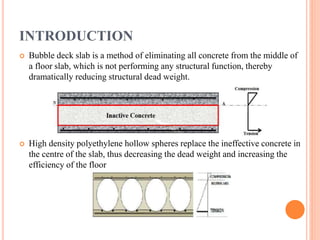
 Bubble deck slab is a method of eliminating all concrete from the middle of
a floor slab, which is not performing any structural function, thereby
dramatically reducing structural dead weight.
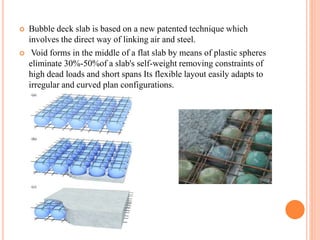
 High density polyethylene hollow spheres replace the ineffective concrete in
the centre of the slab, thus decreasing the dead weight and increasing the
efficiency of the floor
 Bubble deck slab is based on a new patented technique which
involves the direct way of linking air and steel.
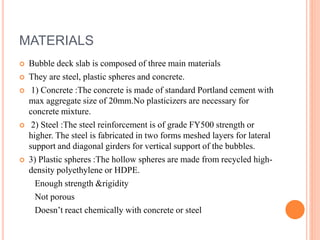
 Void forms in the middle of a flat slab by means of plastic spheres
eliminate 30%-50%of a slab's self-weight removing constraints of
high dead loads and short spans Its flexible layout easily adapts to
irregular and curved plan configurations.
MATERIALS
 Bubble deck slab is composed of three main materials
 They are steel, plastic spheres and concrete.
 1) Concrete :The concrete is made of standard Portland cement with
max aggregate size of 20mm.No plasticizers are necessary for
concrete mixture.
 2) Steel :The steel reinforcement is of grade FY500 strength or
higher. The steel is fabricated in two forms meshed layers for lateral
support and diagonal girders for vertical support of the bubbles.
 3) Plastic spheres :The hollow spheres are made from recycled high-
density polyethylene or HDPE.
Enough strength &rigidity
Not porous
Doesn’t react chemically with concrete or steel
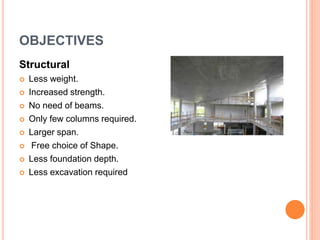
OBJECTIVES
Structural
 Less weight.
 Increased strength.
 No need of beams.
 Only few columns required.
 Larger span.
 Free choice of Shape.
 Less foundation depth.
 Less excavation required
Construction
 Light in weight less equipment is required.
 Easy incorporation of ducts and pipes into slab.
 Less work on construction site.
Engineering
 The biaxial flat slab system and columns are ideal for
structures with high resistance against Explosions.
 These slabs and column system acts as an elastic membrane
which transfer horizontal forces to stiff vertical structures
which is used for Earthquake resistant designs.
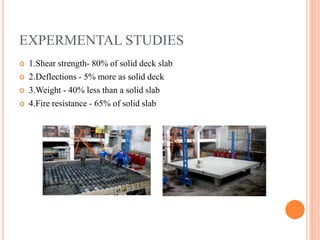
EXPERMENTAL STUDIES
 1.Shear strength- 80% of solid deck slab
 2.Deflections - 5% more as solid deck
 3.Weight - 40% less than a solid slab
 4.Fire resistance - 65% of solid slab
SCOPE FOR FUTURE USE
 Used for constructing all types of building especially sky scrapers.
 Best for larger span halls like theatres and auditoriums.
 Pedestrian bridge decks.
 Used in parking areas as less number of columns are required.
 Obviously this intellectual slab design may become the future of
slab construction which gives a tremendous contribution in
Sustainable development
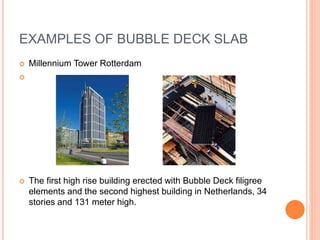
EXAMPLES OF BUBBLE DECK SLAB
 Millennium Tower Rotterdam

 The first high rise building erected with Bubble Deck filigree
elements and the second highest building in Netherlands, 34
stories and 131 meter high.
CONCLUSION
 Weight reduction is 50% compared to solid.
 The bubble deck technology is environmentally green and
sustainable; avoiding the cement production allows reducing global
Co2 emissions.
 In comparative of conventional slab the volume of concrete in
bubble deck (continuous) are less required that is 25% approximate.
 Cost and time saving by using bubbles in the slab like weight of
slab, concrete volume indirectly load on the beam and walls also
decrease/ less so that building foundations can be designed for
smaller dead loads.
THANK YOU

BUBBLE DECK SLAB .pptx

  • 1.
    MSPM’S Deogiri Institute ofEngineering and Management Studies, Aurangabad Academic Year 2020-21 Department of Civil Engineering Presentation on Bubble Deck Slab Guided by Submitted by Prof .S.B.Deshmukh Gunjan Salve 42160
  • 2.
  • 3.
    CONTENTS  INTRODUCTION  MATERIALS OBJECTIVES  EXPERMENTAL STUDIES  SCOPE FOR FUTURE USE  CONCLUSION
  • 4.
    INTRODUCTION  Bubble deckslab is a method of eliminating all concrete from the middle of a floor slab, which is not performing any structural function, thereby dramatically reducing structural dead weight.  High density polyethylene hollow spheres replace the ineffective concrete in the centre of the slab, thus decreasing the dead weight and increasing the efficiency of the floor
  • 5.
     Bubble deckslab is based on a new patented technique which involves the direct way of linking air and steel.  Void forms in the middle of a flat slab by means of plastic spheres eliminate 30%-50%of a slab's self-weight removing constraints of high dead loads and short spans Its flexible layout easily adapts to irregular and curved plan configurations.
  • 6.
    MATERIALS  Bubble deckslab is composed of three main materials  They are steel, plastic spheres and concrete.  1) Concrete :The concrete is made of standard Portland cement with max aggregate size of 20mm.No plasticizers are necessary for concrete mixture.  2) Steel :The steel reinforcement is of grade FY500 strength or higher. The steel is fabricated in two forms meshed layers for lateral support and diagonal girders for vertical support of the bubbles.  3) Plastic spheres :The hollow spheres are made from recycled high- density polyethylene or HDPE. Enough strength &rigidity Not porous Doesn’t react chemically with concrete or steel
  • 7.
    OBJECTIVES Structural  Less weight. Increased strength.  No need of beams.  Only few columns required.  Larger span.  Free choice of Shape.  Less foundation depth.  Less excavation required
  • 8.
    Construction  Light inweight less equipment is required.  Easy incorporation of ducts and pipes into slab.  Less work on construction site. Engineering  The biaxial flat slab system and columns are ideal for structures with high resistance against Explosions.  These slabs and column system acts as an elastic membrane which transfer horizontal forces to stiff vertical structures which is used for Earthquake resistant designs.
  • 9.
    EXPERMENTAL STUDIES  1.Shearstrength- 80% of solid deck slab  2.Deflections - 5% more as solid deck  3.Weight - 40% less than a solid slab  4.Fire resistance - 65% of solid slab
  • 10.
    SCOPE FOR FUTUREUSE  Used for constructing all types of building especially sky scrapers.  Best for larger span halls like theatres and auditoriums.  Pedestrian bridge decks.  Used in parking areas as less number of columns are required.  Obviously this intellectual slab design may become the future of slab construction which gives a tremendous contribution in Sustainable development
  • 11.
    EXAMPLES OF BUBBLEDECK SLAB  Millennium Tower Rotterdam   The first high rise building erected with Bubble Deck filigree elements and the second highest building in Netherlands, 34 stories and 131 meter high.
  • 12.
    CONCLUSION  Weight reductionis 50% compared to solid.  The bubble deck technology is environmentally green and sustainable; avoiding the cement production allows reducing global Co2 emissions.  In comparative of conventional slab the volume of concrete in bubble deck (continuous) are less required that is 25% approximate.  Cost and time saving by using bubbles in the slab like weight of slab, concrete volume indirectly load on the beam and walls also decrease/ less so that building foundations can be designed for smaller dead loads.
  • 13.