BUBBLE-DECK SLAB
SYSTEM
Presented by
ASHLIN T V
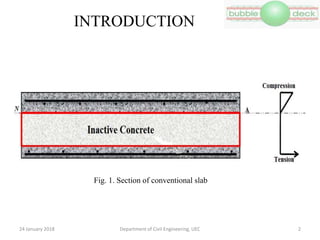
INTRODUCTION
Department of Civil Engineering, UEC 2
Fig. 1. Section of conventional slab
24 January 2018
BUBBLE-DECK
24 January 2018 Department of Civil Engineering, UEC 3
High density
polyethylene hollow
spheres
Fig. 2. Section of Bubble deck slab
 System which eliminates the inactive concrete from the
slab
 Reducing the structural dead weight
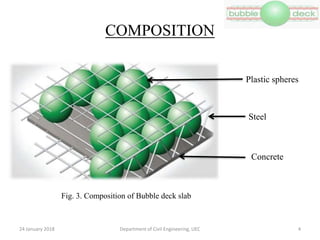
COMPOSITION
Department of Civil Engineering, UEC 4
Plastic spheres
Steel
Concrete
Fig. 3. Composition of Bubble deck slab
24 January 2018
Department of Civil Engineering, UEC 5
Version
Bubble
diameter
(mm)
Minimum
slab
thickness
(mm)
Minimum
centre to
centre
spacing
(mm)
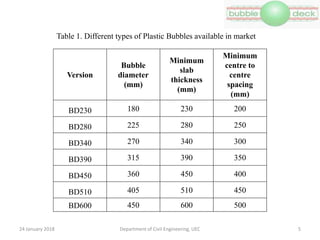
BD230 180 230 200
BD280 225 280 250
BD340 270 340 300
BD390 315 390 350
BD450 360 450 400
BD510 405 510 450
BD600 450 600 500
Table 1. Different types of Plastic Bubbles available in market
24 January 2018
TYPES OF BUBBLE-DECK
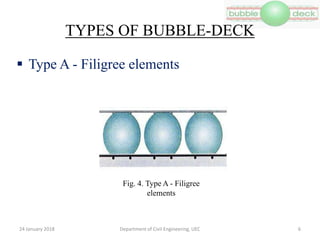
 Type A - Filigree elements
Department of Civil Engineering, UEC 6
Fig. 4. Type A - Filigree
elements
24 January 2018
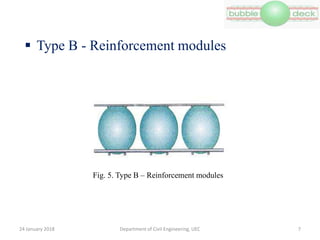
 Type B - Reinforcement modules
Department of Civil Engineering, UEC 7
Fig. 5. Type B – Reinforcement modules
24 January 2018
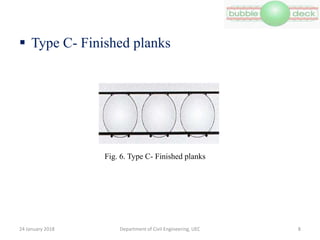
 Type C- Finished planks
Department of Civil Engineering, UEC 8
Fig. 6. Type C- Finished planks
24 January 2018
ADVANTAGES
 Structural
– Less weight
– Increased strength
– No need of beams
– Few columns required
– Larger span
– Design freedom
Department of Civil Engineering, UEC 924 January 2018
 Construction
– Easy installation of ducts and pipes into slab
– Less work on construction site
– Reduced concrete usage
Department of Civil Engineering, UEC 10
 Environment
– Less material and energy consumption
– Reducing CO2 emission up to 40Kg/m2
– Components can be replaced
24 January 2018
 Economy
– Savings in material
– Reduction in transportation cost
– Faster construction time
– Building is more flexible and easy in installation
Department of Civil Engineering, UEC 1124 January 2018
INSTALLATION
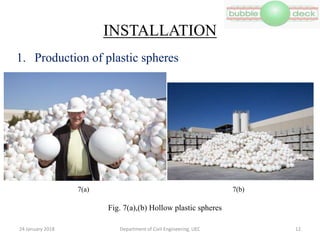
1. Production of plastic spheres
Department of Civil Engineering, UEC 12
7(a) 7(b)
Fig. 7(a),(b) Hollow plastic spheres
24 January 2018
2. Production of reinforcement cage
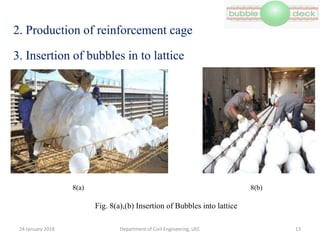
3. Insertion of bubbles in to lattice
Department of Civil Engineering, UEC 13
8(a) 8(b)
Fig. 8(a),(b) Insertion of Bubbles into lattice
24 January 2018
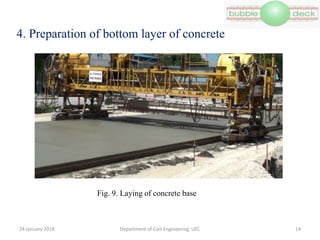
4. Preparation of bottom layer of concrete
Department of Civil Engineering, UEC 14
Fig. 9. Laying of concrete base
24 January 2018
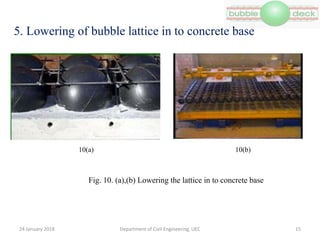
5. Lowering of bubble lattice in to concrete base
Department of Civil Engineering, UEC 15
Fig. 10. (a),(b) Lowering the lattice in to concrete base
10(a) 10(b)
24 January 2018
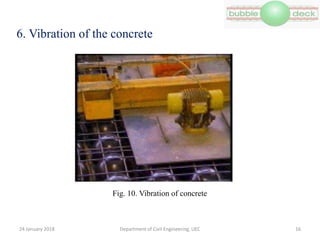
6. Vibration of the concrete
Department of Civil Engineering, UEC 16
Fig. 10. Vibration of concrete
24 January 2018
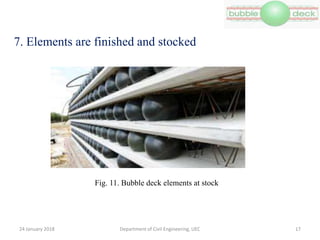
7. Elements are finished and stocked
Department of Civil Engineering, UEC 17
Fig. 11. Bubble deck elements at stock
24 January 2018
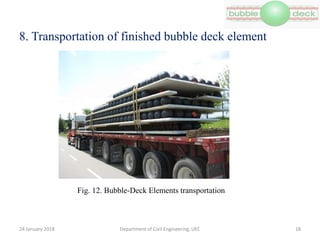
8. Transportation of finished bubble deck element
Department of Civil Engineering, UEC 18
Fig. 12. Bubble-Deck Elements transportation
24 January 2018
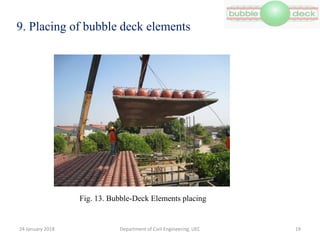
9. Placing of bubble deck elements
Department of Civil Engineering, UEC 19
Fig. 13. Bubble-Deck Elements placing
24 January 2018
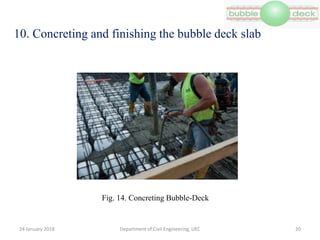
10. Concreting and finishing the bubble deck slab
Department of Civil Engineering, UEC 20
Fig. 14. Concreting Bubble-Deck
24 January 2018
STRUCTURAL PROPERTIES
 Sound insulation
1db higher noise reduction
 Fire resistance
17% to 39% higher thermal resistance
 Durability
 Shear strength
 Vibration
Department of Civil Engineering, UEC 2124 January 2018
APPLICATIONS
 Millennium Tower, Holland
 Le Coie, UK
 Administrative Center, Brasilia, Brazil
 Harvey Mudd College, California, USA
 Walterbos Complex Tax Office Towers, Netherland
Department of Civil Engineering, UEC 2224 January 2018
LIMITATIONS
 Require skilled labour
 Thickness of slab
Department of Civil Engineering, UEC 2324 January 2018
SCOPE FOR THE FUTURE
• Constructing buildings especially sky scrapers
• Larger span halls like theatres and auditoriums
• Pedestrian bridge deck
• Used in parking areas
Department of Civil Engineering, UEC 2424 January 2018
CONCLUSIONS
 Bubble-Deck Slab perform better than normal
conventional solid slab
 Reduction in weight
 Technology is environmentally green and sustainable
 Reduction in concrete usage
 Cost and time saving
Department of Civil Engineering, UEC 2524 January 2018
REFERENCES
1. Arathi Shetkar & Nagesh Hanche (2015),” An Experimental Study on
Bubble Deck Slab System with Elliptical Balls”, International Journal of
Science and Research, 12(1), 21-27.
2. Bhagyasree G Bhade & Barelikar S M (2016), “ An Experimental Study of
Two Way Bubble Deck slab With Spherical Hollow Balls”, International
Journal of Recent scientific Research, 7(6), 11621-11626
3. Mike Mota (2013), “voided two way flat slabs”, American Society of Civil
Engineers Journal”, 1640-1649
4. Neeraj Tiwari & Sana Zafar (2016), “ Structural Behaviour of Bubble Deck
Slabs and Its Application”, International Journal for Scientific Research and
Development, 6(2), 433-437
Department of Civil Engineering, UEC 2624 January 2018
5. PrabhuTeja P, Vijay Kumar P, Anusha S Mounika C H, Purnachandra Saha
(2012), “Structural Behavior of Bubble Deck Slab”, International
Conference on Advance in Research, Science and Management, 383-388
6. Raj R Vakil & Dr. Mangulkar Madhuri Nilesh (2017), “Comparative Study
of Bubble-Deck and Solid Deck Slab”, International Journal of Advance
Research in Science and Engineering, 6(10), 383-392.
7. Shivani Mirajkar & Mitali Balapur (2017), “Study of Bubble- Deck Slab
System”, International Journal of Advance Research in Science and
Engineering, 7, 01-05.
8. Surendar M &Ranjitham M (2016), “ Numerical and Experimental Study on
Bubble Deck Slab”, International Journal of Engineering Science and
Computing, 6(5), 5959-5962
Department of Civil Engineering, UEC 2724 January 2018
Thank you

Bubble deck slab system

  • 1.
  • 2.
    INTRODUCTION Department of CivilEngineering, UEC 2 Fig. 1. Section of conventional slab 24 January 2018
  • 3.
    BUBBLE-DECK 24 January 2018Department of Civil Engineering, UEC 3 High density polyethylene hollow spheres Fig. 2. Section of Bubble deck slab  System which eliminates the inactive concrete from the slab  Reducing the structural dead weight
  • 4.
    COMPOSITION Department of CivilEngineering, UEC 4 Plastic spheres Steel Concrete Fig. 3. Composition of Bubble deck slab 24 January 2018
  • 5.
    Department of CivilEngineering, UEC 5 Version Bubble diameter (mm) Minimum slab thickness (mm) Minimum centre to centre spacing (mm) BD230 180 230 200 BD280 225 280 250 BD340 270 340 300 BD390 315 390 350 BD450 360 450 400 BD510 405 510 450 BD600 450 600 500 Table 1. Different types of Plastic Bubbles available in market 24 January 2018
  • 6.
    TYPES OF BUBBLE-DECK Type A - Filigree elements Department of Civil Engineering, UEC 6 Fig. 4. Type A - Filigree elements 24 January 2018
  • 7.
     Type B- Reinforcement modules Department of Civil Engineering, UEC 7 Fig. 5. Type B – Reinforcement modules 24 January 2018
  • 8.
     Type C-Finished planks Department of Civil Engineering, UEC 8 Fig. 6. Type C- Finished planks 24 January 2018
  • 9.
    ADVANTAGES  Structural – Lessweight – Increased strength – No need of beams – Few columns required – Larger span – Design freedom Department of Civil Engineering, UEC 924 January 2018
  • 10.
     Construction – Easyinstallation of ducts and pipes into slab – Less work on construction site – Reduced concrete usage Department of Civil Engineering, UEC 10  Environment – Less material and energy consumption – Reducing CO2 emission up to 40Kg/m2 – Components can be replaced 24 January 2018
  • 11.
     Economy – Savingsin material – Reduction in transportation cost – Faster construction time – Building is more flexible and easy in installation Department of Civil Engineering, UEC 1124 January 2018
  • 12.
    INSTALLATION 1. Production ofplastic spheres Department of Civil Engineering, UEC 12 7(a) 7(b) Fig. 7(a),(b) Hollow plastic spheres 24 January 2018
  • 13.
    2. Production ofreinforcement cage 3. Insertion of bubbles in to lattice Department of Civil Engineering, UEC 13 8(a) 8(b) Fig. 8(a),(b) Insertion of Bubbles into lattice 24 January 2018
  • 14.
    4. Preparation ofbottom layer of concrete Department of Civil Engineering, UEC 14 Fig. 9. Laying of concrete base 24 January 2018
  • 15.
    5. Lowering ofbubble lattice in to concrete base Department of Civil Engineering, UEC 15 Fig. 10. (a),(b) Lowering the lattice in to concrete base 10(a) 10(b) 24 January 2018
  • 16.
    6. Vibration ofthe concrete Department of Civil Engineering, UEC 16 Fig. 10. Vibration of concrete 24 January 2018
  • 17.
    7. Elements arefinished and stocked Department of Civil Engineering, UEC 17 Fig. 11. Bubble deck elements at stock 24 January 2018
  • 18.
    8. Transportation offinished bubble deck element Department of Civil Engineering, UEC 18 Fig. 12. Bubble-Deck Elements transportation 24 January 2018
  • 19.
    9. Placing ofbubble deck elements Department of Civil Engineering, UEC 19 Fig. 13. Bubble-Deck Elements placing 24 January 2018
  • 20.
    10. Concreting andfinishing the bubble deck slab Department of Civil Engineering, UEC 20 Fig. 14. Concreting Bubble-Deck 24 January 2018
  • 21.
    STRUCTURAL PROPERTIES  Soundinsulation 1db higher noise reduction  Fire resistance 17% to 39% higher thermal resistance  Durability  Shear strength  Vibration Department of Civil Engineering, UEC 2124 January 2018
  • 22.
    APPLICATIONS  Millennium Tower,Holland  Le Coie, UK  Administrative Center, Brasilia, Brazil  Harvey Mudd College, California, USA  Walterbos Complex Tax Office Towers, Netherland Department of Civil Engineering, UEC 2224 January 2018
  • 23.
    LIMITATIONS  Require skilledlabour  Thickness of slab Department of Civil Engineering, UEC 2324 January 2018
  • 24.
    SCOPE FOR THEFUTURE • Constructing buildings especially sky scrapers • Larger span halls like theatres and auditoriums • Pedestrian bridge deck • Used in parking areas Department of Civil Engineering, UEC 2424 January 2018
  • 25.
    CONCLUSIONS  Bubble-Deck Slabperform better than normal conventional solid slab  Reduction in weight  Technology is environmentally green and sustainable  Reduction in concrete usage  Cost and time saving Department of Civil Engineering, UEC 2524 January 2018
  • 26.
    REFERENCES 1. Arathi Shetkar& Nagesh Hanche (2015),” An Experimental Study on Bubble Deck Slab System with Elliptical Balls”, International Journal of Science and Research, 12(1), 21-27. 2. Bhagyasree G Bhade & Barelikar S M (2016), “ An Experimental Study of Two Way Bubble Deck slab With Spherical Hollow Balls”, International Journal of Recent scientific Research, 7(6), 11621-11626 3. Mike Mota (2013), “voided two way flat slabs”, American Society of Civil Engineers Journal”, 1640-1649 4. Neeraj Tiwari & Sana Zafar (2016), “ Structural Behaviour of Bubble Deck Slabs and Its Application”, International Journal for Scientific Research and Development, 6(2), 433-437 Department of Civil Engineering, UEC 2624 January 2018
  • 27.
    5. PrabhuTeja P,Vijay Kumar P, Anusha S Mounika C H, Purnachandra Saha (2012), “Structural Behavior of Bubble Deck Slab”, International Conference on Advance in Research, Science and Management, 383-388 6. Raj R Vakil & Dr. Mangulkar Madhuri Nilesh (2017), “Comparative Study of Bubble-Deck and Solid Deck Slab”, International Journal of Advance Research in Science and Engineering, 6(10), 383-392. 7. Shivani Mirajkar & Mitali Balapur (2017), “Study of Bubble- Deck Slab System”, International Journal of Advance Research in Science and Engineering, 7, 01-05. 8. Surendar M &Ranjitham M (2016), “ Numerical and Experimental Study on Bubble Deck Slab”, International Journal of Engineering Science and Computing, 6(5), 5959-5962 Department of Civil Engineering, UEC 2724 January 2018
  • 28.