International Research Journal of Engineering and Technology (IRJET) e-ISSN: 2395-0056
Volume: 05 Issue: 12 | Dec 2018 www.irjet.net p-ISSN: 2395-0072
© 2018, IRJET | Impact Factor value: 7.211 | ISO 9001:2008 Certified Journal | Page 430
ANALYSIS ON PERFORMANCE OF REINFORCED CONCRETE AND
PRESTRESSED SLABS USING BALLS AND CORES: A LITERATURE
REVIEW
Mr. A.Varadharaj1, Mr. Fazil.P2
1Assistant Professor, Department of Civil Engineering, RVS .Technical Campus, Coimbatore-641402, India,
2PG student, Department of Civil Engineering, RVS .Technical Campus, Coimbatore-641402, India
---------------------------------------------------------------------***----------------------------------------------------------------------
Abstract - The usage of concrete is high in slab
construction. It leads to loss of concrete because the load
transfers from the structure only on the column portion not
throughout the slab. So reduce the concrete in centre of the
slab by using recycled balls (bubbled deck slab system) or by
making hollow cores or voids (hollow core slab system).
Objective of both the system of slabs to reduce self weight of
the entire system by removing ineffective concrete from the
structure and thereby making the whole structureeconomical
and light weight. This study presents a comparative study of
polymer spherical bubbled deck slab system with elliptical
bubbled deck slab system. A polyethylene bubbled deck slab
has two-dimensional arrangement of voids includedtoreduce
the self-weight. The analytical study conducted on ANSYScivil
FEM software. In the study slabs of three one way slabs of
1000x1000x150mm with hollow spherical balls of varying
diameters of 60mm, 80mm and 100mm respectively are
compared with three one way slabs with elliptical balls such
that the minor axis is same as that of spherical balls. Theeffect
of shape and diameter on the performance of slabs with
spherical and elliptical balls are conducting and comparing
with a one way solid slab of same size. Behavior of slabs on
varying the diameters of bubbles can make drasticchangeson
the properties and performance.
Key Words: Bubbled deck slab system, Hollow core slab
system, ANSYS.
1. INTRODUCTION
Several attempts have been madetomould biaxial slabswith
hollow cavities in order to reduce the self weight.Mostof the
studies have consisted of laying blocks of a light weight
material like expanded polystyrene betweenthebottomand
top reinforcement, while other types included waffle slabs
and grid slabs.
Because of the problems faced in hollow-core slabs,
primarily lack of structural integrity, inflexibility and
reduced architectural possibilities, majorattentionhasbeen
on biaxial slabs and ways to reduce the weight. Several
methods have been introduced during the last 30 years, but
the success was limited, due to major problems with shear
capacity and fire resistance as well as impractical execution.
Of these types, only waffle slabs can be regarded to have a
certain use in the industry. But the use also will be very
limited due to reduced shear resistances, local punchingand
fire resistance. The idea of placing large blocks of light
material in the slab suffers from the same flaws, which is
why the use of these systems has never gained acceptance
and they are only used in a limited number of projects.
Bubble deck eliminates up to 35% of the structural concrete.
When coupled with the reduced floor thickness and facade,
smaller foundations and columns, construction costs can be
reduced by as much as 10%.
With virtually no formwork, no downturn beams or drop
heads, and fast coverage of typically 350ft2 per panel, using
Bubble deck means floor cycles up to 20% faster than
traditional construction methods. Regardless ofprojectsize,
shape or complexity; simplyshore,place, andpourto quickly
install concrete decks. The Bubble deck system offersa wide
range of advantages in building design and during
construction. There are a number of green attributes
including; reduction in total construction materials, use of
recycled materials, lower energy consumption and reduced
structural behaviour of Bubble deck Slab CO2 emissions,less
transportation and crane lifts that make Bubble deck more
environmentally friendly than other concrete construction
techniques.
Bubble deck can achieve larger spans as compared to a site
cast concrete structure without the need forpost-tensioning
or pre-stressed sections. The total construction time for the
structure was reduced and allowed the consultants to fast
track the design without the interior design finalized. The
total time from design inception to completion of structure
was less than 12 months. The contractor was abletosetover
60,000ft2 in a month and allowed the concrete structure to
be complete before the start of fall classes. The Bubble deck,
on the other hand, creates such a cushion of air between
layers of concrete with the reinforcement of both the metal
grid and the weight distribution across the plastic spheres.
Now that’s a rather innovative concept that you don’t often
see. True enough, you might not initially see many
differences between a building that has been constructed
using in-situ casting and one that uses Bubble deck
technology, but the differences are significant.
One notable difference about Bubbledeck technologyisthat
it allows for stronger, and often thicker, slabs of concrete
that span larger areas, as well as the opportunity to
architecturally design larger cantilevers. According to the
Bubble deck Group, the hollow spheres at the core of this
technology allow for an approximately 35% reduction of
dead weight from the building’s concrete slabs. When those
International Research Journal of Engineering and Technology (IRJET) e-ISSN: 2395-0056
Volume: 05 Issue: 12 | Dec 2018 www.irjet.net p-ISSN: 2395-0072
© 2018, IRJET | Impact Factor value: 7.211 | ISO 9001:2008 Certified Journal | Page 431
slabs cover a larger area, there is also no requirement for
supporting columns, walls, and down stand beams. These
latter elements can often generate great limitations for an
architect, not allowing them tocreatewide,openspaceswith
minimal supporting features.
2. LITERATURE REVIEW
Amer M Ibrahim, Nazar K Ali and Wissam Di Salman,
et.al., (2012): A Bubble deck slab has a two dimensional
arrangement of voids within the slabs to reduce self-weight.
The behavior of Bubble deck slabs is influenced by the ratio
of bubble diameter to slab thickness. To verify the flexural
behavior of Bubble deck slab such as ultimate load,
deflection, concrete compressive strain and crack pattern,
two dimensional flexural tests were tested by using special
loading frame. Results have shown that the crack pattern
and flexural behavior depend on the void diameter to slab
thickness ratio. The ultimate load capacities for Bubbledeck
slabs having bubble diameter to slab thickness of 0.01 to
0.64 were the same of solid slabs, the ultimate capacities
were reduced to about 10%.
Arati Shetkara, Nagesh Hanche et.al., (2015): A Bubble
Deck slab has a two-dimensional arrangement of voids
within the slabs to reduce self-weight. The behavior of
Bubble Deck slabs is influenced by the ratio of bubble
diameter to slab thickness. This new prefabricated
construction technology is recently applied in many
industrial projects in the world. Advantage of Bubble Deck
system is the significant cost saving, because of the
possibility of obtaining great spans with less support
elements. Bubble diameter varies between 180mm to
450mm and the slab depth is 230mm to 600mm. The
nominal diameter of the gaps are of sizes: 180, 225,270 and
315mm. In this experiment, the applied force is from the
bottom to the top of the slab, until the cracks occur in the
slabs and the failure modes were recorded.Results obtained
shows the better load bearing capacity in Bubble Deck
can be achieved using the hollow elliptical balls, thereby
reducing material consumption make the construction
time faster, and to reduce the overall costs. Besides that,
result of the study also shows a reduction in deadweight
up to 50%, which allow creating foundation sizes smaller.
BubbleDeck-UK et.al., (2008): Bubble deck technology
using spheres made of recycled industrial plastic to
create air voids while providing strength through arch
action. Results show a dramatic reduction of dead weight
by as much as 50% allowing much longer spans and less
supporting structure than traditional solutions. Therefore,
the Bubble Deck has many advantages as compare to
traditional concrete slab, such as: lower total cost, reduced
material use, enhanced structural efficiency, decreased
construction time, and is a green technology. It gains much
of attention from engineers and researchers from the
world.
Calin S, Asavoaie C et.al., (2010): An experimental
program on the effects of concrete strength on the shape
and diameter of plastic balls on the overall behavior of
bubble deck. Concrete slabs with spherical balls andimplied
the realization of a monolithic slab element at a scale of 1:1
were used. The Bubble Deck slab sample was subjected to
static loadings. The results showed deformation, cracking
and failing characteristics of slabs subjected to static
gravitational loadings. Results also suggest that
performance can be improved by tradition al spherical
ball’s shape by using hollow elliptical balls for better
load-bearing capacity in Bubble Deck.
C Marais et.al., (2010): The study on economic value of
internal spherical void formers (SVF) slabs in South Africa
and compared the cost of construction to large span slab
systems, coffer and post- tensioned slabs. The final results
shows that the stiffness of SVF slab areas should be
reduced by approximately 10% compared to that of a
solid slab with same thickness.
Gudmundur B et.al., (2003): The direct way of linking air
and steel the bubble deck is a two-way hollow deck in
which plastic balls serves the purpose of eliminating
concrete that has no carrying effect by adapting the
geometry of the ball and the mesh width, an optimized
concrete construction is obtained, with simultaneous
maximum utility of both moment and shear zones. Results
obtained showed the basic effect of the bubbles in the
weight reduction of the deck. Results also show the dead
load of the Bubble Deck to be 1/3 lesser than a solid deck
with the same thickness – and that without effecting the
bending strength and the deflection behavior of the deck.
M.Surendar and M.Ranjitham et.al., (2016): A numerical
and experimental study conducted on bubble deck slab and
the model is analyzed by ANSYS software with appropriate
support conditions as with the experimental setup and
providing uniformly distributed loading in the bubble deck
slab and in conventional slab. The stress and deformation
results were evaluated and compared the bubble deck slab
with conventional slab were observed using finite element
analysis. At last the comparison has been made for Bubble
Deck Slab with the Conventional slab over its self weight.
Conventional slab carried the stress of about 30.98MPa by
applying the UDL load of about 340kN and causes
deflection of 12.822mm.Th e bubble deck slab carried the
stress of about 30.8MPa by applying the UDL load of about
320kN and causes deflection of 14.303mm. The bubble deck
slab can withstand 80% of stress when compared with
conventional slab. Slight variation occurs in the
deformation when compared to conventional slab. The
stress and deformation results of bubble deck slabs were
evaluated and compared with conventional slab, using
finite element analysis. From the evaluation oftheseresults,
bubble deck slab gives better performance than that of the
conventional slab.
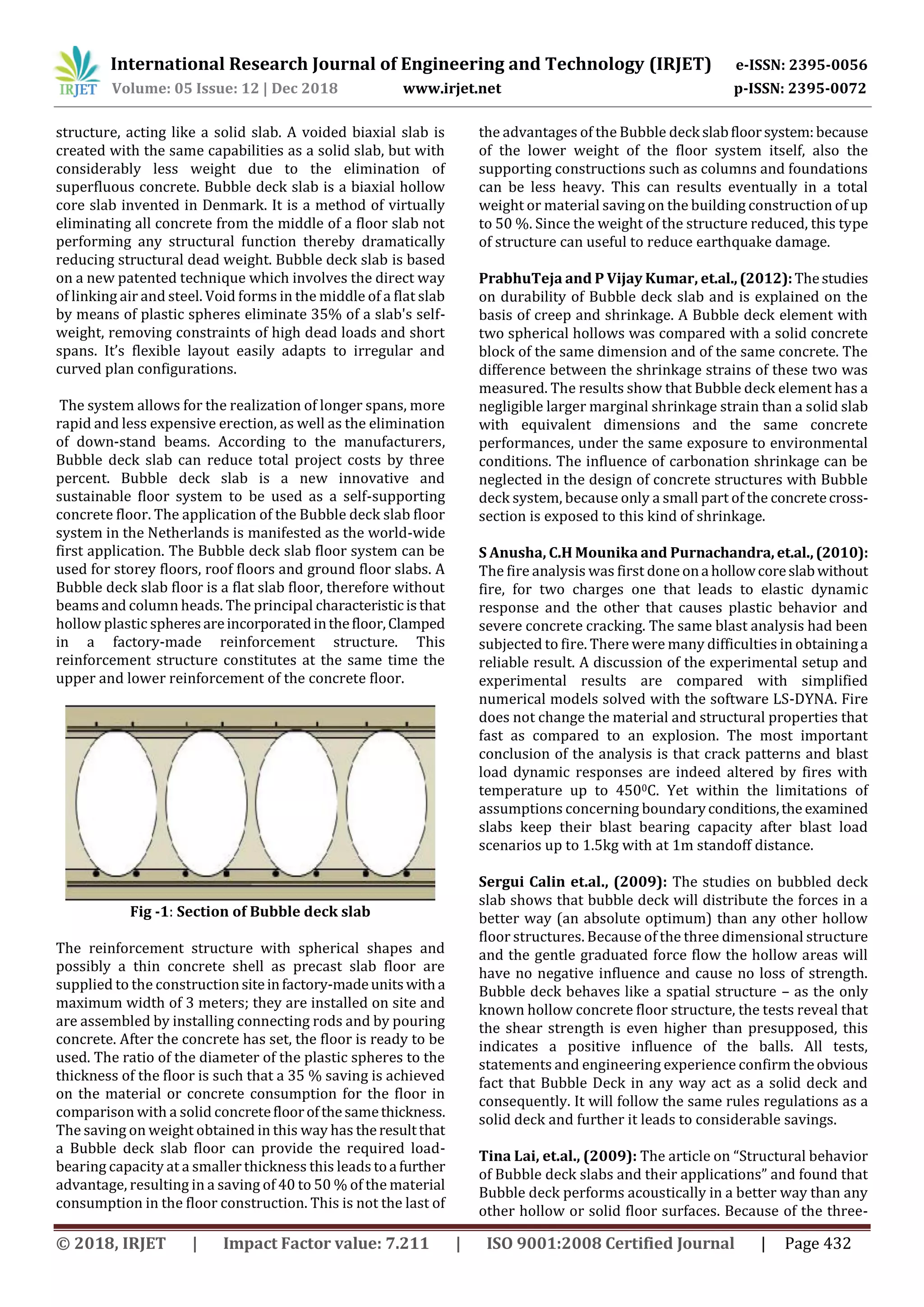
Prabhu Teja, P Vijay Kumar et.al., (2012): New system
was invented called Bubble deck technology is by locks
ellipsoids between the top and bottom reinforcement
meshes shown in fig 1, thereby creating a natural cell
International Research Journal of Engineering and Technology (IRJET) e-ISSN: 2395-0056
Volume: 05 Issue: 12 | Dec 2018 www.irjet.net p-ISSN: 2395-0072
© 2018, IRJET | Impact Factor value: 7.211 | ISO 9001:2008 Certified Journal | Page 432
structure, acting like a solid slab. A voided biaxial slab is
created with the same capabilities as a solid slab, but with
considerably less weight due to the elimination of
superfluous concrete. Bubble deck slab is a biaxial hollow
core slab invented in Denmark. It is a method of virtually
eliminating all concrete from the middle of a floor slab not
performing any structural function thereby dramatically
reducing structural dead weight. Bubble deck slab is based
on a new patented technique which involves the direct way
of linking air and steel. Void forms in the middle of a flat slab
by means of plastic spheres eliminate 35% of a slab's self-
weight, removing constraints of high dead loads and short
spans. It’s flexible layout easily adapts to irregular and
curved plan configurations.
The system allows for the realization of longer spans, more
rapid and less expensive erection, as well as the elimination
of down-stand beams. According to the manufacturers,
Bubble deck slab can reduce total project costs by three
percent. Bubble deck slab is a new innovative and
sustainable floor system to be used as a self-supporting
concrete floor. The application of the Bubble deck slab floor
system in the Netherlands is manifested as the world-wide
first application. The Bubble deck slab floor system can be
used for storey floors, roof floors and ground floor slabs. A
Bubble deck slab floor is a flat slab floor, therefore without
beams and column heads. The principal characteristicisthat
hollow plastic spheresareincorporatedinthefloor,Clamped
in a factory-made reinforcement structure. This
reinforcement structure constitutes at the same time the
upper and lower reinforcement of the concrete floor.
Fig -1: Section of Bubble deck slab
The reinforcement structure with spherical shapes and
possibly a thin concrete shell as precast slab floor are
supplied to the constructionsiteinfactory-madeunitswitha
maximum width of 3 meters; they are installed on site and
are assembled by installing connecting rods and by pouring
concrete. After the concrete has set, the floor is ready to be
used. The ratio of the diameter of the plastic spheres to the
thickness of the floor is such that a 35 % saving is achieved
on the material or concrete consumption for the floor in
comparison with a solid concretefloorofthesamethickness.
The saving on weight obtained in this way has theresultthat
a Bubble deck slab floor can provide the required load-
bearing capacity at a smaller thickness this leads toa further
advantage, resulting in a saving of 40 to 50 % of the material
consumption in the floor construction. This is not the last of
the advantages of the Bubble deck slabfloorsystem:because
of the lower weight of the floor system itself, also the
supporting constructions such as columns and foundations
can be less heavy. This can results eventually in a total
weight or material saving on the building construction of up
to 50 %. Since the weight of the structure reduced, this type
of structure can useful to reduce earthquake damage.
PrabhuTeja and P Vijay Kumar, et.al.,(2012):Thestudies
on durability of Bubble deck slab and is explained on the
basis of creep and shrinkage. A Bubble deck element with
two spherical hollows was compared with a solid concrete
block of the same dimension and of the same concrete. The
difference between the shrinkage strains of these two was
measured. The results show that Bubble deck element has a
negligible larger marginal shrinkage strain than a solid slab
with equivalent dimensions and the same concrete
performances, under the same exposure to environmental
conditions. The influence of carbonation shrinkage can be
neglected in the design of concrete structures with Bubble
deck system, because only a small part of the concretecross-
section is exposed to this kind of shrinkage.
S Anusha, C.H Mounika and Purnachandra, et.al.,(2010):
The fire analysis was first done ona hollowcoreslabwithout
fire, for two charges one that leads to elastic dynamic
response and the other that causes plastic behavior and
severe concrete cracking. The same blast analysis had been
subjected to fire. There were many difficulties in obtaininga
reliable result. A discussion of the experimental setup and
experimental results are compared with simplified
numerical models solved with the software LS-DYNA. Fire
does not change the material and structural properties that
fast as compared to an explosion. The most important
conclusion of the analysis is that crack patterns and blast
load dynamic responses are indeed altered by fires with
temperature up to 4500C. Yet within the limitations of
assumptions concerning boundaryconditions,the examined
slabs keep their blast bearing capacity after blast load
scenarios up to 1.5kg with at 1m standoff distance.
Sergui Calin et.al., (2009): The studies on bubbled deck
slab shows that bubble deck will distribute the forces in a
better way (an absolute optimum) than any other hollow
floor structures. Because of the three dimensional structure
and the gentle graduated force flow the hollow areas will
have no negative influence and cause no loss of strength.
Bubble deck behaves like a spatial structure – as the only
known hollow concrete floor structure, the tests reveal that
the shear strength is even higher than presupposed, this
indicates a positive influence of the balls. All tests,
statements and engineering experience confirm theobvious
fact that Bubble Deck in any way act as a solid deck and
consequently. It will follow the same rules regulations as a
solid deck and further it leads to considerable savings.
Tina Lai, et.al., (2009): The article on “Structural behavior
of Bubble deck slabs and their applications” and found that
Bubble deck performs acoustically in a better way than any
other hollow or solid floor surfaces. Because of the three-
International Research Journal of Engineering and Technology (IRJET) e-ISSN: 2395-0056
Volume: 05 Issue: 12 | Dec 2018 www.irjet.net p-ISSN: 2395-0072
© 2018, IRJET | Impact Factor value: 7.211 | ISO 9001:2008 Certified Journal | Page 433
dimensional structure and the graduated force flow, the
hollow spheres have a positive influence on sound
insulation. The tests reveal that the airborne sound
insulation is even higher than expected. This indicates the
bubbles have a positive on sound insulation. The main
criteria for reducing noise is the weight of the deck and
therefore Bubble deck evidently will not act otherwise than
other deck types with equal weight.
3. CONCLUSIONS
Bubble deck slab technology is an innovatory method of
virtually eliminating all concrete from the middle of a floor
slab, thereby reducing dead weight and increasing the
efficiency of the floor by using recycled hollow plastic balls.
This new prefabricated construction technology using
bubble deck slab is recently applied in many industrial
projects in the world. This technology is widely used for the
construction of multi-storeyed buildings. Bubble deck slab
technology reduces the loads on the columns, walls,
foundations and entire part of thebuilding.Bubbledeck uses
less concrete than traditional concretefloorsystems.Bubble
deck slab technology has been experimented in many parts
of the world using international codes and standards.
Advantage of Bubble Deck system is the significant cost
saving, because of the possibility of obtaining great spans
with less support elements. By using the hollow elliptical
balls, the better load bearing capacity in Bubble Deck can be
achieved. Reducing material consumption made it possible
to make the construction time faster, to reduce the overall
costs. Besides that, it has led to reduce dead weight up to
50%, which allow creating foundation sizes smaller.
REFERENCES
[1] Amer M. Ibrahim, Nazar K Ali (June 2013) Wissam D
Salman, Flexural capacities of reinforced concrete two-
way bubble deck slabs of plastic spherical voids, Diyala
Journal of Engineering Sciences, Vol. 06,Pp 9-20.
[2] Arati Shetkar , Nagesh Hanche (2015) An Experimental
Study On Bubble Deck Slab System With Elliptical Balls,
Proceeding of NCRIET-2015 & Indian J.Sci.Res.
12(1):021-027
[3] A. Churakov (2014) Biaxial hollow slab with innovative
types of voids, Construction of Unique Buildings ad
structures, Vol. 6(21), Pp. 70-88
[4] Chung J.H., Choi H.K., Lee S.C (2011) Shear Capacity of
Biaxial Hollow Slab with Donut Type Hollow Sphere,
Procedia Engineering, Vol. 14, Pp. 2219 -2222
[5] Er. Immanuel Joseph Chacko,Er.Sneha M. Varghes
(2016) Study on Structural Behaviour of Bubble Deck
Slab using Indian Standards, International Journal Of
Innovative Research In Technology ISSN: 2349-6002
[6] Harding P ( July 2004) BubbleDeck-Advanced Structure
Engineering. Bubble Deck article. Pp. 4-7
[7] Jasna Jamal, Jiji Jolly (May 2016) A study on structural
behaviour of bubble deck slab using spherical and
elliptical balls, International Research Journal of
Engineering and Technology Volume: 04 Issue: 05
[8] L R Terec, M A Terec(2013) The bubbledeck floor
system: A brief presentation, Construction, Vol 2,Pp33-
40
[9] Martina Schnellenbach-Held and Karsten Pfeffer
(December 2011) Punching behavior of biaxial hollow
slabs, Cement and Concrete Composites, Volume 24,
Issue 6, Pages 551-556
[10] Marais et al. (June 2010) study of punching shear of
concrete slab, American concrete institute.
[11] M.Surendar, M.Ranjitham (2016) Numerical and
Experimental Study on Bubble Deck Slab, International
Journal of Engineering Science and Computing
[12] Mr. Muhammad Shafiq Mushfiq et al. ( May 2017)
Experimental Study On Bubble Deck Slab, International
Research Journal of Engineering and Technology
(IRJET).
[13] Neeraj Tiwari Sana Zafar (2016) Structural
Behaviour of Bubble Deck Slabs and Its Application,
International Journal for Scientific Research &
Development Vol. 4, Issue 02, | ISSN (online): 2321-
0613
[14] Prabhu Teja, P Vijay Kumar (March 2012) Structural
behavior of bubbled deck slab, International conference
on advances in engineering, science and management.

IRJET- Analysis on Performance of Reinforced Concrete and Prestressed Slabs using Balls and Cores: A Literature Review

  • 1.
    International Research Journalof Engineering and Technology (IRJET) e-ISSN: 2395-0056 Volume: 05 Issue: 12 | Dec 2018 www.irjet.net p-ISSN: 2395-0072 © 2018, IRJET | Impact Factor value: 7.211 | ISO 9001:2008 Certified Journal | Page 430 ANALYSIS ON PERFORMANCE OF REINFORCED CONCRETE AND PRESTRESSED SLABS USING BALLS AND CORES: A LITERATURE REVIEW Mr. A.Varadharaj1, Mr. Fazil.P2 1Assistant Professor, Department of Civil Engineering, RVS .Technical Campus, Coimbatore-641402, India, 2PG student, Department of Civil Engineering, RVS .Technical Campus, Coimbatore-641402, India ---------------------------------------------------------------------***---------------------------------------------------------------------- Abstract - The usage of concrete is high in slab construction. It leads to loss of concrete because the load transfers from the structure only on the column portion not throughout the slab. So reduce the concrete in centre of the slab by using recycled balls (bubbled deck slab system) or by making hollow cores or voids (hollow core slab system). Objective of both the system of slabs to reduce self weight of the entire system by removing ineffective concrete from the structure and thereby making the whole structureeconomical and light weight. This study presents a comparative study of polymer spherical bubbled deck slab system with elliptical bubbled deck slab system. A polyethylene bubbled deck slab has two-dimensional arrangement of voids includedtoreduce the self-weight. The analytical study conducted on ANSYScivil FEM software. In the study slabs of three one way slabs of 1000x1000x150mm with hollow spherical balls of varying diameters of 60mm, 80mm and 100mm respectively are compared with three one way slabs with elliptical balls such that the minor axis is same as that of spherical balls. Theeffect of shape and diameter on the performance of slabs with spherical and elliptical balls are conducting and comparing with a one way solid slab of same size. Behavior of slabs on varying the diameters of bubbles can make drasticchangeson the properties and performance. Key Words: Bubbled deck slab system, Hollow core slab system, ANSYS. 1. INTRODUCTION Several attempts have been madetomould biaxial slabswith hollow cavities in order to reduce the self weight.Mostof the studies have consisted of laying blocks of a light weight material like expanded polystyrene betweenthebottomand top reinforcement, while other types included waffle slabs and grid slabs. Because of the problems faced in hollow-core slabs, primarily lack of structural integrity, inflexibility and reduced architectural possibilities, majorattentionhasbeen on biaxial slabs and ways to reduce the weight. Several methods have been introduced during the last 30 years, but the success was limited, due to major problems with shear capacity and fire resistance as well as impractical execution. Of these types, only waffle slabs can be regarded to have a certain use in the industry. But the use also will be very limited due to reduced shear resistances, local punchingand fire resistance. The idea of placing large blocks of light material in the slab suffers from the same flaws, which is why the use of these systems has never gained acceptance and they are only used in a limited number of projects. Bubble deck eliminates up to 35% of the structural concrete. When coupled with the reduced floor thickness and facade, smaller foundations and columns, construction costs can be reduced by as much as 10%. With virtually no formwork, no downturn beams or drop heads, and fast coverage of typically 350ft2 per panel, using Bubble deck means floor cycles up to 20% faster than traditional construction methods. Regardless ofprojectsize, shape or complexity; simplyshore,place, andpourto quickly install concrete decks. The Bubble deck system offersa wide range of advantages in building design and during construction. There are a number of green attributes including; reduction in total construction materials, use of recycled materials, lower energy consumption and reduced structural behaviour of Bubble deck Slab CO2 emissions,less transportation and crane lifts that make Bubble deck more environmentally friendly than other concrete construction techniques. Bubble deck can achieve larger spans as compared to a site cast concrete structure without the need forpost-tensioning or pre-stressed sections. The total construction time for the structure was reduced and allowed the consultants to fast track the design without the interior design finalized. The total time from design inception to completion of structure was less than 12 months. The contractor was abletosetover 60,000ft2 in a month and allowed the concrete structure to be complete before the start of fall classes. The Bubble deck, on the other hand, creates such a cushion of air between layers of concrete with the reinforcement of both the metal grid and the weight distribution across the plastic spheres. Now that’s a rather innovative concept that you don’t often see. True enough, you might not initially see many differences between a building that has been constructed using in-situ casting and one that uses Bubble deck technology, but the differences are significant. One notable difference about Bubbledeck technologyisthat it allows for stronger, and often thicker, slabs of concrete that span larger areas, as well as the opportunity to architecturally design larger cantilevers. According to the Bubble deck Group, the hollow spheres at the core of this technology allow for an approximately 35% reduction of dead weight from the building’s concrete slabs. When those
  • 2.
    International Research Journalof Engineering and Technology (IRJET) e-ISSN: 2395-0056 Volume: 05 Issue: 12 | Dec 2018 www.irjet.net p-ISSN: 2395-0072 © 2018, IRJET | Impact Factor value: 7.211 | ISO 9001:2008 Certified Journal | Page 431 slabs cover a larger area, there is also no requirement for supporting columns, walls, and down stand beams. These latter elements can often generate great limitations for an architect, not allowing them tocreatewide,openspaceswith minimal supporting features. 2. LITERATURE REVIEW Amer M Ibrahim, Nazar K Ali and Wissam Di Salman, et.al., (2012): A Bubble deck slab has a two dimensional arrangement of voids within the slabs to reduce self-weight. The behavior of Bubble deck slabs is influenced by the ratio of bubble diameter to slab thickness. To verify the flexural behavior of Bubble deck slab such as ultimate load, deflection, concrete compressive strain and crack pattern, two dimensional flexural tests were tested by using special loading frame. Results have shown that the crack pattern and flexural behavior depend on the void diameter to slab thickness ratio. The ultimate load capacities for Bubbledeck slabs having bubble diameter to slab thickness of 0.01 to 0.64 were the same of solid slabs, the ultimate capacities were reduced to about 10%. Arati Shetkara, Nagesh Hanche et.al., (2015): A Bubble Deck slab has a two-dimensional arrangement of voids within the slabs to reduce self-weight. The behavior of Bubble Deck slabs is influenced by the ratio of bubble diameter to slab thickness. This new prefabricated construction technology is recently applied in many industrial projects in the world. Advantage of Bubble Deck system is the significant cost saving, because of the possibility of obtaining great spans with less support elements. Bubble diameter varies between 180mm to 450mm and the slab depth is 230mm to 600mm. The nominal diameter of the gaps are of sizes: 180, 225,270 and 315mm. In this experiment, the applied force is from the bottom to the top of the slab, until the cracks occur in the slabs and the failure modes were recorded.Results obtained shows the better load bearing capacity in Bubble Deck can be achieved using the hollow elliptical balls, thereby reducing material consumption make the construction time faster, and to reduce the overall costs. Besides that, result of the study also shows a reduction in deadweight up to 50%, which allow creating foundation sizes smaller. BubbleDeck-UK et.al., (2008): Bubble deck technology using spheres made of recycled industrial plastic to create air voids while providing strength through arch action. Results show a dramatic reduction of dead weight by as much as 50% allowing much longer spans and less supporting structure than traditional solutions. Therefore, the Bubble Deck has many advantages as compare to traditional concrete slab, such as: lower total cost, reduced material use, enhanced structural efficiency, decreased construction time, and is a green technology. It gains much of attention from engineers and researchers from the world. Calin S, Asavoaie C et.al., (2010): An experimental program on the effects of concrete strength on the shape and diameter of plastic balls on the overall behavior of bubble deck. Concrete slabs with spherical balls andimplied the realization of a monolithic slab element at a scale of 1:1 were used. The Bubble Deck slab sample was subjected to static loadings. The results showed deformation, cracking and failing characteristics of slabs subjected to static gravitational loadings. Results also suggest that performance can be improved by tradition al spherical ball’s shape by using hollow elliptical balls for better load-bearing capacity in Bubble Deck. C Marais et.al., (2010): The study on economic value of internal spherical void formers (SVF) slabs in South Africa and compared the cost of construction to large span slab systems, coffer and post- tensioned slabs. The final results shows that the stiffness of SVF slab areas should be reduced by approximately 10% compared to that of a solid slab with same thickness. Gudmundur B et.al., (2003): The direct way of linking air and steel the bubble deck is a two-way hollow deck in which plastic balls serves the purpose of eliminating concrete that has no carrying effect by adapting the geometry of the ball and the mesh width, an optimized concrete construction is obtained, with simultaneous maximum utility of both moment and shear zones. Results obtained showed the basic effect of the bubbles in the weight reduction of the deck. Results also show the dead load of the Bubble Deck to be 1/3 lesser than a solid deck with the same thickness – and that without effecting the bending strength and the deflection behavior of the deck. M.Surendar and M.Ranjitham et.al., (2016): A numerical and experimental study conducted on bubble deck slab and the model is analyzed by ANSYS software with appropriate support conditions as with the experimental setup and providing uniformly distributed loading in the bubble deck slab and in conventional slab. The stress and deformation results were evaluated and compared the bubble deck slab with conventional slab were observed using finite element analysis. At last the comparison has been made for Bubble Deck Slab with the Conventional slab over its self weight. Conventional slab carried the stress of about 30.98MPa by applying the UDL load of about 340kN and causes deflection of 12.822mm.Th e bubble deck slab carried the stress of about 30.8MPa by applying the UDL load of about 320kN and causes deflection of 14.303mm. The bubble deck slab can withstand 80% of stress when compared with conventional slab. Slight variation occurs in the deformation when compared to conventional slab. The stress and deformation results of bubble deck slabs were evaluated and compared with conventional slab, using finite element analysis. From the evaluation oftheseresults, bubble deck slab gives better performance than that of the conventional slab. Prabhu Teja, P Vijay Kumar et.al., (2012): New system was invented called Bubble deck technology is by locks ellipsoids between the top and bottom reinforcement meshes shown in fig 1, thereby creating a natural cell
  • 3.
    International Research Journalof Engineering and Technology (IRJET) e-ISSN: 2395-0056 Volume: 05 Issue: 12 | Dec 2018 www.irjet.net p-ISSN: 2395-0072 © 2018, IRJET | Impact Factor value: 7.211 | ISO 9001:2008 Certified Journal | Page 432 structure, acting like a solid slab. A voided biaxial slab is created with the same capabilities as a solid slab, but with considerably less weight due to the elimination of superfluous concrete. Bubble deck slab is a biaxial hollow core slab invented in Denmark. It is a method of virtually eliminating all concrete from the middle of a floor slab not performing any structural function thereby dramatically reducing structural dead weight. Bubble deck slab is based on a new patented technique which involves the direct way of linking air and steel. Void forms in the middle of a flat slab by means of plastic spheres eliminate 35% of a slab's self- weight, removing constraints of high dead loads and short spans. It’s flexible layout easily adapts to irregular and curved plan configurations. The system allows for the realization of longer spans, more rapid and less expensive erection, as well as the elimination of down-stand beams. According to the manufacturers, Bubble deck slab can reduce total project costs by three percent. Bubble deck slab is a new innovative and sustainable floor system to be used as a self-supporting concrete floor. The application of the Bubble deck slab floor system in the Netherlands is manifested as the world-wide first application. The Bubble deck slab floor system can be used for storey floors, roof floors and ground floor slabs. A Bubble deck slab floor is a flat slab floor, therefore without beams and column heads. The principal characteristicisthat hollow plastic spheresareincorporatedinthefloor,Clamped in a factory-made reinforcement structure. This reinforcement structure constitutes at the same time the upper and lower reinforcement of the concrete floor. Fig -1: Section of Bubble deck slab The reinforcement structure with spherical shapes and possibly a thin concrete shell as precast slab floor are supplied to the constructionsiteinfactory-madeunitswitha maximum width of 3 meters; they are installed on site and are assembled by installing connecting rods and by pouring concrete. After the concrete has set, the floor is ready to be used. The ratio of the diameter of the plastic spheres to the thickness of the floor is such that a 35 % saving is achieved on the material or concrete consumption for the floor in comparison with a solid concretefloorofthesamethickness. The saving on weight obtained in this way has theresultthat a Bubble deck slab floor can provide the required load- bearing capacity at a smaller thickness this leads toa further advantage, resulting in a saving of 40 to 50 % of the material consumption in the floor construction. This is not the last of the advantages of the Bubble deck slabfloorsystem:because of the lower weight of the floor system itself, also the supporting constructions such as columns and foundations can be less heavy. This can results eventually in a total weight or material saving on the building construction of up to 50 %. Since the weight of the structure reduced, this type of structure can useful to reduce earthquake damage. PrabhuTeja and P Vijay Kumar, et.al.,(2012):Thestudies on durability of Bubble deck slab and is explained on the basis of creep and shrinkage. A Bubble deck element with two spherical hollows was compared with a solid concrete block of the same dimension and of the same concrete. The difference between the shrinkage strains of these two was measured. The results show that Bubble deck element has a negligible larger marginal shrinkage strain than a solid slab with equivalent dimensions and the same concrete performances, under the same exposure to environmental conditions. The influence of carbonation shrinkage can be neglected in the design of concrete structures with Bubble deck system, because only a small part of the concretecross- section is exposed to this kind of shrinkage. S Anusha, C.H Mounika and Purnachandra, et.al.,(2010): The fire analysis was first done ona hollowcoreslabwithout fire, for two charges one that leads to elastic dynamic response and the other that causes plastic behavior and severe concrete cracking. The same blast analysis had been subjected to fire. There were many difficulties in obtaininga reliable result. A discussion of the experimental setup and experimental results are compared with simplified numerical models solved with the software LS-DYNA. Fire does not change the material and structural properties that fast as compared to an explosion. The most important conclusion of the analysis is that crack patterns and blast load dynamic responses are indeed altered by fires with temperature up to 4500C. Yet within the limitations of assumptions concerning boundaryconditions,the examined slabs keep their blast bearing capacity after blast load scenarios up to 1.5kg with at 1m standoff distance. Sergui Calin et.al., (2009): The studies on bubbled deck slab shows that bubble deck will distribute the forces in a better way (an absolute optimum) than any other hollow floor structures. Because of the three dimensional structure and the gentle graduated force flow the hollow areas will have no negative influence and cause no loss of strength. Bubble deck behaves like a spatial structure – as the only known hollow concrete floor structure, the tests reveal that the shear strength is even higher than presupposed, this indicates a positive influence of the balls. All tests, statements and engineering experience confirm theobvious fact that Bubble Deck in any way act as a solid deck and consequently. It will follow the same rules regulations as a solid deck and further it leads to considerable savings. Tina Lai, et.al., (2009): The article on “Structural behavior of Bubble deck slabs and their applications” and found that Bubble deck performs acoustically in a better way than any other hollow or solid floor surfaces. Because of the three-
  • 4.
    International Research Journalof Engineering and Technology (IRJET) e-ISSN: 2395-0056 Volume: 05 Issue: 12 | Dec 2018 www.irjet.net p-ISSN: 2395-0072 © 2018, IRJET | Impact Factor value: 7.211 | ISO 9001:2008 Certified Journal | Page 433 dimensional structure and the graduated force flow, the hollow spheres have a positive influence on sound insulation. The tests reveal that the airborne sound insulation is even higher than expected. This indicates the bubbles have a positive on sound insulation. The main criteria for reducing noise is the weight of the deck and therefore Bubble deck evidently will not act otherwise than other deck types with equal weight. 3. CONCLUSIONS Bubble deck slab technology is an innovatory method of virtually eliminating all concrete from the middle of a floor slab, thereby reducing dead weight and increasing the efficiency of the floor by using recycled hollow plastic balls. This new prefabricated construction technology using bubble deck slab is recently applied in many industrial projects in the world. This technology is widely used for the construction of multi-storeyed buildings. Bubble deck slab technology reduces the loads on the columns, walls, foundations and entire part of thebuilding.Bubbledeck uses less concrete than traditional concretefloorsystems.Bubble deck slab technology has been experimented in many parts of the world using international codes and standards. Advantage of Bubble Deck system is the significant cost saving, because of the possibility of obtaining great spans with less support elements. By using the hollow elliptical balls, the better load bearing capacity in Bubble Deck can be achieved. Reducing material consumption made it possible to make the construction time faster, to reduce the overall costs. Besides that, it has led to reduce dead weight up to 50%, which allow creating foundation sizes smaller. REFERENCES [1] Amer M. Ibrahim, Nazar K Ali (June 2013) Wissam D Salman, Flexural capacities of reinforced concrete two- way bubble deck slabs of plastic spherical voids, Diyala Journal of Engineering Sciences, Vol. 06,Pp 9-20. [2] Arati Shetkar , Nagesh Hanche (2015) An Experimental Study On Bubble Deck Slab System With Elliptical Balls, Proceeding of NCRIET-2015 & Indian J.Sci.Res. 12(1):021-027 [3] A. Churakov (2014) Biaxial hollow slab with innovative types of voids, Construction of Unique Buildings ad structures, Vol. 6(21), Pp. 70-88 [4] Chung J.H., Choi H.K., Lee S.C (2011) Shear Capacity of Biaxial Hollow Slab with Donut Type Hollow Sphere, Procedia Engineering, Vol. 14, Pp. 2219 -2222 [5] Er. Immanuel Joseph Chacko,Er.Sneha M. Varghes (2016) Study on Structural Behaviour of Bubble Deck Slab using Indian Standards, International Journal Of Innovative Research In Technology ISSN: 2349-6002 [6] Harding P ( July 2004) BubbleDeck-Advanced Structure Engineering. Bubble Deck article. Pp. 4-7 [7] Jasna Jamal, Jiji Jolly (May 2016) A study on structural behaviour of bubble deck slab using spherical and elliptical balls, International Research Journal of Engineering and Technology Volume: 04 Issue: 05 [8] L R Terec, M A Terec(2013) The bubbledeck floor system: A brief presentation, Construction, Vol 2,Pp33- 40 [9] Martina Schnellenbach-Held and Karsten Pfeffer (December 2011) Punching behavior of biaxial hollow slabs, Cement and Concrete Composites, Volume 24, Issue 6, Pages 551-556 [10] Marais et al. (June 2010) study of punching shear of concrete slab, American concrete institute. [11] M.Surendar, M.Ranjitham (2016) Numerical and Experimental Study on Bubble Deck Slab, International Journal of Engineering Science and Computing [12] Mr. Muhammad Shafiq Mushfiq et al. ( May 2017) Experimental Study On Bubble Deck Slab, International Research Journal of Engineering and Technology (IRJET). [13] Neeraj Tiwari Sana Zafar (2016) Structural Behaviour of Bubble Deck Slabs and Its Application, International Journal for Scientific Research & Development Vol. 4, Issue 02, | ISSN (online): 2321- 0613 [14] Prabhu Teja, P Vijay Kumar (March 2012) Structural behavior of bubbled deck slab, International conference on advances in engineering, science and management.