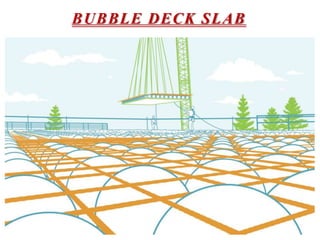
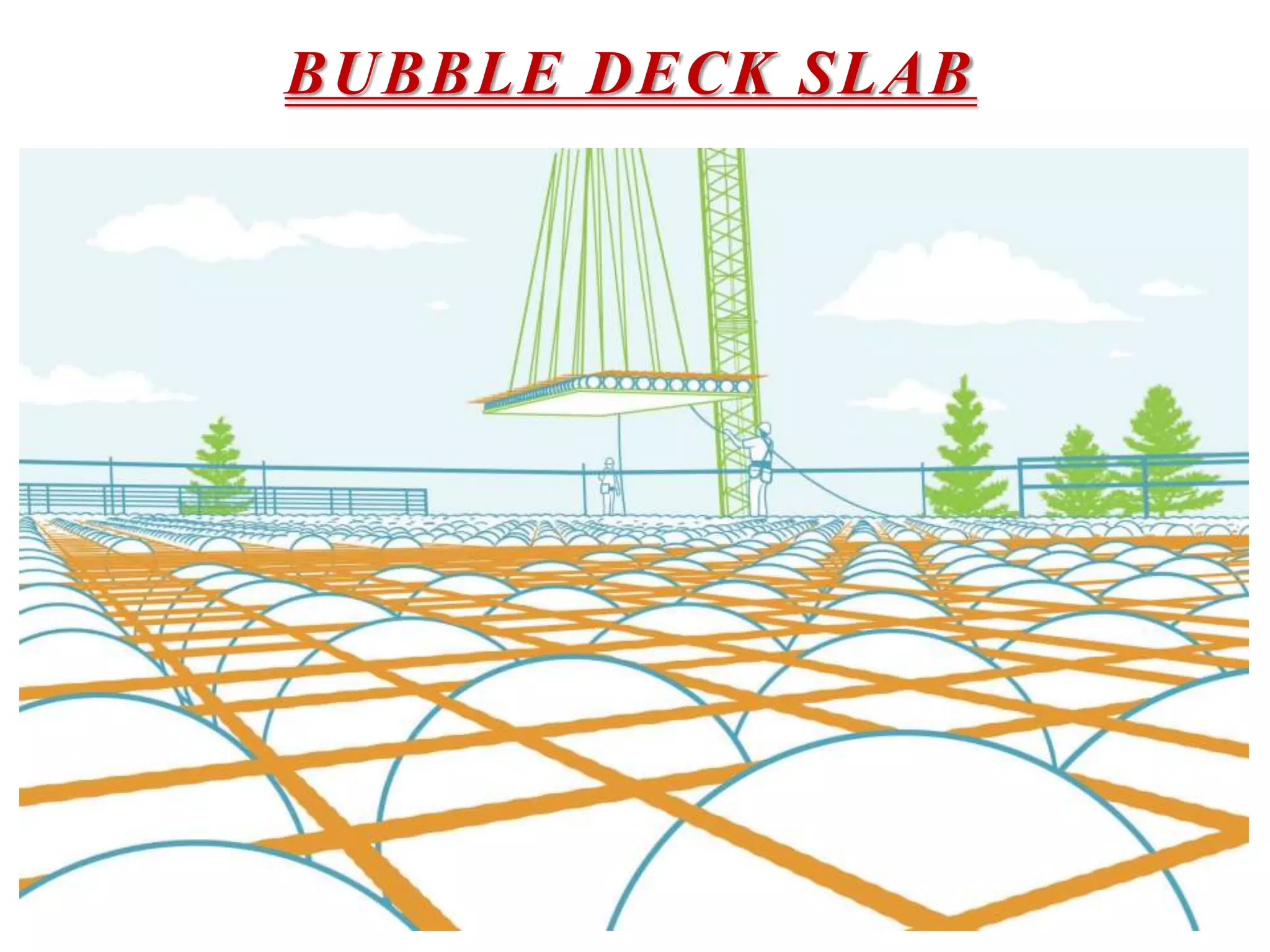
BUBBLE DECK SLAB
Presented by:
Prince Manji
Tanish Das
Saptarshi Bhattacharya
Prasun Mani
Md Irshad Siddhique
Soudeep Chakraborty

Introduction
Types of bubble deck
Materials
Construction
Effects
Advantages
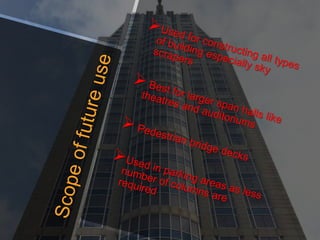
Scope of future use
Conclusion
Contents
Introduction
• The Bubble Deck system is based upon the patented integration
technique - the direct way of linking air and steel.
• The Bubble Deck is a two-way hollow deck in which plastic balls
serves the purpose of eliminating concrete that has no carrying
effect.
• By adapting the geometry of the ball and the mesh width, an
optimized concrete construction is obtained, with simultaneous
maximum utility of both moment and shear zones.
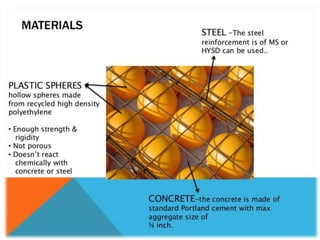
• High density polyethylene hollow spheres replace the in- effective
concrete in the centre of the slab, thus decreasing the dead weight
and increasing the efficiency of the floor
TYPES OF BUBBLE DECK
• Type A- Filigree Elements
• Type B- Reinforcement Modules
• Type C- Finished Planks
Filigree Elements
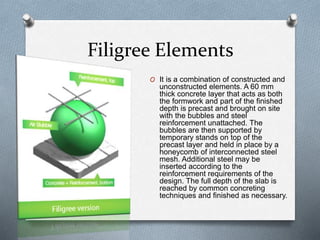
O It is a combination of constructed and
unconstructed elements. A 60 mm
thick concrete layer that acts as both
the formwork and part of the finished
depth is precast and brought on site
with the bubbles and steel
reinforcement unattached. The
bubbles are then supported by
temporary stands on top of the
precast layer and held in place by a
honeycomb of interconnected steel
mesh. Additional steel may be
inserted according to the
reinforcement requirements of the
design. The full depth of the slab is
reached by common concreting
techniques and finished as necessary.
Reinforcement Modules
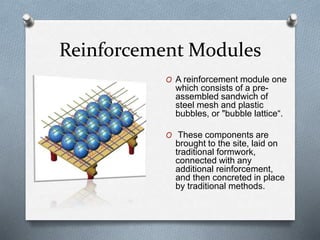
O A reinforcement module one
which consists of a pre-
assembled sandwich of
steel mesh and plastic
bubbles, or "bubble lattice“.
O These components are
brought to the site, laid on
traditional formwork,
connected with any
additional reinforcement,
and then concreted in place
by traditional methods.
Finished Planks
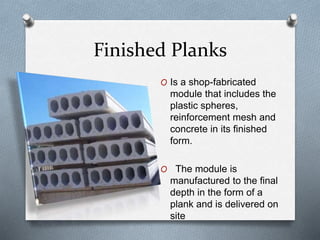
O Is a shop-fabricated
module that includes the
plastic spheres,
reinforcement mesh and
concrete in its finished
form.
O The module is
manufactured to the final
depth in the form of a
plank and is delivered on
site
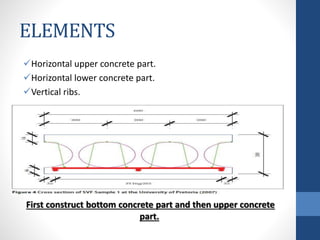
ELEMENTS
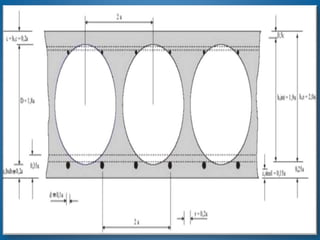
Horizontal upper concrete part.
Horizontal lower concrete part.
Vertical ribs.
First construct bottom concrete part and then upper concrete
part.
Effects
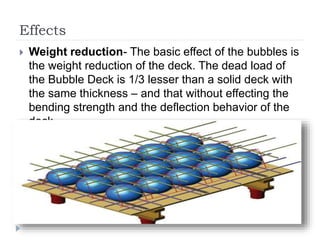
 Weight reduction- The basic effect of the bubbles is
the weight reduction of the deck. The dead load of
the Bubble Deck is 1/3 lesser than a solid deck with
the same thickness – and that without effecting the
bending strength and the deflection behavior of the
deck.
A d v a n t a g e s
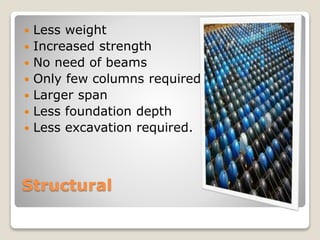
Structural
 Less weight
 Increased strength
 No need of beams
 Only few columns required
 Larger span
 Less foundation depth
 Less excavation required.
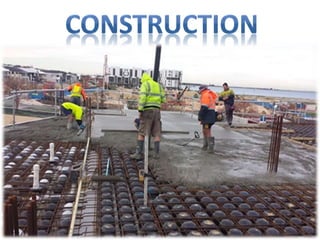
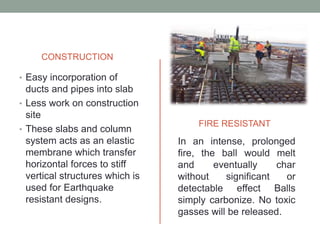
CONSTRUCTION
• Easy incorporation of
ducts and pipes into slab
• Less work on construction
site
• These slabs and column
system acts as an elastic
membrane which transfer
horizontal forces to stiff
vertical structures which is
used for Earthquake
resistant designs.
FIRE RESISTANT
In an intense, prolonged
fire, the ball would melt
and eventually char
without significant or
detectable effect Balls
simply carbonize. No toxic
gasses will be released.
Environmental Advantages
• Less material and energy consumption
• Reducing CO2 emission up to 40 kg/m2
• 1kg of plastic replaces 100kg of concrete
• Every component can be recycled
Economic Advantage
• Economy
• Savings in materials
• Transportation costs reduced
• Faster construction time
• Buildings can be more flexible and easy in installations.
CONCLUSIONS
 The bubble deck technology is environmentally green and sustainable; avoiding
the cement production allows reducing global Co2 emissions.

 In comparative of conventional slab the volume of concrete in bubble deck
(continuous) are less required, that is 25% approximate.
 Cost and time saving by using bubbles in the slab like weight of slab, concrete
volume indirectly load on the beam and walls also decrease/ less so that building
foundations can be designed for smaller dead loads.
www.bubbledeck.com
https://www.bing.com/images/search?q=Symbol+for+Green+Eco-
Friendly&FORM=RESTAB
www.google.co.in
www.wikipedia.org/wiki/bubble-deck-slab
http://www.seminarsonly.com/Civil_Engineering/bubble-deck-slab.php
BIBILIOGRAPHY
F O R Y O U R A T T E N T I O N
Bubble deck slab

Bubble deck slab

  • 1.
  • 2.
    Presented by: Prince Manji TanishDas Saptarshi Bhattacharya Prasun Mani Md Irshad Siddhique Soudeep Chakraborty
  • 3.
     Introduction Types of bubbledeck Materials Construction Effects Advantages Scope of future use Conclusion Contents
  • 4.
    Introduction • The BubbleDeck system is based upon the patented integration technique - the direct way of linking air and steel. • The Bubble Deck is a two-way hollow deck in which plastic balls serves the purpose of eliminating concrete that has no carrying effect. • By adapting the geometry of the ball and the mesh width, an optimized concrete construction is obtained, with simultaneous maximum utility of both moment and shear zones. • High density polyethylene hollow spheres replace the in- effective concrete in the centre of the slab, thus decreasing the dead weight and increasing the efficiency of the floor
  • 5.
    TYPES OF BUBBLEDECK • Type A- Filigree Elements • Type B- Reinforcement Modules • Type C- Finished Planks
  • 6.
    Filigree Elements O Itis a combination of constructed and unconstructed elements. A 60 mm thick concrete layer that acts as both the formwork and part of the finished depth is precast and brought on site with the bubbles and steel reinforcement unattached. The bubbles are then supported by temporary stands on top of the precast layer and held in place by a honeycomb of interconnected steel mesh. Additional steel may be inserted according to the reinforcement requirements of the design. The full depth of the slab is reached by common concreting techniques and finished as necessary.
  • 7.
    Reinforcement Modules O Areinforcement module one which consists of a pre- assembled sandwich of steel mesh and plastic bubbles, or "bubble lattice“. O These components are brought to the site, laid on traditional formwork, connected with any additional reinforcement, and then concreted in place by traditional methods.
  • 8.
    Finished Planks O Isa shop-fabricated module that includes the plastic spheres, reinforcement mesh and concrete in its finished form. O The module is manufactured to the final depth in the form of a plank and is delivered on site
  • 14.
    ELEMENTS Horizontal upper concretepart. Horizontal lower concrete part. Vertical ribs. First construct bottom concrete part and then upper concrete part.
  • 15.
    Effects  Weight reduction-The basic effect of the bubbles is the weight reduction of the deck. The dead load of the Bubble Deck is 1/3 lesser than a solid deck with the same thickness – and that without effecting the bending strength and the deflection behavior of the deck.
  • 16.
    A d va n t a g e s
  • 17.
    Structural  Less weight Increased strength  No need of beams  Only few columns required  Larger span  Less foundation depth  Less excavation required.
  • 18.
    CONSTRUCTION • Easy incorporationof ducts and pipes into slab • Less work on construction site • These slabs and column system acts as an elastic membrane which transfer horizontal forces to stiff vertical structures which is used for Earthquake resistant designs. FIRE RESISTANT In an intense, prolonged fire, the ball would melt and eventually char without significant or detectable effect Balls simply carbonize. No toxic gasses will be released.
  • 19.
    Environmental Advantages • Lessmaterial and energy consumption • Reducing CO2 emission up to 40 kg/m2 • 1kg of plastic replaces 100kg of concrete • Every component can be recycled
  • 20.
    Economic Advantage • Economy •Savings in materials • Transportation costs reduced • Faster construction time • Buildings can be more flexible and easy in installations.
  • 22.
    CONCLUSIONS  The bubbledeck technology is environmentally green and sustainable; avoiding the cement production allows reducing global Co2 emissions.  In comparative of conventional slab the volume of concrete in bubble deck (continuous) are less required, that is 25% approximate.  Cost and time saving by using bubbles in the slab like weight of slab, concrete volume indirectly load on the beam and walls also decrease/ less so that building foundations can be designed for smaller dead loads.

  • 23.
  • 24.
    F O RY O U R A T T E N T I O N
  • 25.
    F O RY O U R A T T E N T I O N
  • 26.
    F O RY O U R A T T E N T I O N
  • 27.
    F O RY O U R A T T E N T I O N
  • 28.
    F O RY O U R A T T E N T I O N
  • 29.
    F O RY O U R A T T E N T I O N
  • 30.
    F O RY O U R A T T E N T I O N