Exploring Patterns of Student Learning Technology Use Ruslan Ramanau, Rhona Sharpe, Greg Benfield
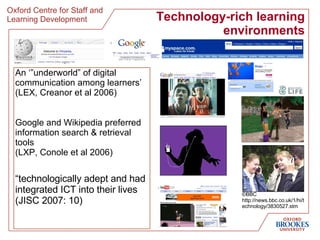
Technology-rich learning environments An ‘”underworld” of digital communication among learners’ (LEX, Creanor et al 2006) Google and Wikipedia preferred information search & retrieval tools  (LXP, Conole et al 2006) “ technologically adept and had integrated ICT into their lives (JISC 2007: 10) ©BBC http://news.bbc.co.uk/1/hi/technology/3830527.stm
Aims and Key Research Question Pathfinder evaluation aimed to explore learner experiences of learning technologies for interpersonal interaction and collaboration at Oxford Brookes  The two key areas of investigation were:  student experiences of e-learning as part of their curriculum  informal social uses of software to support their Universities studies  Key research question:  How do students experience social uses of technology in different learning contexts?
Research Design Mixed-methods approach Seven interview-based case studies to provide rich data on the nature and the impact of e-learning innovation on learner experiences Survey of patterns of online media use and their relation to views on learner choice and independence in studies as well as strategies for self- and context-regulation
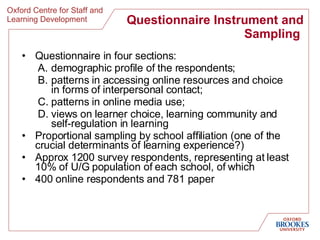
Questionnaire Instrument and Sampling  Questionnaire in four sections: demographic profile of the respondents;  patterns in accessing online resources and choice in forms of interpersonal contact;  patterns in online media use;  views on learner choice, learning community and self-regulation in learning  Proportional sampling by school affiliation (one of the crucial determinants of learning experience?) Approx 1200 survey respondents, representing at least 10% of U/G population of each school, of which 400 online respondents and 781 paper
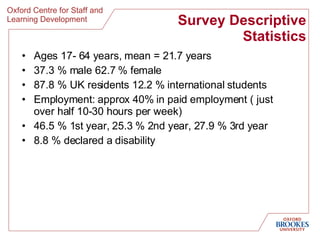
Survey Descriptive Statistics Ages 17- 64 years, mean = 21.7 years 37.3 % male 62.7 % female 87.8 % UK residents 12.2 % international students  Employment: approx 40% in paid employment ( just over half 10-30 hours per week) 46.5 % 1st year, 25.3 % 2nd year, 27.9 % 3rd year  8.8 % declared a disability
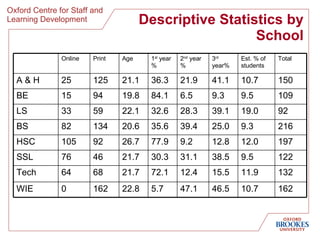
Descriptive Statistics by School 132 11.9 15.5 12.4 72.1 21.7 68 64 Tech 10.7 9.5 12.0 9.3 19.0 9.5 10.7 Est. % of students 162 46.5 47.1 5.7 22.8 162 0 WIE 122 38.5 31.1 30.3 21.7 46 76 SSL 197 12.8 9.2 77.9 26.7 92 105 HSC 216 25.0 39.4 35.6 20.6 134 82 BS 92 39.1 28.3 32.6 22.1 59 33 LS 109 9.3 6.5 84.1 19.8 94 15 BE 150 41.1 21.9 36.3 21.1 125 25 A & H Total 3 rd  year% 2 nd  year % 1 st  year % Age  Print Online
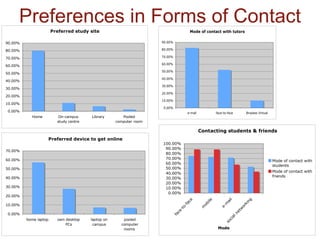
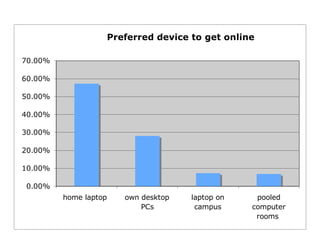
Preferences in Forms of Contact
 
 
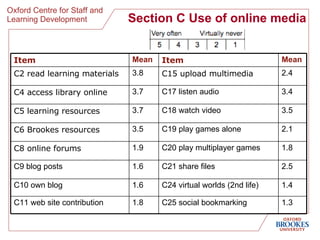
Section C Use of online media 1.4 C24 virtual worlds (2nd life) 1.6 C10 own blog 1.3 C25 social bookmarking 1.8 C11 web site contribution 2.5 C21 share files 1.6 C9 blog posts 1.8 C20 play multiplayer games 1.9 C8 online forums 2.1 C19 play games alone 3.5 C6 Brookes resources 3.5 C18 watch video 3.7 C5 learning resources 3.4 C17 listen audio 3.7 C4 access library online 2.4 C15 upload multimedia 3.8 C2 read learning materials Mean Item Mean Item
Results of Factor Analysis To explore patterns in  online  use a PCI (principal component analysis) with varimax rotation was employed  After examining the Scree Plot and eigenvalues a five-factor solution was deemed appropriate:  multimedia   use  (items C15, C17, C18 and C21) pioneering  (C24 and C25) contributing  (C8, C9 and C10, C11) gaming  (C19, C20)  accessing learning resources  (C2, C4, C5 and C6)
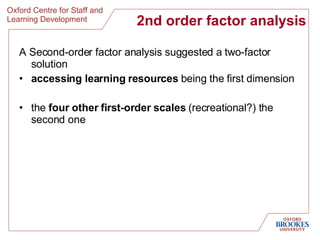
2nd order factor analysis A Second-order factor analysis suggested a two-factor solution  accessing learning resources  being the first dimension  the  four other first-order scales  (recreational?) the second one
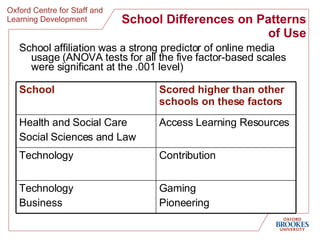
School Differences on Patterns of Use School affiliation was a strong predictor of online media usage (ANOVA tests for all the five factor-based scales were significant at the .001 level) Gaming  Pioneering Technology Business Contribution Technology Access Learning Resources Health and Social Care Social Sciences and Law Scored higher than other schools on these factors School
Differences by year of study Year of study did  not  appear to be a predictor of student scores on the five factor-based scales,  except  … accessing learning resources  increased year on year
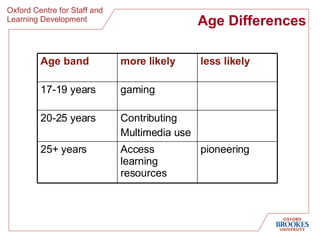
Age Differences pioneering Access learning resources 25+ years Contributing Multimedia use 20-25 years gaming 17-19 years less likely more likely Age band
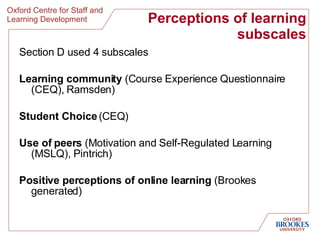
Perceptions of learning subscales Section D used 4 subscales Learning community  (Course Experience Questionnaire (CEQ), Ramsden)  Student Choice  (CEQ) Use of peers  (Motivation and Self-Regulated Learning (MSLQ), Pintrich) Positive perceptions of online learning  (Brookes generated)
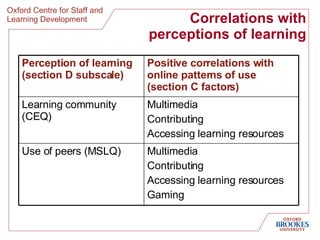
Correlations with perceptions of learning Multimedia Contributing Accessing learning resources Gaming Use of peers (MSLQ) Multimedia Contributing Accessing learning resources Learning community (CEQ) Positive correlations with online patterns of use (section C factors) Perception of learning (section D subscale)
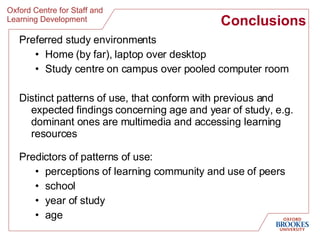
Conclusions Preferred study environments Home (by far), laptop over desktop Study centre on campus over pooled computer room Distinct patterns of use, that conform with previous and expected findings concerning age and year of study, e.g. dominant ones are multimedia and accessing learning resources Predictors of patterns of use: perceptions of learning community and use of peers school year of study age
What next? Exploring school differences are they discipline or cohort related? are they a problem? do they change by year of study? Further development of the questionnaire some ambiguous questions did not ask about programme affiliation section C item analysis
References Conole, G., De Laat, M., Dillon, T. and Darby, J. (2006, November 2006). "JISC LXP: Student Experiences of Technologies Draft Final Report."  November 2006.[Online] Retrieved 20 Nov, 2006, from  http://www.jisc.ac.uk/media/documents/lxp_project_final_report_nov_06.pdf . Creanor, L., Trinder, K., Gowan, D. and Howells, C. (2006, August 2006). "LEX: The Learner Experience of e-Learning Final Project Report August 2006."  [Online] Retrieved 2 November, 2006, from  http://www.jisc.ac.uk/uploaded_documents/LEX%20Final%20Report_August06.pdf   JISC (2007). "Student Expectations Study: Key findings from online research and discussion evenings held in June 2007 for the Joint Information Systems Committee."  [Online] Retrieved 10 September, 2007, from  http://www. jisc .ac. uk/media/documents/publications/studentexpectations . pdf

Brookes Pathfinder Evaluation Nlc 2008

  • 1.
    Exploring Patterns ofStudent Learning Technology Use Ruslan Ramanau, Rhona Sharpe, Greg Benfield
  • 2.
    Technology-rich learning environmentsAn ‘”underworld” of digital communication among learners’ (LEX, Creanor et al 2006) Google and Wikipedia preferred information search & retrieval tools (LXP, Conole et al 2006) “ technologically adept and had integrated ICT into their lives (JISC 2007: 10) ©BBC http://news.bbc.co.uk/1/hi/technology/3830527.stm
  • 3.
    Aims and KeyResearch Question Pathfinder evaluation aimed to explore learner experiences of learning technologies for interpersonal interaction and collaboration at Oxford Brookes The two key areas of investigation were: student experiences of e-learning as part of their curriculum informal social uses of software to support their Universities studies Key research question: How do students experience social uses of technology in different learning contexts?
  • 4.
    Research Design Mixed-methodsapproach Seven interview-based case studies to provide rich data on the nature and the impact of e-learning innovation on learner experiences Survey of patterns of online media use and their relation to views on learner choice and independence in studies as well as strategies for self- and context-regulation
  • 5.
    Questionnaire Instrument andSampling Questionnaire in four sections: demographic profile of the respondents; patterns in accessing online resources and choice in forms of interpersonal contact; patterns in online media use; views on learner choice, learning community and self-regulation in learning Proportional sampling by school affiliation (one of the crucial determinants of learning experience?) Approx 1200 survey respondents, representing at least 10% of U/G population of each school, of which 400 online respondents and 781 paper
  • 6.
    Survey Descriptive StatisticsAges 17- 64 years, mean = 21.7 years 37.3 % male 62.7 % female 87.8 % UK residents 12.2 % international students Employment: approx 40% in paid employment ( just over half 10-30 hours per week) 46.5 % 1st year, 25.3 % 2nd year, 27.9 % 3rd year 8.8 % declared a disability
  • 7.
    Descriptive Statistics bySchool 132 11.9 15.5 12.4 72.1 21.7 68 64 Tech 10.7 9.5 12.0 9.3 19.0 9.5 10.7 Est. % of students 162 46.5 47.1 5.7 22.8 162 0 WIE 122 38.5 31.1 30.3 21.7 46 76 SSL 197 12.8 9.2 77.9 26.7 92 105 HSC 216 25.0 39.4 35.6 20.6 134 82 BS 92 39.1 28.3 32.6 22.1 59 33 LS 109 9.3 6.5 84.1 19.8 94 15 BE 150 41.1 21.9 36.3 21.1 125 25 A & H Total 3 rd year% 2 nd year % 1 st year % Age Print Online
  • 8.
  • 9.
  • 10.
  • 11.
    Section C Useof online media 1.4 C24 virtual worlds (2nd life) 1.6 C10 own blog 1.3 C25 social bookmarking 1.8 C11 web site contribution 2.5 C21 share files 1.6 C9 blog posts 1.8 C20 play multiplayer games 1.9 C8 online forums 2.1 C19 play games alone 3.5 C6 Brookes resources 3.5 C18 watch video 3.7 C5 learning resources 3.4 C17 listen audio 3.7 C4 access library online 2.4 C15 upload multimedia 3.8 C2 read learning materials Mean Item Mean Item
  • 12.
    Results of FactorAnalysis To explore patterns in online use a PCI (principal component analysis) with varimax rotation was employed After examining the Scree Plot and eigenvalues a five-factor solution was deemed appropriate: multimedia use (items C15, C17, C18 and C21) pioneering (C24 and C25) contributing (C8, C9 and C10, C11) gaming (C19, C20) accessing learning resources (C2, C4, C5 and C6)
  • 13.
    2nd order factoranalysis A Second-order factor analysis suggested a two-factor solution accessing learning resources being the first dimension the four other first-order scales (recreational?) the second one
  • 14.
    School Differences onPatterns of Use School affiliation was a strong predictor of online media usage (ANOVA tests for all the five factor-based scales were significant at the .001 level) Gaming Pioneering Technology Business Contribution Technology Access Learning Resources Health and Social Care Social Sciences and Law Scored higher than other schools on these factors School
  • 15.
    Differences by yearof study Year of study did not appear to be a predictor of student scores on the five factor-based scales, except … accessing learning resources increased year on year
  • 16.
    Age Differences pioneeringAccess learning resources 25+ years Contributing Multimedia use 20-25 years gaming 17-19 years less likely more likely Age band
  • 17.
    Perceptions of learningsubscales Section D used 4 subscales Learning community (Course Experience Questionnaire (CEQ), Ramsden) Student Choice (CEQ) Use of peers (Motivation and Self-Regulated Learning (MSLQ), Pintrich) Positive perceptions of online learning (Brookes generated)
  • 18.
    Correlations with perceptionsof learning Multimedia Contributing Accessing learning resources Gaming Use of peers (MSLQ) Multimedia Contributing Accessing learning resources Learning community (CEQ) Positive correlations with online patterns of use (section C factors) Perception of learning (section D subscale)
  • 19.
    Conclusions Preferred studyenvironments Home (by far), laptop over desktop Study centre on campus over pooled computer room Distinct patterns of use, that conform with previous and expected findings concerning age and year of study, e.g. dominant ones are multimedia and accessing learning resources Predictors of patterns of use: perceptions of learning community and use of peers school year of study age
  • 20.
    What next? Exploringschool differences are they discipline or cohort related? are they a problem? do they change by year of study? Further development of the questionnaire some ambiguous questions did not ask about programme affiliation section C item analysis
  • 21.
    References Conole, G.,De Laat, M., Dillon, T. and Darby, J. (2006, November 2006). "JISC LXP: Student Experiences of Technologies Draft Final Report." November 2006.[Online] Retrieved 20 Nov, 2006, from http://www.jisc.ac.uk/media/documents/lxp_project_final_report_nov_06.pdf . Creanor, L., Trinder, K., Gowan, D. and Howells, C. (2006, August 2006). "LEX: The Learner Experience of e-Learning Final Project Report August 2006." [Online] Retrieved 2 November, 2006, from http://www.jisc.ac.uk/uploaded_documents/LEX%20Final%20Report_August06.pdf JISC (2007). "Student Expectations Study: Key findings from online research and discussion evenings held in June 2007 for the Joint Information Systems Committee." [Online] Retrieved 10 September, 2007, from http://www. jisc .ac. uk/media/documents/publications/studentexpectations . pdf