Board of Higher Education Meeting  |  December 6, 2011
 
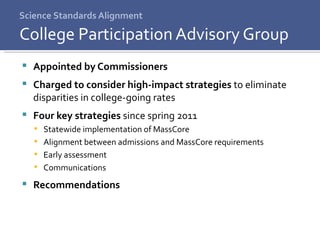
Science Standards Alignment Appointed by Commissioners Charged to consider high-impact strategies  to eliminate disparities in college-going rates Four key strategies  since spring 2011 Statewide implementation of MassCore Alignment between admissions and MassCore requirements Early assessment Communications Recommendations College Participation Advisory Group
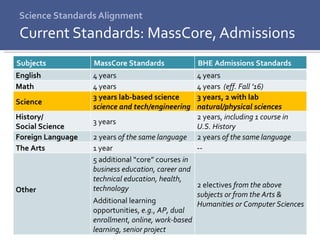
Science Standards Alignment Current Standards: MassCore, Admissions Subjects MassCore Standards BHE Admissions Standards English 4 years 4 years Math 4 years 4 years  (eff. Fall ’16) Science 3 years lab-based science science and tech/engineering 3 years, 2 with lab natural/physical sciences History/ Social Science 3 years 2 years,  including 1 course in  U.S. History Foreign Language 2 years  of the same language 2 years  of the same language The Arts 1 year -- Other  5 additional “core” courses  in business education, career and technical education, health, technology Additional learning opportunities,  e.g., AP, dual enrollment,  online, work-based learning, senior project 2 electives  from the above subjects or from the Arts & Humanities or Computer Sciences
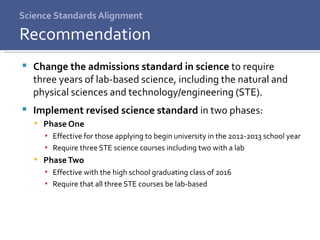
Science Standards Alignment Change the admissions standard in science  to require  three years of lab-based science, including the natural and physical sciences and technology/engineering (STE).  Implement revised science standard  in two phases: Phase One  Effective for those applying to begin university in the 2012-2013 school year  Require three STE science courses including two with a lab Phase Two Effective with the high school graduating class of 2016  Require that all three STE courses be lab-based Recommendation
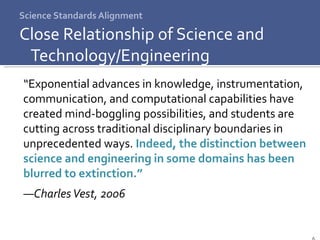
Science Standards Alignment Close Relationship of Science and Technology/Engineering “ Exponential advances in knowledge, instrumentation, communication, and computational capabilities have created mind-boggling possibilities, and students are cutting across traditional disciplinary boundaries in unprecedented ways.  Indeed, the distinction between science and engineering in some domains has been blurred to extinction.”   ― Charles Vest, 2006
 
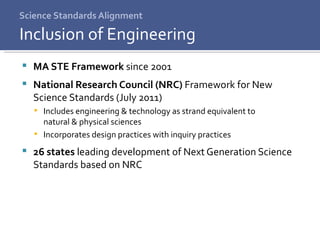
Science Standards Alignment MA STE Framework  since 2001 National Research Council (NRC)  Framework for New Science Standards (July 2011) Includes engineering & technology as strand equivalent to  natural & physical sciences Incorporates design practices with inquiry practices 26 states  leading development of Next Generation Science Standards based on NRC Inclusion of Engineering
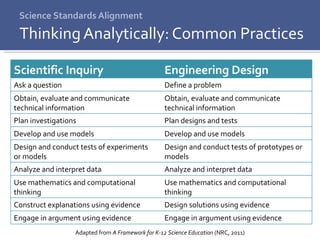
Science Standards Alignment Thinking Analytically: Common Practices Adapted from  A Framework for K-12 Science Education  (NRC, 2011) Scientific Inquiry Engineering Design Ask a question Define a problem Obtain, evaluate and communicate technical information Obtain, evaluate and communicate technical information Plan investigations Plan designs and tests Develop and use models Develop and use models Design and conduct tests of experiments  or models Design and conduct tests of prototypes or models Analyze and interpret data Analyze and interpret data Use mathematics and computational thinking Use mathematics and computational thinking Construct explanations using evidence Design solutions using evidence Engage in argument using evidence Engage in argument using evidence
Science Standards Alignment Example technology/engineering principles: Engineering design to create and test technological products Analysis and purposeful application of materials and manufacturing processes Structure and function relationships Analysis, modeling and design of technological systems Analysis of tradeoffs, constraints and optimization Reflected in our state learning standards  Similar principles reflected in NRC/NGSS Each About  Principles  of a Field
Science Standards Alignment What are they about? Academic learning – concepts and principles What do students do? Laboratory-based – design, model, test, analyze, etc. Where do these classes reside? From 9th grade introductory engineering… …  to upper-level electives: Robotics, Environmental Engineering, Biotechnology In science, science & technology/engineering, and/or technology education departments Engineering Courses as Science Credit
Science Standards Alignment Requires an  aligned system For K-12, ESE has  aligned policies and requirements  to ensure rigor of high school science courses: Standards Licensure Assessment Which high schools are taking advantage of: Designing, implementing, and approving  technology/engineering courses as science credit Ensuring Academic Rigor
Ensuring Academic Rigor * Approval by school (guidance & department) and/or district (school committee) Science Standards Alignment Biology Chemistry Earth Science Physics Tech/Eng High School Standards Course approval*  (for lab-based science credit) Assessment  (MCAS  end-of-course) NA License & HQT
Science Standards Alignment This adjustment to the state university admissions policy: Will help convey a similar conception of college readiness  in science for K-12 and higher education Will recognize high school technology/engineering courses  that are designed, offered and taken for science credit Without this recognition schools and students see this  as a large disincentive to offer and take tech/eng courses  in high school The Last Piece of an Aligned System
 

Science Standards Alignment

  • 1.
    Board of HigherEducation Meeting | December 6, 2011
  • 2.
  • 3.
    Science Standards AlignmentAppointed by Commissioners Charged to consider high-impact strategies to eliminate disparities in college-going rates Four key strategies since spring 2011 Statewide implementation of MassCore Alignment between admissions and MassCore requirements Early assessment Communications Recommendations College Participation Advisory Group
  • 4.
    Science Standards AlignmentCurrent Standards: MassCore, Admissions Subjects MassCore Standards BHE Admissions Standards English 4 years 4 years Math 4 years 4 years (eff. Fall ’16) Science 3 years lab-based science science and tech/engineering 3 years, 2 with lab natural/physical sciences History/ Social Science 3 years 2 years, including 1 course in U.S. History Foreign Language 2 years of the same language 2 years of the same language The Arts 1 year -- Other 5 additional “core” courses in business education, career and technical education, health, technology Additional learning opportunities, e.g., AP, dual enrollment, online, work-based learning, senior project 2 electives from the above subjects or from the Arts & Humanities or Computer Sciences
  • 5.
    Science Standards AlignmentChange the admissions standard in science to require three years of lab-based science, including the natural and physical sciences and technology/engineering (STE). Implement revised science standard in two phases: Phase One Effective for those applying to begin university in the 2012-2013 school year Require three STE science courses including two with a lab Phase Two Effective with the high school graduating class of 2016 Require that all three STE courses be lab-based Recommendation
  • 6.
    Science Standards AlignmentClose Relationship of Science and Technology/Engineering “ Exponential advances in knowledge, instrumentation, communication, and computational capabilities have created mind-boggling possibilities, and students are cutting across traditional disciplinary boundaries in unprecedented ways. Indeed, the distinction between science and engineering in some domains has been blurred to extinction.” ― Charles Vest, 2006
  • 7.
  • 8.
    Science Standards AlignmentMA STE Framework since 2001 National Research Council (NRC) Framework for New Science Standards (July 2011) Includes engineering & technology as strand equivalent to natural & physical sciences Incorporates design practices with inquiry practices 26 states leading development of Next Generation Science Standards based on NRC Inclusion of Engineering
  • 9.
    Science Standards AlignmentThinking Analytically: Common Practices Adapted from A Framework for K-12 Science Education (NRC, 2011) Scientific Inquiry Engineering Design Ask a question Define a problem Obtain, evaluate and communicate technical information Obtain, evaluate and communicate technical information Plan investigations Plan designs and tests Develop and use models Develop and use models Design and conduct tests of experiments or models Design and conduct tests of prototypes or models Analyze and interpret data Analyze and interpret data Use mathematics and computational thinking Use mathematics and computational thinking Construct explanations using evidence Design solutions using evidence Engage in argument using evidence Engage in argument using evidence
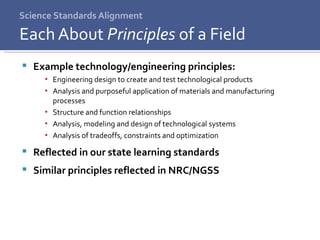
  • 10.
    Science Standards AlignmentExample technology/engineering principles: Engineering design to create and test technological products Analysis and purposeful application of materials and manufacturing processes Structure and function relationships Analysis, modeling and design of technological systems Analysis of tradeoffs, constraints and optimization Reflected in our state learning standards Similar principles reflected in NRC/NGSS Each About Principles of a Field
  • 11.
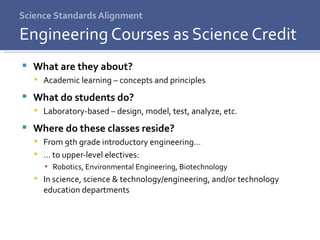
    Science Standards AlignmentWhat are they about? Academic learning – concepts and principles What do students do? Laboratory-based – design, model, test, analyze, etc. Where do these classes reside? From 9th grade introductory engineering… … to upper-level electives: Robotics, Environmental Engineering, Biotechnology In science, science & technology/engineering, and/or technology education departments Engineering Courses as Science Credit
  • 12.
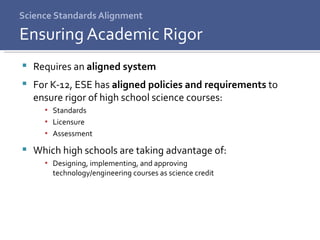
    Science Standards AlignmentRequires an aligned system For K-12, ESE has aligned policies and requirements to ensure rigor of high school science courses: Standards Licensure Assessment Which high schools are taking advantage of: Designing, implementing, and approving technology/engineering courses as science credit Ensuring Academic Rigor
  • 13.
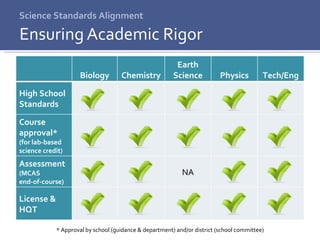
    Ensuring Academic Rigor* Approval by school (guidance & department) and/or district (school committee) Science Standards Alignment Biology Chemistry Earth Science Physics Tech/Eng High School Standards Course approval* (for lab-based science credit) Assessment (MCAS end-of-course) NA License & HQT
  • 14.
    Science Standards AlignmentThis adjustment to the state university admissions policy: Will help convey a similar conception of college readiness in science for K-12 and higher education Will recognize high school technology/engineering courses that are designed, offered and taken for science credit Without this recognition schools and students see this as a large disincentive to offer and take tech/eng courses in high school The Last Piece of an Aligned System
  • 15.

Editor's Notes

  • #5 Admissions standards to the four-year public universities require three years of science, including two with a lab, with courses drawn from the natural and physical sciences. MassCore calls for three years of lab based science with courses drawn from the natural or physical sciences, technology or engineering. The disconnect has caused significant confusion among students who complete the state recommended MassCore course of study only to find that technology/engineering courses acceptable in the science category under MassCore are not accepted as a science for admissions purposes.
  • #6 Amend the admissions standard in science for Massachusetts public universities to require three years of lab-based science, including the natural and physical sciences and technology/engineering. Consider titling this admissions category “science and engineering” or “science, technology and engineering (STE)”. Only those STE courses that have been designated as a science course (taken for science credit) by the high school should be acceptable under the new science admissions standard.
  • #16 Subsequent to the change in the admissions standard for science, convene a P-12/higher education working group to consider criteria for rigorous STE courses (including criteria for what constitutes a lab-based course) and over time build a repository of exemplar courses. This should include a review of any next generation P-12 science standards and their implications for teaching, learning and assessment. This approach will provide quality assurance to future students, schools and admissions officers.