THE MILLENIAL MYTHOLOGY: PUTTING SUPPOSITIONS TO THE TEST IN AN ACADEMIC LIBRARY  Pascal Lupien plupien@uoguelph.ca Randy Oldham roldham@uoguelph.ca University of Guelph
Questions: What percentage of students own PDA’s? What percentage of students use their cell phones to access the Internet? What percentage of students participate in a virtual world, such as Second Life?
Questions: What percentage of students use online social networks such as MySpace or Facebook?  Do students use these tools for academic purposes? Where is the first place that students would go to find resources for their research assignments?
Background About the University of Guelph 19,316 Full-time Undergraduate and Graduate Enrolments Research intensive, learner-centered university
Methodology: survey Reviewed by student groups Pre-tested Sent out via mass e-mail
Methodology: focus groups Conducted after the survey Designed to answer questions not addressed in the survey Used an outside facilitator 4 groups
The Respondents
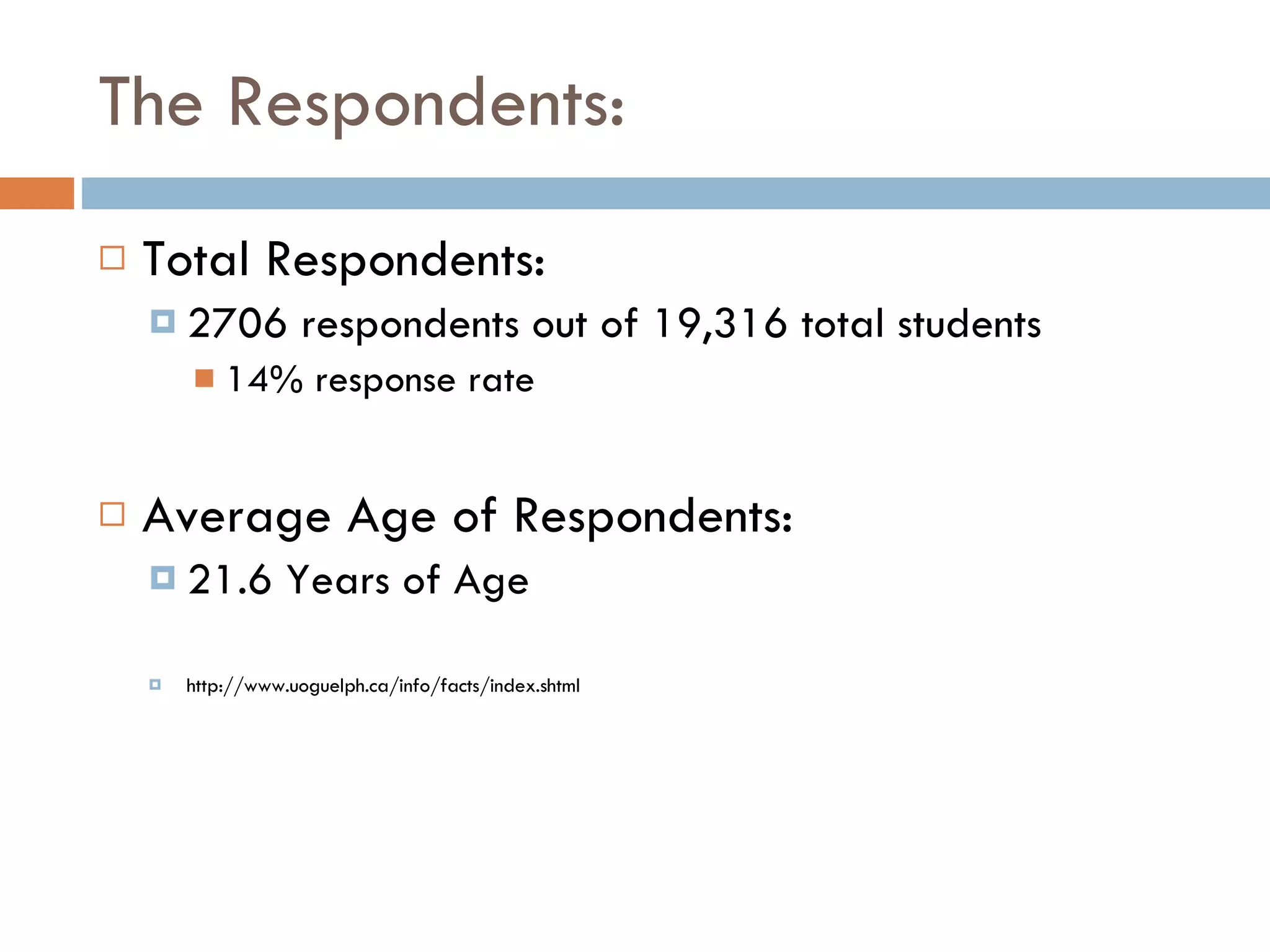
The Respondents: Total Respondents:  2706 respondents out of 19,316 total students  14% response rate Average Age of Respondents: 21.6 Years of Age http://www.uoguelph.ca/info/facts/index.shtml
The Respondents: Gender
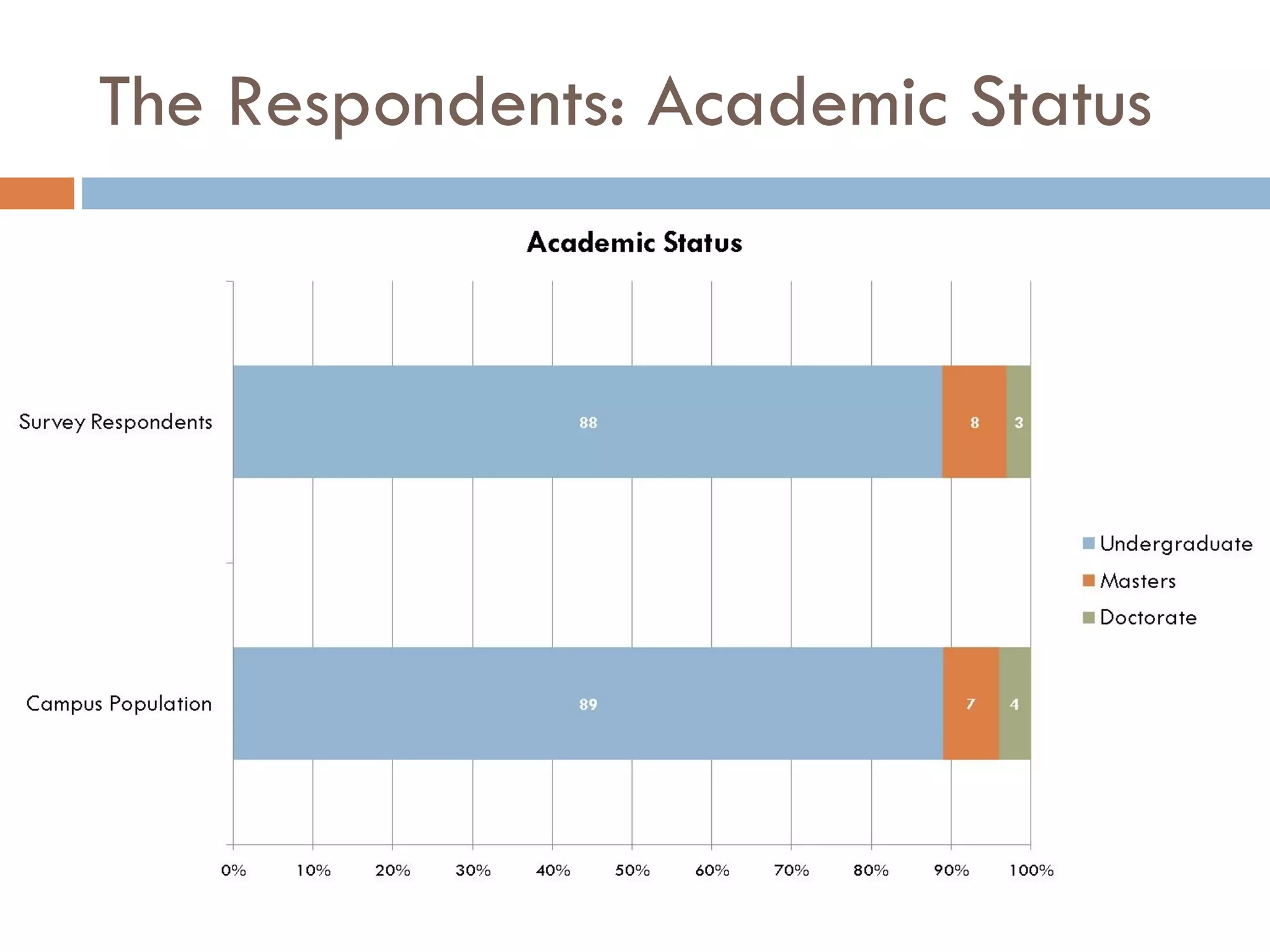
The Respondents: Academic Status
Hardware Ownership & Usage
Hardware: PDAs Do you own a PDA (PalmPilot, Treo, IPAQ etc)?
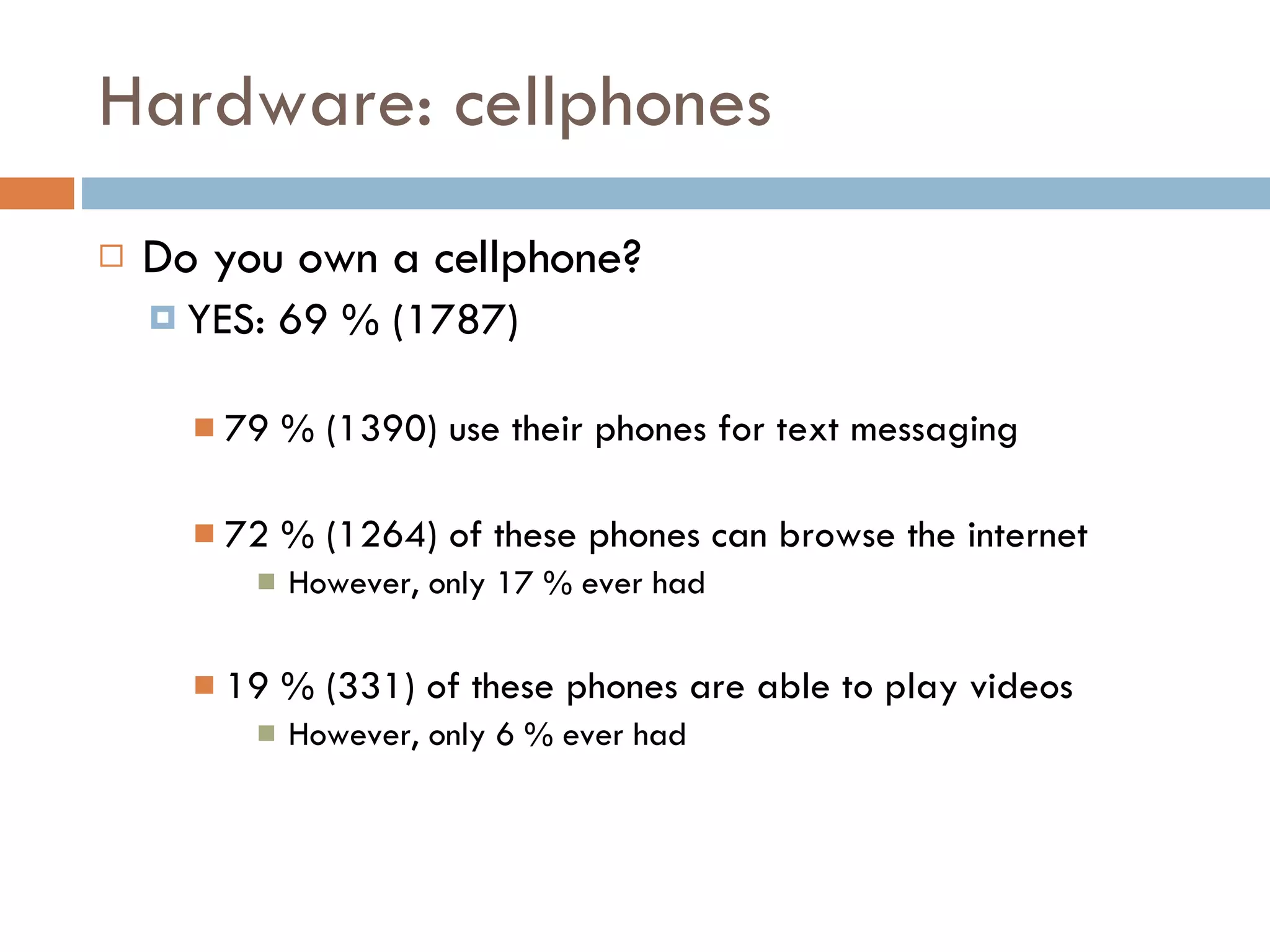
Hardware: cellphones Do you own a cellphone? YES: 69 % (1787) 79 % (1390) use their phones for text messaging 72 % (1264) of these phones can browse the internet However, only 17 % ever had 19 % (331) of these phones are able to play videos However, only 6 % ever had
Instant Messaging & Online Social Networks
Instant Messaging Do you use a chat application, like MSN, Gtalk? Yes: 93 % (2348)
Instant Messaging (cont’) Chat use for academic group projects:
Online Social Networks: How often do you participate in OSNs (like facebook, MSN spaces, myspace)?
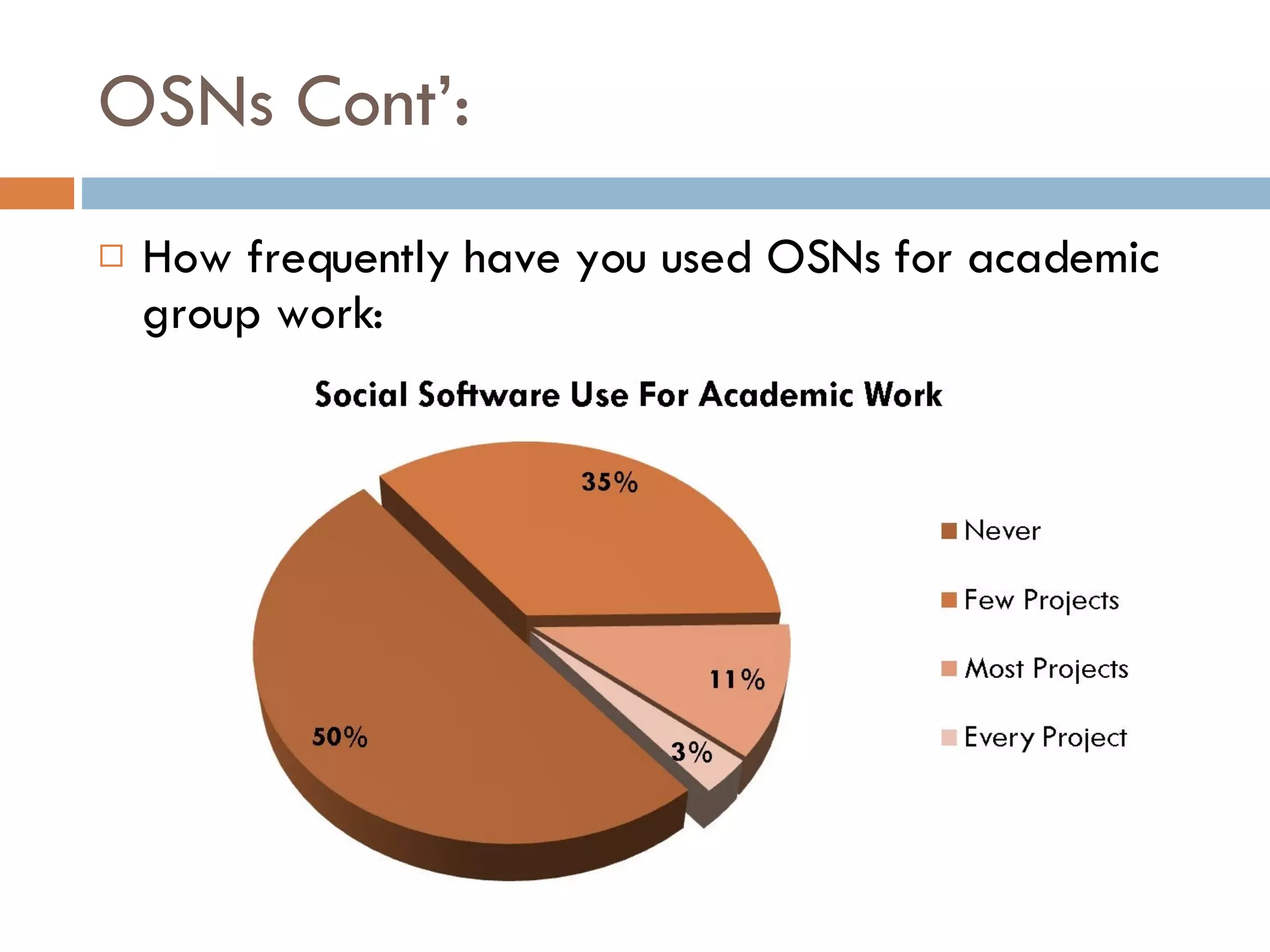
OSNs Cont’: How frequently have you used OSNs for academic group work:
Focus groups: OSNs Prefer to use Facebook & OSN sites for social purposes Prefer to use e-mail to communicate with group project members  Respondents were willing to share their work with friends, but not just anyone
Online Activities
Online Activities (con’t) How often do you play online games:
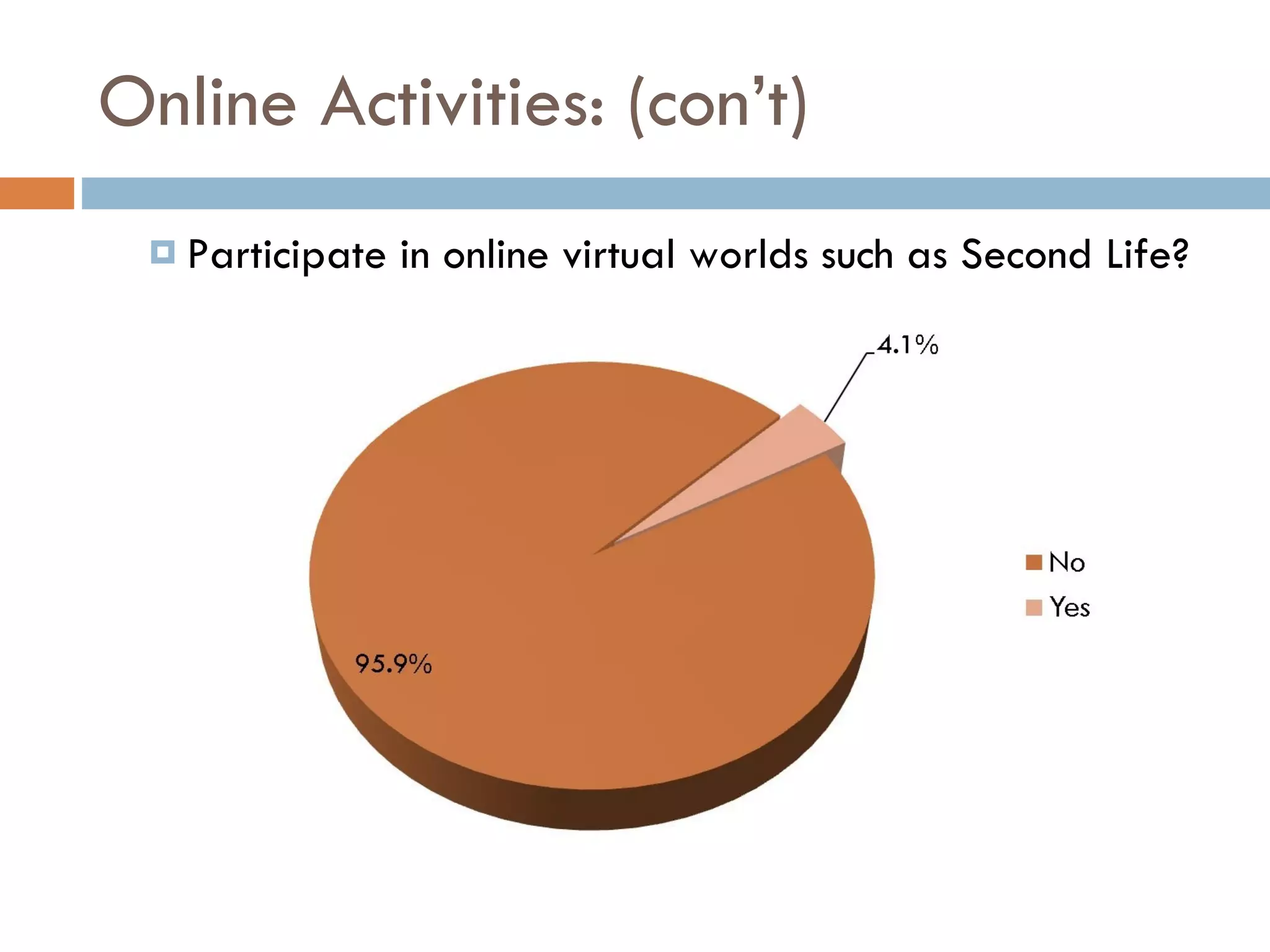
Online Activities: (con’t) Participate in online virtual worlds such as Second Life?
Online Research
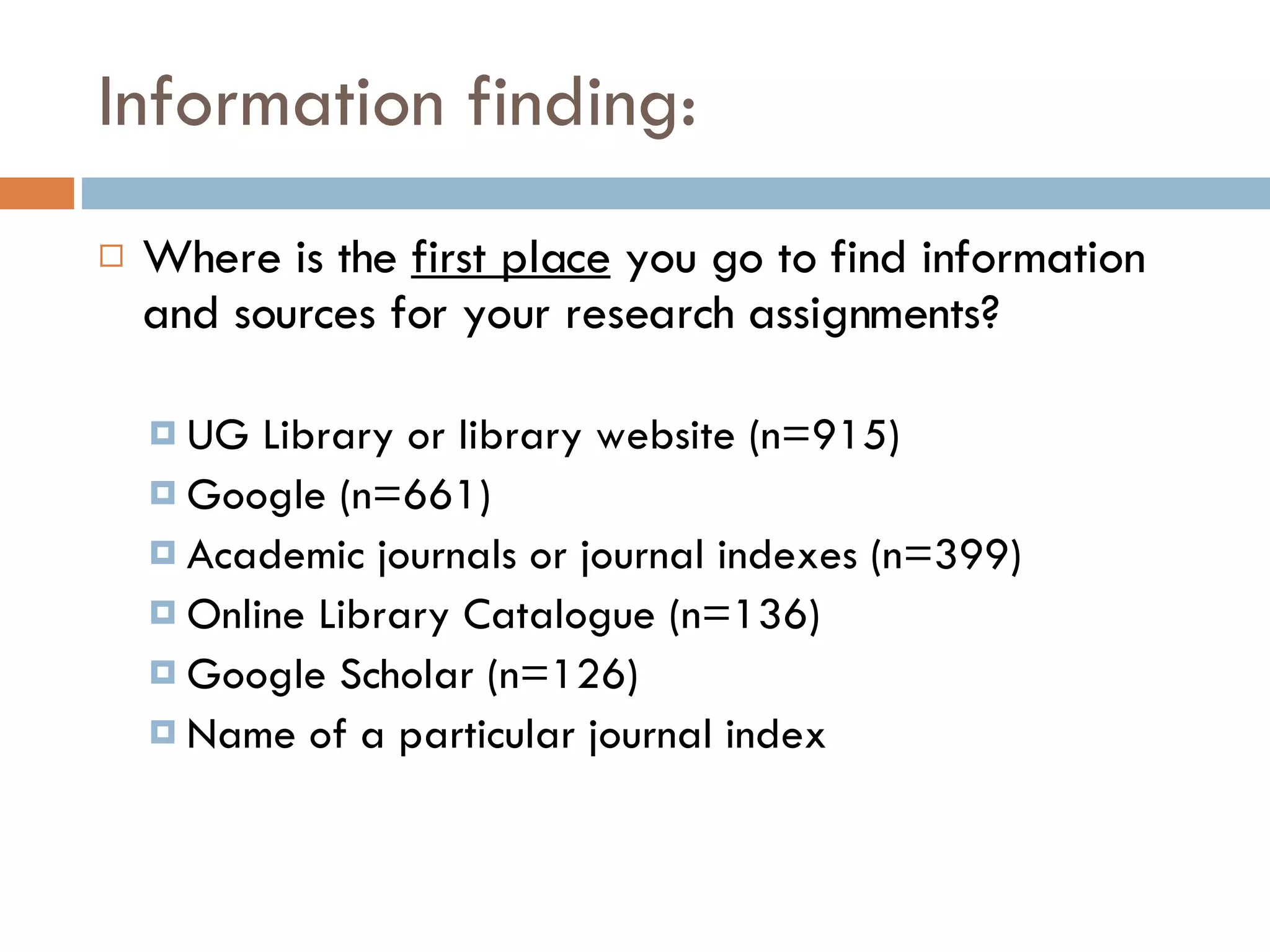
Information finding: Where is the  first place  you go to find information and sources for your research assignments? UG Library or library website (n=915) Google (n=661) Academic journals or journal indexes (n=399)  Online Library Catalogue (n=136)  Google Scholar (n=126) Name of a particular journal index
Information finding (con’t): Combined Library-related answers (website, journal indexes, online catalogue, etc.) account for more than 80% of the answers provided to this open-ended question.
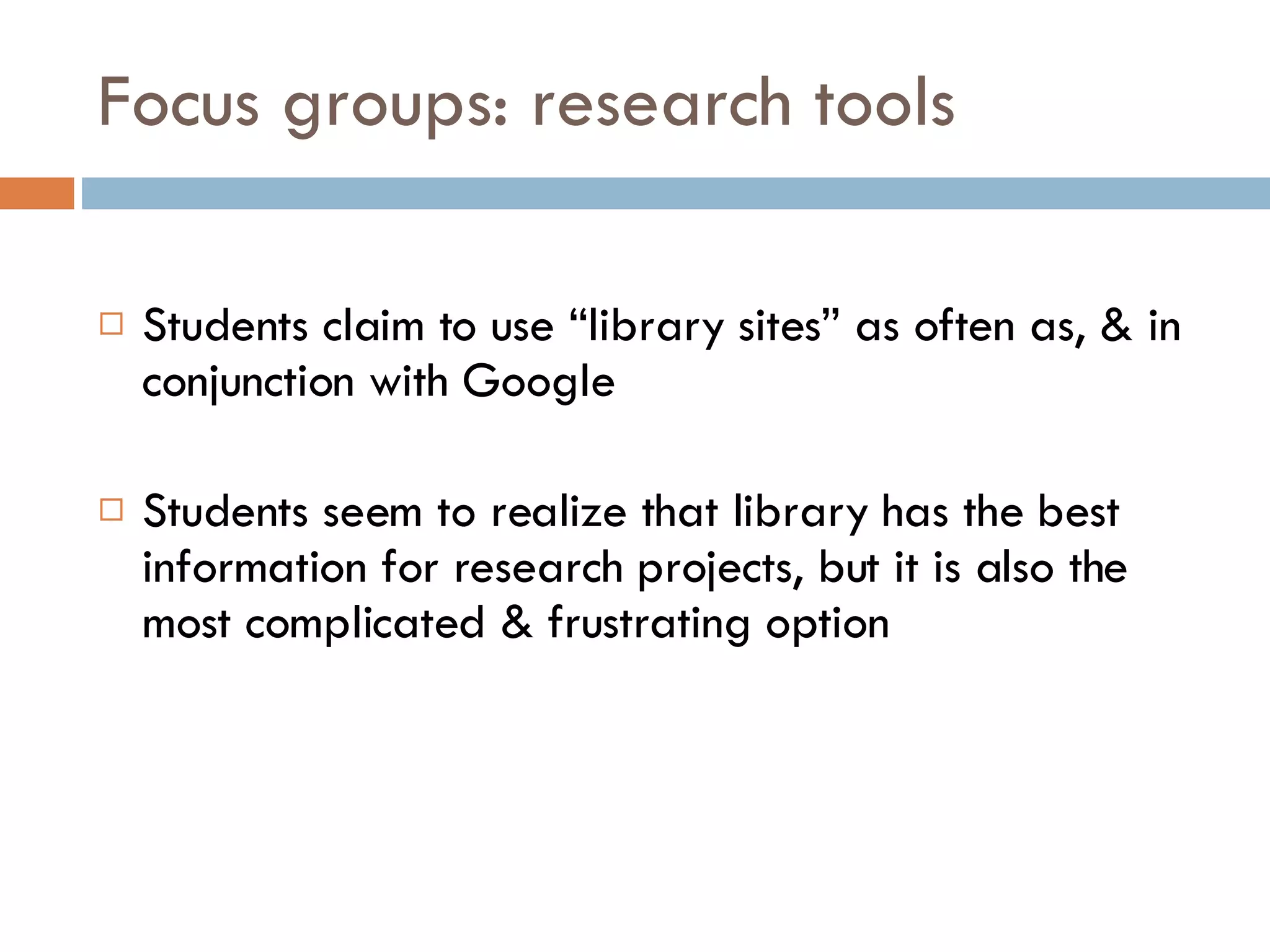
Focus groups: research tools Students claim to use “library sites” as often as, & in conjunction with Google Students seem to realize that library has the best information for research projects, but it is also the most complicated & frustrating option
Discussion Points
Discussion points Technology and gadgets: students may not use them the way we expect them to
Discussion points: Student culture is reluctant to mix personal & academic computing Uptake on OSNs for academic use has been slow, but will likely increase Investment of resources to develop services for OSNs: is it the best use of what we have?
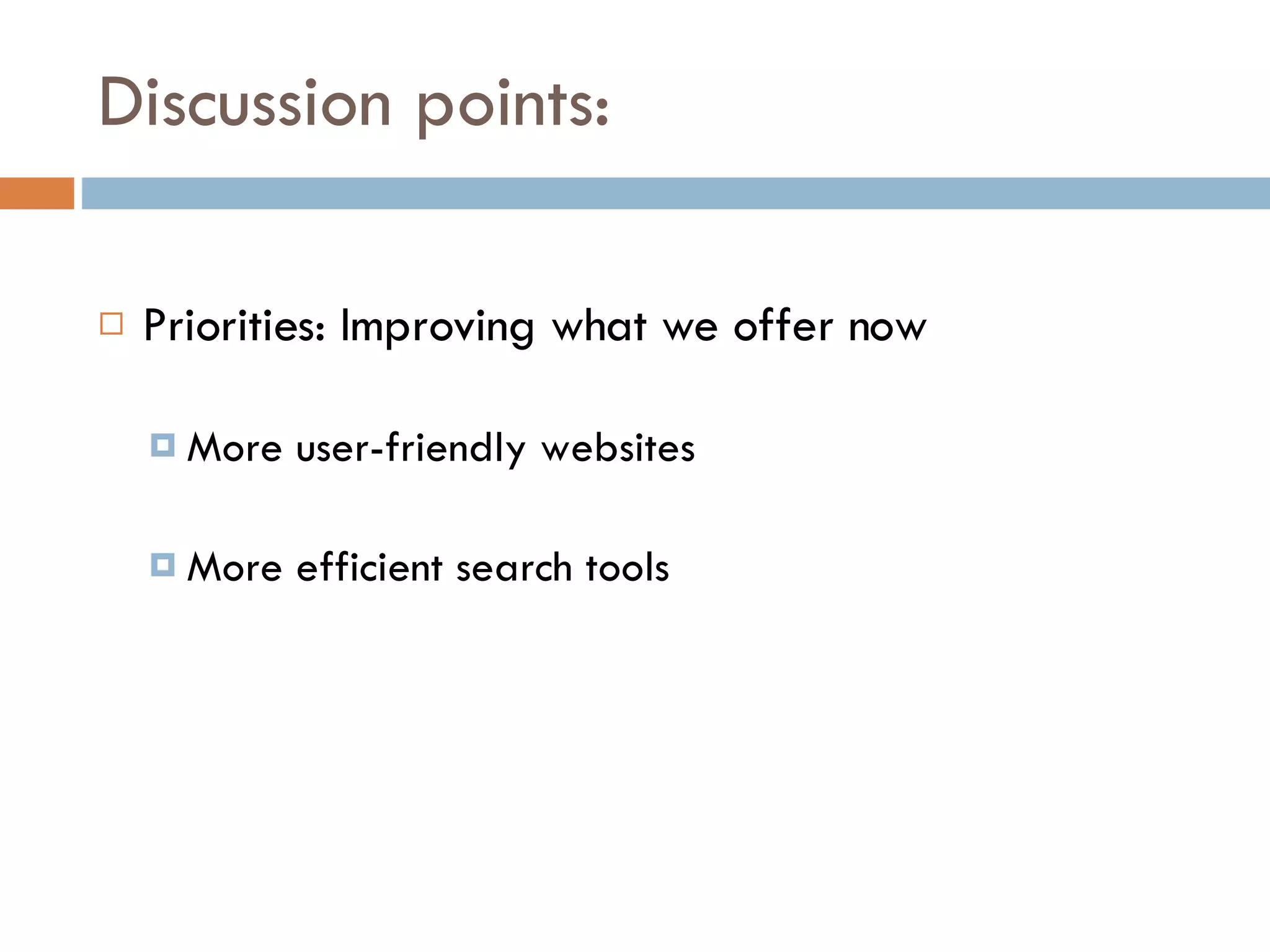
Discussion points: Priorities: Improving what we offer now  More user-friendly websites More efficient search tools
Discussion points: Rather than looking at technologies & trying to find a use for them in our environment, we should determine what our students need & seek solutions to meet those needs Development needs to originate with students
Thank You! Pascal Lupien –  [email_address] Randy Oldham –  [email_address]

Lupien Oldham Presentation Cil2008

  • 1.
    THE MILLENIAL MYTHOLOGY:PUTTING SUPPOSITIONS TO THE TEST IN AN ACADEMIC LIBRARY Pascal Lupien plupien@uoguelph.ca Randy Oldham roldham@uoguelph.ca University of Guelph
  • 2.
    Questions: What percentageof students own PDA’s? What percentage of students use their cell phones to access the Internet? What percentage of students participate in a virtual world, such as Second Life?
  • 3.
    Questions: What percentageof students use online social networks such as MySpace or Facebook? Do students use these tools for academic purposes? Where is the first place that students would go to find resources for their research assignments?
  • 4.
    Background About theUniversity of Guelph 19,316 Full-time Undergraduate and Graduate Enrolments Research intensive, learner-centered university
  • 5.
    Methodology: survey Reviewedby student groups Pre-tested Sent out via mass e-mail
  • 6.
    Methodology: focus groupsConducted after the survey Designed to answer questions not addressed in the survey Used an outside facilitator 4 groups
  • 7.
  • 8.
    The Respondents: TotalRespondents: 2706 respondents out of 19,316 total students 14% response rate Average Age of Respondents: 21.6 Years of Age http://www.uoguelph.ca/info/facts/index.shtml
  • 9.
  • 10.
  • 11.
  • 12.
    Hardware: PDAs Doyou own a PDA (PalmPilot, Treo, IPAQ etc)?
  • 13.
    Hardware: cellphones Doyou own a cellphone? YES: 69 % (1787) 79 % (1390) use their phones for text messaging 72 % (1264) of these phones can browse the internet However, only 17 % ever had 19 % (331) of these phones are able to play videos However, only 6 % ever had
  • 14.
    Instant Messaging &Online Social Networks
  • 15.
    Instant Messaging Doyou use a chat application, like MSN, Gtalk? Yes: 93 % (2348)
  • 16.
    Instant Messaging (cont’)Chat use for academic group projects:
  • 17.
    Online Social Networks:How often do you participate in OSNs (like facebook, MSN spaces, myspace)?
  • 18.
    OSNs Cont’: Howfrequently have you used OSNs for academic group work:
  • 19.
    Focus groups: OSNsPrefer to use Facebook & OSN sites for social purposes Prefer to use e-mail to communicate with group project members Respondents were willing to share their work with friends, but not just anyone
  • 20.
  • 21.
    Online Activities (con’t)How often do you play online games:
  • 22.
    Online Activities: (con’t)Participate in online virtual worlds such as Second Life?
  • 23.
  • 24.
    Information finding: Whereis the first place you go to find information and sources for your research assignments? UG Library or library website (n=915) Google (n=661) Academic journals or journal indexes (n=399) Online Library Catalogue (n=136) Google Scholar (n=126) Name of a particular journal index
  • 25.
    Information finding (con’t):Combined Library-related answers (website, journal indexes, online catalogue, etc.) account for more than 80% of the answers provided to this open-ended question.
  • 26.
    Focus groups: researchtools Students claim to use “library sites” as often as, & in conjunction with Google Students seem to realize that library has the best information for research projects, but it is also the most complicated & frustrating option
  • 27.
  • 28.
    Discussion points Technologyand gadgets: students may not use them the way we expect them to
  • 29.
    Discussion points: Studentculture is reluctant to mix personal & academic computing Uptake on OSNs for academic use has been slow, but will likely increase Investment of resources to develop services for OSNs: is it the best use of what we have?
  • 30.
    Discussion points: Priorities:Improving what we offer now More user-friendly websites More efficient search tools
  • 31.
    Discussion points: Ratherthan looking at technologies & trying to find a use for them in our environment, we should determine what our students need & seek solutions to meet those needs Development needs to originate with students
  • 32.
    Thank You! PascalLupien – [email_address] Randy Oldham – [email_address]

Editor's Notes

  • #2 Introduce ourselves: members of a research group at our university library charged with doing research into our students’ online behaviour, use of technology and their expectations. Our mandate was produce research to help establish priorities and to guide and inform other groups working on the development of emerging services in the library and across campus. We started off by reviewing the literature on Milennials and university students, and there’s plenty of that. But we were sceptical about some of it, and wondered about applying it to our own students, so we wanted to examine our own student population. The topic of the Millennials and their use of technology has become very popular in the library literature. But too often, assumptions are made about young people based on broad generalizations which are accepted, yet are often unsubstantiated. These assumptions sometimes lead to a jump on the bandwagon effect and to adopt the latest “in thing” to create new services that do not really respond to what patrons want or need. A deeper understanding of our younger users’ preferences and use of technology could help us to avoid this and to focus our efforts on using technology in ways that will actually meet their needs. In other words, we should not just adopt technology for the sake of using technology; they should build tools and services that match their users’ interests, needs and capabilities.