SCIENTIFIC INVESTIGATION CHAPTER 2
Topics Discussed The Hallmarks of Science The Building Blocks of Science and Hypothetico-Deductive Method of Research The Seven Steps of the Hypothetico-Deductive Method Other types of Research Case studies Action research
The definition  of  research Research  is an organized, systematic, data-based, critical,  objective, scientific inquiry  into a specific problem that needs  a solution. Managerial decisions based on the results of scientific  research  tend to be effective.
What is Meant by a Scientific Research? Scientific  research  focuses on  solving problems  and pursues a step-by-step  logical ,  organized , and  rigorous method  to  identify the problems, gather  data, analyze them, and draw valid conclusions   therefrom. Thus, scientific research is  not based on hunches, experience, and intuition  (though these may play a part in final decision making), but a purposive and  rigorous.
What is Meant by a Scientific Research? Because of the rigorous way in which the research done, scientific research enables all those who are interested in researching about the same or similar issues to  come up  with comparable findings when the data are analyzed .
What is Meant by a Scientific Research? Scientific research helps researchers to state their findings with accuracy and confidence. This  helps various other organizations to apply those solutions when they encounter similar problems. Scientific investigation tends to be more objective than subjective, and helps managers to highlight the most critical factors at the workplace that need specific attention so as to avoid, minimize, or solve problems.
What is Meant by a Scientific Research? Scientific investigation and managerial decision making are integral aspects of effective problem solving. Scientific research applies to both basic and applied research. Applied research  may or may not be  generalizable  to other organizations, depending on the extent to which differences exist in such factors as size, nature of work,  characteristics of the employees, and structure of the organization.
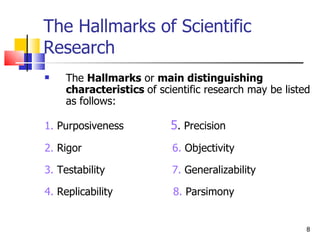
The Hallmarks of Scientific Research The  Hallmarks  or  main distinguishing characteristics  of scientific research may be listed as follows: 1.  Purposiveness  5 . Precision 2.  Rigor  6.  Objectivity 3.  Testability  7.  Generalizability 4.  Replicability  8.  Parsimony
The Hallmarks of Scientific Research We  will  explain  each of these characteristics in the context of the following  example : Consider the case of a manager who is interested in investigating  how employees ’  commitment to the organization can be increased .
1. Purposiveness The manager has started the research with a  definite aim  or  purpose . The focus is on increasing the commitment of employees to the organization, as this will be a beneficial in many ways. An increase in employee commitment will translate into  less turnover ,  less absenteeism, and increased performance levels,  all of which would definitely benefit the organization.
2. Rigor A good  theoretical base  and a sound  methodological design  would add  rigor  to a purposive study. Rigor  means carefulness, and the degree of exactitude in research investigations.
In the case of  our example of increasing the commitment of employees : Let us say that the manager of an organization  asks 10 of its employees  to indicate what would increase their level of commitment to the organization. If the manager depends solely on the basis of their responses reaches to several conclusions on how employee commitment can be increased,  the whole approach to the investigation would be unscientific .
An approach to an investigation would lack rigor for the following reasons: Incorrect conclusions because they are based on the responses of just a few employees ( lacks of methodological sophistication ). the manner of framing and addressing the questions could have introduced bias in the responses ( lacks of methodological sophistication ). There might be many other important influences  on organizational commitment that this small sample did not verbalize during the interviews, and the researcher would have failed to include them ( lacks of a good theoretical framework ). Conclusions   drawn from an investigation that lacks a good theoretical framework and methodological sophistications would be unscientific.
3.  Testability After taking  random  selection of employees  of the organization, and the  study of  previous research  done of the area of organizational commitment , the researcher  develops certain hypotheses  on how employee commitment can be enhanced. Then  these   hypotheses can be tested  by applying certain  statistical tests  to  the data  collected for the purpose. Scientific research  tends itself to  testing logically developed hypotheses  to see whether or not the data support the hypotheses that are developed .
4. Replicability The  results of the tests of hypotheses   should be  supported again and again  when the same type of research is repeated in other similar circumstances. If the results are repeated, we will  gain confidence in the scientific nature of our research.
5. Precision and Confidence Precision refers to the closeness of the findings to reality based on a sample. Precision reflects the degree of accuracy of the results on the basis of the sample, to what really exists in the universe.
Precision and Confidence In business research, we are not able to draw  “ definitive ”  conclusions on the basis of the results of data analysis. The reasons are: We have to base our findings on a sample that we draw from the universe. The sample may not reflect the exact characteristics of the phenomenon we try to study. Measurement errors and other problems are bound to introduce an error in our findings.
Precision and Confidence We would like to design the research in a manner that ensures that  our findings are as close to reality as possible , so that we can  place reliance or confidence in the results.
Precision and Confidence Confidence  refers to the probability that our estimations are correct. It is not enough to be precise, but it is also important that we can confidently claim that 95% of the time our results would be true and there is only a 5% chance of our being wrong. This is also known as confidence level. The greater the precision and confidence we aim at in our research, the more scientific is the investigation and the more useful are the results.
6. objectivity The  conclusions  drawn through the interpretation of the results of data analysis  should be objective . The  conclusions should be based on the facts  of the findings derived from actual data, and  not on our own subjective or emotional values. The more  objective  the interpretation of the data, the  more scientific  the research investigation becomes.
7. Generalizability Generalizability refers to the scope of applicability of the research findings in one organizational setting to other settings. The  wider the range of applicability  of the solutions generated by research, the more useful the research is to the users.
8. Parsimony Parsimony  refers to simplicity in explaining the phenomena or problems that occur, and in generating solutions for the problems. Economy in research models  is achieved when  we can  build into our research framework a  lesser number of variables   that would explain the variance far more efficiently than a complex set of variables that would only marginally add to the variance explained.
Parsimony Parsimony can be introduced with a good understanding of the problem and the important factors that influence it. A  good conceptual theoretical model  can be realized through  interviews  with the concerned people , and a thorough  literature review  of the previous research work in the particular problem area.
Deduction and Induction Deductive reasoning :   application of a general theory to a specific case.  Hypothesis testing   Inductive reasoning : a process where we observe specific phenomena and on this basis arrive at general conclusions.   Counting white swans Both inductive and deductive processes are often used in research.
Example 2.1 A  sales manager might  observe  that customers are perhaps  not pleased as they used to be. The manager may not be certain that this is really the case  but may experience anxiety and some uneasiness that customer  satisfaction is on the decline. This process of  observation  or sensing of the phenomena around us is what gets most of the research- whether applied or basic- started.
Example 2.1  (cont.) The next step is to determine whether there is a real problem, and if so, how serious it is. This  problem identification  calls for some preliminary data gathering. The manager might  talk to a few customers  to find out how they feel about the products and customer service. The manager might find that the customers like the products but are upset because many of the times the product is out of stock, and they perceive the salesperson as not being helpful.
Example 2.1 (cont.) From  discussions with some of the salespersons , the manager might discover that the  factory does not supply the goods on time . Salespersons might also indicate that they try to please the customers by communicating the delivery dates given to them by the factory.
Example 2.1 (cont.) Integration of the information obtained through the  informal and formal interviewing process  has helped the manager to  determine that the problem does exist. It also helps the manager to  formulate a conceptual model  or  theoretical framework  of all the factors contributing  to the problem.
Example 2.1 (cont.) Thus, the following factors contribute to the problem: Delays by the factory in delivering goods The notification of later delivery dates that are not kept The promises of the salespersons to the customers that cannot  be fulfilled All of these factors contribute to customer dissatisfaction .
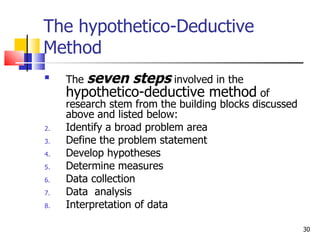
The hypothetico-Deductive Method The  seven steps  involved in the  hypothetico-deductive method  of research stem from the building blocks discussed above and listed below: Identify a broad problem area Define the problem statement Develop hypotheses Determine measures Data collection Data  analysis Interpretation of data
Identify a broad problem area If the manager notice a drop in sales, incorrect accounting results, low-yielding investment, disinterestedness of employees in their work, and the like, could attract the attention of the manager to do a research project.
Define the problem statement Scientific research  starts with a definite aim or purpose. A  problem statement  states the general objective of the research.
Develop hypotheses The network of associations between the problem and the variables that affect it is identified. A scientific hypothesis must meet two requirements: The hypothesis must be  testable The hypothesis must be  falsifiable  (we can only prove our hypotheses until they are disproved).
Determine measures The variables in the theoretical framework should be  measurable  in some way. Some variables  can not be measure quantitatively , such as  unresponsive employees , we need to operationalize this variable. Measurement of variables is discussed in Chs. 6 and 7.
Data collection Data with respect to each variable in the hypothesis need to be obtained. There are two types of data: - Quantitatative data  - Qualitative data
Data Analysis In this step,  the data  gathered are  statistically analyzed  to see if the hypotheses that were generated have been supported. Analyses of both  quantitative  and  qualitative data  can be done to determine if certain relations are important.
Data Analysis Qualitative data  refer to information gathered through interviews and observations. These data usually for objects than can not be physically measured, like feelings and attitudes. Quantitative data  refer to information gathered about objects that can be physically measured. The researcher could obtain these data through the company records, government statistics, or any formal records.
Interpretation of data  Now we must decide whether our hypotheses are supported or not by interpreting the meaning of the results or the data analysis. Based on these results, the researcher would make  recommendations  in order to solve the problem in hand.
Example 2.2  of the Application of the Hypothetico-Deductive Method Observation of the CIO Dilemma The Chief Information Officer (CIO) of a firm observes that the newly installed  Management Information System (MIS) is not being used by middle managers as much as was originally expected. “ There is surely a problem here, ”  the CIO exclaims.
Example 2.2 (cont.) Information Gathering through Informal Interviews - Talking to some of the middle-level managers, the CIO finds that many of them have very little idea as to what MIS is all about, what kinds of information it could provide, and how to access it and utilize the information.
Example 2.2 (cont.) Obtaining More Information through Literature Survey - The CIO immediately  uses the Internet  to explore further information on the lack of use of MIS in organizations. - The search indicates that  many middle-level managers are not familiar with operating personal computers. - Lack of knowledge about what MIS  offers is also found to be another main reason why some managers do not use it.
Example 2.2 (cont.) Formulating a Theory - based on all this information, the CIO  develops a theory  incorporating all  the relevant factors  contributing to the lack of access to the MIS by managers in the organization.
Example 2.2 (cont.) Hypothesizing  From such a theory, the CIO  generates various hypotheses  for testing, one among them being: -  Knowledge of the usefulness of MIS would help managers to put it to greater use.
Example 2.2 (cont.) Data Collection The CIO then  develops a short questionnaire  on the  various factors theorized to influence the use of the MIS by managers , such as: The extent of knowledge of what MIS is What kinds of information MIS provides How to gain access to the information The level of comfort felt by managers in using computers in general How often managers have used the MIS in the preceding 3 months.
Example 2.2 (cont.) Data Analysis The CIO then  analyzes the data obtained through the questionnaire  to see what factors prevent the managers from using the system.
Example 2.2 (cont.) Interpretation of data Based on the results,  the manager deduces or concludes that managers do not use MIS  owing to certain factors. These deductions  help the CIO to take necessary actions  to solve the problem, which might include, among other things: -  Organizing seminars for training managers  on the use of computers, and -  MIS and its usefulness.
Other Types of Research Case studies, and Action research Are sometimes  used to study certain types of issues.
Case Studies Case studies involve in-depth analyses of similar situations in other organizations, where the nature and definition of the problem is the same as experienced in the current situation. If a particular hypothesis has not been supported even in a single other case study, the researcher could ignore that hypothesis.
Case Studies Case studies are not often undertaken in organizations because: It is very seldom to find similar problems happened in an organizations of the same size and same type of setting. Many companies prefer to guard their problems and their data.
Action Research Action research is sometimes undertaken by consultants who want to initiate change processes in organizations. Action research methodology is most appropriate while effecting planned changes.
Action Research The researcher  begins with a problem  that is already identified, and  gathers relevant data  to provide a tentative  problem solution . This solution is then implemented , with the knowledge that there may be unintended consequences following such implementation. The effects are then evaluated, defined, and diagnosed , and the research continues on an ongoing basis  until the problem is fully resolved.
VISIT THE LIBRARY Zeithaml, V., Berry, L. and Parasuraman A. (1996).  “ The behavioral consequences of service quality ” . Journal of Marketing, 60(2), 31.

Brm 2

  • 1.
  • 2.
    Topics Discussed TheHallmarks of Science The Building Blocks of Science and Hypothetico-Deductive Method of Research The Seven Steps of the Hypothetico-Deductive Method Other types of Research Case studies Action research
  • 3.
    The definition of research Research is an organized, systematic, data-based, critical, objective, scientific inquiry into a specific problem that needs a solution. Managerial decisions based on the results of scientific research tend to be effective.
  • 4.
    What is Meantby a Scientific Research? Scientific research focuses on solving problems and pursues a step-by-step logical , organized , and rigorous method to identify the problems, gather data, analyze them, and draw valid conclusions therefrom. Thus, scientific research is not based on hunches, experience, and intuition (though these may play a part in final decision making), but a purposive and rigorous.
  • 5.
    What is Meantby a Scientific Research? Because of the rigorous way in which the research done, scientific research enables all those who are interested in researching about the same or similar issues to come up with comparable findings when the data are analyzed .
  • 6.
    What is Meantby a Scientific Research? Scientific research helps researchers to state their findings with accuracy and confidence. This helps various other organizations to apply those solutions when they encounter similar problems. Scientific investigation tends to be more objective than subjective, and helps managers to highlight the most critical factors at the workplace that need specific attention so as to avoid, minimize, or solve problems.
  • 7.
    What is Meantby a Scientific Research? Scientific investigation and managerial decision making are integral aspects of effective problem solving. Scientific research applies to both basic and applied research. Applied research may or may not be generalizable to other organizations, depending on the extent to which differences exist in such factors as size, nature of work, characteristics of the employees, and structure of the organization.
  • 8.
    The Hallmarks ofScientific Research The Hallmarks or main distinguishing characteristics of scientific research may be listed as follows: 1. Purposiveness 5 . Precision 2. Rigor 6. Objectivity 3. Testability 7. Generalizability 4. Replicability 8. Parsimony
  • 9.
    The Hallmarks ofScientific Research We will explain each of these characteristics in the context of the following example : Consider the case of a manager who is interested in investigating how employees ’ commitment to the organization can be increased .
  • 10.
    1. Purposiveness Themanager has started the research with a definite aim or purpose . The focus is on increasing the commitment of employees to the organization, as this will be a beneficial in many ways. An increase in employee commitment will translate into less turnover , less absenteeism, and increased performance levels, all of which would definitely benefit the organization.
  • 11.
    2. Rigor Agood theoretical base and a sound methodological design would add rigor to a purposive study. Rigor means carefulness, and the degree of exactitude in research investigations.
  • 12.
    In the caseof our example of increasing the commitment of employees : Let us say that the manager of an organization asks 10 of its employees to indicate what would increase their level of commitment to the organization. If the manager depends solely on the basis of their responses reaches to several conclusions on how employee commitment can be increased, the whole approach to the investigation would be unscientific .
  • 13.
    An approach toan investigation would lack rigor for the following reasons: Incorrect conclusions because they are based on the responses of just a few employees ( lacks of methodological sophistication ). the manner of framing and addressing the questions could have introduced bias in the responses ( lacks of methodological sophistication ). There might be many other important influences on organizational commitment that this small sample did not verbalize during the interviews, and the researcher would have failed to include them ( lacks of a good theoretical framework ). Conclusions drawn from an investigation that lacks a good theoretical framework and methodological sophistications would be unscientific.
  • 14.
    3. TestabilityAfter taking random selection of employees of the organization, and the study of previous research done of the area of organizational commitment , the researcher develops certain hypotheses on how employee commitment can be enhanced. Then these hypotheses can be tested by applying certain statistical tests to the data collected for the purpose. Scientific research tends itself to testing logically developed hypotheses to see whether or not the data support the hypotheses that are developed .
  • 15.
    4. Replicability The results of the tests of hypotheses should be supported again and again when the same type of research is repeated in other similar circumstances. If the results are repeated, we will gain confidence in the scientific nature of our research.
  • 16.
    5. Precision andConfidence Precision refers to the closeness of the findings to reality based on a sample. Precision reflects the degree of accuracy of the results on the basis of the sample, to what really exists in the universe.
  • 17.
    Precision and ConfidenceIn business research, we are not able to draw “ definitive ” conclusions on the basis of the results of data analysis. The reasons are: We have to base our findings on a sample that we draw from the universe. The sample may not reflect the exact characteristics of the phenomenon we try to study. Measurement errors and other problems are bound to introduce an error in our findings.
  • 18.
    Precision and ConfidenceWe would like to design the research in a manner that ensures that our findings are as close to reality as possible , so that we can place reliance or confidence in the results.
  • 19.
    Precision and ConfidenceConfidence refers to the probability that our estimations are correct. It is not enough to be precise, but it is also important that we can confidently claim that 95% of the time our results would be true and there is only a 5% chance of our being wrong. This is also known as confidence level. The greater the precision and confidence we aim at in our research, the more scientific is the investigation and the more useful are the results.
  • 20.
    6. objectivity The conclusions drawn through the interpretation of the results of data analysis should be objective . The conclusions should be based on the facts of the findings derived from actual data, and not on our own subjective or emotional values. The more objective the interpretation of the data, the more scientific the research investigation becomes.
  • 21.
    7. Generalizability Generalizabilityrefers to the scope of applicability of the research findings in one organizational setting to other settings. The wider the range of applicability of the solutions generated by research, the more useful the research is to the users.
  • 22.
    8. Parsimony Parsimony refers to simplicity in explaining the phenomena or problems that occur, and in generating solutions for the problems. Economy in research models is achieved when we can build into our research framework a lesser number of variables that would explain the variance far more efficiently than a complex set of variables that would only marginally add to the variance explained.
  • 23.
    Parsimony Parsimony canbe introduced with a good understanding of the problem and the important factors that influence it. A good conceptual theoretical model can be realized through interviews with the concerned people , and a thorough literature review of the previous research work in the particular problem area.
  • 24.
    Deduction and InductionDeductive reasoning : application of a general theory to a specific case. Hypothesis testing Inductive reasoning : a process where we observe specific phenomena and on this basis arrive at general conclusions. Counting white swans Both inductive and deductive processes are often used in research.
  • 25.
    Example 2.1 A sales manager might observe that customers are perhaps not pleased as they used to be. The manager may not be certain that this is really the case but may experience anxiety and some uneasiness that customer satisfaction is on the decline. This process of observation or sensing of the phenomena around us is what gets most of the research- whether applied or basic- started.
  • 26.
    Example 2.1 (cont.) The next step is to determine whether there is a real problem, and if so, how serious it is. This problem identification calls for some preliminary data gathering. The manager might talk to a few customers to find out how they feel about the products and customer service. The manager might find that the customers like the products but are upset because many of the times the product is out of stock, and they perceive the salesperson as not being helpful.
  • 27.
    Example 2.1 (cont.)From discussions with some of the salespersons , the manager might discover that the factory does not supply the goods on time . Salespersons might also indicate that they try to please the customers by communicating the delivery dates given to them by the factory.
  • 28.
    Example 2.1 (cont.)Integration of the information obtained through the informal and formal interviewing process has helped the manager to determine that the problem does exist. It also helps the manager to formulate a conceptual model or theoretical framework of all the factors contributing to the problem.
  • 29.
    Example 2.1 (cont.)Thus, the following factors contribute to the problem: Delays by the factory in delivering goods The notification of later delivery dates that are not kept The promises of the salespersons to the customers that cannot be fulfilled All of these factors contribute to customer dissatisfaction .
  • 30.
    The hypothetico-Deductive MethodThe seven steps involved in the hypothetico-deductive method of research stem from the building blocks discussed above and listed below: Identify a broad problem area Define the problem statement Develop hypotheses Determine measures Data collection Data analysis Interpretation of data
  • 31.
    Identify a broadproblem area If the manager notice a drop in sales, incorrect accounting results, low-yielding investment, disinterestedness of employees in their work, and the like, could attract the attention of the manager to do a research project.
  • 32.
    Define the problemstatement Scientific research starts with a definite aim or purpose. A problem statement states the general objective of the research.
  • 33.
    Develop hypotheses Thenetwork of associations between the problem and the variables that affect it is identified. A scientific hypothesis must meet two requirements: The hypothesis must be testable The hypothesis must be falsifiable (we can only prove our hypotheses until they are disproved).
  • 34.
    Determine measures Thevariables in the theoretical framework should be measurable in some way. Some variables can not be measure quantitatively , such as unresponsive employees , we need to operationalize this variable. Measurement of variables is discussed in Chs. 6 and 7.
  • 35.
    Data collection Datawith respect to each variable in the hypothesis need to be obtained. There are two types of data: - Quantitatative data - Qualitative data
  • 36.
    Data Analysis Inthis step, the data gathered are statistically analyzed to see if the hypotheses that were generated have been supported. Analyses of both quantitative and qualitative data can be done to determine if certain relations are important.
  • 37.
    Data Analysis Qualitativedata refer to information gathered through interviews and observations. These data usually for objects than can not be physically measured, like feelings and attitudes. Quantitative data refer to information gathered about objects that can be physically measured. The researcher could obtain these data through the company records, government statistics, or any formal records.
  • 38.
    Interpretation of data Now we must decide whether our hypotheses are supported or not by interpreting the meaning of the results or the data analysis. Based on these results, the researcher would make recommendations in order to solve the problem in hand.
  • 39.
    Example 2.2 of the Application of the Hypothetico-Deductive Method Observation of the CIO Dilemma The Chief Information Officer (CIO) of a firm observes that the newly installed Management Information System (MIS) is not being used by middle managers as much as was originally expected. “ There is surely a problem here, ” the CIO exclaims.
  • 40.
    Example 2.2 (cont.)Information Gathering through Informal Interviews - Talking to some of the middle-level managers, the CIO finds that many of them have very little idea as to what MIS is all about, what kinds of information it could provide, and how to access it and utilize the information.
  • 41.
    Example 2.2 (cont.)Obtaining More Information through Literature Survey - The CIO immediately uses the Internet to explore further information on the lack of use of MIS in organizations. - The search indicates that many middle-level managers are not familiar with operating personal computers. - Lack of knowledge about what MIS offers is also found to be another main reason why some managers do not use it.
  • 42.
    Example 2.2 (cont.)Formulating a Theory - based on all this information, the CIO develops a theory incorporating all the relevant factors contributing to the lack of access to the MIS by managers in the organization.
  • 43.
    Example 2.2 (cont.)Hypothesizing From such a theory, the CIO generates various hypotheses for testing, one among them being: - Knowledge of the usefulness of MIS would help managers to put it to greater use.
  • 44.
    Example 2.2 (cont.)Data Collection The CIO then develops a short questionnaire on the various factors theorized to influence the use of the MIS by managers , such as: The extent of knowledge of what MIS is What kinds of information MIS provides How to gain access to the information The level of comfort felt by managers in using computers in general How often managers have used the MIS in the preceding 3 months.
  • 45.
    Example 2.2 (cont.)Data Analysis The CIO then analyzes the data obtained through the questionnaire to see what factors prevent the managers from using the system.
  • 46.
    Example 2.2 (cont.)Interpretation of data Based on the results, the manager deduces or concludes that managers do not use MIS owing to certain factors. These deductions help the CIO to take necessary actions to solve the problem, which might include, among other things: - Organizing seminars for training managers on the use of computers, and - MIS and its usefulness.
  • 47.
    Other Types ofResearch Case studies, and Action research Are sometimes used to study certain types of issues.
  • 48.
    Case Studies Casestudies involve in-depth analyses of similar situations in other organizations, where the nature and definition of the problem is the same as experienced in the current situation. If a particular hypothesis has not been supported even in a single other case study, the researcher could ignore that hypothesis.
  • 49.
    Case Studies Casestudies are not often undertaken in organizations because: It is very seldom to find similar problems happened in an organizations of the same size and same type of setting. Many companies prefer to guard their problems and their data.
  • 50.
    Action Research Actionresearch is sometimes undertaken by consultants who want to initiate change processes in organizations. Action research methodology is most appropriate while effecting planned changes.
  • 51.
    Action Research Theresearcher begins with a problem that is already identified, and gathers relevant data to provide a tentative problem solution . This solution is then implemented , with the knowledge that there may be unintended consequences following such implementation. The effects are then evaluated, defined, and diagnosed , and the research continues on an ongoing basis until the problem is fully resolved.
  • 52.
    VISIT THE LIBRARYZeithaml, V., Berry, L. and Parasuraman A. (1996). “ The behavioral consequences of service quality ” . Journal of Marketing, 60(2), 31.