2
2
Topics Discussed
TheHallmarks of Science
The Building Blocks of Science and
Hypothetico-Deductive Method of Research
The Seven Steps of the Hypothetico-
Deductive Method
Other types of Research
- Case studies
- Action research
3.
3
3
The definition ofresearch
Research is an organized, systematic,
data-based, critical, objective,
scientific inquiry into a specific
problem that needs a solution.
Managerial decisions based on the
results of scientific research tend to
be effective.
4.
4
4
What is Meantby a Scientific
Research
?
Scientific research focuses on solving
problems and pursues a step-by-step logical,
organized, and rigorous method to identify
the problems, gather data, analyze them,
and draw valid conclusions therefrom.
Thus, scientific research is not based on
hunches, experience, and intuition (though
these may play a part in final decision
making), but a purposive and rigorous.
5.
5
5
What is Meantby a Scientific
Research
?
Because of the rigorous way in which
the research done, scientific research
enables all those who are interested
in researching about the same or
similar issues to come up with
comparable findings when the data
are analyzed.
6.
6
6
What is Meantby a Scientific
Research
?
Scientific research helps researchers to state
their findings with accuracy and confidence.
This helps various other organizations to
apply those solutions when they encounter
similar problems.
Scientific investigation tends to be more
objective than subjective, and helps managers
to highlight the most critical factors at the
workplace that need specific attention so as to
avoid, minimize, or solve problems.
7.
7
7
What is Meantby a Scientific
Research
?
Scientific investigation and managerial
decision making are integral aspects of
effective problem solving.
Scientific research applies to both basic and
applied research.
Applied research may or may not be
generalizable to other organizations,
depending on the extent to which differences
exist in such factors as size, nature of work,
characteristics of the employees, and
structure of the organization.
8.
8
8
The Hallmarks ofScientific
Research
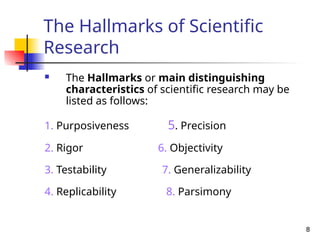
The Hallmarks or main distinguishing
characteristics of scientific research may be
listed as follows:
1. Purposiveness 5. Precision
2. Rigor 6. Objectivity
3. Testability 7. Generalizability
4. Replicability 8. Parsimony
9.
9
9
The Hallmarks ofScientific
Research
We will explain each of these
characteristics in the context of the
following example:
Consider the case of a manager who
is interested in investigating how
employees’ commitment to the
organization can be increased.
10.
10
10
1
.
Purposiveness
The managerhas started the research with a
definite aim or purpose.
The focus is on increasing the commitment of
employees to the organization, as this will be a
beneficial in many ways.
An increase in employee commitment will
translate into less turnover, less absenteeism,
and increased performance levels, all of
which would definitely benefit the organization.
11.
11
11
2
.
Rigor
A goodtheoretical base and a sound
methodological design would add
rigor to a purposive study.
Rigor means carefulness, and the
degree of exactitude in research
investigations.
12.
12
12
In the caseof our example of increasing
the commitment of employees
:
Let us say that the manager of an
organization asks 10 of its employees to
indicate what would increase their level of
commitment to the organization.
If the manager depends solely on the basis
of their responses reaches to several
conclusions on how employee commitment
can be increased, the whole approach to
the investigation would be unscientific.
13.
13
13
An approach toan investigation
would lack rigor for the following
reasons
:
1. Incorrect conclusions because they are based on the
responses of just a few employees (lacks of
methodological sophistication).
2. the manner of framing and addressing the
questions could have introduced bias in the
responses (lacks of methodological sophistication).
3. There might be many other important influences on
organizational commitment that this small sample
did not verbalize during the interviews, and the
researcher would have failed to include them (lacks
of a good theoretical framework).
Conclusions drawn from an investigation that lacks a
good theoretical framework and methodological
sophistications would be unscientific.
14.
14
14
3
.
Testability
After takingrandom selection of employees of the
organization, and the study of previous research
done of the area of organizational commitment,
the researcher develops certain hypotheses on
how employee commitment can be enhanced.
Then these hypotheses can be tested by applying
certain statistical tests to the data collected for
the purpose.
Scientific research tends itself to testing
logically developed hypotheses to see whether
or not the data support the hypotheses that are
developed.
15.
15
15
4
.
Replicability
The resultsof the tests of hypotheses
should be supported again and
again when the same type of
research is repeated in other similar
circumstances.
If the results are repeated, we will
gain confidence in the scientific
nature of our research.
16.
16
5
.
Precision and Confidence
Precision refers to the closeness of
the findings to reality based on a
sample.
Precision reflects the degree of
accuracy of the results on the basis of
the sample, to what really exists in
the universe.
16
17.
17
17
Precision and Confidence
In business research, we are not able to
draw “definitive” conclusions on the basis
of the results of data analysis. The reasons
are:
1. We have to base our findings on a sample
that we draw from the universe. The sample
may not reflect the exact characteristics of
the phenomenon we try to study.
2. Measurement errors and other problems
are bound to introduce an error in our
findings.
18.
18
18
Precision and Confidence
We would like to design the research
in a manner that ensures that our
findings are as close to reality as
possible, so that we can place
reliance or confidence in the
results.
19.
19
19
Precision and Confidence
Confidence refers to the probability that our
estimations are correct.
It is not enough to be precise, but it is also
important that we can confidently claim that
95% of the time our results would be true and
there is only a 5% chance of our being wrong.
This is also known as confidence level.
The greater the precision and confidence we
aim at in our research, the more scientific is
the investigation and the more useful are the
results.
20.
20
20
6
.
objectivity
The conclusionsdrawn through the
interpretation of the results of data analysis
should be objective.
The conclusions should be based on the facts
of the findings derived from actual data, and
not on our own subjective or emotional
values.
The more objective the interpretation of the
data, the more scientific the research
investigation becomes.
21.
21
21
7
.
Generalizability
Generalizability refersto the scope of
applicability of the research findings
in one organizational setting to other
settings.
The wider the range of applicability
of the solutions generated by
research, the more useful the
research is to the users.
22.
22
22
8
.
Parsimony
Parsimony refersto simplicity in explaining
the phenomena or problems that occur, and
in generating solutions for the problems.
Economy in research models is achieved when
we can build into our research framework a
lesser number of variables that would
explain the variance far more efficiently than
a complex set of variables that would only
marginally add to the variance explained.
23.
23
23
Parsimony
Parsimony canbe introduced with a
good understanding of the problem and
the important factors that influence it.
A good conceptual theoretical model
can be realized through interviews with
the concerned people, and a thorough
literature review of the previous
research work in the particular problem
area.
24.
24
24
Deduction and Induction
Deductive reasoning: application of a
general theory to a specific case.
Hypothesis testing
Inductive reasoning: a process where
we observe specific phenomena and
on this basis arrive at general
conclusions.
Counting white swans
Both inductive and deductive
processes are often used in research.
24
25.
25
25
Example 2.1
Asales manager might observe that
customers are perhaps not pleased as they
used to be. The manager may not be certain
that this is really the case but may
experience anxiety and some uneasiness
that customer satisfaction is on the decline.
This process of observation or sensing of
the phenomena around us is what gets most
of the research- whether applied or basic-
started.
26.
26
26
The nextstep is to determine whether there is
a real problem, and if so, how serious it is. This
problem identification calls for some
preliminary data gathering.
The manager might talk to a few customers
to find out how they feel about the products
and customer service. The manager might find
that the customers like the products but are
upset because many of the times the product is
out of stock, and they perceive the salesperson
as not being helpful.
Example 2.1 (cont.)
27.
27
27
Example 2.1 (cont.)
From discussions with some of the
salespersons, the manager might
discover that the factory does not
supply the goods on time.
Salespersons might also indicate that
they try to please the customers by
communicating the delivery dates
given to them by the factory.
28.
28
28
Example 2.1 (cont.)
Integration of the information
obtained through the informal and
formal interviewing process has
helped the manager to determine
that the problem does exist.
It also helps the manager to
formulate a conceptual model or
theoretical framework of all the
factors contributing to the problem.
29.
29
29
Example 2.1 (cont.)
Thus, the following factors contribute to
the problem:
Delays by the factory in delivering goods
The notification of later delivery dates that
are not kept
The promises of the salespersons to the
customers that cannot be fulfilled
All of these factors contribute to customer
dissatisfaction.
30.
30
30
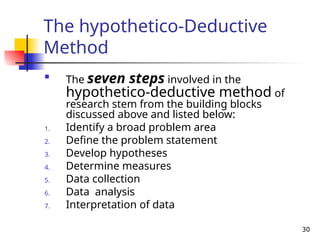
The hypothetico-Deductive
Method
The sevensteps involved in the
hypothetico-deductive method of
research stem from the building blocks
discussed above and listed below:
1. Identify a broad problem area
2. Define the problem statement
3. Develop hypotheses
4. Determine measures
5. Data collection
6. Data analysis
7. Interpretation of data
31.
31
31
Identify a broadproblem
area
If the manager notice a drop in sales,
incorrect accounting results, low-
yielding investment,
disinterestedness of employees in
their work, and the like, could attract
the attention of the manager to do a
research project.
32.
32
32
Define the problemstatement
• Scientific research starts with a
definite aim or purpose.
• A problem statement states the
general objective of the research.
33.
33
33
Develop hypotheses
Thenetwork of associations between the
problem and the variables that affect it is
identified.
A scientific hypothesis must meet two
requirements:
1. The hypothesis must be testable
2. The hypothesis must be falsifiable (we can
only prove our hypotheses until they are
disproved).
34.
34
Determine measures
Thevariables in the theoretical framework
should be measurable in some way.
Some variables can not be measure
quantitatively, such as unresponsive
employees, we need to operationalize this
variable.
Measurement of variables is discussed in
Chs. 6 and 7.
34
35.
35
Data collection
Datawith respect to each variable in
the hypothesis need to be obtained.
There are two types of data:
- Quantitatative data
- Qualitative data
35
36.
36
36
Data Analysis
Inthis step, the data gathered are
statistically analyzed to see if the
hypotheses that were generated have
been supported.
Analyses of both quantitative and
qualitative data can be done to
determine if certain relations are
important.
37.
37
37
Data Analysis
Qualitativedata refer to information
gathered through interviews and
observations. These data usually for objects
than can not be physically measured, like
feelings and attitudes.
Quantitative data refer to information
gathered about objects that can be physically
measured. The researcher could obtain these
data through the company records,
government statistics, or any formal records.
38.
38
38
Interpretation of data
Now we must decide whether our
hypotheses are supported or not by
interpreting the meaning of the
results or the data analysis.
Based on these results, the
researcher would make
recommendations in order to solve
the problem in hand.
39.
39
39
Example 2.2 ofthe Application
of the Hypothetico-Deductive
Method
Observation of the CIO Dilemma
The Chief Information Officer (CIO) of a
firm observes that the newly installed
Management Information System (MIS)
is not being used by middle managers
as much as was originally expected.
“There is surely a problem here,” the
CIO exclaims.
40.
40
40
Example 2.2 (cont.)
Information Gathering through
Informal Interviews
- Talking to some of the middle-level
managers, the CIO finds that many of
them have very little idea as to what
MIS is all about, what kinds of
information it could provide, and how
to access it and utilize the information.
41.
41
41
Example 2.2 (cont.)
Obtaining More Information through
Literature Survey
- The CIO immediately uses the Internet to
explore further information on the lack of use of
MIS in organizations.
- The search indicates that many middle-level
managers are not familiar with operating personal
computers.
- Lack of knowledge about what MIS offers is also
found to be another main reason why some
managers do not use it.
42.
42
42
Example 2.2 (cont.)
Formulating a Theory
- based on all this information, the
CIO develops a theory incorporating
all the relevant factors contributing to
the lack of access to the MIS by
managers in the organization.
43.
43
43
Example 2.2 (cont.)
Hypothesizing
From such a theory, the CIO
generates various hypotheses for
testing, one among them being:
- Knowledge of the usefulness of MIS
would help managers to put it to
greater use.
44.
44
44
Example 2.2 (cont.)
Data Collection
The CIO then develops a short questionnaire on
the various factors theorized to influence the use of
the MIS by managers, such as:
- The extent of knowledge of what MIS is
- What kinds of information MIS provides
- How to gain access to the information
- The level of comfort felt by managers in using
computers in general
- How often managers have used the MIS in the
preceding 3 months.
45.
45
45
Example 2.2 (cont.)
Data Analysis
The CIO then analyzes the data
obtained through the questionnaire
to see what factors prevent the
managers from using the system.
46.
46
46
Example 2.2 (cont.)
Interpretation of data
Based on the results, the manager deduces or
concludes that managers do not use MIS
owing to certain factors.
• These deductions help the CIO to take
necessary actions to solve the problem, which
might include, among other things:
- Organizing seminars for training managers
on the use of computers, and
- MIS and its usefulness.
47.
47
47
Other Types ofResearch
Case studies, and
Action research
Are sometimes used to study certain
types of issues.
48.
48
48
Case Studies
Casestudies involve in-depth analyses
of similar situations in other
organizations, where the nature and
definition of the problem is the same
as experienced in the current situation.
If a particular hypothesis has not been
supported even in a single other case
study, the researcher could ignore that
hypothesis.
49.
49
49
Case Studies
Casestudies are not often
undertaken in organizations because:
1. It is very seldom to find similar
problems happened in an
organizations of the same size and
same type of setting.
2. Many companies prefer to guard
their problems and their data.
50.
50
50
Action Research
Actionresearch is sometimes
undertaken by consultants who want
to initiate change processes in
organizations.
Action research methodology is most
appropriate while effecting planned
changes.
51.
51
51
Action Research
Theresearcher begins with a problem that is
already identified, and gathers relevant data to
provide a tentative problem solution.
This solution is then implemented, with the
knowledge that there may be unintended
consequences following such implementation.
The effects are then evaluated, defined, and
diagnosed, and the research continues on an
ongoing basis until the problem is fully
resolved.
52.
52
52
VISIT THE LIBRARY
Zeithaml, V., Berry, L. and
Parasuraman A. (1996). “The
behavioral consequences of service
quality”. Journal of Marketing, 60(2),
31.