



PILE LOAD TEST
Load Test on Piles – Methods of Pile Load Test
Prepared By: Dharmendra Singh
 Load tests on piles are conducted on completion of 28 days after casting
of piles.
 Two types of tests namely initial and routine tests, for each type of
loading viz. vertical, horizontal (lateral) pull out, are performed on piles.
 Initial Load Tests on Piles
• This test is performed to confirm the design load calculations and to
provide guidelines for setting up the limits of acceptance for routine
tests. It also gives an idea of the suitability of the piling system. Initial
Test on piles are to be carried out at one or more locations depending
on the number of piles required.
•
Load applied for the initial (cyclic) load test is 2.5 times the safe
carrying capacity of the pile. Loading for Initial Tests is conducted as
per Appendix ‘A’ Clause 6.3 of IS-2911 Part IV.
 Routine Load Tests on Piles
• Selection of piles for the Routine Test is done based on number of piles required
subject to maximum of ½% of total number of piles required. The number of
tests may be increased to 2% depending on the nature / type of structure. The
test load applied is 1½ times the safe carrying capacity of the pile.
• he Maintained load method as described in Clause 6.2 of IS-2911 (Part IV) – 1985
shall be followed for loading for the Routine Tests.
• This test will be performed for the following purposes:
• a) To ensure the safe load capacity of piles
• b) Detection of any unusual performance contrary to the findings of the Initial
Test.
• The tests shall be performed at the cut-off level only. A detailed report for the test
result is prepared.
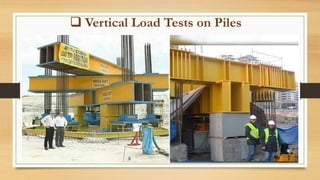
 Vertical Load Tests on Piles
• This test will be carried out as stipulated in IS-2911 (Part IV)
1995.
 Pile Head – The pile head shall be chipped off till sound concrete is met wherever applicable.
The reinforcement shall be cut and head levelled with Plaster of Paris. A bearing plate with a
hole shall be placed on the head for the jack to rest.
 Reaction- Kentledge shall be suitably designed to get the desired reaction on the piles. Anchor
piles (if required) shall be placed at a center to center distance of 3 times the pile diameter
subject to a minimum distance of 2 M.
 Settlement- 2 dial gauges for a single pile and 4 dial gauges for a group of piles with 0.01 mm
sensitivity shall be used. They shall be positioned at equal distance around the piles on datum
bars resting on immovable supports at a distance of 3D (min. of 1.5 m) where D is the diameter
of pile or circumscribing circle for non-circular piles.
 Application of load- It shall be applied as specified depending on the type of test (routine /
initial). Each load shall be maintained till the rate of displacement of the pile top is either 0.1
mm in the first 30 minutes or 0.2 mm in the first one hour or 2 hours whichever occurs first. The
next increment in the load shall be applied on achieving the aforesaid criterion.
The test load shall be maintained for 24 hours.
 Initial Tests– The safe load on a single pile shall be the least of the following:
(i) 2/3rd of the final load at which the total displacement attains a value of 12 mm unless
otherwise required in a given case on the basis of nature and type of structure in which
case, the safe load should be corresponding to the stated total displacement permissible.
(ii) 50% of the final load at which the total displacement equals 10% of the pile diameter in
case of uniform diameter piles or 7.5% of the bulb diameter in case of under reamed piles.
Routine Tests – Acceptance
The maximum settlement at test load should not exceed 12 mm.
 Lateral Load Tests on Piles
 The jack should be placed horizontally, between two piles. The load on the jack shall be the
same on both the piles. The load will be applied in increments of 20% of the estimated safe
load and at the cut off level. The load will be increased after the rate of displacement is
nearer to 0.1 mm per 30 minutes.
 If the cut-off level is approachable, one dial gauge exactly at the cut-off level shall measure
the displacement. In case the cut-off level is not approachable, 2 dial gauges 30 cm apart
vertically, shall be set up and the lateral displacement of the cut-off level calculated by similar
triangles.
 The safe load on the pile shall be the least of the following:
a) 50% of the final load at which the total displacement increases to 12 mm.
b) Final load at which the total displacement corresponds to 5 mm.
*Thank You*

Pile load test ppt

  • 1.
    PILE LOAD TEST LoadTest on Piles – Methods of Pile Load Test Prepared By: Dharmendra Singh
  • 2.
     Load testson piles are conducted on completion of 28 days after casting of piles.  Two types of tests namely initial and routine tests, for each type of loading viz. vertical, horizontal (lateral) pull out, are performed on piles.
  • 3.
     Initial LoadTests on Piles • This test is performed to confirm the design load calculations and to provide guidelines for setting up the limits of acceptance for routine tests. It also gives an idea of the suitability of the piling system. Initial Test on piles are to be carried out at one or more locations depending on the number of piles required. • Load applied for the initial (cyclic) load test is 2.5 times the safe carrying capacity of the pile. Loading for Initial Tests is conducted as per Appendix ‘A’ Clause 6.3 of IS-2911 Part IV.
  • 4.
     Routine LoadTests on Piles • Selection of piles for the Routine Test is done based on number of piles required subject to maximum of ½% of total number of piles required. The number of tests may be increased to 2% depending on the nature / type of structure. The test load applied is 1½ times the safe carrying capacity of the pile. • he Maintained load method as described in Clause 6.2 of IS-2911 (Part IV) – 1985 shall be followed for loading for the Routine Tests. • This test will be performed for the following purposes: • a) To ensure the safe load capacity of piles • b) Detection of any unusual performance contrary to the findings of the Initial Test. • The tests shall be performed at the cut-off level only. A detailed report for the test result is prepared.
  • 5.
     Vertical LoadTests on Piles • This test will be carried out as stipulated in IS-2911 (Part IV) 1995.
  • 6.
     Pile Head– The pile head shall be chipped off till sound concrete is met wherever applicable. The reinforcement shall be cut and head levelled with Plaster of Paris. A bearing plate with a hole shall be placed on the head for the jack to rest.  Reaction- Kentledge shall be suitably designed to get the desired reaction on the piles. Anchor piles (if required) shall be placed at a center to center distance of 3 times the pile diameter subject to a minimum distance of 2 M.  Settlement- 2 dial gauges for a single pile and 4 dial gauges for a group of piles with 0.01 mm sensitivity shall be used. They shall be positioned at equal distance around the piles on datum bars resting on immovable supports at a distance of 3D (min. of 1.5 m) where D is the diameter of pile or circumscribing circle for non-circular piles.  Application of load- It shall be applied as specified depending on the type of test (routine / initial). Each load shall be maintained till the rate of displacement of the pile top is either 0.1 mm in the first 30 minutes or 0.2 mm in the first one hour or 2 hours whichever occurs first. The next increment in the load shall be applied on achieving the aforesaid criterion.
  • 7.
    The test loadshall be maintained for 24 hours.  Initial Tests– The safe load on a single pile shall be the least of the following: (i) 2/3rd of the final load at which the total displacement attains a value of 12 mm unless otherwise required in a given case on the basis of nature and type of structure in which case, the safe load should be corresponding to the stated total displacement permissible. (ii) 50% of the final load at which the total displacement equals 10% of the pile diameter in case of uniform diameter piles or 7.5% of the bulb diameter in case of under reamed piles. Routine Tests – Acceptance The maximum settlement at test load should not exceed 12 mm.
  • 8.
     Lateral LoadTests on Piles
  • 9.
     The jackshould be placed horizontally, between two piles. The load on the jack shall be the same on both the piles. The load will be applied in increments of 20% of the estimated safe load and at the cut off level. The load will be increased after the rate of displacement is nearer to 0.1 mm per 30 minutes.  If the cut-off level is approachable, one dial gauge exactly at the cut-off level shall measure the displacement. In case the cut-off level is not approachable, 2 dial gauges 30 cm apart vertically, shall be set up and the lateral displacement of the cut-off level calculated by similar triangles.  The safe load on the pile shall be the least of the following: a) 50% of the final load at which the total displacement increases to 12 mm. b) Final load at which the total displacement corresponds to 5 mm.
  • 10.