
SUBMITTED BY:
M.Tech Geotechnical
Engineering 1st Sem
 Soil Types
 Soft Soil Types
 Methods of Tunneling in Soft Soils
 Methods of Tunneling in Hard Soils
 Soft soils- Requiring support during and after
excavation
 Hard rocks or Fully self supporting soils
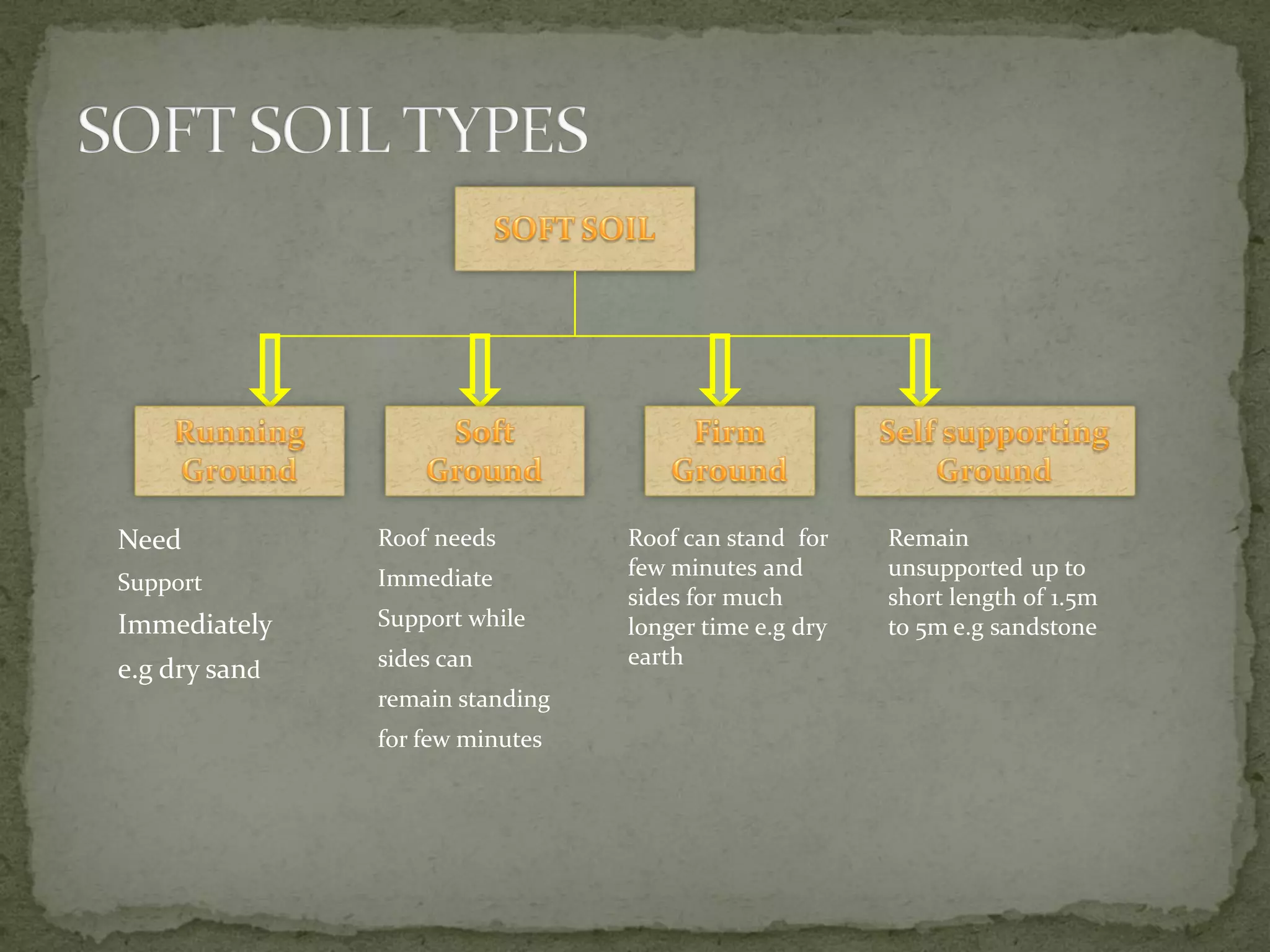
Need
Support
Immediately
e.g dry sand
Roof needs
Immediate
Support while
sides can
remain standing
for few minutes
Roof can stand for
few minutes and
sides for much
longer time e.g dry
earth
Remain
unsupported up to
short length of 1.5m
to 5m e.g sandstone
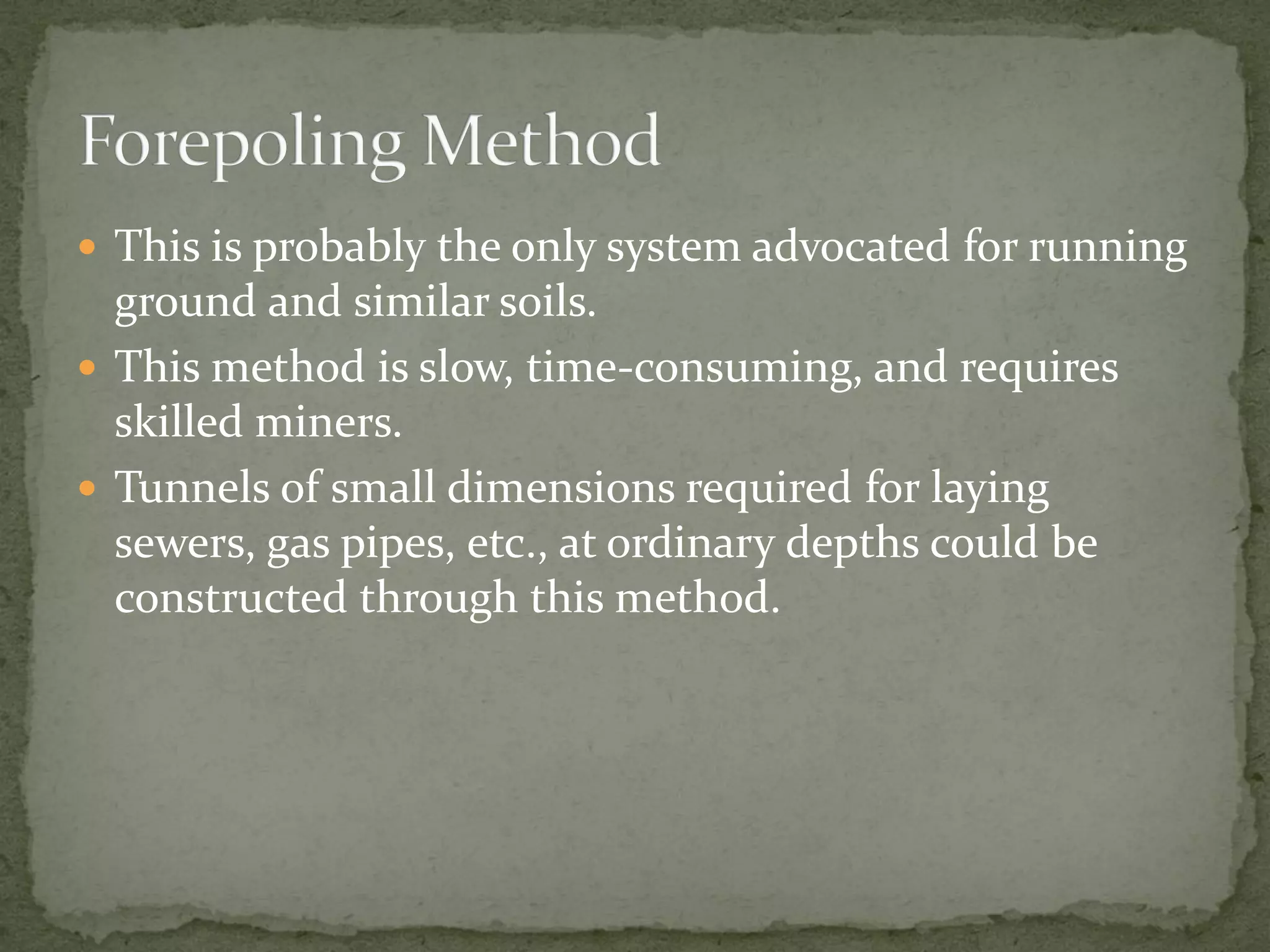
1. Forepoling method
2. Needle beam method
3. Army method
4. Belgian method
5. English method
6. American method
7. Austrian method
8. German method
9. Italian Method
Other Methods
1. Linear plate method
2. Shield method
3. Compressed air method
Methods requiring timbering
 This is probably the only system advocated for running
ground and similar soils.
 This method is slow, time-consuming, and requires
skilled miners.
 Tunnels of small dimensions required for laying
sewers, gas pipes, etc., at ordinary depths could be
constructed through this method.
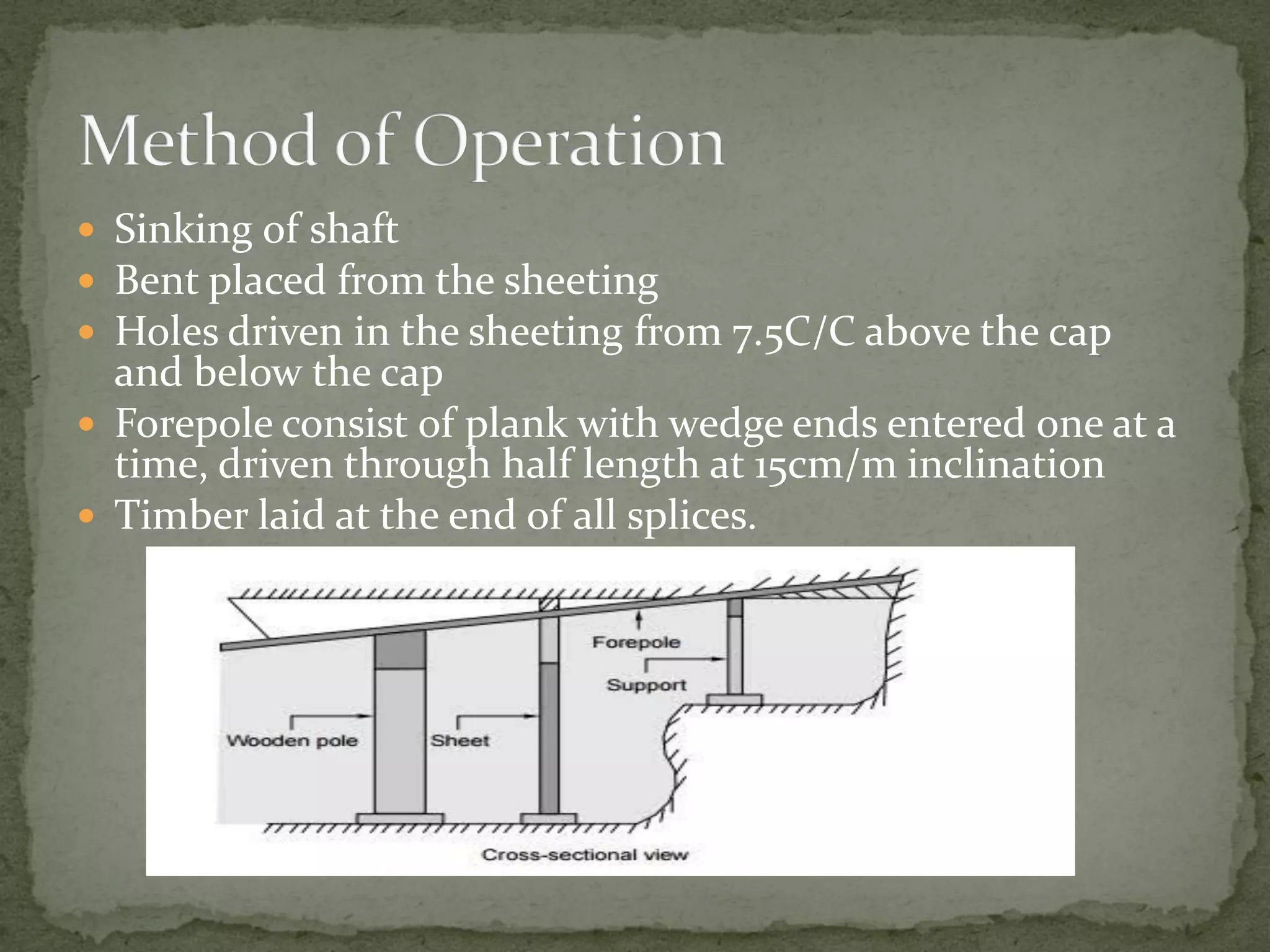
 Sinking of shaft
 Bent placed from the sheeting
 Holes driven in the sheeting from 7.5C/C above the cap
and below the cap
 Forepole consist of plank with wedge ends entered one at a
time, driven through half length at 15cm/m inclination
 Timber laid at the end of all splices.
 This method is suitable for soils where the roof could stand
for some minutes without support.
 This method could be advanced by 10' to 12' length per day.
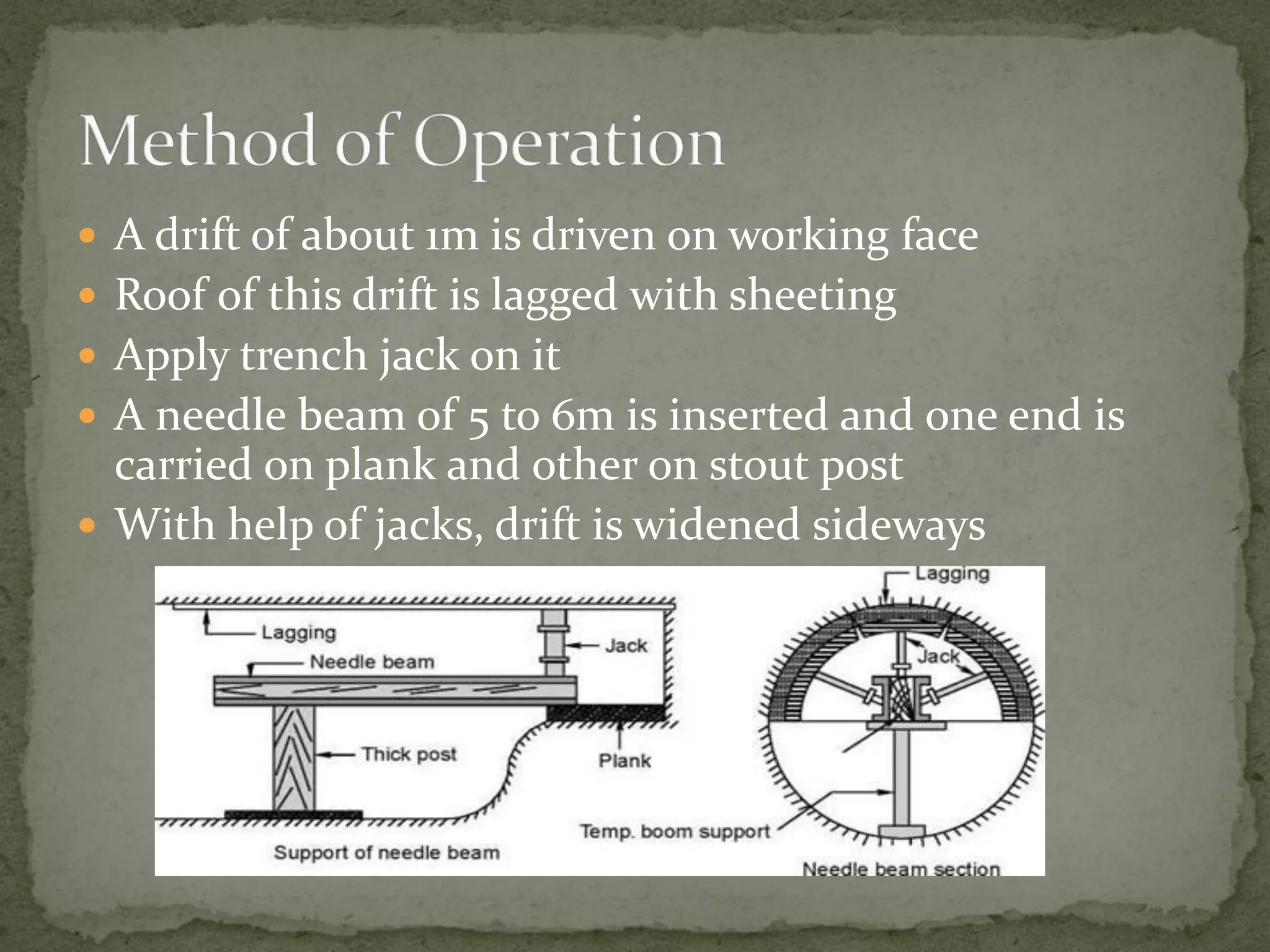
 The needle beam consists of a stout timber beam or a
composite flitched beam and forms the temporary primary
support during the excavation
 A drift of about 1m is driven on working face
 Roof of this drift is lagged with sheeting
 Apply trench jack on it
 A needle beam of 5 to 6m is inserted and one end is
carried on plank and other on stout post
 With help of jacks, drift is widened sideways
 The United States Army devised this method for
constructing small tunnels at reasonably shallow
depths. This was mainly used for laying underground
sewers.
 The advantage of this method lies in its simplicity and
economy as only a few timber planks, with 1-2 trench
jacks, form the leading equipment.
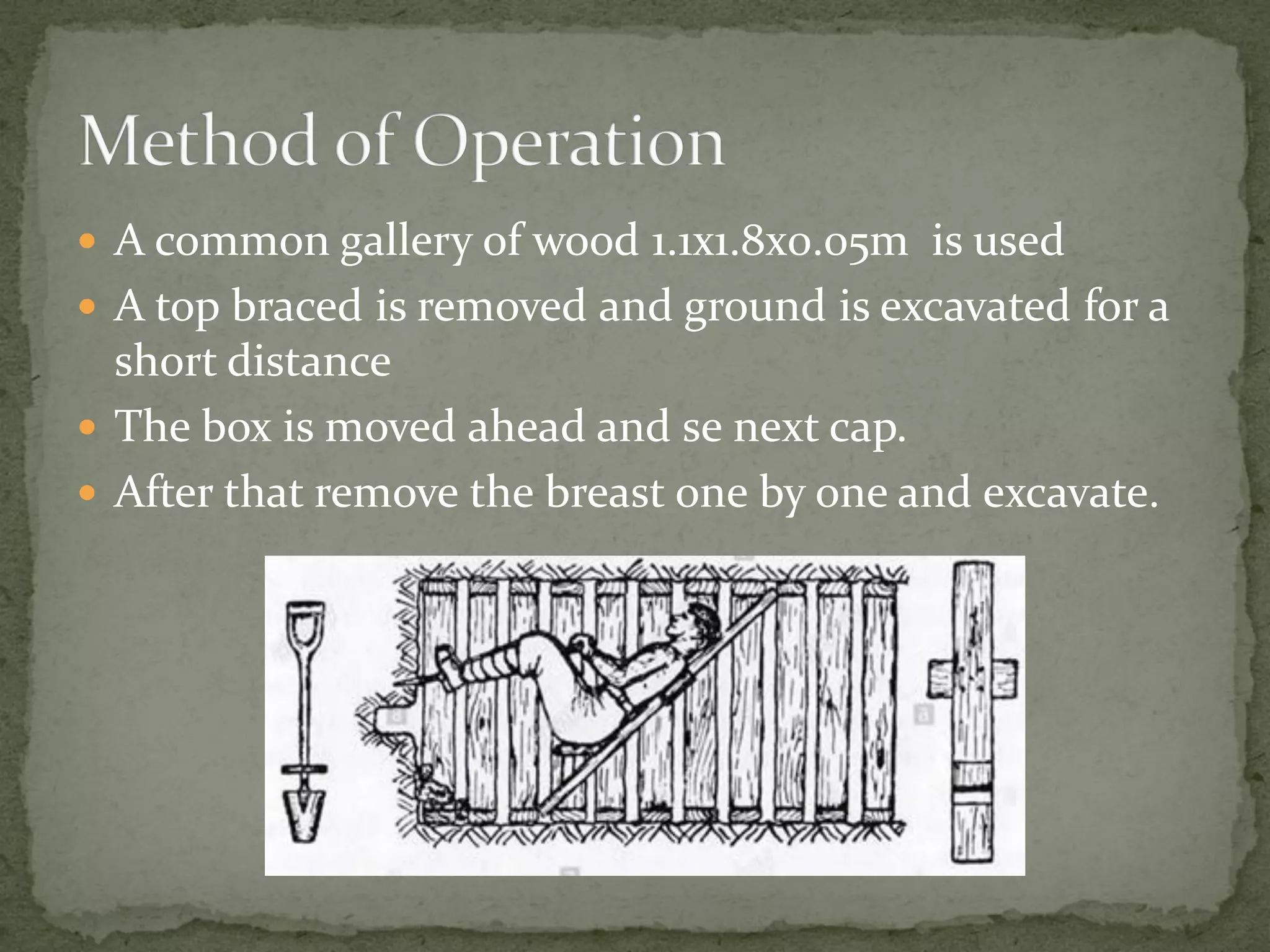
 A common gallery of wood 1.1x1.8x0.05m is used
 A top braced is removed and ground is excavated for a
short distance
 The box is moved ahead and se next cap.
 After that remove the breast one by one and excavate.
 This is a popular method and is suitable for all classes
of moderately firm or hard soils.
 The advantage of the Belgian method lies in lighter
timber sections, as the timber is placed closely.
 Disadvantage is due to the system of the
underpinning of the built arch, mainly when the
avoidable subsidence of the soil may occur, causing
settlement and cracks in the arch masonry.
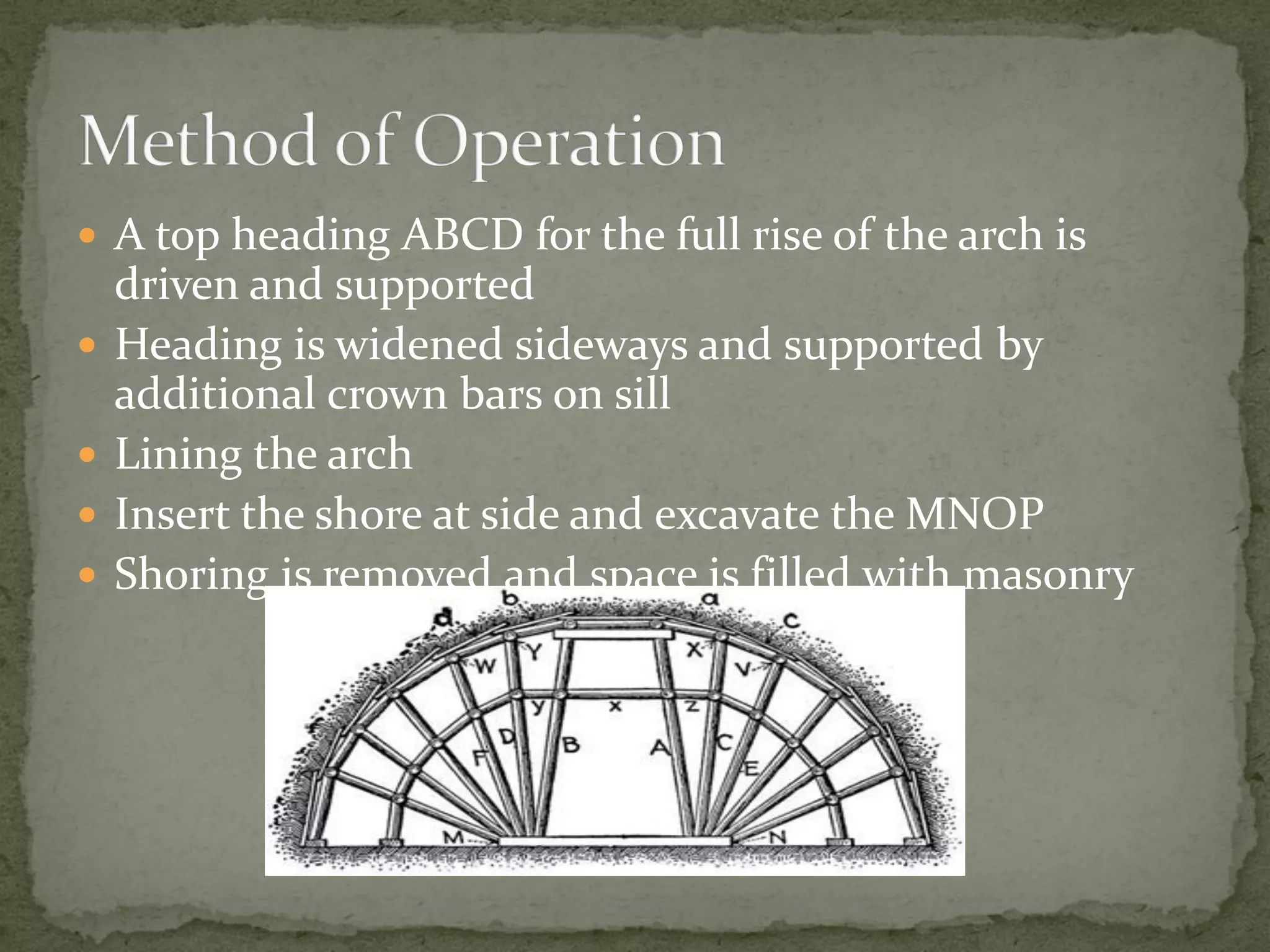
 A top heading ABCD for the full rise of the arch is
driven and supported
 Heading is widened sideways and supported by
additional crown bars on sill
 Lining the arch
 Insert the shore at side and excavate the MNOP
 Shoring is removed and space is filled with masonry
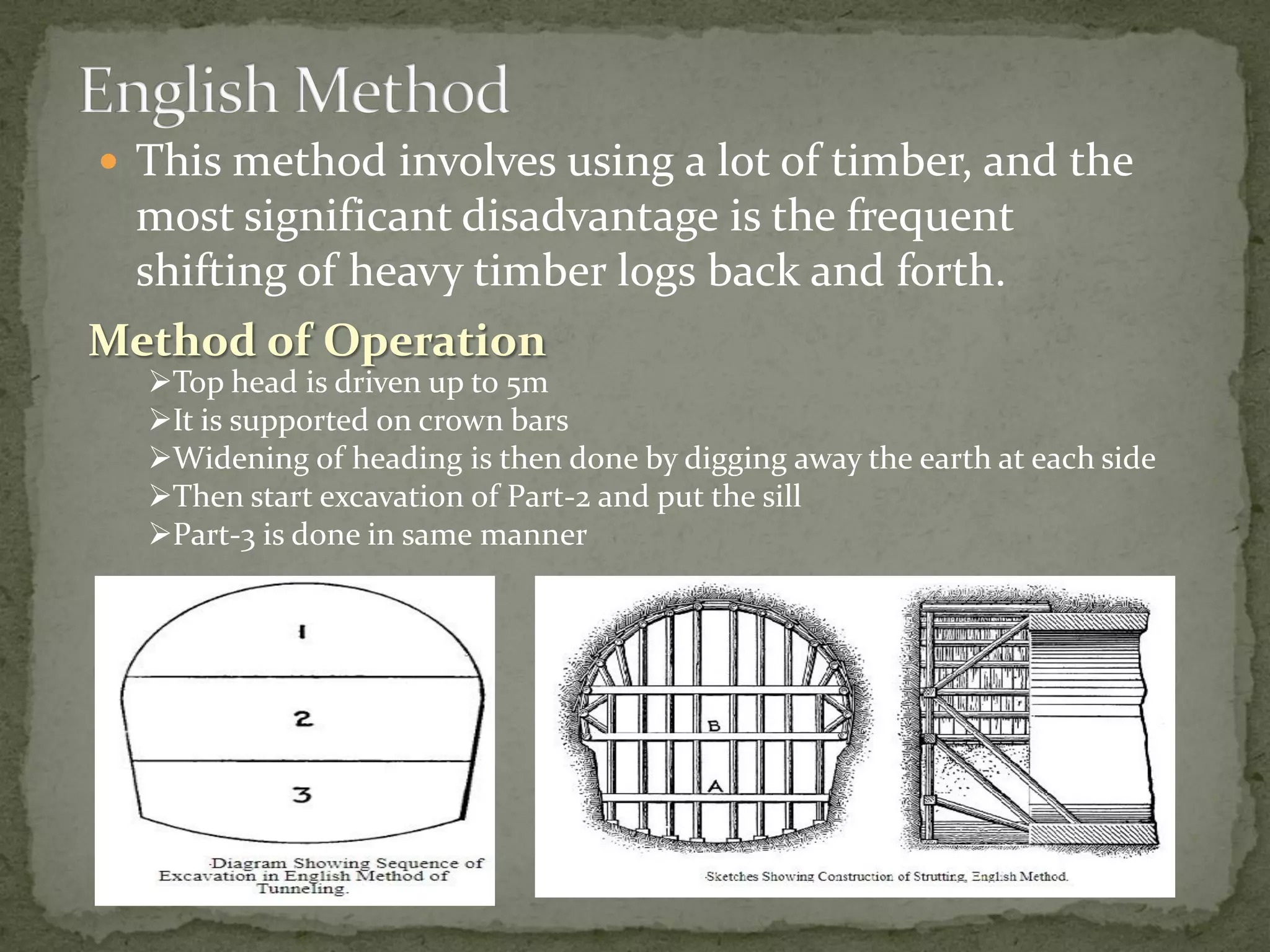
 This method involves using a lot of timber, and the
most significant disadvantage is the frequent
shifting of heavy timber logs back and forth.
Method of Operation
Top head is driven up to 5m
It is supported on crown bars
Widening of heading is then done by digging away the earth at each side
Then start excavation of Part-2 and put the sill
Part-3 is done in same manner
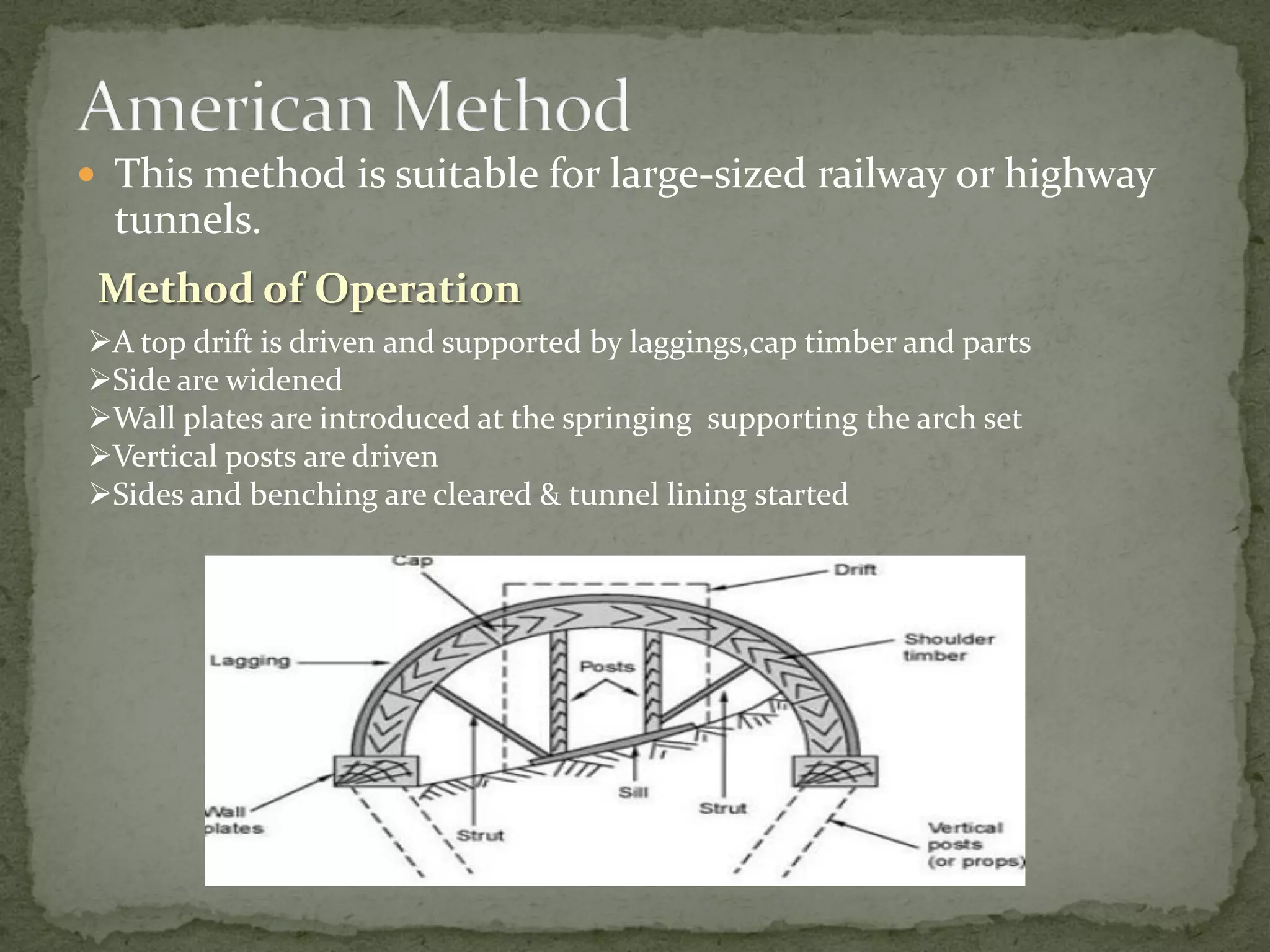
 This method is suitable for large-sized railway or highway
tunnels.
Method of Operation
A top drift is driven and supported by laggings,cap timber and parts
Side are widened
Wall plates are introduced at the springing supporting the arch set
Vertical posts are driven
Sides and benching are cleared & tunnel lining started
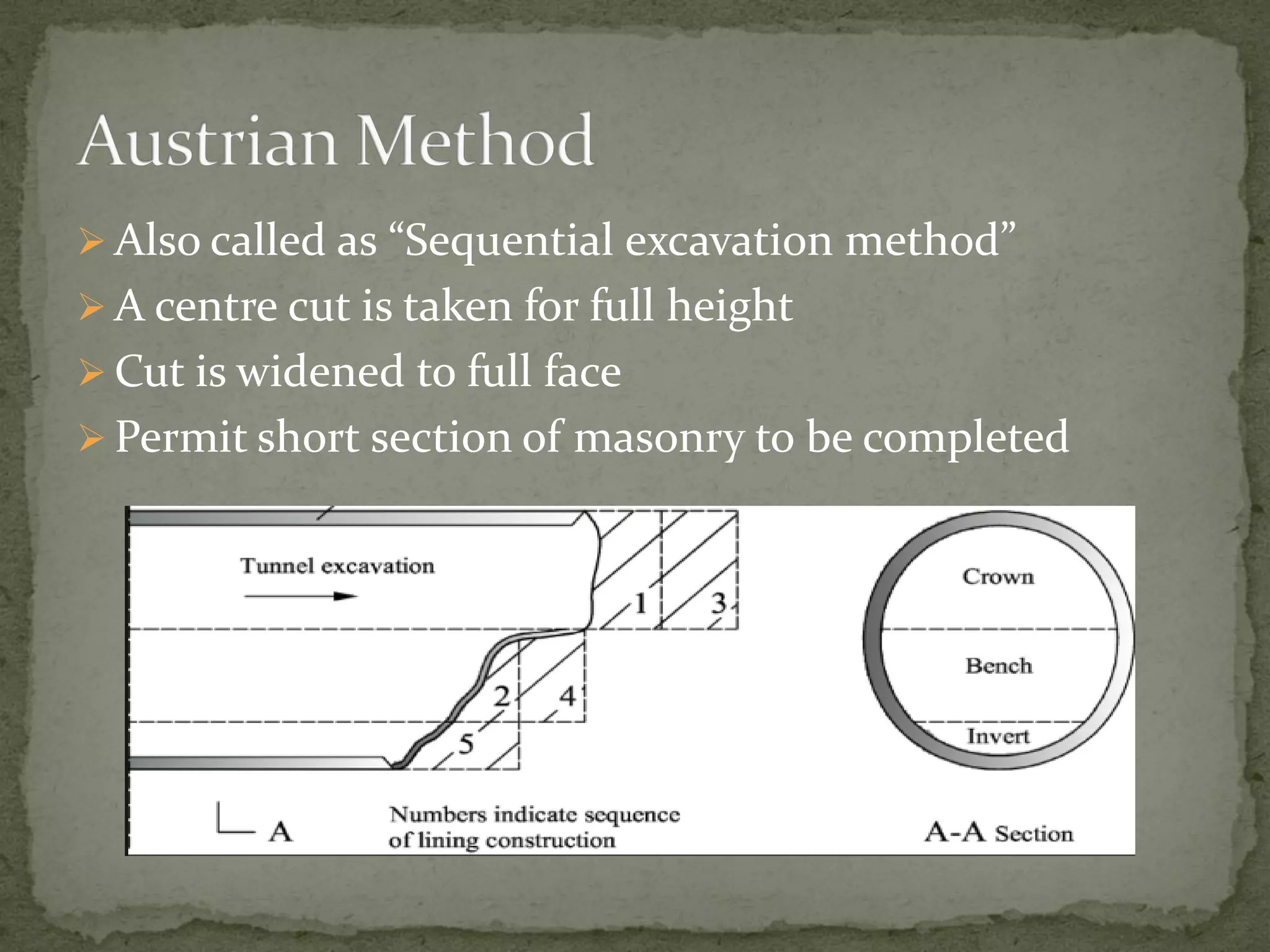
 Also called as “Sequential excavation method”
 A centre cut is taken for full height
 Cut is widened to full face
 Permit short section of masonry to be completed
 In this method 3 drifts are used to support the roof and side.
 One at the crown and rest two are at bottom along the wall.
 Also called core leaving method
 The Italian tunnelling method is also known as packing
method.
 It is used to overcome very difficult geological conditions
(strongly squeezing rock with water ingress).
 Excavation is done in parts with immediate installation of
packing material (even within the finished dimension of
tunnel) and later broken out after ring closure.
Italian Method
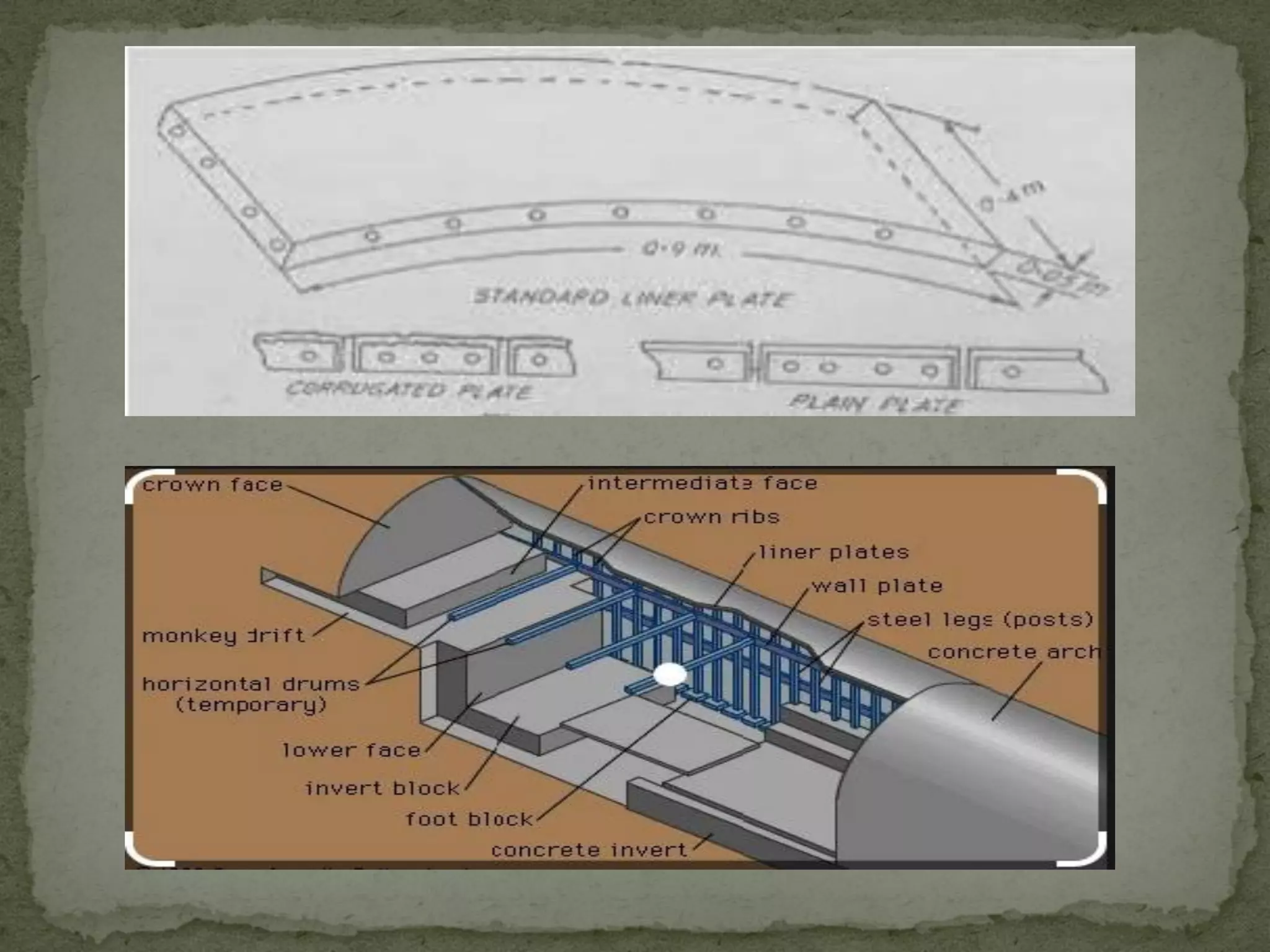
 Plain or corrugated steel plates are used to support the soil
during excavation
 The size of plates are 0.9x0.4 with flange of 0.05m
 Plates are bolted to each other through holes in flange
 Hole of 0.4m depth is cut at crown and liner plate “a” is inserted
 Excavated sides are provided with “b” and “c” plates
 Two wooden wall plates of size about 2ox5cm are placed on each
side of the bench
 Jacks are removed
 The bench is then cleared and the wall plates are under pinned at
bottom
Method of Operation
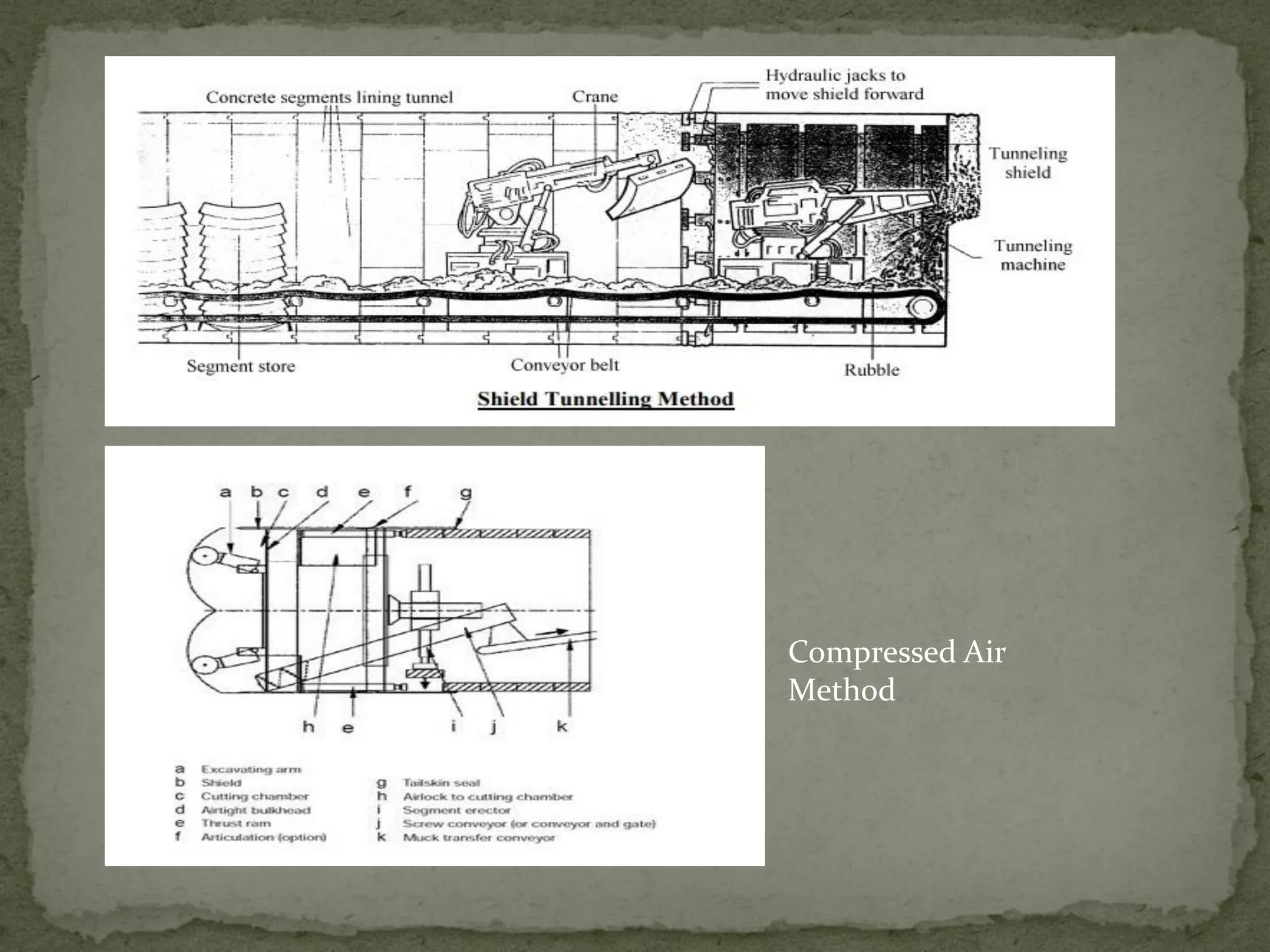
 This method is used for driving a tunnel through water
bearing strata
 Shield is an equipment which acts as a bridge with roof
for workers
 A shield is a movable frame and it is used to support
the face of tunnel
 The excavation & lining of tunnel can be carried out
under protection of shield
 The ground is excavated ahead of the shield of 0.45 t0
0.75m
 The shield is jacked forward
 Primary lining is the heavy cast iron lining used in
conjunction with the shield
 Secondary lining is 5 t0 7cm concrete placed over the
flange of iron
 It is a speedy method
 Most modern method used for tunneling in soft
grounds having water bearing strata.
 Timber support is not required, support is provided by
compressed air into enclosed space to prevent collapse
of roof and sides of tunnel
 Air pressure adopted is approximately 1kg/cm^2
 If pressure will be more than working hour will reduce
which will increase the cost of labors and the
construction cost as well
Compressed Air
Method
General Operation Sequence
 Locating centre line on the ground
 Construction of Shaft
 Transferring centre line to the inside of tunnel
 Setting up and drilling hole for blasting
 Loading holes and carrying out blasting
 Providing ventilation
 Loading and hauling muck
 Pumping of ground water
 Placing reinforcement steel and concrete lining
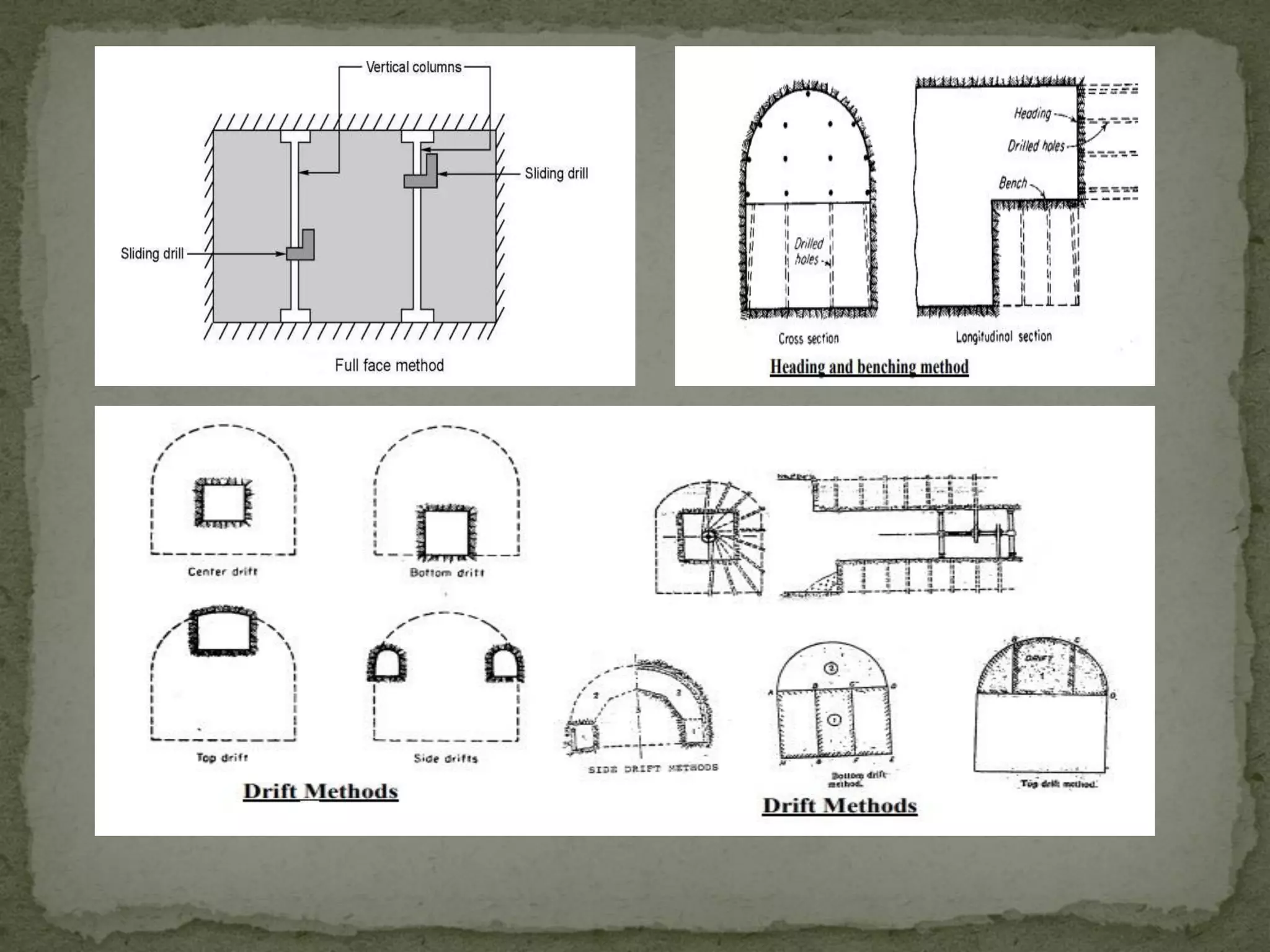
1. Full Face method
2. Heading and bench method
3. Drift method
Full face method
 In this whole section of tunnel is drilled at the same
time
It is suitable for small cross sectional area about 3m
dia
Bars are installed whose width is less than height
Columns are installed vertically whose height is less
than its width
 It is used when tunnel is very large and the quality of
rock is not satisfactory
 If rock is hard and self supporting , heading is
advanced ahead by one round of the bench
 The bench provides platform for timber supports
 Heading is usually 3 to 3.5m ahead of bench
 A drift is a small tunnel driven through all or a portion
of the length of the tunnel prior to excavating full bore
 Types
1. Centre drift
2. Side drift
3. Top drift
4. Bottom drift
Centre drift
Generally 3x3m to 2.5x2.5m centre drift is driven through
portal to portal
Holes for enlargement are ring drilled with a drill set upon the
axis of tunnel
Side Drift
Two drifts are advanced along the sides of tunnel
Breakups are then made in form of arch and permanent
timbering is erected to support the roof
When the drift section chosen lies in top of the tunnel
section, it is called top drift
Top drift
Bottom Drift
 In this, the lower part is first blasted and cleared for
the full length
THANK YOU

METHODS OF TUNNELLING IN SOFT & HARD GROUND.pdf

  • 1.
  • 2.
     Soil Types Soft Soil Types  Methods of Tunneling in Soft Soils  Methods of Tunneling in Hard Soils
  • 3.
     Soft soils-Requiring support during and after excavation  Hard rocks or Fully self supporting soils
  • 4.
    Need Support Immediately e.g dry sand Roofneeds Immediate Support while sides can remain standing for few minutes Roof can stand for few minutes and sides for much longer time e.g dry earth Remain unsupported up to short length of 1.5m to 5m e.g sandstone
  • 5.
    1. Forepoling method 2.Needle beam method 3. Army method 4. Belgian method 5. English method 6. American method 7. Austrian method 8. German method 9. Italian Method Other Methods 1. Linear plate method 2. Shield method 3. Compressed air method Methods requiring timbering
  • 6.
     This isprobably the only system advocated for running ground and similar soils.  This method is slow, time-consuming, and requires skilled miners.  Tunnels of small dimensions required for laying sewers, gas pipes, etc., at ordinary depths could be constructed through this method.
  • 7.
     Sinking ofshaft  Bent placed from the sheeting  Holes driven in the sheeting from 7.5C/C above the cap and below the cap  Forepole consist of plank with wedge ends entered one at a time, driven through half length at 15cm/m inclination  Timber laid at the end of all splices.
  • 8.
     This methodis suitable for soils where the roof could stand for some minutes without support.  This method could be advanced by 10' to 12' length per day.  The needle beam consists of a stout timber beam or a composite flitched beam and forms the temporary primary support during the excavation
  • 9.
     A driftof about 1m is driven on working face  Roof of this drift is lagged with sheeting  Apply trench jack on it  A needle beam of 5 to 6m is inserted and one end is carried on plank and other on stout post  With help of jacks, drift is widened sideways
  • 10.
     The UnitedStates Army devised this method for constructing small tunnels at reasonably shallow depths. This was mainly used for laying underground sewers.  The advantage of this method lies in its simplicity and economy as only a few timber planks, with 1-2 trench jacks, form the leading equipment.
  • 11.
     A commongallery of wood 1.1x1.8x0.05m is used  A top braced is removed and ground is excavated for a short distance  The box is moved ahead and se next cap.  After that remove the breast one by one and excavate.
  • 12.
     This isa popular method and is suitable for all classes of moderately firm or hard soils.  The advantage of the Belgian method lies in lighter timber sections, as the timber is placed closely.  Disadvantage is due to the system of the underpinning of the built arch, mainly when the avoidable subsidence of the soil may occur, causing settlement and cracks in the arch masonry.
  • 13.
     A topheading ABCD for the full rise of the arch is driven and supported  Heading is widened sideways and supported by additional crown bars on sill  Lining the arch  Insert the shore at side and excavate the MNOP  Shoring is removed and space is filled with masonry
  • 14.
     This methodinvolves using a lot of timber, and the most significant disadvantage is the frequent shifting of heavy timber logs back and forth. Method of Operation Top head is driven up to 5m It is supported on crown bars Widening of heading is then done by digging away the earth at each side Then start excavation of Part-2 and put the sill Part-3 is done in same manner
  • 15.
     This methodis suitable for large-sized railway or highway tunnels. Method of Operation A top drift is driven and supported by laggings,cap timber and parts Side are widened Wall plates are introduced at the springing supporting the arch set Vertical posts are driven Sides and benching are cleared & tunnel lining started
  • 16.
     Also calledas “Sequential excavation method”  A centre cut is taken for full height  Cut is widened to full face  Permit short section of masonry to be completed
  • 17.
     In thismethod 3 drifts are used to support the roof and side.  One at the crown and rest two are at bottom along the wall.  Also called core leaving method  The Italian tunnelling method is also known as packing method.  It is used to overcome very difficult geological conditions (strongly squeezing rock with water ingress).  Excavation is done in parts with immediate installation of packing material (even within the finished dimension of tunnel) and later broken out after ring closure. Italian Method
  • 18.
     Plain orcorrugated steel plates are used to support the soil during excavation  The size of plates are 0.9x0.4 with flange of 0.05m  Plates are bolted to each other through holes in flange  Hole of 0.4m depth is cut at crown and liner plate “a” is inserted  Excavated sides are provided with “b” and “c” plates  Two wooden wall plates of size about 2ox5cm are placed on each side of the bench  Jacks are removed  The bench is then cleared and the wall plates are under pinned at bottom Method of Operation
  • 20.
     This methodis used for driving a tunnel through water bearing strata  Shield is an equipment which acts as a bridge with roof for workers  A shield is a movable frame and it is used to support the face of tunnel  The excavation & lining of tunnel can be carried out under protection of shield
  • 21.
     The groundis excavated ahead of the shield of 0.45 t0 0.75m  The shield is jacked forward  Primary lining is the heavy cast iron lining used in conjunction with the shield  Secondary lining is 5 t0 7cm concrete placed over the flange of iron  It is a speedy method
  • 22.
     Most modernmethod used for tunneling in soft grounds having water bearing strata.  Timber support is not required, support is provided by compressed air into enclosed space to prevent collapse of roof and sides of tunnel  Air pressure adopted is approximately 1kg/cm^2  If pressure will be more than working hour will reduce which will increase the cost of labors and the construction cost as well
  • 23.
  • 24.
    General Operation Sequence Locating centre line on the ground  Construction of Shaft  Transferring centre line to the inside of tunnel  Setting up and drilling hole for blasting  Loading holes and carrying out blasting  Providing ventilation  Loading and hauling muck  Pumping of ground water  Placing reinforcement steel and concrete lining
  • 25.
    1. Full Facemethod 2. Heading and bench method 3. Drift method Full face method  In this whole section of tunnel is drilled at the same time It is suitable for small cross sectional area about 3m dia Bars are installed whose width is less than height Columns are installed vertically whose height is less than its width
  • 26.
     It isused when tunnel is very large and the quality of rock is not satisfactory  If rock is hard and self supporting , heading is advanced ahead by one round of the bench  The bench provides platform for timber supports  Heading is usually 3 to 3.5m ahead of bench
  • 27.
     A driftis a small tunnel driven through all or a portion of the length of the tunnel prior to excavating full bore  Types 1. Centre drift 2. Side drift 3. Top drift 4. Bottom drift
  • 28.
    Centre drift Generally 3x3mto 2.5x2.5m centre drift is driven through portal to portal Holes for enlargement are ring drilled with a drill set upon the axis of tunnel Side Drift Two drifts are advanced along the sides of tunnel Breakups are then made in form of arch and permanent timbering is erected to support the roof When the drift section chosen lies in top of the tunnel section, it is called top drift Top drift Bottom Drift  In this, the lower part is first blasted and cleared for the full length
  • 30.