Bricks
BY :: Yashvant Chotaliya
1
BRICK
• A brick is a rectangular shaped block made by various materials such as,
• Fired clay bricks
• Fly ash bricks
• Glass bricks
• Plastic bricks
2
A Half brick wall costs 40-
45rs per sq ft and one brick
wall costs 70-80rs per sq ft
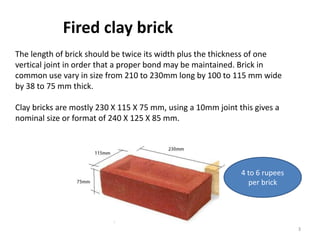
The length of brick should be twice its width plus the thickness of one
vertical joint in order that a proper bond may be maintained. Brick in
common use vary in size from 210 to 230mm long by 100 to 115 mm wide
by 38 to 75 mm thick.
Clay bricks are mostly 230 X 115 X 75 mm, using a 10mm joint this gives a
nominal size or format of 240 X 125 X 85 mm.
3
Fired clay brick
4 to 6 rupees
per brick
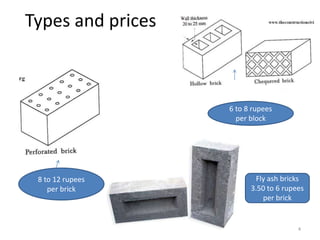
Types and prices
4
8 to 12 rupees
per brick
6 to 8 rupees
per block
Fly ash bricks
3.50 to 6 rupees
per brick
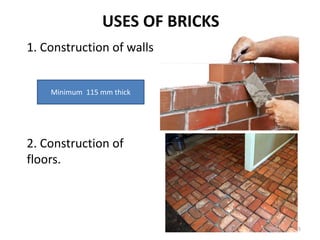
USES OF BRICKS
5
1. Construction of walls
2. Construction of
floors.
Minimum 115 mm thick
USES OF BRICKS
6
3. Construction of
arches and cornices.
4. Construction of brick
retaining wall.
USES OF BRICKS
7
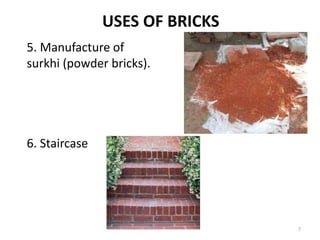
5. Manufacture of
surkhi (powder bricks).
6. Staircase
USES OF BRICKS
8
7. Foundation.
8. Masonry
veneer walls.
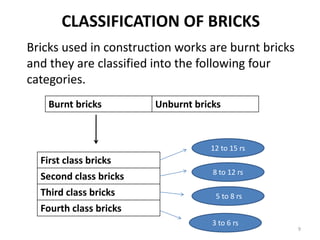
Burnt bricks Unburnt bricks
First class bricks
Second class bricks
Third class bricks
Fourth class bricks
Bricks used in construction works are burnt bricks
and they are classified into the following four
categories.
CLASSIFICATION OF BRICKS
9
12 to 15 rs
8 to 12 rs
5 to 8 rs
3 to 6 rs
Tools needed for masonry
10
Plumb bob
Spirit level
11
BRICK BONDS
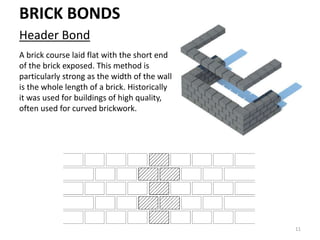
Header Bond
A brick course laid flat with the short end
of the brick exposed. This method is
particularly strong as the width of the wall
is the whole length of a brick. Historically
it was used for buildings of high quality,
often used for curved brickwork.
12
BRICK BONDS
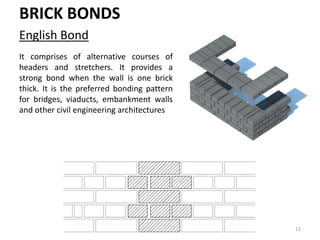
English Bond
It comprises of alternative courses of
headers and stretchers. It provides a
strong bond when the wall is one brick
thick. It is the preferred bonding pattern
for bridges, viaducts, embankment walls
and other civil engineering architectures
13
BRICK BONDS
Flemish Bond
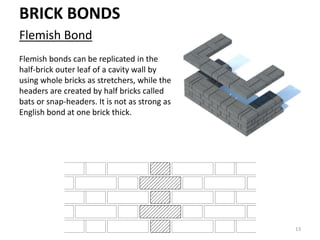
Flemish bonds can be replicated in the
half-brick outer leaf of a cavity wall by
using whole bricks as stretchers, while the
headers are created by half bricks called
bats or snap-headers. It is not as strong as
English bond at one brick thick.
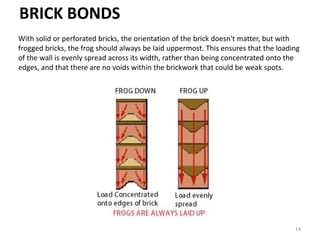
With solid or perforated bricks, the orientation of the brick doesn't matter, but with
frogged bricks, the frog should always be laid uppermost. This ensures that the loading
of the wall is evenly spread across its width, rather than being concentrated onto the
edges, and that there are no voids within the brickwork that could be weak spots.
14
BRICK BONDS
15
Rat trap Bond
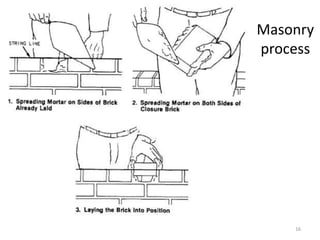
Masonry
process
16
Elements made by bricks
• Arches
• Foundation
• Columns
• Lintels
• Facade
• Vaults
• Domes
• Flooring
• Pathways
• Sitting
• pedestals
17
18
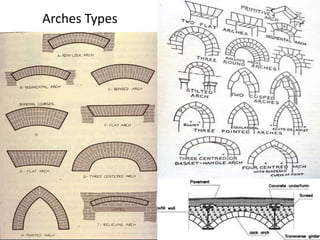
Arches Types
Process of making Arch
• Measure span of arch and height of arch
• Make shape of that arch in plywood sheet
• Draw a vertical line perpendicular to the springing
base line from the center point, using an L- square.
This is the position for the keystone. Starting with the
keystone, use the arch's half circle to count how
many bricks will be needed to fill either side.
• Build two pillars on which arch is going to be rest.
19
20
Pillars Wooden or iron frame
21
END

Brick - MATERIAL STUDIO

  • 1.
  • 2.
    BRICK • A brickis a rectangular shaped block made by various materials such as, • Fired clay bricks • Fly ash bricks • Glass bricks • Plastic bricks 2 A Half brick wall costs 40- 45rs per sq ft and one brick wall costs 70-80rs per sq ft
  • 3.
    The length ofbrick should be twice its width plus the thickness of one vertical joint in order that a proper bond may be maintained. Brick in common use vary in size from 210 to 230mm long by 100 to 115 mm wide by 38 to 75 mm thick. Clay bricks are mostly 230 X 115 X 75 mm, using a 10mm joint this gives a nominal size or format of 240 X 125 X 85 mm. 3 Fired clay brick 4 to 6 rupees per brick
  • 4.
    Types and prices 4 8to 12 rupees per brick 6 to 8 rupees per block Fly ash bricks 3.50 to 6 rupees per brick
  • 5.
    USES OF BRICKS 5 1.Construction of walls 2. Construction of floors. Minimum 115 mm thick
  • 6.
    USES OF BRICKS 6 3.Construction of arches and cornices. 4. Construction of brick retaining wall.
  • 7.
    USES OF BRICKS 7 5.Manufacture of surkhi (powder bricks). 6. Staircase
  • 8.
    USES OF BRICKS 8 7.Foundation. 8. Masonry veneer walls.
  • 9.
    Burnt bricks Unburntbricks First class bricks Second class bricks Third class bricks Fourth class bricks Bricks used in construction works are burnt bricks and they are classified into the following four categories. CLASSIFICATION OF BRICKS 9 12 to 15 rs 8 to 12 rs 5 to 8 rs 3 to 6 rs
  • 10.
    Tools needed formasonry 10 Plumb bob Spirit level
  • 11.
    11 BRICK BONDS Header Bond Abrick course laid flat with the short end of the brick exposed. This method is particularly strong as the width of the wall is the whole length of a brick. Historically it was used for buildings of high quality, often used for curved brickwork.
  • 12.
    12 BRICK BONDS English Bond Itcomprises of alternative courses of headers and stretchers. It provides a strong bond when the wall is one brick thick. It is the preferred bonding pattern for bridges, viaducts, embankment walls and other civil engineering architectures
  • 13.
    13 BRICK BONDS Flemish Bond Flemishbonds can be replicated in the half-brick outer leaf of a cavity wall by using whole bricks as stretchers, while the headers are created by half bricks called bats or snap-headers. It is not as strong as English bond at one brick thick.
  • 14.
    With solid orperforated bricks, the orientation of the brick doesn't matter, but with frogged bricks, the frog should always be laid uppermost. This ensures that the loading of the wall is evenly spread across its width, rather than being concentrated onto the edges, and that there are no voids within the brickwork that could be weak spots. 14 BRICK BONDS
  • 15.
  • 16.
  • 17.
    Elements made bybricks • Arches • Foundation • Columns • Lintels • Facade • Vaults • Domes • Flooring • Pathways • Sitting • pedestals 17
  • 18.
  • 19.
    Process of makingArch • Measure span of arch and height of arch • Make shape of that arch in plywood sheet • Draw a vertical line perpendicular to the springing base line from the center point, using an L- square. This is the position for the keystone. Starting with the keystone, use the arch's half circle to count how many bricks will be needed to fill either side. • Build two pillars on which arch is going to be rest. 19
  • 20.
  • 21.