Brick
Presented by Kajal Selani
A brick is building material used to make walls,
pavements and other elements
in masonry construction.
Traditionally, the term brick referred to a unit
composed of clay, but it is now used to denote any
rectangular units laid in mortar.
Bricks are produced in numerous classes, types,
materials, and sizes which vary with region and time
period, and are produced in bulk quantities.
About
Brick
How are they
made?
 Bricks are made from wetting clay which you press it into
a mould and then bake the clay in an oven until it is hard.
Classification
of Bricks
First Class
Bricks
 These are thoroughly burnt and or of deep red, cherry
color.
 These should be free from flaws ,cracks and stones.
 The surface should be smooth and rectangular ,with
parallel ,sharp and straight edges and square corners
 These should have uniform texture
 Water absorption should be 12-15% of its dry weight
when immersed in cold water for 24 hours.
Uses :
 These bricks are recommended for pointing, exposed
facework in masonry structures.
Second
Class Bricks
 These are supposed to have the same requirements as
the first class bricks
 Small cracks and distortions are permitted.
 A little higher water absorption of about 16-20% of its
dry weight is allowed
 The crushing strength should not be less than 7.0
n/mm^2.
Uses :
These are recommended for all masonry works
Third Class
Bricks
These are under burnt.
They are soft and light colored producing a dull sound
Water absorption is about 25% of dry weight
Uses:
It is used for building temporary structures
Fourth Class
Bricks
These are over burnt and badly distorted in shape and
size and brittle in nature.
Uses:
 The ballast of such bricks is used
for foundation and road metal.
Common brick: it is a general multipurpose unit
manufactured economically without special reference
to appearance.
Facing brick: these are made primarily with a view
to have good appearance and texture
Engineering bricks: these are strong impermeable
smooth.
Manufacture:
Handmade: these bricks are hand molded .
Machine made: depending upon mechanical
arrangement, bricks are known as wire cut bricks.
Types of
Bricks
Solid: small holes not exceeding 25% of the
volume of the brick are permitted
Perforated: small holes may be exceed 25% of
the total volume of the brick
Hollow: the total of holes which need not be small,
may exceed 25% of the volume of the brick
Cellular: holes closed at one end exceed 20% of the
value
Solid Block Perforated Block
Hollow Block
Brick
Masonry
The art of laying bricks in mortar in a
proper systematic manner gives
homogeneous mass which can withstand
forces without disintegration, called brick
masonry
Terms
Terms
The surfaces of a brick have names:
Top and bottom surfaces are beds.
Ends are headers and header faces.
Sides are stretchers or stretcher
faces.
Brick size
The coordinating dimensions are a measure of the
physical space taken up by a brick together with the
mortar required on one bed , one header face and one
stretcher face.
The working dimensions are the sizes to which
manufacturers will try to make the bricks.
Frog
The depression provided in the face of a brick during
its manufacturing.
Depth of frog in a brick should be 10 to 20mm
Frog should be upward. Why?
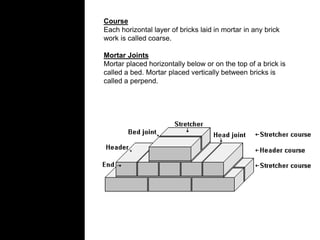
Course
Each horizontal layer of bricks laid in mortar in any brick
work is called coarse.
Mortar Joints
Mortar placed horizontally below or on the top of a brick is
called a bed. Mortar placed vertically between bricks is
called a perpend.
Bats
The portions mad by cutting standard bricks across
their width are known as brick bats.
These are named according their fraction of full length
of a standard brick.
Closers
The portions made by cutting across their length in such
a manner that their one stretcher face remains uncut or
half cut.
Quoins
The external corners of walls are called quoins
The brick which form the external corner is known as
quoin brick.
Requirements
The usual functional requirements of a masonry wall
include:
i) Adequate strength to support imposed loads
ii) Sufficient water tightness
iii) Sufficient visual privacy and sound transmission
iv) Appropriate fire resistance
v) Ability to accommodate heating, air conditioning,
electrical, and plumbing equipment
vi) Ability to receive various finish materials
vii) Ability to provide openings such as doors and
window
Bonds
The arrangement of bricks in brick work so that the vertical
joints do not come over each other.
Bonds in brick work is provided to achieve a united mass
as soon as practicable to suit the length, height and
thickness of brick work and stresses to which it is
subjected.
Brick
Bonds
Common types used are:
i. Stretcher Bond
ii. Header Bond
iii. English Bond
iv. Flemish Bond
Stretcher
Bond
Only used for walls of half brick thickness (partition wall) ,
this is the only practical bond which can be used on a wall
of this thickness. To break the vertical continuity ½ brick
closer is provided in alternating courses
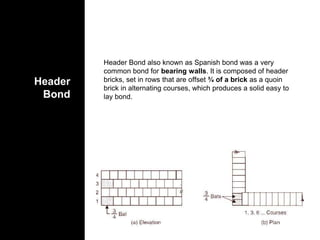
Header
Bond
Header Bond also known as Spanish bond was a very
common bond for bearing walls. It is composed of header
bricks, set in rows that are offset ¾ of a brick as a quoin
brick in alternating courses, which produces a solid easy to
lay bond.
English
Bond
The strongest bond
This bond maximizes the strength of wall
Pattern on the face of the wall shows distinctive courses
of headers & stretchers.
Flemish
Bond
 Not such strong as English bond
 Decorative pattern on face of the wall shows alternate
headers & stretchers in each with the headers centered
under and over stretchers in adjacent courses.
Brick

Brick

  • 1.
  • 2.
    A brick isbuilding material used to make walls, pavements and other elements in masonry construction. Traditionally, the term brick referred to a unit composed of clay, but it is now used to denote any rectangular units laid in mortar. Bricks are produced in numerous classes, types, materials, and sizes which vary with region and time period, and are produced in bulk quantities. About Brick
  • 3.
    How are they made? Bricks are made from wetting clay which you press it into a mould and then bake the clay in an oven until it is hard.
  • 5.
  • 6.
    First Class Bricks  Theseare thoroughly burnt and or of deep red, cherry color.  These should be free from flaws ,cracks and stones.  The surface should be smooth and rectangular ,with parallel ,sharp and straight edges and square corners  These should have uniform texture  Water absorption should be 12-15% of its dry weight when immersed in cold water for 24 hours. Uses :  These bricks are recommended for pointing, exposed facework in masonry structures.
  • 8.
    Second Class Bricks  Theseare supposed to have the same requirements as the first class bricks  Small cracks and distortions are permitted.  A little higher water absorption of about 16-20% of its dry weight is allowed  The crushing strength should not be less than 7.0 n/mm^2. Uses : These are recommended for all masonry works
  • 9.
    Third Class Bricks These areunder burnt. They are soft and light colored producing a dull sound Water absorption is about 25% of dry weight Uses: It is used for building temporary structures
  • 10.
    Fourth Class Bricks These areover burnt and badly distorted in shape and size and brittle in nature. Uses:  The ballast of such bricks is used for foundation and road metal.
  • 11.
    Common brick: itis a general multipurpose unit manufactured economically without special reference to appearance. Facing brick: these are made primarily with a view to have good appearance and texture Engineering bricks: these are strong impermeable smooth. Manufacture: Handmade: these bricks are hand molded . Machine made: depending upon mechanical arrangement, bricks are known as wire cut bricks.
  • 12.
  • 13.
    Solid: small holesnot exceeding 25% of the volume of the brick are permitted Perforated: small holes may be exceed 25% of the total volume of the brick Hollow: the total of holes which need not be small, may exceed 25% of the volume of the brick Cellular: holes closed at one end exceed 20% of the value
  • 14.
    Solid Block PerforatedBlock Hollow Block
  • 15.
  • 16.
    The art oflaying bricks in mortar in a proper systematic manner gives homogeneous mass which can withstand forces without disintegration, called brick masonry
  • 17.
  • 18.
    Terms The surfaces ofa brick have names: Top and bottom surfaces are beds. Ends are headers and header faces. Sides are stretchers or stretcher faces.
  • 19.
  • 20.
    The coordinating dimensionsare a measure of the physical space taken up by a brick together with the mortar required on one bed , one header face and one stretcher face. The working dimensions are the sizes to which manufacturers will try to make the bricks.
  • 21.
    Frog The depression providedin the face of a brick during its manufacturing. Depth of frog in a brick should be 10 to 20mm Frog should be upward. Why?
  • 22.
    Course Each horizontal layerof bricks laid in mortar in any brick work is called coarse. Mortar Joints Mortar placed horizontally below or on the top of a brick is called a bed. Mortar placed vertically between bricks is called a perpend.
  • 23.
    Bats The portions madby cutting standard bricks across their width are known as brick bats. These are named according their fraction of full length of a standard brick.
  • 24.
    Closers The portions madeby cutting across their length in such a manner that their one stretcher face remains uncut or half cut.
  • 25.
    Quoins The external cornersof walls are called quoins The brick which form the external corner is known as quoin brick.
  • 26.
    Requirements The usual functionalrequirements of a masonry wall include: i) Adequate strength to support imposed loads ii) Sufficient water tightness iii) Sufficient visual privacy and sound transmission iv) Appropriate fire resistance v) Ability to accommodate heating, air conditioning, electrical, and plumbing equipment vi) Ability to receive various finish materials vii) Ability to provide openings such as doors and window
  • 27.
    Bonds The arrangement ofbricks in brick work so that the vertical joints do not come over each other. Bonds in brick work is provided to achieve a united mass as soon as practicable to suit the length, height and thickness of brick work and stresses to which it is subjected.
  • 28.
    Brick Bonds Common types usedare: i. Stretcher Bond ii. Header Bond iii. English Bond iv. Flemish Bond
  • 29.
    Stretcher Bond Only used forwalls of half brick thickness (partition wall) , this is the only practical bond which can be used on a wall of this thickness. To break the vertical continuity ½ brick closer is provided in alternating courses
  • 31.
    Header Bond Header Bond alsoknown as Spanish bond was a very common bond for bearing walls. It is composed of header bricks, set in rows that are offset ¾ of a brick as a quoin brick in alternating courses, which produces a solid easy to lay bond.
  • 33.
    English Bond The strongest bond Thisbond maximizes the strength of wall Pattern on the face of the wall shows distinctive courses of headers & stretchers.
  • 35.
    Flemish Bond  Not suchstrong as English bond  Decorative pattern on face of the wall shows alternate headers & stretchers in each with the headers centered under and over stretchers in adjacent courses.