Composition of breast
milk
Presenter: Dr. Pugazhenthi
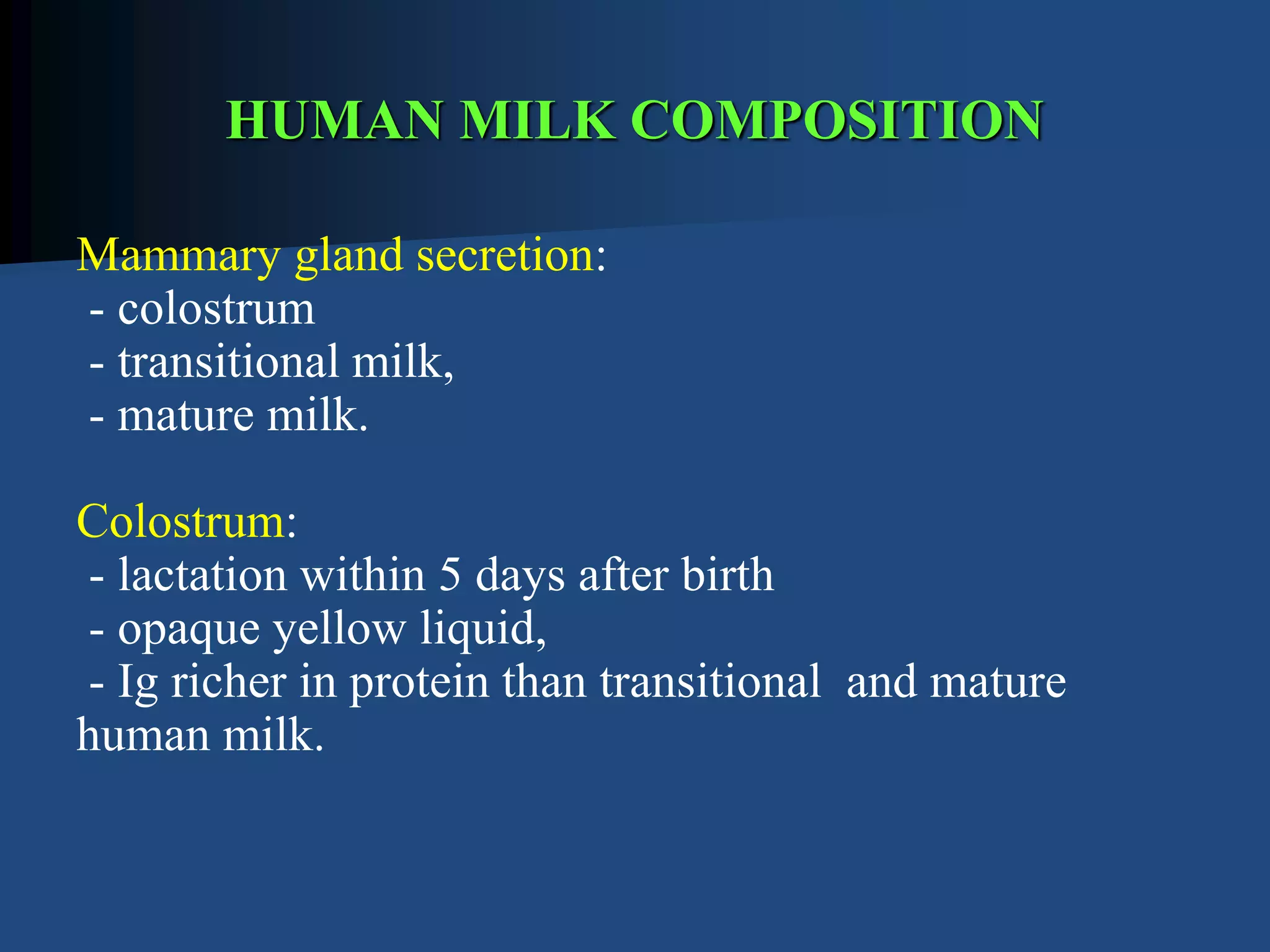
HUMAN MILK COMPOSITION
Mammary gland secretion:
- colostrum
- transitional milk,
- mature milk.
Colostrum:
- lactation within 5 days after birth
- opaque yellow liquid,
- Ig richer in protein than transitional and mature
human milk.
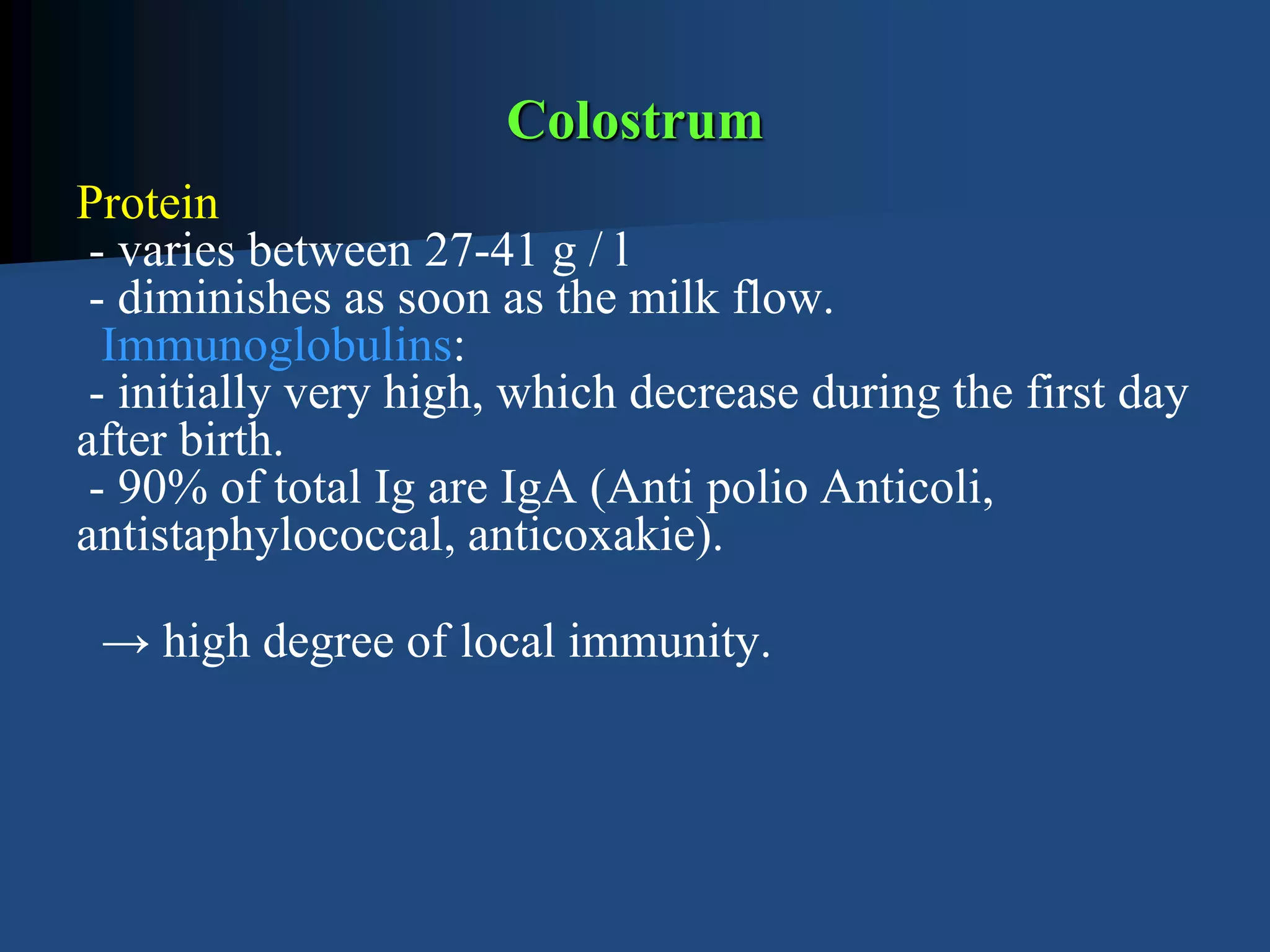
Colostrum
Protein
- varies between 27-41 g / l
- diminishes as soon as the milk flow.
Immunoglobulins:
- initially very high, which decrease during the first day
after birth.
- 90% of total Ig are IgA (Anti polio Anticoli,
antistaphylococcal, anticoxakie).
→ high degree of local immunity.
Colostrum
Colostrum is adapted to the needs of the newborn in the
first days of life, with increased quantities of:
- lactoferrin
- secretory IgA,
- protein bound vitamin B12
- zinc
- lipase, alpha-amylase, phosphatase, protease
inhibitors
- taurine
Colostrum
Carbohydrates:
- total of 55-60 g / l
- proportion of lactose is small (37 g / l)
- oligosaccharides (23g / l), promotes implantation of
the newborn intestine of the Bacillus bifidus.
Colostrum
Total lipids:
- initial 30g / l, in conjunction with low activity of
intestinal lipase.
- unsaturated fatty acids are essential especially those in
large quantities and have a role in nervous system
development.
Colostrum
Mineral salts:
- the amount of 3.9 g / l
- the Na, P, Ca, Fe, Zn, Cu more in line with that of
protein.
Vitamins A, E, C, B12 are well represented in colostrum
compared with mature milk.
Caloric value = 58 kcal/100ml.
Transitional milk
 on the 6th and 10th postpartum, although biochemical
and immunological changes continue until one month;
- decreases the protein, mineral salts, pH,
- increase the level of lipids and lactose.
Mature human milk (h.m.)
Water - 87%.
Total Protein - 10g / l:
4g / l casein
6g / l of whey protein (lactalbumin and lactoglobulin)
Human milk is a milk type albumin.
Mature human milk
Human casein:
- mammary gland synthesis of amino acids in the blood
three fractions (alpha, beta and kappa)
- kappa - casein has a role in colonization of the
intestinal bifidus Bacilus in breastfed infant.
Mature human milk
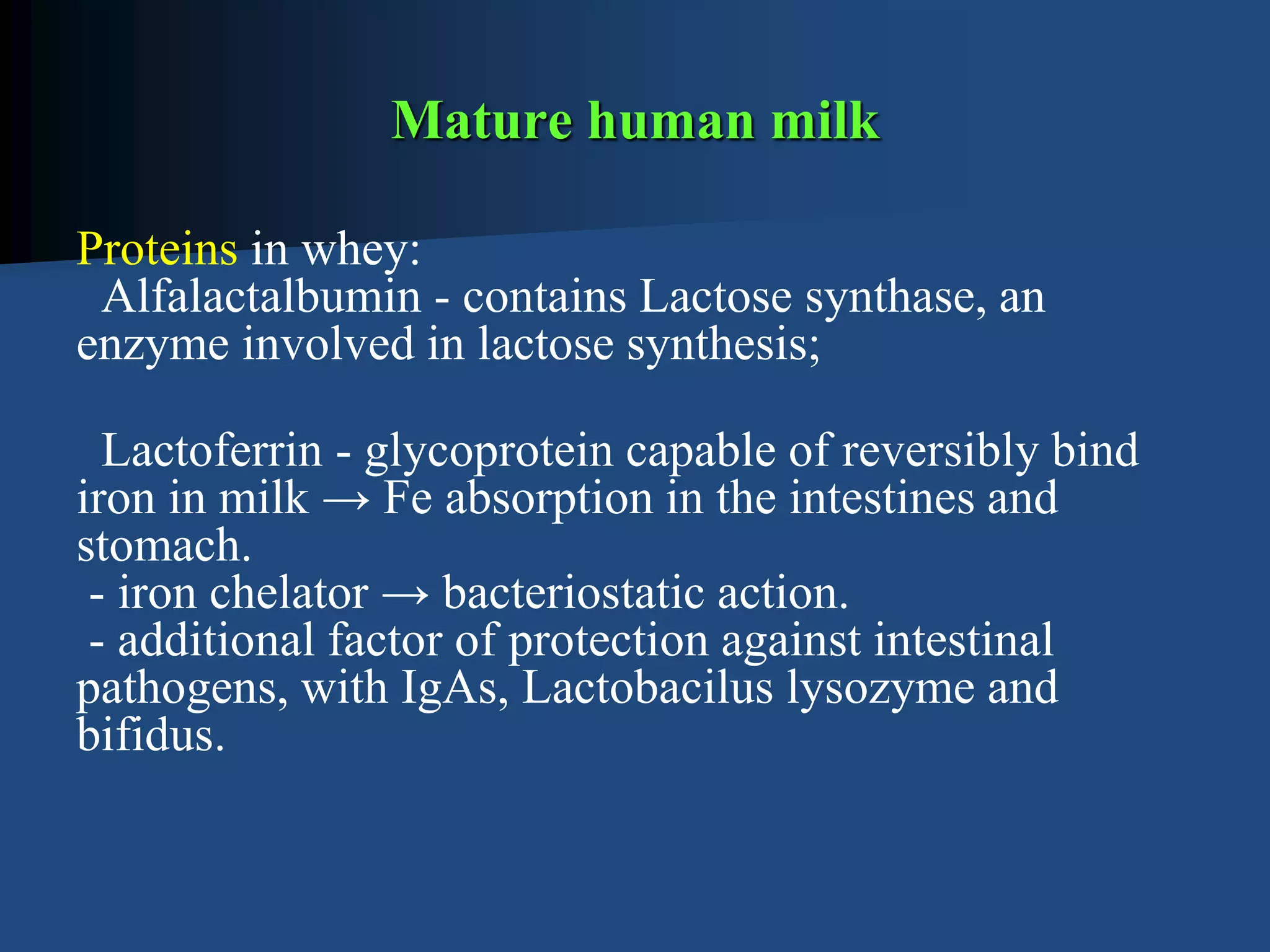
Proteins in whey:
Alfalactalbumin - contains Lactose synthase, an
enzyme involved in lactose synthesis;
Lactoferrin - glycoprotein capable of reversibly bind
iron in milk → Fe absorption in the intestines and
stomach.
- iron chelator → bacteriostatic action.
- additional factor of protection against intestinal
pathogens, with IgAs, Lactobacilus lysozyme and
bifidus.
Mature human milk
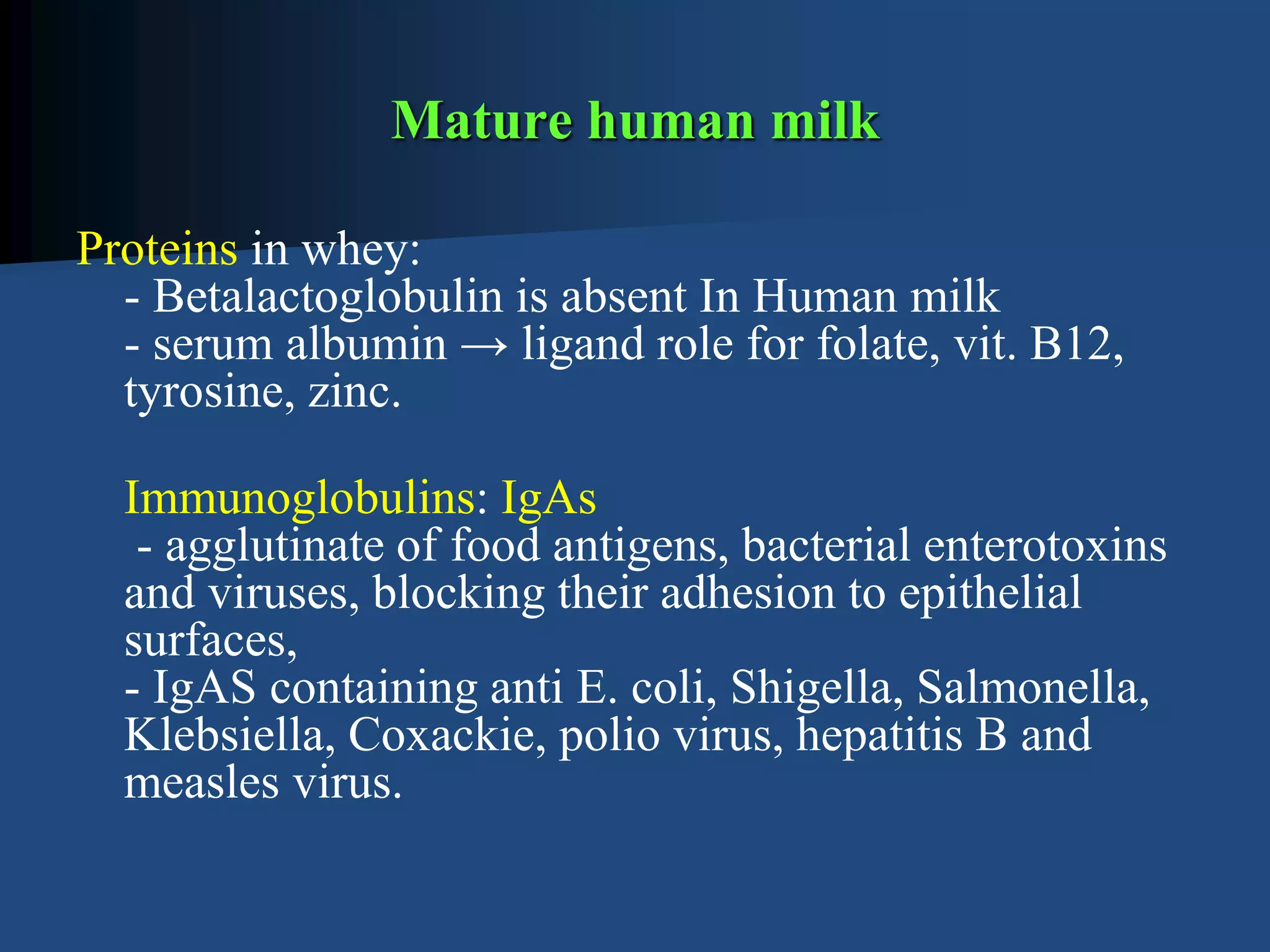
Proteins in whey:
- Betalactoglobulin is absent In Human milk
- serum albumin → ligand role for folate, vit. B12,
tyrosine, zinc.
Immunoglobulins: IgAs
- agglutinate of food antigens, bacterial enterotoxins
and viruses, blocking their adhesion to epithelial
surfaces,
- IgAS containing anti E. coli, Shigella, Salmonella,
Klebsiella, Coxackie, polio virus, hepatitis B and
measles virus.
Mature human milk
Ig G and Ig M:
- small quantities in milk,
- serum Ig does not differ structurally.
Enzymes in human milk - a role in:
- digestion of milk components
- antibiotic protection.
Lysozyme:
- contribute to lysis of intestinal bacteria,
- enhances antibody formation.
Mature human milk - Enzymes
Lipases have a role in digestion of human milk
triglycerides.
Alpha amylase:
- catalyzes the hydrolysis of starch into maltose
- pancreatic and intestinal amylase often deficit in the
infant.
Proteases and protease inhibitors:
- greater amount compared with cow's milk
- catalyzes the hydrolysis of proteins.
Mature human milk
Amino acids:
taurine - a role in absorption of lipids and brain
development.
Human milk proteins are absorbed and used by the
infant with optimal efficiency.
Mature human milk
Carbohydrates - 70 g / l:
- lactose (beta-lactose - 60 g / l) - a source of galactose
(cerebroside composition of the brain);
- oligosaccharides (10 g / l) - role in the defense of non-
specific antibiotic (promotes intestinal colonization with
Lactobacilus bifidus).
Mature human milk
Lactobacilus bifidus - roles:
- causes acidification of the intestinal environment →
inhibits the growth of pathogens
-Anti anemic and antirickets (promotes absorption of
Fe, Ca, vit. D and lipid)
- synthesis of vitamins B and K.
Mature human milk
Lipids: 36 - 40 g / l
fatty acids (FA), mono and polyunsaturated fats (oleic
acid, palmitic and linoleic)
-over half of the total FA h.m.
- role in CNS maturation in the newborn
period
triglycerides - report equally between unsaturated and
saturated FA.
Mature human milk
Cholesterol and lecithin:
large quantities h.m. than c.m.
The presence of lipase in human milk:
- facilitates lipid hydrolysis
- FA promote rapid release of usable energy
metabolism.
Mature human milk
Mineral salts and trace elements:
- content four times lower than c.m., less influenced by
maternal dietary intake, being provided by maternal
stores.
- thus, if sufficient phosphorus and calcium are the
mother's diet, they are obtained through its mobilization
from bone deposits.
Mature human milk
Sodium: → low amount - renal function overloading is
avoided.
Calcium four times and phosphorus 6-7 times less than
the c.m., but the Ca : P = 2 : 1 is favorable for their
proper absorption.
Iron:
- amount of two times higher in h.m.
- intestinal absorption and incorporation into the
hemoglobin molecule is much higher in infants
breastfed.
Mature human milk
Vitamins:
soluble (A, D, E, K)
soluble (C, folic acid, vitamin complex. B)
- varying proportions, in relation to food intake.
- a balanced diet of the mother provides adequate
intake of these vitamins, except vitamin D.
Mature human milk
The amount of vitamin D in human milk does not
provide even if your baby needs a proper sun exposure,
but is higher than that of cow's milk, which explains the
lower incidence of rickets in infants breastfed.
The energy value of h.m. mature = 65-68 kcal/100ml.
Factors of human milk
1. Antiinfectious protection factors:
- immunological
- biological
- provide protection against infectious agents from the
environment until the baby develops its own immunity.
breastfed infants versus artificially fed infants:
-low rate of hospitalization
-low incidence of respiratory infections, diarrhea, a
rash, etc.
Factors of human milk
Antiinfectious protection factors
Cellular factors (macrophages, neutrophils, Lyzozyme :
anti-infective role in maternal mammary gland and
infant's digestive tract (protects against enterocolitis
ulceronecrosis).
Immunoglobulins - IgAs:
- opsonizant role,
- mobilize and agglutinate bacteria, viruses and antigens
of food,
Ly stimulates the formation of intestinal mucosal IgA
in the infant.
Factors of human milk
Antiinfectious protection factors
Lactoferrin - bacteriostatic role.
Lysozyme - a role in combination with complement
and antimicrobial IgAs, which potentiates the action.
Lactoperoxidase - bactericidal action against germs
like Pseudomonas, E. coli, Salmonella, Streptococcus.
Factors of human milk
Antiinfectious protection factors
Mucin - prevent adhesion of germs and rotaviruses to
the surface of intestine.
C3 and C4 fractions of complement - role in
chemoattraction of phagocytes and intracellular
incorporation of particles.
Bifidogens factors (glycoproteins and
oligosaccharides) - role in promoting growth of
Lactobacilus bifidus in the intestine of breastfed infant.
Factors of human milk
2. Modulators of growth factors:
- stimulates growth of mammary gland
- acting on the baby's organs.
Epidermal growth factor (epidermal Growth
Factor - EGF) and insulin-like growth factor (Insulin-
like growth factor: IGF-1) - role in the maturation of the
gastrointestinal tract.
Factors of human milk
Modulators of growth factors
Nervous growth factor - essential for the
development of sympathetic neurons and sensory
cells.
B-cell stimulating factor - role in the proliferation of
B cells and production of immunoglobulins.
Taurine - improves fat absorption and promotes
intestinal colonization of Lactobacilus bifidus.
The composition of cow's milk (c.m)
Protein: 32-34 g / l
casein - 28 g
whey protein (lactalbumin and lactoglobulin): 4-6 g.
β-lactglobulin is highly antigenic / allergy.
Casein c.m precipitates in the stomach of infants in
large clots, difficult digestible → longer intervals of
time between lunches.
The composition of cow's milk
Carbohydrates: 48-50 g / l (vs. 68-70 g / l h.m)
represented only lactose → low intake of galactose →
slow myelination of CNS.
oligosaccharides missing → absence of bowel
colonization with bacillus bifidus in bottle fed infant
The composition of cow's milk
Lipids: 36 g / l
- saturated, indigestible, deficient in essential fatty
acids
- five times lower amount of linoleic acid
- cholesterol in amounts less than h.m
The composition of cow's milk
Mineral salts:
- amount of four times higher than in h.m.
with high protein content → metabolites and
osmolarity ↑ ↑ → ↑ baby's water needs.
- amounts of phosphate and citrate ↑ → ↑ pH gastric →
prevents absorption and promotes Calcium elimination
The composition of cow's milk
Mineral salts
The ratio Ca / P ~ 1:
- inappropriate for absorption
- rickety
- putrefaction (intestinal flora - E. coli)
↑ effort to remove the liver and kidney metabolites.
The composition of cow's milk
Iron:
Fe deficiency . This explains its poor absorption
frequency and iron deficiency anemia in infants fed
cow's milk.
Vitamins:
- smaller quantities than in human milk and by boiling
the milk a good part of them are destroyed.
Disadvantages administration of cow milk
- iron deficiency, the intake / absorption + low intestinal
absorption (occult bleeding) due allergenicity of cow's
milk;
- various nutritional deficiencies (rickets, etc.);
- dehydration through increased renal load;
- increased risk to allergy.
Patient’s Attenders the very next Day
Thank you

breast milk composition - Pugal.pptx

  • 1.
  • 2.
    HUMAN MILK COMPOSITION Mammarygland secretion: - colostrum - transitional milk, - mature milk. Colostrum: - lactation within 5 days after birth - opaque yellow liquid, - Ig richer in protein than transitional and mature human milk.
  • 3.
    Colostrum Protein - varies between27-41 g / l - diminishes as soon as the milk flow. Immunoglobulins: - initially very high, which decrease during the first day after birth. - 90% of total Ig are IgA (Anti polio Anticoli, antistaphylococcal, anticoxakie). → high degree of local immunity.
  • 4.
    Colostrum Colostrum is adaptedto the needs of the newborn in the first days of life, with increased quantities of: - lactoferrin - secretory IgA, - protein bound vitamin B12 - zinc - lipase, alpha-amylase, phosphatase, protease inhibitors - taurine
  • 5.
    Colostrum Carbohydrates: - total of55-60 g / l - proportion of lactose is small (37 g / l) - oligosaccharides (23g / l), promotes implantation of the newborn intestine of the Bacillus bifidus.
  • 6.
    Colostrum Total lipids: - initial30g / l, in conjunction with low activity of intestinal lipase. - unsaturated fatty acids are essential especially those in large quantities and have a role in nervous system development.
  • 7.
    Colostrum Mineral salts: - theamount of 3.9 g / l - the Na, P, Ca, Fe, Zn, Cu more in line with that of protein. Vitamins A, E, C, B12 are well represented in colostrum compared with mature milk. Caloric value = 58 kcal/100ml.
  • 8.
    Transitional milk  onthe 6th and 10th postpartum, although biochemical and immunological changes continue until one month; - decreases the protein, mineral salts, pH, - increase the level of lipids and lactose.
  • 9.
    Mature human milk(h.m.) Water - 87%. Total Protein - 10g / l: 4g / l casein 6g / l of whey protein (lactalbumin and lactoglobulin) Human milk is a milk type albumin.
  • 10.
    Mature human milk Humancasein: - mammary gland synthesis of amino acids in the blood three fractions (alpha, beta and kappa) - kappa - casein has a role in colonization of the intestinal bifidus Bacilus in breastfed infant.
  • 11.
    Mature human milk Proteinsin whey: Alfalactalbumin - contains Lactose synthase, an enzyme involved in lactose synthesis; Lactoferrin - glycoprotein capable of reversibly bind iron in milk → Fe absorption in the intestines and stomach. - iron chelator → bacteriostatic action. - additional factor of protection against intestinal pathogens, with IgAs, Lactobacilus lysozyme and bifidus.
  • 12.
    Mature human milk Proteinsin whey: - Betalactoglobulin is absent In Human milk - serum albumin → ligand role for folate, vit. B12, tyrosine, zinc. Immunoglobulins: IgAs - agglutinate of food antigens, bacterial enterotoxins and viruses, blocking their adhesion to epithelial surfaces, - IgAS containing anti E. coli, Shigella, Salmonella, Klebsiella, Coxackie, polio virus, hepatitis B and measles virus.
  • 13.
    Mature human milk IgG and Ig M: - small quantities in milk, - serum Ig does not differ structurally. Enzymes in human milk - a role in: - digestion of milk components - antibiotic protection. Lysozyme: - contribute to lysis of intestinal bacteria, - enhances antibody formation.
  • 14.
    Mature human milk- Enzymes Lipases have a role in digestion of human milk triglycerides. Alpha amylase: - catalyzes the hydrolysis of starch into maltose - pancreatic and intestinal amylase often deficit in the infant. Proteases and protease inhibitors: - greater amount compared with cow's milk - catalyzes the hydrolysis of proteins.
  • 15.
    Mature human milk Aminoacids: taurine - a role in absorption of lipids and brain development. Human milk proteins are absorbed and used by the infant with optimal efficiency.
  • 16.
    Mature human milk Carbohydrates- 70 g / l: - lactose (beta-lactose - 60 g / l) - a source of galactose (cerebroside composition of the brain); - oligosaccharides (10 g / l) - role in the defense of non- specific antibiotic (promotes intestinal colonization with Lactobacilus bifidus).
  • 17.
    Mature human milk Lactobacilusbifidus - roles: - causes acidification of the intestinal environment → inhibits the growth of pathogens -Anti anemic and antirickets (promotes absorption of Fe, Ca, vit. D and lipid) - synthesis of vitamins B and K.
  • 18.
    Mature human milk Lipids:36 - 40 g / l fatty acids (FA), mono and polyunsaturated fats (oleic acid, palmitic and linoleic) -over half of the total FA h.m. - role in CNS maturation in the newborn period triglycerides - report equally between unsaturated and saturated FA.
  • 19.
    Mature human milk Cholesteroland lecithin: large quantities h.m. than c.m. The presence of lipase in human milk: - facilitates lipid hydrolysis - FA promote rapid release of usable energy metabolism.
  • 20.
    Mature human milk Mineralsalts and trace elements: - content four times lower than c.m., less influenced by maternal dietary intake, being provided by maternal stores. - thus, if sufficient phosphorus and calcium are the mother's diet, they are obtained through its mobilization from bone deposits.
  • 21.
    Mature human milk Sodium:→ low amount - renal function overloading is avoided. Calcium four times and phosphorus 6-7 times less than the c.m., but the Ca : P = 2 : 1 is favorable for their proper absorption. Iron: - amount of two times higher in h.m. - intestinal absorption and incorporation into the hemoglobin molecule is much higher in infants breastfed.
  • 22.
    Mature human milk Vitamins: soluble(A, D, E, K) soluble (C, folic acid, vitamin complex. B) - varying proportions, in relation to food intake. - a balanced diet of the mother provides adequate intake of these vitamins, except vitamin D.
  • 23.
    Mature human milk Theamount of vitamin D in human milk does not provide even if your baby needs a proper sun exposure, but is higher than that of cow's milk, which explains the lower incidence of rickets in infants breastfed. The energy value of h.m. mature = 65-68 kcal/100ml.
  • 24.
    Factors of humanmilk 1. Antiinfectious protection factors: - immunological - biological - provide protection against infectious agents from the environment until the baby develops its own immunity. breastfed infants versus artificially fed infants: -low rate of hospitalization -low incidence of respiratory infections, diarrhea, a rash, etc.
  • 25.
    Factors of humanmilk Antiinfectious protection factors Cellular factors (macrophages, neutrophils, Lyzozyme : anti-infective role in maternal mammary gland and infant's digestive tract (protects against enterocolitis ulceronecrosis). Immunoglobulins - IgAs: - opsonizant role, - mobilize and agglutinate bacteria, viruses and antigens of food, Ly stimulates the formation of intestinal mucosal IgA in the infant.
  • 26.
    Factors of humanmilk Antiinfectious protection factors Lactoferrin - bacteriostatic role. Lysozyme - a role in combination with complement and antimicrobial IgAs, which potentiates the action. Lactoperoxidase - bactericidal action against germs like Pseudomonas, E. coli, Salmonella, Streptococcus.
  • 27.
    Factors of humanmilk Antiinfectious protection factors Mucin - prevent adhesion of germs and rotaviruses to the surface of intestine. C3 and C4 fractions of complement - role in chemoattraction of phagocytes and intracellular incorporation of particles. Bifidogens factors (glycoproteins and oligosaccharides) - role in promoting growth of Lactobacilus bifidus in the intestine of breastfed infant.
  • 28.
    Factors of humanmilk 2. Modulators of growth factors: - stimulates growth of mammary gland - acting on the baby's organs. Epidermal growth factor (epidermal Growth Factor - EGF) and insulin-like growth factor (Insulin- like growth factor: IGF-1) - role in the maturation of the gastrointestinal tract.
  • 29.
    Factors of humanmilk Modulators of growth factors Nervous growth factor - essential for the development of sympathetic neurons and sensory cells. B-cell stimulating factor - role in the proliferation of B cells and production of immunoglobulins. Taurine - improves fat absorption and promotes intestinal colonization of Lactobacilus bifidus.
  • 30.
    The composition ofcow's milk (c.m) Protein: 32-34 g / l casein - 28 g whey protein (lactalbumin and lactoglobulin): 4-6 g. β-lactglobulin is highly antigenic / allergy. Casein c.m precipitates in the stomach of infants in large clots, difficult digestible → longer intervals of time between lunches.
  • 31.
    The composition ofcow's milk Carbohydrates: 48-50 g / l (vs. 68-70 g / l h.m) represented only lactose → low intake of galactose → slow myelination of CNS. oligosaccharides missing → absence of bowel colonization with bacillus bifidus in bottle fed infant
  • 32.
    The composition ofcow's milk Lipids: 36 g / l - saturated, indigestible, deficient in essential fatty acids - five times lower amount of linoleic acid - cholesterol in amounts less than h.m
  • 33.
    The composition ofcow's milk Mineral salts: - amount of four times higher than in h.m. with high protein content → metabolites and osmolarity ↑ ↑ → ↑ baby's water needs. - amounts of phosphate and citrate ↑ → ↑ pH gastric → prevents absorption and promotes Calcium elimination
  • 34.
    The composition ofcow's milk Mineral salts The ratio Ca / P ~ 1: - inappropriate for absorption - rickety - putrefaction (intestinal flora - E. coli) ↑ effort to remove the liver and kidney metabolites.
  • 35.
    The composition ofcow's milk Iron: Fe deficiency . This explains its poor absorption frequency and iron deficiency anemia in infants fed cow's milk. Vitamins: - smaller quantities than in human milk and by boiling the milk a good part of them are destroyed.
  • 36.
    Disadvantages administration ofcow milk - iron deficiency, the intake / absorption + low intestinal absorption (occult bleeding) due allergenicity of cow's milk; - various nutritional deficiencies (rickets, etc.); - dehydration through increased renal load; - increased risk to allergy.
  • 39.
  • 41.