

Colostrum
Md . Sajib Al Reza
Lecturer
Nutrition and Dietetics
College of Nursing Science Dinajpur
Dinajpur 5201, Bangladesh
 sajib.ftns2010@gmail.com
Colostrum … …
The medical dictionary define ‘Colostrum’ as ‘the first milk secreted at
the time of parturition (The act or process of giving birth), differing
from the milk secreted later, by containing more lactalbumin and
lactoprotein, and also being rich in antibodies that confer passive
immunity to the newborn, also called “foremilk”.
• It lasts for 2- 4 days after the lactation is started. Colostrum is very
important component of the breast milk and it has role to play in
immune system of every mammal. Human colostrum (HC) is the
first milk produced after birth and is particularly rich in
immunoglobulin (Ig), antimicrobial peptides (lactoferrin and lacto
peroxidase) and other bioactive molecule, including growth factors
which are important for nutrition, growth and development of
newborn infants and also for passive immunity.
©Sajib
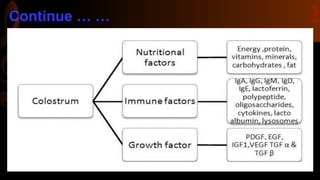
Continue … …
©Sajib
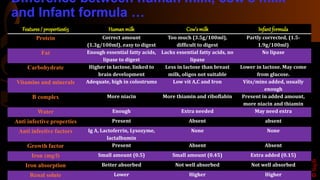
Difference between human milk, cow’s milk
and Infant formula …
Features/ properties63 Humanmilk Cow’smilk Infantformula
Protein Correct amount
(1.3g/100ml), easy to digest
Too much (3.5g/100ml),
difficult to digest
Partly corrected, (1.5-
1.9g/100ml)
Fat Enough essential fatty acids,
lipase to digest
Lacks essential fatty acids, no
lipase
No lipase
Carbohydrate Higher in lactose, linked to
brain development
Less in lactose than breast
milk, oligos not suitable
Lower in lactose. May come
from glucose.
Vitamins and minerals Adequate, high in colostrums Low vit A,C and Iron Vits/mins added, usually
enough
B complex More niacin More thiamin and riboflabin Present in added amount,
more niacin and thiamin
Water Enough Extra needed May need extra
Anti infective properties Present Absent absent
Anti infective factors Ig A, Lactoferrin, Lysozyme,
lactalbumin
None None
Growth factor Present Absent Absent
Iron (mg/l) Small amount (0.5) Small amount (0.45) Extra added (0.15)
Iron absorption Better absorbed Not well absorbed Not well absorbed
Renal solute Lower Higher Higher
©Sajib
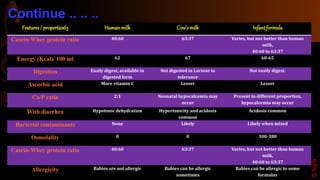
Continue .. .. ..
Features/ properties63 Humanmilk Cow’smilk Infantformula
Casein-Whey protein ratio 40:60 63:37 Varies, but not better than human
milk,
40:60 to 63:37
Energy (Kcal)/ 100 ml 62 67 60-65
Digestion Easily digest, available in
digested form
Not digested in Lactose in
tolerance
Not easily digest.
Ascorbic acid More vitamin C Lesser Lesser
Ca/P ratio 2:1 Neonatal hypocalcemia may
occur
Present in different proportion,
hypocalcemia may occur
With diarrhea Hypotonic dehydration Hypertonicity and acidosis
common
Acidosis common
Bacterial contaminants None Likely Likely when mixed
Osmolality 0 0 300-380
Casein-Whey protein ratio 40:60 63:37 Varies, but not better than human
milk,
40:60 to 63:37
Allergicity Babies are not allergic Babies can be allergic
sometimes
Babies can be allergic to some
formulas
©Sajib
Continue … ….
©Sajib
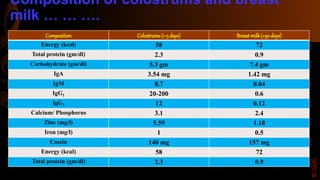
Composition of colostrums and breast
milk … … ….
Composition Colostrums(1-5days) Breastmilk(>30days)
Energy (kcal) 58 72
Total protein (gm/dl) 2.3 0.9
Carbohydrate (gm/dl) 5.3 gm 7.4 gm
IgA 3.54 mg 1.42 mg
IgM 8.7 0.04
IgG1 20-200 0.6
IgG2 12 0.12
Calcium/ Phosphorus 3.1 2.4
Zinc (mg/l) 5.59 1.18
Iron (mg/l) 1 0.5
Casein 140 mg 157 mg
Energy (kcal) 58 72
Total protein (gm/dl) 2.3 0.9
©Sajib
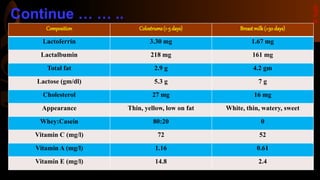
Continue … … ..
Composition Colostrums(1-5days) Breastmilk(>30days)
Lactoferrin 3.30 mg 1.67 mg
Lactalbumin 218 mg 161 mg
Total fat 2.9 g 4.2 gm
Lactose (gm/dl) 5.3 g 7 g
Cholesterol 27 mg 16 mg
Appearance Thin, yellow, low on fat White, thin, watery, sweet
Whey:Casein 80:20 0
Vitamin C (mg/l) 72 52
Vitamin A (mg/l) 1.16 0.61
Vitamin E (mg/l) 14.8 2.4
©Sajib
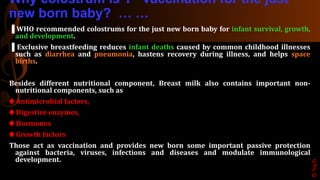
Why colostrum is 1 vaccination for the just
new born baby? … …
▐ WHO recommended colostrums for the just new born baby for infant survival, growth,
and development.
▐ Exclusive breastfeeding reduces infant deaths caused by common childhood illnesses
such as diarrhea and pneumonia, hastens recovery during illness, and helps space
births.
Besides different nutritional component, Breast milk also contains important non-
nutritional components, such as
♠ Antimicrobial factors,
♠ Digestive enzymes,
♠ Hormones
♠ Growth factors
Those act as vaccination and provides new born some important passive protection
against bacteria, viruses, infections and diseases and modulate immunological
development.
©Sajib
Continue … …
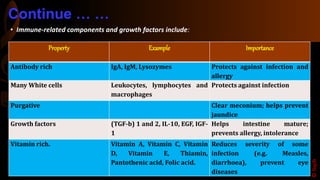
• Immune-related components and growth factors include:
Property Example Importance
Antibody rich IgA, IgM, Lysozymes Protects against infection and
allergy
Many White cells Leukocytes, lymphocytes and
macrophages
Protects against infection
Purgative Clear meconium; helps prevent
jaundice
Growth factors (TGF-b) 1 and 2, IL-10, EGF, IGF-
1
Helps intestine mature;
prevents allergy, intolerance
Vitamin rich. Vitamin A, Vitamin C, Vitamin
D, Vitamin E, Thiamin,
Pantothenic acid, Folic acid.
Reduces severity of some
infection (e.g. Measles,
diarrhoea), prevent eye
diseases
©Sajib
Milk component … …
• Caseinates—Compounds derived by the interaction of alkali with casein, the major milk
protein. The casein family contains phosphorus and will coagulate or precipitate at pH 4.6.
The serum (whey) proteins do not contain phosphorus, and these proteins remain in
solution in milk at pH 4.6. The principle of coagulation, or curd formation, at reduced pH
is the basis for cheese curd formation.
• Casein micelles—Large colloidal particles that are complexes of protein and salt ions,
principally calcium and phosphorus.
• Whey—The watery liquid remaining after the curd is formed in the manufacture of cheese
and fermented or acidified dairy products. Lactose—Milk sugar, composed of glucose and
galactose.
• Serum phase—The watery portion of a fluid; the portion of milk without fat globules and
casein micelles.
• Lactase—The enzyme that splits lactose (milk sugar) into glucose and galactose.
• Lactose—Milk sugar, composed of glucose and galactose.
©Sajib
Continue …. ….
• Carbohydrate: Lactose = glucose + galactose
• Fat: triacylglycerols, phospholipids, sterols, fatty acids
• Protein: Caseins + whey protein. 82% of milk protein is casein and the
remaining 18% is serum or whey protein. Milk proteins contain all 9
essential amino acids required by humans.
• Vitamins : vitamins A, D. Milk is a good source of thiamin, riboflavin and
vitamin B12 .
• Minerals: Milk is a good source of calcium, magnesium, phosphorus,
potassium, selenium, and zinc.
• Enzymes: Lipases + protease + Alkaline phosphatase. Major Lipases include
lipoprotein lipase. The major protease in milk is plasmin.
©Sajib
Thank you
©Sajib

Colostrum by sajib reza

  • 1.
    Colostrum Md . SajibAl Reza Lecturer Nutrition and Dietetics College of Nursing Science Dinajpur Dinajpur 5201, Bangladesh  sajib.ftns2010@gmail.com
  • 2.
    Colostrum … … Themedical dictionary define ‘Colostrum’ as ‘the first milk secreted at the time of parturition (The act or process of giving birth), differing from the milk secreted later, by containing more lactalbumin and lactoprotein, and also being rich in antibodies that confer passive immunity to the newborn, also called “foremilk”. • It lasts for 2- 4 days after the lactation is started. Colostrum is very important component of the breast milk and it has role to play in immune system of every mammal. Human colostrum (HC) is the first milk produced after birth and is particularly rich in immunoglobulin (Ig), antimicrobial peptides (lactoferrin and lacto peroxidase) and other bioactive molecule, including growth factors which are important for nutrition, growth and development of newborn infants and also for passive immunity. ©Sajib
  • 3.
  • 4.
    Difference between humanmilk, cow’s milk and Infant formula … Features/ properties63 Humanmilk Cow’smilk Infantformula Protein Correct amount (1.3g/100ml), easy to digest Too much (3.5g/100ml), difficult to digest Partly corrected, (1.5- 1.9g/100ml) Fat Enough essential fatty acids, lipase to digest Lacks essential fatty acids, no lipase No lipase Carbohydrate Higher in lactose, linked to brain development Less in lactose than breast milk, oligos not suitable Lower in lactose. May come from glucose. Vitamins and minerals Adequate, high in colostrums Low vit A,C and Iron Vits/mins added, usually enough B complex More niacin More thiamin and riboflabin Present in added amount, more niacin and thiamin Water Enough Extra needed May need extra Anti infective properties Present Absent absent Anti infective factors Ig A, Lactoferrin, Lysozyme, lactalbumin None None Growth factor Present Absent Absent Iron (mg/l) Small amount (0.5) Small amount (0.45) Extra added (0.15) Iron absorption Better absorbed Not well absorbed Not well absorbed Renal solute Lower Higher Higher ©Sajib
  • 5.
    Continue .. .... Features/ properties63 Humanmilk Cow’smilk Infantformula Casein-Whey protein ratio 40:60 63:37 Varies, but not better than human milk, 40:60 to 63:37 Energy (Kcal)/ 100 ml 62 67 60-65 Digestion Easily digest, available in digested form Not digested in Lactose in tolerance Not easily digest. Ascorbic acid More vitamin C Lesser Lesser Ca/P ratio 2:1 Neonatal hypocalcemia may occur Present in different proportion, hypocalcemia may occur With diarrhea Hypotonic dehydration Hypertonicity and acidosis common Acidosis common Bacterial contaminants None Likely Likely when mixed Osmolality 0 0 300-380 Casein-Whey protein ratio 40:60 63:37 Varies, but not better than human milk, 40:60 to 63:37 Allergicity Babies are not allergic Babies can be allergic sometimes Babies can be allergic to some formulas ©Sajib
  • 6.
  • 7.
    Composition of colostrumsand breast milk … … …. Composition Colostrums(1-5days) Breastmilk(>30days) Energy (kcal) 58 72 Total protein (gm/dl) 2.3 0.9 Carbohydrate (gm/dl) 5.3 gm 7.4 gm IgA 3.54 mg 1.42 mg IgM 8.7 0.04 IgG1 20-200 0.6 IgG2 12 0.12 Calcium/ Phosphorus 3.1 2.4 Zinc (mg/l) 5.59 1.18 Iron (mg/l) 1 0.5 Casein 140 mg 157 mg Energy (kcal) 58 72 Total protein (gm/dl) 2.3 0.9 ©Sajib
  • 8.
    Continue … ….. Composition Colostrums(1-5days) Breastmilk(>30days) Lactoferrin 3.30 mg 1.67 mg Lactalbumin 218 mg 161 mg Total fat 2.9 g 4.2 gm Lactose (gm/dl) 5.3 g 7 g Cholesterol 27 mg 16 mg Appearance Thin, yellow, low on fat White, thin, watery, sweet Whey:Casein 80:20 0 Vitamin C (mg/l) 72 52 Vitamin A (mg/l) 1.16 0.61 Vitamin E (mg/l) 14.8 2.4 ©Sajib
  • 9.
    Why colostrum is1 vaccination for the just new born baby? … … ▐ WHO recommended colostrums for the just new born baby for infant survival, growth, and development. ▐ Exclusive breastfeeding reduces infant deaths caused by common childhood illnesses such as diarrhea and pneumonia, hastens recovery during illness, and helps space births. Besides different nutritional component, Breast milk also contains important non- nutritional components, such as ♠ Antimicrobial factors, ♠ Digestive enzymes, ♠ Hormones ♠ Growth factors Those act as vaccination and provides new born some important passive protection against bacteria, viruses, infections and diseases and modulate immunological development. ©Sajib
  • 10.
    Continue … … •Immune-related components and growth factors include: Property Example Importance Antibody rich IgA, IgM, Lysozymes Protects against infection and allergy Many White cells Leukocytes, lymphocytes and macrophages Protects against infection Purgative Clear meconium; helps prevent jaundice Growth factors (TGF-b) 1 and 2, IL-10, EGF, IGF- 1 Helps intestine mature; prevents allergy, intolerance Vitamin rich. Vitamin A, Vitamin C, Vitamin D, Vitamin E, Thiamin, Pantothenic acid, Folic acid. Reduces severity of some infection (e.g. Measles, diarrhoea), prevent eye diseases ©Sajib
  • 11.
    Milk component …… • Caseinates—Compounds derived by the interaction of alkali with casein, the major milk protein. The casein family contains phosphorus and will coagulate or precipitate at pH 4.6. The serum (whey) proteins do not contain phosphorus, and these proteins remain in solution in milk at pH 4.6. The principle of coagulation, or curd formation, at reduced pH is the basis for cheese curd formation. • Casein micelles—Large colloidal particles that are complexes of protein and salt ions, principally calcium and phosphorus. • Whey—The watery liquid remaining after the curd is formed in the manufacture of cheese and fermented or acidified dairy products. Lactose—Milk sugar, composed of glucose and galactose. • Serum phase—The watery portion of a fluid; the portion of milk without fat globules and casein micelles. • Lactase—The enzyme that splits lactose (milk sugar) into glucose and galactose. • Lactose—Milk sugar, composed of glucose and galactose. ©Sajib
  • 12.
    Continue …. …. •Carbohydrate: Lactose = glucose + galactose • Fat: triacylglycerols, phospholipids, sterols, fatty acids • Protein: Caseins + whey protein. 82% of milk protein is casein and the remaining 18% is serum or whey protein. Milk proteins contain all 9 essential amino acids required by humans. • Vitamins : vitamins A, D. Milk is a good source of thiamin, riboflavin and vitamin B12 . • Minerals: Milk is a good source of calcium, magnesium, phosphorus, potassium, selenium, and zinc. • Enzymes: Lipases + protease + Alkaline phosphatase. Major Lipases include lipoprotein lipase. The major protease in milk is plasmin. ©Sajib
  • 13.