MILK
Mansoura University
Faculty Of Pharmacy
Biochemistry department
Under supervision of :
Prof.Dr/ Amal M. El-Gayar .
No Biochemistry research of 3rd grade students :
1 Alaa ElSayed ElBadrawy.
2 Alaa Ahmed Abd El-Maksoud.
3 Alaa Hassan Islam Ibrahim.
4 Alaa Gamal Mousa Omran.
5 Athar MahmoudYoussef.
-Milk is a white liquid produced by the mammary glands
of mammals .
-It is the primary source of nutrition for young mammals before
they are able to digest other types of food.
-Early-lactation milk contains colostrum, which carries the
mother's antibodies to its young and can reduce the risk of many
diseases.
-Milk contains many other nutrients and components.
Types of Milk
▪
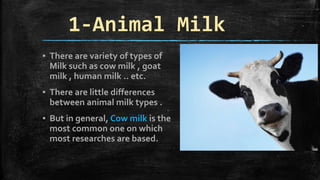
1-Animal Milk
▪ There are variety of types of
Milk such as cow milk , goat
milk , human milk .. etc.
▪ There are little differences
between animal milk types .
▪ But in general, Cow milk is the
most common one on which
most researches are based.
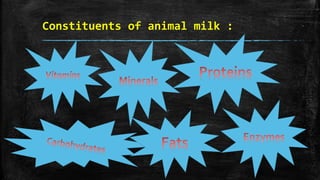
Constituents of animal milk :
A-Vitamins
▪ Animak milk contains the water soluble vitamins:Thiamin (vit B1),
riboflavin (vit B2), niacin (vit B3), pantothenic acid (vit B5),
pyridoxine(Vit B6), cobalamine(Vit B12), vitamin C, and folate .
▪ Animal milk contains the fat soluble vitamins : A, D, E, and K.
▪ The content level of fat soluble vitamins in dairy products
depends on the fat content of the product.
▪ Reduced fat (2% fat) , low fat (1% fat) , and skim milk must be
fortified with vitamin A to be nutritionally equivalent to whole
milk.
B-Minerals
▪ Milk is a good source of :
Calcium
Magnesiumphosphorus
Potassium
 Selenium
 zinc
▪ Many minerals in milk are associated together in
the form of salts.
C-Protein
▪ The total protein component of milk is composed of numerous
specific proteins.
▪ The primary group of milk proteins are the caseins.There are 3 or
4 caseins in the milk of most species; the different caseins are
distinct molecules but are similar in structure.
All other proteins found in milk are grouped together under the
name of whey proteins.
The major whey proteins in cow milk are beta lactoglobulin and
alpha-lactalbumin.
D-Fats
▪ Milk fat has the most complex fatty acid composition of the edible fats.
▪ Over 400 individual fatty acids have been identified in milk fat.
However, approximately 15 to 20 fatty acids make up 90% of the milk
fat.
▪ The major fatty acids in milk fat are straight chain fatty acids that are
saturated and have 4 to 18 carbons , monounsaturated fatty acids (16:1,
18:1), and polyunsaturated fatty acids (18:2, 18:3).
▪ Some of the fatty acids are found in very small amounts but contribute
to the unique and desirable flavor of milk fat and butter.
▪ For example, the C14:0 and C16:0 ß-hydroxy fatty acids spontaneously
form lactones upon heating which enhance the flavor of butter.
E-Carbohydrates
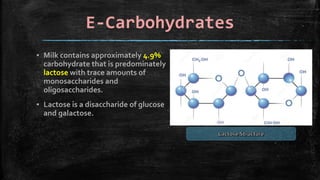
▪ Milk contains approximately 4.9%
carbohydrate that is predominately
lactose with trace amounts of
monosaccharides and
oligosaccharides.
▪ Lactose is a disaccharide of glucose
and galactose.
Lactose, To be continued:
▪ Infant mammals nurse on their mothers to drink milk, which is
rich in lactose.
▪ The intestinal villi secrete the enzyme called lactase (β-D-
galactosidase) to digest it.
▪ This enzyme cleaves the lactose molecule into its two subunits,
the simple sugars glucose and galactose, which can be absorbed.
▪ Since lactose occurs mostly in milk, in most mammals, the
production of lactase gradually decreases with maturity due to a
lack of continuing consumption.
F-Enzymes
2-Human Milk
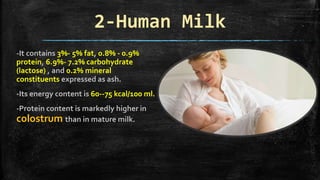
-It contains 3%- 5% fat, 0.8% - 0.9%
protein, 6.9%- 7.2% carbohydrate
(lactose) , and 0.2% mineral
constituents expressed as ash.
-Its energy content is 60--75 kcal/100 ml.
-Protein content is markedly higher in
colostrum than in mature milk.
-It is the first milk produced by the breasts during pregnancy
and continuing through the early days of breastfeeding.
-This special milk is yellow to orange in color and thick and
sticky.
-It is low in fat, and high in carbohydrates, protein, and
antibodies to help keep your baby healthy.
-Colostrum is extremely easy to digest, and is therefore the
perfect first food for your baby.
Factors affecting human milk composition:
Race, age, parity, or diet do not
greatly affect milk composition and
there is no consistent compositional
difference between milks from the
two breasts unless one is infected.
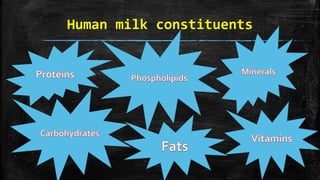
Human milk constituents
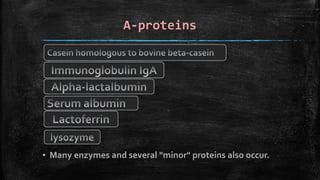
A-proteins
▪ Many enzymes and several "minor" proteins also occur.
B-Carbohydrate (sugar)
▪ Lactose but 30 or more oligosaccharides, all containing
terminal Gal-(beta 1,4)-Glucose and ranging from 3--14
saccharide units per molecule are also present.
▪ -These may amount in the aggregate to as much as 1 g/100 ml
in mature milk and 2.5 g/100 ml in colostrum.
▪ -Some of them may function to control intestinal flora because
of their ability to promote growth of certain strains of
lactobacilli.
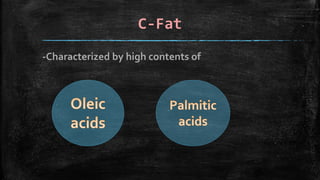
C-Fat
-Characterized by high contents of
D-Phospholipids
-amounting in the aggregate to about 75 mg/100 ml,
include:
▪ Phosphatidyl ethanolamine
▪ Phosphatidyl choline
▪ Phosphatidyl serine
▪ Phosphatidyl inositol
▪ Sphingomyelin
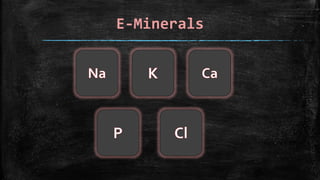
E-Minerals
F-Vitamins
▪ All of the vitamins, except K, are found
in human milk in nutritionally
significant concentrations.
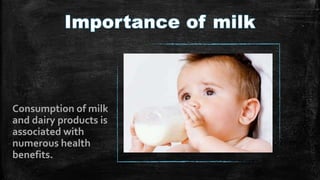
Consumption of milk
and dairy products is
associated with
numerous health
benefits.
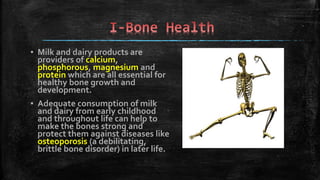
▪ Milk and dairy products are
providers of calcium,
phosphorous, magnesium and
protein which are all essential for
healthy bone growth and
development.
▪ Adequate consumption of milk
and dairy from early childhood
and throughout life can help to
make the bones strong and
protect them against diseases like
osteoporosis (a debilitating,
brittle bone disorder) in later life.
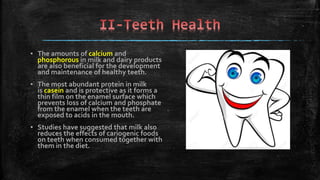
▪ The amounts of calcium and
phosphorous in milk and dairy products
are also beneficial for the development
and maintenance of healthy teeth.
▪ The most abundant protein in milk
is casein and is protective as it forms a
thin film on the enamel surface which
prevents loss of calcium and phosphate
from the enamel when the teeth are
exposed to acids in the mouth.
▪ Studies have suggested that milk also
reduces the effects of cariogenic foods
on teeth when consumed together with
them in the diet.
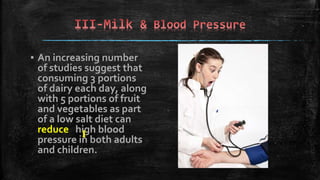
▪ An increasing number
of studies suggest that
consuming 3 portions
of dairy each day, along
with 5 portions of fruit
and vegetables as part
of a low salt diet can
reduce high blood
pressure in both adults
and children.
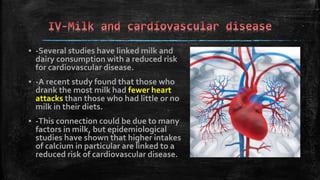
▪ -Several studies have linked milk and
dairy consumption with a reduced risk
for cardiovascular disease.
▪ -A recent study found that those who
drank the most milk had fewer heart
attacks than those who had little or no
milk in their diets.
▪ -This connection could be due to many
factors in milk, but epidemiological
studies have shown that higher intakes
of calcium in particular are linked to a
reduced risk of cardiovascular disease.
▪ Contrary to popular belief, research has
shown that people who consume milk and
dairy foods are likely to be slimmer than
those who do not.
▪ The consumption of milk and dairy foods as
part of a calorie controlled diet is associated
with increased weight loss, particularly form
the abdomen.
▪ This is particularly beneficial since excess fat
around the trunk region of the body is
associated with greater risks to health.
Milk

Milk

  • 1.
    MILK Mansoura University Faculty OfPharmacy Biochemistry department
  • 2.
    Under supervision of: Prof.Dr/ Amal M. El-Gayar . No Biochemistry research of 3rd grade students : 1 Alaa ElSayed ElBadrawy. 2 Alaa Ahmed Abd El-Maksoud. 3 Alaa Hassan Islam Ibrahim. 4 Alaa Gamal Mousa Omran. 5 Athar MahmoudYoussef.
  • 3.
    -Milk is awhite liquid produced by the mammary glands of mammals . -It is the primary source of nutrition for young mammals before they are able to digest other types of food. -Early-lactation milk contains colostrum, which carries the mother's antibodies to its young and can reduce the risk of many diseases. -Milk contains many other nutrients and components.
  • 4.
  • 5.
    1-Animal Milk ▪ Thereare variety of types of Milk such as cow milk , goat milk , human milk .. etc. ▪ There are little differences between animal milk types . ▪ But in general, Cow milk is the most common one on which most researches are based.
  • 6.
  • 7.
    A-Vitamins ▪ Animak milkcontains the water soluble vitamins:Thiamin (vit B1), riboflavin (vit B2), niacin (vit B3), pantothenic acid (vit B5), pyridoxine(Vit B6), cobalamine(Vit B12), vitamin C, and folate . ▪ Animal milk contains the fat soluble vitamins : A, D, E, and K. ▪ The content level of fat soluble vitamins in dairy products depends on the fat content of the product. ▪ Reduced fat (2% fat) , low fat (1% fat) , and skim milk must be fortified with vitamin A to be nutritionally equivalent to whole milk.
  • 8.
    B-Minerals ▪ Milk isa good source of : Calcium Magnesiumphosphorus Potassium  Selenium  zinc ▪ Many minerals in milk are associated together in the form of salts.
  • 9.
    C-Protein ▪ The totalprotein component of milk is composed of numerous specific proteins. ▪ The primary group of milk proteins are the caseins.There are 3 or 4 caseins in the milk of most species; the different caseins are distinct molecules but are similar in structure. All other proteins found in milk are grouped together under the name of whey proteins. The major whey proteins in cow milk are beta lactoglobulin and alpha-lactalbumin.
  • 10.
    D-Fats ▪ Milk fathas the most complex fatty acid composition of the edible fats. ▪ Over 400 individual fatty acids have been identified in milk fat. However, approximately 15 to 20 fatty acids make up 90% of the milk fat. ▪ The major fatty acids in milk fat are straight chain fatty acids that are saturated and have 4 to 18 carbons , monounsaturated fatty acids (16:1, 18:1), and polyunsaturated fatty acids (18:2, 18:3). ▪ Some of the fatty acids are found in very small amounts but contribute to the unique and desirable flavor of milk fat and butter. ▪ For example, the C14:0 and C16:0 ß-hydroxy fatty acids spontaneously form lactones upon heating which enhance the flavor of butter.
  • 11.
    E-Carbohydrates ▪ Milk containsapproximately 4.9% carbohydrate that is predominately lactose with trace amounts of monosaccharides and oligosaccharides. ▪ Lactose is a disaccharide of glucose and galactose.
  • 12.
    Lactose, To becontinued: ▪ Infant mammals nurse on their mothers to drink milk, which is rich in lactose. ▪ The intestinal villi secrete the enzyme called lactase (β-D- galactosidase) to digest it. ▪ This enzyme cleaves the lactose molecule into its two subunits, the simple sugars glucose and galactose, which can be absorbed. ▪ Since lactose occurs mostly in milk, in most mammals, the production of lactase gradually decreases with maturity due to a lack of continuing consumption.
  • 13.
  • 16.
    2-Human Milk -It contains3%- 5% fat, 0.8% - 0.9% protein, 6.9%- 7.2% carbohydrate (lactose) , and 0.2% mineral constituents expressed as ash. -Its energy content is 60--75 kcal/100 ml. -Protein content is markedly higher in colostrum than in mature milk.
  • 17.
    -It is thefirst milk produced by the breasts during pregnancy and continuing through the early days of breastfeeding. -This special milk is yellow to orange in color and thick and sticky. -It is low in fat, and high in carbohydrates, protein, and antibodies to help keep your baby healthy. -Colostrum is extremely easy to digest, and is therefore the perfect first food for your baby.
  • 18.
    Factors affecting humanmilk composition: Race, age, parity, or diet do not greatly affect milk composition and there is no consistent compositional difference between milks from the two breasts unless one is infected.
  • 19.
  • 20.
    A-proteins ▪ Many enzymesand several "minor" proteins also occur.
  • 21.
    B-Carbohydrate (sugar) ▪ Lactosebut 30 or more oligosaccharides, all containing terminal Gal-(beta 1,4)-Glucose and ranging from 3--14 saccharide units per molecule are also present. ▪ -These may amount in the aggregate to as much as 1 g/100 ml in mature milk and 2.5 g/100 ml in colostrum. ▪ -Some of them may function to control intestinal flora because of their ability to promote growth of certain strains of lactobacilli.
  • 22.
  • 23.
    D-Phospholipids -amounting in theaggregate to about 75 mg/100 ml, include: ▪ Phosphatidyl ethanolamine ▪ Phosphatidyl choline ▪ Phosphatidyl serine ▪ Phosphatidyl inositol ▪ Sphingomyelin
  • 24.
  • 25.
    F-Vitamins ▪ All ofthe vitamins, except K, are found in human milk in nutritionally significant concentrations.
  • 26.
    Consumption of milk anddairy products is associated with numerous health benefits.
  • 28.
    ▪ Milk anddairy products are providers of calcium, phosphorous, magnesium and protein which are all essential for healthy bone growth and development. ▪ Adequate consumption of milk and dairy from early childhood and throughout life can help to make the bones strong and protect them against diseases like osteoporosis (a debilitating, brittle bone disorder) in later life.
  • 29.
    ▪ The amountsof calcium and phosphorous in milk and dairy products are also beneficial for the development and maintenance of healthy teeth. ▪ The most abundant protein in milk is casein and is protective as it forms a thin film on the enamel surface which prevents loss of calcium and phosphate from the enamel when the teeth are exposed to acids in the mouth. ▪ Studies have suggested that milk also reduces the effects of cariogenic foods on teeth when consumed together with them in the diet.
  • 30.
    ▪ An increasingnumber of studies suggest that consuming 3 portions of dairy each day, along with 5 portions of fruit and vegetables as part of a low salt diet can reduce high blood pressure in both adults and children.
  • 31.
    ▪ -Several studieshave linked milk and dairy consumption with a reduced risk for cardiovascular disease. ▪ -A recent study found that those who drank the most milk had fewer heart attacks than those who had little or no milk in their diets. ▪ -This connection could be due to many factors in milk, but epidemiological studies have shown that higher intakes of calcium in particular are linked to a reduced risk of cardiovascular disease.
  • 32.
    ▪ Contrary topopular belief, research has shown that people who consume milk and dairy foods are likely to be slimmer than those who do not. ▪ The consumption of milk and dairy foods as part of a calorie controlled diet is associated with increased weight loss, particularly form the abdomen. ▪ This is particularly beneficial since excess fat around the trunk region of the body is associated with greater risks to health.