By
Kusuma Neela Bolla
Dept. Applied Nutrition
Introduction:
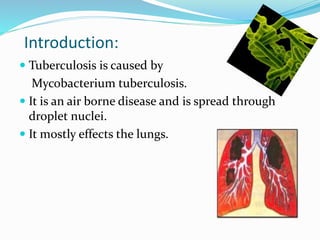
 Tuberculosis is caused by
Mycobacterium tuberculosis.
 It is an air borne disease and is spread through
droplet nuclei.
 It mostly effects the lungs.
Mycobacterium
tuberculosis
•Aerobic
•Non-motile
•Gram positive
bacillus
History:
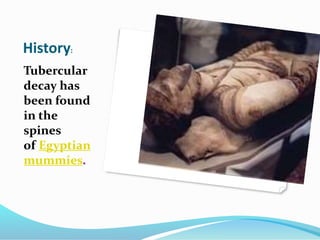
Tubercular
decay has
been found
in the
spines
of Egyptian
mummies.
Dr. Robert
Koch
discovered
the
tuberculosis
bacillus
Staining:
 High lipid and mycolic acid content makes staining
difficult.
 Special staining techniques:
Acid fast staining
Auramine-Rodamine staining
Fluorescent microscopy
Stained bacilli:
Culturing:
Lowenstein-
Jensen
culture
medium
Symptoms
•Chest pain
•Coughing blood
•Chills
•Appetite loss
•Weight loss
CAUSES
Risk factors for TB
 HIV infection
 Low socioeconomic
status
 Alcoholism
 Homelessness
 Diseases that weaken the
immune system
 Migration from a country
with a high number of cases
 Crowded living conditions
Screening:
 Tuberculin test or Mantoux test.
It produces false negative tests.
 Interferon-γ release assays.
 Chest Photofluorography.
The latter two techniques are expensive but results are
more reliable.
Drug resistant Tb:
 Multi drug resistant Tb and Extensively drug resistant
Tb are major health issues.
 These have resistance to the primary line of drugs
given to the patient
 This has made the cure of Tb difficult.
Treatment:
 Antibiotics like isoniazid and rifampicin are
commonly used.
 DOTS
Role of Diet:
 Malnutrition aggravates the severity of infection
 Chemotherapy effects nutritional status
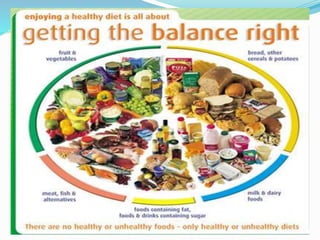
 Balanced diet is required to build immunity and to
fight against the disease.
 Should increase intake of nutrients like proteins,
minerals and vitamins.
 Along with drugs Balanced diet is required to fight the
disease.
Dietary management:
 An all-fruit diet for three days. Take three meals a day
of fresh juicy fruits at five-hourly intervals.
 A fruit and milk diet for further 10 days, adding a cup
of milk to each fruit meal.
 After this a balanced vegetarian diet should be given
 PRINCIPLE OF THE DIET is HIGH
CARBOHYDRATE, HIGH PROTEIN, LOW FAT, HIGH
CALCIUM which is non-oily and non-spicy.
 AVOID Tea, coffee, sugar, white flour and products
made from them, refined foods, fried foods, flesh
foods, alcohol and smoking.
Dietary recommendations:
Dietary Fat
 Eat less than ten percent of calories from saturated fats
and less than 300 mg/day of cholesterol, and eat as few
trans-fats (hydrogenated fat) as possible.
 Maintain total intake of fats/oils at between 20-35
percent of calories, with most fat coming from
polyunsaturated and monounsaturated fat, such as
oily fish, nuts, and vegetable oils.
 Regarding meat, poultry, dry beans, and milk or milk
products, choose lean, low-fat, or fat-free options.
Carbohydrates:
 Eat fibre-rich fruits, vegetables, and whole grains as
often as possible.
 Consume foods and drinks with little added sugars or
caloric sweeteners.
Protein:
 Eat lean meats and poultry.
 Eat a variety of protein rich foods, with more fish,
beans, peas, nuts and seeds.
 Bake, broil, or grill food.
Vitamins:
 Vitamin A, C, D should be
consumed more.
Minerals:
Calcium:
 It is required for calcification of lesions.
Iron:
 Deficiency leads to anemia which aggravates the
condition.
Sodium and Potassium:
 Eat less than 2,300 mg (approximately 1 teaspoon of
salt) of sodium per day.
 Choose low-sodium foods, and do not add salt when
cooking. Also, eat potassium-rich foods, such as fruits
and vegetables.
Prevention of Tuberculosis:
 BCG vaccine is major part of Tb control programme.
 Its efficacy is only 80%
 RNTCP- Revised National Tb Control Programme
 Recombinant tuberculosis vaccine is under trials
Prevention is better than cure
ThankYou
One and All

Tb

  • 1.
    By Kusuma Neela Bolla Dept.Applied Nutrition
  • 2.
    Introduction:  Tuberculosis iscaused by Mycobacterium tuberculosis.  It is an air borne disease and is spread through droplet nuclei.  It mostly effects the lungs.
  • 3.
  • 4.
    History: Tubercular decay has been found inthe spines of Egyptian mummies.
  • 5.
  • 6.
    Staining:  High lipidand mycolic acid content makes staining difficult.  Special staining techniques: Acid fast staining Auramine-Rodamine staining Fluorescent microscopy
  • 7.
  • 8.
  • 10.
  • 11.
  • 12.
    Risk factors forTB  HIV infection  Low socioeconomic status  Alcoholism  Homelessness  Diseases that weaken the immune system  Migration from a country with a high number of cases  Crowded living conditions
  • 13.
    Screening:  Tuberculin testor Mantoux test. It produces false negative tests.  Interferon-γ release assays.  Chest Photofluorography. The latter two techniques are expensive but results are more reliable.
  • 14.
    Drug resistant Tb: Multi drug resistant Tb and Extensively drug resistant Tb are major health issues.  These have resistance to the primary line of drugs given to the patient  This has made the cure of Tb difficult.
  • 15.
    Treatment:  Antibiotics likeisoniazid and rifampicin are commonly used.  DOTS
  • 16.
    Role of Diet: Malnutrition aggravates the severity of infection  Chemotherapy effects nutritional status  Balanced diet is required to build immunity and to fight against the disease.  Should increase intake of nutrients like proteins, minerals and vitamins.  Along with drugs Balanced diet is required to fight the disease.
  • 17.
    Dietary management:  Anall-fruit diet for three days. Take three meals a day of fresh juicy fruits at five-hourly intervals.  A fruit and milk diet for further 10 days, adding a cup of milk to each fruit meal.  After this a balanced vegetarian diet should be given  PRINCIPLE OF THE DIET is HIGH CARBOHYDRATE, HIGH PROTEIN, LOW FAT, HIGH CALCIUM which is non-oily and non-spicy.  AVOID Tea, coffee, sugar, white flour and products made from them, refined foods, fried foods, flesh foods, alcohol and smoking.
  • 19.
    Dietary recommendations: Dietary Fat Eat less than ten percent of calories from saturated fats and less than 300 mg/day of cholesterol, and eat as few trans-fats (hydrogenated fat) as possible.  Maintain total intake of fats/oils at between 20-35 percent of calories, with most fat coming from polyunsaturated and monounsaturated fat, such as oily fish, nuts, and vegetable oils.  Regarding meat, poultry, dry beans, and milk or milk products, choose lean, low-fat, or fat-free options.
  • 20.
    Carbohydrates:  Eat fibre-richfruits, vegetables, and whole grains as often as possible.  Consume foods and drinks with little added sugars or caloric sweeteners. Protein:  Eat lean meats and poultry.  Eat a variety of protein rich foods, with more fish, beans, peas, nuts and seeds.  Bake, broil, or grill food.
  • 21.
    Vitamins:  Vitamin A,C, D should be consumed more. Minerals: Calcium:  It is required for calcification of lesions. Iron:  Deficiency leads to anemia which aggravates the condition.
  • 22.
    Sodium and Potassium: Eat less than 2,300 mg (approximately 1 teaspoon of salt) of sodium per day.  Choose low-sodium foods, and do not add salt when cooking. Also, eat potassium-rich foods, such as fruits and vegetables.
  • 23.
    Prevention of Tuberculosis: BCG vaccine is major part of Tb control programme.  Its efficacy is only 80%  RNTCP- Revised National Tb Control Programme  Recombinant tuberculosis vaccine is under trials
  • 24.
  • 25.