


Nutrition
WE ARE WHAT WE EAT
Sara Almheiri
Table of contents
• Calories
• Breast feeding
• formula feeding
• Introduction of solids
• Vitamins
• Minrals
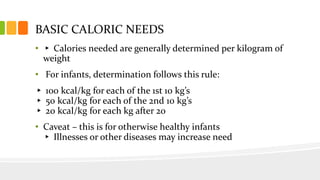
BASIC CALORIC NEEDS
• ▸ Calories needed are generally determined per kilogram of
weight
• For infants, determination follows this rule:
▸ 100 kcal/kg for each of the 1st 10 kg’s
▸ 50 kcal/kg for each of the 2nd 10 kg’s
▸ 20 kcal/kg for each kg after 20
• Caveat – this is for otherwise healthy infants
▸ Illnesses or other diseases may increase need
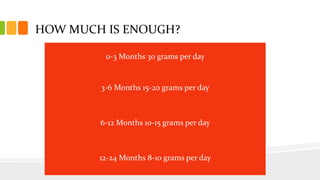
HOW MUCH IS ENOUGH?
0-3 Months 30 grams per day
3-6 Months 15-20 grams per day
6-12 Months 10-15 grams per day
12-24 Months 8-10 grams per day
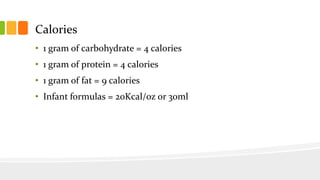
Calories
• 1 gram of carbohydrate = 4 calories
• 1 gram of protein = 4 calories
• 1 gram of fat = 9 calories
• Infant formulas = 20Kcal/oz or 30ml
Calories
• Full term and preterm infants:
• Require 100-140 kcl/kg/day to grow
• Malnourished child
• 20-30% more energy for growth catch up
• Protein intake
• 3.5g/kg/day (preterm)
• 2-2.5g/kg/day (full term)
Breast milk
• Carbohydrate
– Lactose
• Protein
– Alpha-lactalbumin
• Fat
– Arachidonic acid
– Docosahexaenonic acid
Breast milk
• Breast is best
▸ Breast milk changes
• ▸ With time from birth
▸ Length of feeding
▸ Time of day
▸ From mother to mother
• ▸ Caloric density also changes
▸ Rough estimate is that BM is around 20 kcal/ounce
COLOSTRUM
• Produced first few days after birth
• Not a significant nutritional source
• Low in lactose, low in overall calories compared to later milk
• Low in calcium and potassium
• Higher in sodium, chloride, magnesium
• ▸ High in immunologic factors
• ▸ Secretory IgA
▸ Lactoferrin
▸ Leukocytes
▸ Various growth factors
TRANSITIONAL MILK
• Transitional from colostrum to mature milk
• Typically occurs from roughly day 4-5 to around 2 weeks
• Sodium content declines some
• potassium increases
• Lactose increases
MATURE MILK
• Begins around 2 weeks and is “fully” mature by around 4 weeks
• Milk content now stabilizes and doesn’t change much more for
the rest of breastfeeding
• Protein content ~1 gram/dL
• Breastmilk of moms of premies starts out higher in protein, ~2
grams/dL
• Protein levels in milk decrease over the first 1-1.5 months
(regardless of gestational age)
• Fat ~3.5 grams/dL
• Lactose ~7-7.5 grams/dL
Protective effect
• Infection; it has secretory IgA
• Chronic disorders, e.g., allergies, celiac, crohn, lymphoma,
and obesity
• Hospitalizations
• Infant mortality
Absolute contraindication for breast milk
• HIV
• Human T-lymphotropic virus
• Active tuberculosis infection
• Until completion of approximately 2 weeks of appropriate
therapy
• Infant with classic galactosemia
• Galactose 1-phosphate uridyltransferase deficiency
INFANT FORMULAS
• How many calories per ounce?
▸ Bit of a trick question – it depends on how it is mixed
• from the powder
▸ Standard mixing is 1 scoop to 2 ounces of water
• ▸ This yields 20 kcal/ounce for most standard formulas
▸ Other possible mixes:
• 3 scoops to 5 1⁄2 ounces
• water = 22 kcal/ounce
• 3 scoops to 5 ounces
• water = 24 kcal/ounce
INFANT FORMULA VARIETIES
• Standard formula is cow milk based
• Soy formula
• Rare indications for this formula type
• Partially hydrolyzed formulas
• Proteins are broken down into peptides
• Elemental formula
– Proteins are fully broken down into amino acids
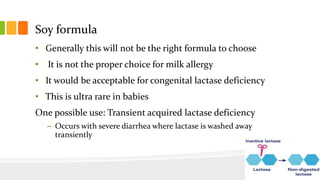
Soy formula
• Generally this will not be the right formula to choose
• It is not the proper choice for milk allergy
• It would be acceptable for congenital lactase deficiency
• This is ultra rare in babies
One possible use: Transient acquired lactase deficiency
– Occurs with severe diarrhea where lactase is washed away
transiently
PARTIALLY HYDROLYZED FORMULAS
• Good starting point for food allergies if they are not severe
• Some infants will still react even to the peptides of the
whole protein so this formula would not work
• Reported that around 90% of infants with cows milk allergy
will do okay on this type of formula
ELEMENTAL FORMULAS
• Ideal for those with severe allergies
• No peptides remain, only amino acids
• Therefore, no allergens are present
WHY NOT PUT EVERYONE ON AN ELEMENTAL
FORMULA?
1) It’s an expensive formula
2) It tastes really bad
▸ Really, really bad
“AR” FORMULAS
• Still Cow milk based
• “AR” = added rice or anti-reflux
• Contain a rice starch that is “activated” upon
eating and thickens the formula to reduce reflux
• Can accomplish this by adding cereal to standard formula as
well
– Effective dose = 1 tablespoon cereal per ounce (cut the nipple)
• Very thick and adds calories this way
Can be effective but reflux may not be the issue for the baby
OTHER FORMULA TYPES
• Many other types ( colic, gas ..)
• Most are probably not needed
BREAST MILK VS FORMULA
Ultimately, formula cannot exactly replicate BM
Remember, BM changes as the baby feeds
BM contains antibodies, has anti-inflammatory properties
and thousands of specific bioactive substances that can help
mature the immune system and encourage proper bacterial
colonization of the GI tract
However, we should not shame mothers who do not
breastfeed
CAUTION
• Don’t change formulas too rapidly
• Give it at least 2 weeks, if not a month, to see if they
improve
• Mucosa must regenerate
• Eosinophils have a tissue life span of 2-5 days; however, in
vitro cytokines can extend this to over 14 days
• Thus, likely lifespan in the GI tract with allergy is ~2 weeks
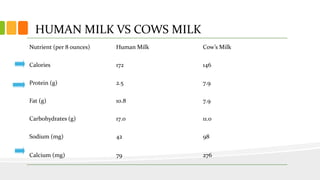
HUMAN MILK VS COWS MILK
Nutrient (per 8 ounces) Human Milk Cow’s Milk
Calories 172 146
Protein (g) 2.5 7.9
Fat (g) 10.8 7.9
Carbohydrates (g) 17.0 11.0
Sodium (mg) 42 98
Calcium (mg) 79 276
INTRODUCTION OF SOLIDS
• Breastfeeding or formula until 1 year of age ▸ Cow’s milk
may be started at age 1 yr
• Use whole milk, not reduced fat
– ▸Toddler brains still need increased fat content
• ▸ Solids
• Okay to start introducing at 6 months
•
WHY NOT SOLIDS START EARLIER?
• Very likely that many parents do start at 6 months
• ▸ Extrusion reflex makes it difficult to swallow
• ▸ Often less calories overall
• ▸ Baby foods often have less calories per ounce
• ▸ Less breastmilk also means less bioactive
• goodness
▸ Breastfeeding stops earlier in those with early solids
HOW TO INTRODUCE SOLIDS
• ▸ Start with cereals (oatmeal, rice, etc.)
▸ Wheat is usually last due to it’s allergenicity
• ▸ Progress to fruits and vegetables then meats
▸ Add only 1 new food at a time
▸ Wait 3-4 days before introducing a new food
• ▸ Finger foods should wait until 8-10 months
• ▸ Juice can start at 6 months
• ▸ Best if only in a cup
▸ No more than 4-6 ounces a day
WHAT ABOUT ALLERGENS?
• New evidence suggests early introduction of allergy
inducing foods is better
• ▸ LEAP (Learning early about peanut) study, 2015
• ▸ Randomized 640 infants with severe eczema, egg allergy
or both to either eating or avoiding peanuts until 60 months
old
• ▸ Peanut allergy in 17.2% of avoidance vs. 3.2% of
consumption group
AVOID UNTIL AGE 1Y
• Honey
▸ Risk of botulism
• ▸ Cow’s milk
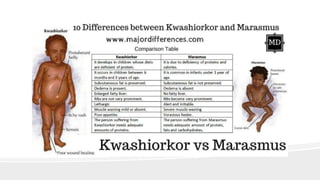
Marasmus vs Kwashiorkor
• Both are due to caloric insufficiency
• Marasmus: total calorie malnutrition
• Marasmus – from Greek marasmos “withering or wasting,
decay”
• Kwashiorkor – protein deficiency malnutrition with
maintained caloric intake
o Kwashiorkor – from Ga language of Ghana “the sickness of
the weaning”
Marasmus
• ●Total calorie deficiency
• Body pulls from its stores until those stores are spent
• Leads to total body wasting
• Loss of subcutaneous fat stores causes bones to become
prominent (especially in the face)
• Note: ascites is NOT a defining feature
Kwashiorkor
• Protein deficiency with maintained calories (usually via
carbohydrates)
• Body becomes total protein depleted
• Hypoalbuminemia develops and fluid extravasation occurs
• Leads to the development of ascites
• May have swollen face (moon facies)
• Fatty liver can develop
• Muscle wasting still seen due to protein deficiency
Vitamins
• A – retinol
• B1 – thiamine
• B2 – riboflavin
• B3 – Niacin
• B6 – pyridoxine
• B9 – folate
• B12 – cobalamin
• C – ascorbic acid
• D – calciferol
• E – Tocopherol
• K – phytonadione
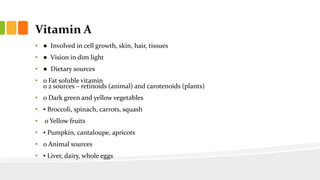
Vitamin A
• ● Involved in cell growth, skin, hair, tissues
• ● Vision in dim light
• ● Dietary sources
• o Fat soluble vitamin
o 2 sources – retinoids (animal) and carotenoids (plants)
• o Dark green and yellow vegetables
• ▪ Broccoli, spinach, carrots, squash
• o Yellow fruits
• ▪ Pumpkin, cantaloupe, apricots
• o Animal sources
• ▪ Liver, dairy, whole eggs
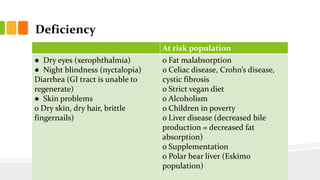
Deficiency
At risk population
● Dry eyes (xerophthalmia)
● Night blindness (nyctalopia)
Diarrhea (GI tract is unable to
regenerate)
● Skin problems
o Dry skin, dry hair, brittle
fingernails)
o Fat malabsorption
o Celiac disease, Crohn’s disease,
cystic fibrosis
o Strict vegan diet
o Alcoholism
o Children in poverty
o Liver disease (decreased bile
production = decreased fat
absorption)
o Supplementation
o Polar bear liver (Eskimo
population)
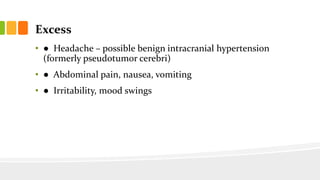
Excess
• ● Headache – possible benign intracranial hypertension
(formerly pseudotumor cerebri)
• ● Abdominal pain, nausea, vomiting
• ● Irritability, mood swings
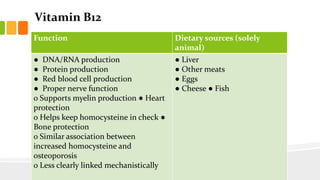
Vitamin B12
Function Dietary sources (solely
animal)
● DNA/RNA production
● Protein production
● Red blood cell production
● Proper nerve function
o Supports myelin production ● Heart
protection
o Helps keep homocysteine in check ●
Bone protection
o Similar association between
increased homocysteine and
osteoporosis
o Less clearly linked mechanistically
● Liver
● Other meats
● Eggs
● Cheese ● Fish
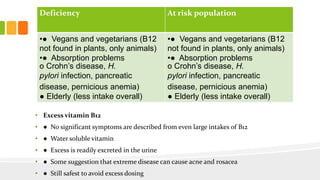
• Excess vitamin B12
• ● No significant symptoms are described from even large intakes of B12
• ● Water soluble vitamin
• ● Excess is readily excreted in the urine
• ● Some suggestion that extreme disease can cause acne and rosacea
• ● Still safest to avoid excess dosing
Deficiency At risk population
•● Vegans and vegetarians (B12
not found in plants, only animals)
•● Absorption problems
o Crohn’s disease, H.
pylori infection, pancreatic
disease, pernicious anemia)
● Elderly (less intake overall)
•● Vegans and vegetarians (B12
not found in plants, only animals)
•● Absorption problems
o Crohn’s disease, H.
pylori infection, pancreatic
disease, pernicious anemia)
● Elderly (less intake overall)
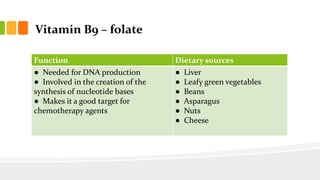
Vitamin B9 – folate
Function Dietary sources
● Needed for DNA production
● Involved in the creation of the
synthesis of nucleotide bases
● Makes it a good target for
chemotherapy agents
● Liver
● Leafy green vegetables
● Beans
● Asparagus
● Nuts
● Cheese
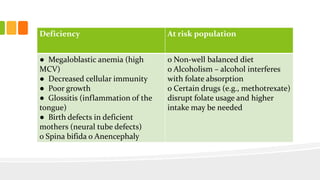
Deficiency At risk population
● Megaloblastic anemia (high
MCV)
● Decreased cellular immunity
● Poor growth
● Glossitis (inflammation of the
tongue)
● Birth defects in deficient
mothers (neural tube defects)
o Spina bifida o Anencephaly
o Non-well balanced diet
o Alcoholism – alcohol interferes
with folate absorption
o Certain drugs (e.g., methotrexate)
disrupt folate usage and higher
intake may be needed
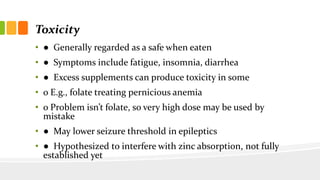
Toxicity
• ● Generally regarded as a safe when eaten
• ● Symptoms include fatigue, insomnia, diarrhea
• ● Excess supplements can produce toxicity in some
• o E.g., folate treating pernicious anemia
• o Problem isn’t folate, so very high dose may be used by
mistake
• ● May lower seizure threshold in epileptics
• ● Hypothesized to interfere with zinc absorption, not fully
established yet
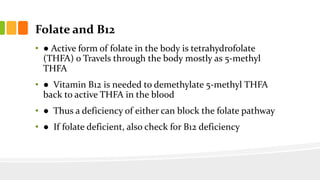
Folate and B12
• ● Active form of folate in the body is tetrahydrofolate
(THFA) o Travels through the body mostly as 5-methyl
THFA
• ● Vitamin B12 is needed to demethylate 5-methyl THFA
back to active THFA in the blood
• ● Thus a deficiency of either can block the folate pathway
• ● If folate deficient, also check for B12 deficiency
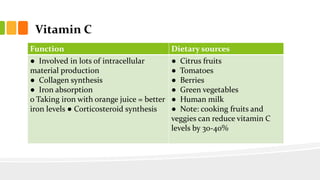
Vitamin C
Function Dietary sources
● Involved in lots of intracellular
material production
● Collagen synthesis
● Iron absorption
o Taking iron with orange juice = better
iron levels ● Corticosteroid synthesis
● Citrus fruits
● Tomatoes
● Berries
● Green vegetables
● Human milk
● Note: cooking fruits and
veggies can reduce vitamin C
levels by 30-40%
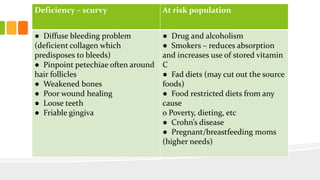
Deficiency – scurvy At risk population
● Diffuse bleeding problem
(deficient collagen which
predisposes to bleeds)
● Pinpoint petechiae often around
hair follicles
● Weakened bones
● Poor wound healing
● Loose teeth
● Friable gingiva
● Drug and alcoholism
● Smokers – reduces absorption
and increases use of stored vitamin
C
● Fad diets (may cut out the source
foods)
● Food restricted diets from any
cause
o Poverty, dieting, etc
● Crohn’s disease
● Pregnant/breastfeeding moms
(higher needs)
Toxicity
– ● Nausea, diarrhea, cramping
– ● Possibly increased risk of renal stones with very high doses
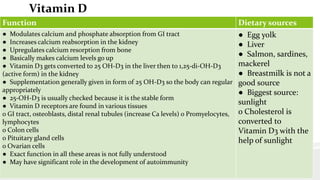
Vitamin D
Function Dietary sources
● Modulates calcium and phosphate absorption from GI tract
● Increases calcium reabsorption in the kidney
● Upregulates calcium resorption from bone
● Basically makes calcium levels go up
● Vitamin D3 gets converted to 25 OH-D3 in the liver then to 1,25-di-OH-D3
(active form) in the kidney
● Supplementation generally given in form of 25 OH-D3 so the body can regular
appropriately
● 25-OH-D3 is usually checked because it is the stable form
● Vitamin D receptors are found in various tissues
o GI tract, osteoblasts, distal renal tubules (increase Ca levels) o Promyelocytes,
lymphocytes
o Colon cells
o Pituitary gland cells
o Ovarian cells
● Exact function in all these areas is not fully understood
● May have significant role in the development of autoimmunity
● Egg yolk
● Liver
● Salmon, sardines,
mackerel
● Breastmilk is not a
good source
● Biggest source:
sunlight
o Cholesterol is
converted to
Vitamin D3 with the
help of sunlight
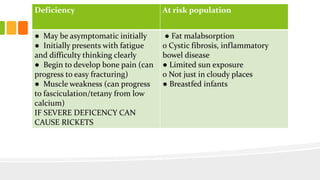
Deficiency At risk population
● May be asymptomatic initially
● Initially presents with fatigue
and difficulty thinking clearly
● Begin to develop bone pain (can
progress to easy fracturing)
● Muscle weakness (can progress
to fasciculation/tetany from low
calcium)
IF SEVERE DEFICENCY CAN
CAUSE RICKETS
● Fat malabsorption
o Cystic fibrosis, inflammatory
bowel disease
● Limited sun exposure
o Not just in cloudy places
● Breastfed infants
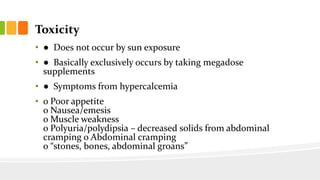
Toxicity
• ● Does not occur by sun exposure
• ● Basically exclusively occurs by taking megadose
supplements
• ● Symptoms from hypercalcemia
• o Poor appetite
o Nausea/emesis
o Muscle weakness
o Polyuria/polydipsia – decreased solids from abdominal
cramping o Abdominal cramping
o “stones, bones, abdominal groans”
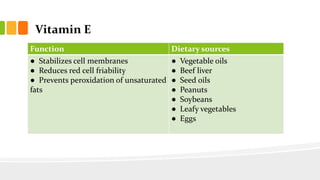
Vitamin E
Function Dietary sources
● Stabilizes cell membranes
● Reduces red cell friability
● Prevents peroxidation of unsaturated
fats
● Vegetable oils
● Beef liver
● Seed oils
● Peanuts
● Soybeans
● Leafy vegetables
● Eggs
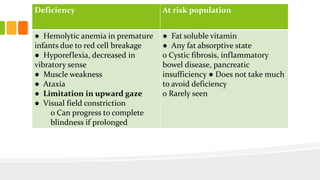
Deficiency At risk population
● Hemolytic anemia in premature
infants due to red cell breakage
● Hyporeflexia, decreased in
vibratory sense
● Muscle weakness
● Ataxia
● Limitation in upward gaze
● Visual field constriction
o Can progress to complete
blindness if prolonged
● Fat soluble vitamin
● Any fat absorptive state
o Cystic fibrosis, inflammatory
bowel disease, pancreatic
insufficiency ● Does not take much
to avoid deficiency
o Rarely seen
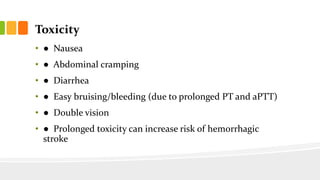
Toxicity
• ● Nausea
• ● Abdominal cramping
• ● Diarrhea
• ● Easy bruising/bleeding (due to prolonged PT and aPTT)
• ● Double vision
• ● Prolonged toxicity can increase risk of hemorrhagic
stroke
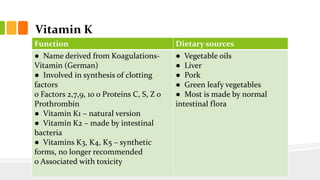
Vitamin K
Function Dietary sources
● Name derived from Koagulations-
Vitamin (German)
● Involved in synthesis of clotting
factors
o Factors 2,7,9, 10 o Proteins C, S, Z o
Prothrombin
● Vitamin K1 – natural version
● Vitamin K2 – made by intestinal
bacteria
● Vitamins K3, K4, K5 – synthetic
forms, no longer recommended
o Associated with toxicity
● Vegetable oils
● Liver
● Pork
● Green leafy vegetables
● Most is made by normal
intestinal flora
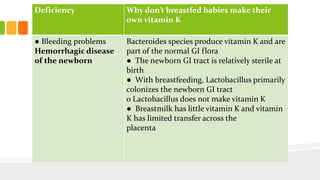
Deficiency Why don’t breastfed babies make their
own vitamin K
● Bleeding problems
Hemorrhagic disease
of the newborn
Bacteroides species produce vitamin K and are
part of the normal GI flora
● The newborn GI tract is relatively sterile at
birth
● With breastfeeding, Lactobacillus primarily
colonizes the newborn GI tract
o Lactobacillus does not make vitamin K
● Breastmilk has little vitamin K and vitamin
K has limited transfer across the
placenta
Toxicity
• ● Rare even at high doses
• ● Can present with anemia, brain damage, liver damage
• ● Very high doses of water soluble analog can exacerbate
• hyperbilirubinemia in infants
• ● Can also cause hemolysis in infants
Fat soluble vitamins
• Vitamins ADEK
• Any condition that impairs fat absorption impairs
absorption of these vitamins
• Increased doses may need to be given to at risk groups
o These 4 come in a combined supplem
Minerals -Iron deficiency
• Decreased work capacity, growth retardation, increased
susceptibility to infection, irritability
• Stomatitis, glossitis, cheilitis, disaccharidase deficiency
• Increased lead absorption
• Craving for ice (pagophagia)
• Lower IQ scores/decreased scholastic performance
Zinc deficiency
• Alopecia, dermatitis
• Frequents infections due to Tcell dysfunction
• Ophthalmologic problems
• Acrodermatitis enteropathica
– Autosomal recessive inherited defect in zinc transport
– Presents 1–2 months after birth of formula fed or
– 1–2 months after stopping breastfeeding
Copper deficiency
• Microcytic anemia
• Chronic diarrhea
• Neutropenia
• Flaring of longbone metaphysis • Periosteal elevations
• Fractures
Copper deficiency -Menkes Kinky Hair
Syndrome
– X-linked recessive defect in copper transport ATPase
– Growth retardation, abnormal hair (kinky, colorless,
– friable)
– Cerebellar degeneration, optic atrophy, and early death (usually by age 3
years if untreated)
– Progressive neurodegenerative condition; symptoms begin during first
few months of life
– Hypothermia, hypotonia, and generalized myoclonic seizures
– Serum copper and ceruloplasmin levels are low, but cellular copper
content is increased (copper uptake across the brush border of intestine
is increased but transport from these cells into plasma is defective)
– Copper-histidine therapy given subcutaneously each day for life
(particularly if started during neonatal period) has been shown to be
effective in preventing neurologic deterioration in some patients
Selenium deficiency
• Cardiomyopathy
• Abnormalities of hair and nails
• Myositis
• Macrocytic anemia
Biotin deficiency
• Alopecia
• Brawny dermatitis
• Hypotonia
• Hyperesthesia
Iodine deficiency
• Goiter
• Cretinism (hypothyroid dwarfism with mental deficiency)
Thank you

Nutrition

  • 1.
    Nutrition WE ARE WHATWE EAT Sara Almheiri
  • 2.
    Table of contents •Calories • Breast feeding • formula feeding • Introduction of solids • Vitamins • Minrals
  • 3.
    BASIC CALORIC NEEDS •▸ Calories needed are generally determined per kilogram of weight • For infants, determination follows this rule: ▸ 100 kcal/kg for each of the 1st 10 kg’s ▸ 50 kcal/kg for each of the 2nd 10 kg’s ▸ 20 kcal/kg for each kg after 20 • Caveat – this is for otherwise healthy infants ▸ Illnesses or other diseases may increase need
  • 4.
    HOW MUCH ISENOUGH? 0-3 Months 30 grams per day 3-6 Months 15-20 grams per day 6-12 Months 10-15 grams per day 12-24 Months 8-10 grams per day
  • 5.
    Calories • 1 gramof carbohydrate = 4 calories • 1 gram of protein = 4 calories • 1 gram of fat = 9 calories • Infant formulas = 20Kcal/oz or 30ml
  • 6.
    Calories • Full termand preterm infants: • Require 100-140 kcl/kg/day to grow • Malnourished child • 20-30% more energy for growth catch up • Protein intake • 3.5g/kg/day (preterm) • 2-2.5g/kg/day (full term)
  • 7.
    Breast milk • Carbohydrate –Lactose • Protein – Alpha-lactalbumin • Fat – Arachidonic acid – Docosahexaenonic acid
  • 8.
    Breast milk • Breastis best ▸ Breast milk changes • ▸ With time from birth ▸ Length of feeding ▸ Time of day ▸ From mother to mother • ▸ Caloric density also changes ▸ Rough estimate is that BM is around 20 kcal/ounce
  • 9.
    COLOSTRUM • Produced firstfew days after birth • Not a significant nutritional source • Low in lactose, low in overall calories compared to later milk • Low in calcium and potassium • Higher in sodium, chloride, magnesium • ▸ High in immunologic factors • ▸ Secretory IgA ▸ Lactoferrin ▸ Leukocytes ▸ Various growth factors
  • 10.
    TRANSITIONAL MILK • Transitionalfrom colostrum to mature milk • Typically occurs from roughly day 4-5 to around 2 weeks • Sodium content declines some • potassium increases • Lactose increases
  • 11.
    MATURE MILK • Beginsaround 2 weeks and is “fully” mature by around 4 weeks • Milk content now stabilizes and doesn’t change much more for the rest of breastfeeding • Protein content ~1 gram/dL • Breastmilk of moms of premies starts out higher in protein, ~2 grams/dL • Protein levels in milk decrease over the first 1-1.5 months (regardless of gestational age) • Fat ~3.5 grams/dL • Lactose ~7-7.5 grams/dL
  • 12.
    Protective effect • Infection;it has secretory IgA • Chronic disorders, e.g., allergies, celiac, crohn, lymphoma, and obesity • Hospitalizations • Infant mortality
  • 13.
    Absolute contraindication forbreast milk • HIV • Human T-lymphotropic virus • Active tuberculosis infection • Until completion of approximately 2 weeks of appropriate therapy • Infant with classic galactosemia • Galactose 1-phosphate uridyltransferase deficiency
  • 14.
    INFANT FORMULAS • Howmany calories per ounce? ▸ Bit of a trick question – it depends on how it is mixed • from the powder ▸ Standard mixing is 1 scoop to 2 ounces of water • ▸ This yields 20 kcal/ounce for most standard formulas ▸ Other possible mixes: • 3 scoops to 5 1⁄2 ounces • water = 22 kcal/ounce • 3 scoops to 5 ounces • water = 24 kcal/ounce
  • 15.
    INFANT FORMULA VARIETIES •Standard formula is cow milk based • Soy formula • Rare indications for this formula type • Partially hydrolyzed formulas • Proteins are broken down into peptides • Elemental formula – Proteins are fully broken down into amino acids
  • 16.
    Soy formula • Generallythis will not be the right formula to choose • It is not the proper choice for milk allergy • It would be acceptable for congenital lactase deficiency • This is ultra rare in babies One possible use: Transient acquired lactase deficiency – Occurs with severe diarrhea where lactase is washed away transiently
  • 17.
    PARTIALLY HYDROLYZED FORMULAS •Good starting point for food allergies if they are not severe • Some infants will still react even to the peptides of the whole protein so this formula would not work • Reported that around 90% of infants with cows milk allergy will do okay on this type of formula
  • 18.
    ELEMENTAL FORMULAS • Idealfor those with severe allergies • No peptides remain, only amino acids • Therefore, no allergens are present WHY NOT PUT EVERYONE ON AN ELEMENTAL FORMULA? 1) It’s an expensive formula 2) It tastes really bad ▸ Really, really bad
  • 19.
    “AR” FORMULAS • StillCow milk based • “AR” = added rice or anti-reflux • Contain a rice starch that is “activated” upon eating and thickens the formula to reduce reflux • Can accomplish this by adding cereal to standard formula as well – Effective dose = 1 tablespoon cereal per ounce (cut the nipple) • Very thick and adds calories this way Can be effective but reflux may not be the issue for the baby
  • 20.
    OTHER FORMULA TYPES •Many other types ( colic, gas ..) • Most are probably not needed
  • 21.
    BREAST MILK VSFORMULA Ultimately, formula cannot exactly replicate BM Remember, BM changes as the baby feeds BM contains antibodies, has anti-inflammatory properties and thousands of specific bioactive substances that can help mature the immune system and encourage proper bacterial colonization of the GI tract However, we should not shame mothers who do not breastfeed
  • 22.
    CAUTION • Don’t changeformulas too rapidly • Give it at least 2 weeks, if not a month, to see if they improve • Mucosa must regenerate • Eosinophils have a tissue life span of 2-5 days; however, in vitro cytokines can extend this to over 14 days • Thus, likely lifespan in the GI tract with allergy is ~2 weeks
  • 23.
    HUMAN MILK VSCOWS MILK Nutrient (per 8 ounces) Human Milk Cow’s Milk Calories 172 146 Protein (g) 2.5 7.9 Fat (g) 10.8 7.9 Carbohydrates (g) 17.0 11.0 Sodium (mg) 42 98 Calcium (mg) 79 276
  • 24.
    INTRODUCTION OF SOLIDS •Breastfeeding or formula until 1 year of age ▸ Cow’s milk may be started at age 1 yr • Use whole milk, not reduced fat – ▸Toddler brains still need increased fat content • ▸ Solids • Okay to start introducing at 6 months •
  • 25.
    WHY NOT SOLIDSSTART EARLIER? • Very likely that many parents do start at 6 months • ▸ Extrusion reflex makes it difficult to swallow • ▸ Often less calories overall • ▸ Baby foods often have less calories per ounce • ▸ Less breastmilk also means less bioactive • goodness ▸ Breastfeeding stops earlier in those with early solids
  • 26.
    HOW TO INTRODUCESOLIDS • ▸ Start with cereals (oatmeal, rice, etc.) ▸ Wheat is usually last due to it’s allergenicity • ▸ Progress to fruits and vegetables then meats ▸ Add only 1 new food at a time ▸ Wait 3-4 days before introducing a new food • ▸ Finger foods should wait until 8-10 months • ▸ Juice can start at 6 months • ▸ Best if only in a cup ▸ No more than 4-6 ounces a day
  • 27.
    WHAT ABOUT ALLERGENS? •New evidence suggests early introduction of allergy inducing foods is better • ▸ LEAP (Learning early about peanut) study, 2015 • ▸ Randomized 640 infants with severe eczema, egg allergy or both to either eating or avoiding peanuts until 60 months old • ▸ Peanut allergy in 17.2% of avoidance vs. 3.2% of consumption group
  • 28.
    AVOID UNTIL AGE1Y • Honey ▸ Risk of botulism • ▸ Cow’s milk
  • 29.
    Marasmus vs Kwashiorkor •Both are due to caloric insufficiency • Marasmus: total calorie malnutrition • Marasmus – from Greek marasmos “withering or wasting, decay” • Kwashiorkor – protein deficiency malnutrition with maintained caloric intake o Kwashiorkor – from Ga language of Ghana “the sickness of the weaning”
  • 31.
    Marasmus • ●Total caloriedeficiency • Body pulls from its stores until those stores are spent • Leads to total body wasting • Loss of subcutaneous fat stores causes bones to become prominent (especially in the face) • Note: ascites is NOT a defining feature
  • 32.
    Kwashiorkor • Protein deficiencywith maintained calories (usually via carbohydrates) • Body becomes total protein depleted • Hypoalbuminemia develops and fluid extravasation occurs • Leads to the development of ascites • May have swollen face (moon facies) • Fatty liver can develop • Muscle wasting still seen due to protein deficiency
  • 33.
    Vitamins • A –retinol • B1 – thiamine • B2 – riboflavin • B3 – Niacin • B6 – pyridoxine • B9 – folate • B12 – cobalamin • C – ascorbic acid • D – calciferol • E – Tocopherol • K – phytonadione
  • 34.
    Vitamin A • ●Involved in cell growth, skin, hair, tissues • ● Vision in dim light • ● Dietary sources • o Fat soluble vitamin o 2 sources – retinoids (animal) and carotenoids (plants) • o Dark green and yellow vegetables • ▪ Broccoli, spinach, carrots, squash • o Yellow fruits • ▪ Pumpkin, cantaloupe, apricots • o Animal sources • ▪ Liver, dairy, whole eggs
  • 35.
    Deficiency At risk population ●Dry eyes (xerophthalmia) ● Night blindness (nyctalopia) Diarrhea (GI tract is unable to regenerate) ● Skin problems o Dry skin, dry hair, brittle fingernails) o Fat malabsorption o Celiac disease, Crohn’s disease, cystic fibrosis o Strict vegan diet o Alcoholism o Children in poverty o Liver disease (decreased bile production = decreased fat absorption) o Supplementation o Polar bear liver (Eskimo population)
  • 36.
    Excess • ● Headache– possible benign intracranial hypertension (formerly pseudotumor cerebri) • ● Abdominal pain, nausea, vomiting • ● Irritability, mood swings
  • 37.
    Vitamin B12 Function Dietarysources (solely animal) ● DNA/RNA production ● Protein production ● Red blood cell production ● Proper nerve function o Supports myelin production ● Heart protection o Helps keep homocysteine in check ● Bone protection o Similar association between increased homocysteine and osteoporosis o Less clearly linked mechanistically ● Liver ● Other meats ● Eggs ● Cheese ● Fish
  • 38.
    • Excess vitaminB12 • ● No significant symptoms are described from even large intakes of B12 • ● Water soluble vitamin • ● Excess is readily excreted in the urine • ● Some suggestion that extreme disease can cause acne and rosacea • ● Still safest to avoid excess dosing Deficiency At risk population •● Vegans and vegetarians (B12 not found in plants, only animals) •● Absorption problems o Crohn’s disease, H. pylori infection, pancreatic disease, pernicious anemia) ● Elderly (less intake overall) •● Vegans and vegetarians (B12 not found in plants, only animals) •● Absorption problems o Crohn’s disease, H. pylori infection, pancreatic disease, pernicious anemia) ● Elderly (less intake overall)
  • 39.
    Vitamin B9 –folate Function Dietary sources ● Needed for DNA production ● Involved in the creation of the synthesis of nucleotide bases ● Makes it a good target for chemotherapy agents ● Liver ● Leafy green vegetables ● Beans ● Asparagus ● Nuts ● Cheese
  • 40.
    Deficiency At riskpopulation ● Megaloblastic anemia (high MCV) ● Decreased cellular immunity ● Poor growth ● Glossitis (inflammation of the tongue) ● Birth defects in deficient mothers (neural tube defects) o Spina bifida o Anencephaly o Non-well balanced diet o Alcoholism – alcohol interferes with folate absorption o Certain drugs (e.g., methotrexate) disrupt folate usage and higher intake may be needed
  • 41.
    Toxicity • ● Generallyregarded as a safe when eaten • ● Symptoms include fatigue, insomnia, diarrhea • ● Excess supplements can produce toxicity in some • o E.g., folate treating pernicious anemia • o Problem isn’t folate, so very high dose may be used by mistake • ● May lower seizure threshold in epileptics • ● Hypothesized to interfere with zinc absorption, not fully established yet
  • 42.
    Folate and B12 •● Active form of folate in the body is tetrahydrofolate (THFA) o Travels through the body mostly as 5-methyl THFA • ● Vitamin B12 is needed to demethylate 5-methyl THFA back to active THFA in the blood • ● Thus a deficiency of either can block the folate pathway • ● If folate deficient, also check for B12 deficiency
  • 43.
    Vitamin C Function Dietarysources ● Involved in lots of intracellular material production ● Collagen synthesis ● Iron absorption o Taking iron with orange juice = better iron levels ● Corticosteroid synthesis ● Citrus fruits ● Tomatoes ● Berries ● Green vegetables ● Human milk ● Note: cooking fruits and veggies can reduce vitamin C levels by 30-40%
  • 44.
    Deficiency – scurvyAt risk population ● Diffuse bleeding problem (deficient collagen which predisposes to bleeds) ● Pinpoint petechiae often around hair follicles ● Weakened bones ● Poor wound healing ● Loose teeth ● Friable gingiva ● Drug and alcoholism ● Smokers – reduces absorption and increases use of stored vitamin C ● Fad diets (may cut out the source foods) ● Food restricted diets from any cause o Poverty, dieting, etc ● Crohn’s disease ● Pregnant/breastfeeding moms (higher needs)
  • 45.
    Toxicity – ● Nausea,diarrhea, cramping – ● Possibly increased risk of renal stones with very high doses
  • 46.
    Vitamin D Function Dietarysources ● Modulates calcium and phosphate absorption from GI tract ● Increases calcium reabsorption in the kidney ● Upregulates calcium resorption from bone ● Basically makes calcium levels go up ● Vitamin D3 gets converted to 25 OH-D3 in the liver then to 1,25-di-OH-D3 (active form) in the kidney ● Supplementation generally given in form of 25 OH-D3 so the body can regular appropriately ● 25-OH-D3 is usually checked because it is the stable form ● Vitamin D receptors are found in various tissues o GI tract, osteoblasts, distal renal tubules (increase Ca levels) o Promyelocytes, lymphocytes o Colon cells o Pituitary gland cells o Ovarian cells ● Exact function in all these areas is not fully understood ● May have significant role in the development of autoimmunity ● Egg yolk ● Liver ● Salmon, sardines, mackerel ● Breastmilk is not a good source ● Biggest source: sunlight o Cholesterol is converted to Vitamin D3 with the help of sunlight
  • 47.
    Deficiency At riskpopulation ● May be asymptomatic initially ● Initially presents with fatigue and difficulty thinking clearly ● Begin to develop bone pain (can progress to easy fracturing) ● Muscle weakness (can progress to fasciculation/tetany from low calcium) IF SEVERE DEFICENCY CAN CAUSE RICKETS ● Fat malabsorption o Cystic fibrosis, inflammatory bowel disease ● Limited sun exposure o Not just in cloudy places ● Breastfed infants
  • 48.
    Toxicity • ● Doesnot occur by sun exposure • ● Basically exclusively occurs by taking megadose supplements • ● Symptoms from hypercalcemia • o Poor appetite o Nausea/emesis o Muscle weakness o Polyuria/polydipsia – decreased solids from abdominal cramping o Abdominal cramping o “stones, bones, abdominal groans”
  • 49.
    Vitamin E Function Dietarysources ● Stabilizes cell membranes ● Reduces red cell friability ● Prevents peroxidation of unsaturated fats ● Vegetable oils ● Beef liver ● Seed oils ● Peanuts ● Soybeans ● Leafy vegetables ● Eggs
  • 50.
    Deficiency At riskpopulation ● Hemolytic anemia in premature infants due to red cell breakage ● Hyporeflexia, decreased in vibratory sense ● Muscle weakness ● Ataxia ● Limitation in upward gaze ● Visual field constriction o Can progress to complete blindness if prolonged ● Fat soluble vitamin ● Any fat absorptive state o Cystic fibrosis, inflammatory bowel disease, pancreatic insufficiency ● Does not take much to avoid deficiency o Rarely seen
  • 51.
    Toxicity • ● Nausea •● Abdominal cramping • ● Diarrhea • ● Easy bruising/bleeding (due to prolonged PT and aPTT) • ● Double vision • ● Prolonged toxicity can increase risk of hemorrhagic stroke
  • 52.
    Vitamin K Function Dietarysources ● Name derived from Koagulations- Vitamin (German) ● Involved in synthesis of clotting factors o Factors 2,7,9, 10 o Proteins C, S, Z o Prothrombin ● Vitamin K1 – natural version ● Vitamin K2 – made by intestinal bacteria ● Vitamins K3, K4, K5 – synthetic forms, no longer recommended o Associated with toxicity ● Vegetable oils ● Liver ● Pork ● Green leafy vegetables ● Most is made by normal intestinal flora
  • 53.
    Deficiency Why don’tbreastfed babies make their own vitamin K ● Bleeding problems Hemorrhagic disease of the newborn Bacteroides species produce vitamin K and are part of the normal GI flora ● The newborn GI tract is relatively sterile at birth ● With breastfeeding, Lactobacillus primarily colonizes the newborn GI tract o Lactobacillus does not make vitamin K ● Breastmilk has little vitamin K and vitamin K has limited transfer across the placenta
  • 54.
    Toxicity • ● Rareeven at high doses • ● Can present with anemia, brain damage, liver damage • ● Very high doses of water soluble analog can exacerbate • hyperbilirubinemia in infants • ● Can also cause hemolysis in infants
  • 55.
    Fat soluble vitamins •Vitamins ADEK • Any condition that impairs fat absorption impairs absorption of these vitamins • Increased doses may need to be given to at risk groups o These 4 come in a combined supplem
  • 56.
    Minerals -Iron deficiency •Decreased work capacity, growth retardation, increased susceptibility to infection, irritability • Stomatitis, glossitis, cheilitis, disaccharidase deficiency • Increased lead absorption • Craving for ice (pagophagia) • Lower IQ scores/decreased scholastic performance
  • 57.
    Zinc deficiency • Alopecia,dermatitis • Frequents infections due to Tcell dysfunction • Ophthalmologic problems • Acrodermatitis enteropathica – Autosomal recessive inherited defect in zinc transport – Presents 1–2 months after birth of formula fed or – 1–2 months after stopping breastfeeding
  • 58.
    Copper deficiency • Microcyticanemia • Chronic diarrhea • Neutropenia • Flaring of longbone metaphysis • Periosteal elevations • Fractures
  • 59.
    Copper deficiency -MenkesKinky Hair Syndrome – X-linked recessive defect in copper transport ATPase – Growth retardation, abnormal hair (kinky, colorless, – friable) – Cerebellar degeneration, optic atrophy, and early death (usually by age 3 years if untreated) – Progressive neurodegenerative condition; symptoms begin during first few months of life – Hypothermia, hypotonia, and generalized myoclonic seizures – Serum copper and ceruloplasmin levels are low, but cellular copper content is increased (copper uptake across the brush border of intestine is increased but transport from these cells into plasma is defective) – Copper-histidine therapy given subcutaneously each day for life (particularly if started during neonatal period) has been shown to be effective in preventing neurologic deterioration in some patients
  • 60.
    Selenium deficiency • Cardiomyopathy •Abnormalities of hair and nails • Myositis • Macrocytic anemia
  • 61.
    Biotin deficiency • Alopecia •Brawny dermatitis • Hypotonia • Hyperesthesia
  • 62.
    Iodine deficiency • Goiter •Cretinism (hypothyroid dwarfism with mental deficiency)
  • 63.