The Magic milk
Dr. Leen Doya
Department of pediatric
Tishreen university
INTRODUCTION
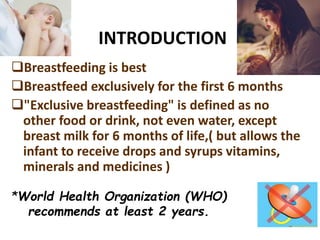
Breastfeeding is best
Breastfeed exclusively for the first 6 months
"Exclusive breastfeeding" is defined as no
other food or drink, not even water, except
breast milk for 6 months of life,( but allows the
infant to receive drops and syrups vitamins,
minerals and medicines )
*World Health Organization (WHO)
recommends at least 2 years.
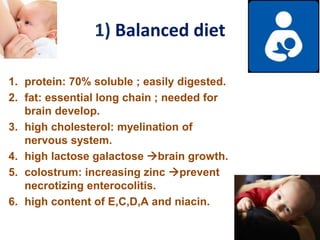
1) Balanced diet
1. protein: 70% soluble ; easily digested.
2. fat: essential long chain ; needed for
brain develop.
3. high cholesterol: myelination of
nervous system.
4. high lactose galactose brain growth.
5. colostrum: increasing zinc prevent
necrotizing enterocolitis.
6. high content of E,C,D,A and niacin.
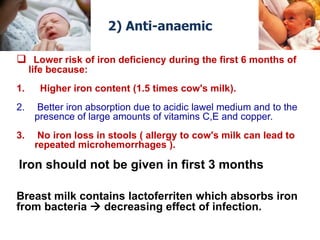
2) Anti-anaemic
 Lower risk of iron deficiency during the first 6 months of
life because:
1. Higher iron content (1.5 times cow's milk).
2. Better iron absorption due to acidic lawel medium and to the
presence of large amounts of vitamins C,E and copper.
3. No iron loss in stools ( allergy to cow's milk can lead to
repeated microhemorrhages ).
Iron should not be given in first 3 months
Breast milk contains lactoferriten which absorbs iron
from bacteria  decreasing effect of infection.
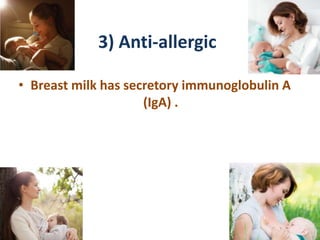
3) Anti-allergic
• Breast milk has secretory immunoglobulin A
(IgA) .
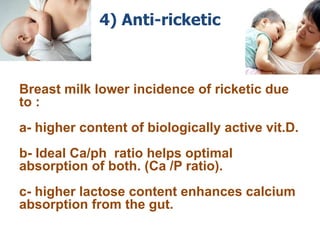
4) Anti-ricketic
Breast milk lower incidence of ricketic due
to :
a- higher content of biologically active vit.D.
b- Ideal Ca/ph ratio helps optimal
absorption of both. (Ca /P ratio).
c- higher lactose content enhances calcium
absorption from the gut.
1- Contains (immunoglobulins) , Secretory IgA.
2- Lactoferrin (iron-binding protein) inhibits growth of E-
coli by depriving it from iron.
3- Lactose and bifidus factor promote growth of protecting
flora.
4- Milk macrophages phagocytose and kill bacteria and
fungi.
5- Milk B-lymphocytes secrete IgA , T-lymphocytes
involved in cell-mediated immunity.
5) Anti-infection property
Benefit of
breastfeeding
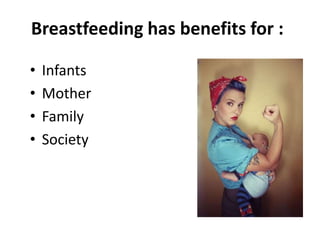
Breastfeeding has benefits for :
• Infants
• Mother
• Family
• Society
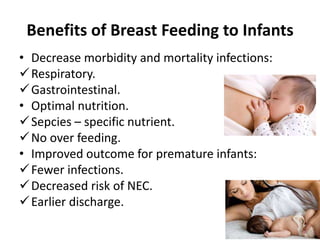
Benefits of Breast Feeding to Infants
• Decrease morbidity and mortality infections:
Respiratory.
Gastrointestinal.
• Optimal nutrition.
Sepcies – specific nutrient.
No over feeding.
• Improved outcome for premature infants:
Fewer infections.
Decreased risk of NEC.
Earlier discharge.
Benefits of Breast Feeding
to Older Child
• Functional Competent immune system .
• Protective effect against type 2 diabetes.
• Decreased risk of some childhood leukemias
( with longer duration ).
• less likely to suffer from serious lung infections
and infections of the intestines causing diarrhea
and dehydration.
• They also have normal growth and development
• can regulate the amount of milk they take, and,
therefore, are less likely to be overfed and become
overweight or obese.
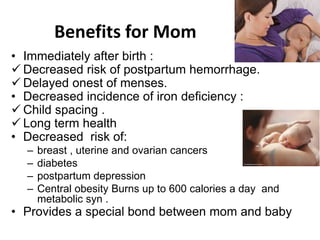
Benefits for Mom
• Immediately after birth :
 Decreased risk of postpartum hemorrhage.
 Delayed onest of menses.
• Decreased incidence of iron deficiency :
 Child spacing .
 Long term health
• Decreased risk of:
– breast , uterine and ovarian cancers
– diabetes
– postpartum depression
– Central obesity Burns up to 600 calories a day and
metabolic syn .
• Provides a special bond between mom and baby
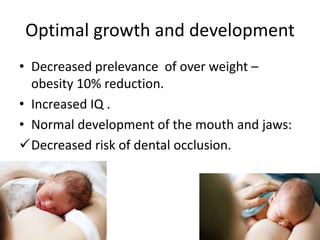
Optimal growth and development
• Decreased prelevance of over weight –
obesity 10% reduction.
• Increased IQ .
• Normal development of the mouth and jaws:
Decreased risk of dental occlusion.
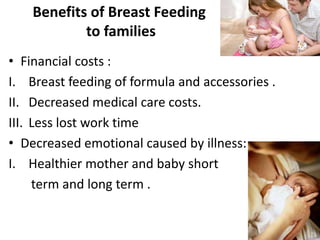
Benefits of Breast Feeding
to families
• Financial costs :
I. Breast feeding of formula and accessories .
II. Decreased medical care costs.
III. Less lost work time
• Decreased emotional caused by illness:
I. Healthier mother and baby short
term and long term .
Benefits of Breast Feeding
to society
• Lower health care costs.
• Higher work productivity
environmentally friendly
• No waste.
• No product transportation or
packaging.
• Decreased tax dollars spent to
subsidize dairy farming, free
formula, and health care
programs.
• Decreased social costs of
morbidity and mortality
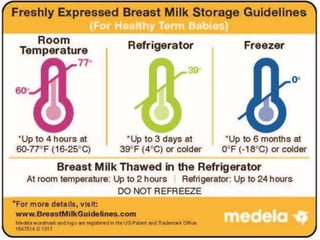
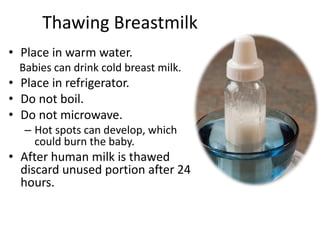
Thawing Breastmilk
• Place in warm water.
Babies can drink cold breast milk.
• Place in refrigerator.
• Do not boil.
• Do not microwave.
– Hot spots can develop, which
could burn the baby.
• After human milk is thawed
discard unused portion after 24
hours.
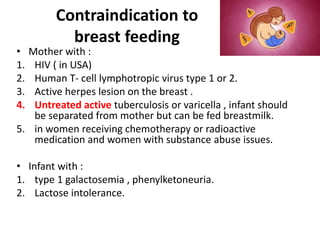
Contraindication to
breast feeding
• Mother with :
1. HIV ( in USA)
2. Human T- cell lymphotropic virus type 1 or 2.
3. Active herpes lesion on the breast .
4. Untreated active tuberculosis or varicella , infant should
be separated from mother but can be fed breastmilk.
5. in women receiving chemotherapy or radioactive
medication and women with substance abuse issues.
• Infant with :
1. type 1 galactosemia , phenylketoneuria.
2. Lactose intolerance.
THE END

Human milk

  • 1.
    The Magic milk Dr.Leen Doya Department of pediatric Tishreen university
  • 4.
    INTRODUCTION Breastfeeding is best Breastfeedexclusively for the first 6 months "Exclusive breastfeeding" is defined as no other food or drink, not even water, except breast milk for 6 months of life,( but allows the infant to receive drops and syrups vitamins, minerals and medicines ) *World Health Organization (WHO) recommends at least 2 years.
  • 7.
    1) Balanced diet 1.protein: 70% soluble ; easily digested. 2. fat: essential long chain ; needed for brain develop. 3. high cholesterol: myelination of nervous system. 4. high lactose galactose brain growth. 5. colostrum: increasing zinc prevent necrotizing enterocolitis. 6. high content of E,C,D,A and niacin.
  • 8.
    2) Anti-anaemic  Lowerrisk of iron deficiency during the first 6 months of life because: 1. Higher iron content (1.5 times cow's milk). 2. Better iron absorption due to acidic lawel medium and to the presence of large amounts of vitamins C,E and copper. 3. No iron loss in stools ( allergy to cow's milk can lead to repeated microhemorrhages ). Iron should not be given in first 3 months Breast milk contains lactoferriten which absorbs iron from bacteria  decreasing effect of infection.
  • 9.
    3) Anti-allergic • Breastmilk has secretory immunoglobulin A (IgA) .
  • 10.
    4) Anti-ricketic Breast milklower incidence of ricketic due to : a- higher content of biologically active vit.D. b- Ideal Ca/ph ratio helps optimal absorption of both. (Ca /P ratio). c- higher lactose content enhances calcium absorption from the gut.
  • 11.
    1- Contains (immunoglobulins), Secretory IgA. 2- Lactoferrin (iron-binding protein) inhibits growth of E- coli by depriving it from iron. 3- Lactose and bifidus factor promote growth of protecting flora. 4- Milk macrophages phagocytose and kill bacteria and fungi. 5- Milk B-lymphocytes secrete IgA , T-lymphocytes involved in cell-mediated immunity. 5) Anti-infection property
  • 12.
  • 13.
    Breastfeeding has benefitsfor : • Infants • Mother • Family • Society
  • 14.
    Benefits of BreastFeeding to Infants • Decrease morbidity and mortality infections: Respiratory. Gastrointestinal. • Optimal nutrition. Sepcies – specific nutrient. No over feeding. • Improved outcome for premature infants: Fewer infections. Decreased risk of NEC. Earlier discharge.
  • 15.
    Benefits of BreastFeeding to Older Child • Functional Competent immune system . • Protective effect against type 2 diabetes. • Decreased risk of some childhood leukemias ( with longer duration ). • less likely to suffer from serious lung infections and infections of the intestines causing diarrhea and dehydration. • They also have normal growth and development • can regulate the amount of milk they take, and, therefore, are less likely to be overfed and become overweight or obese.
  • 16.
    Benefits for Mom •Immediately after birth :  Decreased risk of postpartum hemorrhage.  Delayed onest of menses. • Decreased incidence of iron deficiency :  Child spacing .  Long term health • Decreased risk of: – breast , uterine and ovarian cancers – diabetes – postpartum depression – Central obesity Burns up to 600 calories a day and metabolic syn . • Provides a special bond between mom and baby
  • 17.
    Optimal growth anddevelopment • Decreased prelevance of over weight – obesity 10% reduction. • Increased IQ . • Normal development of the mouth and jaws: Decreased risk of dental occlusion.
  • 18.
    Benefits of BreastFeeding to families • Financial costs : I. Breast feeding of formula and accessories . II. Decreased medical care costs. III. Less lost work time • Decreased emotional caused by illness: I. Healthier mother and baby short term and long term .
  • 19.
    Benefits of BreastFeeding to society • Lower health care costs. • Higher work productivity environmentally friendly • No waste. • No product transportation or packaging. • Decreased tax dollars spent to subsidize dairy farming, free formula, and health care programs. • Decreased social costs of morbidity and mortality
  • 21.
    Thawing Breastmilk • Placein warm water. Babies can drink cold breast milk. • Place in refrigerator. • Do not boil. • Do not microwave. – Hot spots can develop, which could burn the baby. • After human milk is thawed discard unused portion after 24 hours.
  • 22.
    Contraindication to breast feeding •Mother with : 1. HIV ( in USA) 2. Human T- cell lymphotropic virus type 1 or 2. 3. Active herpes lesion on the breast . 4. Untreated active tuberculosis or varicella , infant should be separated from mother but can be fed breastmilk. 5. in women receiving chemotherapy or radioactive medication and women with substance abuse issues. • Infant with : 1. type 1 galactosemia , phenylketoneuria. 2. Lactose intolerance.
  • 28.

Editor's Notes

  • #22Ā Thawing breastmilk Place in warm water. Babies can drink cold breast milk. Place in refrigerator. Do not boil. Do not microwave. Hot spots can develop, which could burn the baby. After human milk is thawed discard unused portion after 24 hours.