Journal club
Human milk composition-
Nutrient and bioactive factors
• Authors: Olivia Ballard,Ardythe L Morrow
• Journal:Pediatric clinics of North America:
Breast feeding Updates for the
Pediatricaian.
Morrow and Chantry
February 2013,Volume 60,Number 1
Introduction:
• EBF for 6 months with continued breastfeeding for 1-
2yrs of life is normative standard for infant feeding.`
• Human milk is uniquely suited to human infant in
nutritional and bioactive factors that promote
survival and healthy infant.
• Human milk composition is dynamic.
`WHO.infant and young children nutrition.Geneva:WHO;2003
• Briefly reviews nutritional a components of
human milk and provides overview of varied
bioactive factors .
• Discuss impact on human milk with storage
and pasteurization .
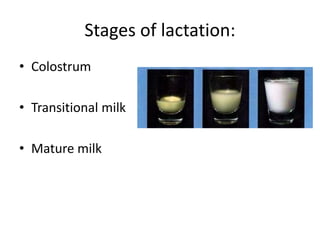
Stages of lactation:
• Colostrum
• Transitional milk
• Mature milk
Studies on human milk composition:
• Gold standard for milk collection involves
sampling of all milk expressed over 24 hrs,with
collection over time multiple times from same
individual`
`Bauerj,Gerss.Longitudinal aanalysis of macro and mineral in human milk.Clin Nutr
2011;30(2)215-20
Nutritional components
Nutritional components derived from 3 sources
• Synthesis in lactocyte.
• Dietary in origin
• Maternal stores
Macronutrients:
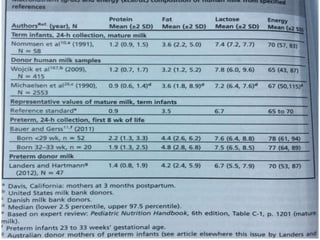
• Varies with mothers and across lactation
• Macronutrient composition is conserved across
population despite variation in maternal status.
• After 4 months of postpartum associated with
:maternal wt for ht,protein intake ,parity and
nursing frequency and return of mensturation.`
• Higher quantity of milk lower conc. of fat and
protein but higher concentration of lactose `
`Nommsen LA et al.Determinants of energy,protein,lipid in humam milk in first 12 months of
lactation:the DARLING Study.Am J Nutr 1991;53(2):457-65
Proteins:
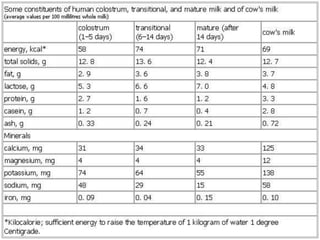
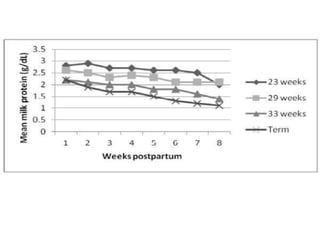
• Term mature milk:0.9-1.2g/dl
• Predominantly whey and casein.
• Most abundant proteins are- casein,a-
lactoalbumin,lactoferrin,sIgA,lysozyme and serum
albumin.
• Non protein nitrogen compounds-urea,uric acid
,creatinine,aa,nucleotides(25% of human milk
nitrogen)
• Concentration is not affected by maternal
diet,but increases with weight for height and
decreases in mother producing more milk.
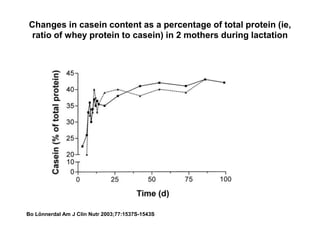
Changes in casein content as a percentage of total protein (ie,
ratio of whey protein to casein) in 2 mothers during lactation
Bo Lönnerdal Am J Clin Nutr 2003;77:1537S-1543S
Fat:
• Term mature milk:3.2- 3.6gm/dl.
• High conc of palmitic and oleic acid
• Highly variable macronutrient-foremilk and hindmilk
• Significantly lower in night and morning compared to
afternoon and evening`
• 25% variation in lipid concentration between mothers can be
explained by maternal protein intake.
` Kent JC, Mitoulas LR, Cregan MD, Ramsay DT, Doherty DA, Hartmann PE. Volume and
frequency of breastfeedings and fat content of breast milk throughout the
day. Pediatrics. 2006;117(3):e387–395.
• Fatty acid profile varies in relation to maternal
diet particularly LCPUFA.
• LCPUFA intake in western is predominantly
w-6,sup optimal w-3 fatty acids.
• DHA composition in human milk is low in N
American population,supplementation to be
considered for breast feeding women .
Carbhoydrate:
• Predominant sugar lactose 6.7-7.8gm/dl
• Least variable of macro nutrients
• Higher quantity in mothers producing more
milk
• Oligosaccharide 1gm/dl bioactive factor
Micronutrients:
• Vary depending on maternal diet and body stores
including Vit A,B1,B6,B2,B12,D and iodine.
• Maternal diet is not always optimal so continuing
multivitamins during lactation is recommended.`
• Vit K and Vit D low quantity in human milk.
`Greer FR. Do breastfed infants need supplemental vitamins? Pediatric clinics of North
America.2001;48(2):415–423.
Bioactive components:
• Elements that affect biologic processes or
substrates and hence have an impact on body
function or condition.
• Secreted by mammary epithelium,produced
by cells in milk,drawn from maternal blood.
• 1.Growth factors .
• 2.Immunologic factors.
Growth factors
• Epidermal growth factor:intestinal maturation
and repair.
• Neuronal growth factors:BDNF,GDNF:growth
and development of the enteral nervous
system.
• Insulin like growth factor superfamily:tissue
growth
• VEGF:regulation of vascular system
• Erythropoetin:Intestinal development and
prevention of anaemia.
• Calcitonin and somatostatin:growth regulating
hormones.
• Adiponectin:regulating metabolism and body
composition.
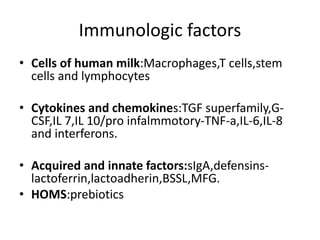
Immunologic factors
• Cells of human milk:Macrophages,T cells,stem
cells and lymphocytes
• Cytokines and chemokines:TGF superfamily,G-
CSF,IL 7,IL 10/pro infalmmotory-TNF-a,IL-6,IL-8
and interferons.
• Acquired and innate factors:sIgA,defensins-
lactoferrin,lactoadherin,BSSL,MFG.
• HOMS:prebiotics
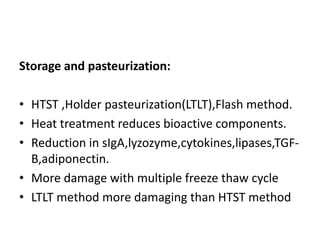
Storage and pasteurization:
• HTST ,Holder pasteurization(LTLT),Flash method.
• Heat treatment reduces bioactive components.
• Reduction in sIgA,lyzozyme,cytokines,lipases,TGF-
B,adiponectin.
• More damage with multiple freeze thaw cycle
• LTLT method more damaging than HTST method
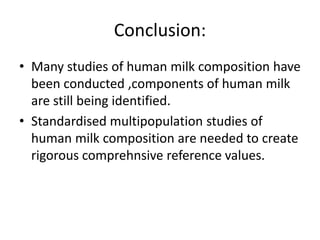
Conclusion:
• Many studies of human milk composition have
been conducted ,components of human milk
are still being identified.
• Standardised multipopulation studies of
human milk composition are needed to create
rigorous comprehnsive reference values.
THANK YOU

Human milk composition jc

  • 1.
    Journal club Human milkcomposition- Nutrient and bioactive factors
  • 2.
    • Authors: OliviaBallard,Ardythe L Morrow • Journal:Pediatric clinics of North America: Breast feeding Updates for the Pediatricaian. Morrow and Chantry February 2013,Volume 60,Number 1
  • 3.
    Introduction: • EBF for6 months with continued breastfeeding for 1- 2yrs of life is normative standard for infant feeding.` • Human milk is uniquely suited to human infant in nutritional and bioactive factors that promote survival and healthy infant. • Human milk composition is dynamic. `WHO.infant and young children nutrition.Geneva:WHO;2003
  • 4.
    • Briefly reviewsnutritional a components of human milk and provides overview of varied bioactive factors . • Discuss impact on human milk with storage and pasteurization .
  • 5.
    Stages of lactation: •Colostrum • Transitional milk • Mature milk
  • 7.
    Studies on humanmilk composition: • Gold standard for milk collection involves sampling of all milk expressed over 24 hrs,with collection over time multiple times from same individual` `Bauerj,Gerss.Longitudinal aanalysis of macro and mineral in human milk.Clin Nutr 2011;30(2)215-20
  • 8.
    Nutritional components Nutritional componentsderived from 3 sources • Synthesis in lactocyte. • Dietary in origin • Maternal stores
  • 9.
    Macronutrients: • Varies withmothers and across lactation • Macronutrient composition is conserved across population despite variation in maternal status. • After 4 months of postpartum associated with :maternal wt for ht,protein intake ,parity and nursing frequency and return of mensturation.` • Higher quantity of milk lower conc. of fat and protein but higher concentration of lactose ` `Nommsen LA et al.Determinants of energy,protein,lipid in humam milk in first 12 months of lactation:the DARLING Study.Am J Nutr 1991;53(2):457-65
  • 11.
    Proteins: • Term maturemilk:0.9-1.2g/dl • Predominantly whey and casein. • Most abundant proteins are- casein,a- lactoalbumin,lactoferrin,sIgA,lysozyme and serum albumin. • Non protein nitrogen compounds-urea,uric acid ,creatinine,aa,nucleotides(25% of human milk nitrogen) • Concentration is not affected by maternal diet,but increases with weight for height and decreases in mother producing more milk.
  • 13.
    Changes in caseincontent as a percentage of total protein (ie, ratio of whey protein to casein) in 2 mothers during lactation Bo Lönnerdal Am J Clin Nutr 2003;77:1537S-1543S
  • 14.
    Fat: • Term maturemilk:3.2- 3.6gm/dl. • High conc of palmitic and oleic acid • Highly variable macronutrient-foremilk and hindmilk • Significantly lower in night and morning compared to afternoon and evening` • 25% variation in lipid concentration between mothers can be explained by maternal protein intake. ` Kent JC, Mitoulas LR, Cregan MD, Ramsay DT, Doherty DA, Hartmann PE. Volume and frequency of breastfeedings and fat content of breast milk throughout the day. Pediatrics. 2006;117(3):e387–395.
  • 15.
    • Fatty acidprofile varies in relation to maternal diet particularly LCPUFA. • LCPUFA intake in western is predominantly w-6,sup optimal w-3 fatty acids. • DHA composition in human milk is low in N American population,supplementation to be considered for breast feeding women .
  • 16.
    Carbhoydrate: • Predominant sugarlactose 6.7-7.8gm/dl • Least variable of macro nutrients • Higher quantity in mothers producing more milk • Oligosaccharide 1gm/dl bioactive factor
  • 17.
    Micronutrients: • Vary dependingon maternal diet and body stores including Vit A,B1,B6,B2,B12,D and iodine. • Maternal diet is not always optimal so continuing multivitamins during lactation is recommended.` • Vit K and Vit D low quantity in human milk. `Greer FR. Do breastfed infants need supplemental vitamins? Pediatric clinics of North America.2001;48(2):415–423.
  • 18.
    Bioactive components: • Elementsthat affect biologic processes or substrates and hence have an impact on body function or condition. • Secreted by mammary epithelium,produced by cells in milk,drawn from maternal blood. • 1.Growth factors . • 2.Immunologic factors.
  • 19.
    Growth factors • Epidermalgrowth factor:intestinal maturation and repair. • Neuronal growth factors:BDNF,GDNF:growth and development of the enteral nervous system. • Insulin like growth factor superfamily:tissue growth
  • 20.
    • VEGF:regulation ofvascular system • Erythropoetin:Intestinal development and prevention of anaemia. • Calcitonin and somatostatin:growth regulating hormones. • Adiponectin:regulating metabolism and body composition.
  • 21.
    Immunologic factors • Cellsof human milk:Macrophages,T cells,stem cells and lymphocytes • Cytokines and chemokines:TGF superfamily,G- CSF,IL 7,IL 10/pro infalmmotory-TNF-a,IL-6,IL-8 and interferons. • Acquired and innate factors:sIgA,defensins- lactoferrin,lactoadherin,BSSL,MFG. • HOMS:prebiotics
  • 22.
    Storage and pasteurization: •HTST ,Holder pasteurization(LTLT),Flash method. • Heat treatment reduces bioactive components. • Reduction in sIgA,lyzozyme,cytokines,lipases,TGF- B,adiponectin. • More damage with multiple freeze thaw cycle • LTLT method more damaging than HTST method
  • 23.
    Conclusion: • Many studiesof human milk composition have been conducted ,components of human milk are still being identified. • Standardised multipopulation studies of human milk composition are needed to create rigorous comprehnsive reference values.
  • 24.

Editor's Notes

  • #4 Unlike ims wch is stsandarised over small range
  • #5 Undeerstandin composition of human milk imp for management of infant feeding especially fragile,high rsik infants