Composition
and Biosynthesis
Milk
Normal
Chemical composition
of milk
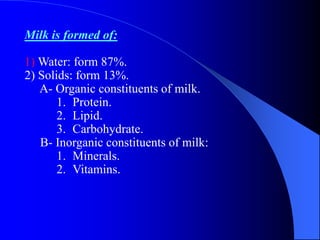
Milk is formed of:
1) Water: form 87%.
2) Solids: form 13%.
A- Organic constituents of milk.
1. Protein.
2. Lipid.
3. Carbohydrate.
B- Inorganic constituents of milk:
1. Minerals.
2. Vitamins.
A- Organic Constituents of Milk
1- Protein:
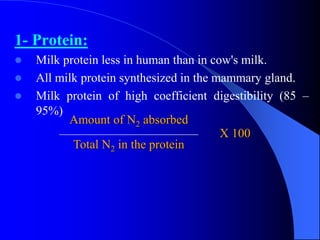
 Milk protein less in human than in cow's milk.
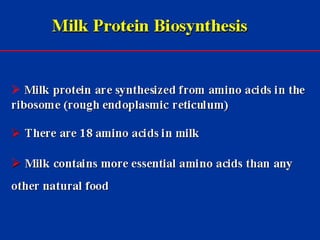
 All milk protein synthesized in the mammary gland.
 Milk protein of high coefficient digestibility (85 –
95%)
X 100
Amount of N2 absorbed
Total N2 in the protein
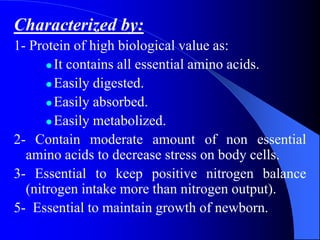
Characterized by:
1- Protein of high biological value as:
 It contains all essential amino acids.
 Easily digested.
 Easily absorbed.
 Easily metabolized.
2- Contain moderate amount of non essential
amino acids to decrease stress on body cells.
3- Essential to keep positive nitrogen balance
(nitrogen intake more than nitrogen output).
5- Essential to maintain growth of newborn.
Types of Milk Proteins are:
1. Casein.
2. Lactalbumin.
3. Lactglobulin.
4. Milk enzymes.
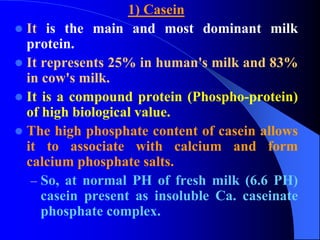
1) Casein
 It is the main and most dominant milk
protein.
 It represents 25% in human's milk and 83%
in cow's milk.
 It is a compound protein (Phospho-protein)
of high biological value.
 The high phosphate content of casein allows
it to associate with calcium and form
calcium phosphate salts.
– So, at normal PH of fresh milk (6.6 PH)
casein present as insoluble Ca. caseinate
phosphate complex.
B- Lactalbumin:
 Represent 87% of whey protein.
 PPT by full saturation with ammonium
sulphate.
 Rich in cystein and cystin so give +ve result
with sulpher test.
 Simple protein.
 Soluble protein.
 Easily digested.
 Consists of two fractions:
– α Lactalbumin 32% of whey protein.
– β lactglobulin 55% of whey protein.
N.B:
β lactglobulin called globulin because it need
small amount of NaCl to be dissolved but it is
not PPT by half saturation as albumin.
3- Lactglobulin:
 Represent 13% of whey protein.
 PPT by half saturation with ammonium sulphate
solution.
 Rich in cystein and cystin so give +ve result with
sulpher test.
 Simple protein.
 Soluble protein.
 Easily digested.
 Consists of two fractions:
True globulin (Euglobulin) 50%.
False globulin (Pseudoglobulin) 50%.
 They carry antibodies causing immunity so
called immunoglobulins.
 They present in higher concentration in
colostrum.
4- Milk enzymes:
1. Catalase.
2. Peroxidase.
3. Xanthin oxidase.
4. Alkaline phophatase.
5. Amylase.
6. Lipase.
7. Aldehyde oxidase.
2- Lipid:
 Human's and cow's milk contain the same
amount 3.5 gm/dl but buffalo's milk is a little
higher 7 gm/dl.
 Easily separated on standing.
 Responsible for white color of milk
 It consists mainly of triacylglycerol
distributed as coarse emulsion which contains
oleic, myristic, palmitic and stearic fatty acids.
Also contain small amounts of:
 phospholipids 0.1%.
–Milk phospholipids are lecithin, cephalin,
sphingomyelin (9:5:1).
–Phospholipids in cow's milk twice that of
human milk.
 Cholesterol 0.01%.
Cow's milk contains higher proportion (mainly free
form) than human milk mainly (ester form)
 Milk contain fat soluble substance:
e.g:
 Fat soluble vitamins (vitamin A) which is
higher in human milk than cow's milk.
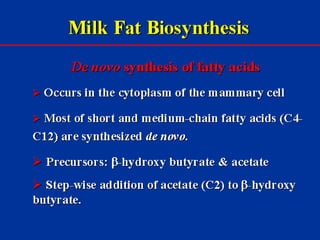
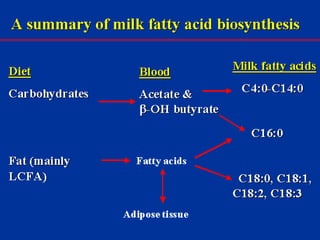
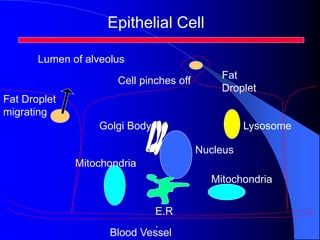
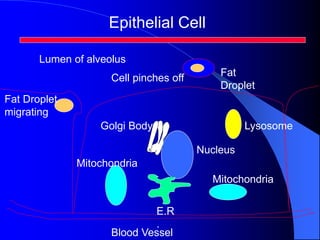
 Milk fat is formed mainly in lactating mammary gland
from:
–Active acetate.
–Glycerol: derived from glucose
(dihydroxyaceton phosphate).
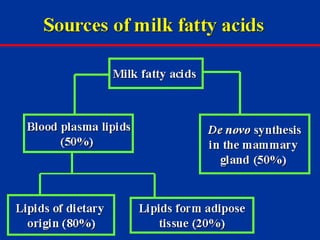
 Milk fat may be derived from blood triacylglycerol but
to a limited extent.
3- Carbohydrates:
 Lactose (milk sugar) is the only carbohydrate of
milk.
 It is a reducing disaccharide consists of glucose
and galactose.
 Human's milk contains 7% lactose while cow's
milk contains 5% lactose.
 Lactose may be excreted in urine during last
third of pregnancy physiologically so it should
be differentiated from glucose by osazon test.
Importance of lactose:
1. It is less sweet than sucrose so allow the baby to take
large amount of milk without causing nausea.
2. It is non fermentable carbohydrate so it doesn't
produce CO2 in GIT and the baby doesn't suffer from
abdominal colic or distention.
3. Lactose help growth of lactic acid producing bacteria
so help in absorption of Ca, P, Fe, Cu which prefer
acidic medium for their absorption.
4. Lactose inhibits growth of putrefactive bacteria which
cause abdominal distention by increasing the acidity
of the intestine.
B-Inorganic constituents of milk
1- Minerals:
 Human milk contain less mineral elements
(0.4%) than cow's milk (0.8%).
 Milk rich in Ca and P which are present in their
proper ratio for absorption (2:1) in human milk
while in cow's milk (1:2) which is not suitable
for their maximum absorption .
 Ca and P are essential for:
Growth of bone and teeth.
Stability of casein.
 Milk is deficient in Fe and Cu which are
supplied by their storage in liver during prenatal
life (this store is sufficient till weaning time).
 N.B:
 Milk is deficient in Iron but it is more in human
milk than cow's milk Thus anaemia in breast
feeding is less common.
 Milk contain adequate amount of Na, K, Mg.
 Human milk contains Na:K (1:2) which is
suitable for the optimal growth of newborn.
2- Vitamins:
 Milk is deficient in:
 Vitamin C.
 Vitamin D.
 Vitamin K.
 Milk contain adequate amount of vitamin B complex
which are sufficient for first week of life
e.g:
 Pantothenic acid.
 Riboflavin (gives the whey the greenish tint in
sunlight).
N.B:
 Vitamin C must be supplied to the growing baby
in the form of fruit juices to withstand infection.
 Fortified vitamin D milk is used in order to
supply the baby with vitamin D requirement
which is added from cod liver oil.
 Exposure to sunlight in the early morning or
before sunset help in formation of active vitamin
D from cholesterol.
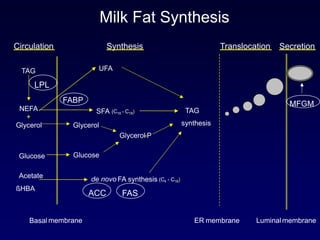
Basal membrane ER membrane Luminal membrane
LPL
FASACC
de novo FA synthesis (C4 - C16)
TAG
synthesis
Glucose
SFA (C16 - C18)
Synthesis Secretion
Acetate
ßHBA
TAG
Glucose
Circulation Translocation
UFA
FABP
NEFA
+
Glycerol
MFGM
Glycerol
Glycerol-P
Milk Fat Synthesis
Epithelial Cell
Mitochondria
Mitochondria
E.R
.
Blood Vessel
Nucleus
Fat
Droplet
Fat Droplet
migrating
Golgi Body Lysosome
Lumen of alveolus
Epithelial Cell
Mitochondria
Mitochondria
E.R
.
Blood Vessel
Nucleus
Fat
Droplet
Fat Droplet
migrating
Golgi Body Lysosome
Lumen of alveolus
Epithelial Cell
Mitochondria
Mitochondria
E.R
.
Blood Vessel
Nucleus
Fat
Droplet
Fat Droplet
migrating
Golgi Body Lysosome
Lumen of alveolus
Cell pinches off
Epithelial Cell
Mitochondria
Mitochondria
E.R
.
Blood Vessel
Nucleus
Fat
Droplet
Fat Droplet
migrating
Golgi Body Lysosome
Lumen of alveolus
Cell pinches off
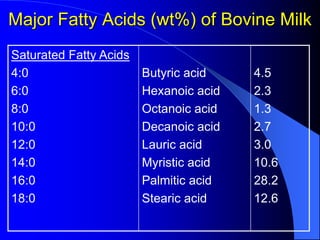
Major Fatty Acids (wt%) of Bovine Milk
Saturated Fatty Acids
4:0
6:0
8:0
10:0
12:0
14:0
16:0
18:0
Butyric acid
Hexanoic acid
Octanoic acid
Decanoic acid
Lauric acid
Myristic acid
Palmitic acid
Stearic acid
4.5
2.3
1.3
2.7
3.0
10.6
28.2
12.6
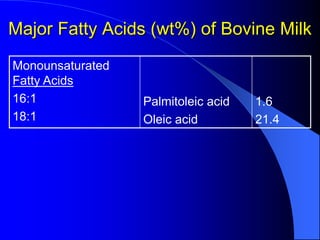
Major Fatty Acids (wt%) of Bovine Milk
Monounsaturated
Fatty Acids
16:1
18:1
Palmitoleic acid
Oleic acid
1.6
21.4
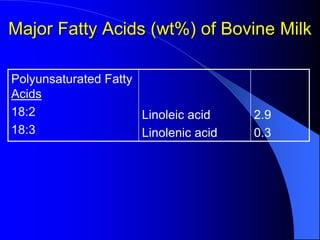
Major Fatty Acids (wt%) of Bovine Milk
Polyunsaturated Fatty
Acids
18:2
18:3
Linoleic acid
Linolenic acid
2.9
0.3
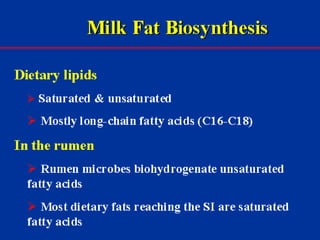
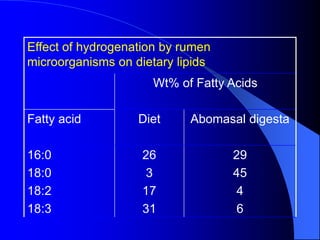
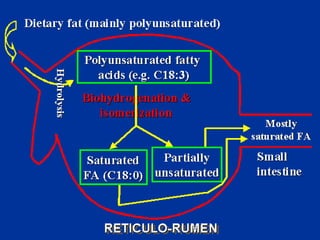
Effect of hydrogenation by rumen
microorganisms on dietary lipids
Wt% of Fatty Acids
Fatty acid Diet Abomasal digesta
16:0
18:0
18:2
18:3
26
3
17
31
29
45
4
6
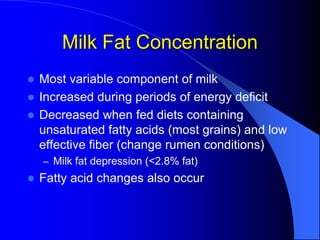
Milk Fat Concentration
 Most variable component of milk
 Increased during periods of energy deficit
 Decreased when fed diets containing
unsaturated fatty acids (most grains) and low
effective fiber (change rumen conditions)
– Milk fat depression (<2.8% fat)
 Fatty acid changes also occur
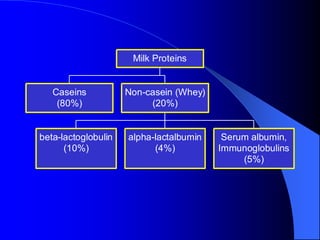
Caseins
(80%)
beta-lactoglobulin
(10%)
alpha-lactalbumin
(4%)
Serum albumin,
Immunoglobulins
(5%)
Non-casein (Whey)
(20%)
Milk Proteins
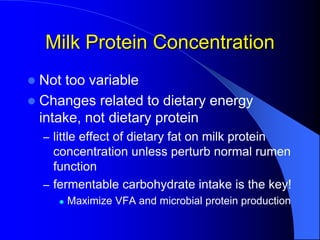
Milk Protein Concentration
 Not too variable
 Changes related to dietary energy
intake, not dietary protein
– little effect of dietary fat on milk protein
concentration unless perturb normal rumen
function
– fermentable carbohydrate intake is the key!
 Maximize VFA and microbial protein production
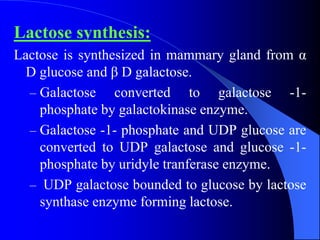
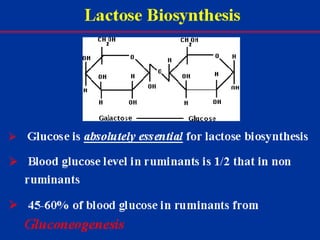
Lactose synthesis:
Lactose is synthesized in mammary gland from α
D glucose and β D galactose.
– Galactose converted to galactose -1-
phosphate by galactokinase enzyme.
– Galactose -1- phosphate and UDP glucose are
converted to UDP galactose and glucose -1-
phosphate by uridyle tranferase enzyme.
– UDP galactose bounded to glucose by lactose
synthase enzyme forming lactose.
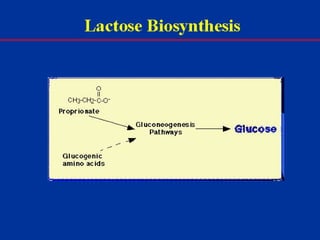
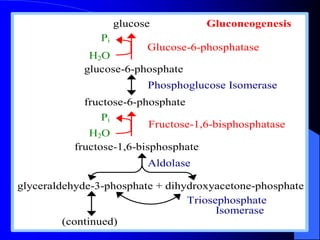
Glucose-6-phosphatase
Fructose-1,6-bisphosphatase
glucose Gluconeogenesis
Pi
H2O
glucose-6-phosphate
Phosphoglucose Isomerase
fructose-6-phosphate
Pi
H2O
fructose-1,6-bisphosphate
Aldolase
glyceraldehyde-3-phosphate + dihydroxyacetone-phosphate
Triosephosphate
Isomerase
(continued)
Composition and biosynthesis of milk component

Composition and biosynthesis of milk component

  • 1.
  • 2.
  • 3.
    Milk is formedof: 1) Water: form 87%. 2) Solids: form 13%. A- Organic constituents of milk. 1. Protein. 2. Lipid. 3. Carbohydrate. B- Inorganic constituents of milk: 1. Minerals. 2. Vitamins.
  • 4.
  • 5.
    1- Protein:  Milkprotein less in human than in cow's milk.  All milk protein synthesized in the mammary gland.  Milk protein of high coefficient digestibility (85 – 95%) X 100 Amount of N2 absorbed Total N2 in the protein
  • 6.
    Characterized by: 1- Proteinof high biological value as:  It contains all essential amino acids.  Easily digested.  Easily absorbed.  Easily metabolized. 2- Contain moderate amount of non essential amino acids to decrease stress on body cells. 3- Essential to keep positive nitrogen balance (nitrogen intake more than nitrogen output). 5- Essential to maintain growth of newborn.
  • 7.
    Types of MilkProteins are: 1. Casein. 2. Lactalbumin. 3. Lactglobulin. 4. Milk enzymes.
  • 8.
    1) Casein  Itis the main and most dominant milk protein.  It represents 25% in human's milk and 83% in cow's milk.  It is a compound protein (Phospho-protein) of high biological value.  The high phosphate content of casein allows it to associate with calcium and form calcium phosphate salts. – So, at normal PH of fresh milk (6.6 PH) casein present as insoluble Ca. caseinate phosphate complex.
  • 9.
    B- Lactalbumin:  Represent87% of whey protein.  PPT by full saturation with ammonium sulphate.  Rich in cystein and cystin so give +ve result with sulpher test.  Simple protein.  Soluble protein.  Easily digested.
  • 10.
     Consists oftwo fractions: – α Lactalbumin 32% of whey protein. – β lactglobulin 55% of whey protein. N.B: β lactglobulin called globulin because it need small amount of NaCl to be dissolved but it is not PPT by half saturation as albumin.
  • 11.
    3- Lactglobulin:  Represent13% of whey protein.  PPT by half saturation with ammonium sulphate solution.  Rich in cystein and cystin so give +ve result with sulpher test.  Simple protein.  Soluble protein.  Easily digested.
  • 12.
     Consists oftwo fractions: True globulin (Euglobulin) 50%. False globulin (Pseudoglobulin) 50%.  They carry antibodies causing immunity so called immunoglobulins.  They present in higher concentration in colostrum.
  • 13.
    4- Milk enzymes: 1.Catalase. 2. Peroxidase. 3. Xanthin oxidase. 4. Alkaline phophatase. 5. Amylase. 6. Lipase. 7. Aldehyde oxidase.
  • 14.
    2- Lipid:  Human'sand cow's milk contain the same amount 3.5 gm/dl but buffalo's milk is a little higher 7 gm/dl.  Easily separated on standing.  Responsible for white color of milk  It consists mainly of triacylglycerol distributed as coarse emulsion which contains oleic, myristic, palmitic and stearic fatty acids.
  • 15.
    Also contain smallamounts of:  phospholipids 0.1%. –Milk phospholipids are lecithin, cephalin, sphingomyelin (9:5:1). –Phospholipids in cow's milk twice that of human milk.  Cholesterol 0.01%. Cow's milk contains higher proportion (mainly free form) than human milk mainly (ester form)  Milk contain fat soluble substance: e.g:
  • 16.
     Fat solublevitamins (vitamin A) which is higher in human milk than cow's milk.  Milk fat is formed mainly in lactating mammary gland from: –Active acetate. –Glycerol: derived from glucose (dihydroxyaceton phosphate).  Milk fat may be derived from blood triacylglycerol but to a limited extent.
  • 17.
    3- Carbohydrates:  Lactose(milk sugar) is the only carbohydrate of milk.  It is a reducing disaccharide consists of glucose and galactose.  Human's milk contains 7% lactose while cow's milk contains 5% lactose.  Lactose may be excreted in urine during last third of pregnancy physiologically so it should be differentiated from glucose by osazon test.
  • 18.
    Importance of lactose: 1.It is less sweet than sucrose so allow the baby to take large amount of milk without causing nausea. 2. It is non fermentable carbohydrate so it doesn't produce CO2 in GIT and the baby doesn't suffer from abdominal colic or distention. 3. Lactose help growth of lactic acid producing bacteria so help in absorption of Ca, P, Fe, Cu which prefer acidic medium for their absorption. 4. Lactose inhibits growth of putrefactive bacteria which cause abdominal distention by increasing the acidity of the intestine.
  • 19.
  • 20.
    1- Minerals:  Humanmilk contain less mineral elements (0.4%) than cow's milk (0.8%).  Milk rich in Ca and P which are present in their proper ratio for absorption (2:1) in human milk while in cow's milk (1:2) which is not suitable for their maximum absorption .  Ca and P are essential for: Growth of bone and teeth. Stability of casein.
  • 21.
     Milk isdeficient in Fe and Cu which are supplied by their storage in liver during prenatal life (this store is sufficient till weaning time).  N.B:  Milk is deficient in Iron but it is more in human milk than cow's milk Thus anaemia in breast feeding is less common.  Milk contain adequate amount of Na, K, Mg.  Human milk contains Na:K (1:2) which is suitable for the optimal growth of newborn.
  • 22.
    2- Vitamins:  Milkis deficient in:  Vitamin C.  Vitamin D.  Vitamin K.  Milk contain adequate amount of vitamin B complex which are sufficient for first week of life e.g:  Pantothenic acid.  Riboflavin (gives the whey the greenish tint in sunlight).
  • 23.
    N.B:  Vitamin Cmust be supplied to the growing baby in the form of fruit juices to withstand infection.  Fortified vitamin D milk is used in order to supply the baby with vitamin D requirement which is added from cod liver oil.  Exposure to sunlight in the early morning or before sunset help in formation of active vitamin D from cholesterol.
  • 30.
    Basal membrane ERmembrane Luminal membrane LPL FASACC de novo FA synthesis (C4 - C16) TAG synthesis Glucose SFA (C16 - C18) Synthesis Secretion Acetate ßHBA TAG Glucose Circulation Translocation UFA FABP NEFA + Glycerol MFGM Glycerol Glycerol-P Milk Fat Synthesis
  • 31.
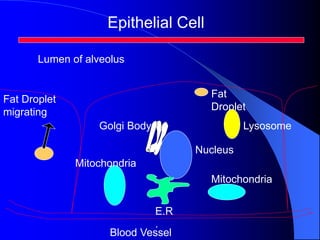
    Epithelial Cell Mitochondria Mitochondria E.R . Blood Vessel Nucleus Fat Droplet FatDroplet migrating Golgi Body Lysosome Lumen of alveolus
  • 32.
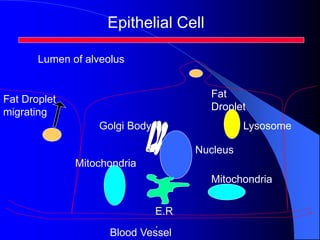
    Epithelial Cell Mitochondria Mitochondria E.R . Blood Vessel Nucleus Fat Droplet FatDroplet migrating Golgi Body Lysosome Lumen of alveolus
  • 33.
    Epithelial Cell Mitochondria Mitochondria E.R . Blood Vessel Nucleus Fat Droplet FatDroplet migrating Golgi Body Lysosome Lumen of alveolus Cell pinches off
  • 34.
    Epithelial Cell Mitochondria Mitochondria E.R . Blood Vessel Nucleus Fat Droplet FatDroplet migrating Golgi Body Lysosome Lumen of alveolus Cell pinches off
  • 35.
    Major Fatty Acids(wt%) of Bovine Milk Saturated Fatty Acids 4:0 6:0 8:0 10:0 12:0 14:0 16:0 18:0 Butyric acid Hexanoic acid Octanoic acid Decanoic acid Lauric acid Myristic acid Palmitic acid Stearic acid 4.5 2.3 1.3 2.7 3.0 10.6 28.2 12.6
  • 36.
    Major Fatty Acids(wt%) of Bovine Milk Monounsaturated Fatty Acids 16:1 18:1 Palmitoleic acid Oleic acid 1.6 21.4
  • 37.
    Major Fatty Acids(wt%) of Bovine Milk Polyunsaturated Fatty Acids 18:2 18:3 Linoleic acid Linolenic acid 2.9 0.3
  • 39.
    Effect of hydrogenationby rumen microorganisms on dietary lipids Wt% of Fatty Acids Fatty acid Diet Abomasal digesta 16:0 18:0 18:2 18:3 26 3 17 31 29 45 4 6
  • 40.
    Milk Fat Concentration Most variable component of milk  Increased during periods of energy deficit  Decreased when fed diets containing unsaturated fatty acids (most grains) and low effective fiber (change rumen conditions) – Milk fat depression (<2.8% fat)  Fatty acid changes also occur
  • 46.
  • 47.
    Milk Protein Concentration Not too variable  Changes related to dietary energy intake, not dietary protein – little effect of dietary fat on milk protein concentration unless perturb normal rumen function – fermentable carbohydrate intake is the key!  Maximize VFA and microbial protein production
  • 48.
    Lactose synthesis: Lactose issynthesized in mammary gland from α D glucose and β D galactose. – Galactose converted to galactose -1- phosphate by galactokinase enzyme. – Galactose -1- phosphate and UDP glucose are converted to UDP galactose and glucose -1- phosphate by uridyle tranferase enzyme. – UDP galactose bounded to glucose by lactose synthase enzyme forming lactose.
  • 51.