Evidence-based interventions to
support breastfeeding
Journal club
• Author: Lori Feldman-Winter,MD,MPH
• Journal:Pediatric clinics of North America:
Breast feeding Updates for the
Pediatrician.
Morrow and Chantry
February 2013,Volume 60,Number 1
Introduction
• Decision to breast feed is one of the most
important decision a mother can make.
• 75% of US mothers started breastfeeding in early
postpartum period according to CDC and NIS.
• Merely 14.8% women exclusively breast fed upto
6 months(NIS) in 2008.
• Therefore along with focusing on the decision to
breastfeed there should be focus on protection
and support of breastfeeding
• Describes evidence based practices that have
been established to support breastfeeding.
• Discusses barriers and challenges to
breastfeeding support .
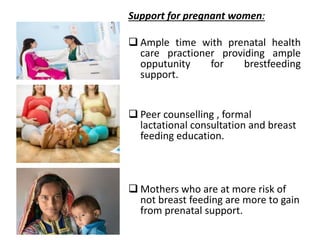
Support for pregnant women:
 Ample time with prenatal health
care practioner providing ample
opputunity for brestfeeding
support.
 Peer counselling , formal
lactational consultation and breast
feeding education.
 Mothers who are at more risk of
not breast feeding are more to gain
from prenatal support.
Content of effective sessions-benefits,priciples
of lactation,myths,common
problems,solutions and skill training.
Prenatal classes in workshop format increases
self efficacy.
Weight control strategies should be offered.
More effective when combined with
elimination of infant formula marketing
Step 3 of BFHI
Support in preipartum setting:
• Importance of skin to skin
conatct : improves physiologic
transition,increases success of
first breast feed and more
effective breast feeding.
• The first breast feed: early first
breastfeed leads to increased
milk supply in first days, early
passage of meconium and
continuing of breast feeding.
• Newborn
procedures:weighing,injectons,b
lood sampling.
BFHI:
• Has been shown to increase initiation,
continuation and exclusivity.
• 10 steps have dose dependent effect.
Support for postpartum women in
community
• Support by physician and advanced practice
nurses.
Professional support by other health care
professional:
Peer(lay) Support
Employment
• Schools and preconception education:
• Government and legistation:
Conclusion
• Considerable progress has been made in past
decade in developing support systems to enable
more women to reach breastfeeding goals.
• Each of this system is to rigorously tested and
replicated if effective.
• Additional research is needed to determine best
support during preconception period
• Along with outcome ,cost benefit analysis of
breast feeding support program.
• evaluation of government activities and program.
Breast feeding support

Breast feeding support

  • 1.
    Evidence-based interventions to supportbreastfeeding Journal club
  • 2.
    • Author: LoriFeldman-Winter,MD,MPH • Journal:Pediatric clinics of North America: Breast feeding Updates for the Pediatrician. Morrow and Chantry February 2013,Volume 60,Number 1
  • 3.
    Introduction • Decision tobreast feed is one of the most important decision a mother can make. • 75% of US mothers started breastfeeding in early postpartum period according to CDC and NIS. • Merely 14.8% women exclusively breast fed upto 6 months(NIS) in 2008. • Therefore along with focusing on the decision to breastfeed there should be focus on protection and support of breastfeeding
  • 4.
    • Describes evidencebased practices that have been established to support breastfeeding. • Discusses barriers and challenges to breastfeeding support .
  • 5.
    Support for pregnantwomen:  Ample time with prenatal health care practioner providing ample opputunity for brestfeeding support.  Peer counselling , formal lactational consultation and breast feeding education.  Mothers who are at more risk of not breast feeding are more to gain from prenatal support.
  • 6.
    Content of effectivesessions-benefits,priciples of lactation,myths,common problems,solutions and skill training. Prenatal classes in workshop format increases self efficacy. Weight control strategies should be offered. More effective when combined with elimination of infant formula marketing Step 3 of BFHI
  • 7.
    Support in preipartumsetting: • Importance of skin to skin conatct : improves physiologic transition,increases success of first breast feed and more effective breast feeding. • The first breast feed: early first breastfeed leads to increased milk supply in first days, early passage of meconium and continuing of breast feeding. • Newborn procedures:weighing,injectons,b lood sampling.
  • 8.
    BFHI: • Has beenshown to increase initiation, continuation and exclusivity. • 10 steps have dose dependent effect.
  • 10.
    Support for postpartumwomen in community • Support by physician and advanced practice nurses.
  • 11.
    Professional support byother health care professional:
  • 12.
  • 13.
  • 14.
    • Schools andpreconception education:
  • 15.
    • Government andlegistation:
  • 16.
    Conclusion • Considerable progresshas been made in past decade in developing support systems to enable more women to reach breastfeeding goals. • Each of this system is to rigorously tested and replicated if effective. • Additional research is needed to determine best support during preconception period • Along with outcome ,cost benefit analysis of breast feeding support program. • evaluation of government activities and program.