Breastfeeding techniques
Dr. Arunadevi, MD.
• Every infant and child has the right to good
nutrition according to the "Convention on the
Rights of the Child".
• Under nutrition is associated with 45% of child
deaths.
Globally in 2020,
• 149 million children under 5 were -stunted
• 45 million -wasted
• 38.9 million - overweight or obese.
• About 44% of infants 0–6 months old are
exclusively breastfed.
• Over 820 000 children's lives could be saved
every year among children under 5 years.
Good Breastfeeding Techniques
• The baby should be properly positioned to achieve
effective latching.
• The mother should wear comfortable apparel,
with the breast well exposed for the infant to be
able to latch.
• The child’s mouth, chin and umbilicus should line
up with the head in neutral position
• Infant is brought to breast with nose touching or
close to breast
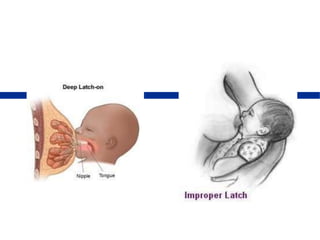
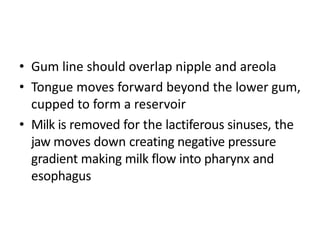
• Gum line should overlap nipple and areola
• Tongue moves forward beyond the lower gum,
cupped to form a reservoir
• Milk is removed for the lactiferous sinuses, the
jaw moves down creating negative pressure
gradient making milk flow into pharynx and
esophagus
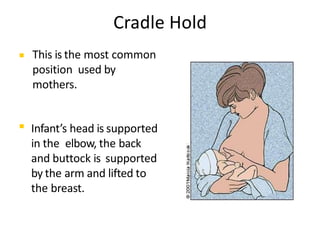
Cradle Hold
Cradle Hold
 This is the most common
position used by
mothers.

Infant’s head is supported
in the elbow, the back
and buttock is supported
by the arm and lifted to
the breast.
Adapted from AAFP Journal September 2001
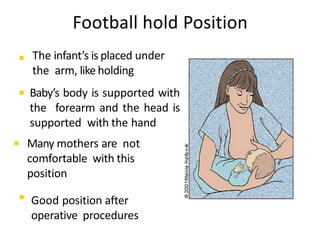
Football Hold Position
 The infant’s is placed under
the arm, like holding a football
 Baby’s body is supported with
the forearm and the head is
supported with the hand.
 Many mothers are not
comfortable with this
position

Good position after
operative procedures
Adapted from AAFP Journal September 2001
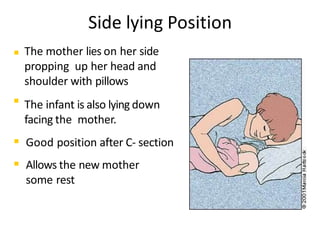
Football hold Position
 The mother lies on her side
propping up her head and
shoulder with pillows.

The infant is also lying down
facing the mother.
 Good position after C- section.
 Allows the new mother
some rest.
Side lying Position
Adapted from AAFP Journal September 2001
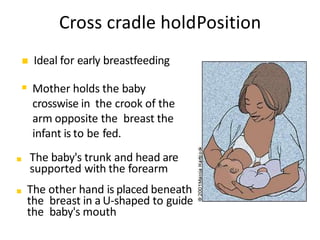
 Ideal for early breastfeeding.
 Mother holds the baby
crosswise in the crook of the
arm opposite the breast the
infant is to be fed.
 The baby's trunk and head are
supported with the forearm
 The other hand is placed beneath
the breast in a U-shaped to guide
the baby's mouth
Cross cradle holdPosition
Adapted from AAFP Journal September 2001
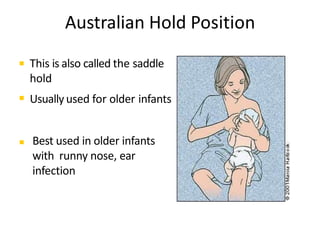
Australian Hold Position
 This is also called the saddle
hold
 Usually used for older infants
 Best used in older infants
with runny nose, ear
infection.
Australian Hold Position
Adapted from AAFP Journal September 2001
OPTIMAL/ EFFECTIVE BREAST
FEEDING
• Frequent feedings 8-12 times daily.
• Intermittent episodes of rhythmic sucking
with audible swallows should be heard while
the infant is nursing.
• Infant should have about 6-8 wet diapers in a
24 hour period
• Infant should have minimum of 3-4 bowel
movements every 24 hours.
• Stools should be about one tablespoon or
larger and should be soft and yellow after day
3.
• Average daily weight gain of 15 -30g.
• Infant has regained birth weight by day 10 of
life.
HOW TO ACHIEVE OPTIMAL BREAST
FEEDING?
Skin to skin contact for about 1-2 hours after
delivery
• Helps to maintain the body temperatures
• Reduce risk of hypoglycaemia
• Enhance oxytocin release and
• Beneficial nutrition with intake of colostrum
Activities, attitudes and procedures during the
delivery and post partum period
• Breastfeeding should be started and fully
established before discharge from the hospital
• Observe at least one feeding and ensure this is
done properly and breast milk is produced
• Lactation specialist
• Early follow up
• Breastfeeding improves IQ, school attendance,
and is associated with higher income in adult
life.
• Improving child development and reducing
health costs
• Economic gains for individual families as well
as at the national level

BREASTFEEEDING TECHNIQUES.pptx

  • 1.
  • 2.
    • Every infantand child has the right to good nutrition according to the "Convention on the Rights of the Child".
  • 3.
    • Under nutritionis associated with 45% of child deaths. Globally in 2020, • 149 million children under 5 were -stunted • 45 million -wasted • 38.9 million - overweight or obese.
  • 4.
    • About 44%of infants 0–6 months old are exclusively breastfed. • Over 820 000 children's lives could be saved every year among children under 5 years.
  • 5.
    Good Breastfeeding Techniques •The baby should be properly positioned to achieve effective latching. • The mother should wear comfortable apparel, with the breast well exposed for the infant to be able to latch. • The child’s mouth, chin and umbilicus should line up with the head in neutral position • Infant is brought to breast with nose touching or close to breast
  • 7.
    • Gum lineshould overlap nipple and areola • Tongue moves forward beyond the lower gum, cupped to form a reservoir • Milk is removed for the lactiferous sinuses, the jaw moves down creating negative pressure gradient making milk flow into pharynx and esophagus
  • 8.
    Cradle Hold Cradle Hold This is the most common position used by mothers.  Infant’s head is supported in the elbow, the back and buttock is supported by the arm and lifted to the breast. Adapted from AAFP Journal September 2001
  • 9.
    Football Hold Position The infant’s is placed under the arm, like holding a football  Baby’s body is supported with the forearm and the head is supported with the hand.  Many mothers are not comfortable with this position  Good position after operative procedures Adapted from AAFP Journal September 2001 Football hold Position
  • 10.
     The motherlies on her side propping up her head and shoulder with pillows.  The infant is also lying down facing the mother.  Good position after C- section.  Allows the new mother some rest. Side lying Position Adapted from AAFP Journal September 2001
  • 11.
     Ideal forearly breastfeeding.  Mother holds the baby crosswise in the crook of the arm opposite the breast the infant is to be fed.  The baby's trunk and head are supported with the forearm  The other hand is placed beneath the breast in a U-shaped to guide the baby's mouth Cross cradle holdPosition Adapted from AAFP Journal September 2001
  • 12.
    Australian Hold Position This is also called the saddle hold  Usually used for older infants  Best used in older infants with runny nose, ear infection. Australian Hold Position Adapted from AAFP Journal September 2001
  • 13.
  • 14.
    • Frequent feedings8-12 times daily. • Intermittent episodes of rhythmic sucking with audible swallows should be heard while the infant is nursing. • Infant should have about 6-8 wet diapers in a 24 hour period
  • 15.
    • Infant shouldhave minimum of 3-4 bowel movements every 24 hours. • Stools should be about one tablespoon or larger and should be soft and yellow after day 3. • Average daily weight gain of 15 -30g. • Infant has regained birth weight by day 10 of life.
  • 16.
    HOW TO ACHIEVEOPTIMAL BREAST FEEDING?
  • 17.
    Skin to skincontact for about 1-2 hours after delivery • Helps to maintain the body temperatures • Reduce risk of hypoglycaemia • Enhance oxytocin release and • Beneficial nutrition with intake of colostrum Activities, attitudes and procedures during the delivery and post partum period
  • 18.
    • Breastfeeding shouldbe started and fully established before discharge from the hospital • Observe at least one feeding and ensure this is done properly and breast milk is produced • Lactation specialist • Early follow up
  • 19.
    • Breastfeeding improvesIQ, school attendance, and is associated with higher income in adult life. • Improving child development and reducing health costs • Economic gains for individual families as well as at the national level