Breaking Rules
 in Consumer
   Research
Breaking
 Rules
Enhancing your decision making...in just
5 minutes

A Futures Coaching initiative
www.futurescoaching.com
#1 Favour in-depths
๎€Œ
    For real depth of understanding always
     go for one-on-ones over focus groups

    ๎€Œ
        Could a focus group ever tell you that
         some nature-lovers use binoculars to
                              approach God?
#2 Pick experience
    ๎€Œ
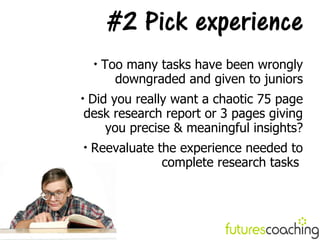
        Too many tasks have been wrongly
          downgraded and given to juniors
๎€Œ
 Did you really want a chaotic 75 page
desk research report or 3 pages giving
    you precise & meaningful insights?
๎€Œ
    Reevaluate the experience needed to
                complete research tasks
#3 Look for the essence
   ๎€Œ
    Avoid transcripts and videos: no one
  (should) have the time to review these
           ๎€Œ
               What counts is: the essential, the
                break-through insight, the 'aha!'
                                        moment
       ๎€Œ
           A BIG outcome from a focus group
                   could be a one liner: not a
                           presentation deck
#4 Use innovative methods
    ๎€Œ
        A big agency billed a training session I
        attended 'New research techniques for
              the new decade', then presented
          semiotics, lexical analysis & tracking!
            ๎€Œ
                Their justification: a new wave of
                  researchers find this stuff new
    ๎€Œ
        There is little innovation in research so
          insist on new ways; new approaches
#5 Reject research as a job
     ๎€Œ
         A major FMCG firm has an overflow of
            customer, shopper & channel data
     ๎€Œ
         Its insights team see running research
                             studies as their job
     ๎€Œ
         Avoid this: delivering business goals is
              the real objective, a task which is
           (sometimes) supported by research
#6 Become your consumer
    ๎€Œ
        What do consumers say? Become the
        consumer of your products and you'll
               already have the first insights
      When I worked for Habitat, I had to
        ๎€Œ


    spend days in store; working for Olam
       (a commodities company) requires
        time spent living & working in the
                              countryside
#7 Probe people
      ๎€Œ
       How many times have I seen user-
        based segmentations? But we are
      consumers for a fraction of our lives
๎€Œ
    People are more than consumers: they
     have jobs, friends, hobbies - & all this
            colours attitudes & behaviours
๎€Œ
    Research real people in their everyday
         lives first before drilling down to
                         purchase & usage
#8 Know your culture
        ๎€Œ
         Working with Ford, they wanted
        databooks; Virgin Atlantic wanted
                            interpretation
    ๎€Œ
     Know that company cultures dictate
    the type of research that is 'required'
๎€Œ
 Know too, that there are times when
the real research need is at odds with
     what the culture normally dicates
#9 Focus on the last 5 items
            ๎€Œ
                Huge U&A surveys are overloaded
                         with detailed questions
       ๎€Œ
           But questions near the end can often
                be the key to decode the results
            ๎€Œ
                I particularly like value statements
                tacked on the back so I know, the
                       'who?' and not just the 'how
                              much/how often/why'
#10 Cut down your budget
            ๎€Œ
              Even with complex targeting,
          incremental focus groups deliver
                       diminishing returns
              I've seen 8 even 16 groups
                ๎€Œ


        commissioned when 4 would have
                  given 95%+ of insights
    ๎€Œ
     In-depths are the same. Did 72 make
    the study more robust or were the last
      42 interviews giving the same thing?
Enhance your decision-making


       join forces with
What is Futures Coaching up to
              during May 2012?
   Helping reinvent an entire supermarket department
   Preparing an international innovations project for a
                                 winning global brand
 Building a Key Note for NGO Fundraisers in Geneva in
                                                June
Pitching to build an international development strategy
                           for a major European agency
     Planning a business trip to Jakarta and Singapore
             Pitching some new book ideas to Pearson
LONDON โ€ข PARIS


   Website: www.futurescoaching.com
Blog: http://futurescoaching.typepad.com
    Email: chris@futurescoaching.com

Breaking the rules of Consumer Research

  • 1.
    Breaking Rules inConsumer Research
  • 2.
    Breaking Rules Enhancing yourdecision making...in just 5 minutes A Futures Coaching initiative www.futurescoaching.com
  • 3.
    #1 Favour in-depths ๎€Œ For real depth of understanding always go for one-on-ones over focus groups ๎€Œ Could a focus group ever tell you that some nature-lovers use binoculars to approach God?
  • 4.
    #2 Pick experience ๎€Œ Too many tasks have been wrongly downgraded and given to juniors ๎€Œ Did you really want a chaotic 75 page desk research report or 3 pages giving you precise & meaningful insights? ๎€Œ Reevaluate the experience needed to complete research tasks
  • 5.
    #3 Look forthe essence ๎€Œ Avoid transcripts and videos: no one (should) have the time to review these ๎€Œ What counts is: the essential, the break-through insight, the 'aha!' moment ๎€Œ A BIG outcome from a focus group could be a one liner: not a presentation deck
  • 6.
    #4 Use innovativemethods ๎€Œ A big agency billed a training session I attended 'New research techniques for the new decade', then presented semiotics, lexical analysis & tracking! ๎€Œ Their justification: a new wave of researchers find this stuff new ๎€Œ There is little innovation in research so insist on new ways; new approaches
  • 7.
    #5 Reject researchas a job ๎€Œ A major FMCG firm has an overflow of customer, shopper & channel data ๎€Œ Its insights team see running research studies as their job ๎€Œ Avoid this: delivering business goals is the real objective, a task which is (sometimes) supported by research
  • 8.
    #6 Become yourconsumer ๎€Œ What do consumers say? Become the consumer of your products and you'll already have the first insights When I worked for Habitat, I had to ๎€Œ spend days in store; working for Olam (a commodities company) requires time spent living & working in the countryside
  • 9.
    #7 Probe people ๎€Œ How many times have I seen user- based segmentations? But we are consumers for a fraction of our lives ๎€Œ People are more than consumers: they have jobs, friends, hobbies - & all this colours attitudes & behaviours ๎€Œ Research real people in their everyday lives first before drilling down to purchase & usage
  • 10.
    #8 Know yourculture ๎€Œ Working with Ford, they wanted databooks; Virgin Atlantic wanted interpretation ๎€Œ Know that company cultures dictate the type of research that is 'required' ๎€Œ Know too, that there are times when the real research need is at odds with what the culture normally dicates
  • 11.
    #9 Focus onthe last 5 items ๎€Œ Huge U&A surveys are overloaded with detailed questions ๎€Œ But questions near the end can often be the key to decode the results ๎€Œ I particularly like value statements tacked on the back so I know, the 'who?' and not just the 'how much/how often/why'
  • 12.
    #10 Cut downyour budget ๎€Œ Even with complex targeting, incremental focus groups deliver diminishing returns I've seen 8 even 16 groups ๎€Œ commissioned when 4 would have given 95%+ of insights ๎€Œ In-depths are the same. Did 72 make the study more robust or were the last 42 interviews giving the same thing?
  • 13.
  • 14.
    What is FuturesCoaching up to during May 2012? Helping reinvent an entire supermarket department Preparing an international innovations project for a winning global brand Building a Key Note for NGO Fundraisers in Geneva in June Pitching to build an international development strategy for a major European agency Planning a business trip to Jakarta and Singapore Pitching some new book ideas to Pearson
  • 15.
    LONDON โ€ข PARIS Website: www.futurescoaching.com Blog: http://futurescoaching.typepad.com Email: chris@futurescoaching.com