PONS
NAME : SAKSHI
MBBS Batch 2020 - 2021
ESIC MEDICAL COLLEGE, GULBARGA
Objectives
Gross anatomy
Development
Internal anatomy
Functions
BRAINSTEM
Consists of:
Midbrain
The pons
Medulla oblongata
GROSS ANATOMY
PONS
The pons is also called the pons Varolii
Extends from cranial end of Medulla oblongata to the cerebral
peduncles of midbrain
This region of the brainstem includes neural
pathways and tracts that conduct signals from the brain down to
the cerebellum and medulla, and tracts that carry the sensory
signals up into the thalamus.
Development
During embryonic development :
Rhombencephalon
Metencephalon
pons cerebellum
Anatomical Position
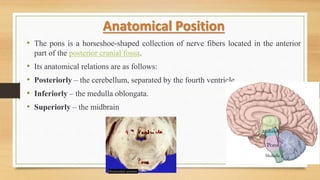
• The pons is a horseshoe-shaped collection of nerve fibers located in the anterior
part of the posterior cranial fossa.
• Its anatomical relations are as follows:
• Posteriorly – the cerebellum, separated by the fourth ventricle.
• Inferiorly – the medulla oblongata.
• Superiorly – the midbrain
Horizontal section
Midbrain
Pons
Medulla
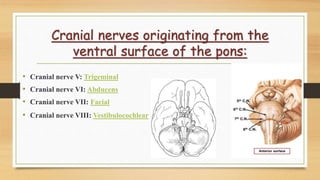
Cranial nerves originating from the
ventral surface of the pons:
• Cranial nerve V: Trigeminal
• Cranial nerve VI: Abducens
• Cranial nerve VII: Facial
• Cranial nerve VIII: Vestibulocochlear
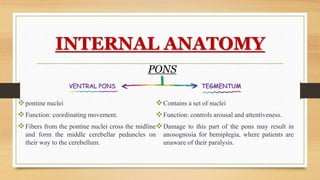
INTERNAL ANATOMY
pontine nuclei
Function: coordinating movement.
Fibers from the pontine nuclei cross the midline
and form the middle cerebellar peduncles on
their way to the cerebellum.
Contains a set of nuclei
Function: controls arousal and attentiveness.
Damage to this part of the pons may result in
anosognosia for hemiplegia, where patients are
unaware of their paralysis.
PONS
VENTRAL PONS TEGMENTUM
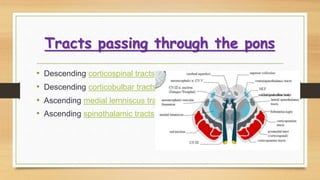
Tracts passing through the pons
• Descending corticospinal tracts
• Descending corticobulbar tracts
• Ascending medial lemniscus tracts
• Ascending spinothalamic tracts
Corticobulbar tract
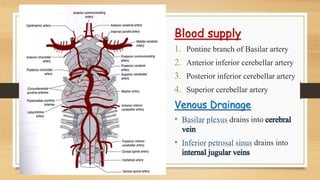
Blood supply
1. Pontine branch of Basilar artery
2. Anterior inferior cerebellar artery
3. Posterior inferior cerebellar artery
4. Superior cerebellar artery
Venous Drainage
• Basilar plexus drains into cerebral
vein
• Inferior petrosal sinus drains into
internal jugular veins
FUNCTIONS
• Pons relays sensory information between the cerebrum and cerebellum
• It connects forebrain to hindbrain
• Regulates breathing
It is also called as pneumotaxic center of the brain
• Involved in control of sleep cycle
The reticular activating system operates the body’s sleep-wake cycle
• Regulates involuntary actions
Like respiration, bladder control etc.…
• Sensory role in hearing, equilibrium and
taste.
• Motor role in rapid eye movement, facial
expression, chewing and swallowing.
• pons has some role in secretion of saliva
and tears.
• It is a part of body’s fight-or-flight system
Brainstem consist of midbrain, pons and medulla
oblongata.
Pons is also called as pons varolli ; horse-shoe shaped
collection of the nerve fibers
Located in the anterior part of the posterior cranial fossa
Extends from medulla oblongata to the midbrain
Develops from metencephalon
Several cranial nerves originate form ventral surface of the pons { cranial
nerves V, VI, VII & VIII }
Pons is divided into ventral pons (coordinating movement) and tegmentum
(control arousal and attentiveness)
Ascending and descending tracts pass through pons
Blood supply is by Basilar artery branches
FUNCTIONS: pons relay sensory information, regulates breathing,
connects forebrain to the hindbrain, sleep control and regulates several
involuntary functions also.
Thank you
Resources
• Ganong’s book of medical physiology
• BD Chourasia's Human anatomy

pons CNS neurophysiology

  • 1.
    PONS NAME : SAKSHI MBBSBatch 2020 - 2021 ESIC MEDICAL COLLEGE, GULBARGA
  • 2.
  • 3.
  • 4.
    GROSS ANATOMY PONS The ponsis also called the pons Varolii Extends from cranial end of Medulla oblongata to the cerebral peduncles of midbrain This region of the brainstem includes neural pathways and tracts that conduct signals from the brain down to the cerebellum and medulla, and tracts that carry the sensory signals up into the thalamus.
  • 5.
    Development During embryonic development: Rhombencephalon Metencephalon pons cerebellum
  • 6.
    Anatomical Position • Thepons is a horseshoe-shaped collection of nerve fibers located in the anterior part of the posterior cranial fossa. • Its anatomical relations are as follows: • Posteriorly – the cerebellum, separated by the fourth ventricle. • Inferiorly – the medulla oblongata. • Superiorly – the midbrain Horizontal section Midbrain Pons Medulla
  • 7.
    Cranial nerves originatingfrom the ventral surface of the pons: • Cranial nerve V: Trigeminal • Cranial nerve VI: Abducens • Cranial nerve VII: Facial • Cranial nerve VIII: Vestibulocochlear
  • 8.
    INTERNAL ANATOMY pontine nuclei Function:coordinating movement. Fibers from the pontine nuclei cross the midline and form the middle cerebellar peduncles on their way to the cerebellum. Contains a set of nuclei Function: controls arousal and attentiveness. Damage to this part of the pons may result in anosognosia for hemiplegia, where patients are unaware of their paralysis. PONS VENTRAL PONS TEGMENTUM
  • 9.
    Tracts passing throughthe pons • Descending corticospinal tracts • Descending corticobulbar tracts • Ascending medial lemniscus tracts • Ascending spinothalamic tracts Corticobulbar tract
  • 10.
    Blood supply 1. Pontinebranch of Basilar artery 2. Anterior inferior cerebellar artery 3. Posterior inferior cerebellar artery 4. Superior cerebellar artery Venous Drainage • Basilar plexus drains into cerebral vein • Inferior petrosal sinus drains into internal jugular veins
  • 11.
    FUNCTIONS • Pons relayssensory information between the cerebrum and cerebellum • It connects forebrain to hindbrain • Regulates breathing It is also called as pneumotaxic center of the brain • Involved in control of sleep cycle The reticular activating system operates the body’s sleep-wake cycle
  • 12.
    • Regulates involuntaryactions Like respiration, bladder control etc.… • Sensory role in hearing, equilibrium and taste. • Motor role in rapid eye movement, facial expression, chewing and swallowing. • pons has some role in secretion of saliva and tears. • It is a part of body’s fight-or-flight system
  • 13.
    Brainstem consist ofmidbrain, pons and medulla oblongata. Pons is also called as pons varolli ; horse-shoe shaped collection of the nerve fibers Located in the anterior part of the posterior cranial fossa Extends from medulla oblongata to the midbrain Develops from metencephalon
  • 14.
    Several cranial nervesoriginate form ventral surface of the pons { cranial nerves V, VI, VII & VIII } Pons is divided into ventral pons (coordinating movement) and tegmentum (control arousal and attentiveness) Ascending and descending tracts pass through pons Blood supply is by Basilar artery branches FUNCTIONS: pons relay sensory information, regulates breathing, connects forebrain to the hindbrain, sleep control and regulates several involuntary functions also.
  • 15.
    Thank you Resources • Ganong’sbook of medical physiology • BD Chourasia's Human anatomy