Downloaded 12,857 times
![Long termism in business
Issues of corporate ethics have taken the form of short-termism vs.
long-termism
If businesses are focused on long term stability and growth, they are
ethical:
Short term strategies, aimed at earning per share for the year in
question, compromise on longer interests
Warren Buffet has often stressed on long term strategies
Investigations into Fannie Mae suggested that the entire senior
management was intensively focused on earnings guidance
Capital market orientation of companies force them to be tempted
by short term targets:
Increasingly, the entire system of how companies are evaluated by
analysts, investors and stock markets leads to a short term approach
McKinsey survey [March 2006] shows that companies are focused on
short term strategies due to market pressures](https://image.slidesharecdn.com/business-ethics-121020060511-phpapp01/85/Business-ethics-3-320.jpg)
![Warren Buffet’s rule of thumb for
ethical conduct
“…I want employees to ask themselves (when
they are in doubt about whether a particular
conduct is ethical or not) whether they are
willing to have any contemplated act appear the
next day on the front page of their local paper –
to be read by their spouses, children and friends
– with the reporting done by an informed and
critical reporter.” [Berkshire Hathaway’s code of
ethics]](https://image.slidesharecdn.com/business-ethics-121020060511-phpapp01/85/Business-ethics-8-320.jpg)
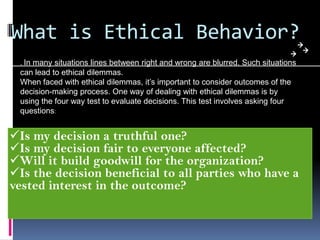
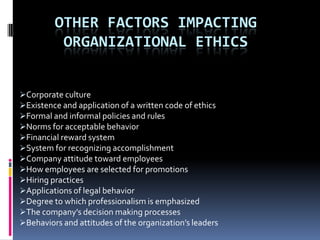
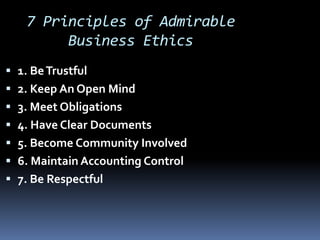

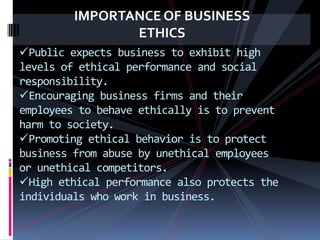




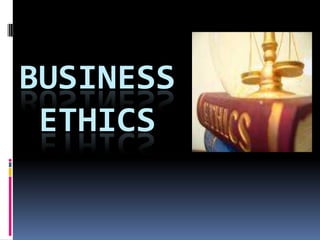
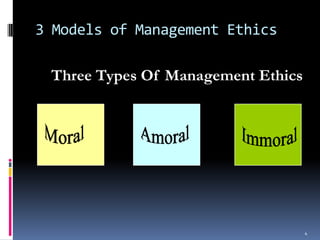
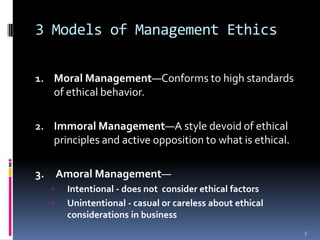
Business ethics refers to written and unwritten codes that govern decisions and actions within a company. An organization's culture determines what is considered right and wrong conduct. If businesses focus on long-term stability and growth over short-term goals, their decisions are more likely to be ethical. Managers play a key role in establishing an organization's ethical standards and culture. Upholding strong business ethics is important for public trust, preventing harm, and protecting employees and the company.


