ETYMOLOGY OF
THE ENGLISH
LANGUAGE
Julia E. Mishina
Points to be discussed:
 The mixed character of the English
language.
 Words of native origin and the role they
play in the language.
 Borrowings in the English language:
classification, special types, assimilation.
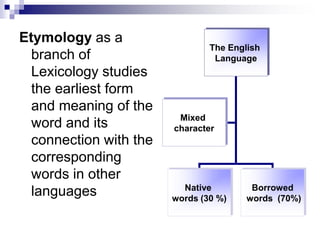
Etymology as a
branch of
Lexicology studies
the earliest form
and meaning of the
word and its
connection with the
corresponding
words in other
languages
The English
Language
Native
words (30 %)
Borrowed
words (70%)
Mixed
character
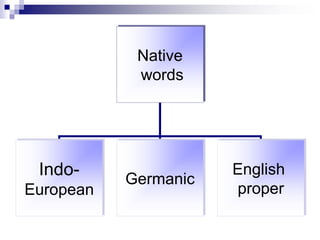
Native
words
Indo-
European
Germanic
English
proper
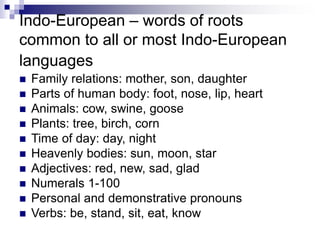
Indo-European – words of roots
common to all or most Indo-European
languages
 Family relations: mother, son, daughter
 Parts of human body: foot, nose, lip, heart
 Animals: cow, swine, goose
 Plants: tree, birch, corn
 Time of day: day, night
 Heavenly bodies: sun, moon, star
 Adjectives: red, new, sad, glad
 Numerals 1-100
 Personal and demonstrative pronouns
 Verbs: be, stand, sit, eat, know
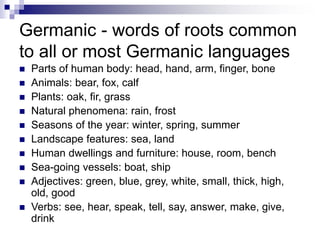
Germanic - words of roots common
to all or most Germanic languages
 Parts of human body: head, hand, arm, finger, bone
 Animals: bear, fox, calf
 Plants: oak, fir, grass
 Natural phenomena: rain, frost
 Seasons of the year: winter, spring, summer
 Landscape features: sea, land
 Human dwellings and furniture: house, room, bench
 Sea-going vessels: boat, ship
 Adjectives: green, blue, grey, white, small, thick, high,
old, good
 Verbs: see, hear, speak, tell, say, answer, make, give,
drink
English proper words have no
cognates in other languages:
Bird, boy, girl, lord, lady, woman, daisy,
always
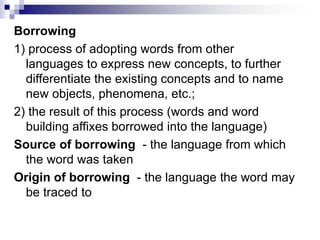
Borrowing
1) process of adopting words from other
languages to express new concepts, to further
differentiate the existing concepts and to name
new objects, phenomena, etc.;
2) the result of this process (words and word
building affixes borrowed into the language)
Source of borrowing - the language from which
the word was taken
Origin of borrowing - the language the word may
be traced to
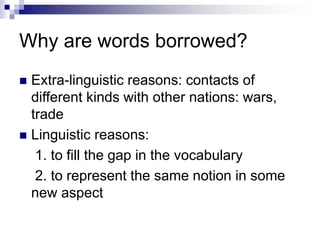
Why are words borrowed?
 Extra-linguistic reasons: contacts of
different kinds with other nations: wars,
trade
 Linguistic reasons:
1. to fill the gap in the vocabulary
2. to represent the same notion in some
new aspect
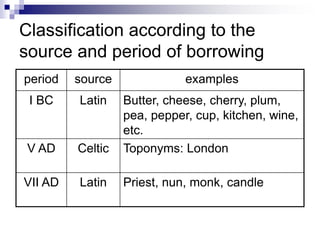
Classification according to the
source and period of borrowing
period source examples
I BC Latin Butter, cheese, cherry, plum,
pea, pepper, cup, kitchen, wine,
etc.
V AD Celtic Toponyms: London
VII AD Latin Priest, nun, monk, candle
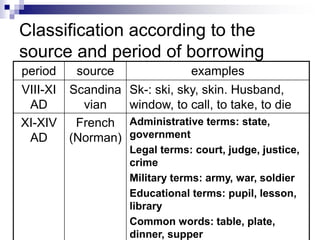
Classification according to the
source and period of borrowing
period source examples
VIII-XI
AD
Scandina
vian
Sk-: ski, sky, skin. Husband,
window, to call, to take, to die
XI-XIV
AD
French
(Norman)
Administrative terms: state,
government
Legal terms: court, judge, justice,
crime
Military terms: army, war, soldier
Educational terms: pupil, lesson,
library
Common words: table, plate,
dinner, supper
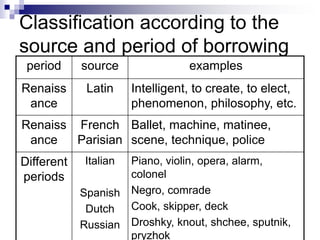
Classification according to the
source and period of borrowing
period source examples
Renaiss
ance
Latin Intelligent, to create, to elect,
phenomenon, philosophy, etc.
Renaiss
ance
French
Parisian
Ballet, machine, matinee,
scene, technique, police
Different
periods
Italian
Spanish
Dutch
Russian
Piano, violin, opera, alarm,
colonel
Negro, comrade
Cook, skipper, deck
Droshky, knout, shchee, sputnik,
pryzhok
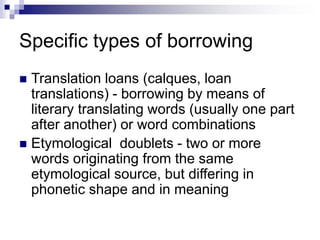
Specific types of borrowing
 Translation loans (calques, loan
translations) - borrowing by means of
literary translating words (usually one part
after another) or word combinations
 Etymological doublets - two or more
words originating from the same
etymological source, but differing in
phonetic shape and in meaning
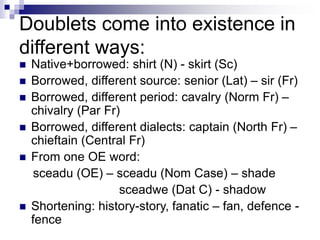
Doublets come into existence in
different ways:
 Native+borrowed: shirt (N) - skirt (Sc)
 Borrowed, different source: senior (Lat) – sir (Fr)
 Borrowed, different period: cavalry (Norm Fr) –
chivalry (Par Fr)
 Borrowed, different dialects: captain (North Fr) –
chieftain (Central Fr)
 From one OE word:
sceadu (OE) – sceadu (Nom Case) – shade
sceadwe (Dat C) - shadow
 Shortening: history-story, fanatic – fan, defence -
fence
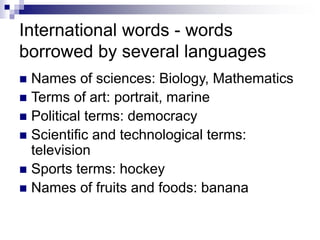
International words - words
borrowed by several languages
 Names of sciences: Biology, Mathematics
 Terms of art: portrait, marine
 Political terms: democracy
 Scientific and technological terms:
television
 Sports terms: hockey
 Names of fruits and foods: banana
Assimilation of loan words -
adjusting to the norms of the
recipient language
 Phonetic adaptation (assimilation) -
adaptation of a word to the phonetic
system of the new language
 Grammatical adaptation - a complete
change of the former paradigm of the
borrowed word
 Semantic adaptation - adjustment to the
system of meanings of the vocabulary

etymology.ppt

  • 1.
  • 2.
    Points to bediscussed:  The mixed character of the English language.  Words of native origin and the role they play in the language.  Borrowings in the English language: classification, special types, assimilation.
  • 3.
    Etymology as a branchof Lexicology studies the earliest form and meaning of the word and its connection with the corresponding words in other languages The English Language Native words (30 %) Borrowed words (70%) Mixed character
  • 4.
  • 5.
    Indo-European – wordsof roots common to all or most Indo-European languages  Family relations: mother, son, daughter  Parts of human body: foot, nose, lip, heart  Animals: cow, swine, goose  Plants: tree, birch, corn  Time of day: day, night  Heavenly bodies: sun, moon, star  Adjectives: red, new, sad, glad  Numerals 1-100  Personal and demonstrative pronouns  Verbs: be, stand, sit, eat, know
  • 6.
    Germanic - wordsof roots common to all or most Germanic languages  Parts of human body: head, hand, arm, finger, bone  Animals: bear, fox, calf  Plants: oak, fir, grass  Natural phenomena: rain, frost  Seasons of the year: winter, spring, summer  Landscape features: sea, land  Human dwellings and furniture: house, room, bench  Sea-going vessels: boat, ship  Adjectives: green, blue, grey, white, small, thick, high, old, good  Verbs: see, hear, speak, tell, say, answer, make, give, drink
  • 7.
    English proper wordshave no cognates in other languages: Bird, boy, girl, lord, lady, woman, daisy, always
  • 8.
    Borrowing 1) process ofadopting words from other languages to express new concepts, to further differentiate the existing concepts and to name new objects, phenomena, etc.; 2) the result of this process (words and word building affixes borrowed into the language) Source of borrowing - the language from which the word was taken Origin of borrowing - the language the word may be traced to
  • 9.
    Why are wordsborrowed?  Extra-linguistic reasons: contacts of different kinds with other nations: wars, trade  Linguistic reasons: 1. to fill the gap in the vocabulary 2. to represent the same notion in some new aspect
  • 10.
    Classification according tothe source and period of borrowing period source examples I BC Latin Butter, cheese, cherry, plum, pea, pepper, cup, kitchen, wine, etc. V AD Celtic Toponyms: London VII AD Latin Priest, nun, monk, candle
  • 11.
    Classification according tothe source and period of borrowing period source examples VIII-XI AD Scandina vian Sk-: ski, sky, skin. Husband, window, to call, to take, to die XI-XIV AD French (Norman) Administrative terms: state, government Legal terms: court, judge, justice, crime Military terms: army, war, soldier Educational terms: pupil, lesson, library Common words: table, plate, dinner, supper
  • 12.
    Classification according tothe source and period of borrowing period source examples Renaiss ance Latin Intelligent, to create, to elect, phenomenon, philosophy, etc. Renaiss ance French Parisian Ballet, machine, matinee, scene, technique, police Different periods Italian Spanish Dutch Russian Piano, violin, opera, alarm, colonel Negro, comrade Cook, skipper, deck Droshky, knout, shchee, sputnik, pryzhok
  • 13.
    Specific types ofborrowing  Translation loans (calques, loan translations) - borrowing by means of literary translating words (usually one part after another) or word combinations  Etymological doublets - two or more words originating from the same etymological source, but differing in phonetic shape and in meaning
  • 14.
    Doublets come intoexistence in different ways:  Native+borrowed: shirt (N) - skirt (Sc)  Borrowed, different source: senior (Lat) – sir (Fr)  Borrowed, different period: cavalry (Norm Fr) – chivalry (Par Fr)  Borrowed, different dialects: captain (North Fr) – chieftain (Central Fr)  From one OE word: sceadu (OE) – sceadu (Nom Case) – shade sceadwe (Dat C) - shadow  Shortening: history-story, fanatic – fan, defence - fence
  • 15.
    International words -words borrowed by several languages  Names of sciences: Biology, Mathematics  Terms of art: portrait, marine  Political terms: democracy  Scientific and technological terms: television  Sports terms: hockey  Names of fruits and foods: banana
  • 16.
    Assimilation of loanwords - adjusting to the norms of the recipient language  Phonetic adaptation (assimilation) - adaptation of a word to the phonetic system of the new language  Grammatical adaptation - a complete change of the former paradigm of the borrowed word  Semantic adaptation - adjustment to the system of meanings of the vocabulary