Eco 328
Balancing payments, savings and external wealth
2
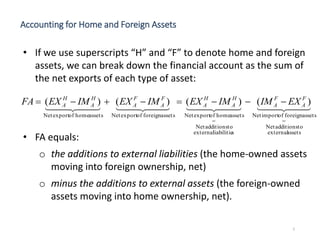
• If we use superscripts “H” and “F” to denote home and foreign
assets, we can break down the financial account as the sum of
the net exports of each type of asset:
• FA equals:
o the additions to external liabilities (the home-owned assets
moving into foreign ownership, net)
o minus the additions to external assets (the foreign-owned
assets moving into home ownership, net).
Accounting for Home and Foreign Assets
        
assetsexternal
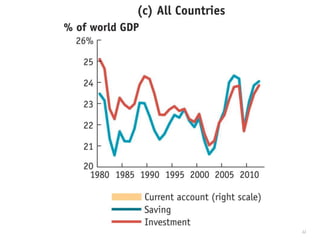
toadditionsNet
=
assetsforeignofimportNet
sliabilitieexternal
toadditionsNet
=
assetshomeofexportNetassetsforeignofexportNetassetshomeofexportNet
)()()()( F
A
F
A
H
A
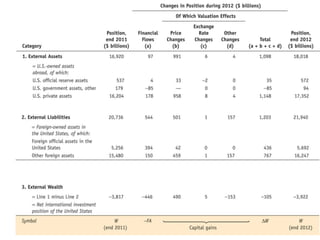
H
A
F
A
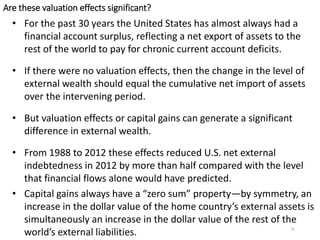
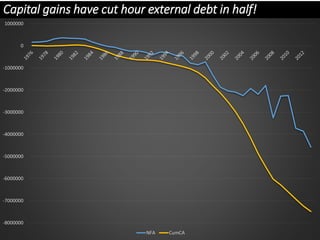
F
A
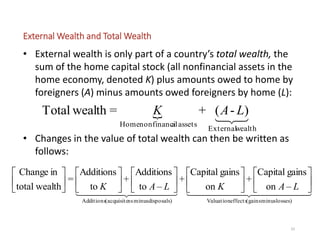
H
A
H
A EXIMIMEXIMEXIMEXFA 
3
• Recall that gross national disposable income is
• In addition, the home economy can free up resources by
engaging in net sales (or purchases) of assets. We calculate
these extra resources using our previous definitions:
How the Balance of Payments Accounts Work:

incomefromcountryhometo
availableResources
CAGNENUTNFIATBGNEGNDIY 
   
    

esasset tradtodue
countryhometheto
availableresourcesExtra
purchasesviaimportedassetsall
ofValue
giftsas
imported
assetsall
ofValue
imported
assetsall
ofValue
salesviaexportedassetsall
ofValue
giftsas
exported
assetsall
ofValue
exported
assetsall
ofValue
][][ KAFAKAKAIMEXKAIMKAEX OUTINAAINAOUTA 
4
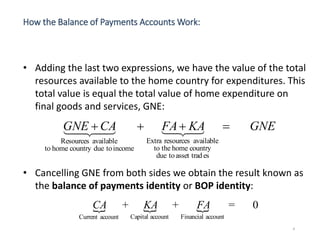
• Adding the last two expressions, we have the value of the total
resources available to the home country for expenditures. This
total value is equal the total value of home expenditure on
final goods and services, GNE:
• Cancelling GNE from both sides we obtain the result known as
the balance of payments identity or BOP identity:
How the Balance of Payments Accounts Work:
GNEKAFACAGNE  
esasset tradtodue
countryhometheto
availableresourcesExtra
incometoduecountryhometo
availableResources
   0=++
accountFinancialaccountCapitalaccountCurrent
FAKACA
5
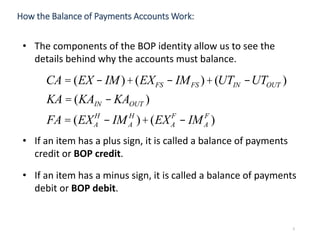
• The components of the BOP identity allow us to see the
details behind why the accounts must balance.
• If an item has a plus sign, it is called a balance of payments
credit or BOP credit.
• If an item has a minus sign, it is called a balance of payments
debit or BOP debit.
How the Balance of Payments Accounts Work:
CA = (EX - IM)+(EXFS - IMFS )+(UTIN -UTOUT )
KA = (KAIN - KAOUT )
FA = (EXA
H
- IMA
H
)+(EXA
F
- IMA
F
)
6
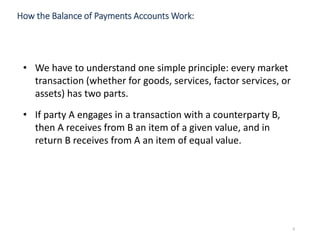
• We have to understand one simple principle: every market
transaction (whether for goods, services, factor services, or
assets) has two parts.
• If party A engages in a transaction with a counterparty B,
then A receives from B an item of a given value, and in
return B receives from A an item of equal value.
How the Balance of Payments Accounts Work:
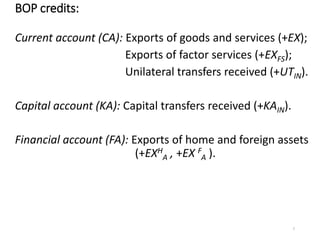
BOP credits:
Current account (CA): Exports of goods and services (+EX);
Exports of factor services (+EXFS);
Unilateral transfers received (+UTIN).
Capital account (KA): Capital transfers received (+KAIN).
Financial account (FA): Exports of home and foreign assets
(+EXH
A , +EX F
A ).
7
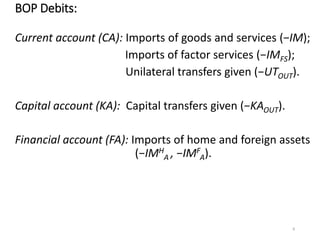
BOP Debits:
Current account (CA): Imports of goods and services (−IM);
Imports of factor services (−IMFS);
Unilateral transfers given (−UTOUT).
Capital account (KA): Capital transfers given (−KAOUT).
Financial account (FA): Imports of home and foreign assets
(−IMH
A , −IMF
A).
8
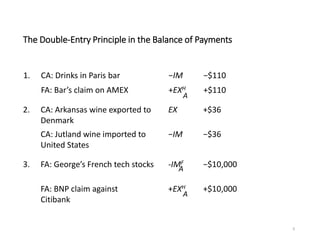
The Double-Entry Principle in the Balance of Payments
1. CA: Drinks in Paris bar −IM −$110
FA: Bar’s claim on AMEX +EXH +$110
2. CA: Arkansas wine exported to
Denmark
EX +$36
CA: Jutland wine imported to
United States
−IM −$36
3. FA: George’s French tech stocks -IMF −$10,000
FA: BNP claim against
Citibank
+EXH +$10,000
9
A
A
A
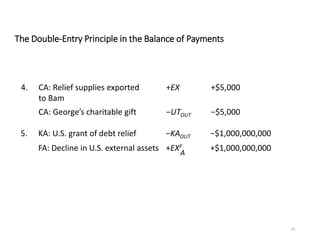
The Double-Entry Principle in the Balance of Payments
4. CA: Relief supplies exported
to Bam
+EX +$5,000
CA: George’s charitable gift −UTOUT −$5,000
5. KA: U.S. grant of debt relief −KAOUT −$1,000,000,000
FA: Decline in U.S. external assets +EXF +$1,000,000,000
10
A
11
2012
12
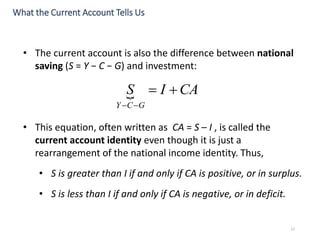
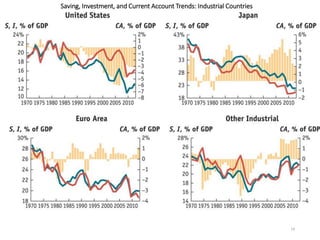
• The current account is also the difference between national
saving (S = Y − C − G) and investment:
• This equation, often written as CA = S – I , is called the
current account identity even though it is just a
rearrangement of the national income identity. Thus,
• S is greater than I if and only if CA is positive, or in surplus.
• S is less than I if and only if CA is negative, or in deficit.
What the Current Account Tells Us
 CAIS
GCY


13
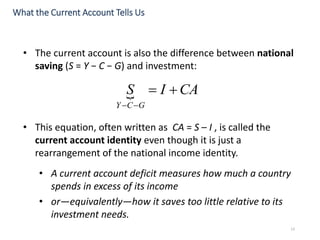
• The current account is also the difference between national
saving (S = Y − C − G) and investment:
• This equation, often written as CA = S – I , is called the
current account identity even though it is just a
rearrangement of the national income identity.
• A current account deficit measures how much a country
spends in excess of its income
• or—equivalently—how it saves too little relative to its
investment needs.
What the Current Account Tells Us
 CAIS
GCY


14
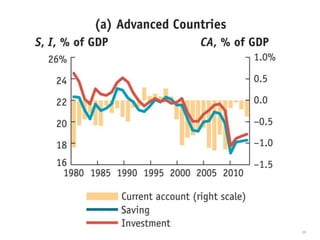
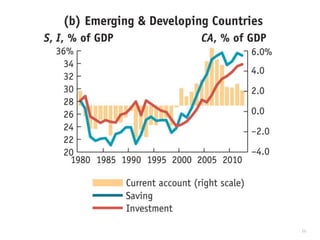
Saving, Investment, and Current Account Trends: Industrial Countries
15
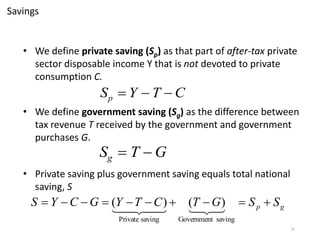
Savings
• We define private saving (Sp) as that part of after-tax private
sector disposable income Y that is not devoted to private
consumption C.
• We define government saving (Sg) as the difference between
tax revenue T received by the government and government
purchases G.
• Private saving plus government saving equals total national
saving, S

Sp  Y  T  C

Sg  T  G
gp SSGTCTYGCYS 

savingGovernmentsavingPrivate
)()(
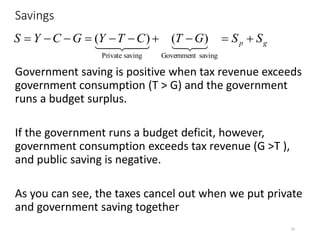
Savings
Government saving is positive when tax revenue exceeds
government consumption (T > G) and the government
runs a budget surplus.
If the government runs a budget deficit, however,
government consumption exceeds tax revenue (G >T ),
and public saving is negative.
As you can see, the taxes cancel out when we put private
and government saving together
16
gp SSGTCTYGCYS 

savingGovernmentsavingPrivate
)()(
17
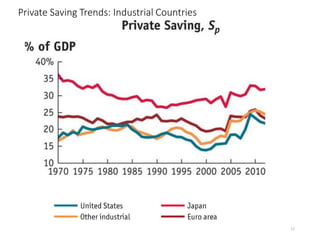
Private Saving Trends: Industrial Countries
18
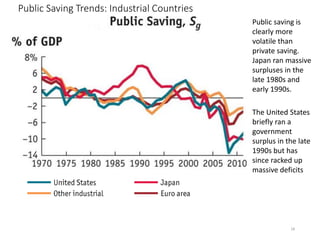
Public saving is
clearly more
volatile than
private saving.
Japan ran massive
surpluses in the
late 1980s and
early 1990s.
The United States
briefly ran a
government
surplus in the late
1990s but has
since racked up
massive deficits
Public Saving Trends: Industrial Countries
19
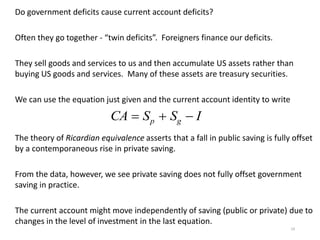
Do government deficits cause current account deficits?
Often they go together - “twin deficits”. Foreigners finance our deficits.
They sell goods and services to us and then accumulate US assets rather than
buying US goods and services. Many of these assets are treasury securities.
We can use the equation just given and the current account identity to write
The theory of Ricardian equivalence asserts that a fall in public saving is fully offset
by a contemporaneous rise in private saving.
From the data, however, we see private saving does not fully offset government
saving in practice.
The current account might move independently of saving (public or private) due to
changes in the level of investment in the last equation.

CA  Sp  Sg  I
20
21
22
23
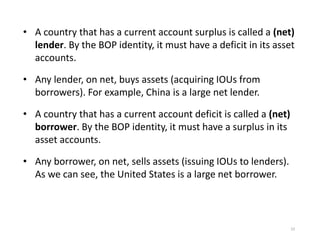
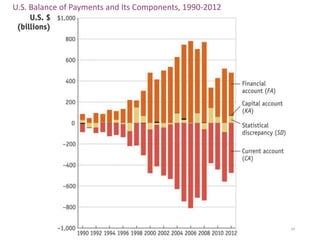
• A country that has a current account surplus is called a (net)
lender. By the BOP identity, it must have a deficit in its asset
accounts.
• Any lender, on net, buys assets (acquiring IOUs from
borrowers). For example, China is a large net lender.
• A country that has a current account deficit is called a (net)
borrower. By the BOP identity, it must have a surplus in its
asset accounts.
• Any borrower, on net, sells assets (issuing IOUs to lenders).
As we can see, the United States is a large net borrower.
24
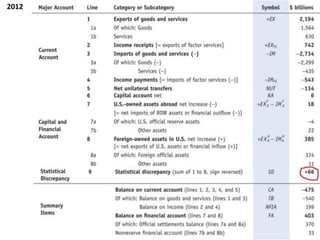
U.S. Balance of Payments and Its Components, 1990-2012
25
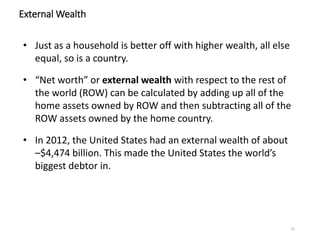
External Wealth
• Just as a household is better off with higher wealth, all else
equal, so is a country.
• “Net worth” or external wealth with respect to the rest of
the world (ROW) can be calculated by adding up all of the
home assets owned by ROW and then subtracting all of the
ROW assets owned by the home country.
• In 2012, the United States had an external wealth of about
–$4,474 billion. This made the United States the world’s
biggest debtor in.
26
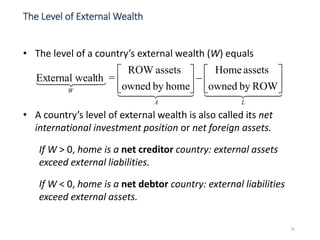
• The level of a country’s external wealth (W) equals
• A country’s level of external wealth is also called its net
international investment position or net foreign assets.
If W > 0, home is a net creditor country: external assets
exceed external liabilities.
If W < 0, home is a net debtor country: external liabilities
exceed external assets.
The Level of External Wealth
    
  
LA
W












ROWbyowned
assetsHome
homebyowned
assetsROW
=wealthExternal
27
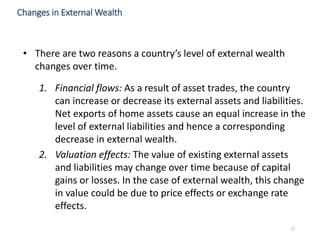
• There are two reasons a country’s level of external wealth
changes over time.
1. Financial flows: As a result of asset trades, the country
can increase or decrease its external assets and liabilities.
Net exports of home assets cause an equal increase in the
level of external liabilities and hence a corresponding
decrease in external wealth.
2. Valuation effects: The value of existing external assets
and liabilities may change over time because of capital
gains or losses. In the case of external wealth, this change
in value could be due to price effects or exchange rate
effects.
Changes in External Wealth
28
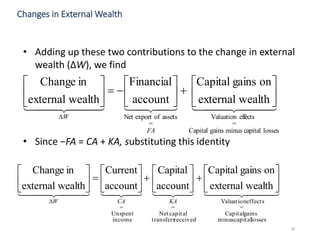
• Adding up these two contributions to the change in external
wealth (ΔW), we find
• Since −FA = CA + KA, substituting this identity
Changes in External Wealth
    
lossescapitalminusgainsCapital
=
effectsValuation
=
assetsofexportNet
wealthexternal
ongainsCapital
account
Financial
wealthexternal
inChange



















FA
W
    
lossescapitalminus
gainsCapital
=
effectsValuation
receivedtransfers
capitalNet
=
income
Unspent
=
wealthexternal
ongainsCapital
account
Capital
account
urrentC
wealthexternal
inChange
























 KACAW
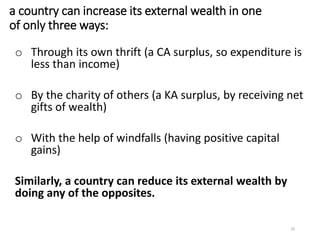
a country can increase its external wealth in one
of only three ways:
o Through its own thrift (a CA surplus, so expenditure is
less than income)
o By the charity of others (a KA surplus, by receiving net
gifts of wealth)
o With the help of windfalls (having positive capital
gains)
Similarly, a country can reduce its external wealth by
doing any of the opposites.
29
30
31
Are these valuation effects significant?
• For the past 30 years the United States has almost always had a
financial account surplus, reflecting a net export of assets to the
rest of the world to pay for chronic current account deficits.
• If there were no valuation effects, then the change in the level of
external wealth should equal the cumulative net import of assets
over the intervening period.
• But valuation effects or capital gains can generate a significant
difference in external wealth.
• From 1988 to 2012 these effects reduced U.S. net external
indebtedness in 2012 by more than half compared with the level
that financial flows alone would have predicted.
• Capital gains always have a “zero sum” property—by symmetry, an
increase in the dollar value of the home country’s external assets is
simultaneously an increase in the dollar value of the rest of the
world’s external liabilities.
Capital gains have cut hour external debt in half!
32
-8000000
-7000000
-6000000
-5000000
-4000000
-3000000
-2000000
-1000000
0
1000000
NFA CumCA
33
• External wealth is only part of a country’s total wealth, the
sum of the home capital stock (all nonfinancial assets in the
home economy, denoted K) plus amounts owed to home by
foreigners (A) minus amounts owed foreigners by home (L):
• Changes in the value of total wealth can then be written as
follows:
External Wealth and Total Wealth
 
wealthExternal
assetsalnonfinanciHome
)-(+=wealthTotal LAK
    
losses)minus(gainseffectsValuationdisposals)minusns(acquisitoAdditions
–on
gainsCapital
+
on
gainsCapital
+
–to
Additions
+
to
Additions
=
wealthtotal
inChange






























LAKLAK
34
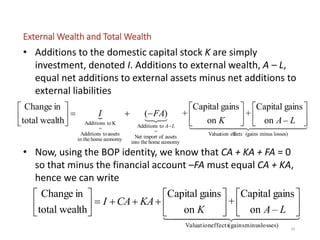
• Additions to the domestic capital stock K are simply
investment, denoted I. Additions to external wealth, A – L,
equal net additions to external assets minus net additions to
external liabilities
• Now, using the BOP identity, we know that CA + KA + FA = 0
so that minus the financial account –FA must equal CA + KA,
hence we can write
External Wealth and Total Wealth

  

losses)minus(gainseffectsValuation
economyhometheinto
assetsofimportNet
=
toAdditions
economyhomein the
assetstoAdditions
=
KtoAdditions –on
gainsCapital
+
on
gainsCapital
+)(
wealthtotal
inChange



















LAK
FAI
LA
  
losses)minus(gainseffectsValuation
–on
gainsCapital
+
on
gainsCapital
wealthtotal
inChange


















LAK
KACAI
35
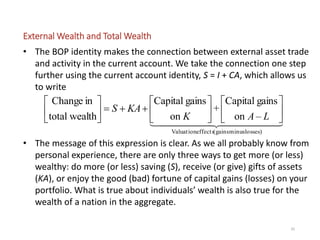
• The BOP identity makes the connection between external asset trade
and activity in the current account. We take the connection one step
further using the current account identity, S = I + CA, which allows us
to write
• The message of this expression is clear. As we all probably know from
personal experience, there are only three ways to get more (or less)
wealthy: do more (or less) saving (S), receive (or give) gifts of assets
(KA), or enjoy the good (bad) fortune of capital gains (losses) on your
portfolio. What is true about individuals’ wealth is also true for the
wealth of a nation in the aggregate.
External Wealth and Total Wealth
  
losses)minus(gainseffectsValuation
–on
gainsCapital
+
on
gainsCapital
wealthtotal
inChange


















LAK
KAS

Balancing payments, savings and external wealth

  • 1.
    Eco 328 Balancing payments,savings and external wealth
  • 2.
    2 • If weuse superscripts “H” and “F” to denote home and foreign assets, we can break down the financial account as the sum of the net exports of each type of asset: • FA equals: o the additions to external liabilities (the home-owned assets moving into foreign ownership, net) o minus the additions to external assets (the foreign-owned assets moving into home ownership, net). Accounting for Home and Foreign Assets          assetsexternal toadditionsNet = assetsforeignofimportNet sliabilitieexternal toadditionsNet = assetshomeofexportNetassetsforeignofexportNetassetshomeofexportNet )()()()( F A F A H A H A F A F A H A H A EXIMIMEXIMEXIMEXFA 
  • 3.
    3 • Recall thatgross national disposable income is • In addition, the home economy can free up resources by engaging in net sales (or purchases) of assets. We calculate these extra resources using our previous definitions: How the Balance of Payments Accounts Work:  incomefromcountryhometo availableResources CAGNENUTNFIATBGNEGNDIY            esasset tradtodue countryhometheto availableresourcesExtra purchasesviaimportedassetsall ofValue giftsas imported assetsall ofValue imported assetsall ofValue salesviaexportedassetsall ofValue giftsas exported assetsall ofValue exported assetsall ofValue ][][ KAFAKAKAIMEXKAIMKAEX OUTINAAINAOUTA 
  • 4.
    4 • Adding thelast two expressions, we have the value of the total resources available to the home country for expenditures. This total value is equal the total value of home expenditure on final goods and services, GNE: • Cancelling GNE from both sides we obtain the result known as the balance of payments identity or BOP identity: How the Balance of Payments Accounts Work: GNEKAFACAGNE   esasset tradtodue countryhometheto availableresourcesExtra incometoduecountryhometo availableResources    0=++ accountFinancialaccountCapitalaccountCurrent FAKACA
  • 5.
    5 • The componentsof the BOP identity allow us to see the details behind why the accounts must balance. • If an item has a plus sign, it is called a balance of payments credit or BOP credit. • If an item has a minus sign, it is called a balance of payments debit or BOP debit. How the Balance of Payments Accounts Work: CA = (EX - IM)+(EXFS - IMFS )+(UTIN -UTOUT ) KA = (KAIN - KAOUT ) FA = (EXA H - IMA H )+(EXA F - IMA F )
  • 6.
    6 • We haveto understand one simple principle: every market transaction (whether for goods, services, factor services, or assets) has two parts. • If party A engages in a transaction with a counterparty B, then A receives from B an item of a given value, and in return B receives from A an item of equal value. How the Balance of Payments Accounts Work:
  • 7.
    BOP credits: Current account(CA): Exports of goods and services (+EX); Exports of factor services (+EXFS); Unilateral transfers received (+UTIN). Capital account (KA): Capital transfers received (+KAIN). Financial account (FA): Exports of home and foreign assets (+EXH A , +EX F A ). 7
  • 8.
    BOP Debits: Current account(CA): Imports of goods and services (−IM); Imports of factor services (−IMFS); Unilateral transfers given (−UTOUT). Capital account (KA): Capital transfers given (−KAOUT). Financial account (FA): Imports of home and foreign assets (−IMH A , −IMF A). 8
  • 9.
    The Double-Entry Principlein the Balance of Payments 1. CA: Drinks in Paris bar −IM −$110 FA: Bar’s claim on AMEX +EXH +$110 2. CA: Arkansas wine exported to Denmark EX +$36 CA: Jutland wine imported to United States −IM −$36 3. FA: George’s French tech stocks -IMF −$10,000 FA: BNP claim against Citibank +EXH +$10,000 9 A A A
  • 10.
    The Double-Entry Principlein the Balance of Payments 4. CA: Relief supplies exported to Bam +EX +$5,000 CA: George’s charitable gift −UTOUT −$5,000 5. KA: U.S. grant of debt relief −KAOUT −$1,000,000,000 FA: Decline in U.S. external assets +EXF +$1,000,000,000 10 A
  • 11.
  • 12.
    12 • The currentaccount is also the difference between national saving (S = Y − C − G) and investment: • This equation, often written as CA = S – I , is called the current account identity even though it is just a rearrangement of the national income identity. Thus, • S is greater than I if and only if CA is positive, or in surplus. • S is less than I if and only if CA is negative, or in deficit. What the Current Account Tells Us  CAIS GCY  
  • 13.
    13 • The currentaccount is also the difference between national saving (S = Y − C − G) and investment: • This equation, often written as CA = S – I , is called the current account identity even though it is just a rearrangement of the national income identity. • A current account deficit measures how much a country spends in excess of its income • or—equivalently—how it saves too little relative to its investment needs. What the Current Account Tells Us  CAIS GCY  
  • 14.
    14 Saving, Investment, andCurrent Account Trends: Industrial Countries
  • 15.
    15 Savings • We defineprivate saving (Sp) as that part of after-tax private sector disposable income Y that is not devoted to private consumption C. • We define government saving (Sg) as the difference between tax revenue T received by the government and government purchases G. • Private saving plus government saving equals total national saving, S  Sp  Y  T  C  Sg  T  G gp SSGTCTYGCYS   savingGovernmentsavingPrivate )()(
  • 16.
    Savings Government saving ispositive when tax revenue exceeds government consumption (T > G) and the government runs a budget surplus. If the government runs a budget deficit, however, government consumption exceeds tax revenue (G >T ), and public saving is negative. As you can see, the taxes cancel out when we put private and government saving together 16 gp SSGTCTYGCYS   savingGovernmentsavingPrivate )()(
  • 17.
    17 Private Saving Trends:Industrial Countries
  • 18.
    18 Public saving is clearlymore volatile than private saving. Japan ran massive surpluses in the late 1980s and early 1990s. The United States briefly ran a government surplus in the late 1990s but has since racked up massive deficits Public Saving Trends: Industrial Countries
  • 19.
    19 Do government deficitscause current account deficits? Often they go together - “twin deficits”. Foreigners finance our deficits. They sell goods and services to us and then accumulate US assets rather than buying US goods and services. Many of these assets are treasury securities. We can use the equation just given and the current account identity to write The theory of Ricardian equivalence asserts that a fall in public saving is fully offset by a contemporaneous rise in private saving. From the data, however, we see private saving does not fully offset government saving in practice. The current account might move independently of saving (public or private) due to changes in the level of investment in the last equation.  CA  Sp  Sg  I
  • 20.
  • 21.
  • 22.
  • 23.
    23 • A countrythat has a current account surplus is called a (net) lender. By the BOP identity, it must have a deficit in its asset accounts. • Any lender, on net, buys assets (acquiring IOUs from borrowers). For example, China is a large net lender. • A country that has a current account deficit is called a (net) borrower. By the BOP identity, it must have a surplus in its asset accounts. • Any borrower, on net, sells assets (issuing IOUs to lenders). As we can see, the United States is a large net borrower.
  • 24.
    24 U.S. Balance ofPayments and Its Components, 1990-2012
  • 25.
    25 External Wealth • Justas a household is better off with higher wealth, all else equal, so is a country. • “Net worth” or external wealth with respect to the rest of the world (ROW) can be calculated by adding up all of the home assets owned by ROW and then subtracting all of the ROW assets owned by the home country. • In 2012, the United States had an external wealth of about –$4,474 billion. This made the United States the world’s biggest debtor in.
  • 26.
    26 • The levelof a country’s external wealth (W) equals • A country’s level of external wealth is also called its net international investment position or net foreign assets. If W > 0, home is a net creditor country: external assets exceed external liabilities. If W < 0, home is a net debtor country: external liabilities exceed external assets. The Level of External Wealth         LA W             ROWbyowned assetsHome homebyowned assetsROW =wealthExternal
  • 27.
    27 • There aretwo reasons a country’s level of external wealth changes over time. 1. Financial flows: As a result of asset trades, the country can increase or decrease its external assets and liabilities. Net exports of home assets cause an equal increase in the level of external liabilities and hence a corresponding decrease in external wealth. 2. Valuation effects: The value of existing external assets and liabilities may change over time because of capital gains or losses. In the case of external wealth, this change in value could be due to price effects or exchange rate effects. Changes in External Wealth
  • 28.
    28 • Adding upthese two contributions to the change in external wealth (ΔW), we find • Since −FA = CA + KA, substituting this identity Changes in External Wealth      lossescapitalminusgainsCapital = effectsValuation = assetsofexportNet wealthexternal ongainsCapital account Financial wealthexternal inChange                    FA W      lossescapitalminus gainsCapital = effectsValuation receivedtransfers capitalNet = income Unspent = wealthexternal ongainsCapital account Capital account urrentC wealthexternal inChange                          KACAW
  • 29.
    a country canincrease its external wealth in one of only three ways: o Through its own thrift (a CA surplus, so expenditure is less than income) o By the charity of others (a KA surplus, by receiving net gifts of wealth) o With the help of windfalls (having positive capital gains) Similarly, a country can reduce its external wealth by doing any of the opposites. 29
  • 30.
  • 31.
    31 Are these valuationeffects significant? • For the past 30 years the United States has almost always had a financial account surplus, reflecting a net export of assets to the rest of the world to pay for chronic current account deficits. • If there were no valuation effects, then the change in the level of external wealth should equal the cumulative net import of assets over the intervening period. • But valuation effects or capital gains can generate a significant difference in external wealth. • From 1988 to 2012 these effects reduced U.S. net external indebtedness in 2012 by more than half compared with the level that financial flows alone would have predicted. • Capital gains always have a “zero sum” property—by symmetry, an increase in the dollar value of the home country’s external assets is simultaneously an increase in the dollar value of the rest of the world’s external liabilities.
  • 32.
    Capital gains havecut hour external debt in half! 32 -8000000 -7000000 -6000000 -5000000 -4000000 -3000000 -2000000 -1000000 0 1000000 NFA CumCA
  • 33.
    33 • External wealthis only part of a country’s total wealth, the sum of the home capital stock (all nonfinancial assets in the home economy, denoted K) plus amounts owed to home by foreigners (A) minus amounts owed foreigners by home (L): • Changes in the value of total wealth can then be written as follows: External Wealth and Total Wealth   wealthExternal assetsalnonfinanciHome )-(+=wealthTotal LAK      losses)minus(gainseffectsValuationdisposals)minusns(acquisitoAdditions –on gainsCapital + on gainsCapital + –to Additions + to Additions = wealthtotal inChange                               LAKLAK
  • 34.
    34 • Additions tothe domestic capital stock K are simply investment, denoted I. Additions to external wealth, A – L, equal net additions to external assets minus net additions to external liabilities • Now, using the BOP identity, we know that CA + KA + FA = 0 so that minus the financial account –FA must equal CA + KA, hence we can write External Wealth and Total Wealth      losses)minus(gainseffectsValuation economyhometheinto assetsofimportNet = toAdditions economyhomein the assetstoAdditions = KtoAdditions –on gainsCapital + on gainsCapital +)( wealthtotal inChange                    LAK FAI LA    losses)minus(gainseffectsValuation –on gainsCapital + on gainsCapital wealthtotal inChange                   LAK KACAI
  • 35.
    35 • The BOPidentity makes the connection between external asset trade and activity in the current account. We take the connection one step further using the current account identity, S = I + CA, which allows us to write • The message of this expression is clear. As we all probably know from personal experience, there are only three ways to get more (or less) wealthy: do more (or less) saving (S), receive (or give) gifts of assets (KA), or enjoy the good (bad) fortune of capital gains (losses) on your portfolio. What is true about individuals’ wealth is also true for the wealth of a nation in the aggregate. External Wealth and Total Wealth    losses)minus(gainseffectsValuation –on gainsCapital + on gainsCapital wealthtotal inChange                   LAK KAS