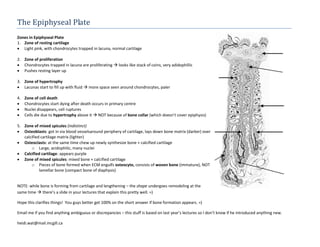
Bone formation occurs through two main processes: endochondral ossification and intramembranous ossification. Endochondral ossification involves the formation of long bones from cartilage templates. It is a multi-step process where cartilage is replaced by bone. First, primary ossification centers form in the diaphyses as bone collars prevent nutrient diffusion into cartilage, causing cartilage cell death. Blood vessels then invade and deposit osteoblasts that form trabecular bone. Secondary ossification centers later develop in the epiphyses through the same process. The epiphyseal plate contains proliferating and hypertrophying cartilage cells that drive bone growth until skeletal maturity is reached.
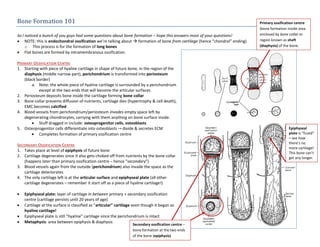
![After that… (we’re at the stage of second last diagram above)
1. After the primary and secondary ossification centers have done their job – you end up a piece of bone formed from the chunk of hyaline cartilage
you started off with.
2. The long bone then lengthens via the action of the epiphyseal plate
3. As the chrondrogenic layer forms more hyaline cartilage, the epiphseal plate “grows” outwards (see [1] below)
4. However, the overall width of the plate does NOT increase because the other end is being chew up by osteoclasts (see [2]) – (so this is after the
chondrocytes go through the layers of hypertrophy, cell death, etc.)
Putting it in Perspective – what it really looks like Shaft (diaphysis)
becomes compact
[2] Big fat osteoCLASTS bone
[1] Direction of growth
chewing everything up
(due to cartilage
at this end
proliferation)
Mixed spicules (mixture
of cartilage & bone) –
osteoclasts chewing
away in this region.
Zoom in on the black box – epiphyseal plate
Skeletal muscle!
Cartilage at the head of
the bone remains – this is
the articular cartilage (no Head of bone (epiphysis) plate!)
perichondrium!) becomes filled with
spongy bone.](https://image.slidesharecdn.com/boneformation-091202055639-phpapp02/85/Bone-Formation-2-320.jpg)