Tooth Formation
Stages of Tooth Formation

A. BUD STAGE
1. Neuro-ectoderm cells (instead of fusing into neural canal) some migrate from
   neural crest into mesoderm (will become CT) right under maxillary & mandibular
   arches
2. Neuro-ectoderm cells secrete growth factors inducing ectoderm epithelial cells
   to divide (enlargement)  forms epithelial tooth buds (10 future deciduous
   teeth per arch)

B. CAP STAGE – EARLY
3. Epithelial structure (from oral ectoderm) divides & penentrates mesoderm
   forming cavity  future enamel organ
4. Neuro-ectoderm cells mix with mesodermal cells forming neural crest mesoderm

C. CAP STAGE – LATE
5. Future enamel organ remains connected to oral ectoderm by dental lamina
6. Cavity enlarges, cells of enamel organ differentiates into defined layers by going to
   different regions :
        a. Outer dental epithelium (ODE): squamous
           o Some will form a second bud of permanent tooth (@ age 3-4, will push
                out baby tooth)
           o ODE remains connected to ectoderm
        b. Inner dental epithelium (IDE): tall columnar
           o At end of late stage, will start recruiting neuroepithelial cells to align
                underneath
7. These neurocrest mesoderm cells (mix of ecto + mesoderm cells) start
   differentiating into odontoblasts

D. BELL STAGE
8. Enamel organ also differentiates into:
        a. Stratum intermedium: cuboidal cells sitting on top of IDE
        b. Stellate reticulum: star-shaped cells scattered in space btw ODE +
             IDE
9. IDE is formed by ameloblasts which synthesize enamel  shaping the
    crown at this stage
10. Cervical loop  transition from IDE to ODE; marks position of neck of
    tooth (future crown – root junction), grows deeper into mesoderm
    (bordered by IDE + ODE)
11. Odontblasts become aligned beneath IDE, primitive dental papilla (future
    pulp) is formed
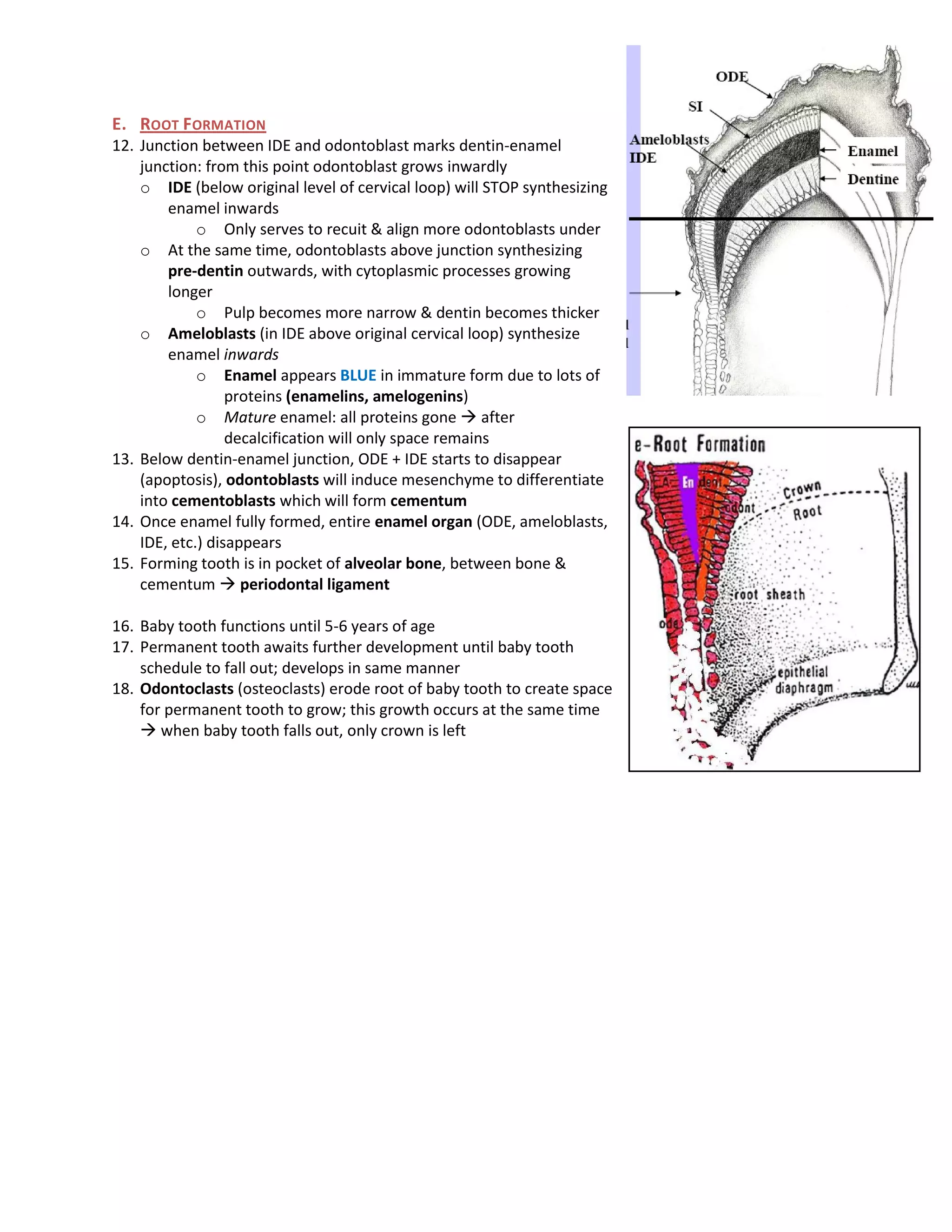
E. ROOT F ORMATION
12. Junction between IDE and odontoblast marks dentin-enamel
    junction: from this point odontoblast grows inwardly
    o IDE (below original level of cervical loop) will STOP synthesizing
        enamel inwards
             o Only serves to recuit & align more odontoblasts under
    o At the same time, odontoblasts above junction synthesizing
        pre-dentin outwards, with cytoplasmic processes growing
        longer
             o Pulp becomes more narrow & dentin becomes thicker
    o Ameloblasts (in IDE above original cervical loop) synthesize
        enamel inwards
             o Enamel appears BLUE in immature form due to lots of
                  proteins (enamelins, amelogenins)
             o Mature enamel: all proteins gone  after
                  decalcification will only space remains
13. Below dentin-enamel junction, ODE + IDE starts to disappear
    (apoptosis), odontoblasts will induce mesenchyme to differentiate
    into cementoblasts which will form cementum
14. Once enamel fully formed, entire enamel organ (ODE, ameloblasts,
    IDE, etc.) disappears
15. Forming tooth is in pocket of alveolar bone, between bone &
    cementum  periodontal ligament

16. Baby tooth functions until 5-6 years of age
17. Permanent tooth awaits further development until baby tooth
    schedule to fall out; develops in same manner
18. Odontoclasts (osteoclasts) erode root of baby tooth to create space
    for permanent tooth to grow; this growth occurs at the same time
     when baby tooth falls out, only crown is left

Tooth Formation

  • 1.
    Tooth Formation Stages ofTooth Formation A. BUD STAGE 1. Neuro-ectoderm cells (instead of fusing into neural canal) some migrate from neural crest into mesoderm (will become CT) right under maxillary & mandibular arches 2. Neuro-ectoderm cells secrete growth factors inducing ectoderm epithelial cells to divide (enlargement)  forms epithelial tooth buds (10 future deciduous teeth per arch) B. CAP STAGE – EARLY 3. Epithelial structure (from oral ectoderm) divides & penentrates mesoderm forming cavity  future enamel organ 4. Neuro-ectoderm cells mix with mesodermal cells forming neural crest mesoderm C. CAP STAGE – LATE 5. Future enamel organ remains connected to oral ectoderm by dental lamina 6. Cavity enlarges, cells of enamel organ differentiates into defined layers by going to different regions : a. Outer dental epithelium (ODE): squamous o Some will form a second bud of permanent tooth (@ age 3-4, will push out baby tooth) o ODE remains connected to ectoderm b. Inner dental epithelium (IDE): tall columnar o At end of late stage, will start recruiting neuroepithelial cells to align underneath 7. These neurocrest mesoderm cells (mix of ecto + mesoderm cells) start differentiating into odontoblasts D. BELL STAGE 8. Enamel organ also differentiates into: a. Stratum intermedium: cuboidal cells sitting on top of IDE b. Stellate reticulum: star-shaped cells scattered in space btw ODE + IDE 9. IDE is formed by ameloblasts which synthesize enamel  shaping the crown at this stage 10. Cervical loop  transition from IDE to ODE; marks position of neck of tooth (future crown – root junction), grows deeper into mesoderm (bordered by IDE + ODE) 11. Odontblasts become aligned beneath IDE, primitive dental papilla (future pulp) is formed
  • 2.
    E. ROOT FORMATION 12. Junction between IDE and odontoblast marks dentin-enamel junction: from this point odontoblast grows inwardly o IDE (below original level of cervical loop) will STOP synthesizing enamel inwards o Only serves to recuit & align more odontoblasts under o At the same time, odontoblasts above junction synthesizing pre-dentin outwards, with cytoplasmic processes growing longer o Pulp becomes more narrow & dentin becomes thicker o Ameloblasts (in IDE above original cervical loop) synthesize enamel inwards o Enamel appears BLUE in immature form due to lots of proteins (enamelins, amelogenins) o Mature enamel: all proteins gone  after decalcification will only space remains 13. Below dentin-enamel junction, ODE + IDE starts to disappear (apoptosis), odontoblasts will induce mesenchyme to differentiate into cementoblasts which will form cementum 14. Once enamel fully formed, entire enamel organ (ODE, ameloblasts, IDE, etc.) disappears 15. Forming tooth is in pocket of alveolar bone, between bone & cementum  periodontal ligament 16. Baby tooth functions until 5-6 years of age 17. Permanent tooth awaits further development until baby tooth schedule to fall out; develops in same manner 18. Odontoclasts (osteoclasts) erode root of baby tooth to create space for permanent tooth to grow; this growth occurs at the same time  when baby tooth falls out, only crown is left