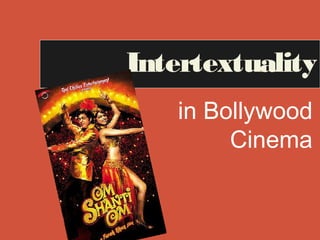
Intertextuality
    in Bollywood
         Cinema
“Om Shanti Om” song and dance number from Karz (1980)
http://www.youtube.com/watch?v=eS29KERO_d4
Karz scene from Om Shanti Om (2007).
http://www.youtube.com/watch?v=S7NIk3FQa_I
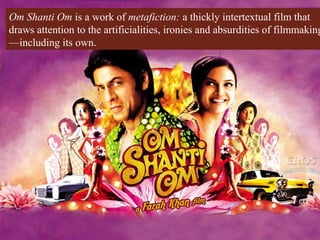
Om Shanti Om is a work of metafiction: a thickly intertextual film that
draws attention to the artificialities, ironies and absurdities of filmmaking
—including its own.
“Metafiction is fiction about fiction:
novels and stories that call attention to
their fictional status and their own
compositional procedures”
                             David Lodge
Metafiction is
any text “that
systematically
flaunts its own
condition of
artifice and that
by so doing
probes into the
problematic
relationship
between real-
seeming artifice
and reality”
     Robert Alter
Understanding Texts
Text: a coherent narrative embodied in some
medium

Like… a movie, for example!
Analyzing Texts
Explanation: Description of the elements that
make up the text and their relations to one
another.

Interpretation: Assigning value and meaning
to those elements and relations.
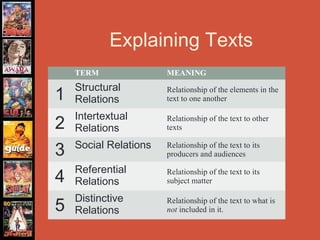
Explaining Texts
    TERM               MEANING
    Structural
1   Relations
                       Relationship of the elements in the
                       text to one another

    Intertextual
2   Relations
                       Relationship of the text to other
                       texts


3   Social Relations   Relationship of the text to its
                       producers and audiences

    Referential
4   Relations
                       Relationship of the text to its
                       subject matter

    Distinctive
5   Relations
                       Relationship of the text to what is
                       not included in it.
Intertextuality

All texts derive part
of their meaning from
prior texts.

Themes       Actors
Storylines   Directors
Symbols      Titles
Dialogue     Songs/Music
Characters   Costumes
Intertextuality
Julia Kristeva              Mikhail Bakhtin
“Every text takes shape     “The life of the word is contained
as a mosaic of citations,   in its transfer from one mouth to
                            another, from one context to
every text is the           another context, from one social
absorption and              collective to another, from one
transformation of other     generation to another generation.
                            In this process the word does not
texts”                      forget its own path and cannot
                            completely free itself from the
                            power of those concrete contexts
                            into which it has entered”
Intertextual Play

      Extracting a sign (or
      set of signs from one
      setting and inserting
      them—often in
      altered ways—into
      another to create
      meaning.
Intertextual Levels
Horizontal   References to other
References   films

Vertical     References to other
References   media: literature, art,
             music, etc.
Horizontal References
         Karz (1980)                       Om Shanti Om (2007)
In 1959, wealthy Ravi Verma is         In the 1970s, junior artist Om
murdered by his wife. He is            Prakash witnesses the murder of
reincarnated as Monty, who             superstar Shantipriya by her husband,
becomes a major rock star. During      and is murdered to silence him. He is
a performance he begins having         reincarnated as Om Kapoor, who
flashbacks to his previous life.       becomes a movie superstar. During a
After traveling to the village in      performance he begins having
Ooty where he was killed, he           flashbacks to his previous life. After
reunites with his aged mother and      traveling to the ruined studio where
sister. He tricks the murderess into   he was killed, he reunites with his
believing she is haunted, then         aged mother and brother. He tricks
sings a song that tells the whole      the murderer into believing he is
story.                                 haunted, then sings a song that tells
                                       the whole story.
Vertical References
The song “Om Shanty
Om” sung in Karz
(1980) and Om Shanti
Om (2007) is a Hindi
adaptation of a
Trinidadian “soca” hit
by Lord Shorty. It was
one of the hits that
inspired the success of
the soca genre of
music, which mixes
Indian musical
elements with African     http://www.youtube.com/watch?v=SlDsizk5YS4
and calypso.
Genette’s Five Types
                  The effective co-presence of more than one text.
Intertextuality   Replication of elements from one text in another
                  text (example: quotation).

Paratextuality
                  The relationship between a text and its
                  contextualizing “paratexts” (credits)

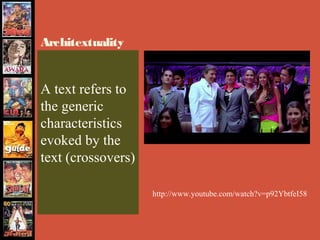
Architextuality
                  A text refers to the generic characteristics evoked
                  by the text (crossovers)
                  A text “comments” on another related text in such
Metatextuality    a way that the conventions of the text form
                  become explicit (movies about making movies)

Hypertextuality
                  A text is created by transforming a prior text into
                  something new (remake)
Intertextuality

The effective co-
presence of more
than one text.
Replication of
elements from one
text in another text
(example:
quotation).            http://www.youtube.com/watch?v=TjUXr560Gu0

                       See also:
                       http://www.cgtantra.com/forums/showthread.php?
                       t=9067
Paratextuality


The relationship
between a text and
its contextualizing
“paratexts” (credits)

                        http://www.youtube.com/watch?v=UsGE8pclLBo
Architextuality


A text refers to
the generic
characteristics
evoked by the
text (crossovers)
GENRE
A Sharukh Khan film
A Farah Khan film
A Vishal-Shekhar film
A megahit
A remake (of Karz)
A rebirth movie
etc
Architextuality


A text refers to
the generic
characteristics
evoked by the
text (crossovers)

                    http://www.youtube.com/watch?v=p92YbtfeI58
Metatextuality
A text
“comments” on
another related
text in such a way
that the
conventions of the
text form become
explicit (movies
about making
movies)              http://www.youtube.com/watch?v=fCTa8Y4CYmw
Hypertextuality


A text is created
by transforming a
prior text into
something new
(remake)
Metafiction


How does metafiction
matter to the meaning
of a text?
Metafiction
Level One:
Metanarrative
Stories within stories;
movies within
movies.
Metafiction
Level Two:
Metalepsis
The text breaks
discursive levels; reveals
the elements through
which texts are
constructed, commenting
on the artificiality of the
medium/genre
Metafiction
Level Three:
Extroversion
Metafictional narrative
not only shows the
constructed nature of the
text but uses this to
comment on the world of
life outside the text.
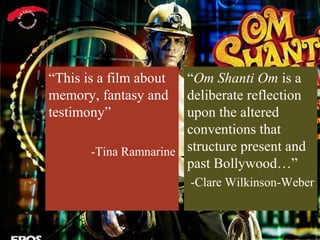
“This is a film about  “Om Shanti Om is a
memory, fantasy and    deliberate reflection
testimony”             upon the altered
                       conventions that
       -Tina Ramnarine structure present and
                       past Bollywood…”
                        -Clare Wilkinson-Weber
Ages of Bollywood Cinema
                       Postindependence
                       nationalism. Values of duty,     Hero: Innocent, suffering,
Golden Age             labor, sacrifice. Everyone in    dutiful
(Bo m ba y Film is )   their place for the greater      Heroine: Pure, enigmatic,
                       good                             obedient, pious


                                                        Hero: “Angry young man.”
                       Political and social upheaval.   Lean bodied and tough. Hard-
Silver Age             Deepening disillusionment        drinking. Westernized and
                                                        technological. Good at core:
(New                   with authority. Widespread       Respects respectable women,
                       corruption. Rising violence.
Cinema)                Breakdown of law and order.      brave, helps the weak.
                                                        Heroine: Pure, virtuous but
                                                        spunky.

                                                        Hero and heroine are
                       Rise of religious political
Bronze Age             movements. Importance of         struggling to understand what
                       diaspora. Conservative values    it means to be a modern Indian
Bollywood              but liberal economics and        (and act accordingly). Key
International          rising emphasis on               issues are authenticity and
                       consumption.
                                                        family.
Om Shanti Om
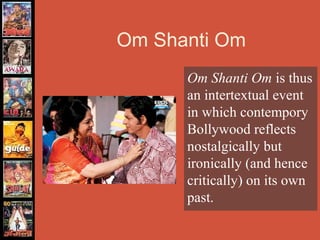
      Om Shanti Om is thus
      an intertextual event
      in which contempory
      Bollywood reflects
      nostalgically but
      ironically (and hence
      critically) on its own
      past.
Om Shanti Om

       In doing so it also
       reflects nostalgically and
       ironically (and hence
       critically) on its own
       present at a time when
       changes in economy and
       communication are
       ushering in an
       extraordinary period of
       experimentation.
References
Bakhtin, M.M. 1984. Problems of Dostoevsky’s Poetics. C. Emerson
(transl. and ed.), Minneapolis: University of Minnesota Press.
Gopalan, L 2002 Cinema of Interruptions: Action Genres in
Contemporary Indian Cinema. British Film Institute.
Kristeva, Julia. 1980. Desire in Language: A Semiotic Approach to
Literature and Art. New York: Columbia University Press.
Mehta, Monika. 2005. “Globalizing Bombay Cinema” Cultural
Dynamics 17(2): 135-154.
O’Flaherty, Wendy Doniger. 1981. “The mythological in disguise: An
analysis of Karz” India International Centre Quarterly 8(1): 23-29.
Pendakur, M. 2003 Indian Popular Cinema: Industry, Ideology and
Consciousness. Cresskill, NJ: Hampton Press.
Peterson, Mark Allen. 2003. Anthropology and Mass Communication:
Media and Myth in the New Millennium. Berghahn Books.
Romnarine, Tina K. 2011. “Music in circulation between diasporic
histories and modern media: exploring sonic politics in two Bollywood
films Om Shanti Om and Dulha Mil Gaya” South Asian Diaspora 3(2):
143-158.
Wilkinson-Weber, Clare. 2010. “A Need for Redress: Costume in some
recent Hindi film remakes” BioScope: South Asian Screen Studies 1(2):
125-145.

Bollywood intertextuality

  • 1.
    Intertextuality in Bollywood Cinema
  • 2.
    “Om Shanti Om”song and dance number from Karz (1980) http://www.youtube.com/watch?v=eS29KERO_d4
  • 3.
    Karz scene fromOm Shanti Om (2007). http://www.youtube.com/watch?v=S7NIk3FQa_I
  • 4.
    Om Shanti Omis a work of metafiction: a thickly intertextual film that draws attention to the artificialities, ironies and absurdities of filmmaking —including its own.
  • 5.
    “Metafiction is fictionabout fiction: novels and stories that call attention to their fictional status and their own compositional procedures” David Lodge
  • 6.
    Metafiction is any text“that systematically flaunts its own condition of artifice and that by so doing probes into the problematic relationship between real- seeming artifice and reality” Robert Alter
  • 7.
    Understanding Texts Text: acoherent narrative embodied in some medium Like… a movie, for example!
  • 8.
    Analyzing Texts Explanation: Descriptionof the elements that make up the text and their relations to one another. Interpretation: Assigning value and meaning to those elements and relations.
  • 9.
    Explaining Texts TERM MEANING Structural 1 Relations Relationship of the elements in the text to one another Intertextual 2 Relations Relationship of the text to other texts 3 Social Relations Relationship of the text to its producers and audiences Referential 4 Relations Relationship of the text to its subject matter Distinctive 5 Relations Relationship of the text to what is not included in it.
  • 10.
    Intertextuality All texts derivepart of their meaning from prior texts. Themes Actors Storylines Directors Symbols Titles Dialogue Songs/Music Characters Costumes
  • 11.
    Intertextuality Julia Kristeva Mikhail Bakhtin “Every text takes shape “The life of the word is contained as a mosaic of citations, in its transfer from one mouth to another, from one context to every text is the another context, from one social absorption and collective to another, from one transformation of other generation to another generation. In this process the word does not texts” forget its own path and cannot completely free itself from the power of those concrete contexts into which it has entered”
  • 12.
    Intertextual Play Extracting a sign (or set of signs from one setting and inserting them—often in altered ways—into another to create meaning.
  • 13.
    Intertextual Levels Horizontal References to other References films Vertical References to other References media: literature, art, music, etc.
  • 14.
    Horizontal References Karz (1980) Om Shanti Om (2007) In 1959, wealthy Ravi Verma is In the 1970s, junior artist Om murdered by his wife. He is Prakash witnesses the murder of reincarnated as Monty, who superstar Shantipriya by her husband, becomes a major rock star. During and is murdered to silence him. He is a performance he begins having reincarnated as Om Kapoor, who flashbacks to his previous life. becomes a movie superstar. During a After traveling to the village in performance he begins having Ooty where he was killed, he flashbacks to his previous life. After reunites with his aged mother and traveling to the ruined studio where sister. He tricks the murderess into he was killed, he reunites with his believing she is haunted, then aged mother and brother. He tricks sings a song that tells the whole the murderer into believing he is story. haunted, then sings a song that tells the whole story.
  • 15.
    Vertical References The song“Om Shanty Om” sung in Karz (1980) and Om Shanti Om (2007) is a Hindi adaptation of a Trinidadian “soca” hit by Lord Shorty. It was one of the hits that inspired the success of the soca genre of music, which mixes Indian musical elements with African http://www.youtube.com/watch?v=SlDsizk5YS4 and calypso.
  • 16.
    Genette’s Five Types The effective co-presence of more than one text. Intertextuality Replication of elements from one text in another text (example: quotation). Paratextuality The relationship between a text and its contextualizing “paratexts” (credits) Architextuality A text refers to the generic characteristics evoked by the text (crossovers) A text “comments” on another related text in such Metatextuality a way that the conventions of the text form become explicit (movies about making movies) Hypertextuality A text is created by transforming a prior text into something new (remake)
  • 17.
    Intertextuality The effective co- presenceof more than one text. Replication of elements from one text in another text (example: quotation). http://www.youtube.com/watch?v=TjUXr560Gu0 See also: http://www.cgtantra.com/forums/showthread.php? t=9067
  • 18.
    Paratextuality The relationship between atext and its contextualizing “paratexts” (credits) http://www.youtube.com/watch?v=UsGE8pclLBo
  • 19.
    Architextuality A text refersto the generic characteristics evoked by the text (crossovers)
  • 20.
    GENRE A Sharukh Khanfilm A Farah Khan film A Vishal-Shekhar film A megahit A remake (of Karz) A rebirth movie etc
  • 21.
    Architextuality A text refersto the generic characteristics evoked by the text (crossovers) http://www.youtube.com/watch?v=p92YbtfeI58
  • 22.
    Metatextuality A text “comments” on anotherrelated text in such a way that the conventions of the text form become explicit (movies about making movies) http://www.youtube.com/watch?v=fCTa8Y4CYmw
  • 23.
    Hypertextuality A text iscreated by transforming a prior text into something new (remake)
  • 24.
    Metafiction How does metafiction matterto the meaning of a text?
  • 25.
  • 26.
    Metafiction Level Two: Metalepsis The textbreaks discursive levels; reveals the elements through which texts are constructed, commenting on the artificiality of the medium/genre
  • 27.
    Metafiction Level Three: Extroversion Metafictional narrative notonly shows the constructed nature of the text but uses this to comment on the world of life outside the text.
  • 28.
    “This is afilm about “Om Shanti Om is a memory, fantasy and deliberate reflection testimony” upon the altered conventions that -Tina Ramnarine structure present and past Bollywood…” -Clare Wilkinson-Weber
  • 29.
    Ages of BollywoodCinema Postindependence nationalism. Values of duty, Hero: Innocent, suffering, Golden Age labor, sacrifice. Everyone in dutiful (Bo m ba y Film is ) their place for the greater Heroine: Pure, enigmatic, good obedient, pious Hero: “Angry young man.” Political and social upheaval. Lean bodied and tough. Hard- Silver Age Deepening disillusionment drinking. Westernized and technological. Good at core: (New with authority. Widespread Respects respectable women, corruption. Rising violence. Cinema) Breakdown of law and order. brave, helps the weak. Heroine: Pure, virtuous but spunky. Hero and heroine are Rise of religious political Bronze Age movements. Importance of struggling to understand what diaspora. Conservative values it means to be a modern Indian Bollywood but liberal economics and (and act accordingly). Key International rising emphasis on issues are authenticity and consumption. family.
  • 30.
    Om Shanti Om Om Shanti Om is thus an intertextual event in which contempory Bollywood reflects nostalgically but ironically (and hence critically) on its own past.
  • 31.
    Om Shanti Om In doing so it also reflects nostalgically and ironically (and hence critically) on its own present at a time when changes in economy and communication are ushering in an extraordinary period of experimentation.
  • 32.
    References Bakhtin, M.M. 1984.Problems of Dostoevsky’s Poetics. C. Emerson (transl. and ed.), Minneapolis: University of Minnesota Press. Gopalan, L 2002 Cinema of Interruptions: Action Genres in Contemporary Indian Cinema. British Film Institute. Kristeva, Julia. 1980. Desire in Language: A Semiotic Approach to Literature and Art. New York: Columbia University Press. Mehta, Monika. 2005. “Globalizing Bombay Cinema” Cultural Dynamics 17(2): 135-154. O’Flaherty, Wendy Doniger. 1981. “The mythological in disguise: An analysis of Karz” India International Centre Quarterly 8(1): 23-29. Pendakur, M. 2003 Indian Popular Cinema: Industry, Ideology and Consciousness. Cresskill, NJ: Hampton Press. Peterson, Mark Allen. 2003. Anthropology and Mass Communication: Media and Myth in the New Millennium. Berghahn Books. Romnarine, Tina K. 2011. “Music in circulation between diasporic histories and modern media: exploring sonic politics in two Bollywood films Om Shanti Om and Dulha Mil Gaya” South Asian Diaspora 3(2): 143-158. Wilkinson-Weber, Clare. 2010. “A Need for Redress: Costume in some recent Hindi film remakes” BioScope: South Asian Screen Studies 1(2): 125-145.

Editor's Notes

  • #3 Om Shanti Om from karz
  • #4 Karz scene from Om Shanti Om. Several things are happening here. First, this recreates the song and dance routine from a movie 1980 movie called Karz , starring Rsihi Kapoor as a music superstar who discovers he is the reincarnation of a murdered man. Second, the scene employs Rishi Kapoor to play himself playing Monty. Third, the song Monty is singing, Om Shant Om is also the title of this film Fourth, the scene widens to show that this is a movie set, and we see the director, Subhash Ghai, also playing himself. Fifth, we are introduced to our leading man, a film-obsessed junior artist (extra) named Om who comes from a multigenerational lineage of junior artists, just as there are multigenerational lineages of stars like the Dutts, the Roshans and, of course, the Kapoors. Sixth, Om fights with another junior artist over Kapoor’s coat; this is the director of OSO, Farah Khan (who will later appear palying herself at OK’s birthday party in the future, and again at the end of the credits.
  • #12 The point here is that ALL texts, including everyday human speech, are necessarily intertextual.
  • #18 So many examples, from dialogue like “Frankly, I don’t give a damn” . Shantipriya's film is called "Dreamy Girl,“ after Dream Girl, the 1970s hit that took Hema Malini to super-stardom, and also landed her with her iconic nickname of “Dream Girl” Best clip I was going to use was the song "Dhoom Tana“ in which they use CGI to put the actress playing Shantipriya into Amrapali (1966), Sachaa Jhutha (1970) and Jai-Vijai: Part II (1977) showing Shantipriya starring with leading men of the day.
  • #19 Paratexts are the subordinate texts that accompany and comment on a text. So in a book, the table of contents, index, page numbers, etc. In movies, credits, and both these movies play with the convention of the credits. Om Shanti Om you say. Farah Khan is famous for this. In Karz, the credits appear on the monitors and signs around the room as Monty is performing the opening song.
  • #20 Shah Rukh Khan's character Om Prakash Makhija is named after the 1970s actor Om Prakash, who dropped his own last name (Bakshi). So the line “we could do something with the Om Prakash” is a joke whose humor depends on your prior knowledge. Similarly, Govinda Architextuality refers to the meanings created by the knowledge about a text and its intertests that people bring to the text. This is especially true of genre conventions.
  • #22 Amrita Arora, Malaika Arora, Shabana Azmi, Abhishek Bachchan, Amitabh Bachchan, Vidya Balan, Bipasha Basu, Mithun Chakraborty, Suresh Chatwal, Juhi Chawla, Priyanka Chopra, Yash Chopra, Sabu Cyril, Vishal Dadlani, Bobby Deol, Ritesh Deshmukh,  Dhananjay, Dharmendra, Sanjay Dutt, Sunil Dutt, Lara Dutta, Subhash Ghai, Govinda, Jeetendra, Karan Johar,  Kajol, Kareena Kapoor, Karisma Kapoor, Rishi Kapoor, Sanjay Kapoor, Tusshar Kapoor, Arbaaz Khan, Farah Khan, Feroz Khan, Saif Ali Khan, Salman Khan, Zayed Khan, Rajesh Khanna, Akshay Kumar, Urmila, Diya Mirza, Koena Mitra, Dino Morea, Rani Mukerji, Chunky Pandey, Ameesha Patel, Rekha, Hrithik Roshan, Rakesh Roshan, Shilpa Shetty, Sunil Shetty, Aftab Shivdasani, Tabu, Preity Zinta What does it mean for a star to play themselves? A star is not a person but a persona, an enacted symbol representing a person. But it get more interesting. Some, like Rishi Kapoor, play themselves. Others are played by look-alike actors. Mahesh Khanna plays Majesh Khanna. Dhananjay plays Dharmendra. Dev Anand was approached to make an appearance in the film, but he made it clear that he does not believe in blink-and-miss special appearances. So he was played by professional look alike Sev Anand. Famously, some body double named Salim palyed Manoj Kumar and Kumar was furious about the idea that any security officer at a studio in the 1970s would not be able to recognize him, and threatened a suit. The whole thing ended in apologies, and an agreement that the scene would be cut from all Indian tv showings. The character Rajesh Kapoor is an imaginary member of the Kapoor family. His name and appearance are a play off of Rajesh Khanna, a big superstar of the 70's, but he is Om’s entrée into the world of superstar lineages. Both Kareena Kapoor and Karisma Kapoor have acted with the real SRK
  • #23 Again, there are so many examples.
  • #24 The scene I was going to show here is the very opening scene, just before the song, when we enter the studio. What we see is not a recreation of that world but a more colorful re-imagining of that world. The studio we see bears the same resemblance to an actual studio of the 60s and 70s that MGM studios in Disney world bears to the real MGM studios of the Hollywood. Don’t copy anything exactly, “create something new out of references” is what Farah Khan is supposed to have told her creative staff. Om Shanti Om is itself an imaginative reinvention of the , and follows the plot of Karz very closely, and even acknowledges the film in its opening scene. It varies dramatically in the end, where the ghost comes in. This is very similar to the Golden Age Anand kumar vehicle Madhumati , directed by Bimal Roy. Roy’s daughter,  Rinki Bhattacharya threatened legal action against Red Chillies Entertainment and Gaura Khan for plagiarism.
  • #27 Characters who are conscious of their fictional nature, author’s intrusions into the text, characters address their author, or the readers, or otherwise break down the distinction between their world and the real one. Many of the in-jokes function this way. The awareness of the importance of kinship over merit, the changing of names, these are the filmmakers winking at the audience.
  • #28 In Om Shanti Om, Om must return to the place where the crime was committed to regain his memory of the crime. The scene has changed, and as the plot develops, Om has to recreate the place , the scene which is the destroyed film set, to retrieve the past and exact justice. He does this through creatively remaking the movie that was never made. His plan goes awry in part because the contemporary actress cannot quite pull off her character, because she does not share Om ’s and Mukesh’s memory of that time. But the plan succeeds when the past itself, in the form of Shanti’s ghost, appears to exact Mukesh’s karmic debt ( karz ). Movies are like ghosts, in that they have a continued life in the present, even as they carry with them the styles, stories, aesthetics and other baggage of the past. Farah Khan’s film does not recreate that lost world because it still exists in the films themselves. Instead, she does something quite remarkable: she recreates the memory of that world by constructing an intertextual simulacrum of past Bollywood. This reflects the paradox of contemporary Indian cinema, with its deep roots—and its claims for authenticity—rooted in the golden and silver ages, but its current wealth and popularity heavily dependent on the Indian diaspora.
  • #29 All five kinds of intertextuality, and all three levels of metafiction, can be found in the opening scene and the credits, which bookend the production. Why?
  • #30 OSO is about the present reflecting on the past.