READING and WRITING
• Learning Competency
• Identifies the context in
which a text was
developed
• Hypertext
• Intertext
EN11/12RWS-Ivac-7
• Topic
• Context of Text
Development
• Hypertext
• Intertext
Hypertext and
Intertextuality
TEXT
• It is any object that can be “read”, whether this object is a work
of literature, a street sign, an arrangement of buildings etc.
• A coherent set of signs that transmits some kind of informative
message; this set of symbols is considered in terms of the
informative message’s content, rather than in terms of its
physical form or the medium in which it is represented.
• Context- is the background, environment, setting, framework, or
surroundings of events or occurrences.
• helps readers understand the cultural, social, philosophical ideas
and movements
Intertextuality
• Intertextuality is the shaping of a text meaning by another text.
• The way that one text influences another.
• A connection between language, images, characters, themes, or subjects
depending on their similarities in language, genre or discourse.
• An example of intertextuality is an author’s borrowing and
transformation of a prior text or to a reader’s referencing of one text
in reading another.
• Synonyms: continuity, interrelationship, interrelatedness,
interconnectedness, connection, linkage, cohesion, coherence
Intertext
• Derived from the Latin intertexto, meaning to intermingle while
weaving, intertextuality is a term first introduced by French
semiotician Julia Kristeva in the late sixties.
• A text contains many layers of accumulated, cultural, historical, and
social knowledge, which continually adds to and affects one another.
• Text is always influenced by previous texts.
• A literary work, then, is not simply the product of a single author,
but of its relationship to other texts and to the structures of
language itself.
Sample intertextuality
• The Lion, the Witch, and the Wardrobe by C.S. Lewis
• In this case, C.S. Lewis adapts the Christ’s crucifixion in his
fantasy novel, The Lion, the Witch and the Wardrobe. He, very
shrewdly, weaves together the religious and entertainment
themes for a children book. Lewis uses an important event
from The New Testament and transforms into a story about
redemption. In doing so, he uses Edmund, a character that
betrays his savior, Aslan, to suffer. Generally, the motive of
this theme is to introduce other themes such as evil actions,
losing innocence and redemption.
PARODY
• Derived from the Greek phrase parodia which referred to a
type of poem which imitated the style of epic poems but with
mockery and light comedy.
• Parody is an imitation of a writer, artist or a genre in such a
way as to make fun of or comment on the original work. The
humorous effect in parody is achieved by imitating and poking
fun at something in hopes the audience will find it amusing.
• It is meant for entertaining.
Importance of PARODY
• It allows us to criticize and question without being aggressive or
malicious.
• It imitates, stresses and draws attention to certain features, characters, or
plot points which are weak, silly, strange, or subject to criticism of any
sort.
• It allows comedians to take on serious issues while still making us laugh.
• Ex. Gaugie puts on her father’s big shoes and stomps around saying, “I
need to make a business call. I am very busy, very important
businessman!”
Sonnet 130
William Shakespeare
My mistress’ eyes are nothing like the sun;
Coral is far more red than her lips’ red
If snow be white, why then her breasts are dun;
If hairs be wires, black wires grow on her head.
I have seen roses damasked, red and white,
But no such roses see I in her cheeks;
And in some perfumes is there more delight
Than in the breath that from my mistress reeks.
I love to hear her speak, yet well I know
That music hath a far more pleasing sound;
I grant I never saw a goddess go;
My mistress, when she walks, treads on the ground:
And yet, by heaven, I think my love as rare
As any she belied with false compare.
Allusion
• indirect reference: an indirect reference to somebody or something
• a brief and indirect reference to a person, place, thing, or idea of historical,
cultural, literary, or political significance
• does not describe in detail the person or thing to which it refers
• is just a passing comment and the writer expects the reader to possess enough
knowledge to spot the allusion and grasp its importance in a text
• Examples:
1. “I do not approve of this quixotic idea”
Quixotic means stupid and impractical derived from Cervantes’s “Don Quixote”,
a story of a foolish knight and his misadventures.
Importance of Allusion
• To visualize what’s happening by evoking a mental picture.
Example:
“Don’t act like Rome in front of her.”
• “Romeo” is a reference to Shakespeare’s Romeo, a passionate
lover Juliet, in “Romeo and Juliet”.
PASTICHE
• a literary piece that imitates another famous literary work
of another writer with the purpose of honoring it and not
mocking it. It is lighthearted but respectful in its imitation.
• Examples of PASTICHE
• Rosencrantz and Guildenstern Are Dead (tragicomedy) by Tom
Stoppard
• The Traveler by Dave McClure
The Traveler
Dave McClure
“Long ago upon a hilltop (let me finish
then I will stop)
I espied a curious traveler where no
traveler was before.
As I raised an arm in greeting all at
once he took to beating
at the air like one entreating passing
boats to come ashore
like a castaway repeating empty
movements from the shore
or an over-eager whore.”
The Raven
Edgar Allan Poe
“Once upon a midnight dreary, while
I pondered, weak and weary,
Over many a quaint and curious
volume of forgotten lore,
While I nodded, nearly napping,
Suddenly there came a tapping,
As of someone gently rapping,
Rapping at my chamber door.
‘Tis some visitor’, I muttered,
‘tapping at my chamber door –
Only this, and nothing more.”
Intertext
"Communication is too often taken for granted when
it should be taken to pieces."
-John Fiske
Intertextual relations
2 Dimensions
Horizontal – relations that are between primary texts that are more
or less explicitly linked
Vertical – relation between a primary text and other texts of a
different type that refer to it (secondary and tertiary texts)
• Secondary texts – e.g., publicity, journalistic features, criticism
• Tertiary texts – produced by viewers themselves – e.g., letters,
gossip, conversation
Function of Intertextuality
Majority of the writers borrow ideas from the previous works to give a
layer of meanings to their works. In fact, when readers read the new
text with reflection of another literary work, all related assumptions,
effects and ideas of other text provide them a different meaning and
changes the technique of interpretation of the original piece.
Since readers take influence from other texts, and while reading new texts
they sift through archives, this device gives them relevance and
clarifies their understanding of the new texts. For writers,
intertextuality allows them to open new perspectives and possibilities to
construct their story. Thus, writers may explore a particular ideology in
their narrative by discussing recent rhetoric in the original text.
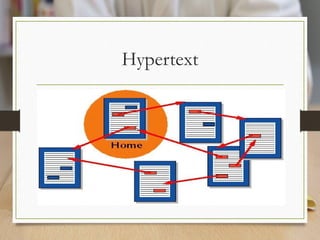
Hypertext
• According to K. Amaral, 2010 is simply a non-linear way of
presenting information; readers may follow their own path,
create their own order – their own meaning out the material.
• Accomplished by creating “links” between information. These
links are provided so that the readers may “jump” to further
information about a specific topic being discussed.
• Links was the term coined by Ted Nelson around 1965. It is
when you type a word and attach a link to that word so that upon
clicking on that word, the reader is sent to the site attached.
Hypertext
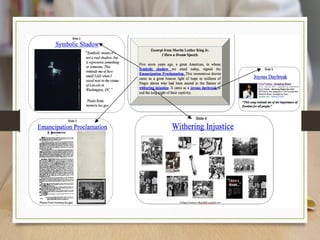
• Hypertext is the foundation of the World Wide Web enabling
users to click on link to obtain more information on a subsequent
page on the same site or from website anywhere in the world.
• Materials include pictures, video materials animated and audio
illustrations.
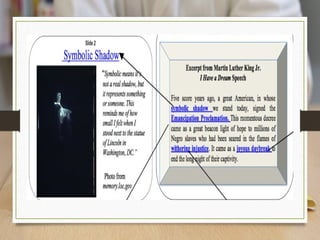
• A user may then browse through the sections of the text,
jumping from one text section to another. This permits a reader
to choose a path through the text that will be most relevant to his
or her interests for flexibility and personalization.
Hypertext
Features of Hypertext
• Humans learn associatively.
• We are able to figure out materials if we are allowed to move at our own pace,
investigating that which interests us, and stimulating more senses through
multimedia
• Supply flexibility to the reader when compared to reading linear text such as
books. Clearly some of this flexibility does exist in books (e.g. table of contents
and indexes), but it is not as widely used or exploited.
• Hypertext permits readers to use these features automatically rather than requiring
readers to manually refer to them as needed. This provides additional control to
the reader in determining the order that the text is to be read. This flexibility does
promise an advantage of personalization and eases the burden of finding
information.
501741047-7-HYPERTEXT-AND-INTERTEXT.pptx

501741047-7-HYPERTEXT-AND-INTERTEXT.pptx

  • 1.
    READING and WRITING •Learning Competency • Identifies the context in which a text was developed • Hypertext • Intertext EN11/12RWS-Ivac-7 • Topic • Context of Text Development • Hypertext • Intertext
  • 2.
  • 3.
    TEXT • It isany object that can be “read”, whether this object is a work of literature, a street sign, an arrangement of buildings etc. • A coherent set of signs that transmits some kind of informative message; this set of symbols is considered in terms of the informative message’s content, rather than in terms of its physical form or the medium in which it is represented. • Context- is the background, environment, setting, framework, or surroundings of events or occurrences. • helps readers understand the cultural, social, philosophical ideas and movements
  • 4.
    Intertextuality • Intertextuality isthe shaping of a text meaning by another text. • The way that one text influences another. • A connection between language, images, characters, themes, or subjects depending on their similarities in language, genre or discourse. • An example of intertextuality is an author’s borrowing and transformation of a prior text or to a reader’s referencing of one text in reading another. • Synonyms: continuity, interrelationship, interrelatedness, interconnectedness, connection, linkage, cohesion, coherence
  • 5.
    Intertext • Derived fromthe Latin intertexto, meaning to intermingle while weaving, intertextuality is a term first introduced by French semiotician Julia Kristeva in the late sixties. • A text contains many layers of accumulated, cultural, historical, and social knowledge, which continually adds to and affects one another. • Text is always influenced by previous texts. • A literary work, then, is not simply the product of a single author, but of its relationship to other texts and to the structures of language itself.
  • 6.
    Sample intertextuality • TheLion, the Witch, and the Wardrobe by C.S. Lewis • In this case, C.S. Lewis adapts the Christ’s crucifixion in his fantasy novel, The Lion, the Witch and the Wardrobe. He, very shrewdly, weaves together the religious and entertainment themes for a children book. Lewis uses an important event from The New Testament and transforms into a story about redemption. In doing so, he uses Edmund, a character that betrays his savior, Aslan, to suffer. Generally, the motive of this theme is to introduce other themes such as evil actions, losing innocence and redemption.
  • 7.
    PARODY • Derived fromthe Greek phrase parodia which referred to a type of poem which imitated the style of epic poems but with mockery and light comedy. • Parody is an imitation of a writer, artist or a genre in such a way as to make fun of or comment on the original work. The humorous effect in parody is achieved by imitating and poking fun at something in hopes the audience will find it amusing. • It is meant for entertaining.
  • 8.
    Importance of PARODY •It allows us to criticize and question without being aggressive or malicious. • It imitates, stresses and draws attention to certain features, characters, or plot points which are weak, silly, strange, or subject to criticism of any sort. • It allows comedians to take on serious issues while still making us laugh. • Ex. Gaugie puts on her father’s big shoes and stomps around saying, “I need to make a business call. I am very busy, very important businessman!”
  • 9.
    Sonnet 130 William Shakespeare Mymistress’ eyes are nothing like the sun; Coral is far more red than her lips’ red If snow be white, why then her breasts are dun; If hairs be wires, black wires grow on her head. I have seen roses damasked, red and white, But no such roses see I in her cheeks; And in some perfumes is there more delight Than in the breath that from my mistress reeks. I love to hear her speak, yet well I know That music hath a far more pleasing sound; I grant I never saw a goddess go; My mistress, when she walks, treads on the ground: And yet, by heaven, I think my love as rare As any she belied with false compare.
  • 10.
    Allusion • indirect reference:an indirect reference to somebody or something • a brief and indirect reference to a person, place, thing, or idea of historical, cultural, literary, or political significance • does not describe in detail the person or thing to which it refers • is just a passing comment and the writer expects the reader to possess enough knowledge to spot the allusion and grasp its importance in a text • Examples: 1. “I do not approve of this quixotic idea” Quixotic means stupid and impractical derived from Cervantes’s “Don Quixote”, a story of a foolish knight and his misadventures.
  • 11.
    Importance of Allusion •To visualize what’s happening by evoking a mental picture. Example: “Don’t act like Rome in front of her.” • “Romeo” is a reference to Shakespeare’s Romeo, a passionate lover Juliet, in “Romeo and Juliet”.
  • 12.
    PASTICHE • a literarypiece that imitates another famous literary work of another writer with the purpose of honoring it and not mocking it. It is lighthearted but respectful in its imitation. • Examples of PASTICHE • Rosencrantz and Guildenstern Are Dead (tragicomedy) by Tom Stoppard • The Traveler by Dave McClure
  • 13.
    The Traveler Dave McClure “Longago upon a hilltop (let me finish then I will stop) I espied a curious traveler where no traveler was before. As I raised an arm in greeting all at once he took to beating at the air like one entreating passing boats to come ashore like a castaway repeating empty movements from the shore or an over-eager whore.”
  • 14.
    The Raven Edgar AllanPoe “Once upon a midnight dreary, while I pondered, weak and weary, Over many a quaint and curious volume of forgotten lore, While I nodded, nearly napping, Suddenly there came a tapping, As of someone gently rapping, Rapping at my chamber door. ‘Tis some visitor’, I muttered, ‘tapping at my chamber door – Only this, and nothing more.”
  • 15.
    Intertext "Communication is toooften taken for granted when it should be taken to pieces." -John Fiske
  • 16.
    Intertextual relations 2 Dimensions Horizontal– relations that are between primary texts that are more or less explicitly linked Vertical – relation between a primary text and other texts of a different type that refer to it (secondary and tertiary texts) • Secondary texts – e.g., publicity, journalistic features, criticism • Tertiary texts – produced by viewers themselves – e.g., letters, gossip, conversation
  • 17.
    Function of Intertextuality Majorityof the writers borrow ideas from the previous works to give a layer of meanings to their works. In fact, when readers read the new text with reflection of another literary work, all related assumptions, effects and ideas of other text provide them a different meaning and changes the technique of interpretation of the original piece. Since readers take influence from other texts, and while reading new texts they sift through archives, this device gives them relevance and clarifies their understanding of the new texts. For writers, intertextuality allows them to open new perspectives and possibilities to construct their story. Thus, writers may explore a particular ideology in their narrative by discussing recent rhetoric in the original text.
  • 18.
    Hypertext • According toK. Amaral, 2010 is simply a non-linear way of presenting information; readers may follow their own path, create their own order – their own meaning out the material. • Accomplished by creating “links” between information. These links are provided so that the readers may “jump” to further information about a specific topic being discussed. • Links was the term coined by Ted Nelson around 1965. It is when you type a word and attach a link to that word so that upon clicking on that word, the reader is sent to the site attached.
  • 19.
    Hypertext • Hypertext isthe foundation of the World Wide Web enabling users to click on link to obtain more information on a subsequent page on the same site or from website anywhere in the world. • Materials include pictures, video materials animated and audio illustrations. • A user may then browse through the sections of the text, jumping from one text section to another. This permits a reader to choose a path through the text that will be most relevant to his or her interests for flexibility and personalization.
  • 20.
  • 21.
    Features of Hypertext •Humans learn associatively. • We are able to figure out materials if we are allowed to move at our own pace, investigating that which interests us, and stimulating more senses through multimedia • Supply flexibility to the reader when compared to reading linear text such as books. Clearly some of this flexibility does exist in books (e.g. table of contents and indexes), but it is not as widely used or exploited. • Hypertext permits readers to use these features automatically rather than requiring readers to manually refer to them as needed. This provides additional control to the reader in determining the order that the text is to be read. This flexibility does promise an advantage of personalization and eases the burden of finding information.