4/26/2015 1i.s
4/26/2015i.s 2
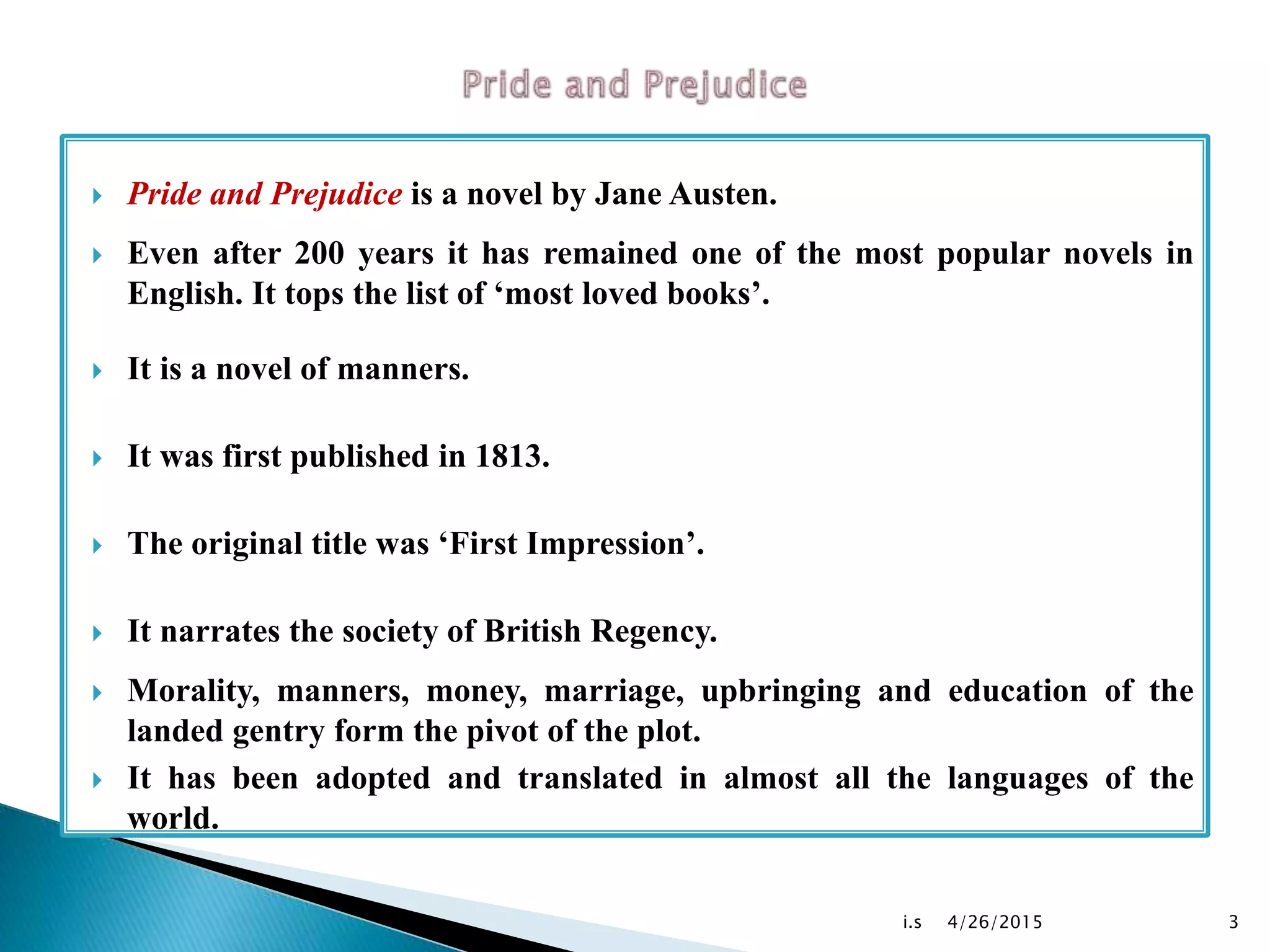
 Pride and Prejudice is a novel by Jane Austen.
 Even after 200 years it has remained one of the most popular novels in
English. It tops the list of ‘most loved books’.
 It is a novel of manners.
 It was first published in 1813.
 The original title was ‘First Impression’.
 It narrates the society of British Regency.
 Morality, manners, money, marriage, upbringing and education of the
landed gentry form the pivot of the plot.
 It has been adopted and translated in almost all the languages of the
world.
4/26/2015 3i.s
 Jane Austen was born on 16th Dec.1775 at Hampshire, London. Her
father, Rev. George Austen was the local Rector. She was the seventh
of altogether eight brothers and sisters. Jane did not have any formal
education. She was educated at home and as a young maid learned how
to play piano, dance in local ball dances, reading literatures and write
creatively. She disliked city life and preferred long walking in the
mountainous villages. It is said that she visited London only twice
during her life-time. In 1795 she became emotionally attached to a
young man named Tom Lefroy; but the relationship ended because of
the rejection of the Lefroy family. While living in Bath, Austen
received her only marriage proposal from a young man named Harris
Bigg-Wither. At first she accepted the proposal but rejected the offer
next morning for some unknown reasons. She remained a spinster and
died at 41 on 18th July, 1817.
4/26/2015i.s 4
 Jane started her writing career in 1787.She began writing plays, poems
and stories for her and for her family amusement. Fair copy of
Twenty-nine of these writings was later published under the title
Juvenilia. Among these works are a satirical novel in letters titled Love
and Freindship [sic] in which she mocked popular novels of sensibility
and The History of England, a manuscript of 34 pages accompanied by
13 water-colour miniatures by her sister Cassandra. Austen's History
parodied popular historical writing, particularly Oliver Goldsmith’s
History of England (1764).
4/26/2015i.s 5
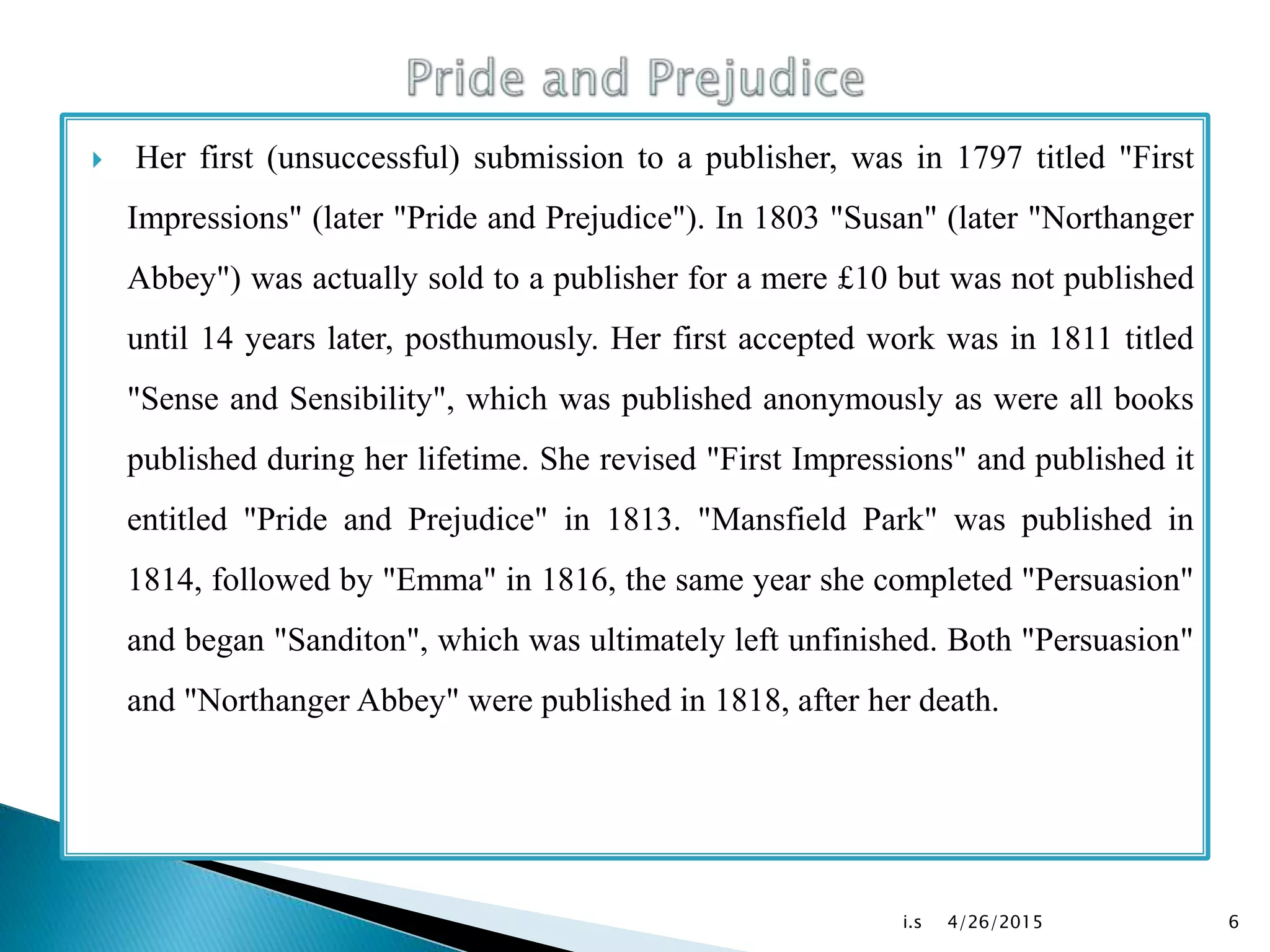
 Her first (unsuccessful) submission to a publisher, was in 1797 titled "First
Impressions" (later "Pride and Prejudice"). In 1803 "Susan" (later "Northanger
Abbey") was actually sold to a publisher for a mere £10 but was not published
until 14 years later, posthumously. Her first accepted work was in 1811 titled
"Sense and Sensibility", which was published anonymously as were all books
published during her lifetime. She revised "First Impressions" and published it
entitled "Pride and Prejudice" in 1813. "Mansfield Park" was published in
1814, followed by "Emma" in 1816, the same year she completed "Persuasion"
and began "Sanditon", which was ultimately left unfinished. Both "Persuasion"
and "Northanger Abbey" were published in 1818, after her death.
4/26/2015i.s 6
4/26/2015i.s 7
Jane Austen
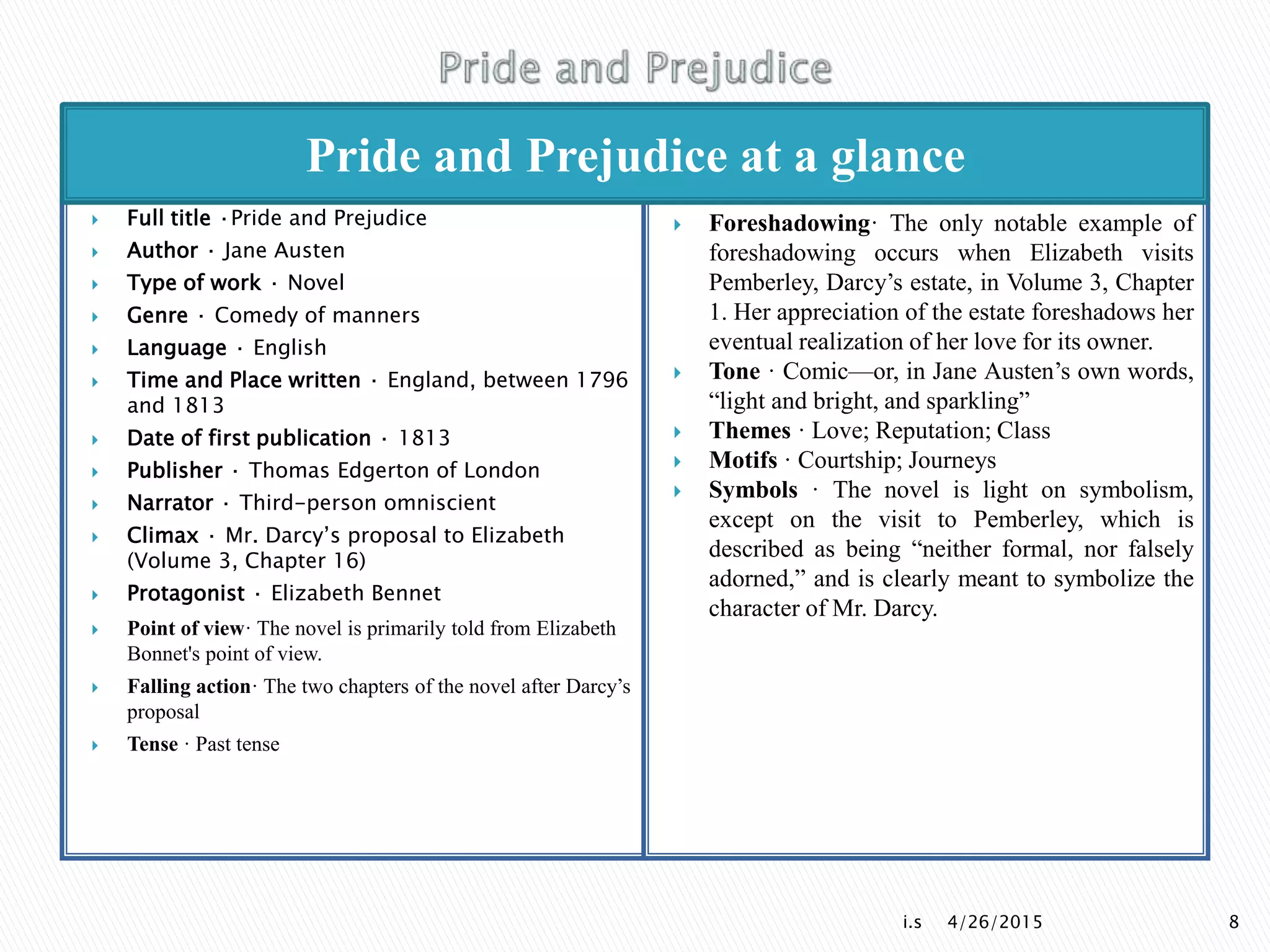
 Full title ·Pride and Prejudice
 Author · Jane Austen
 Type of work · Novel
 Genre · Comedy of manners
 Language · English
 Time and Place written · England, between 1796
and 1813
 Date of first publication · 1813
 Publisher · Thomas Edgerton of London
 Narrator · Third-person omniscient
 Climax · Mr. Darcy’s proposal to Elizabeth
(Volume 3, Chapter 16)
 Protagonist · Elizabeth Bennet
 Point of view· The novel is primarily told from Elizabeth
Bonnet's point of view.
 Falling action· The two chapters of the novel after Darcy’s
proposal
 Tense · Past tense
 Foreshadowing· The only notable example of
foreshadowing occurs when Elizabeth visits Pemberley,
Darcy’s estate, in Volume 3, Chapter 1. Her appreciation
of the estate foreshadows her eventual realization of her
love for its owner.
 Tone · Comic—or, in Jane Austen’s own words, “light
and bright, and sparkling”
 Themes · Love; Reputation; Class
 Motifs · Courtship; Journeys
 Symbols · The novel is light on symbolism, except on
the visit to Pemberley, which is described as being
“neither formal, nor falsely adorned,” and is clearly
meant to symbolize the character of Mr. Darcy.
4/26/2015i.s 8
Pride and Prejudice at a glance
A Micro summary of ‘Pride and Prejudice’.
 The Bennets are eagerly anticipating the arrival of Mr. Bingley, an eligible bachelor.
Mrs. Bennet, excited about a prospective son-in-law, sends her daughters to a ball at
Netherfield, where the second daughter, Lizzy Bennet, meets the disagreeable Mr.
Darcy. Lizzy's elder sister Jane and Mr. Bingley fall in love at first sight. Lizzy becomes
furious finding Mr. Darcy trying to separate them. She turns down proposals from Mr.
Collins, a distant cousin and Mr. Darcy. After meeting a certain Mr. Wickham, she finds
Mr. Darcy even more despicable. Lizzy's youngest sister Lydia elopes with Mr.
Wickham. Mr. Darcy saves the good name of the family by compelling Mr. Wickham to
marry Lydia. Lizzy realizes the benevolence and dependability of Mr. Darcy. Her first
impression changes and despite pressure from Mr. Darcy's aunt, Lady Catherine de
Borough, to turn down Mr. Darcy's second proposal, she accepts. Jane and Mr. Bingley
are also reunited at the end. Everybody lives happily ever after.
4/26/2015i.s 9
4/26/2015i.s 10
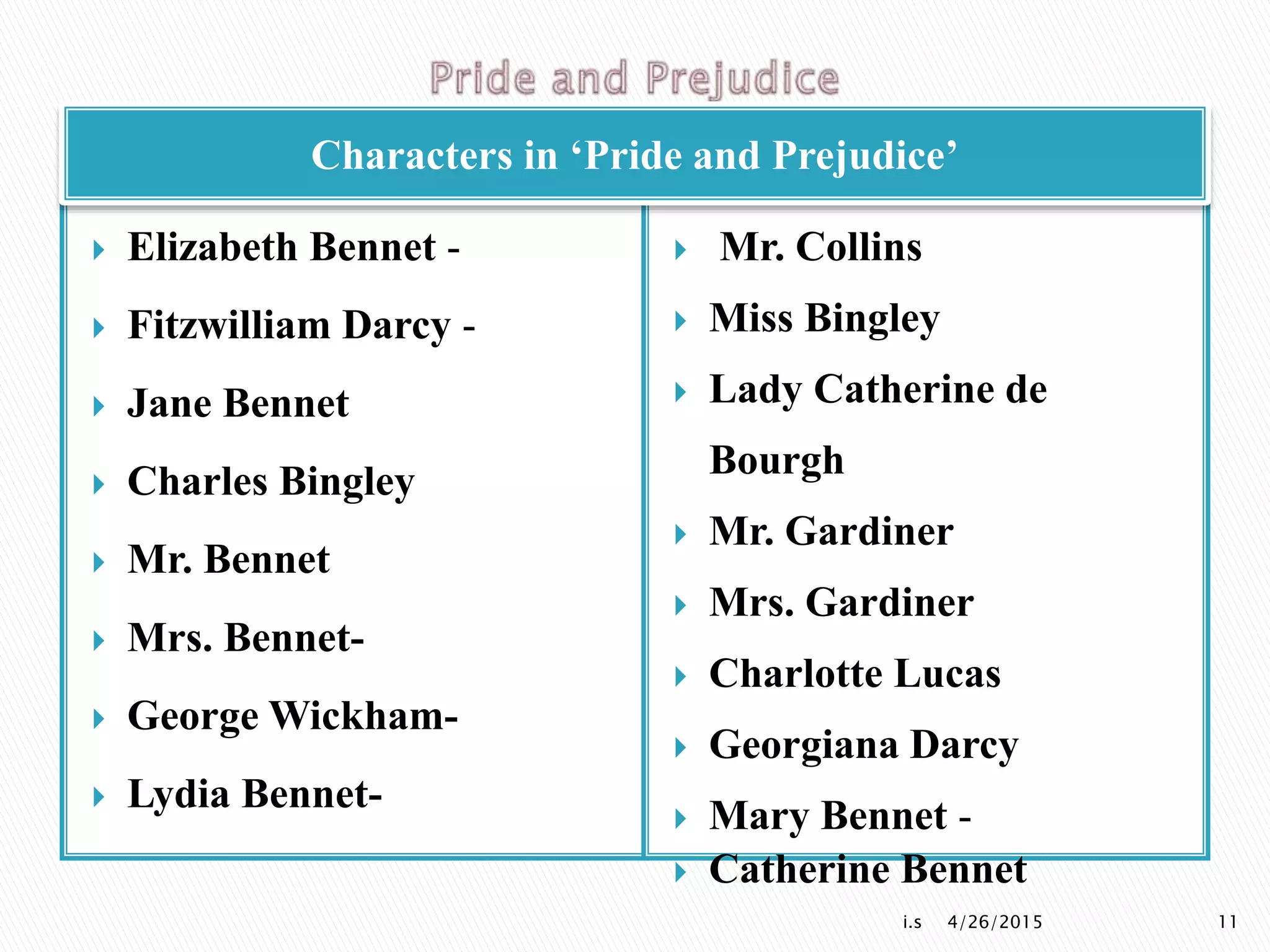
 Elizabeth Bennet -
 Fitzwilliam Darcy -
 Jane Bennet
 Charles Bingley
 Mr. Bennet
 Mrs. Bennet-
 George Wickham-
 Lydia Bennet-
 Mr. Collins
 Miss Bingley
 Lady Catherine de Bourgh
 Mr. Gardiner
 Mrs. Gardiner
 Charlotte Lucas
 Georgiana Darcy
 Mary and Catherine Bennet -
4/26/2015i.s 11
Characters in ‘Pride and Prejudice’
4/26/2015 12i.s
Bennet Family
4/26/2015 13i.s
4/26/2015 14i.s
4/26/2015 15i.s
4/26/2015 16i.s
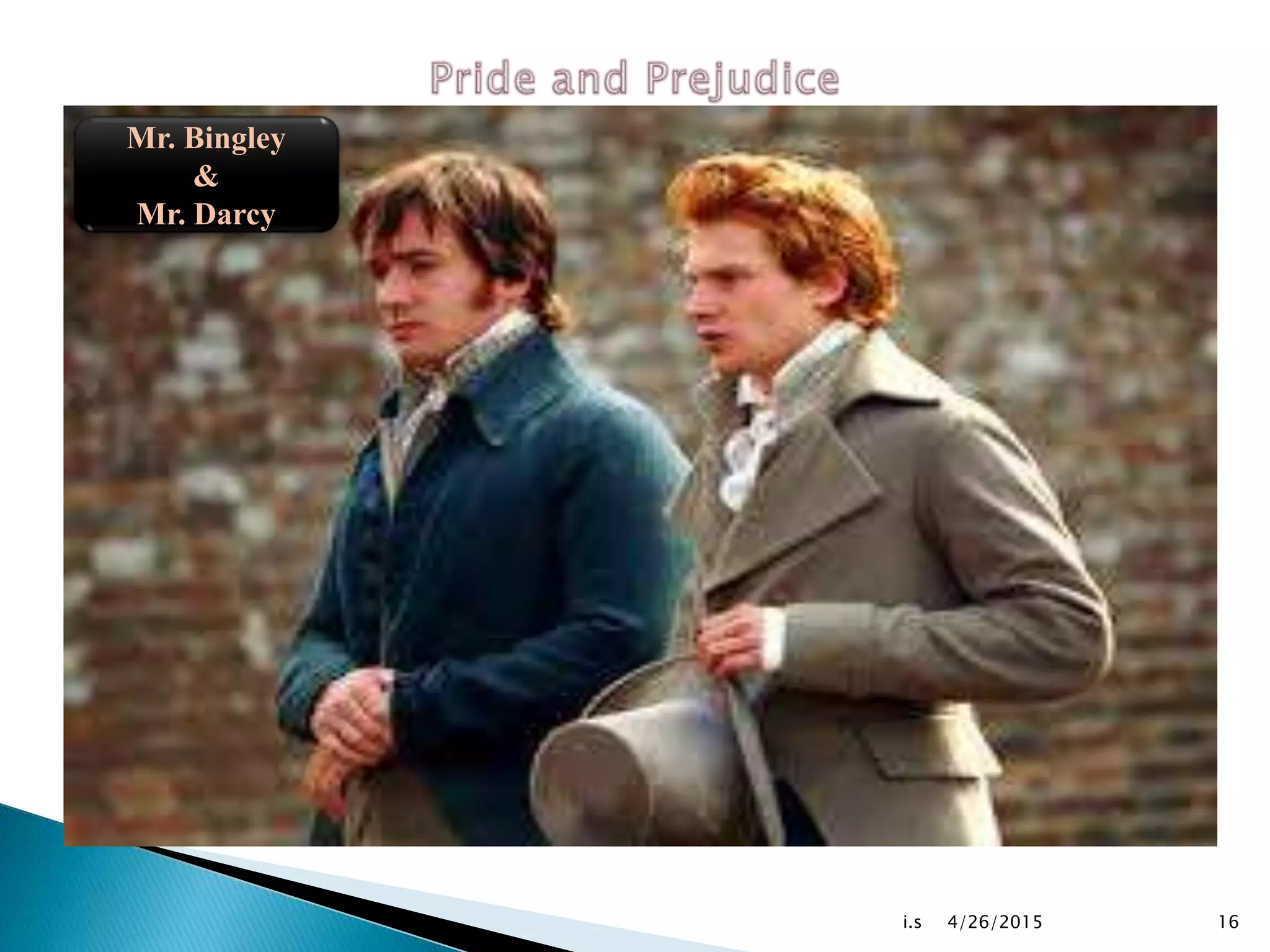
Mr. Bingley
&
Mr. Darcy
4/26/2015 17i.s
Lady Catherine De
Borough
The Story of ‘Pride and Prejudice’.
 Mr. Bennet is a small gentry at Longbourn.
 Mr. & Mrs. Bennet is living with their five marriageable daughters.
 Mr. Bingley leases Netherfield Park.
 He arrives at Longbourn to take possession of Netherfield Park with his family and friend
Mr. Darcy.
 Mr. Darcy slights Elizabeth at a local ball.
 In the Party at Sir William Lucas', Elizabeth refuses to dance with Mr. Darcy as a revenge.
 Jane goes to Netherfield and catches cold.
 Elizabeth goes to Netherfield to help; mother and sisters visit; Jane and Elizabeth leave a
few days later.
 Mr. Collins' letter and arrival.
 They all walk to Meryton and meet Mr. Wickham. Darcy and Bingley meet the group.
4/26/2015 18i.s
 Evening at Phillips'; Elizabeth dances with Darcy, mentions Wickham; Darcy becomes
aware of family expectations for Jane and Bingley;
 Collins bores Darcy; Mrs. Bennet talks unwisely; Mary shows off; Bennet family last
to leave.
 Collins proposes to Elizabeth, rejected.
 Netherfield party returns to London.
 Collins proposes to Charlotte Lucas, accepted.
 Mr. and Mrs. Gardiner visit and take Jane to London.
 Wickham courts Miss King, an heiress.
 Elizabeth, Sir William and Maria Lucas go to Hunsford via London to visit Charlotte.
 Darcy and Colonel Fitzwilliam arrive at Rosings.
 Lady Catherine de Bourgh rude and condescending to everyone, especially Elizabeth.
 Darcy proposes to Elizabeth, rejected.
 Darcy's letter of explanation.
4/26/2015 19i.s
 Darcy and Fitzwilliam leave.
 Elizabeth, Maria and Jane return to Longbourne, meeting Kitty and Lydia on
the way.
 Elizabeth does not reveal what she has learned about Wickham.
 Lydia invited by Mrs. Forster to go with regiment to Brighton; Elizabeth
advises against it but is ignored.
 Elizabeth and Wickham talk of Darcy; Elizabeth hints that she knows the truth.
 Elizabeth and Gardiners go to Derbyshire on holiday.
 They visit Pemberley; housekeeper's positive report; Darcy appear.
 Visit with Bingleys, introduced to Georgiana Darcy.
 Letters from Jane about Lydia and Wickham's elopement.
4/26/2015i.s 20
 Return to Longbourne; marriage of Lydia and Wickham arranged; Elizabeth
learns of Darcy's involvement in this.
 Bingley and Darcy return to Netherfield; Bingley proposes to Jane.
 Lady Catherine arrives to threaten Elizabeth not to marry Darcy; letter from
Collins warning against the same thing.
 Darcy returns from London, proposes Elizabeth, accepted.
 Reactions of family to news.
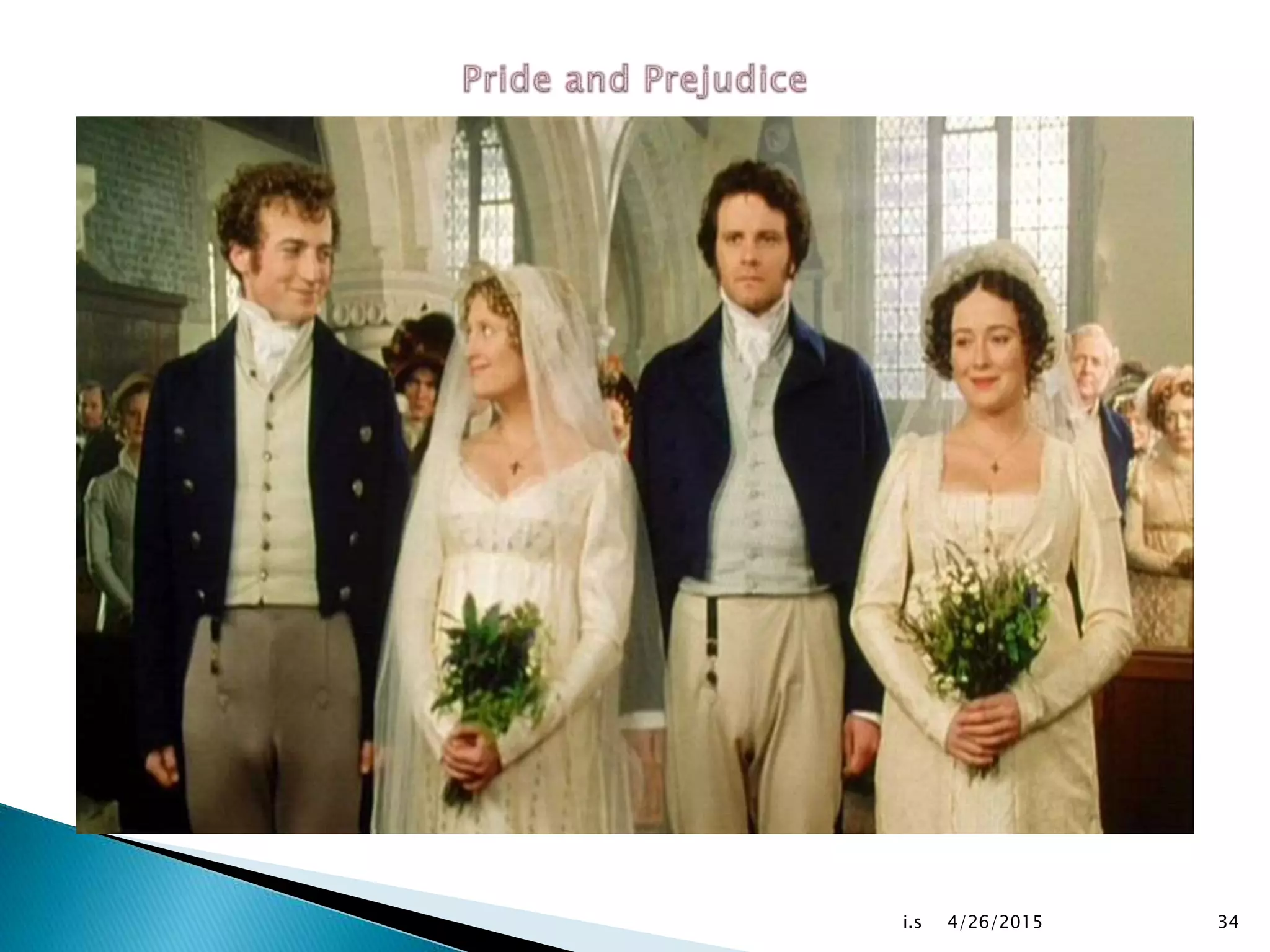
 The story ends with marriages of Charles Bingley to Jane and Darcy to
Elizabeth. And the readers close the book with an impression that they lived
happily thereafter.
4/26/2015i.s 21
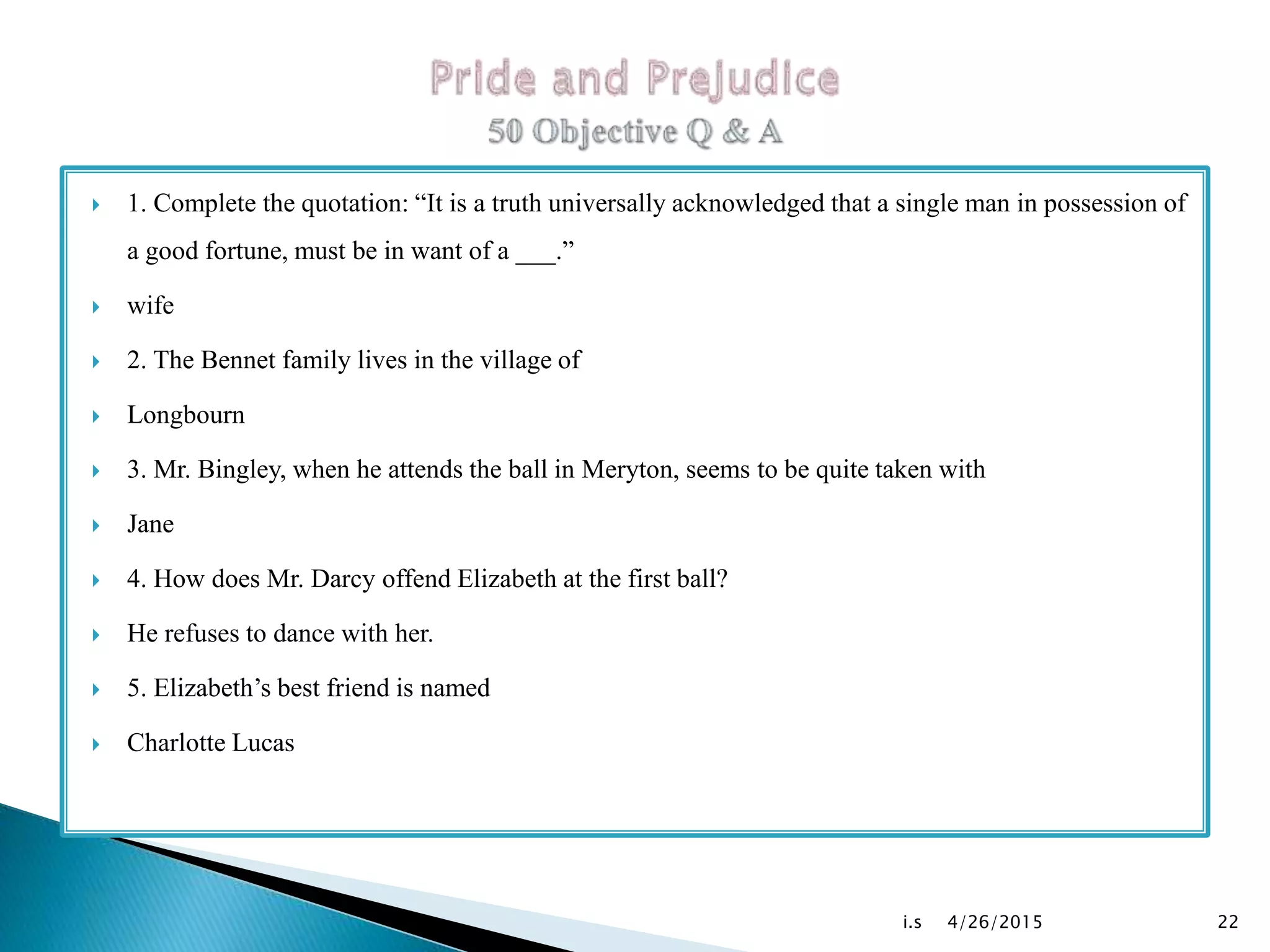
 1. Complete the quotation: “It is a truth universally acknowledged that a single man in possession of
a good fortune, must be in want of a ___.”
 wife
 2. The Bennet family lives in the village of
 Longbourn
 3. Mr. Bingley, when he attends the ball in Meryton, seems to be quite taken with
 Jane
 4. How does Mr. Darcy offend Elizabeth at the first ball?
 He refuses to dance with her.
 5. Elizabeth’s best friend is named
 Charlotte Lucas
4/26/2015i.s 22
 6. Why does Jane’s visit to the Bingleys end up lasting for days?
 She gets soaked in a rainstorm and becomes ill.
 7. What does it mean that Mr. Bennet’s property is “entailed”?
 It can only be inherited by a male.
 8. What reason does Wickham give Elizabeth for his dislike of Darcy?
 Darcy cheated him out of an inheritance.
 9. To which Bennet daughter does Mr. Collins propose marriage?
 Elizabeth
 10. Whom does Mr. Collins marry?
 Charlotte Lucas
4/26/2015i.s 23
 11. Why does Miss Bingley dislike Elizabeth?
 She is jealous of Darcy’s growing attraction to Elizabeth.
 12. Where do the Bingleys and Darcy go for the winter?
 London
 13. In March, Elizabeth goes to visit
 Charlotte Lucas
 14. Lady Catherine de Bourgh is Darcy’s
 Aunt
 15. When Darcy first proposes to Elizabeth, he spends most of the proposal dwelling on
 How socially unsuitable a match she is for him
4/26/2015i.s 24
 16. When Darcy proposes for the first time, Elizabeth
 Turns him down
 17. Elizabeth’s feelings toward Darcy begin to change when he
 Sends her a letter explaining his actions
 18. Darcy’s estate is called
 Pemberley
 19. Where does Lydia spend the summer, and why?
 Brighton, to be near the militia regiment
 20. What socially disastrous romantic decision does Lydia make?
 She elopes with Wickham.
4/26/2015i.s 25
 21. Who spearheads the search for Lydia after Mr. Bennet returns home in defeat?
 Mr. Gardiner
 22. Who pays off Wickham, convincing him to marry Lydia?
 Darcy
 23. When he returns to Netherfield, Mr. Bingley
 Resumes courting Jane
 24. What does Lady Catherine forbid Elizabeth to do?
 Marry Darcy
 25. The novel ends with
 Bingley marrying Jane, and Darcy marrying Elizabeth.
 www.sparknotes.com
4/26/2015i.s 26
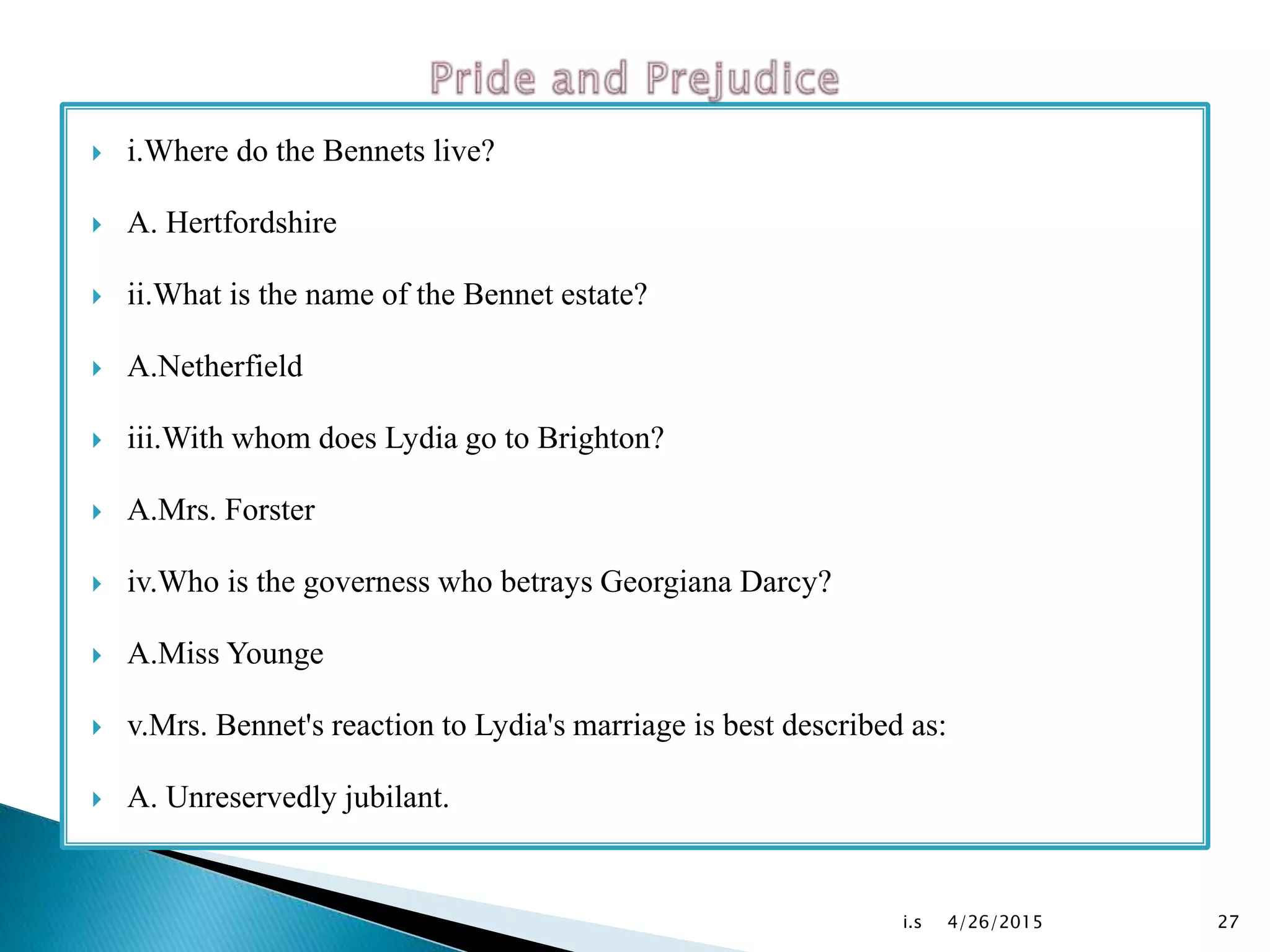
 i.Where do the Bennets live?
 A. Hertfordshire
 ii.What is the name of the Bennet estate?
 A.Netherfield
 iii.With whom does Lydia go to Brighton?
 A.Mrs. Forster
 iv.Who is the governess who betrays Georgiana Darcy?
 A.Miss Younge
 v.Mrs. Bennet's reaction to Lydia's marriage is best described as:
 A. Unreservedly jubilant.
4/26/2015i.s 27
 vi.Why does Mr. Collins come to Longbourn?
 A.He is looking for a wife.
 vii.Who is Mr. Collins's patroness?
 A.Lady Catherine
 viii. What is Mr. Gardiner's profession?
 A.Merchant
 ix.What feature initially attracts Darcy to Elizabeth?
 A.Her eyes
 x. Why doesn't Bingley visit Jane while she is in London?
 A.He doesn't know that she's there.
4/26/2015i.s 28
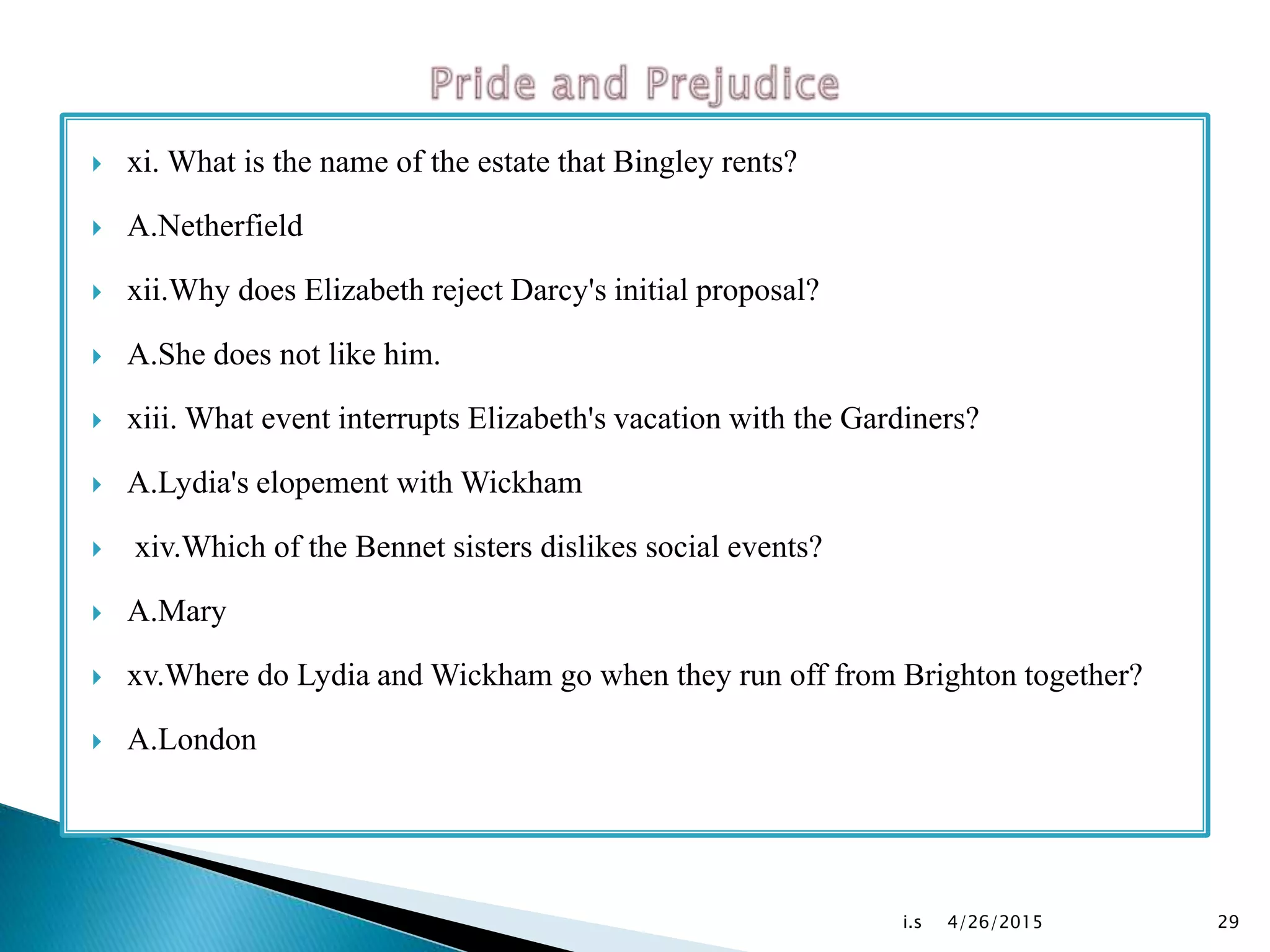
 xi. What is the name of the estate that Bingley rents?
 A.Netherfield
 xii.Why does Elizabeth reject Darcy's initial proposal?
 A.She does not like him.
 xiii. What event interrupts Elizabeth's vacation with the Gardiners?
 A.Lydia's elopement with Wickham
 xiv.Which of the Bennet sisters dislikes social events?
 A.Mary
 xv.Where do Lydia and Wickham go when they run off from Brighton together?
 A.London
4/26/2015i.s 29
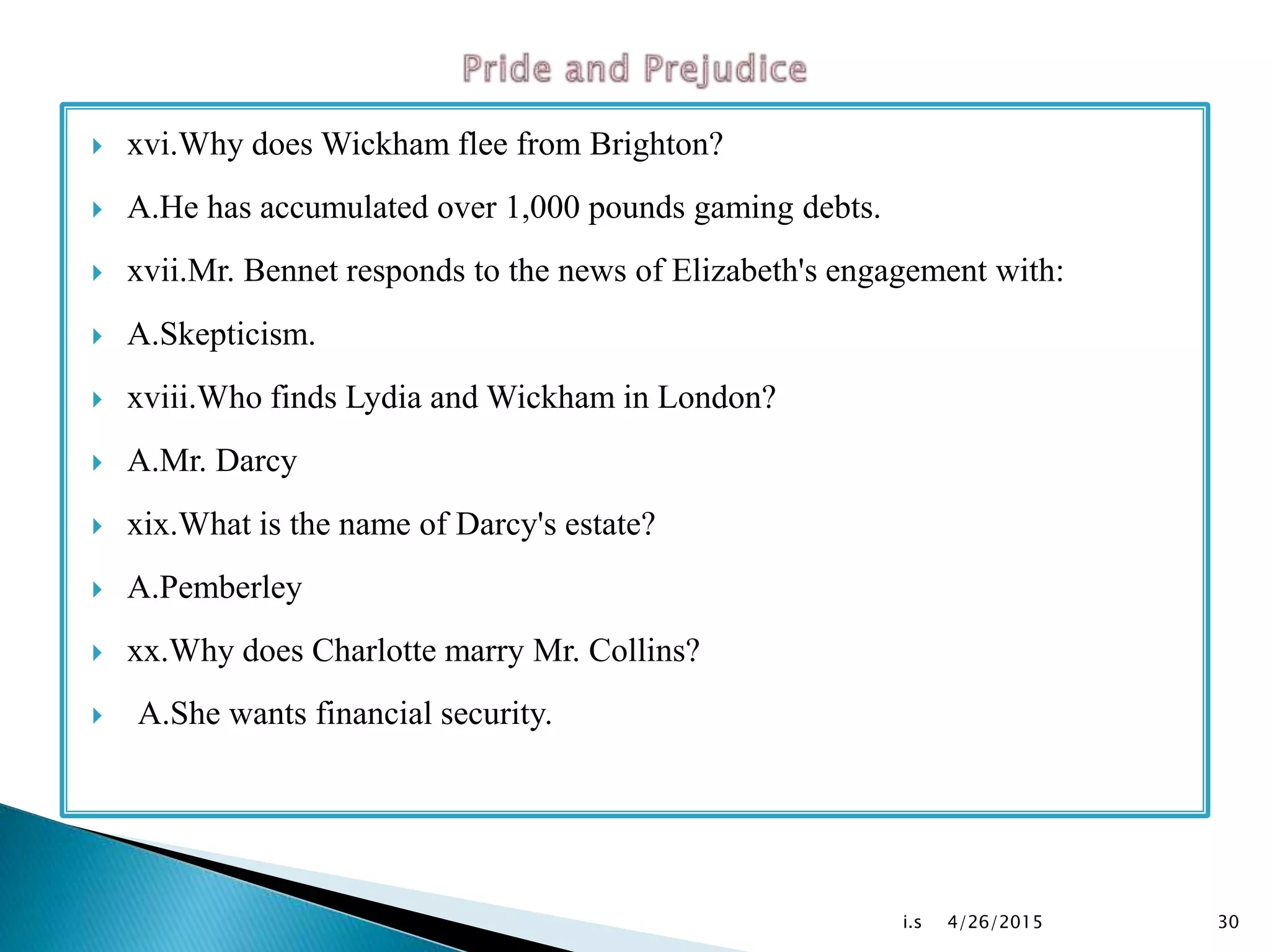
 xvi.Why does Wickham flee from Brighton?
 A.He has accumulated over 1,000 pounds gaming debts.
 xvii.Mr. Bennet responds to the news of Elizabeth's engagement with:
 A.Skepticism.
 xviii.Who finds Lydia and Wickham in London?
 A.Mr. Darcy
 xix.What is the name of Darcy's estate?
 A.Pemberley
 xx.Why does Charlotte marry Mr. Collins?
 A.She wants financial security.
4/26/2015i.s 30
 xxi. Whom does Caroline want Mr. Bingley to marry?
 A. Georgiana Darcy
 xxii. How many children do the Gardiners have?
 A. Four
 xxiii. After finding out about Lydia's elopement, Elizabeth runs into:
 A. Darcy.
 xxiv. Which of the Bennet sisters is the youngest?
 A. Lydia
 xxv. Which daughter is Mrs. Bennet's favorite?
 A.Lydia
www.gradesaver.com
4/26/2015i.s 31
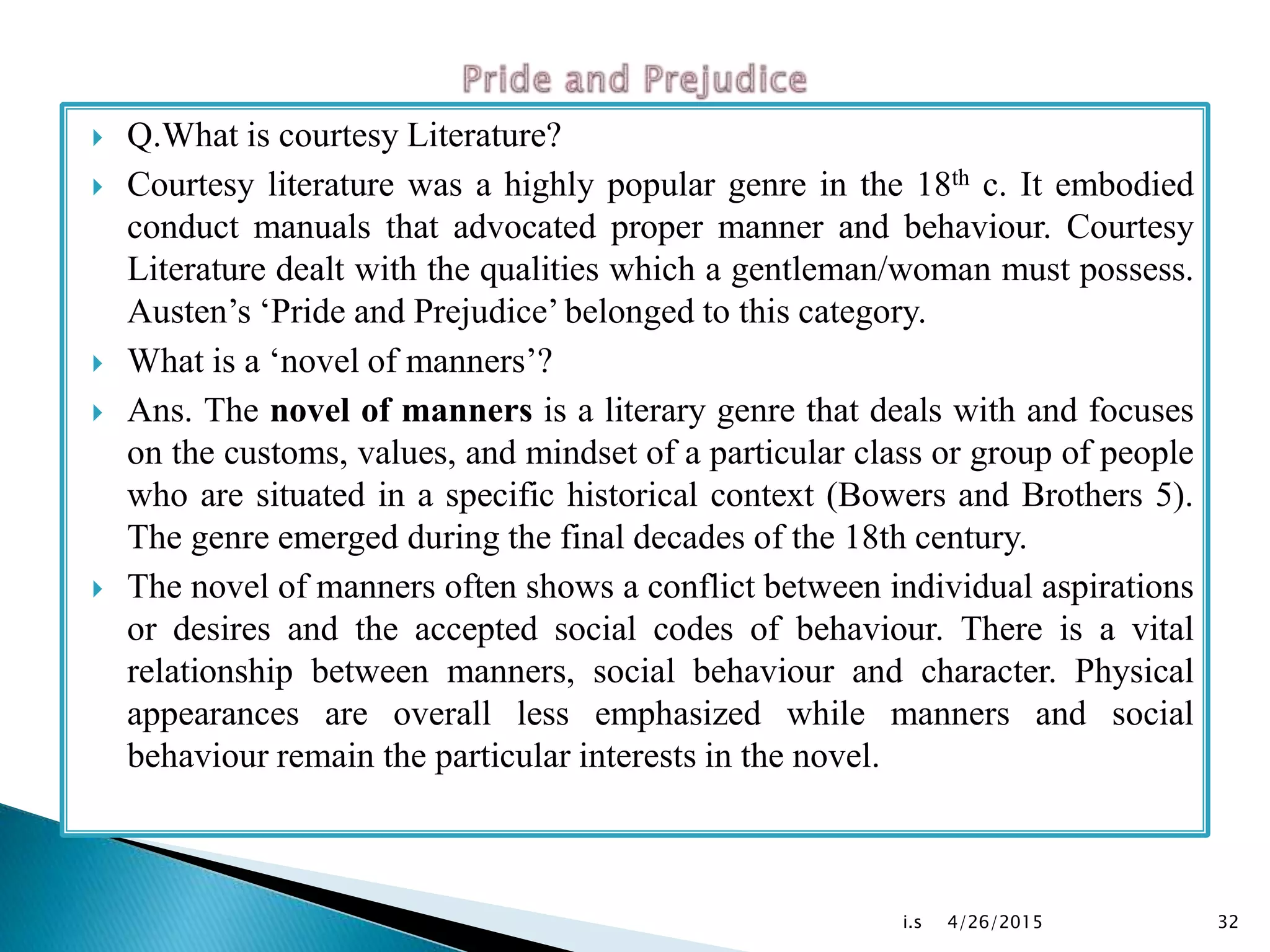
 Q.What is courtesy Literature?
 Courtesy literature was a highly popular genre in the 18th c. It embodied
conduct manuals that advocated proper manner and behaviour. Courtesy
Literature dealt with the qualities which a gentleman/woman must possess.
Austen’s ‘Pride and Prejudice’ belonged to this category.
 What is a ‘novel of manners’?
 Ans. The novel of manners is a literary genre that deals with and focuses
on the customs, values, and mindset of a particular class or group of people
who are situated in a specific historical context (Bowers and Brothers 5).
The genre emerged during the final decades of the 18th century.
 The novel of manners often shows a conflict between individual aspirations
or desires and the accepted social codes of behaviour. There is a vital
relationship between manners, social behaviour and character. Physical
appearances are overall less emphasized while manners and social
behaviour remain the particular interests in the novel.
4/26/2015i.s 32
 The idea of manners assumes not only a social significance, as it is applied
today, but a moral one as well, which preceded the social context in which
it was used. What connects the two is the idea of "pleasing” Characters in
the novels are not always morally and socially obliging to each other,
however, but there is differentiation between the upstanding hero or
heroine and the socially less acceptable characters. Well known examples
of the novel of manners include:
 Jane Austen's Pride and Prejudice, Sense and Sensibility, Emma, Mansfield
Park, Persuasion; Charlotte Bronte’s Jane Eyre, Villette; Henry
Mackenzie's The Man of Feeling; William Makepeace Thackeray's Vanity
Fair; Evelyn Waugh's A Handful of Dust; Edith Wharton's The Age of
Innocence, The House of Mirth. Scott Fitzgerald's The Great Gatsby.
 Changes in English society in the nineteenth century that eroded the
boundaries between these various groups provided the background for the
emergence of the novel of manners.
 The novel of manners often deals with gender issues as well.
4/26/2015i.s 33
4/26/2015i.s 34
4/26/2015i.s 35
Indranil Sarkar
Sapatgram,Assam
4/26/2015 36i.s

Pride and Prejudice

  • 1.
  • 2.
  • 3.
     Pride andPrejudice is a novel by Jane Austen.  Even after 200 years it has remained one of the most popular novels in English. It tops the list of ‘most loved books’.  It is a novel of manners.  It was first published in 1813.  The original title was ‘First Impression’.  It narrates the society of British Regency.  Morality, manners, money, marriage, upbringing and education of the landed gentry form the pivot of the plot.  It has been adopted and translated in almost all the languages of the world. 4/26/2015 3i.s
  • 4.
     Jane Austenwas born on 16th Dec.1775 at Hampshire, London. Her father, Rev. George Austen was the local Rector. She was the seventh of altogether eight brothers and sisters. Jane did not have any formal education. She was educated at home and as a young maid learned how to play piano, dance in local ball dances, reading literatures and write creatively. She disliked city life and preferred long walking in the mountainous villages. It is said that she visited London only twice during her life-time. In 1795 she became emotionally attached to a young man named Tom Lefroy; but the relationship ended because of the rejection of the Lefroy family. While living in Bath, Austen received her only marriage proposal from a young man named Harris Bigg-Wither. At first she accepted the proposal but rejected the offer next morning for some unknown reasons. She remained a spinster and died at 41 on 18th July, 1817. 4/26/2015i.s 4
  • 5.
     Jane startedher writing career in 1787.She began writing plays, poems and stories for her and for her family amusement. Fair copy of Twenty-nine of these writings was later published under the title Juvenilia. Among these works are a satirical novel in letters titled Love and Freindship [sic] in which she mocked popular novels of sensibility and The History of England, a manuscript of 34 pages accompanied by 13 water-colour miniatures by her sister Cassandra. Austen's History parodied popular historical writing, particularly Oliver Goldsmith’s History of England (1764). 4/26/2015i.s 5
  • 6.
     Her first(unsuccessful) submission to a publisher, was in 1797 titled "First Impressions" (later "Pride and Prejudice"). In 1803 "Susan" (later "Northanger Abbey") was actually sold to a publisher for a mere £10 but was not published until 14 years later, posthumously. Her first accepted work was in 1811 titled "Sense and Sensibility", which was published anonymously as were all books published during her lifetime. She revised "First Impressions" and published it entitled "Pride and Prejudice" in 1813. "Mansfield Park" was published in 1814, followed by "Emma" in 1816, the same year she completed "Persuasion" and began "Sanditon", which was ultimately left unfinished. Both "Persuasion" and "Northanger Abbey" were published in 1818, after her death. 4/26/2015i.s 6
  • 7.
  • 8.
     Full title·Pride and Prejudice  Author · Jane Austen  Type of work · Novel  Genre · Comedy of manners  Language · English  Time and Place written · England, between 1796 and 1813  Date of first publication · 1813  Publisher · Thomas Edgerton of London  Narrator · Third-person omniscient  Climax · Mr. Darcy’s proposal to Elizabeth (Volume 3, Chapter 16)  Protagonist · Elizabeth Bennet  Point of view· The novel is primarily told from Elizabeth Bonnet's point of view.  Falling action· The two chapters of the novel after Darcy’s proposal  Tense · Past tense  Foreshadowing· The only notable example of foreshadowing occurs when Elizabeth visits Pemberley, Darcy’s estate, in Volume 3, Chapter 1. Her appreciation of the estate foreshadows her eventual realization of her love for its owner.  Tone · Comic—or, in Jane Austen’s own words, “light and bright, and sparkling”  Themes · Love; Reputation; Class  Motifs · Courtship; Journeys  Symbols · The novel is light on symbolism, except on the visit to Pemberley, which is described as being “neither formal, nor falsely adorned,” and is clearly meant to symbolize the character of Mr. Darcy. 4/26/2015i.s 8 Pride and Prejudice at a glance
  • 9.
    A Micro summaryof ‘Pride and Prejudice’.  The Bennets are eagerly anticipating the arrival of Mr. Bingley, an eligible bachelor. Mrs. Bennet, excited about a prospective son-in-law, sends her daughters to a ball at Netherfield, where the second daughter, Lizzy Bennet, meets the disagreeable Mr. Darcy. Lizzy's elder sister Jane and Mr. Bingley fall in love at first sight. Lizzy becomes furious finding Mr. Darcy trying to separate them. She turns down proposals from Mr. Collins, a distant cousin and Mr. Darcy. After meeting a certain Mr. Wickham, she finds Mr. Darcy even more despicable. Lizzy's youngest sister Lydia elopes with Mr. Wickham. Mr. Darcy saves the good name of the family by compelling Mr. Wickham to marry Lydia. Lizzy realizes the benevolence and dependability of Mr. Darcy. Her first impression changes and despite pressure from Mr. Darcy's aunt, Lady Catherine de Borough, to turn down Mr. Darcy's second proposal, she accepts. Jane and Mr. Bingley are also reunited at the end. Everybody lives happily ever after. 4/26/2015i.s 9
  • 10.
  • 11.
     Elizabeth Bennet-  Fitzwilliam Darcy -  Jane Bennet  Charles Bingley  Mr. Bennet  Mrs. Bennet-  George Wickham-  Lydia Bennet-  Mr. Collins  Miss Bingley  Lady Catherine de Bourgh  Mr. Gardiner  Mrs. Gardiner  Charlotte Lucas  Georgiana Darcy  Mary and Catherine Bennet - 4/26/2015i.s 11 Characters in ‘Pride and Prejudice’
  • 12.
  • 13.
  • 14.
  • 15.
  • 16.
  • 17.
  • 18.
    The Story of‘Pride and Prejudice’.  Mr. Bennet is a small gentry at Longbourn.  Mr. & Mrs. Bennet is living with their five marriageable daughters.  Mr. Bingley leases Netherfield Park.  He arrives at Longbourn to take possession of Netherfield Park with his family and friend Mr. Darcy.  Mr. Darcy slights Elizabeth at a local ball.  In the Party at Sir William Lucas', Elizabeth refuses to dance with Mr. Darcy as a revenge.  Jane goes to Netherfield and catches cold.  Elizabeth goes to Netherfield to help; mother and sisters visit; Jane and Elizabeth leave a few days later.  Mr. Collins' letter and arrival.  They all walk to Meryton and meet Mr. Wickham. Darcy and Bingley meet the group. 4/26/2015 18i.s
  • 19.
     Evening atPhillips'; Elizabeth dances with Darcy, mentions Wickham; Darcy becomes aware of family expectations for Jane and Bingley;  Collins bores Darcy; Mrs. Bennet talks unwisely; Mary shows off; Bennet family last to leave.  Collins proposes to Elizabeth, rejected.  Netherfield party returns to London.  Collins proposes to Charlotte Lucas, accepted.  Mr. and Mrs. Gardiner visit and take Jane to London.  Wickham courts Miss King, an heiress.  Elizabeth, Sir William and Maria Lucas go to Hunsford via London to visit Charlotte.  Darcy and Colonel Fitzwilliam arrive at Rosings.  Lady Catherine de Bourgh rude and condescending to everyone, especially Elizabeth.  Darcy proposes to Elizabeth, rejected.  Darcy's letter of explanation. 4/26/2015 19i.s
  • 20.
     Darcy andFitzwilliam leave.  Elizabeth, Maria and Jane return to Longbourne, meeting Kitty and Lydia on the way.  Elizabeth does not reveal what she has learned about Wickham.  Lydia invited by Mrs. Forster to go with regiment to Brighton; Elizabeth advises against it but is ignored.  Elizabeth and Wickham talk of Darcy; Elizabeth hints that she knows the truth.  Elizabeth and Gardiners go to Derbyshire on holiday.  They visit Pemberley; housekeeper's positive report; Darcy appear.  Visit with Bingleys, introduced to Georgiana Darcy.  Letters from Jane about Lydia and Wickham's elopement. 4/26/2015i.s 20
  • 21.
     Return toLongbourne; marriage of Lydia and Wickham arranged; Elizabeth learns of Darcy's involvement in this.  Bingley and Darcy return to Netherfield; Bingley proposes to Jane.  Lady Catherine arrives to threaten Elizabeth not to marry Darcy; letter from Collins warning against the same thing.  Darcy returns from London, proposes Elizabeth, accepted.  Reactions of family to news.  The story ends with marriages of Charles Bingley to Jane and Darcy to Elizabeth. And the readers close the book with an impression that they lived happily thereafter. 4/26/2015i.s 21
  • 22.
     1. Completethe quotation: “It is a truth universally acknowledged that a single man in possession of a good fortune, must be in want of a ___.”  wife  2. The Bennet family lives in the village of  Longbourn  3. Mr. Bingley, when he attends the ball in Meryton, seems to be quite taken with  Jane  4. How does Mr. Darcy offend Elizabeth at the first ball?  He refuses to dance with her.  5. Elizabeth’s best friend is named  Charlotte Lucas 4/26/2015i.s 22
  • 23.
     6. Whydoes Jane’s visit to the Bingleys end up lasting for days?  She gets soaked in a rainstorm and becomes ill.  7. What does it mean that Mr. Bennet’s property is “entailed”?  It can only be inherited by a male.  8. What reason does Wickham give Elizabeth for his dislike of Darcy?  Darcy cheated him out of an inheritance.  9. To which Bennet daughter does Mr. Collins propose marriage?  Elizabeth  10. Whom does Mr. Collins marry?  Charlotte Lucas 4/26/2015i.s 23
  • 24.
     11. Whydoes Miss Bingley dislike Elizabeth?  She is jealous of Darcy’s growing attraction to Elizabeth.  12. Where do the Bingleys and Darcy go for the winter?  London  13. In March, Elizabeth goes to visit  Charlotte Lucas  14. Lady Catherine de Bourgh is Darcy’s  Aunt  15. When Darcy first proposes to Elizabeth, he spends most of the proposal dwelling on  How socially unsuitable a match she is for him 4/26/2015i.s 24
  • 25.
     16. WhenDarcy proposes for the first time, Elizabeth  Turns him down  17. Elizabeth’s feelings toward Darcy begin to change when he  Sends her a letter explaining his actions  18. Darcy’s estate is called  Pemberley  19. Where does Lydia spend the summer, and why?  Brighton, to be near the militia regiment  20. What socially disastrous romantic decision does Lydia make?  She elopes with Wickham. 4/26/2015i.s 25
  • 26.
     21. Whospearheads the search for Lydia after Mr. Bennet returns home in defeat?  Mr. Gardiner  22. Who pays off Wickham, convincing him to marry Lydia?  Darcy  23. When he returns to Netherfield, Mr. Bingley  Resumes courting Jane  24. What does Lady Catherine forbid Elizabeth to do?  Marry Darcy  25. The novel ends with  Bingley marrying Jane, and Darcy marrying Elizabeth.  www.sparknotes.com 4/26/2015i.s 26
  • 27.
     i.Where dothe Bennets live?  A. Hertfordshire  ii.What is the name of the Bennet estate?  A.Netherfield  iii.With whom does Lydia go to Brighton?  A.Mrs. Forster  iv.Who is the governess who betrays Georgiana Darcy?  A.Miss Younge  v.Mrs. Bennet's reaction to Lydia's marriage is best described as:  A. Unreservedly jubilant. 4/26/2015i.s 27
  • 28.
     vi.Why doesMr. Collins come to Longbourn?  A.He is looking for a wife.  vii.Who is Mr. Collins's patroness?  A.Lady Catherine  viii. What is Mr. Gardiner's profession?  A.Merchant  ix.What feature initially attracts Darcy to Elizabeth?  A.Her eyes  x. Why doesn't Bingley visit Jane while she is in London?  A.He doesn't know that she's there. 4/26/2015i.s 28
  • 29.
     xi. Whatis the name of the estate that Bingley rents?  A.Netherfield  xii.Why does Elizabeth reject Darcy's initial proposal?  A.She does not like him.  xiii. What event interrupts Elizabeth's vacation with the Gardiners?  A.Lydia's elopement with Wickham  xiv.Which of the Bennet sisters dislikes social events?  A.Mary  xv.Where do Lydia and Wickham go when they run off from Brighton together?  A.London 4/26/2015i.s 29
  • 30.
     xvi.Why doesWickham flee from Brighton?  A.He has accumulated over 1,000 pounds gaming debts.  xvii.Mr. Bennet responds to the news of Elizabeth's engagement with:  A.Skepticism.  xviii.Who finds Lydia and Wickham in London?  A.Mr. Darcy  xix.What is the name of Darcy's estate?  A.Pemberley  xx.Why does Charlotte marry Mr. Collins?  A.She wants financial security. 4/26/2015i.s 30
  • 31.
     xxi. Whomdoes Caroline want Mr. Bingley to marry?  A. Georgiana Darcy  xxii. How many children do the Gardiners have?  A. Four  xxiii. After finding out about Lydia's elopement, Elizabeth runs into:  A. Darcy.  xxiv. Which of the Bennet sisters is the youngest?  A. Lydia  xxv. Which daughter is Mrs. Bennet's favorite?  A.Lydia www.gradesaver.com 4/26/2015i.s 31
  • 32.
     Q.What iscourtesy Literature?  Courtesy literature was a highly popular genre in the 18th c. It embodied conduct manuals that advocated proper manner and behaviour. Courtesy Literature dealt with the qualities which a gentleman/woman must possess. Austen’s ‘Pride and Prejudice’ belonged to this category.  What is a ‘novel of manners’?  Ans. The novel of manners is a literary genre that deals with and focuses on the customs, values, and mindset of a particular class or group of people who are situated in a specific historical context (Bowers and Brothers 5). The genre emerged during the final decades of the 18th century.  The novel of manners often shows a conflict between individual aspirations or desires and the accepted social codes of behaviour. There is a vital relationship between manners, social behaviour and character. Physical appearances are overall less emphasized while manners and social behaviour remain the particular interests in the novel. 4/26/2015i.s 32
  • 33.
     The ideaof manners assumes not only a social significance, as it is applied today, but a moral one as well, which preceded the social context in which it was used. What connects the two is the idea of "pleasing” Characters in the novels are not always morally and socially obliging to each other, however, but there is differentiation between the upstanding hero or heroine and the socially less acceptable characters. Well known examples of the novel of manners include:  Jane Austen's Pride and Prejudice, Sense and Sensibility, Emma, Mansfield Park, Persuasion; Charlotte Bronte’s Jane Eyre, Villette; Henry Mackenzie's The Man of Feeling; William Makepeace Thackeray's Vanity Fair; Evelyn Waugh's A Handful of Dust; Edith Wharton's The Age of Innocence, The House of Mirth. Scott Fitzgerald's The Great Gatsby.  Changes in English society in the nineteenth century that eroded the boundaries between these various groups provided the background for the emergence of the novel of manners.  The novel of manners often deals with gender issues as well. 4/26/2015i.s 33
  • 34.
  • 35.
  • 36.