Radical Resistance&
Moral Panics
A condition, episode, person or
group of persons comes to be
defined as a threat to societal
values and interests. Its “dangers”
come to be naturalized as they are
presented repetitively in a stylized
and stereotypical fashion by the
mass media.
Moral Panic
Horror Comics
(1950s)
Role Playing
Games (1980s)
Internet Addiction
(2000s)
Examples
{ {PANIC
Spiraling
upsurge in
public concern,
which draws
responses and
“solutions” from
authorities
{
A moral panic is
typically
expressed as
outrage (rather
than fear) over
a potential
disruption of
the social order.
“Panic”
{ {MORAL
Organized
around the
notion that the
threat is to
something held
sacred or
fundamental to
society
{
“Moral”
need not
be tied to a
religious
framework.
“Moral”
{
“Waste”
“Corruption”
“Poor Education”
“Moral” can
invoke a purely
secular moral
framework
centered on
common social
values.
“Moral”
{
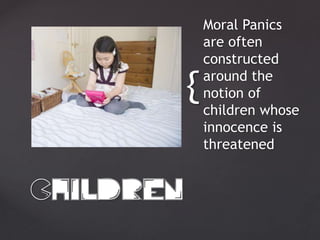
Moral Panics
are often
constructed
around the
notion of
children whose
innocence is
threatened
Children
Moral Entrepreneurs
Those who start
the panic when
they fear a
threat to
prevailing social
or cultural
values
Moral Entrepreneurs
People who start
the panic by
articulating
general
concerns as a
specific threat
to prevailing
social or
cultural values
Folk Devils
People who
supposedly
threaten the
social order
{
The media
operate as agents
of moral
indignation,
either by actively
crusading, or
simply by framing
news stories in
dramatic ways
that will appeal
to consumers.Media
1.Exaggeration & Distortion: “Over-
reporting” numbers, effects, damage.
Emotive language. Repetition of false stories
Media
1.Exaggeration & Distortion: “Over-
reporting” numbers, effects, damage.
Emotive language. Repetition of false stories
2.Prediction: What happened before will
happen again. Reporting of non-events.
Media
1.Exaggeration & Distortion: “Over-
reporting” numbers, effects, damage.
Emotive language. Repetition of false stories
2.Prediction: What happened before will
happen again. Reporting of non-events.
3.Symbolization: Individual signs represent
the moral panic. “Dramatized and ritualistic
interviews” (p.29)
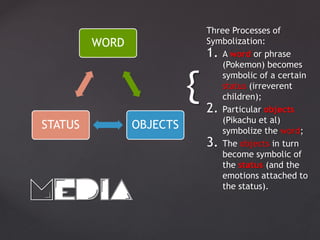
Media
{
WORD
OBJECTSSTATUS
Three Processes of
Symbolization:
1. A word or phrase
(Pokemon) becomes
symbolic of a certain
status (irreverent
children);
2. Particular objects
(Pikachu et al)
symbolize the word;
3. The objects in turn
become symbolic of
the status (and the
emotions attached to
the status).
Media
{OF A MORAL PANIC
Characteristics
5
concern
1
There must be
awareness that the
behaviour of the
group or category
in question is likely
to have a negative
impact on society
hostility
2
Hostility towards
the group in
question increases,
and they become
"folk devils".
Clear distinctions
are drawn
between them"
and "us".
consensus
3
Widespread
acceptance
emerges that the
group in question
poses a very real
threat to society.
disproportion
4
The action taken is
disproportionate to
the actual threat
posed by the
accused group.
volatility
5
Moral panics are
highly volatile; they
tend to disappear
as quickly as they
appeared, due to a
wane in public
interest or news
reports changing to
another topic
{
Most classic models
of moral panics
involved threats
from within.
Globalization
{
Most classic models
of moral panics
involved threats
from within.
Many contemporary
forms of moral
panic involve
threats from
without.
Globalization
{
Moral panics are
often produced
by the
introduction of
new practices,
representations,
and artifacts.
Globalization
Moral panics are clusters of
discourses that seek to:
1. explain global interconnections
2. morally evaluate them; and
3. pursue changes that will
a. break these connections; or
b. bring them into conformity
with the local moral order
Globalization
{PANIC IN THE GULF
POKEMON
{
Pokemon arrived
in Saudi Arabia,
Kuwait, Qatar
and UAE in 2000
and quickly
became the most
popular
children’s fad in
memory.
{Mickey
Mouse
Tom &
Jerry
Captain
Majid
1. CONCERN
It was unlike
earlier
children’s
fads.
{Mickey
Mouse
Tom &
Jerry
Captain
Majid
1. CONCERN
It was unlike
earlier
children’s
fads.
The Pokemon panic was not anti-Western or anti-
Global per se; people contrasted Pokemon with the
international media commodities they loved.
{
“Imsukuhum
Kulhum”
[“Gotta Catch ‘em
all”]
{
“Imsukuhum
Kulhum”
[“Gotta Catch ‘em
all”]
Viral pattern of
consumption
{
“Imsukuhum
Kulhum”
[“Gotta Catch ‘em
all”]
Viral pattern of
consumption
It is Pokemon’s refusal to stay “just a game” or “just
a show” that is the first and most common complaint
“If Pokemon were limited to the cartoon serial,
the matter would be easy. However, it has turned
to games, pictures and various other forms. …The
problem is that in school, children chat about
Pokemon because he doesn’t disappear from their
vision. His picture is on the schoolbags, the pen
cases and notebooks. …How then does a mother
protect her child from it? I don’t say that it causes
a great harm, but it is not useful to our children,
and it gets in the way of useful things.”
--Qatari mother quoted in newspaper
{
“This is like anything else
from the west. They produce
and we consume. They have
their ways to attract our
minds, so it is not difficult for
them to steal our childrens’
minds and to turn their
products into a profitable
trade.”
MORAL
ENTREPRENEUR
Mulhaq li Watan wa lil Muwatin
newspaper (Qatar 2000)
2. HOSTILITY
{
Mulhaq li Watan wa lil Muwatin
newspaper (Qatar 2000)
“This is like anything else
from the west. They produce
and we consume. They have
their ways to attract our
minds, so it is not difficult for
them to steal our childrens’
minds and to turn their
products into a profitable
trade.”
MORAL
ENTREPRENEUR
FOLK DEVILS
2. HOSTILITY
{
Mulhaq li Watan wa lil Muwatin
newspaper (Qatar 2000)
“This is like anything else
from the west. They produce
and we consume. They have
their ways to attract our
minds, so it is not difficult for
them to steal our childrens’
minds and to turn their
products into a profitable
trade.”
MORAL
ENTREPRENEUR
FOLK DEVILS
EXPLOITING
CHILDREN
2. HOSTILITY
{
Globalization Starts With
Children
Pokemon Conquers
Childrens’ Minds
A Pokemon in Every Home
Pokemon: Legendary
Creatures Sneak Into Arab
Childrens’ Bedrooms
Newspaper
Headlines
3. CONSENSUS
{
Globalization Starts With
Children
Pokemon Conquers
Childrens’ Minds
A Pokemon in Every Home
Pokemon: Legendary
Creatures Sneak Into Arab
Childrens’ Bedrooms
Newspaper
Headlines
Even sports and investment columnists used
their columns express concern over the
problem of children’s attachment to Pokemon
3. CONSENSUS
{
Pokemon is not just a
video of game or toy;
it is a virus. It
colonizes children’s
lives.
1
4. DISPROPORTION
{
Pokemon obstructs
children’s educations
and interferes with
their family lives. 2
4. DISPROPORTION
{
Pokemon teaches
foreign norms and
values. 3
4. DISPROPORTION
GLOBAL FOREIGN GLOBAL “ARAB”
“If we must choose between…Pokémon, who comes from Confucian culture, on
the one hand, and Aladdin, who is a distortion of the Arab character on the
other hand, then the mind will say welcome to the Arab character Aladdin, who
at least expresses Arab and Islamic heritage and fame.”
--Ali Ben Shewil Al-Qurani, Al-Jazeera
{
Pokemon teaches
wrongful and harmful
foreign norms and
values. 4
4. DISPROPORTION
Gambling is Haram Evolution is anti-Islamic
{
Pokemon deliberately
seeks to corrupt
children by turning
them from traditional
culture and Islamic
values and seducing
them into evil.
5
4. DISPROPORTION
Evil Words Zionist Codes
{
In response to public demand,
the Prince of Riyadh asks for
an investigation into the
moral dangers posed by
Pokémon
5. Volatility
Salman bin Abdul Aziz
{
The Grand Mufti rules:
1. Pokemon encourages
gambling
2. Pokemon teaches
evolutionary thought
3. Pokemon supports
certain non-Islamic
doctines
4. Pokemon may encode
Zionist symbolism
5. Volatility
Pokemon “becomes a means by
which different societies may
describe themselves at risk, as
vulnerable to threats both
externally and internally. Talk of
Pokemon points directly to the
vulnerabilities of global
consumerist citizenship.”
Christine Yano (2004: 109)
Cohen, Stanley. 1972. Folk Devils and Moral Panics.
Cook, Daniel. 2001. Exchange Value as Pedagogy in Children’s
Leisure: Moral Panics in Children’s Culture at Century’s End.
Leisure Sciences 23: 81-98.
Critcher, Charles. 2003. Moral Panics in the Media. Open
University Press.
Drotner, Kirstin. 1992. Media and Moral Panics. In Media Cultures.
Michael Skovmand and Kim Christian Schroder, eds. Pp. 42-62.
Routledge.
Goode, Erich and Nachman Ben Yehuda. 1994. Moral Panics: The
Construction of Deviance. Blackwell.
Thompson, Kenneth. 1998. Moral Panics. Routledge.
Peterson, Mark Allen. 2011. Pokemon Panics: Class Play in the
Private Schools. In Connected in Cairo: Growing Up Cosmopolitan
in the Modern Middle East. Indiana University Press
Yano, Christine. 2004. Panic Attacks: Anti-Pokemon Voices in
Global Markets. In Pikachu’s Global Adventure. Joseph Tobin, ed.
Duke University Press.
References

Moral panics

  • 1.
  • 2.
    A condition, episode,person or group of persons comes to be defined as a threat to societal values and interests. Its “dangers” come to be naturalized as they are presented repetitively in a stylized and stereotypical fashion by the mass media. Moral Panic
  • 3.
    Horror Comics (1950s) Role Playing Games(1980s) Internet Addiction (2000s) Examples
  • 4.
    { {PANIC Spiraling upsurge in publicconcern, which draws responses and “solutions” from authorities
  • 5.
    { A moral panicis typically expressed as outrage (rather than fear) over a potential disruption of the social order. “Panic”
  • 6.
    { {MORAL Organized around the notionthat the threat is to something held sacred or fundamental to society
  • 7.
    { “Moral” need not be tiedto a religious framework. “Moral”
  • 8.
    { “Waste” “Corruption” “Poor Education” “Moral” can invokea purely secular moral framework centered on common social values. “Moral”
  • 9.
    { Moral Panics are often constructed aroundthe notion of children whose innocence is threatened Children
  • 10.
    Moral Entrepreneurs Those whostart the panic when they fear a threat to prevailing social or cultural values
  • 11.
    Moral Entrepreneurs People whostart the panic by articulating general concerns as a specific threat to prevailing social or cultural values Folk Devils People who supposedly threaten the social order
  • 12.
    { The media operate asagents of moral indignation, either by actively crusading, or simply by framing news stories in dramatic ways that will appeal to consumers.Media
  • 13.
    1.Exaggeration & Distortion:“Over- reporting” numbers, effects, damage. Emotive language. Repetition of false stories Media
  • 14.
    1.Exaggeration & Distortion:“Over- reporting” numbers, effects, damage. Emotive language. Repetition of false stories 2.Prediction: What happened before will happen again. Reporting of non-events. Media
  • 15.
    1.Exaggeration & Distortion:“Over- reporting” numbers, effects, damage. Emotive language. Repetition of false stories 2.Prediction: What happened before will happen again. Reporting of non-events. 3.Symbolization: Individual signs represent the moral panic. “Dramatized and ritualistic interviews” (p.29) Media
  • 16.
    { WORD OBJECTSSTATUS Three Processes of Symbolization: 1.A word or phrase (Pokemon) becomes symbolic of a certain status (irreverent children); 2. Particular objects (Pikachu et al) symbolize the word; 3. The objects in turn become symbolic of the status (and the emotions attached to the status). Media
  • 17.
    {OF A MORALPANIC Characteristics 5
  • 18.
    concern 1 There must be awarenessthat the behaviour of the group or category in question is likely to have a negative impact on society
  • 19.
    hostility 2 Hostility towards the groupin question increases, and they become "folk devils". Clear distinctions are drawn between them" and "us".
  • 20.
    consensus 3 Widespread acceptance emerges that the groupin question poses a very real threat to society.
  • 21.
    disproportion 4 The action takenis disproportionate to the actual threat posed by the accused group.
  • 22.
    volatility 5 Moral panics are highlyvolatile; they tend to disappear as quickly as they appeared, due to a wane in public interest or news reports changing to another topic
  • 23.
    { Most classic models ofmoral panics involved threats from within. Globalization
  • 24.
    { Most classic models ofmoral panics involved threats from within. Many contemporary forms of moral panic involve threats from without. Globalization
  • 25.
    { Moral panics are oftenproduced by the introduction of new practices, representations, and artifacts. Globalization
  • 26.
    Moral panics areclusters of discourses that seek to: 1. explain global interconnections 2. morally evaluate them; and 3. pursue changes that will a. break these connections; or b. bring them into conformity with the local moral order Globalization
  • 27.
    {PANIC IN THEGULF POKEMON
  • 28.
    { Pokemon arrived in SaudiArabia, Kuwait, Qatar and UAE in 2000 and quickly became the most popular children’s fad in memory.
  • 29.
    {Mickey Mouse Tom & Jerry Captain Majid 1. CONCERN Itwas unlike earlier children’s fads.
  • 30.
    {Mickey Mouse Tom & Jerry Captain Majid 1. CONCERN Itwas unlike earlier children’s fads. The Pokemon panic was not anti-Western or anti- Global per se; people contrasted Pokemon with the international media commodities they loved.
  • 31.
  • 32.
  • 33.
    { “Imsukuhum Kulhum” [“Gotta Catch ‘em all”] Viralpattern of consumption It is Pokemon’s refusal to stay “just a game” or “just a show” that is the first and most common complaint
  • 34.
    “If Pokemon werelimited to the cartoon serial, the matter would be easy. However, it has turned to games, pictures and various other forms. …The problem is that in school, children chat about Pokemon because he doesn’t disappear from their vision. His picture is on the schoolbags, the pen cases and notebooks. …How then does a mother protect her child from it? I don’t say that it causes a great harm, but it is not useful to our children, and it gets in the way of useful things.” --Qatari mother quoted in newspaper
  • 35.
    { “This is likeanything else from the west. They produce and we consume. They have their ways to attract our minds, so it is not difficult for them to steal our childrens’ minds and to turn their products into a profitable trade.” MORAL ENTREPRENEUR Mulhaq li Watan wa lil Muwatin newspaper (Qatar 2000) 2. HOSTILITY
  • 36.
    { Mulhaq li Watanwa lil Muwatin newspaper (Qatar 2000) “This is like anything else from the west. They produce and we consume. They have their ways to attract our minds, so it is not difficult for them to steal our childrens’ minds and to turn their products into a profitable trade.” MORAL ENTREPRENEUR FOLK DEVILS 2. HOSTILITY
  • 37.
    { Mulhaq li Watanwa lil Muwatin newspaper (Qatar 2000) “This is like anything else from the west. They produce and we consume. They have their ways to attract our minds, so it is not difficult for them to steal our childrens’ minds and to turn their products into a profitable trade.” MORAL ENTREPRENEUR FOLK DEVILS EXPLOITING CHILDREN 2. HOSTILITY
  • 38.
    { Globalization Starts With Children PokemonConquers Childrens’ Minds A Pokemon in Every Home Pokemon: Legendary Creatures Sneak Into Arab Childrens’ Bedrooms Newspaper Headlines 3. CONSENSUS
  • 39.
    { Globalization Starts With Children PokemonConquers Childrens’ Minds A Pokemon in Every Home Pokemon: Legendary Creatures Sneak Into Arab Childrens’ Bedrooms Newspaper Headlines Even sports and investment columnists used their columns express concern over the problem of children’s attachment to Pokemon 3. CONSENSUS
  • 40.
    { Pokemon is notjust a video of game or toy; it is a virus. It colonizes children’s lives. 1 4. DISPROPORTION
  • 41.
    { Pokemon obstructs children’s educations andinterferes with their family lives. 2 4. DISPROPORTION
  • 42.
    { Pokemon teaches foreign normsand values. 3 4. DISPROPORTION
  • 43.
    GLOBAL FOREIGN GLOBAL“ARAB” “If we must choose between…Pokémon, who comes from Confucian culture, on the one hand, and Aladdin, who is a distortion of the Arab character on the other hand, then the mind will say welcome to the Arab character Aladdin, who at least expresses Arab and Islamic heritage and fame.” --Ali Ben Shewil Al-Qurani, Al-Jazeera
  • 44.
    { Pokemon teaches wrongful andharmful foreign norms and values. 4 4. DISPROPORTION
  • 45.
    Gambling is HaramEvolution is anti-Islamic
  • 46.
    { Pokemon deliberately seeks tocorrupt children by turning them from traditional culture and Islamic values and seducing them into evil. 5 4. DISPROPORTION
  • 47.
  • 48.
    { In response topublic demand, the Prince of Riyadh asks for an investigation into the moral dangers posed by Pokémon 5. Volatility Salman bin Abdul Aziz
  • 49.
    { The Grand Muftirules: 1. Pokemon encourages gambling 2. Pokemon teaches evolutionary thought 3. Pokemon supports certain non-Islamic doctines 4. Pokemon may encode Zionist symbolism 5. Volatility
  • 50.
    Pokemon “becomes ameans by which different societies may describe themselves at risk, as vulnerable to threats both externally and internally. Talk of Pokemon points directly to the vulnerabilities of global consumerist citizenship.” Christine Yano (2004: 109)
  • 51.
    Cohen, Stanley. 1972.Folk Devils and Moral Panics. Cook, Daniel. 2001. Exchange Value as Pedagogy in Children’s Leisure: Moral Panics in Children’s Culture at Century’s End. Leisure Sciences 23: 81-98. Critcher, Charles. 2003. Moral Panics in the Media. Open University Press. Drotner, Kirstin. 1992. Media and Moral Panics. In Media Cultures. Michael Skovmand and Kim Christian Schroder, eds. Pp. 42-62. Routledge. Goode, Erich and Nachman Ben Yehuda. 1994. Moral Panics: The Construction of Deviance. Blackwell. Thompson, Kenneth. 1998. Moral Panics. Routledge. Peterson, Mark Allen. 2011. Pokemon Panics: Class Play in the Private Schools. In Connected in Cairo: Growing Up Cosmopolitan in the Modern Middle East. Indiana University Press Yano, Christine. 2004. Panic Attacks: Anti-Pokemon Voices in Global Markets. In Pikachu’s Global Adventure. Joseph Tobin, ed. Duke University Press. References