MIDNIGHT’S CHILDREN : A
POSTCOLONIAL CRITIQUE
By Rahila Khan
M.Phil. Scholar
SBK women’s University
ABSTRACT
This paper is a postcolonial critique of Salman Rushdie's most
famous novel, Midnight's children. It is a postcolonial novel in
which the novelist gives an account of the historical events that
happened during British Raj and Independence in India. He adds
beauty to these events through using the tool of magical realism,
which makes it a beautiful piece of literature instead of a boring
historical document. In this paper, I have attempted to highlight
different postcolonial elements found in the novel along with its
narrative style of magical realism.
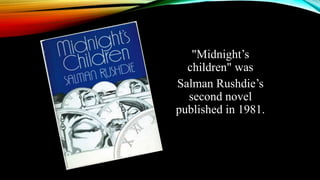
"Midnight’s
children" was
Salman Rushdie’s
second novel
published in 1981.
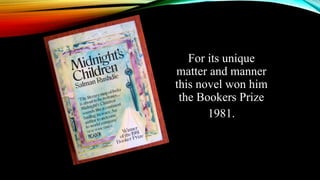
For its unique
matter and manner
this novel won him
the Bookers Prize
1981.
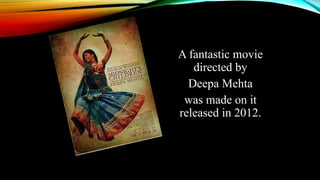
A fantastic movie
directed by
Deepa Mehta
was made on it
released in 2012.
“Midnight’s Children traces the grotesque destiny of
a Muslim Indian family from 1915 to 1977, when Indira
Gandhi’s Emergency rule was about to end in a
general election” (Towers, 1981).
INTRODUCTION
 The novel deals with India's transition from British colonialism
to independence and the partition of Subcontinent.
 It is considered an example of postcolonial literature and
magical realism.
 Midnight's children are the children born at the stroke of the
midnight of 15th August 1947 that marked India’s independence.
 The story is narrated by its chief protagonist, Saleem Sinai.
METHODOLOGY
The conceptual framework of Postcolonial theory is adopted to
critique this novel.
Content is analyzed to extract Postcolonial elements of
• Magical realism
• Mimicry
• Hybridity
• Miscegenation
• Postcolonial Feminism
RESULTS
 Following postcolonial elements were found through
content analysis
• Magical realism
• Mimicry
• Hybridity
• Miscegenation
• Postcolonial Feminism
MAGICAL REALISM
The magical realism narrative adds beauty and vigor to the
historical events represented in this novel which otherwise
could have been boring to read.
The midnight children were not ordinary kids , they had
supernatural powers.
Saleem’s incredible sense of smell, Parvati-the-witch’s
invisibility basket,Tai the eternal boatman is ageless, Mian
Abdullah’s humming and so on…
MAGICAL REALISM
“It's only minutes since I reached the final, typically long and
rich sentence of Midnight's Children and closed the covers. It
feels like shutting the lid on a magic box. A swirling, overloaded
mass of words, colors, smells, allusions and illusions has
suddenly been contained. A portal to a fantastical, vital
dimension has been sealed off ” (Jordison, 2008).
MIMICRY
Saleem Sanai highlighting mimicry in his society says that,
“In India, we've always been vulnerable to Europeans… Evie had only been with us a
matter of weeks, and already I was being sucked into a grotesque mimicry of European
literature.…Perhaps it would be fair to say that Europe repeats itself, in India, as
farce…” (Rushdie, 2011).
Saleem describing behavior of Sinai’s(Amina & Ahmed)at the cocktail hour says,
“when William Methwold comes to call ,they slip effortlessly into their imitation of
Oxford drawls; and they are learning, about ceiling fans and gas cookers, and Methwold,
supervising their transformation, is mumbling under his breath” (Rushdie, 2011).
Mr Methwold represents the colonizers part of mimicry, when he says,
“Sabkuch ticktock hai. Everything's just fine” (Rushdie, 2011).
HYBRIDITY
Saleem is a perfect representation of the hybrid man, born with multiple
allegiances and identities. He is a character of mixed backgrounds the
son of a colonial named William Methwold and a poor Indian woman,
yet raised as a son by the middle-class Sinais.
According to Gupta (2009) , Rushdie privileges a postmodern space or
third principle that blends both sides of binaries: east/west,
secular/religious, real/fantasy, and colonizer/colonized and foregrounds
hybridity over clarity and open-endedness over closure.
MISCEGENATION
Modern India is believed to be an outcome of miscegenation
(interbreeding of people).
Saleem Sinai the hero is also a perfect example of it.
According to Schellinger (1998), “Saleem is the child of a poor
Indian woman and a departing Englishman….even Saleem’s
huge nose is an intertextual reference both to the elephant –
headed Indian god Ganeesh and to such western models as
Tristram shandy and Cyrano de Bergerac”.
POSTCOLONIAL FEMINISM
Naseem is kept behind “perforated sheet” even when she has to be
examined by a doctor.
When doctor feels shocked and asks her father about how to examine
her without looking at her ,he is told by Naseem’s father Ghani that,
“'You Europe-returned chappies forget certain things. Doctor Sahib, my
daughter is a decent girl, it goes without saying. She does not flaunt her
body under the noses of strange men. You will understand that you cannot
be permitted to see her, no, not in any circumstances; accordingly, I have
required her to be positioned behind that sheet. She stands there, like a
good girl.'” (Rushdie, 2011)
POSTCOLONIAL FEMINISM
After getting married to Ahmed Sinao, Mumtaz is asked to change her name,
“'Change your name,' Ahmed Sinai said. 'Time for a fresh start. Throw Mumtaz
and her Nadir Khan out of the window, I'll choose you a new name. Amina.
Amina Sinai: you'd like that?' 'Whatever you say, husband,” says Mumtaz”
(Rushdie, 2011) .
Jamila the third generation female is also put behind PURDAH
“And when Jamila Singer's fame had reached the point at which she could no
longer avoid giving a public concert… it was Major (Retired) Latif who devised
her famous, all-concealing, white silk chadar, the curtain or veil, heavily
embroidered in gold brocade-work and religious calligraphy, behind which she
sat demurely whenever she performed in public” (Rushdie, 2011) .
DISCUSSION AND IMPLICATION
• Several post colonial elements were found in this novel
including mimicry , miscegenation , hybridity, postcolonial
Feminism.
• Narrative style of magical realism adds beauty to the narration
of historical events
• Several other postcolonial elements can be found in this novel,
and a more detail analysis of same postcolonial elements can be
done.
REFERENCES
Benny, C. P. (n.d.). Magic Realism as a postcolonial device in Salman Rushdie's
Midnight's Children .
Gupta, M. (2009). Salman Rushdie: A Re-telling History Through Fiction. prestige.
Jordison, S. (2008). Midnight's Children is the right winner. The Guardian.
Pryor, M. (n.d.). study.com.
Rushdie, S. (2011). Midnight's children. Vintage Books.
Schellinger, P. (1998). Encyclopedia of the Novel. Chicago: Fitzroy Dearborn
Publishers,.
Towers, R. (1981, September 24). On the Indian World Mountain. On the Indian
World Mountain. The New York review of Books.
Weickgenannt, N. (2008). The Nation’s Monstrous Women: Wives, Widows and
Witches in Salman Rushdie's Midnight's Children. The Journal of Commonwealth
Literature, 43-65.
THANK YOU FOR LISTENING

Midnight's Children: A Postcolonial Critique

  • 1.
    MIDNIGHT’S CHILDREN :A POSTCOLONIAL CRITIQUE By Rahila Khan M.Phil. Scholar SBK women’s University
  • 2.
    ABSTRACT This paper isa postcolonial critique of Salman Rushdie's most famous novel, Midnight's children. It is a postcolonial novel in which the novelist gives an account of the historical events that happened during British Raj and Independence in India. He adds beauty to these events through using the tool of magical realism, which makes it a beautiful piece of literature instead of a boring historical document. In this paper, I have attempted to highlight different postcolonial elements found in the novel along with its narrative style of magical realism.
  • 3.
  • 4.
    For its unique matterand manner this novel won him the Bookers Prize 1981.
  • 5.
    A fantastic movie directedby Deepa Mehta was made on it released in 2012.
  • 6.
    “Midnight’s Children tracesthe grotesque destiny of a Muslim Indian family from 1915 to 1977, when Indira Gandhi’s Emergency rule was about to end in a general election” (Towers, 1981).
  • 7.
    INTRODUCTION  The noveldeals with India's transition from British colonialism to independence and the partition of Subcontinent.  It is considered an example of postcolonial literature and magical realism.  Midnight's children are the children born at the stroke of the midnight of 15th August 1947 that marked India’s independence.  The story is narrated by its chief protagonist, Saleem Sinai.
  • 8.
    METHODOLOGY The conceptual frameworkof Postcolonial theory is adopted to critique this novel. Content is analyzed to extract Postcolonial elements of • Magical realism • Mimicry • Hybridity • Miscegenation • Postcolonial Feminism
  • 9.
    RESULTS  Following postcolonialelements were found through content analysis • Magical realism • Mimicry • Hybridity • Miscegenation • Postcolonial Feminism
  • 10.
    MAGICAL REALISM The magicalrealism narrative adds beauty and vigor to the historical events represented in this novel which otherwise could have been boring to read. The midnight children were not ordinary kids , they had supernatural powers. Saleem’s incredible sense of smell, Parvati-the-witch’s invisibility basket,Tai the eternal boatman is ageless, Mian Abdullah’s humming and so on…
  • 11.
    MAGICAL REALISM “It's onlyminutes since I reached the final, typically long and rich sentence of Midnight's Children and closed the covers. It feels like shutting the lid on a magic box. A swirling, overloaded mass of words, colors, smells, allusions and illusions has suddenly been contained. A portal to a fantastical, vital dimension has been sealed off ” (Jordison, 2008).
  • 12.
    MIMICRY Saleem Sanai highlightingmimicry in his society says that, “In India, we've always been vulnerable to Europeans… Evie had only been with us a matter of weeks, and already I was being sucked into a grotesque mimicry of European literature.…Perhaps it would be fair to say that Europe repeats itself, in India, as farce…” (Rushdie, 2011). Saleem describing behavior of Sinai’s(Amina & Ahmed)at the cocktail hour says, “when William Methwold comes to call ,they slip effortlessly into their imitation of Oxford drawls; and they are learning, about ceiling fans and gas cookers, and Methwold, supervising their transformation, is mumbling under his breath” (Rushdie, 2011). Mr Methwold represents the colonizers part of mimicry, when he says, “Sabkuch ticktock hai. Everything's just fine” (Rushdie, 2011).
  • 13.
    HYBRIDITY Saleem is aperfect representation of the hybrid man, born with multiple allegiances and identities. He is a character of mixed backgrounds the son of a colonial named William Methwold and a poor Indian woman, yet raised as a son by the middle-class Sinais. According to Gupta (2009) , Rushdie privileges a postmodern space or third principle that blends both sides of binaries: east/west, secular/religious, real/fantasy, and colonizer/colonized and foregrounds hybridity over clarity and open-endedness over closure.
  • 14.
    MISCEGENATION Modern India isbelieved to be an outcome of miscegenation (interbreeding of people). Saleem Sinai the hero is also a perfect example of it. According to Schellinger (1998), “Saleem is the child of a poor Indian woman and a departing Englishman….even Saleem’s huge nose is an intertextual reference both to the elephant – headed Indian god Ganeesh and to such western models as Tristram shandy and Cyrano de Bergerac”.
  • 15.
    POSTCOLONIAL FEMINISM Naseem iskept behind “perforated sheet” even when she has to be examined by a doctor. When doctor feels shocked and asks her father about how to examine her without looking at her ,he is told by Naseem’s father Ghani that, “'You Europe-returned chappies forget certain things. Doctor Sahib, my daughter is a decent girl, it goes without saying. She does not flaunt her body under the noses of strange men. You will understand that you cannot be permitted to see her, no, not in any circumstances; accordingly, I have required her to be positioned behind that sheet. She stands there, like a good girl.'” (Rushdie, 2011)
  • 16.
    POSTCOLONIAL FEMINISM After gettingmarried to Ahmed Sinao, Mumtaz is asked to change her name, “'Change your name,' Ahmed Sinai said. 'Time for a fresh start. Throw Mumtaz and her Nadir Khan out of the window, I'll choose you a new name. Amina. Amina Sinai: you'd like that?' 'Whatever you say, husband,” says Mumtaz” (Rushdie, 2011) . Jamila the third generation female is also put behind PURDAH “And when Jamila Singer's fame had reached the point at which she could no longer avoid giving a public concert… it was Major (Retired) Latif who devised her famous, all-concealing, white silk chadar, the curtain or veil, heavily embroidered in gold brocade-work and religious calligraphy, behind which she sat demurely whenever she performed in public” (Rushdie, 2011) .
  • 17.
    DISCUSSION AND IMPLICATION •Several post colonial elements were found in this novel including mimicry , miscegenation , hybridity, postcolonial Feminism. • Narrative style of magical realism adds beauty to the narration of historical events • Several other postcolonial elements can be found in this novel, and a more detail analysis of same postcolonial elements can be done.
  • 18.
    REFERENCES Benny, C. P.(n.d.). Magic Realism as a postcolonial device in Salman Rushdie's Midnight's Children . Gupta, M. (2009). Salman Rushdie: A Re-telling History Through Fiction. prestige. Jordison, S. (2008). Midnight's Children is the right winner. The Guardian. Pryor, M. (n.d.). study.com. Rushdie, S. (2011). Midnight's children. Vintage Books. Schellinger, P. (1998). Encyclopedia of the Novel. Chicago: Fitzroy Dearborn Publishers,. Towers, R. (1981, September 24). On the Indian World Mountain. On the Indian World Mountain. The New York review of Books. Weickgenannt, N. (2008). The Nation’s Monstrous Women: Wives, Widows and Witches in Salman Rushdie's Midnight's Children. The Journal of Commonwealth Literature, 43-65.
  • 19.
    THANK YOU FORLISTENING