BIOMASS POWER PLANTS
Manohar Tatwawadi
total output power solutions
Pune, Maharashtra
3/30/2020 total output power solutions 1
Biomass as carbon-neutral fuel
• The use of biomass as a fuel is considered to be carbon neutral
because plants and trees remove carbon dioxide (CO2 ) from the
atmosphere and store it while they grow. Burning biomass in
homes, in industrial processes, for energy generation , or for
transport activities returns this sequester red CO2 to the
atmosphere. At the same time, new plant or tree growth keeps the
atmosphere’s carbon cycle in balance by recapturing CO2 .
• This net-zero or carbon-neutral cycle can be repeated indefinitely,
as long as biomass is re-grown in the next management cycle and
harvested for use. The sustainable management of the biomass
source is thus critical to ensuring that the carbon cycle is not
interrupted.
• In contrast to biomass, fossil fuels such as gas, oil, and coal are not
regarded as carbon-neutral because they release CO2 which has
been stored for millions of years, and because they cannot be
stored or sequestered.
3/30/2020 total output power solutions 2
Sources of biomass as fuel
• Wheat, barley, and oats all produce copious amounts of straw,
which has traditionally been burned.
• Rice produces both straw in the fields and rice husks at the
processing plant; both of these can be conveniently and easily
converted into energy.
• When maize is harvested, significant quantities of biomass remain
in the field. Much of this needs to be returned to the soil, but when
the harvested maize is stripped from its cob the latter remains,
constituting more biomass which can easily be converted into
energy on-site.
• Sugar cane harvesting leaves harvest “trash” in the fields, while
processing produces fibrous bagasse. The latter is a valuable source
of energy.
• Harvesting and processing of coconuts produces quantities of shell
and fiber that can be utilized.
• Peanuts leave shells, which are a great source of biomass energy.
3/30/2020 total output power solutions 3
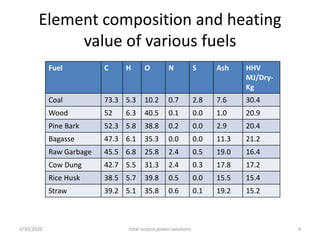
Element composition and heating
value of various fuels
Fuel C H O N S Ash HHV
MJ/Dry-
Kg
Coal 73.3 5.3 10.2 0.7 2.8 7.6 30.4
Wood 52 6.3 40.5 0.1 0.0 1.0 20.9
Pine Bark 52.3 5.8 38.8 0.2 0.0 2.9 20.4
Bagasse 47.3 6.1 35.3 0.0 0.0 11.3 21.2
Raw Garbage 45.5 6.8 25.8 2.4 0.5 19.0 16.4
Cow Dung 42.7 5.5 31.3 2.4 0.3 17.8 17.2
Rice Husk 38.5 5.7 39.8 0.5 0.0 15.5 15.4
Straw 39.2 5.1 35.8 0.6 0.1 19.2 15.2
3/30/2020 total output power solutions 4
How much biomass does a biomass power
plant need to generate one MWh.
3/30/2020 total output power solutions 5
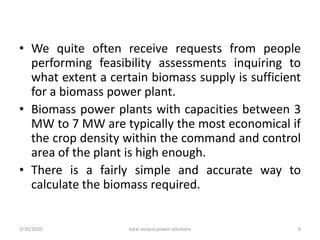
• We quite often receive requests from people
performing feasibility assessments inquiring to
what extent a certain biomass supply is sufficient
for a biomass power plant.
• Biomass power plants with capacities between 3
MW to 7 MW are typically the most economical if
the crop density within the command and control
area of the plant is high enough.
• There is a fairly simple and accurate way to
calculate the biomass required.
3/30/2020 total output power solutions 6
Biomass Required
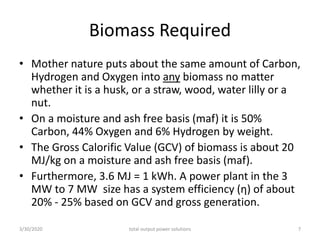
• Mother nature puts about the same amount of Carbon,
Hydrogen and Oxygen into any biomass no matter
whether it is a husk, or a straw, wood, water lilly or a
nut.
• On a moisture and ash free basis (maf) it is 50%
Carbon, 44% Oxygen and 6% Hydrogen by weight.
• The Gross Calorific Value (GCV) of biomass is about 20
MJ/kg on a moisture and ash free basis (maf).
• Furthermore, 3.6 MJ = 1 kWh. A power plant in the 3
MW to 7 MW size has a system efficiency (η) of about
20% - 25% based on GCV and gross generation.
3/30/2020 total output power solutions 7
Biomass Requirement
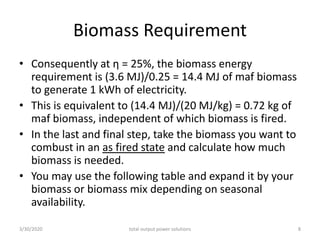
• Consequently at η = 25%, the biomass energy
requirement is (3.6 MJ)/0.25 = 14.4 MJ of maf biomass
to generate 1 kWh of electricity.
• This is equivalent to (14.4 MJ)/(20 MJ/kg) = 0.72 kg of
maf biomass, independent of which biomass is fired.
• In the last and final step, take the biomass you want to
combust in an as fired state and calculate how much
biomass is needed.
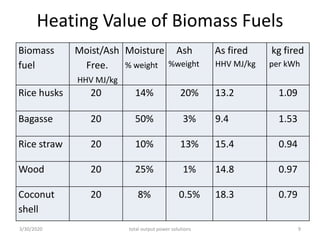
• You may use the following table and expand it by your
biomass or biomass mix depending on seasonal
availability.
3/30/2020 total output power solutions 8
Heating Value of Biomass Fuels
Biomass
fuel
Moist/Ash
Free.
HHV MJ/kg
Moisture
% weight
Ash
%weight
As fired
HHV MJ/kg
kg fired
per kWh
Rice husks 20 14% 20% 13.2 1.09
Bagasse 20 50% 3% 9.4 1.53
Rice straw 20 10% 13% 15.4 0.94
Wood 20 25% 1% 14.8 0.97
Coconut
shell
20 8% 0.5% 18.3 0.79
3/30/2020 total output power solutions 9
Biomass Requirement
• Assuming a plant load factor of 68%, i.e. 29,376
MWh/year electricity are generated by a 5 MW
plant, between 23,529 tons to 45,569 ton of
biomass per year depending on the biomass and
condition delivered to the gate are required to
sustain operation.
• It is assumed that the thermal efficiency of the
boiler is about the same independent of which
fuel is fired. This assumption is not quite correct
because firing a wet, or high ash fuel lowers the
thermal efficiency of the boiler.
3/30/2020 total output power solutions 10
Little Facts
• These figures are fully sufficient to get an
overview how much biomass is needed to
support a 5 MW power plant.
• Be aware that the inaccuracy lies not in the
numbers, but in the resolve of the operator to
check the moisture content of the biomass at the
power plant gate and reject very wet biomass
which has not been adequately sun dried, or
biomass loaded with tramp ash.
• Neither tramp ash nor high water content are
good for the operation.
3/30/2020 total output power solutions 11
3/30/2020 total output power solutions 12

Biomass Power Plants

  • 1.
    BIOMASS POWER PLANTS ManoharTatwawadi total output power solutions Pune, Maharashtra 3/30/2020 total output power solutions 1
  • 2.
    Biomass as carbon-neutralfuel • The use of biomass as a fuel is considered to be carbon neutral because plants and trees remove carbon dioxide (CO2 ) from the atmosphere and store it while they grow. Burning biomass in homes, in industrial processes, for energy generation , or for transport activities returns this sequester red CO2 to the atmosphere. At the same time, new plant or tree growth keeps the atmosphere’s carbon cycle in balance by recapturing CO2 . • This net-zero or carbon-neutral cycle can be repeated indefinitely, as long as biomass is re-grown in the next management cycle and harvested for use. The sustainable management of the biomass source is thus critical to ensuring that the carbon cycle is not interrupted. • In contrast to biomass, fossil fuels such as gas, oil, and coal are not regarded as carbon-neutral because they release CO2 which has been stored for millions of years, and because they cannot be stored or sequestered. 3/30/2020 total output power solutions 2
  • 3.
    Sources of biomassas fuel • Wheat, barley, and oats all produce copious amounts of straw, which has traditionally been burned. • Rice produces both straw in the fields and rice husks at the processing plant; both of these can be conveniently and easily converted into energy. • When maize is harvested, significant quantities of biomass remain in the field. Much of this needs to be returned to the soil, but when the harvested maize is stripped from its cob the latter remains, constituting more biomass which can easily be converted into energy on-site. • Sugar cane harvesting leaves harvest “trash” in the fields, while processing produces fibrous bagasse. The latter is a valuable source of energy. • Harvesting and processing of coconuts produces quantities of shell and fiber that can be utilized. • Peanuts leave shells, which are a great source of biomass energy. 3/30/2020 total output power solutions 3
  • 4.
    Element composition andheating value of various fuels Fuel C H O N S Ash HHV MJ/Dry- Kg Coal 73.3 5.3 10.2 0.7 2.8 7.6 30.4 Wood 52 6.3 40.5 0.1 0.0 1.0 20.9 Pine Bark 52.3 5.8 38.8 0.2 0.0 2.9 20.4 Bagasse 47.3 6.1 35.3 0.0 0.0 11.3 21.2 Raw Garbage 45.5 6.8 25.8 2.4 0.5 19.0 16.4 Cow Dung 42.7 5.5 31.3 2.4 0.3 17.8 17.2 Rice Husk 38.5 5.7 39.8 0.5 0.0 15.5 15.4 Straw 39.2 5.1 35.8 0.6 0.1 19.2 15.2 3/30/2020 total output power solutions 4
  • 5.
    How much biomassdoes a biomass power plant need to generate one MWh. 3/30/2020 total output power solutions 5
  • 6.
    • We quiteoften receive requests from people performing feasibility assessments inquiring to what extent a certain biomass supply is sufficient for a biomass power plant. • Biomass power plants with capacities between 3 MW to 7 MW are typically the most economical if the crop density within the command and control area of the plant is high enough. • There is a fairly simple and accurate way to calculate the biomass required. 3/30/2020 total output power solutions 6
  • 7.
    Biomass Required • Mothernature puts about the same amount of Carbon, Hydrogen and Oxygen into any biomass no matter whether it is a husk, or a straw, wood, water lilly or a nut. • On a moisture and ash free basis (maf) it is 50% Carbon, 44% Oxygen and 6% Hydrogen by weight. • The Gross Calorific Value (GCV) of biomass is about 20 MJ/kg on a moisture and ash free basis (maf). • Furthermore, 3.6 MJ = 1 kWh. A power plant in the 3 MW to 7 MW size has a system efficiency (η) of about 20% - 25% based on GCV and gross generation. 3/30/2020 total output power solutions 7
  • 8.
    Biomass Requirement • Consequentlyat η = 25%, the biomass energy requirement is (3.6 MJ)/0.25 = 14.4 MJ of maf biomass to generate 1 kWh of electricity. • This is equivalent to (14.4 MJ)/(20 MJ/kg) = 0.72 kg of maf biomass, independent of which biomass is fired. • In the last and final step, take the biomass you want to combust in an as fired state and calculate how much biomass is needed. • You may use the following table and expand it by your biomass or biomass mix depending on seasonal availability. 3/30/2020 total output power solutions 8
  • 9.
    Heating Value ofBiomass Fuels Biomass fuel Moist/Ash Free. HHV MJ/kg Moisture % weight Ash %weight As fired HHV MJ/kg kg fired per kWh Rice husks 20 14% 20% 13.2 1.09 Bagasse 20 50% 3% 9.4 1.53 Rice straw 20 10% 13% 15.4 0.94 Wood 20 25% 1% 14.8 0.97 Coconut shell 20 8% 0.5% 18.3 0.79 3/30/2020 total output power solutions 9
  • 10.
    Biomass Requirement • Assuminga plant load factor of 68%, i.e. 29,376 MWh/year electricity are generated by a 5 MW plant, between 23,529 tons to 45,569 ton of biomass per year depending on the biomass and condition delivered to the gate are required to sustain operation. • It is assumed that the thermal efficiency of the boiler is about the same independent of which fuel is fired. This assumption is not quite correct because firing a wet, or high ash fuel lowers the thermal efficiency of the boiler. 3/30/2020 total output power solutions 10
  • 11.
    Little Facts • Thesefigures are fully sufficient to get an overview how much biomass is needed to support a 5 MW power plant. • Be aware that the inaccuracy lies not in the numbers, but in the resolve of the operator to check the moisture content of the biomass at the power plant gate and reject very wet biomass which has not been adequately sun dried, or biomass loaded with tramp ash. • Neither tramp ash nor high water content are good for the operation. 3/30/2020 total output power solutions 11
  • 12.
    3/30/2020 total outputpower solutions 12