FUELS AND COMBUSTION
Manohar Tatwawadi
Director
“total output power solutions”
FUELS
• Generally three types of Fuels are used in
Coal Based Thermal Power Stations
1. Light Diesel Oil
2. Furnace Oil / LSHS and
3. Pulverised Coal
• Liquid Fuels are generally used for initial
starting, or for stabilisation of flame.
16-Dec-2021 Manohar Tatwawadi 2
Liquid Fuels
16-Dec-2021
LIQUID FUEL PROPERTIES
LIQUID FUELS PROPERTIES
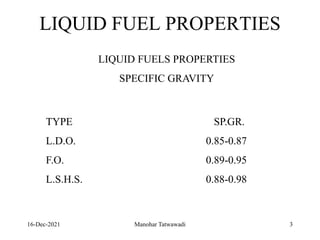
SPECIFIC GRAVITY
TYPE SP.GR.
L.D.O. 0.85-0.87
F.O. 0.89-0.95
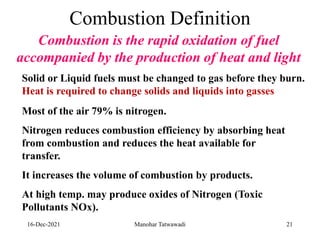
L.S.H.S. 0.88-0.98
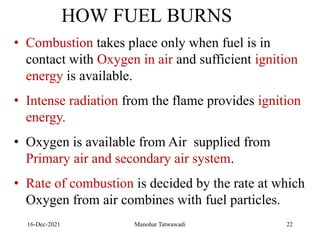
3
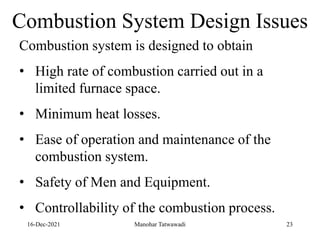
Manohar Tatwawadi
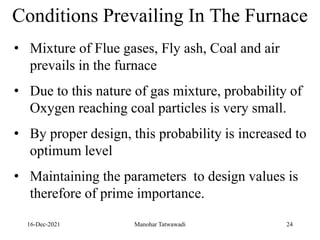
16-Dec-2021
FUEL PROPERTIES
LIQUID FUEL PROPERTIES
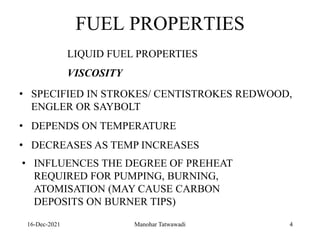
VISCOSITY
• SPECIFIED IN STROKES/ CENTISTROKES REDWOOD,
ENGLER OR SAYBOLT
• DEPENDS ON TEMPERATURE
• DECREASES AS TEMP INCREASES
• INFLUENCES THE DEGREE OF PREHEAT
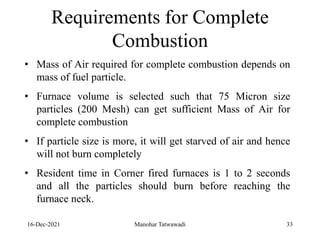
REQUIRED FOR PUMPING, BURNING,
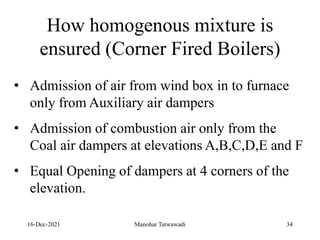
ATOMISATION (MAY CAUSE CARBON
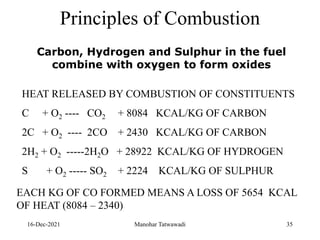
DEPOSITS ON BURNER TIPS)
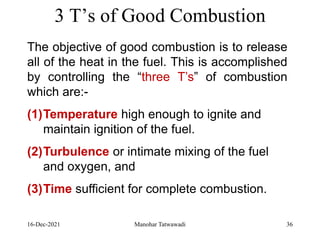
4
Manohar Tatwawadi
16-Dec-2021
FUEL PROPERTIES
LIQUID FUEL PROPERTIES
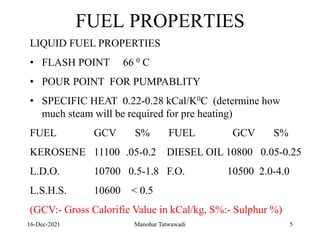
• FLASH POINT 66 0 C
• POUR POINT FOR PUMPABLITY
• SPECIFIC HEAT 0.22-0.28 kCal/K0C (determine how
much steam will be required for pre heating)
FUEL GCV S% FUEL GCV S%
KEROSENE 11100 .05-0.2 DIESEL OIL 10800 0.05-0.25
L.D.O. 10700 0.5-1.8 F.O. 10500 2.0-4.0
L.S.H.S. 10600 < 0.5
(GCV:- Gross Calorific Value in kCal/kg, S%:- Sulphur %)
5
Manohar Tatwawadi
16-Dec-2021
LIQUID FUELS
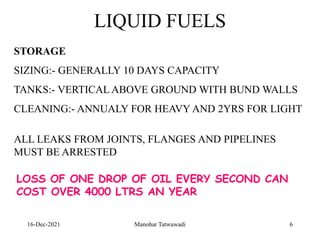
STORAGE
SIZING:- GENERALLY 10 DAYS CAPACITY
TANKS:- VERTICAL ABOVE GROUND WITH BUND WALLS
CLEANING:- ANNUALY FOR HEAVY AND 2YRS FOR LIGHT
ALL LEAKS FROM JOINTS, FLANGES AND PIPELINES
MUST BE ARRESTED
LOSS OF ONE DROP OF OIL EVERY SECOND CAN
COST OVER 4000 LTRS AN YEAR
6
Manohar Tatwawadi
16-Dec-2021
LIQUID FUEL
CONTAMINATIONS
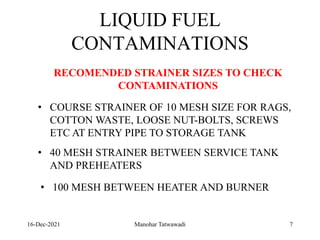
• COURSE STRAINER OF 10 MESH SIZE FOR RAGS,
COTTON WASTE, LOOSE NUT-BOLTS, SCREWS
ETC AT ENTRY PIPE TO STORAGE TANK
• 40 MESH STRAINER BETWEEN SERVICE TANK
AND PREHEATERS
• 100 MESH BETWEEN HEATER AND BURNER
RECOMENDED STRAINER SIZES TO CHECK
CONTAMINATIONS
7
Manohar Tatwawadi
16-Dec-2021
SOLID FUEL (COAL)
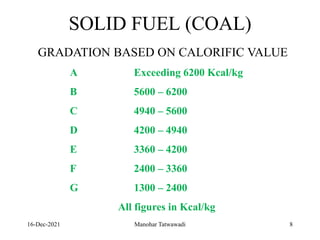
GRADATION BASED ON CALORIFIC VALUE
A Exceeding 6200 Kcal/kg
B 5600 – 6200
C 4940 – 5600
D 4200 – 4940
E 3360 – 4200
F 2400 – 3360
G 1300 – 2400
All figures in Kcal/kg
8
Manohar Tatwawadi
16-Dec-2021
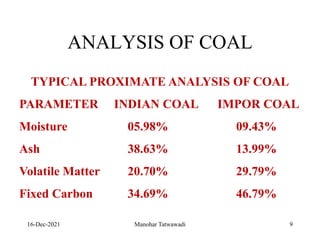
ANALYSIS OF COAL
TYPICAL PROXIMATE ANALYSIS OF COAL
PARAMETER INDIAN COAL IMPOR COAL
Moisture 05.98% 09.43%
Ash 38.63% 13.99%
Volatile Matter 20.70% 29.79%
Fixed Carbon 34.69% 46.79%
9
Manohar Tatwawadi
16-Dec-2021
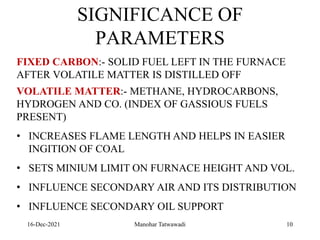
SIGNIFICANCE OF
PARAMETERS
FIXED CARBON:- SOLID FUEL LEFT IN THE FURNACE
AFTER VOLATILE MATTER IS DISTILLED OFF
VOLATILE MATTER:- METHANE, HYDROCARBONS,
HYDROGEN AND CO. (INDEX OF GASSIOUS FUELS
PRESENT)
• INCREASES FLAME LENGTH AND HELPS IN EASIER
INGITION OF COAL
• SETS MINIUM LIMIT ON FURNACE HEIGHT AND VOL.
• INFLUENCE SECONDARY AIR AND ITS DISTRIBUTION
• INFLUENCE SECONDARY OIL SUPPORT
10
Manohar Tatwawadi
16-Dec-2021
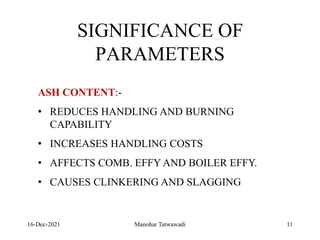
SIGNIFICANCE OF
PARAMETERS
ASH CONTENT:-
• REDUCES HANDLING AND BURNING
CAPABILITY
• INCREASES HANDLING COSTS
• AFFECTS COMB. EFFY AND BOILER EFFY.
• CAUSES CLINKERING AND SLAGGING
11
Manohar Tatwawadi
16-Dec-2021
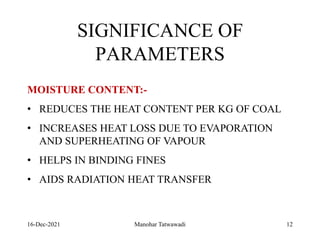
SIGNIFICANCE OF
PARAMETERS
MOISTURE CONTENT:-
• REDUCES THE HEAT CONTENT PER KG OF COAL
• INCREASES HEAT LOSS DUE TO EVAPORATION
AND SUPERHEATING OF VAPOUR
• HELPS IN BINDING FINES
• AIDS RADIATION HEAT TRANSFER
12
Manohar Tatwawadi
16-Dec-2021
SIGNIFICANCE OF
PARAMETERS
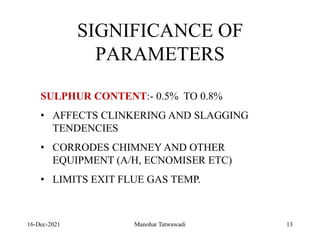
SULPHUR CONTENT:- 0.5% TO 0.8%
• AFFECTS CLINKERING AND SLAGGING
TENDENCIES
• CORRODES CHIMNEY AND OTHER
EQUIPMENT (A/H, ECNOMISER ETC)
• LIMITS EXIT FLUE GAS TEMP.
13
Manohar Tatwawadi
ANALYSIS OF COAL
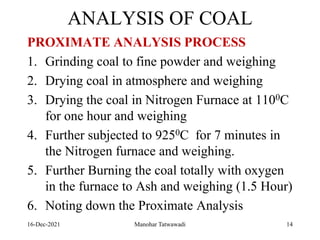
PROXIMATE ANALYSIS PROCESS
1. Grinding coal to fine powder and weighing
2. Drying coal in atmosphere and weighing
3. Drying the coal in Nitrogen Furnace at 1100C
for one hour and weighing
4. Further subjected to 9250C for 7 minutes in
the Nitrogen furnace and weighing.
5. Further Burning the coal totally with oxygen
in the furnace to Ash and weighing (1.5 Hour)
6. Noting down the Proximate Analysis
16-Dec-2021 Manohar Tatwawadi 14
PROXIMATE ANALYSIS OF
COAL
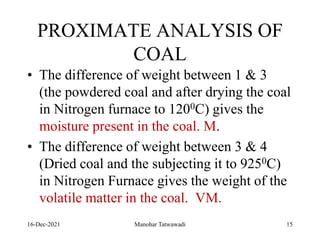
• The difference of weight between 1 & 3
(the powdered coal and after drying the coal
in Nitrogen furnace to 1200C) gives the
moisture present in the coal. M.
• The difference of weight between 3 & 4
(Dried coal and the subjecting it to 9250C)
in Nitrogen Furnace gives the weight of the
volatile matter in the coal. VM.
16-Dec-2021 Manohar Tatwawadi 15
PROXIMATE ANALYSIS OF
COAL
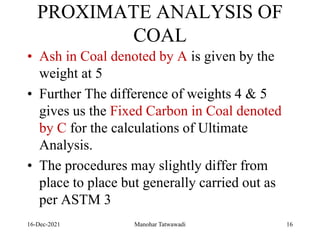
• Ash in Coal denoted by A is given by the
weight at 5
• Further The difference of weights 4 & 5
gives us the Fixed Carbon in Coal denoted
by C for the calculations of Ultimate
Analysis.
• The procedures may slightly differ from
place to place but generally carried out as
per ASTM 3
16-Dec-2021 Manohar Tatwawadi 16
16-Dec-2021
ULTIMATE ANALYSIS OF COAL DERIVED
FROM PROXIMATE ANALYSIS
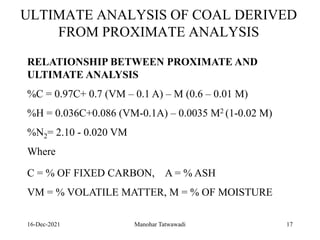
RELATIONSHIP BETWEEN PROXIMATE AND
ULTIMATE ANALYSIS
%C = 0.97C+ 0.7 (VM – 0.1 A) – M (0.6 – 0.01 M)
%H = 0.036C+0.086 (VM-0.1A) – 0.0035 M2 (1-0.02 M)
%N2= 2.10 - 0.020 VM
Where
C = % OF FIXED CARBON, A = % ASH
VM = % VOLATILE MATTER, M = % OF MOISTURE
17
Manohar Tatwawadi
16-Dec-2021
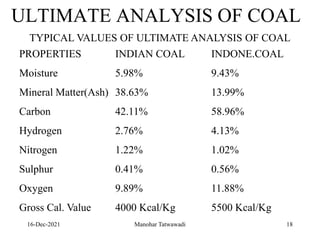
ULTIMATE ANALYSIS OF COAL
TYPICAL VALUES OF ULTIMATE ANALYSIS OF COAL
PROPERTIES INDIAN COAL INDONE.COAL
Moisture 5.98% 9.43%
Mineral Matter(Ash) 38.63% 13.99%
Carbon 42.11% 58.96%
Hydrogen 2.76% 4.13%
Nitrogen 1.22% 1.02%
Sulphur 0.41% 0.56%
Oxygen 9.89% 11.88%
Gross Cal. Value 4000 Kcal/Kg 5500 Kcal/Kg
18
Manohar Tatwawadi
16-Dec-2021
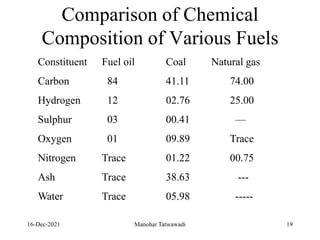
Comparison of Chemical
Composition of Various Fuels
Constituent Fuel oil Coal Natural gas
Carbon 84 41.11 74.00
Hydrogen 12 02.76 25.00
Sulphur 03 00.41 —
Oxygen 01 09.89 Trace
Nitrogen Trace 01.22 00.75
Ash Trace 38.63 ---
Water Trace 05.98 -----
19
Manohar Tatwawadi
16-Dec-2021
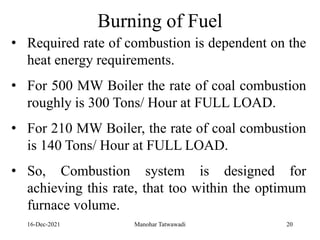
Burning of Fuel
• Required rate of combustion is dependent on the
heat energy requirements.
• For 500 MW Boiler the rate of coal combustion
roughly is 300 Tons/ Hour at FULL LOAD.
• For 210 MW Boiler, the rate of coal combustion
is 140 Tons/ Hour at FULL LOAD.
• So, Combustion system is designed for
achieving this rate, that too within the optimum
furnace volume.
20
Manohar Tatwawadi
16-Dec-2021
Combustion Definition
Combustion is the rapid oxidation of fuel
accompanied by the production of heat and light
Solid or Liquid fuels must be changed to gas before they burn.
Heat is required to change solids and liquids into gasses
Most of the air 79% is nitrogen.
Nitrogen reduces combustion efficiency by absorbing heat
from combustion and reduces the heat available for
transfer.
It increases the volume of combustion by products.
At high temp. may produce oxides of Nitrogen (Toxic
Pollutants NOx).
21
Manohar Tatwawadi
16-Dec-2021
• Combustion takes place only when fuel is in
contact with Oxygen in air and sufficient ignition
energy is available.
• Intense radiation from the flame provides ignition
energy.
• Oxygen is available from Air supplied from
Primary air and secondary air system.
• Rate of combustion is decided by the rate at which
Oxygen from air combines with fuel particles.
HOW FUEL BURNS
22
Manohar Tatwawadi
16-Dec-2021
Combustion System Design Issues
Combustion system is designed to obtain
• High rate of combustion carried out in a
limited furnace space.
• Minimum heat losses.
• Ease of operation and maintenance of the
combustion system.
• Safety of Men and Equipment.
• Controllability of the combustion process.
23
Manohar Tatwawadi
16-Dec-2021
Conditions Prevailing In The Furnace
• Mixture of Flue gases, Fly ash, Coal and air
prevails in the furnace
• Due to this nature of gas mixture, probability of
Oxygen reaching coal particles is very small.
• By proper design, this probability is increased to
optimum level
• Maintaining the parameters to design values is
therefore of prime importance.
24
Manohar Tatwawadi
16-Dec-2021
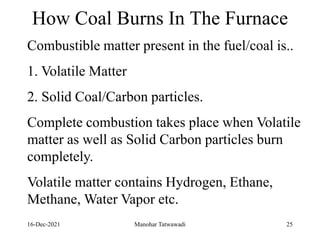
How Coal Burns In The Furnace
Combustible matter present in the fuel/coal is..
1. Volatile Matter
2. Solid Coal/Carbon particles.
Complete combustion takes place when Volatile
matter as well as Solid Carbon particles burn
completely.
Volatile matter contains Hydrogen, Ethane,
Methane, Water Vapor etc.
25
Manohar Tatwawadi
16-Dec-2021
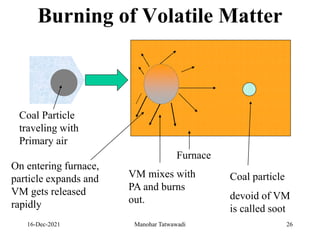
Burning of Volatile Matter
Coal Particle
traveling with
Primary air
Furnace
Coal particle
devoid of VM
is called soot
On entering furnace,
particle expands and
VM gets released
rapidly
VM mixes with
PA and burns
out.
26
Manohar Tatwawadi
16-Dec-2021
• Primary air is consumed in combustion of Volatile Matter.
• Combustion of VM completes within first 40 to 50
milliseconds if primary air is able to mix with gaseous VM.
• Primary air flow rate must be such that it fulfills Oxygen
requirement for combustion of VM.
• Combustion of soot particles is slow as Oxygen from air do
not reach to the solid particles as readily as that of VM.
• Oxygen transport to soot particles is by diffusion.
Combustion Process
27
Manohar Tatwawadi
16-Dec-2021
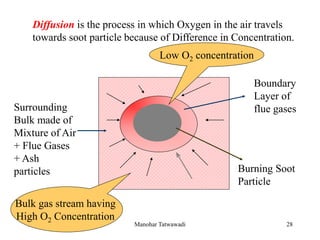
Diffusion is the process in which Oxygen in the air travels
towards soot particle because of Difference in Concentration.
Burning Soot
Particle
Boundary
Layer of
flue gases
Surrounding
Bulk made of
Mixture of Air
+ Flue Gases
+ Ash
particles
Low O2 concentration
Bulk gas stream having
High O2 Concentration
28
Manohar Tatwawadi
16-Dec-2021
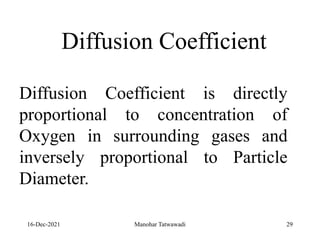
Diffusion Coefficient is directly
proportional to concentration of
Oxygen in surrounding gases and
inversely proportional to Particle
Diameter.
29
Manohar Tatwawadi
Diffusion Coefficient
16-Dec-2021
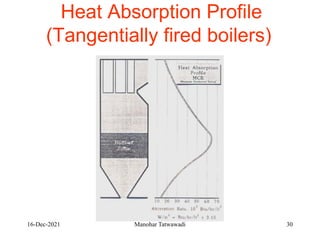
Heat Absorption Profile
(Tangentially fired boilers)
30
Manohar Tatwawadi
16-Dec-2021
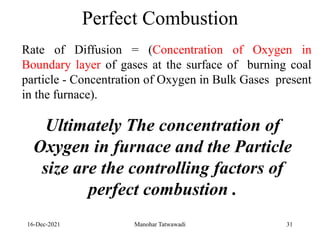
Rate of Diffusion = (Concentration of Oxygen in
Boundary layer of gases at the surface of burning coal
particle - Concentration of Oxygen in Bulk Gases present
in the furnace).
Ultimately The concentration of
Oxygen in furnace and the Particle
size are the controlling factors of
perfect combustion .
Perfect Combustion
31
Manohar Tatwawadi
16-Dec-2021
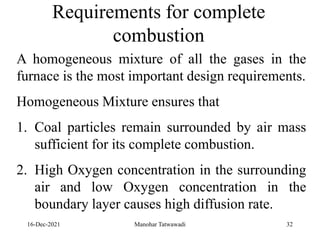
A homogeneous mixture of all the gases in the
furnace is the most important design requirements.
Homogeneous Mixture ensures that
1. Coal particles remain surrounded by air mass
sufficient for its complete combustion.
2. High Oxygen concentration in the surrounding
air and low Oxygen concentration in the
boundary layer causes high diffusion rate.
Requirements for complete
combustion
32
Manohar Tatwawadi
16-Dec-2021
Requirements for Complete
Combustion
• Mass of Air required for complete combustion depends on
mass of fuel particle.
• Furnace volume is selected such that 75 Micron size
particles (200 Mesh) can get sufficient Mass of Air for
complete combustion
• If particle size is more, it will get starved of air and hence
will not burn completely
• Resident time in Corner fired furnaces is 1 to 2 seconds
and all the particles should burn before reaching the
furnace neck.
33
Manohar Tatwawadi
16-Dec-2021
• Admission of air from wind box in to furnace
only from Auxiliary air dampers
• Admission of combustion air only from the
Coal air dampers at elevations A,B,C,D,E and F
• Equal Opening of dampers at 4 corners of the
elevation.
How homogenous mixture is
ensured (Corner Fired Boilers)
34
Manohar Tatwawadi
16-Dec-2021
Principles of Combustion
Carbon, Hydrogen and Sulphur in the fuel
combine with oxygen to form oxides
HEAT RELEASED BY COMBUSTION OF CONSTITUENTS
C + O2 ---- CO2 + 8084 KCAL/KG OF CARBON
2C + O2 ---- 2CO + 2430 KCAL/KG OF CARBON
2H2 + O2 -----2H2O + 28922 KCAL/KG OF HYDROGEN
S + O2 ----- SO2 + 2224 KCAL/KG OF SULPHUR
EACH KG OF CO FORMED MEANS A LOSS OF 5654 KCAL
OF HEAT (8084 – 2340)
35
Manohar Tatwawadi
16-Dec-2021
3 T’s of Good Combustion
The objective of good combustion is to release
all of the heat in the fuel. This is accomplished
by controlling the “three T’s” of combustion
which are:-
(1)Temperature high enough to ignite and
maintain ignition of the fuel.
(2)Turbulence or intimate mixing of the fuel
and oxygen, and
(3)Time sufficient for complete combustion.
36
Manohar Tatwawadi
16-Dec-2021
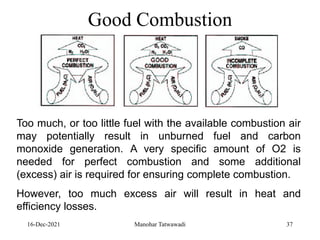
Good Combustion
Too much, or too little fuel with the available combustion air
may potentially result in unburned fuel and carbon
monoxide generation. A very specific amount of O2 is
needed for perfect combustion and some additional
(excess) air is required for ensuring complete combustion.
However, too much excess air will result in heat and
efficiency losses.
37
Manohar Tatwawadi
16-Dec-2021
• Dampers A,B,C,D,E,F open from 0 to 40% for 0%
to 100% loading of the coal mill.
• Dampers should be closed for the elevations not in
service.
• AB, CD, EF dampers open as per the oil pressure for
the elevation in service.
• For the elevations not in service, these dampers open
to maintain Furnace - Windbox DP.
• AA, FF, BC and DE dampers open to maintain
Furnace - Windbox DP
Auxiliary air dampers
(Secondary Air)
38
Manohar Tatwawadi
16-Dec-2021
Air Requirement For Complete
Combustion of Coal
Calculation of Theoretical Air requirement
SAMPLE CASE :-
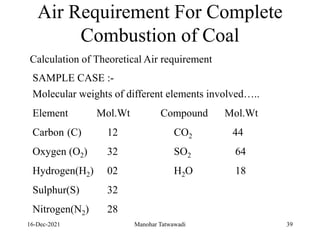
Molecular weights of different elements involved…..
Element Mol.Wt Compound Mol.Wt
Carbon (C) 12 CO2 44
Oxygen (O2) 32 SO2 64
Hydrogen(H2) 02 H2O 18
Sulphur(S) 32
Nitrogen(N2) 28
39
Manohar Tatwawadi
Chemical Reactions and Fuel
Contents Analysis
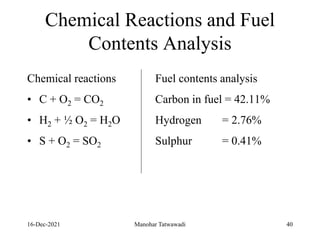
Chemical reactions Fuel contents analysis
• C + O2 = CO2 Carbon in fuel = 42.11%
• H2 + ½ O2 = H2O Hydrogen = 2.76%
• S + O2 = SO2 Sulphur = 0.41%
16-Dec-2021 Manohar Tatwawadi 40
Combustion Process Analysis
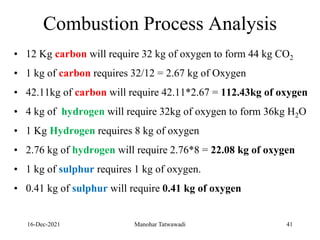
• 12 Kg carbon will require 32 kg of oxygen to form 44 kg CO2
• 1 kg of carbon requires 32/12 = 2.67 kg of Oxygen
• 42.11kg of carbon will require 42.11*2.67 = 112.43kg of oxygen
• 4 kg of hydrogen will require 32kg of oxygen to form 36kg H2O
• 1 Kg Hydrogen requires 8 kg of oxygen
• 2.76 kg of hydrogen will require 2.76*8 = 22.08 kg of oxygen
• 1 kg of sulphur requires 1 kg of oxygen.
• 0.41 kg of sulphur will require 0.41 kg of oxygen
16-Dec-2021 Manohar Tatwawadi 41
16-Dec-2021
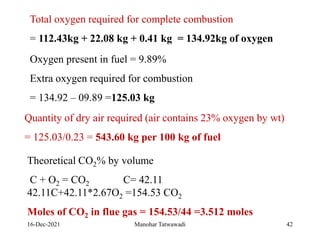
Total oxygen required for complete combustion
= 112.43kg + 22.08 kg + 0.41 kg = 134.92kg of oxygen
Oxygen present in fuel = 9.89%
Extra oxygen required for combustion
= 134.92 – 09.89 =125.03 kg
Quantity of dry air required (air contains 23% oxygen by wt)
= 125.03/0.23 = 543.60 kg per 100 kg of fuel
Theoretical CO2% by volume
C + O2 = CO2 C= 42.11
42.11C+42.11*2.67O2 =154.53 CO2
Moles of CO2 in flue gas = 154.53/44 =3.512 moles
42
Manohar Tatwawadi
16-Dec-2021
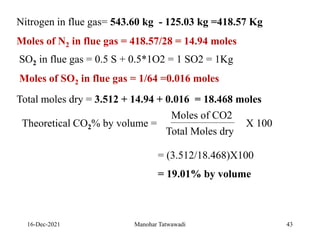
Nitrogen in flue gas= 543.60 kg - 125.03 kg =418.57 Kg
Moles of N2 in flue gas = 418.57/28 = 14.94 moles
SO2 in flue gas = 0.5 S + 0.5*1O2 = 1 SO2 = 1Kg
Moles of SO2 in flue gas = 1/64 =0.016 moles
Total moles dry = 3.512 + 14.94 + 0.016 = 18.468 moles
Theoretical CO2% by volume =
Moles of CO2
Total Moles dry
X 100
= (3.512/18.468)X100
= 19.01% by volume
43
Manohar Tatwawadi
16-Dec-2021
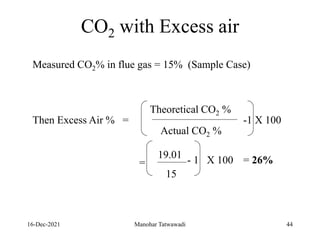
CO2 with Excess air
Measured CO2% in flue gas = 15% (Sample Case)
Theoretical CO2 %
Actual CO2 %
Then Excess Air % = -1 X 100
19.01
15
- 1 X 100
= = 26%
44
Manohar Tatwawadi
16-Dec-2021
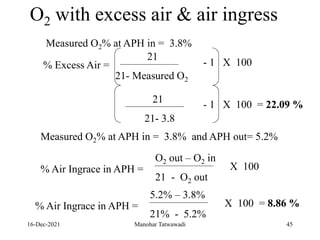
O2 with excess air & air ingress
Measured O2% at APH in = 3.8%
% Excess Air =
21
21- Measured O2
- 1 X 100
21
21- 3.8
- 1 X 100 = 22.09 %
% Air Ingrace in APH =
Measured O2% at APH in = 3.8% and APH out= 5.2%
O2 out – O2 in
21 - O2 out
X 100
% Air Ingrace in APH =
5.2% – 3.8%
21% - 5.2%
X 100 = 8.86 %
45
Manohar Tatwawadi
16-Dec-2021 46
Manohar Tatwawadi

Fuels and Combustion Equations

  • 1.
    FUELS AND COMBUSTION ManoharTatwawadi Director “total output power solutions”
  • 2.
    FUELS • Generally threetypes of Fuels are used in Coal Based Thermal Power Stations 1. Light Diesel Oil 2. Furnace Oil / LSHS and 3. Pulverised Coal • Liquid Fuels are generally used for initial starting, or for stabilisation of flame. 16-Dec-2021 Manohar Tatwawadi 2 Liquid Fuels
  • 3.
    16-Dec-2021 LIQUID FUEL PROPERTIES LIQUIDFUELS PROPERTIES SPECIFIC GRAVITY TYPE SP.GR. L.D.O. 0.85-0.87 F.O. 0.89-0.95 L.S.H.S. 0.88-0.98 3 Manohar Tatwawadi
  • 4.
    16-Dec-2021 FUEL PROPERTIES LIQUID FUELPROPERTIES VISCOSITY • SPECIFIED IN STROKES/ CENTISTROKES REDWOOD, ENGLER OR SAYBOLT • DEPENDS ON TEMPERATURE • DECREASES AS TEMP INCREASES • INFLUENCES THE DEGREE OF PREHEAT REQUIRED FOR PUMPING, BURNING, ATOMISATION (MAY CAUSE CARBON DEPOSITS ON BURNER TIPS) 4 Manohar Tatwawadi
  • 5.
    16-Dec-2021 FUEL PROPERTIES LIQUID FUELPROPERTIES • FLASH POINT 66 0 C • POUR POINT FOR PUMPABLITY • SPECIFIC HEAT 0.22-0.28 kCal/K0C (determine how much steam will be required for pre heating) FUEL GCV S% FUEL GCV S% KEROSENE 11100 .05-0.2 DIESEL OIL 10800 0.05-0.25 L.D.O. 10700 0.5-1.8 F.O. 10500 2.0-4.0 L.S.H.S. 10600 < 0.5 (GCV:- Gross Calorific Value in kCal/kg, S%:- Sulphur %) 5 Manohar Tatwawadi
  • 6.
    16-Dec-2021 LIQUID FUELS STORAGE SIZING:- GENERALLY10 DAYS CAPACITY TANKS:- VERTICAL ABOVE GROUND WITH BUND WALLS CLEANING:- ANNUALY FOR HEAVY AND 2YRS FOR LIGHT ALL LEAKS FROM JOINTS, FLANGES AND PIPELINES MUST BE ARRESTED LOSS OF ONE DROP OF OIL EVERY SECOND CAN COST OVER 4000 LTRS AN YEAR 6 Manohar Tatwawadi
  • 7.
    16-Dec-2021 LIQUID FUEL CONTAMINATIONS • COURSESTRAINER OF 10 MESH SIZE FOR RAGS, COTTON WASTE, LOOSE NUT-BOLTS, SCREWS ETC AT ENTRY PIPE TO STORAGE TANK • 40 MESH STRAINER BETWEEN SERVICE TANK AND PREHEATERS • 100 MESH BETWEEN HEATER AND BURNER RECOMENDED STRAINER SIZES TO CHECK CONTAMINATIONS 7 Manohar Tatwawadi
  • 8.
    16-Dec-2021 SOLID FUEL (COAL) GRADATIONBASED ON CALORIFIC VALUE A Exceeding 6200 Kcal/kg B 5600 – 6200 C 4940 – 5600 D 4200 – 4940 E 3360 – 4200 F 2400 – 3360 G 1300 – 2400 All figures in Kcal/kg 8 Manohar Tatwawadi
  • 9.
    16-Dec-2021 ANALYSIS OF COAL TYPICALPROXIMATE ANALYSIS OF COAL PARAMETER INDIAN COAL IMPOR COAL Moisture 05.98% 09.43% Ash 38.63% 13.99% Volatile Matter 20.70% 29.79% Fixed Carbon 34.69% 46.79% 9 Manohar Tatwawadi
  • 10.
    16-Dec-2021 SIGNIFICANCE OF PARAMETERS FIXED CARBON:-SOLID FUEL LEFT IN THE FURNACE AFTER VOLATILE MATTER IS DISTILLED OFF VOLATILE MATTER:- METHANE, HYDROCARBONS, HYDROGEN AND CO. (INDEX OF GASSIOUS FUELS PRESENT) • INCREASES FLAME LENGTH AND HELPS IN EASIER INGITION OF COAL • SETS MINIUM LIMIT ON FURNACE HEIGHT AND VOL. • INFLUENCE SECONDARY AIR AND ITS DISTRIBUTION • INFLUENCE SECONDARY OIL SUPPORT 10 Manohar Tatwawadi
  • 11.
    16-Dec-2021 SIGNIFICANCE OF PARAMETERS ASH CONTENT:- •REDUCES HANDLING AND BURNING CAPABILITY • INCREASES HANDLING COSTS • AFFECTS COMB. EFFY AND BOILER EFFY. • CAUSES CLINKERING AND SLAGGING 11 Manohar Tatwawadi
  • 12.
    16-Dec-2021 SIGNIFICANCE OF PARAMETERS MOISTURE CONTENT:- •REDUCES THE HEAT CONTENT PER KG OF COAL • INCREASES HEAT LOSS DUE TO EVAPORATION AND SUPERHEATING OF VAPOUR • HELPS IN BINDING FINES • AIDS RADIATION HEAT TRANSFER 12 Manohar Tatwawadi
  • 13.
    16-Dec-2021 SIGNIFICANCE OF PARAMETERS SULPHUR CONTENT:-0.5% TO 0.8% • AFFECTS CLINKERING AND SLAGGING TENDENCIES • CORRODES CHIMNEY AND OTHER EQUIPMENT (A/H, ECNOMISER ETC) • LIMITS EXIT FLUE GAS TEMP. 13 Manohar Tatwawadi
  • 14.
    ANALYSIS OF COAL PROXIMATEANALYSIS PROCESS 1. Grinding coal to fine powder and weighing 2. Drying coal in atmosphere and weighing 3. Drying the coal in Nitrogen Furnace at 1100C for one hour and weighing 4. Further subjected to 9250C for 7 minutes in the Nitrogen furnace and weighing. 5. Further Burning the coal totally with oxygen in the furnace to Ash and weighing (1.5 Hour) 6. Noting down the Proximate Analysis 16-Dec-2021 Manohar Tatwawadi 14
  • 15.
    PROXIMATE ANALYSIS OF COAL •The difference of weight between 1 & 3 (the powdered coal and after drying the coal in Nitrogen furnace to 1200C) gives the moisture present in the coal. M. • The difference of weight between 3 & 4 (Dried coal and the subjecting it to 9250C) in Nitrogen Furnace gives the weight of the volatile matter in the coal. VM. 16-Dec-2021 Manohar Tatwawadi 15
  • 16.
    PROXIMATE ANALYSIS OF COAL •Ash in Coal denoted by A is given by the weight at 5 • Further The difference of weights 4 & 5 gives us the Fixed Carbon in Coal denoted by C for the calculations of Ultimate Analysis. • The procedures may slightly differ from place to place but generally carried out as per ASTM 3 16-Dec-2021 Manohar Tatwawadi 16
  • 17.
    16-Dec-2021 ULTIMATE ANALYSIS OFCOAL DERIVED FROM PROXIMATE ANALYSIS RELATIONSHIP BETWEEN PROXIMATE AND ULTIMATE ANALYSIS %C = 0.97C+ 0.7 (VM – 0.1 A) – M (0.6 – 0.01 M) %H = 0.036C+0.086 (VM-0.1A) – 0.0035 M2 (1-0.02 M) %N2= 2.10 - 0.020 VM Where C = % OF FIXED CARBON, A = % ASH VM = % VOLATILE MATTER, M = % OF MOISTURE 17 Manohar Tatwawadi
  • 18.
    16-Dec-2021 ULTIMATE ANALYSIS OFCOAL TYPICAL VALUES OF ULTIMATE ANALYSIS OF COAL PROPERTIES INDIAN COAL INDONE.COAL Moisture 5.98% 9.43% Mineral Matter(Ash) 38.63% 13.99% Carbon 42.11% 58.96% Hydrogen 2.76% 4.13% Nitrogen 1.22% 1.02% Sulphur 0.41% 0.56% Oxygen 9.89% 11.88% Gross Cal. Value 4000 Kcal/Kg 5500 Kcal/Kg 18 Manohar Tatwawadi
  • 19.
    16-Dec-2021 Comparison of Chemical Compositionof Various Fuels Constituent Fuel oil Coal Natural gas Carbon 84 41.11 74.00 Hydrogen 12 02.76 25.00 Sulphur 03 00.41 — Oxygen 01 09.89 Trace Nitrogen Trace 01.22 00.75 Ash Trace 38.63 --- Water Trace 05.98 ----- 19 Manohar Tatwawadi
  • 20.
    16-Dec-2021 Burning of Fuel •Required rate of combustion is dependent on the heat energy requirements. • For 500 MW Boiler the rate of coal combustion roughly is 300 Tons/ Hour at FULL LOAD. • For 210 MW Boiler, the rate of coal combustion is 140 Tons/ Hour at FULL LOAD. • So, Combustion system is designed for achieving this rate, that too within the optimum furnace volume. 20 Manohar Tatwawadi
  • 21.
    16-Dec-2021 Combustion Definition Combustion isthe rapid oxidation of fuel accompanied by the production of heat and light Solid or Liquid fuels must be changed to gas before they burn. Heat is required to change solids and liquids into gasses Most of the air 79% is nitrogen. Nitrogen reduces combustion efficiency by absorbing heat from combustion and reduces the heat available for transfer. It increases the volume of combustion by products. At high temp. may produce oxides of Nitrogen (Toxic Pollutants NOx). 21 Manohar Tatwawadi
  • 22.
    16-Dec-2021 • Combustion takesplace only when fuel is in contact with Oxygen in air and sufficient ignition energy is available. • Intense radiation from the flame provides ignition energy. • Oxygen is available from Air supplied from Primary air and secondary air system. • Rate of combustion is decided by the rate at which Oxygen from air combines with fuel particles. HOW FUEL BURNS 22 Manohar Tatwawadi
  • 23.
    16-Dec-2021 Combustion System DesignIssues Combustion system is designed to obtain • High rate of combustion carried out in a limited furnace space. • Minimum heat losses. • Ease of operation and maintenance of the combustion system. • Safety of Men and Equipment. • Controllability of the combustion process. 23 Manohar Tatwawadi
  • 24.
    16-Dec-2021 Conditions Prevailing InThe Furnace • Mixture of Flue gases, Fly ash, Coal and air prevails in the furnace • Due to this nature of gas mixture, probability of Oxygen reaching coal particles is very small. • By proper design, this probability is increased to optimum level • Maintaining the parameters to design values is therefore of prime importance. 24 Manohar Tatwawadi
  • 25.
    16-Dec-2021 How Coal BurnsIn The Furnace Combustible matter present in the fuel/coal is.. 1. Volatile Matter 2. Solid Coal/Carbon particles. Complete combustion takes place when Volatile matter as well as Solid Carbon particles burn completely. Volatile matter contains Hydrogen, Ethane, Methane, Water Vapor etc. 25 Manohar Tatwawadi
  • 26.
    16-Dec-2021 Burning of VolatileMatter Coal Particle traveling with Primary air Furnace Coal particle devoid of VM is called soot On entering furnace, particle expands and VM gets released rapidly VM mixes with PA and burns out. 26 Manohar Tatwawadi
  • 27.
    16-Dec-2021 • Primary airis consumed in combustion of Volatile Matter. • Combustion of VM completes within first 40 to 50 milliseconds if primary air is able to mix with gaseous VM. • Primary air flow rate must be such that it fulfills Oxygen requirement for combustion of VM. • Combustion of soot particles is slow as Oxygen from air do not reach to the solid particles as readily as that of VM. • Oxygen transport to soot particles is by diffusion. Combustion Process 27 Manohar Tatwawadi
  • 28.
    16-Dec-2021 Diffusion is theprocess in which Oxygen in the air travels towards soot particle because of Difference in Concentration. Burning Soot Particle Boundary Layer of flue gases Surrounding Bulk made of Mixture of Air + Flue Gases + Ash particles Low O2 concentration Bulk gas stream having High O2 Concentration 28 Manohar Tatwawadi
  • 29.
    16-Dec-2021 Diffusion Coefficient isdirectly proportional to concentration of Oxygen in surrounding gases and inversely proportional to Particle Diameter. 29 Manohar Tatwawadi Diffusion Coefficient
  • 30.
    16-Dec-2021 Heat Absorption Profile (Tangentiallyfired boilers) 30 Manohar Tatwawadi
  • 31.
    16-Dec-2021 Rate of Diffusion= (Concentration of Oxygen in Boundary layer of gases at the surface of burning coal particle - Concentration of Oxygen in Bulk Gases present in the furnace). Ultimately The concentration of Oxygen in furnace and the Particle size are the controlling factors of perfect combustion . Perfect Combustion 31 Manohar Tatwawadi
  • 32.
    16-Dec-2021 A homogeneous mixtureof all the gases in the furnace is the most important design requirements. Homogeneous Mixture ensures that 1. Coal particles remain surrounded by air mass sufficient for its complete combustion. 2. High Oxygen concentration in the surrounding air and low Oxygen concentration in the boundary layer causes high diffusion rate. Requirements for complete combustion 32 Manohar Tatwawadi
  • 33.
    16-Dec-2021 Requirements for Complete Combustion •Mass of Air required for complete combustion depends on mass of fuel particle. • Furnace volume is selected such that 75 Micron size particles (200 Mesh) can get sufficient Mass of Air for complete combustion • If particle size is more, it will get starved of air and hence will not burn completely • Resident time in Corner fired furnaces is 1 to 2 seconds and all the particles should burn before reaching the furnace neck. 33 Manohar Tatwawadi
  • 34.
    16-Dec-2021 • Admission ofair from wind box in to furnace only from Auxiliary air dampers • Admission of combustion air only from the Coal air dampers at elevations A,B,C,D,E and F • Equal Opening of dampers at 4 corners of the elevation. How homogenous mixture is ensured (Corner Fired Boilers) 34 Manohar Tatwawadi
  • 35.
    16-Dec-2021 Principles of Combustion Carbon,Hydrogen and Sulphur in the fuel combine with oxygen to form oxides HEAT RELEASED BY COMBUSTION OF CONSTITUENTS C + O2 ---- CO2 + 8084 KCAL/KG OF CARBON 2C + O2 ---- 2CO + 2430 KCAL/KG OF CARBON 2H2 + O2 -----2H2O + 28922 KCAL/KG OF HYDROGEN S + O2 ----- SO2 + 2224 KCAL/KG OF SULPHUR EACH KG OF CO FORMED MEANS A LOSS OF 5654 KCAL OF HEAT (8084 – 2340) 35 Manohar Tatwawadi
  • 36.
    16-Dec-2021 3 T’s ofGood Combustion The objective of good combustion is to release all of the heat in the fuel. This is accomplished by controlling the “three T’s” of combustion which are:- (1)Temperature high enough to ignite and maintain ignition of the fuel. (2)Turbulence or intimate mixing of the fuel and oxygen, and (3)Time sufficient for complete combustion. 36 Manohar Tatwawadi
  • 37.
    16-Dec-2021 Good Combustion Too much,or too little fuel with the available combustion air may potentially result in unburned fuel and carbon monoxide generation. A very specific amount of O2 is needed for perfect combustion and some additional (excess) air is required for ensuring complete combustion. However, too much excess air will result in heat and efficiency losses. 37 Manohar Tatwawadi
  • 38.
    16-Dec-2021 • Dampers A,B,C,D,E,Fopen from 0 to 40% for 0% to 100% loading of the coal mill. • Dampers should be closed for the elevations not in service. • AB, CD, EF dampers open as per the oil pressure for the elevation in service. • For the elevations not in service, these dampers open to maintain Furnace - Windbox DP. • AA, FF, BC and DE dampers open to maintain Furnace - Windbox DP Auxiliary air dampers (Secondary Air) 38 Manohar Tatwawadi
  • 39.
    16-Dec-2021 Air Requirement ForComplete Combustion of Coal Calculation of Theoretical Air requirement SAMPLE CASE :- Molecular weights of different elements involved….. Element Mol.Wt Compound Mol.Wt Carbon (C) 12 CO2 44 Oxygen (O2) 32 SO2 64 Hydrogen(H2) 02 H2O 18 Sulphur(S) 32 Nitrogen(N2) 28 39 Manohar Tatwawadi
  • 40.
    Chemical Reactions andFuel Contents Analysis Chemical reactions Fuel contents analysis • C + O2 = CO2 Carbon in fuel = 42.11% • H2 + ½ O2 = H2O Hydrogen = 2.76% • S + O2 = SO2 Sulphur = 0.41% 16-Dec-2021 Manohar Tatwawadi 40
  • 41.
    Combustion Process Analysis •12 Kg carbon will require 32 kg of oxygen to form 44 kg CO2 • 1 kg of carbon requires 32/12 = 2.67 kg of Oxygen • 42.11kg of carbon will require 42.11*2.67 = 112.43kg of oxygen • 4 kg of hydrogen will require 32kg of oxygen to form 36kg H2O • 1 Kg Hydrogen requires 8 kg of oxygen • 2.76 kg of hydrogen will require 2.76*8 = 22.08 kg of oxygen • 1 kg of sulphur requires 1 kg of oxygen. • 0.41 kg of sulphur will require 0.41 kg of oxygen 16-Dec-2021 Manohar Tatwawadi 41
  • 42.
    16-Dec-2021 Total oxygen requiredfor complete combustion = 112.43kg + 22.08 kg + 0.41 kg = 134.92kg of oxygen Oxygen present in fuel = 9.89% Extra oxygen required for combustion = 134.92 – 09.89 =125.03 kg Quantity of dry air required (air contains 23% oxygen by wt) = 125.03/0.23 = 543.60 kg per 100 kg of fuel Theoretical CO2% by volume C + O2 = CO2 C= 42.11 42.11C+42.11*2.67O2 =154.53 CO2 Moles of CO2 in flue gas = 154.53/44 =3.512 moles 42 Manohar Tatwawadi
  • 43.
    16-Dec-2021 Nitrogen in fluegas= 543.60 kg - 125.03 kg =418.57 Kg Moles of N2 in flue gas = 418.57/28 = 14.94 moles SO2 in flue gas = 0.5 S + 0.5*1O2 = 1 SO2 = 1Kg Moles of SO2 in flue gas = 1/64 =0.016 moles Total moles dry = 3.512 + 14.94 + 0.016 = 18.468 moles Theoretical CO2% by volume = Moles of CO2 Total Moles dry X 100 = (3.512/18.468)X100 = 19.01% by volume 43 Manohar Tatwawadi
  • 44.
    16-Dec-2021 CO2 with Excessair Measured CO2% in flue gas = 15% (Sample Case) Theoretical CO2 % Actual CO2 % Then Excess Air % = -1 X 100 19.01 15 - 1 X 100 = = 26% 44 Manohar Tatwawadi
  • 45.
    16-Dec-2021 O2 with excessair & air ingress Measured O2% at APH in = 3.8% % Excess Air = 21 21- Measured O2 - 1 X 100 21 21- 3.8 - 1 X 100 = 22.09 % % Air Ingrace in APH = Measured O2% at APH in = 3.8% and APH out= 5.2% O2 out – O2 in 21 - O2 out X 100 % Air Ingrace in APH = 5.2% – 3.8% 21% - 5.2% X 100 = 8.86 % 45 Manohar Tatwawadi
  • 46.