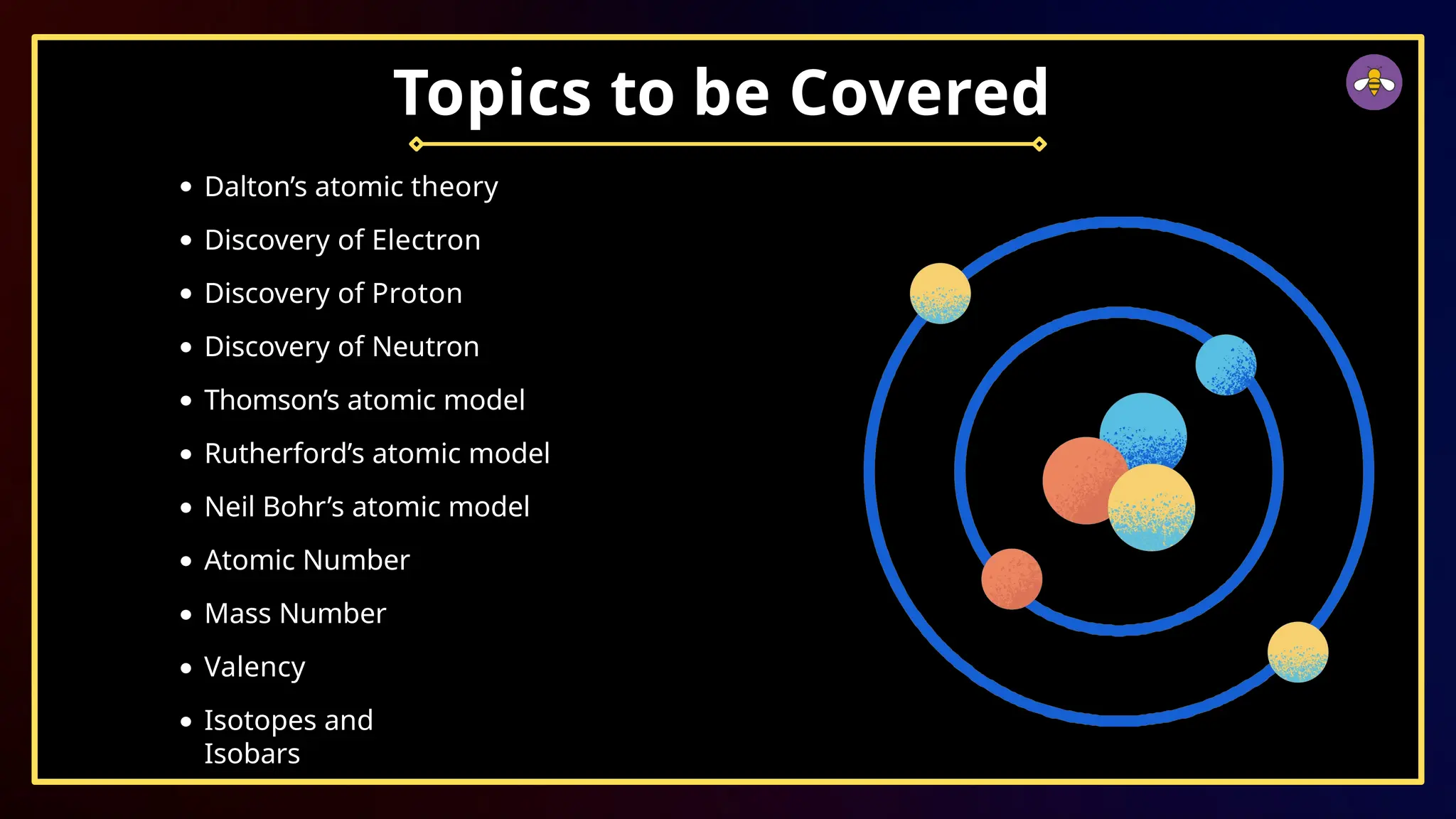
Dalton’s atomic theory
Discoveryof Electron
Discovery of Proton
Discovery of Neutron
Thomson’s atomic model
Rutherford’s atomic model
Neil Bohr’s atomic model
Atomic Number
Mass Number
Valency
Isotopes and
Isobars
Topics to be Covered
3.
In 1808, Dalton'satomic theory described matter as
composed of indivisible atoms, forming the basis of
modern chemistry.
However, by the late 19th century, experiments
revealed subatomic particles—electrons, protons,
and neutrons—leading to the revision of his
concept.
Dalton’s Atomic Theory
4.
Discovery of Electron
J.J. Thomson discovered the existence of electrons by
performing a experiment called Cathode Ray Experiment.
Cathode Ray Tube: A vacuum tube with electrodes (cathode and
anode) used to produce a beam of electrons.
High Voltage: Electricity flows from the negative (cathode) to the
positive (anode) electrode.
The properties of cathode rays are the same,
irrespective of the gas or electrode material used.
Discovery: Proved that atoms are divisible and contain
subatomic particles like electrons.
5.
Electrons are thenegatively charged sub-atomic particles of an atom.
Charge on electron = 1.6
− × 10⁻¹⁹ C
Mass of electron = 9.1 × 10⁻³¹ kg The
symbol for an electron is e– .
Electrons are extremely small.
They are found outside the
nucleus.
Characteristics of an Electron
6.
Discovery of
Proton
E. Goldsteinby his famous anode rays/canal rays
(positively charged radiations) experiment was
able to detect presence of positively charged
particles called protons in the atom.
Characteristics of a Protons
Charge on proton = + 1.6 × 10⁻¹⁹ C
Mass of proton = 1.673 × 10⁻²⁴ gm
i.e., Mass of proton ≅ 2000 ×
Mass of electron
7.
J. Chadwick bombardedlight elements (e.g.,
lithium, boron) with α-particles, discovering
neutral particles with mass equal to protons,
called neutrons.
Since, mass of electrons are negligible
as compared to that of proton and neutrons
hence, sum of masses of protons and
neutrons in an atom will compose its atomic
mass.
Discovery of
Neutrons
8.
Property Electron (e⁻)Proton (p⁺) Neutron (n⁰)
Charge Negative (-1) Positive (+1) Neutral (0)
Mass
Negligible (~1/2000 of
proton)
1 unit ~1 unit
Discoverer J.J. Thomson (1897) E. Goldstein (1886) J. Chadwick (1932)
9.
First model proposedand considered.
Analogy: Atom compared to
a watermelon:
Positive charge = Red edible part.
Electrons = Black seeds embedded in
it.
Alternative Comparison: Known as
the plum pudding model.
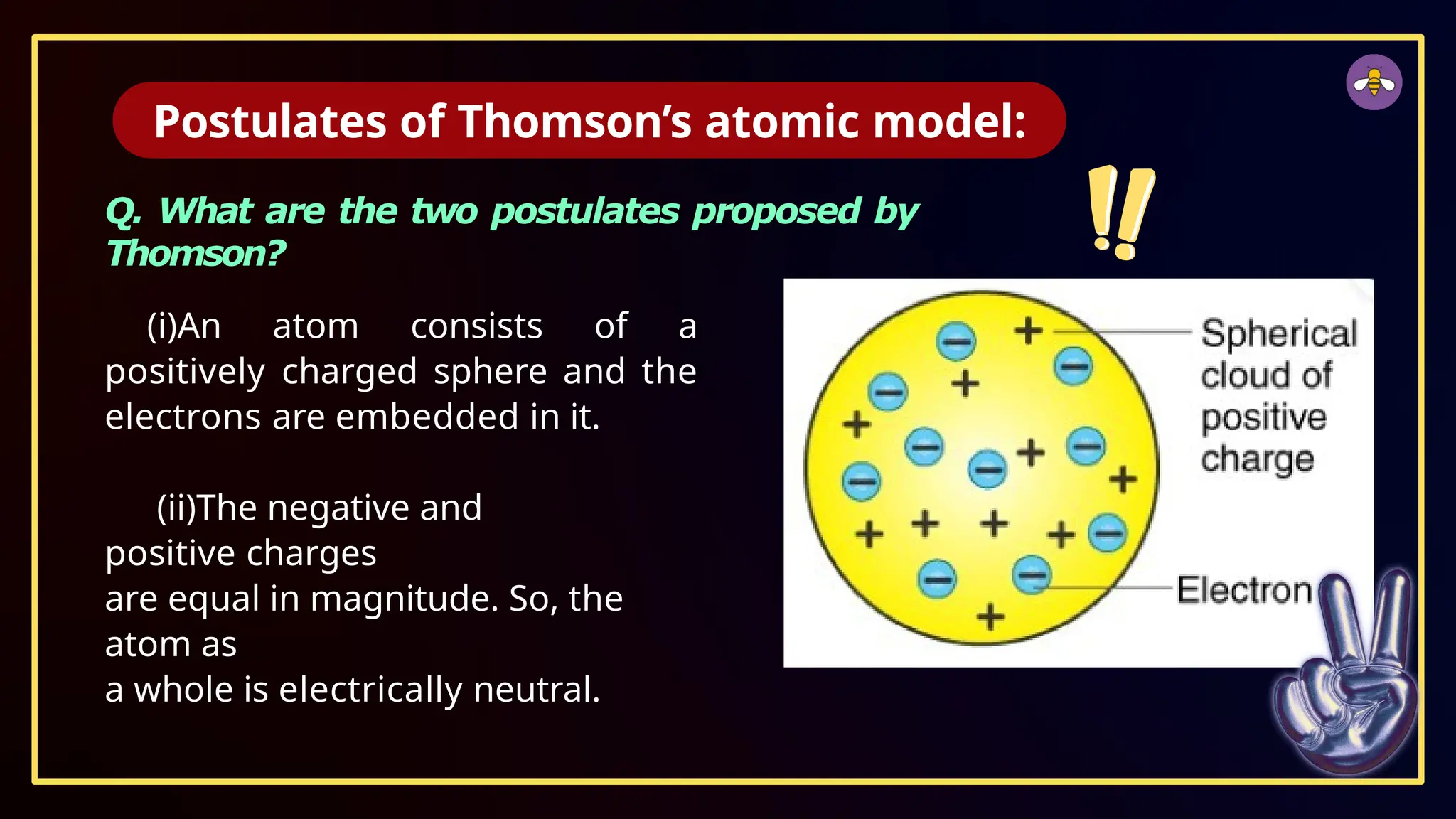
Thomson’s Model of an Atom
11.
Postulates of Thomson’satomic model:
Q. What are the two postulates proposed by
Thomson?
(i)An atom consists of a
positively charged sphere and the
electrons are embedded in it.
(ii)The negative and
positive charges
are equal in magnitude. So, the
atom as
a whole is electrically neutral.
12.
Q. On thebasis of Thomson’s model of an atom, explain how the atomic
neutral as a whole.
Answer: The negatively charged particles are embedded in the positively
charged sphere. These negative and positive charges are equal in magnitude.
Thus, by counterbalancing each other's effect, they make an atom neutral.
13.
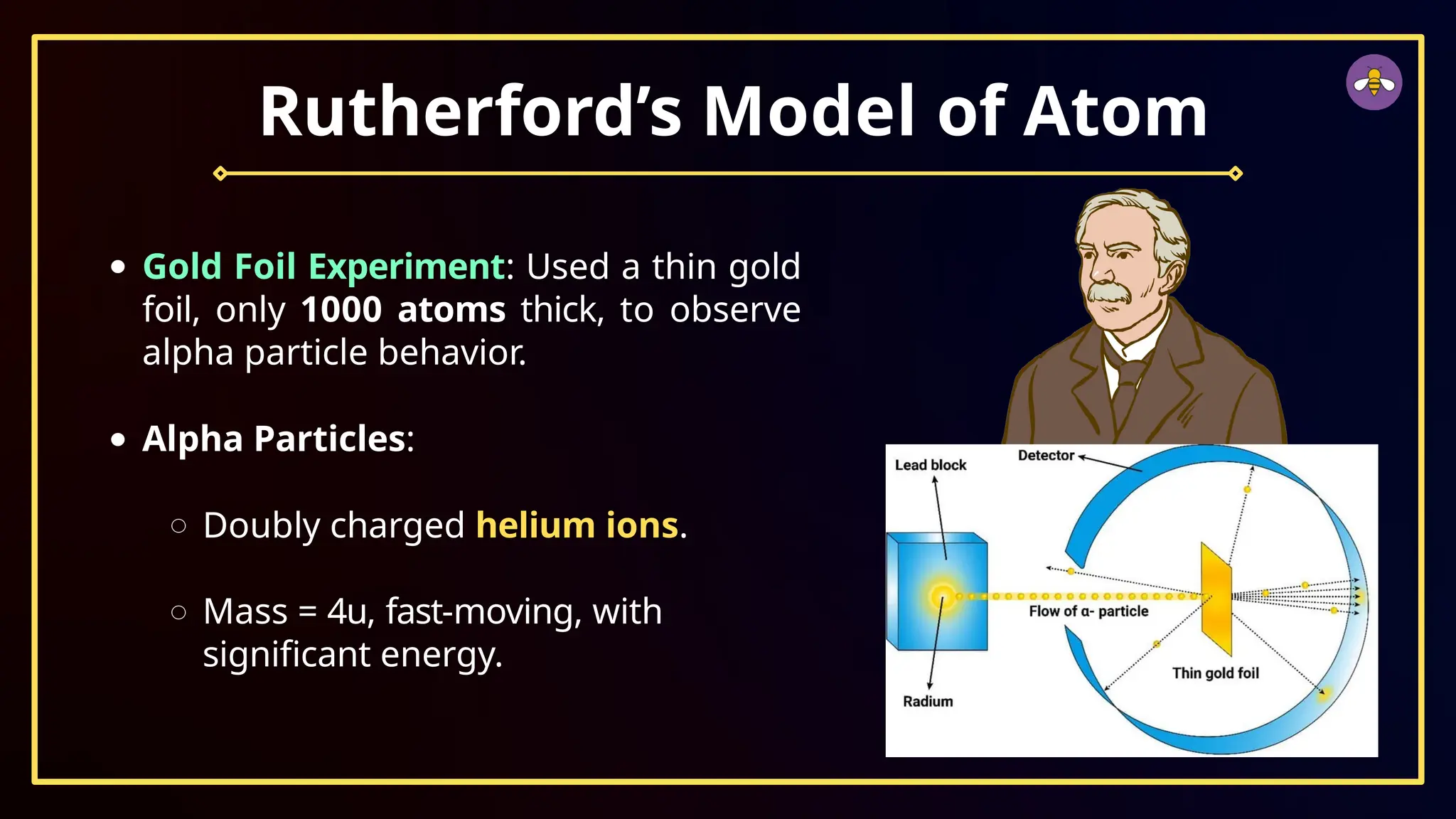
Gold Foil Experiment:Used a thin gold
foil, only 1000 atoms thick, to observe
alpha particle behavior.
Alpha Particles:
Doubly charged helium ions.
Mass = 4u, fast-moving, with
significant energy.
Rutherford’s Model of Atom
15.
Q. Why didRutherford select a gold foil in his α–ray scattering experiment?
Answer:
Rutherford wanted a metal sheet that could be as thin as possible for the
scattering experiment. Gold is the most malleable of all the metals known
to man. It’s simple to make thin sheets out of it. As a result, for his alpha-
ray scattering experiment, Rutherford used gold foil.
16.
Observations:
(i)Most of thealpha
particles passed straight
through that gold foil.
(ii)There was a deflection at
a small angle by some of the
alpha particles.
(iii)A very small amount
of alpha particles
rebounded.
17.
1.Mostly Empty Space:Most alpha particles passed through the gold
foil undeflected, indicating atoms are predominantly empty space.
2.Positively Charged Nucleus: Few alpha particles deflected, and
about 1 in 12,000 bounced back, revealing a small, dense, positively
charged nucleus.
3.Nucleus Size: Nucleus is extremely small, about 1/10⁵ the size of the
atom, occupying negligible space compared to the empty space in an
atom.
4.Mass Concentration: Entire atomic mass is concentrated in the
nucleus.
Conclusions: Q. What were the observations obtained
from Rutherford’s alpha particle
experiment?
18.
NUCLEUS:
The following finalmodel was put by Rutherford
after all the observations:
The nucleus is at the centre and is positively
charged and nearly all the mass of the nucleus
resides in the nucleus.
Nucleus of an atom is very dense.
The size of the nucleus is very less as
compared to the size of the atom.
Rutherford’s
Model of
Atom
19.
Features of Rutherfordproposed model of atom:
(i) There is positively placed nucleus in an atom. Nearly all
the mass resides in nucleus (Proton + Neutron).
(ii)Electrons revolves round the nucleus in well defined
orbits.
(iii)Size of nucleus is very small compared to the size of
atom.
Rutherford’s Model of Atom
20.
Drawbacks of Rutherford’sModel:
Q. What were the drawbacks of Rutherford’s model of an atom?
According to Rutherford, electrons revolve round the nucleus in well-
defined orbits, but electrons being charged particles will lose their
energy and finally will fall into the nucleus.
This will make atom highly unstable.
This was the major drawback of Rutherford which was unexplained by
him.
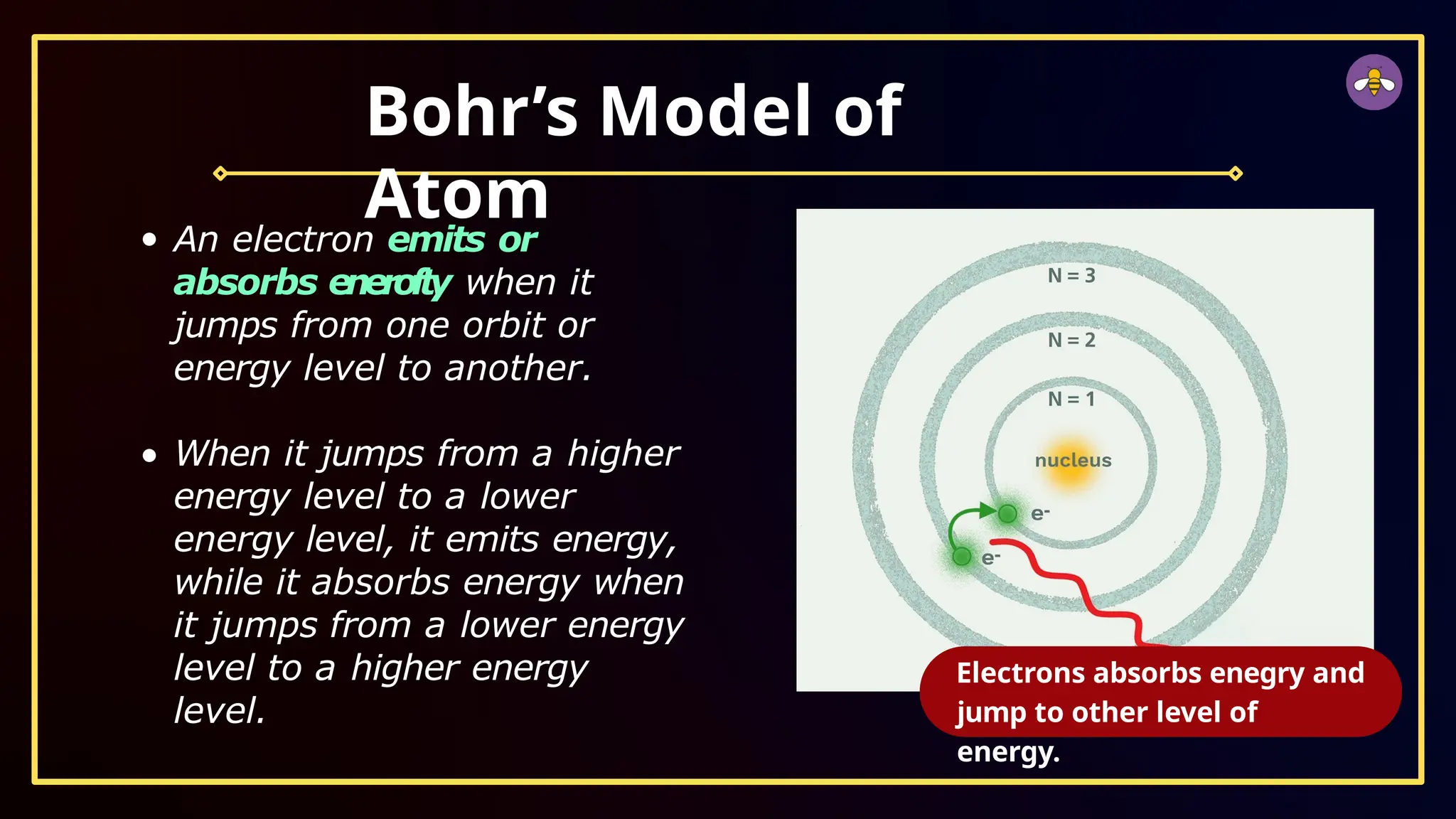
To overcome drawbacks of Rutherford’s Model, Neil Bohr in 1912
proposed modified model of structure of atom.
21.
Bohr’s Model of
Atom
Niels
Bohr
in1913
Q. List the postulates stated by Niels Bohr to
overcome the drawbacks of Rutherford's
model.
Bohr’s postulates:
Electrons revolve around the nucleus in
stable orbits without the emission of radiant
energy. Each orbit has a definite energy and
is called an enerofty shell or enerofty level.
An orbit or energy level is designated as K, L,
M, and N shells. When the electron is in the
lowest energy level, it is said to be in the
ground state.
22.
An electron emitsor
absorbs enerofty when it
jumps from one orbit or
energy level to another.
When it jumps from a higher
energy level to a lower
energy level, it emits energy,
while it absorbs energy when
it jumps from a lower energy
level to a higher energy
level.
Bohr’s Model of
Atom
Electrons absorbs enegry and
jump to other level of
energy.
23.
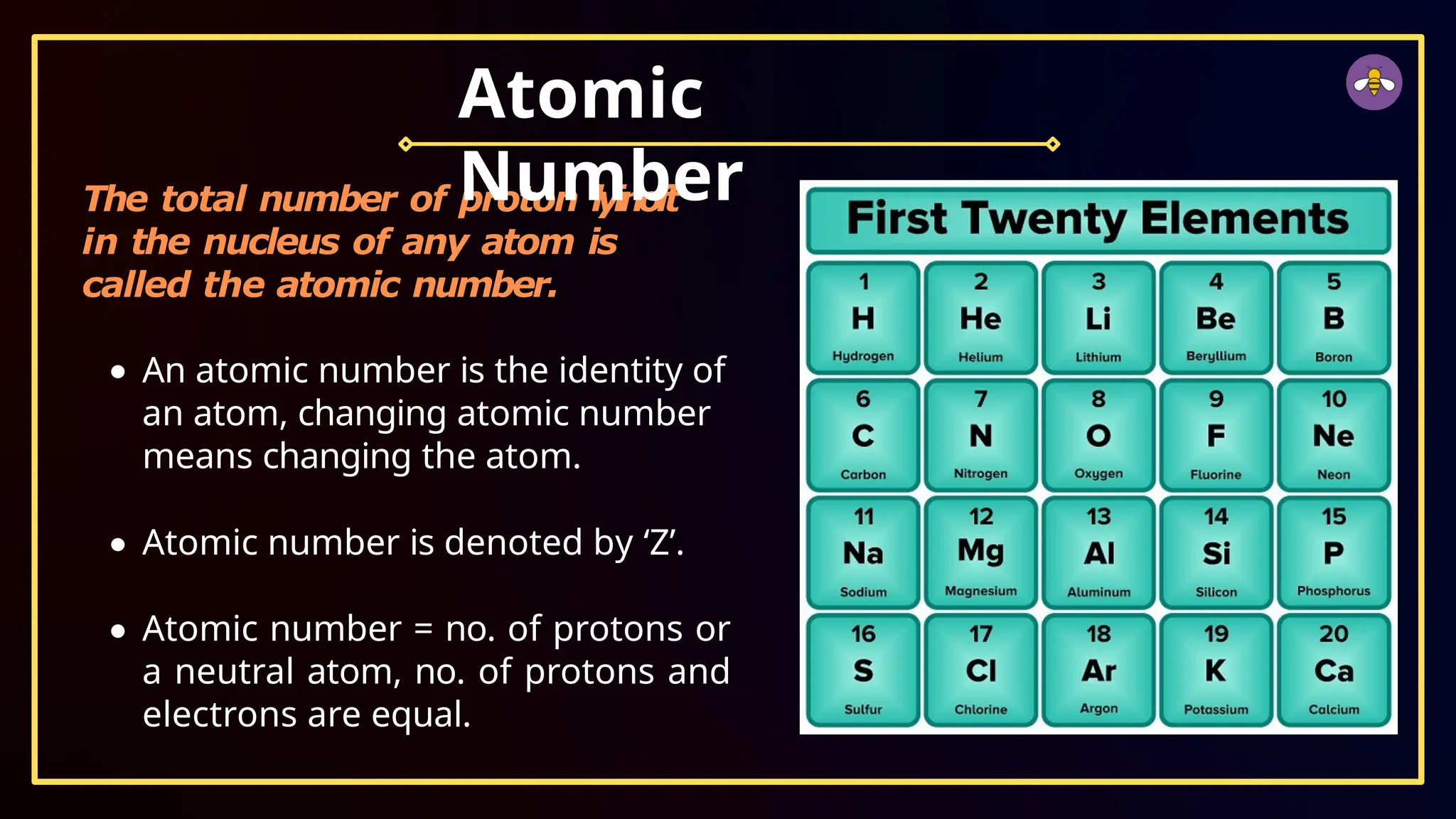
The total numberof proton lyinoft
in the nucleus of any atom is
called the atomic number.
An atomic number is the identity of
an atom, changing atomic number
means changing the atom.
Atomic number is denoted by ‘Z’.
Atomic number = no. of protons or
a neutral atom, no. of protons and
electrons are equal.
Atomic
Number
24.
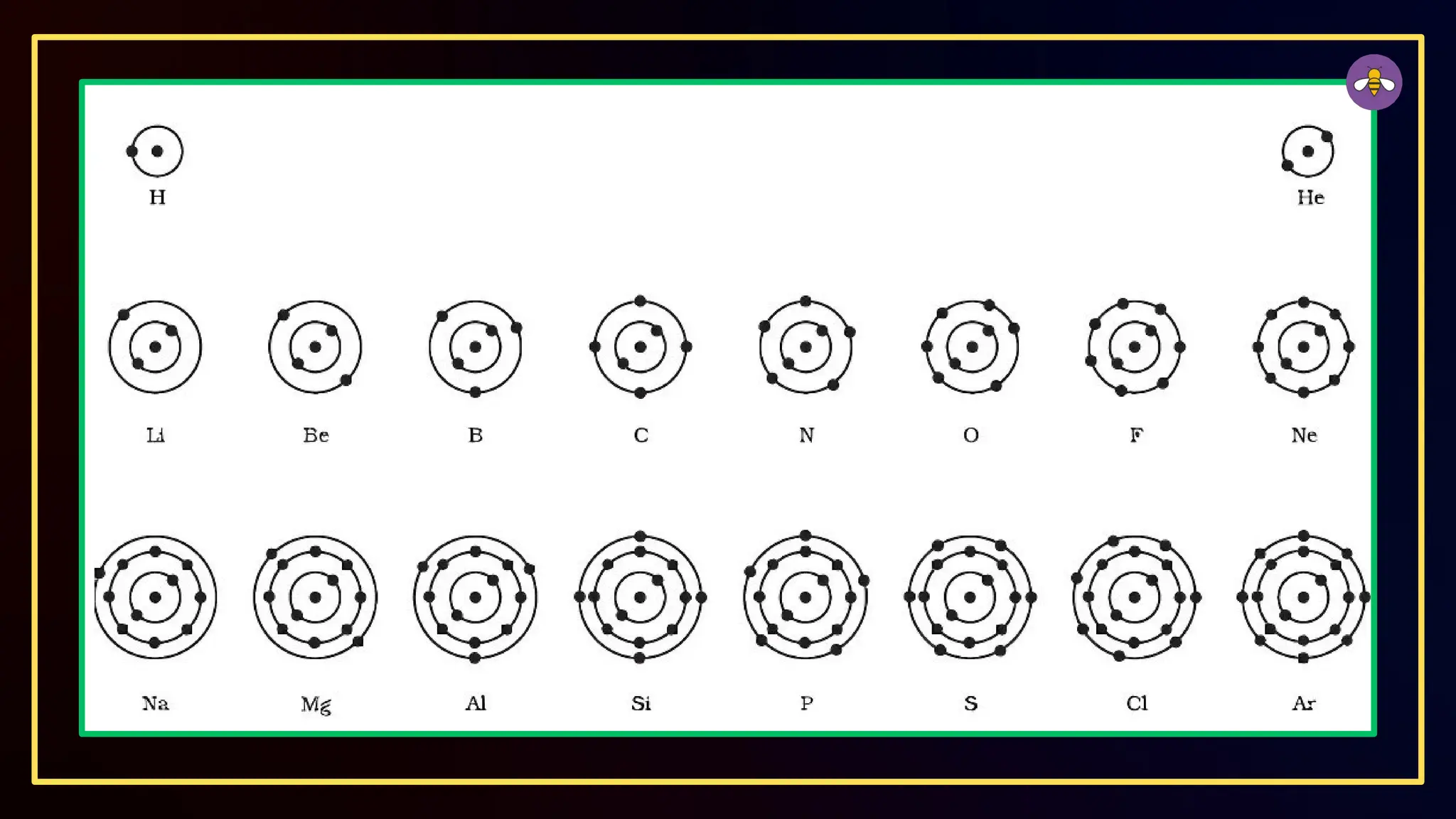
How are ElectronsDistributed in Different
Orbits?
The distribution of electrons in various shells is done in accordance to
‘Bohr-Bury Scheme’.
(i) The fillinoft of electrons in an atom is done in accordance to ‘2n²’,
where ‘n’ is the number of shell and ‘2n²’ represents the total number
of electrons that can be accommodated in that particular shell.
Maximum number of electrons that can be filled in particular shell:
If n = 1, i.e., K = shell, 2n² = 2×1² = 2 electrons
If n = 2, i.e., L = shell, 2n² = 2×2² = 8 electrons
If n = 3, i.e., M = shell, 2n²2 = 2×3² = 18 electrons
If n = 4, i.e., N = shell, 2n² = 2×4² = 32 electrons
25.
(ii) The outermostshell can’t hold more than 8 electrons, while second
last shell can’t have more than 18 electrons, even thouofth they may
have capacity to hold more electrons.
Example: ‘Ca₂₀’, the electron distribution will be :
Ca₂₀ = 2(K), 8(L), 8(M), 2(N)
* But Ca₂₀ = 2, 8, 10 is wrong although ‘M’ shell can contain upto 18 electrons.
(iii) The outermost shell can’t hold more than 2 electrons and the
penultimate shell can’t hold more than 8 electrons unless the
precedinoft inner shell (antepenultimate shell) is filled completely
obeyinoft ‘2n² ’ rule.
Some examples: (i) Ka₁₉ = 2, 8,
8, 1
(ii) Al₁₃ = 2, 8,
3
(iii) F₉ = 2, 7
(iv) Ne₁₀ = 2,
8
Why do Atoms
Combine?
“Theatoms combine to attain a noble or inert gas electronic
configuration, in order to complete their octet by formation of
a chemical bond either by sharing, losing or gaining electrons.”
29.
Valency
The electrons presentin the outermost shell of an atom are
known as the valence electrons.
The combininoft capacity of the atoms or their tendency to react
and form molecules with atoms of the same or different
elements is known as the valency of the atom.
Atoms of elements, having a completely filled outermost shell, show
little chemical activity.
Their combining capacity or valency is zero.
30.
Outer Shell Limit:Max 8 electrons can occupy the outermost shell.
Octet Rule: Atoms strive for 8 electrons in their outermost shell by
gaining or losing electrons.
Valency: The number of electrons lost or gained to achieve stability.
Exceptions: Elements like H, He, Li, Be, B aim for 2 electrons (duplet rule)
and adjust valency accordingly.
Valence Shell and Valence Electrons
32.
Q. Write downthe electron distribution of chlorine atom. How many electrons
are there in the L shell? (Atomic number of chlorine is 17).
33.
Q. Write theelectronic configuration of a positively charged sodium ion (Na+).
Atomic number of sodium is 11.
34.
Q. An atomof element X has 7 electrons in its outermost shell. To achieve a
noble gas configuration, how many electrons will it gain, and what will be the
resulting charge on the ion?
35.
Mass
Number
It is thesum of total number of protons and no. of neutrons lyinoft
in the nucleus of an atom.
It is denoted by ‘A’.
Mass number = no. of protons + no] . neutrons
Relationship
between Mass
number &
Atomic number:
Q. Write thecorrect representation of an element ‘X’ which contains 15
electrons and sixteen neutrons.
38.
Q. What arethe atomic number, mass number and valency of atoms X, Y and Z?
39.
Q. Helium atomhas an atomic mass of 4 u and two protons in its nucleus. How
many neutrons does it have?
40.
Q. Calculate thenumber of neutrons, atomic number and mass number present
in the nucleus of an element X which is represented as ³₁¹₅ X
41.
ISOTOPES
Isotopes are theatoms in which the number of neutrons differs
and the number of protons is the same.
Isotopes are those elements havinoft the same atomic number
and different mass numbers.
Isotopes of Hydrogen:
In protium the number
of neutrons is zero.
In deuterium, the number
of neutrons is one.
In tritium, the number
of neutrons is two.
42.
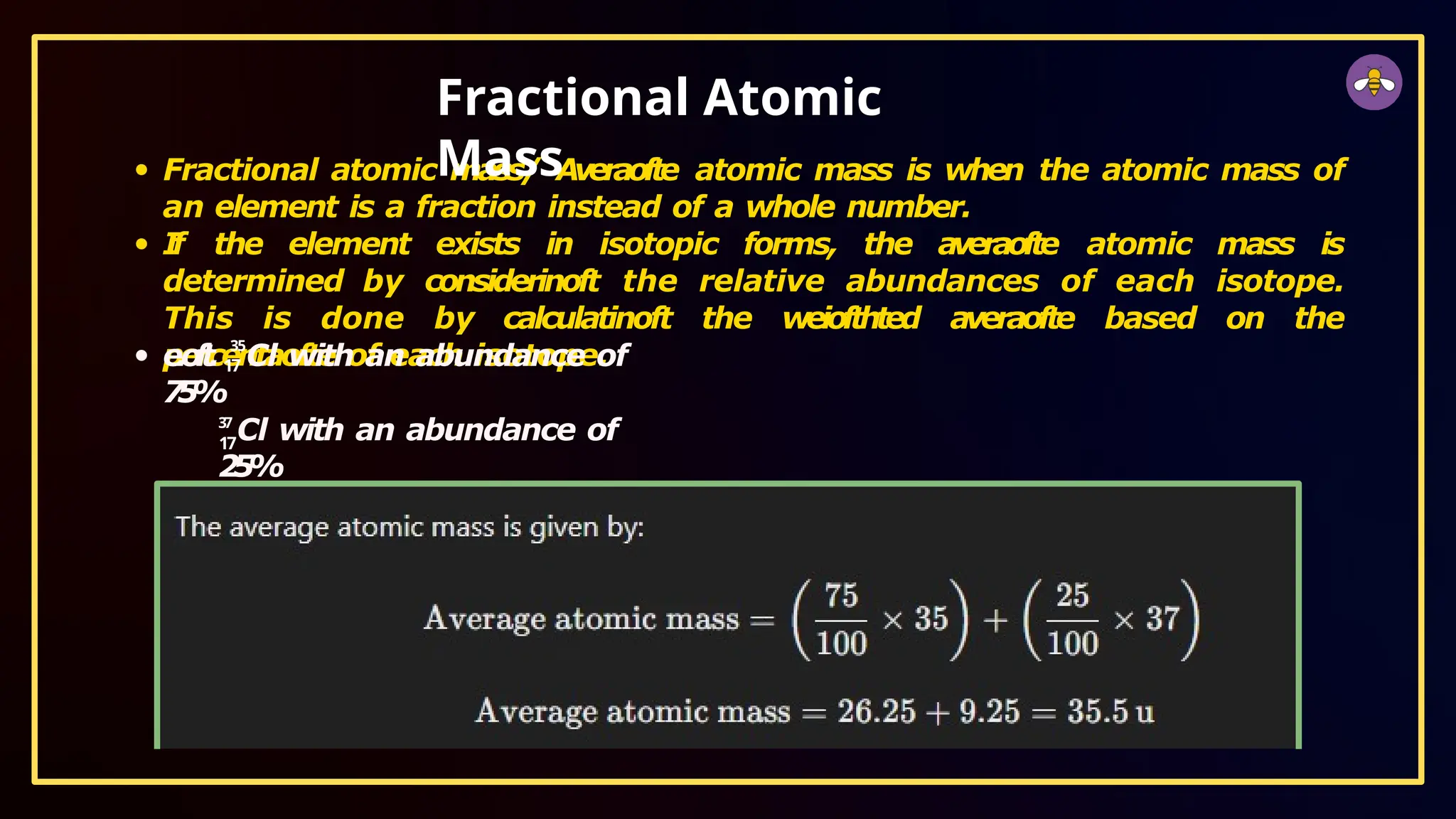
Fractional atomic mass/Averaofte atomic mass is when the atomic mass of
an element is a fraction instead of a whole number.
I
f the element exists in isotopic forms, the averaofte atomic mass is
determined by considerinoft the relative abundances of each isotope.
This is done by calculatinoft the weiofthted averaofte based on the
percentaofte of each isotope.
Fractional Atomic
Mass
e
.
o
f
t
. 35
Cl with an abundance of
7
5
%
17
37
Cl with an abundance of
2
5
%
17
43.
Chemical Properties: Isotopeshave the same atomic number and valence
electrons, leading to identical chemical behavior.
Physical Properties: Isotopes differ in mass numbers due to varying
neutrons, affecting physical properties (e.g., protium, deuterium, tritium).
Application of Isotopes:
(i) Uranium isotope is used as fuel in nuclear reactor.
(ii) Isotope of cobalt is useful in treatment of cancer.
(iii) An isotope of iodine is used in the treatment of goiter.
44.
ISOBARS
Isobars are atoms(nuclides) of different chemical elements which differs in the
chemical property but has the same physical property.
Isobars are those elements which have a different atomic number but the
same mass number.
Isobars have the same atomic mass but different atomic numbers, resulting in
different numbers of electrons and distinct chemical properties.
46.
Q. Will ³⁵Cland ³⁷Cl have different valencies? Justify your answer.
47.
Q. The atomicnumber of calcium and argon are 20 and 18 respectively, but the
mass number of both these elements is 40. What is the name given to such a pair
of elements?
48.
1. Atomic Numberof an element is equal to:
(a) Number of Protons
(b) Number of electrons
(c) Number of neutrons
(d) Both (a) and (b)
49.
2. Isotopes ofan element have:
(a) The same physical properties
(b) Different chemical properties
(c) Different number of neutrons
(d) Different atomic numbers
50.
3.Which of thefollowing correctly represent the electronic distribution in the
Mg atom?
(a) 3, 8, 1
(b) 2, 8, 2
(c) 1, 8, 3
(d) 8, 2, 2
51.
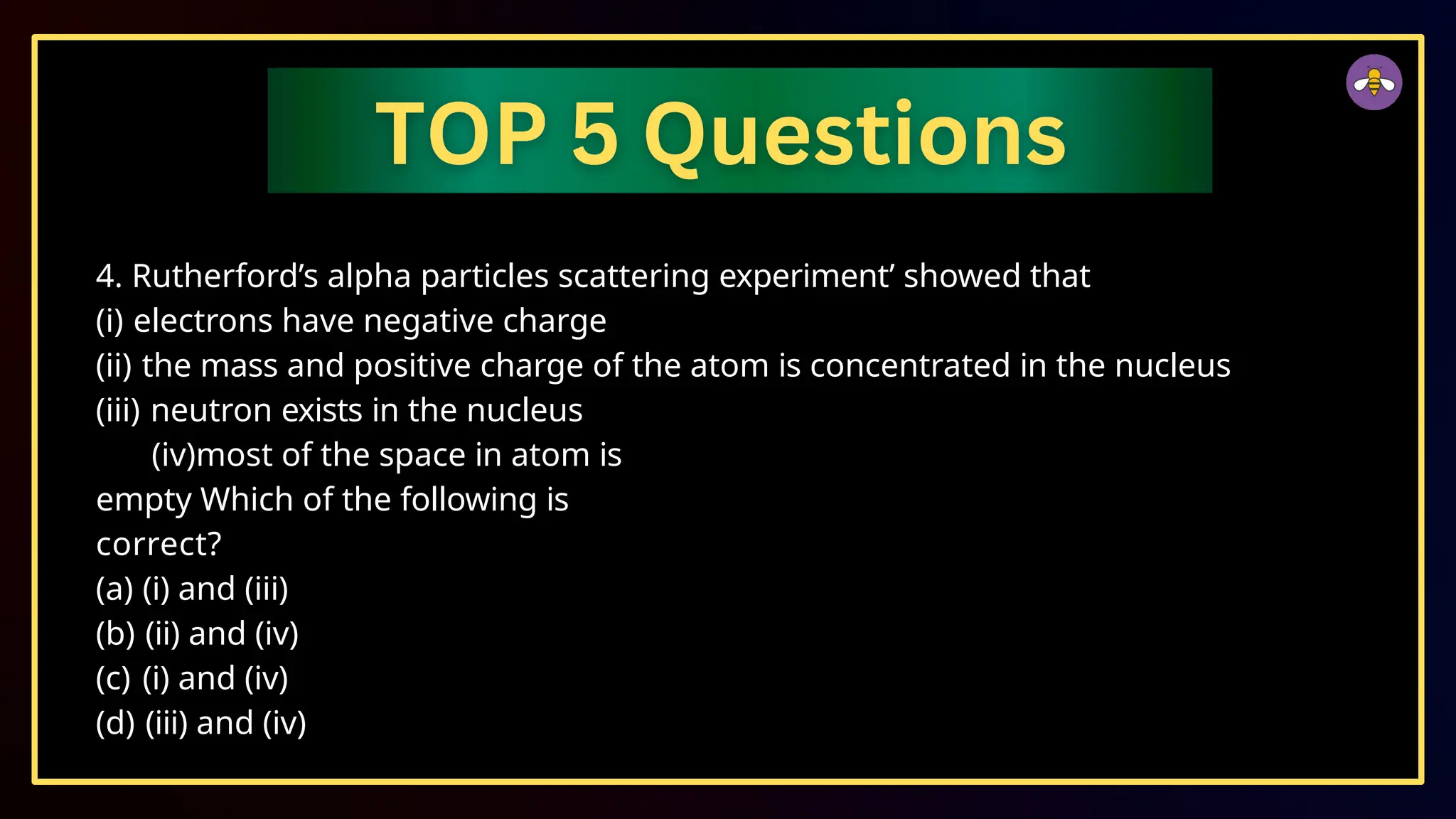
4. Rutherford’s alphaparticles scattering experiment’ showed that
(i) electrons have negative charge
(ii) the mass and positive charge of the atom is concentrated in the nucleus
(iii) neutron exists in the nucleus
(iv)most of the space in atom is
empty Which of the following is
correct?
(a) (i) and (iii)
(b) (ii) and (iv)
(c) (i) and (iv)
(d) (iii) and (iv)
52.
5. Q. Anelement X has a mass number of 4 and an atomic number of 2. What is
the valency of this element?
(a) 0
(b) 1
(c) 2
(d) 4
53.
"Stay positive atthe center and
let the negativity orbit around
you!"









![Mass
Number
It is the sum of total number of protons and no. of neutrons lyinoft
in the nucleus of an atom.
It is denoted by ‘A’.
Mass number = no. of protons + no] . neutrons
Relationship
between Mass
number &
Atomic number:](https://image.slidesharecdn.com/class9th-structureoftheatomprashantkirad-250502053524-d42a6582/75/Class-9th-Structure-of-the-Atom-Prashant-Kirad-pptx-35-2048.jpg)






![Structure Of Atom[1] Monika Khurana](https://cdn.slidesharecdn.com/ss_thumbnails/structure-of-atom1-monika-khurana-1193579725970972-1-thumbnail.jpg?width=640&height=640&fit=bounds)


