The
Development of
the Atomic
Theory
Teresita M. Perucho
Master Teacher I - Science
“
2
LEARNING COMPETENCY
Determine the number of protons,
neutrons, and electrons in a particular
atom
3
OBJECTIVES
➢ Infer the development of atomic theory ;
➢ Simulate and describe each atomic models ;
➢ deduce that scientific models may change over time
and
➢ Construct an atomic timeline using recycled materials.
4
Atomic Theories
5
6
Choose the best answer
1. This diagram represents particles
in a ______________ state.
a. Solid b. liquid c. gas
7
Choose the best answer
1. This diagram represents particles
in a ______________ state.
a. Solid b. liquid c. gas
8
Choose the best answer
2. Particles are always moving.
a. True b. False
9
Choose the best answer
2. Particles are always moving.
a. True b. False
10
Choose the best answer
3. In which state of matter will there be the LARGEST space
between molecules?
a. Solid b. Liquid c. Gas
11
Choose the best answer
3. In which state of matter will there be the LARGEST space
between molecules?
a. Solid b. Liquid c. Gas
12
Choose the best answer
4. All matter is made up of tiny _______________
A. Energy
B. Particles (atoms and molecules)
C. bits
D. antimatter
13
Choose the best answer
4. All matter is made up of tiny _______________
A. Energy
B. Particles (atoms and molecules)
C. bits
D. antimatter
14
Choose the best answer
5. Which has a strongest Inter molecular Forces?
15
Choose the best answer
5. Which has a strongest Inter molecular Forces?
a. Solid b. Liquid c. Gas
16
ENGAGE
Can’t wait to go out and
have some fun?
Lets Take a Trip Through Time
17
Come with us in a
historical adventure!
Let’s find out the story
behind the small but
terrible ATOM.
ATOMIC THEORIES TIMELINE
18
NAME Democritus John Dalton
JJ
Thompson
Ernest
Rutherford
Niels
Bohr
Schrödinger
Heisenberg
TIME
FRAME
KEY
POINTS
MODEL
DEMOCRITUS
460 – 370BC
19
➢ There are various basic elements from
which all matter is made.
➢ Named the smallest particle of matter
“atomos” – not to be cut.
➢ Everything is composed of small atoms
moving in a void and capable of joining.
➢ Some atoms are round, pointy, oily, have
hooks, etc. to account for their properties.
➢ Ideas rejected by leading philosophers
because void = no existence
DEMOCRITUS ATOM
20
Wow !!!
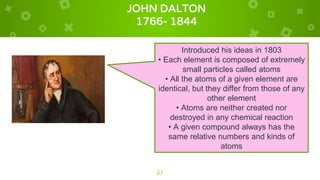
JOHN DALTON
1766- 1844
21
Introduced his ideas in 1803
• Each element is composed of extremely
small particles called atoms
• All the atoms of a given element are
identical, but they differ from those of any
other element
• Atoms are neither created nor
destroyed in any chemical reaction
• A given compound always has the
same relative numbers and kinds of
atoms
22
amazing !!!
John Dalton
Billiard Ball Model
1807
23
Discovered electron
1897 – Cathode Ray
Experiment
• Plum Pudding model
1904
– Electrons in a soup of
positive charges
• Discovered isotopes
1913
J.J. Thompson
1856-1940
24
amazing !!!
Cathode Ray Tube Experiment
25
Chocolate
cookies!!!
JJ THOMPSON
Plum Pudding Model
Ernest Rutherford
1871-1937
26
➢ Atoms have dense , positive
nucleus.
➢ Atoms mass is mostly in the
nucleus .
➢ The nucleus has a positive
charge(Moseley)
➢ Electrons in fixed orbit
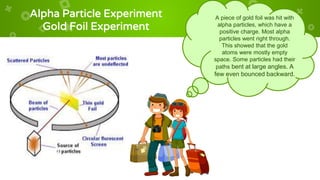
Alpha Particle Experiment
Gold Foil Experiment
27
A piece of gold foil was hit with
alpha particles, which have a
positive charge. Most alpha
particles went right through.
This showed that the gold
atoms were mostly empty
space. Some particles had their
paths bent at large angles. A
few even bounced backward.
28
I often come
across this
symbol whenever
we talk about
science!!!
Ernest Rutherford’s Model
1909
“
29
We are learning so
much in this trip
I am having a blast
, excited to know
more about the
theories of atom
Niels Bohr
1885-1962
30
➢ Electrons orbit the positive nucleus in orbits
that have a set size and energy.
➢ The energy of the orbit is related to its size.
The lowest energy is found in the smallest
orbit.
➢ the change in an electron's energy as it makes
a quantum jump from one orbit to another
➢ Radiation is absorbed or emitted when an
electron moves from one orbit to another.
31
It looks like
the solar
system!!!
Planetary Model
1913
Looks like
the model
of Sir
Rutherford.
Ernst/Erwin Schrödinger 1887-1961
Werner Heisenberg 1901-1976
32
➢ Electrons are in probability zones called
“orbitals”, not orbits and the location cannot be
pinpointed
➢ Electrons are present in a blurry “electron cloud”.
It is within this area that we derived the electron
configuration of an atom.
➢ – Electrons are particles and waves at the same
time
➢ Developed quantum numbers based on theories
of Einstein and Planck
Electrons have an intrinsic
property called spin, and an
electron can have one of two
possible spin values: spin-up or
spin-down. Any two electrons
occupying the same orbital must
have opposite spins.
33
Wow !!!
Quantum Mechanical Model/Wave Mechanical model
1926
That is what
we call
ORBITALS.
ATOMIC TIMELINE
34
ELABORATE
ATOMIC THEORIES TIMELINE
35
NAME Democritus John Dalton
JJ
Thompson
Ernest
Rutherford
Niels
Bohr
Schrödinger
Heisenberg
TIME
FRAME
KEY
POINTS
MODEL
Who among you will
develop a
better theory and
win the Nobel
Prize?
EVALUATION
C
A B D E
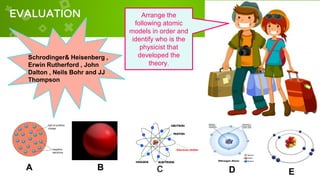
Arrange the
following atomic
models in order and
identify who is the
physicist that
developed the
theory.
Schrodinger& Heisenberg ,
Erwin Rutherford , John
Dalton , Neils Bohr and JJ
Thompson
EVALUATION
C
A
B
D
E
JJ Thompson
John Dalton
Erwin Rutherford
Neils Bohr
Schrodinger&
Heisenberg
ASSIGNMENT
TO BE SUBMITTED ON FRIDAY
39
Construct an atomic timeline
using recycled materials
EXTEND
40
ENGAGE
How do you find today’s
lesson ? Please write
your comment on the
comment box
Join us again
on our next
adventure .
See u soon!
Don’t forget to visit our
Fb page science genius
for our asynchronous
activities & also please
pass your activity & quiz
today in our fb
messenger.
Thank you

ATOMIC TIMELINE

  • 1.
    The Development of the Atomic Theory TeresitaM. Perucho Master Teacher I - Science
  • 2.
  • 3.
    LEARNING COMPETENCY Determine thenumber of protons, neutrons, and electrons in a particular atom 3
  • 4.
    OBJECTIVES ➢ Infer thedevelopment of atomic theory ; ➢ Simulate and describe each atomic models ; ➢ deduce that scientific models may change over time and ➢ Construct an atomic timeline using recycled materials. 4
  • 5.
  • 6.
    6 Choose the bestanswer 1. This diagram represents particles in a ______________ state. a. Solid b. liquid c. gas
  • 7.
    7 Choose the bestanswer 1. This diagram represents particles in a ______________ state. a. Solid b. liquid c. gas
  • 8.
    8 Choose the bestanswer 2. Particles are always moving. a. True b. False
  • 9.
    9 Choose the bestanswer 2. Particles are always moving. a. True b. False
  • 10.
    10 Choose the bestanswer 3. In which state of matter will there be the LARGEST space between molecules? a. Solid b. Liquid c. Gas
  • 11.
    11 Choose the bestanswer 3. In which state of matter will there be the LARGEST space between molecules? a. Solid b. Liquid c. Gas
  • 12.
    12 Choose the bestanswer 4. All matter is made up of tiny _______________ A. Energy B. Particles (atoms and molecules) C. bits D. antimatter
  • 13.
    13 Choose the bestanswer 4. All matter is made up of tiny _______________ A. Energy B. Particles (atoms and molecules) C. bits D. antimatter
  • 14.
    14 Choose the bestanswer 5. Which has a strongest Inter molecular Forces?
  • 15.
    15 Choose the bestanswer 5. Which has a strongest Inter molecular Forces? a. Solid b. Liquid c. Gas
  • 16.
    16 ENGAGE Can’t wait togo out and have some fun?
  • 17.
    Lets Take aTrip Through Time 17 Come with us in a historical adventure! Let’s find out the story behind the small but terrible ATOM.
  • 18.
    ATOMIC THEORIES TIMELINE 18 NAMEDemocritus John Dalton JJ Thompson Ernest Rutherford Niels Bohr Schrödinger Heisenberg TIME FRAME KEY POINTS MODEL
  • 19.
    DEMOCRITUS 460 – 370BC 19 ➢There are various basic elements from which all matter is made. ➢ Named the smallest particle of matter “atomos” – not to be cut. ➢ Everything is composed of small atoms moving in a void and capable of joining. ➢ Some atoms are round, pointy, oily, have hooks, etc. to account for their properties. ➢ Ideas rejected by leading philosophers because void = no existence
  • 20.
  • 21.
    JOHN DALTON 1766- 1844 21 Introducedhis ideas in 1803 • Each element is composed of extremely small particles called atoms • All the atoms of a given element are identical, but they differ from those of any other element • Atoms are neither created nor destroyed in any chemical reaction • A given compound always has the same relative numbers and kinds of atoms
  • 22.
  • 23.
    23 Discovered electron 1897 –Cathode Ray Experiment • Plum Pudding model 1904 – Electrons in a soup of positive charges • Discovered isotopes 1913 J.J. Thompson 1856-1940
  • 24.
  • 25.
  • 26.
    Ernest Rutherford 1871-1937 26 ➢ Atomshave dense , positive nucleus. ➢ Atoms mass is mostly in the nucleus . ➢ The nucleus has a positive charge(Moseley) ➢ Electrons in fixed orbit
  • 27.
    Alpha Particle Experiment GoldFoil Experiment 27 A piece of gold foil was hit with alpha particles, which have a positive charge. Most alpha particles went right through. This showed that the gold atoms were mostly empty space. Some particles had their paths bent at large angles. A few even bounced backward.
  • 28.
    28 I often come acrossthis symbol whenever we talk about science!!! Ernest Rutherford’s Model 1909
  • 29.
    “ 29 We are learningso much in this trip I am having a blast , excited to know more about the theories of atom
  • 30.
    Niels Bohr 1885-1962 30 ➢ Electronsorbit the positive nucleus in orbits that have a set size and energy. ➢ The energy of the orbit is related to its size. The lowest energy is found in the smallest orbit. ➢ the change in an electron's energy as it makes a quantum jump from one orbit to another ➢ Radiation is absorbed or emitted when an electron moves from one orbit to another.
  • 31.
    31 It looks like thesolar system!!! Planetary Model 1913 Looks like the model of Sir Rutherford.
  • 32.
    Ernst/Erwin Schrödinger 1887-1961 WernerHeisenberg 1901-1976 32 ➢ Electrons are in probability zones called “orbitals”, not orbits and the location cannot be pinpointed ➢ Electrons are present in a blurry “electron cloud”. It is within this area that we derived the electron configuration of an atom. ➢ – Electrons are particles and waves at the same time ➢ Developed quantum numbers based on theories of Einstein and Planck Electrons have an intrinsic property called spin, and an electron can have one of two possible spin values: spin-up or spin-down. Any two electrons occupying the same orbital must have opposite spins.
  • 33.
    33 Wow !!! Quantum MechanicalModel/Wave Mechanical model 1926 That is what we call ORBITALS.
  • 34.
  • 35.
    ATOMIC THEORIES TIMELINE 35 NAMEDemocritus John Dalton JJ Thompson Ernest Rutherford Niels Bohr Schrödinger Heisenberg TIME FRAME KEY POINTS MODEL
  • 36.
    Who among youwill develop a better theory and win the Nobel Prize?
  • 37.
    EVALUATION C A B DE Arrange the following atomic models in order and identify who is the physicist that developed the theory. Schrodinger& Heisenberg , Erwin Rutherford , John Dalton , Neils Bohr and JJ Thompson
  • 38.
    EVALUATION C A B D E JJ Thompson John Dalton ErwinRutherford Neils Bohr Schrodinger& Heisenberg
  • 39.
    ASSIGNMENT TO BE SUBMITTEDON FRIDAY 39 Construct an atomic timeline using recycled materials EXTEND
  • 40.
    40 ENGAGE How do youfind today’s lesson ? Please write your comment on the comment box Join us again on our next adventure . See u soon!
  • 41.
    Don’t forget tovisit our Fb page science genius for our asynchronous activities & also please pass your activity & quiz today in our fb messenger. Thank you