DIGITAL TEST 
1
STRUCTURE OF ATOM 
Gold foil experiment 
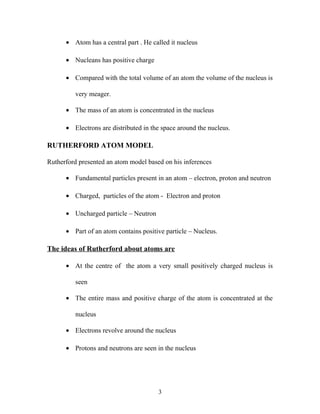
Ruther ford conducted the experiment by allowing high speed alpha 
particles to hit a very thin gold foil. Most of the alpha particles passed through it. 
The path of some particles were seen to have slightly deviated. Some rare ones 
come back in the opposite direction as if they hit at something. Rutherford found 
out they hit at something. Ruther fold found out there things by analyzing the 
impressions made by alpha particles on a screen placed behind the gold foil. He 
arrived at some inferences on there observation. 
2
· Atom has a central part . He called it nucleus 
· Nucleans has positive charge 
· Compared with the total volume of an atom the volume of the nucleus is 
very meager. 
· The mass of an atom is concentrated in the nucleus 
· Electrons are distributed in the space around the nucleus. 
RUTHERFORD ATOM MODEL 
Rutherford presented an atom model based on his inferences 
· Fundamental particles present in an atom – electron, proton and neutron 
· Charged, particles of the atom - Electron and proton 
· Uncharged particle – Neutron 
· Part of an atom contains positive particle – Nucleus. 
The ideas of Rutherford about atoms are 
· At the centre of the atom a very small positively charged nucleus is 
seen 
· The entire mass and positive charge of the atom is concentrated at the 
nucleus 
· Electrons revolve around the nucleus 
· Protons and neutrons are seen in the nucleus 
3
· The number of negatively charged electrons and positively charged 
protons are equal. Hence as atom is electrically neutral. 
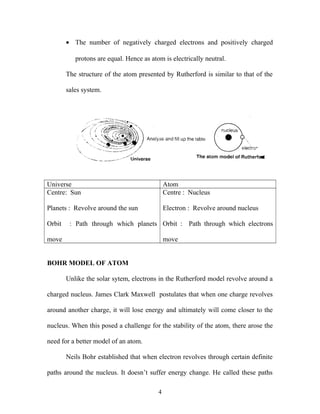
The structure of the atom presented by Rutherford is similar to that of the 
sales system. 
Universe Atom 
Centre: Sun 
Planets : Revolve around the sun 
Orbit : Path through which planets 
move 
Centre : Nucleus 
Electron : Revolve around nucleus 
Orbit : Path through which electrons 
move 
BOHR MODEL OF ATOM 
Unlike the solar sytem, electrons in the Rutherford model revolve around a 
charged nucleus. James Clark Maxwell postulates that when one charge revolves 
around another charge, it will lose energy and ultimately will come closer to the 
nucleus. When this posed a challenge for the stability of the atom, there arose the 
need for a better model of an atom. 
Neils Bohr established that when electron revolves through certain definite 
paths around the nucleus. It doesn’t suffer energy change. He called these paths 
4
orbits. He understood that a definite number of electrons are included in each 
orbit. 
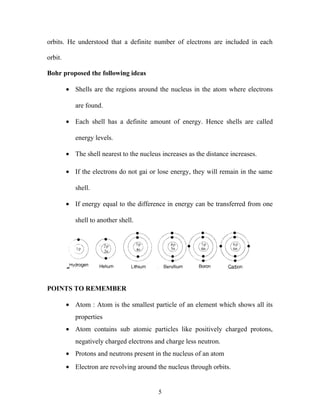
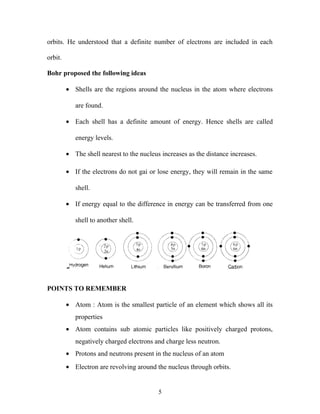
Bohr proposed the following ideas 
· Shells are the regions around the nucleus in the atom where electrons 
are found. 
· Each shell has a definite amount of energy. Hence shells are called 
energy levels. 
· The shell nearest to the nucleus increases as the distance increases. 
· If the electrons do not gai or lose energy, they will remain in the same 
shell. 
· If energy equal to the difference in energy can be transferred from one 
shell to another shell. 
POINTS TO REMEMBER 
· Atom : Atom is the smallest particle of an element which shows all its 
properties 
· Atom contains sub atomic particles like positively charged protons, 
negatively charged electrons and charge less neutron. 
· Protons and neutrons present in the nucleus of an atom 
· Electron are revolving around the nucleus through orbits. 
5
orbits. He understood that a definite number of electrons are included in each 
orbit. 
Bohr proposed the following ideas 
· Shells are the regions around the nucleus in the atom where electrons 
are found. 
· Each shell has a definite amount of energy. Hence shells are called 
energy levels. 
· The shell nearest to the nucleus increases as the distance increases. 
· If the electrons do not gai or lose energy, they will remain in the same 
shell. 
· If energy equal to the difference in energy can be transferred from one 
shell to another shell. 
POINTS TO REMEMBER 
· Atom : Atom is the smallest particle of an element which shows all its 
properties 
· Atom contains sub atomic particles like positively charged protons, 
negatively charged electrons and charge less neutron. 
· Protons and neutrons present in the nucleus of an atom 
· Electron are revolving around the nucleus through orbits. 
5

Dt

  • 1.
  • 2.
    STRUCTURE OF ATOM Gold foil experiment Ruther ford conducted the experiment by allowing high speed alpha particles to hit a very thin gold foil. Most of the alpha particles passed through it. The path of some particles were seen to have slightly deviated. Some rare ones come back in the opposite direction as if they hit at something. Rutherford found out they hit at something. Ruther fold found out there things by analyzing the impressions made by alpha particles on a screen placed behind the gold foil. He arrived at some inferences on there observation. 2
  • 3.
    · Atom hasa central part . He called it nucleus · Nucleans has positive charge · Compared with the total volume of an atom the volume of the nucleus is very meager. · The mass of an atom is concentrated in the nucleus · Electrons are distributed in the space around the nucleus. RUTHERFORD ATOM MODEL Rutherford presented an atom model based on his inferences · Fundamental particles present in an atom – electron, proton and neutron · Charged, particles of the atom - Electron and proton · Uncharged particle – Neutron · Part of an atom contains positive particle – Nucleus. The ideas of Rutherford about atoms are · At the centre of the atom a very small positively charged nucleus is seen · The entire mass and positive charge of the atom is concentrated at the nucleus · Electrons revolve around the nucleus · Protons and neutrons are seen in the nucleus 3
  • 4.
    · The numberof negatively charged electrons and positively charged protons are equal. Hence as atom is electrically neutral. The structure of the atom presented by Rutherford is similar to that of the sales system. Universe Atom Centre: Sun Planets : Revolve around the sun Orbit : Path through which planets move Centre : Nucleus Electron : Revolve around nucleus Orbit : Path through which electrons move BOHR MODEL OF ATOM Unlike the solar sytem, electrons in the Rutherford model revolve around a charged nucleus. James Clark Maxwell postulates that when one charge revolves around another charge, it will lose energy and ultimately will come closer to the nucleus. When this posed a challenge for the stability of the atom, there arose the need for a better model of an atom. Neils Bohr established that when electron revolves through certain definite paths around the nucleus. It doesn’t suffer energy change. He called these paths 4
  • 5.
    orbits. He understoodthat a definite number of electrons are included in each orbit. Bohr proposed the following ideas · Shells are the regions around the nucleus in the atom where electrons are found. · Each shell has a definite amount of energy. Hence shells are called energy levels. · The shell nearest to the nucleus increases as the distance increases. · If the electrons do not gai or lose energy, they will remain in the same shell. · If energy equal to the difference in energy can be transferred from one shell to another shell. POINTS TO REMEMBER · Atom : Atom is the smallest particle of an element which shows all its properties · Atom contains sub atomic particles like positively charged protons, negatively charged electrons and charge less neutron. · Protons and neutrons present in the nucleus of an atom · Electron are revolving around the nucleus through orbits. 5
  • 6.
    orbits. He understoodthat a definite number of electrons are included in each orbit. Bohr proposed the following ideas · Shells are the regions around the nucleus in the atom where electrons are found. · Each shell has a definite amount of energy. Hence shells are called energy levels. · The shell nearest to the nucleus increases as the distance increases. · If the electrons do not gai or lose energy, they will remain in the same shell. · If energy equal to the difference in energy can be transferred from one shell to another shell. POINTS TO REMEMBER · Atom : Atom is the smallest particle of an element which shows all its properties · Atom contains sub atomic particles like positively charged protons, negatively charged electrons and charge less neutron. · Protons and neutrons present in the nucleus of an atom · Electron are revolving around the nucleus through orbits. 5