Terminology in Healthcare and Public
Health Settings
Understanding Medical Words
Lecture c Body Organization
This material (Comp 3 Unit 1) was developed by the University of Alabama at Birmingham, funded by the
Department of Health and Human Services, Office of the National Coordinator for Health Information
Technology under Award Number 90WT0007.
This work is licensed under the Creative Commons Attribution-NonCommercial-ShareAlike 4.0 International
License. To view a copy of this license, visit http://creativecommons.org.
Understanding Medical Words
Learning Objectives
• Discuss the four parts of medical terms
• Recognize word roots and combining forms
• Identify the most common prefixes and suffixes
• Describe the anatomical positions
• Define the body planes
• Identify regions of the body
• Define directional and positional terms
• Build, divide, spell and pronounce common
medical words
2
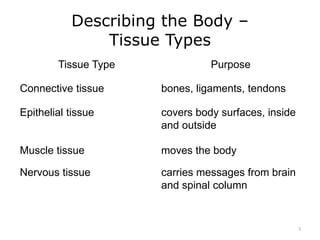
Describing the Body –
Tissue Types
Tissue Type Purpose
Connective tissue bones, ligaments, tendons
Epithelial tissue covers body surfaces, inside
and outside
Muscle tissue moves the body
Nervous tissue carries messages from brain
and spinal column
3
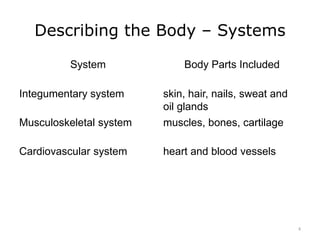
Describing the Body – Systems
System Body Parts Included
Integumentary system skin, hair, nails, sweat and
oil glands
Musculoskeletal system muscles, bones, cartilage
Cardiovascular system heart and blood vessels
4
Describing the Body –
Systems (2)
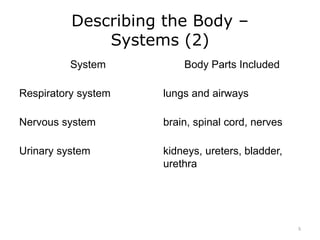
System Body Parts Included
Respiratory system lungs and airways
Nervous system brain, spinal cord, nerves
Urinary system kidneys, ureters, bladder,
urethra
5
Describing the Body –
Systems (3)
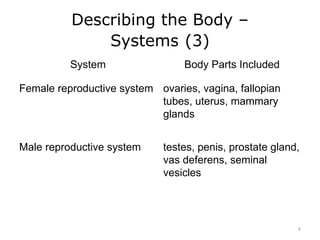
System Body Parts Included
Female reproductive system ovaries, vagina, fallopian
tubes, uterus, mammary
glands
Male reproductive system testes, penis, prostate gland,
vas deferens, seminal
vesicles
6
Describing the Body –
Systems (4)
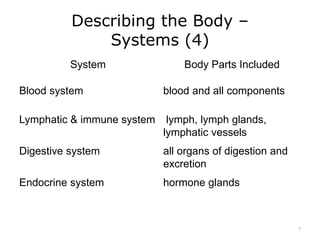
System Body Parts Included
Blood system blood and all components
Lymphatic & immune system lymph, lymph glands,
lymphatic vessels
Digestive system all organs of digestion and
excretion
Endocrine system hormone glands
7
Describing the Body –
Systems (5)
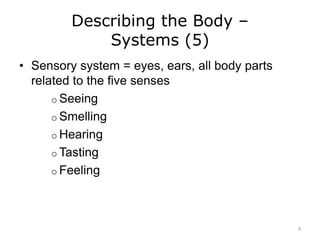
• Sensory system = eyes, ears, all body parts
related to the five senses
o Seeing
o Smelling
o Hearing
o Tasting
o Feeling
8
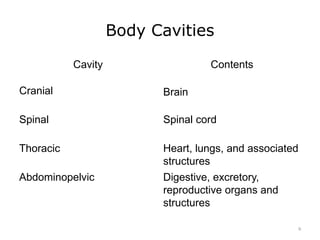
Body Cavities
Cavity Contents
Cranial Brain
Spinal Spinal cord
Thoracic Heart, lungs, and associated
structures
Abdominopelvic Digestive, excretory,
reproductive organs and
structures
9
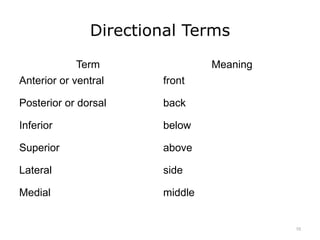
Directional Terms
Term Meaning
Anterior or ventral front
Posterior or dorsal back
Inferior below
Superior above
Lateral side
Medial middle
10
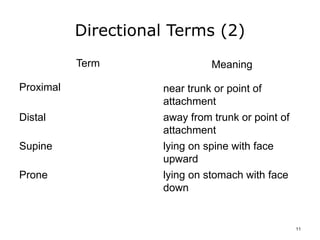
Directional Terms (2)
Term Meaning
Proximal near trunk or point of
attachment
Distal away from trunk or point of
attachment
Supine lying on spine with face
upward
Prone lying on stomach with face
down
11
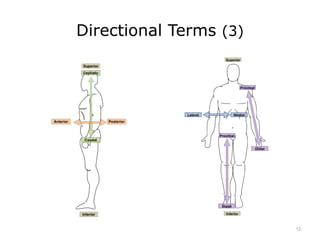
Directional Terms (3)
12
Tell me, Detective . . .
A dead body is discovered lying in
the prone position in an alleyway.
Which of the following
observations can you make
without moving the body?
• Puncture wound below the navel.
• Laceration in the pectoral region.
• Crush injury to sternum.
• Gunshot wound to right buttock.
13
Understanding Medical Words
Summary – Body Organization
• Tissue types
• Body cavities
• Directional and positional terms
14
Understanding Medical Words
References – lecture c
References
SEER Training Modules, Introduction to the Human Body. U.S. National Institutes of Health, National
Cancer Institute. 6/27/2010
SEER Training Modules, Anatomical Terminology. U.S. National Institutes of Health, National Cancer
Institute. 6/27/2010
For additional information on content covered in this unit, please visit: Understanding Medical Words:
A tutorial from the National Library of Medicine
Images
Slide 12: Available From: http://en.wikiversity.org/wiki/File:Anatomical_Directions.png
Slide 13: Clip Art, Available from: Microsoft clips online; Used with permission from Microsoft
15
Terminology in Healthcare and
Public Health Settings
Understanding Medical Words
Lecture c
This material was developed by the
University of Alabama at Birmingham,
funded by the Department of Health and
Human Services, Office of the National
Coordinator for Health Information
Technology under Award Number
90WT0007.
16

Body Organization | Lecture C

  • 1.
    Terminology in Healthcareand Public Health Settings Understanding Medical Words Lecture c Body Organization This material (Comp 3 Unit 1) was developed by the University of Alabama at Birmingham, funded by the Department of Health and Human Services, Office of the National Coordinator for Health Information Technology under Award Number 90WT0007. This work is licensed under the Creative Commons Attribution-NonCommercial-ShareAlike 4.0 International License. To view a copy of this license, visit http://creativecommons.org.
  • 2.
    Understanding Medical Words LearningObjectives • Discuss the four parts of medical terms • Recognize word roots and combining forms • Identify the most common prefixes and suffixes • Describe the anatomical positions • Define the body planes • Identify regions of the body • Define directional and positional terms • Build, divide, spell and pronounce common medical words 2
  • 3.
    Describing the Body– Tissue Types Tissue Type Purpose Connective tissue bones, ligaments, tendons Epithelial tissue covers body surfaces, inside and outside Muscle tissue moves the body Nervous tissue carries messages from brain and spinal column 3
  • 4.
    Describing the Body– Systems System Body Parts Included Integumentary system skin, hair, nails, sweat and oil glands Musculoskeletal system muscles, bones, cartilage Cardiovascular system heart and blood vessels 4
  • 5.
    Describing the Body– Systems (2) System Body Parts Included Respiratory system lungs and airways Nervous system brain, spinal cord, nerves Urinary system kidneys, ureters, bladder, urethra 5
  • 6.
    Describing the Body– Systems (3) System Body Parts Included Female reproductive system ovaries, vagina, fallopian tubes, uterus, mammary glands Male reproductive system testes, penis, prostate gland, vas deferens, seminal vesicles 6
  • 7.
    Describing the Body– Systems (4) System Body Parts Included Blood system blood and all components Lymphatic & immune system lymph, lymph glands, lymphatic vessels Digestive system all organs of digestion and excretion Endocrine system hormone glands 7
  • 8.
    Describing the Body– Systems (5) • Sensory system = eyes, ears, all body parts related to the five senses o Seeing o Smelling o Hearing o Tasting o Feeling 8
  • 9.
    Body Cavities Cavity Contents CranialBrain Spinal Spinal cord Thoracic Heart, lungs, and associated structures Abdominopelvic Digestive, excretory, reproductive organs and structures 9
  • 10.
    Directional Terms Term Meaning Anterioror ventral front Posterior or dorsal back Inferior below Superior above Lateral side Medial middle 10
  • 11.
    Directional Terms (2) TermMeaning Proximal near trunk or point of attachment Distal away from trunk or point of attachment Supine lying on spine with face upward Prone lying on stomach with face down 11
  • 12.
  • 13.
    Tell me, Detective. . . A dead body is discovered lying in the prone position in an alleyway. Which of the following observations can you make without moving the body? • Puncture wound below the navel. • Laceration in the pectoral region. • Crush injury to sternum. • Gunshot wound to right buttock. 13
  • 14.
    Understanding Medical Words Summary– Body Organization • Tissue types • Body cavities • Directional and positional terms 14
  • 15.
    Understanding Medical Words References– lecture c References SEER Training Modules, Introduction to the Human Body. U.S. National Institutes of Health, National Cancer Institute. 6/27/2010 SEER Training Modules, Anatomical Terminology. U.S. National Institutes of Health, National Cancer Institute. 6/27/2010 For additional information on content covered in this unit, please visit: Understanding Medical Words: A tutorial from the National Library of Medicine Images Slide 12: Available From: http://en.wikiversity.org/wiki/File:Anatomical_Directions.png Slide 13: Clip Art, Available from: Microsoft clips online; Used with permission from Microsoft 15
  • 16.
    Terminology in Healthcareand Public Health Settings Understanding Medical Words Lecture c This material was developed by the University of Alabama at Birmingham, funded by the Department of Health and Human Services, Office of the National Coordinator for Health Information Technology under Award Number 90WT0007. 16

Editor's Notes

  • #2 Welcome to Terminology in Health Care and Public Health Settings, Understanding Medical Words. This is lecture C, Body Organization. In this lecture we will discuss ways to describe the body in relation to cell or tissue types, body systems, and body cavities as well as reviewing directional terms.
  • #3 The Objectives for this unit, Understanding Medical Words, are to: Discuss the four parts of medical terms Recognize word roots and combining forms Identify the most common prefixes and suffixes Describe the anatomical positions Define the body planes Identify regions of the body Define directional and positional terms Build, divide, spell and pronounce common medical words
  • #4 The body is composed of different types of cells. The cells come together to form tissues. A tissue is formed when like cells are grouped together and function together to perform a specific activity. The body has four types of cells. Each cell type groups together to form a type of tissue.   Connective tissue supports and protects the body structure. Bones, ligaments, and tendons are forms of connective tissue.   Epithelial (pronounced epp-ih-the (like theory)-lee—ul (u like under)) tissue covers surfaces, inside and outside the body. The skin, the lining of the stomach, and the lining of the intestines are examples of epithelial tissue.   Muscle tissue helps the body move. Skeletal muscles are one example of muscle tissue.   Nervous tissue carries messages from the brain and spinal column and allows information to be sent between the brain and the rest of the body through a network of nerves. (SEER Training Modules, Anatomy & Physiology. U.S. National Institutes of Health, National Cancer Institute. 6/27/2010 http://training.seer.cancer.gov/anatomy/body/ )
  • #5 Cells form into tissues, tissues form into organs and organs form into systems. A system is composed of several organs functioning together in a coordinated manner. The body is divided into various systems. These include:   The integumentary (pronounced in-tegg-you-men-tery ) system includes the skin, hair, nails, sweat and oil glands. It receives sensory information for the sensations of pain, touch, and temperature. It protects the internal organs from infection and trauma and regulates body temperature by sweating.   The musculoskeletal system includes muscles, bones, and cartilage. It supports the body and produces body movement.   And the cardiovascular system includes the heart and blood vessels. It pumps blood throughout the body to transport nutrients, oxygen and wastes.
  • #6 The respiratory (pronounced RES-per-torry)-system includes the lungs and airways. It obtains oxygen and removes carbon dioxide from the body.   The nervous system includes the brain, spinal cord, and nerves. It receives information from the body relating to the senses, including pain, touch, temperature, and body position. It coordinates body movement and stores and interprets memory and emotion.   The urinary system includes the kidneys, ureters (pronounced YOUR-itters), bladder, and urethra (pronounced you-REETH-ruh). Its function relates to excreting urine and waste products.
  • #7 The female reproductive system includes the ovaries, vagina, fallopian (pronounced fuh-LOPE-ee--en) tubes, uterus, and mammary glands. This system secretes hormones, produces ova (you may remember from a previous lecture that the plural of the Latin word for egg, ovum, is ova), and regulates menstruation, pregnancy, and milk production from the breasts.   The male reproductive system includes the testes, penis, prostate (pronounced pros-tate) gland, vas deferens( pronounced vass-DEF (like deaf)-er-ens), and seminal vesicles. This system secretes hormones and produces sperm.   Sometimes, these two systems are combined and referred to generally as the Reproductive System.
  • #8 Other systems include the blood system, the lymphatic (pronounced lim-fattic) system, the digestive system and the endocrine (pronounced endo-crin) system. The blood system includes the blood and all components. The function of this system is to transport oxygen, protect against pathogens, and control bleeding. The lymphatic and immune system includes the lymph (pronounced limf), lymph glands, and lymphatic vessels. This system is key in recognizing and destroying disease-causing organisms and abnormal cells. The digestive system includes all organs of digestion and excretion, such as the esophagus, stomach, intestines, etc.. It digests food, absorbs nutrients into the blood, and excretes undigested wastes. It receives sensory information for the sense of taste. The endocrine system includes all of the various hormone glands, such as the pituitary, adrenal, and thyroid glands. These glands produce and secrete hormones into the blood that, in turn, direct other body organs.
  • #9 And finally, the last system is the sensory system. This system includes the eyes, ears, and all body parts related to the five senses of seeing, smelling, hearing, tasting, and feeling.   Some parts of this system may be included within other body systems, but the primary components of this system are the eyes and ears.
  • #10 There are four major body cavities. A cavity is a hollow space and is surrounded by bones or muscles that support and protect the organs and structures within the cavity. The four body cavities are:   The cranial cavity, which contains the brain.   The spinal cavity, which contains spinal cord.   The thoracic cavity which contains the heart, lungs, and associated structures   The abdominopelvic (pronounced ab-domino-pelvic) cavity, which contains digestive, excretory, and reproductive organs and structures.
  • #11 Your study of terminology in healthcare would be incomplete unless you also learn the following commonly-used directional terms. These terms help to describe the location of one structure, organ, or system in relationship another. They also assist in discussing the position or location of the patient's complaint. Directional terms include: Anterior or ventral, which indicates the front of the body. In contrast, posterior or dorsal indicates the back of the body. Inferior is below another structure, or moving more toward the feet, while superior means something is above another structure, or moving more toward the head. Lateral means alongside another structure. And medial refers to the middle or near the middle of the body or structure. (SEER Training Modules, Anatomy & Physiology. U.S. National Institutes of Health, National Cancer Institute. 6/27/2010 http://training.seer.cancer.gov/anatomy/body/terminology.html)
  • #12 Additional directional terms include proximal, which means located near the trunk or point of attachment to the body.   Distal means something is located is away from the trunk or point of attachment to the body.   Supine refers to the body’s position when you are lying on your spine with your face pointing upward.   Prone, on the other hand, refers to lying on your stomach with your face pointing down.
  • #13 As you have seen there are many directional terms that can be used to describe one body position in relation to another. The directional terms are illustrated for you here.
  • #14 Tell me, Detective . . . So let's see how these terms might be used.   Imagine that a dead body is discovered lying in the prone position in an alleyway. Which of the following observations can you make without moving the body?   Puncture wound below the navel.     Laceration in the pectoral (pronounced PECK-toral) region.     Crush injury to sternum.   Gunshot wound to right buttock.   (note: Pause for about 10 seconds before going on with the next part)   The correct answer is a gunshot wound to right buttock. Remember that prone means lying face down. The other observations would be impossible to make unless the victim was supine, or face up.
  • #15 This concludes Lecture C of Understanding Medical Words. In summary, we covered different tissue types, the body cavities and directional and positional terms.
  • #16 “No Audio”
  • #17 No Audio.