Prepared by Areg .Acha
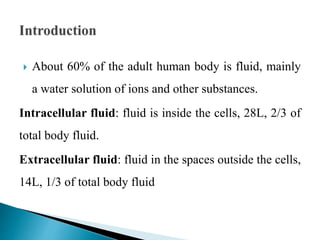
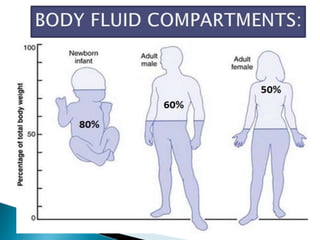
 About 60% of the adult human body is fluid, mainly
a water solution of ions and other substances.
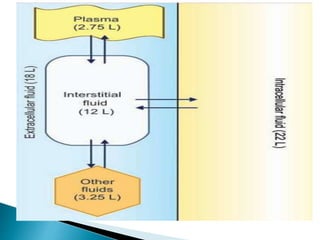
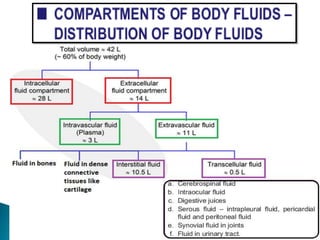
Intracellular fluid: fluid is inside the cells, 28L, 2/3 of
total body fluid.
Extracellular fluid: fluid in the spaces outside the cells,
14L, 1/3 of total body fluid
 Homeostasis.
 Transport mechanism.
 Metabolic reactions.
 Texture (shape) of tissues.
 Temperature regulation.
The percentage of fluid depends on:
 Age.
 Gender
 Degree of obesity
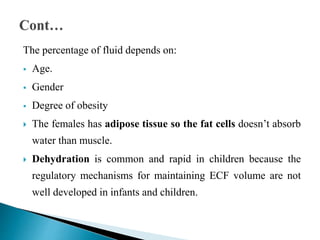
 The females has adipose tissue so the fat cells doesn’t absorb
water than muscle.
 Dehydration is common and rapid in children because the
regulatory mechanisms for maintaining ECF volume are not
well developed in infants and children.
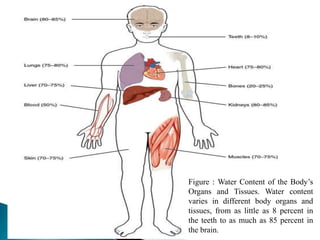
Figure : Water Content of the Body’s
Organs and Tissues. Water content
varies in different body organs and
tissues, from as little as 8 percent in
the teeth to as much as 85 percent in
the brain.
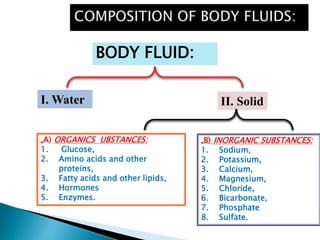
BODY FLUID:
I. Water II. Solid
„A) ORGANICS UBSTANCES:
1. Glucose,
2. Amino acids and other
proteins,
3. Fatty acids and other lipids,
4. Hormones
5. Enzymes.
„B) INORGANIC SUBSTANCES:
1. Sodium,
2. Potassium,
3. Calcium,
4. Magnesium,
5. Chloride,
6. Bicarbonate,
7. Phosphate
8. Sulfate.
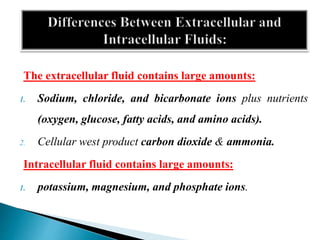
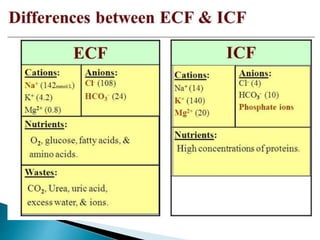
The extracellular fluid contains large amounts:
1. Sodium, chloride, and bicarbonate ions plus nutrients
(oxygen, glucose, fatty acids, and amino acids).
2. Cellular west product carbon dioxide & ammonia.
Intracellular fluid contains large amounts:
1. potassium, magnesium, and phosphate ions.
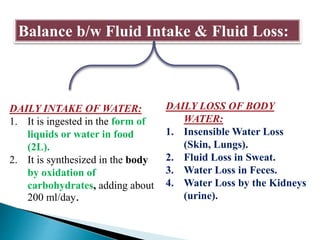
Balance b/w Fluid Intake & Fluid Loss:
DAILY INTAKE OF WATER:
1. It is ingested in the form of
liquids or water in food
(2L).
2. It is synthesized in the body
by oxidation of
carbohydrates, adding about
200 ml/day.
DAILY LOSS OF BODY
WATER:
1. Insensible Water Loss
(Skin, Lungs).
2. Fluid Loss in Sweat.
3. Water Loss in Feces.
4. Water Loss by the Kidneys
(urine).
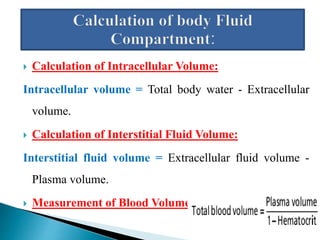
 Calculation of Intracellular Volume:
Intracellular volume = Total body water - Extracellular
volume.
 Calculation of Interstitial Fluid Volume:
Interstitial fluid volume = Extracellular fluid volume -
Plasma volume.
 Measurement of Blood Volume:
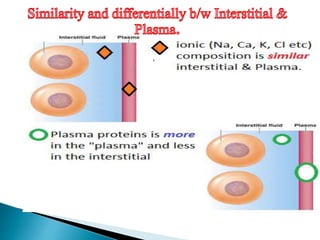
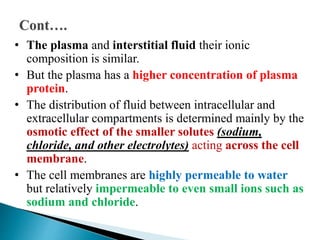
• The plasma and interstitial fluid their ionic
composition is similar.
• But the plasma has a higher concentration of plasma
protein.
• The distribution of fluid between intracellular and
extracellular compartments is determined mainly by the
osmotic effect of the smaller solutes (sodium,
chloride, and other electrolytes) acting across the cell
membrane.
• The cell membranes are highly permeable to water
but relatively impermeable to even small ions such as
sodium and chloride.
 If a solute such as sodium chloride is added to the
extracellular fluid, water rapidly diffuses from the cells
through the cell membranes into the extracellular fluid
 Conversely, if a solute is removed from the extracellular fluid,
water diffuses from the extracellular fluid through the cell
membranes and into the cells.
 Rate of osmosis: is the rate of diffusion of water.
 Concentration of body fluids is expressed in three
ways:
1. Osmolality
2. Osmolarity
3. Tonicity.
 The number of particles (osmoles) per kilogram of
solution (osmoles/kg H2O).
2- OSMOLARITY:
• The number of particles (osmoles) per liter of solution
(osmoles/LH2O).
 These two terms can be used almost synonymously
because the differences are small.
 It is easier to express body fluid quantities in liters of
fluid rather than in kilograms of water.
 Mole (mol): is the molecular weight of a substance in
gram.
 Osmole (Osm): is the expression of amount of
osmotically active particles.
• 1 liter of a solution containing 0.1 mole of glucose has
an osmolarity of 0.1 osmolar because glucose does not
dissociate in solution.
• 1 liter solution containing 0.1 mole of NaCl has an
osmolarity of 0.2 osmolar because NaCl dissociates in
solution to give approximately 0.1 mole of sodium ions
and 0.1 mole of chloride ions, for a total of 0.2 mole of
Example
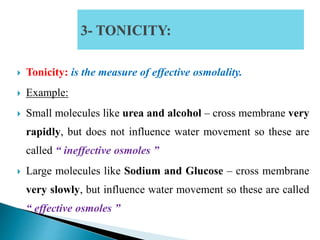
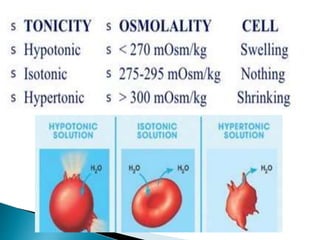
 Tonicity: is the measure of effective osmolality.
 Example:
 Small molecules like urea and alcohol – cross membrane very
rapidly, but does not influence water movement so these are
called “ ineffective osmoles ”
 Large molecules like Sodium and Glucose – cross membrane
very slowly, but influence water movement so these are called
“ effective osmoles ”
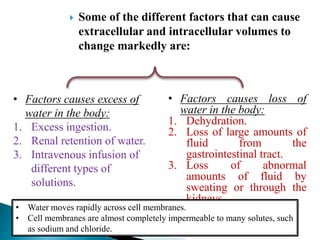
 Some of the different factors that can cause
extracellular and intracellular volumes to
change markedly are:
• Factors causes excess of
water in the body:
1. Excess ingestion.
2. Renal retention of water.
3. Intravenous infusion of
different types of
solutions.
• Factors causes loss of
water in the body:
1. Dehydration.
2. Loss of large amounts of
fluid from the
gastrointestinal tract.
3. Loss of abnormal
amounts of fluid by
sweating or through the
kidneys.
• Water moves rapidly across cell membranes.
• Cell membranes are almost completely impermeable to many solutes, such
as sodium and chloride.
Imbalance of Body Fluid
DEHYDRATION:
 Excessive loss of water from the body.
 Causes:
 Diarrhea or vomiting (Isotonic dehydration).
 Fever (Hypertonic dehydration).
 Excess use of diuretics (Hypotonic dehydration
OVERHYDRATION:
 Condition characterized by great increase in the water
content of the body (also called hyperhydration, Water
intoxication or water poisoning).
 Causes:
 Heart failure.
 Renal disorders.
 Hypersecretion of antidiuretic hormone.
 Intravenous administration of unduly large amount of
medications and fluids.
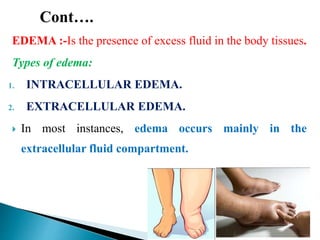
EDEMA :-Is the presence of excess fluid in the body tissues.
Types of edema:
1. INTRACELLULAR EDEMA.
2. EXTRACELLULAR EDEMA.
 In most instances, edema occurs mainly in the
extracellular fluid compartment.
Cont….
 Is presence of large amount of fluid inside the cell.
 Three conditions are especially prone to cause
intracellular swelling:
 Hyponatremia.
 Depression of the metabolic systems of the tissues.
 Lack of adequate nutrition to the cells.
 Inflamed tissues.
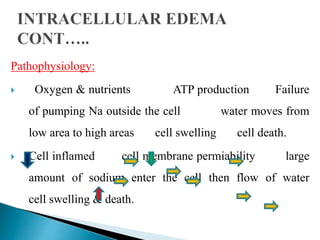
Pathophysiology:
 Oxygen & nutrients ATP production Failure
of pumping Na outside the cell water moves from
low area to high areas cell swelling cell death.
 Cell inflamed cell membrane permiability large
amount of sodium enter the cell then flow of water
cell swelling & death.
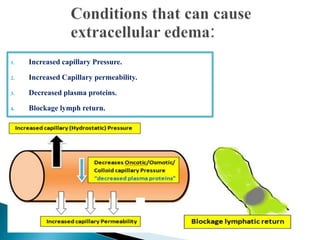
 Is an excess fluid accumulates in the extracellular
spaces.
 There are two general causes of extracellular edema:
 abnormal leakage of fluid from the plasma to the
interstitial spaces across the capillaries.
 failure of the lymphatics to return fluid from the
interstitium back into the blood.
1. Increased capillary Pressure.
2. Increased Capillary permeability.
3. Decreased plasma proteins.
4. Blockage lymph return.
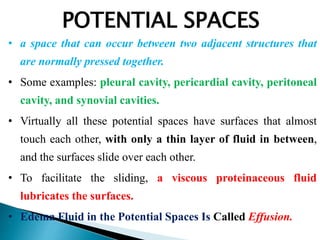
POTENTIAL SPACES
• a space that can occur between two adjacent structures that
are normally pressed together.
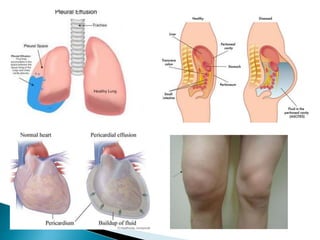
• Some examples: pleural cavity, pericardial cavity, peritoneal
cavity, and synovial cavities.
• Virtually all these potential spaces have surfaces that almost
touch each other, with only a thin layer of fluid in between,
and the surfaces slide over each other.
• To facilitate the sliding, a viscous proteinaceous fluid
lubricates the surfaces.
• Edema Fluid in the Potential Spaces Is Called Effusion.
Body fluid distribution on normal aduly.pptx

Body fluid distribution on normal aduly.pptx

  • 1.
  • 2.
     About 60%of the adult human body is fluid, mainly a water solution of ions and other substances. Intracellular fluid: fluid is inside the cells, 28L, 2/3 of total body fluid. Extracellular fluid: fluid in the spaces outside the cells, 14L, 1/3 of total body fluid
  • 4.
     Homeostasis.  Transportmechanism.  Metabolic reactions.  Texture (shape) of tissues.  Temperature regulation.
  • 6.
    The percentage offluid depends on:  Age.  Gender  Degree of obesity  The females has adipose tissue so the fat cells doesn’t absorb water than muscle.  Dehydration is common and rapid in children because the regulatory mechanisms for maintaining ECF volume are not well developed in infants and children.
  • 7.
    Figure : WaterContent of the Body’s Organs and Tissues. Water content varies in different body organs and tissues, from as little as 8 percent in the teeth to as much as 85 percent in the brain.
  • 9.
    BODY FLUID: I. WaterII. Solid „A) ORGANICS UBSTANCES: 1. Glucose, 2. Amino acids and other proteins, 3. Fatty acids and other lipids, 4. Hormones 5. Enzymes. „B) INORGANIC SUBSTANCES: 1. Sodium, 2. Potassium, 3. Calcium, 4. Magnesium, 5. Chloride, 6. Bicarbonate, 7. Phosphate 8. Sulfate.
  • 10.
    The extracellular fluidcontains large amounts: 1. Sodium, chloride, and bicarbonate ions plus nutrients (oxygen, glucose, fatty acids, and amino acids). 2. Cellular west product carbon dioxide & ammonia. Intracellular fluid contains large amounts: 1. potassium, magnesium, and phosphate ions.
  • 12.
    Balance b/w FluidIntake & Fluid Loss: DAILY INTAKE OF WATER: 1. It is ingested in the form of liquids or water in food (2L). 2. It is synthesized in the body by oxidation of carbohydrates, adding about 200 ml/day. DAILY LOSS OF BODY WATER: 1. Insensible Water Loss (Skin, Lungs). 2. Fluid Loss in Sweat. 3. Water Loss in Feces. 4. Water Loss by the Kidneys (urine).
  • 13.
     Calculation ofIntracellular Volume: Intracellular volume = Total body water - Extracellular volume.  Calculation of Interstitial Fluid Volume: Interstitial fluid volume = Extracellular fluid volume - Plasma volume.  Measurement of Blood Volume:
  • 15.
    • The plasmaand interstitial fluid their ionic composition is similar. • But the plasma has a higher concentration of plasma protein. • The distribution of fluid between intracellular and extracellular compartments is determined mainly by the osmotic effect of the smaller solutes (sodium, chloride, and other electrolytes) acting across the cell membrane. • The cell membranes are highly permeable to water but relatively impermeable to even small ions such as sodium and chloride.
  • 16.
     If asolute such as sodium chloride is added to the extracellular fluid, water rapidly diffuses from the cells through the cell membranes into the extracellular fluid  Conversely, if a solute is removed from the extracellular fluid, water diffuses from the extracellular fluid through the cell membranes and into the cells.  Rate of osmosis: is the rate of diffusion of water.
  • 17.
     Concentration ofbody fluids is expressed in three ways: 1. Osmolality 2. Osmolarity 3. Tonicity.
  • 18.
     The numberof particles (osmoles) per kilogram of solution (osmoles/kg H2O). 2- OSMOLARITY: • The number of particles (osmoles) per liter of solution (osmoles/LH2O).  These two terms can be used almost synonymously because the differences are small.  It is easier to express body fluid quantities in liters of fluid rather than in kilograms of water.
  • 19.
     Mole (mol):is the molecular weight of a substance in gram.  Osmole (Osm): is the expression of amount of osmotically active particles. • 1 liter of a solution containing 0.1 mole of glucose has an osmolarity of 0.1 osmolar because glucose does not dissociate in solution. • 1 liter solution containing 0.1 mole of NaCl has an osmolarity of 0.2 osmolar because NaCl dissociates in solution to give approximately 0.1 mole of sodium ions and 0.1 mole of chloride ions, for a total of 0.2 mole of Example
  • 20.
     Tonicity: isthe measure of effective osmolality.  Example:  Small molecules like urea and alcohol – cross membrane very rapidly, but does not influence water movement so these are called “ ineffective osmoles ”  Large molecules like Sodium and Glucose – cross membrane very slowly, but influence water movement so these are called “ effective osmoles ”
  • 22.
     Some ofthe different factors that can cause extracellular and intracellular volumes to change markedly are: • Factors causes excess of water in the body: 1. Excess ingestion. 2. Renal retention of water. 3. Intravenous infusion of different types of solutions. • Factors causes loss of water in the body: 1. Dehydration. 2. Loss of large amounts of fluid from the gastrointestinal tract. 3. Loss of abnormal amounts of fluid by sweating or through the kidneys. • Water moves rapidly across cell membranes. • Cell membranes are almost completely impermeable to many solutes, such as sodium and chloride.
  • 23.
  • 24.
    DEHYDRATION:  Excessive lossof water from the body.  Causes:  Diarrhea or vomiting (Isotonic dehydration).  Fever (Hypertonic dehydration).  Excess use of diuretics (Hypotonic dehydration
  • 25.
    OVERHYDRATION:  Condition characterizedby great increase in the water content of the body (also called hyperhydration, Water intoxication or water poisoning).  Causes:  Heart failure.  Renal disorders.  Hypersecretion of antidiuretic hormone.  Intravenous administration of unduly large amount of medications and fluids.
  • 26.
    EDEMA :-Is thepresence of excess fluid in the body tissues. Types of edema: 1. INTRACELLULAR EDEMA. 2. EXTRACELLULAR EDEMA.  In most instances, edema occurs mainly in the extracellular fluid compartment. Cont….
  • 27.
     Is presenceof large amount of fluid inside the cell.  Three conditions are especially prone to cause intracellular swelling:  Hyponatremia.  Depression of the metabolic systems of the tissues.  Lack of adequate nutrition to the cells.  Inflamed tissues.
  • 28.
    Pathophysiology:  Oxygen &nutrients ATP production Failure of pumping Na outside the cell water moves from low area to high areas cell swelling cell death.  Cell inflamed cell membrane permiability large amount of sodium enter the cell then flow of water cell swelling & death.
  • 29.
     Is anexcess fluid accumulates in the extracellular spaces.  There are two general causes of extracellular edema:  abnormal leakage of fluid from the plasma to the interstitial spaces across the capillaries.  failure of the lymphatics to return fluid from the interstitium back into the blood.
  • 30.
    1. Increased capillaryPressure. 2. Increased Capillary permeability. 3. Decreased plasma proteins. 4. Blockage lymph return.
  • 31.
    POTENTIAL SPACES • aspace that can occur between two adjacent structures that are normally pressed together. • Some examples: pleural cavity, pericardial cavity, peritoneal cavity, and synovial cavities. • Virtually all these potential spaces have surfaces that almost touch each other, with only a thin layer of fluid in between, and the surfaces slide over each other. • To facilitate the sliding, a viscous proteinaceous fluid lubricates the surfaces. • Edema Fluid in the Potential Spaces Is Called Effusion.

Editor's Notes

  • #13 Fluid intake and output are balanced during steady-state conditions